# Kimi K2.6 Agent Swarm: An A-Z Guide on the Secret Weapon Nobody Saw Coming
**作者**: shmidt
**日期**: 2026-05-25T14:15:31.000Z
**来源**: [https://x.com/shmidtqq/status/2058914868086882710](https://x.com/shmidtqq/status/2058914868086882710)
---

That's not a typo. Not a marketing line. The actual output: a 100,000-word literature review, a 20,000-row dataset, 14 publication-grade charts, and a complete landing page bundle, all generated in parallel, merged, and packaged for download.
This is Kimi K2.6 Agent Swarm. The closest thing we have to deploying an entire research firm from a text box.
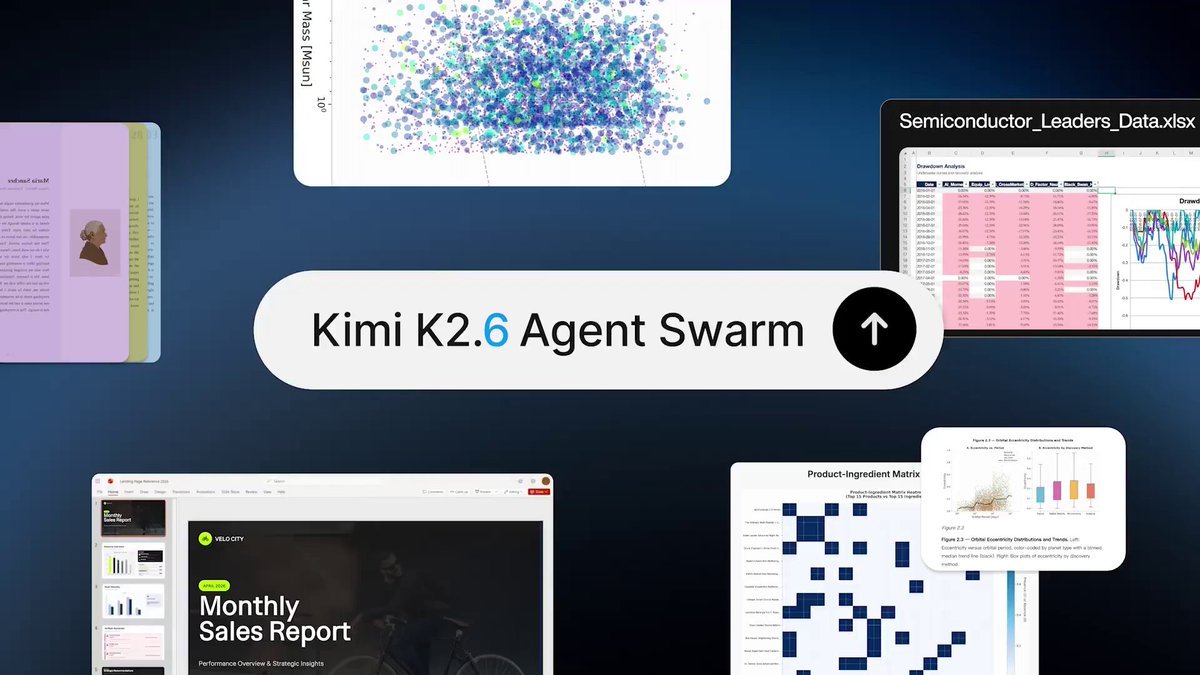
Here's exactly what it does, what it doesn't do, and the use cases that actually matter.
## The numbers that matter
Moonshot AI shipped Kimi K2.6 on April 20, 2026. The headline upgrade isn't a benchmark. It's the swarm primitive built directly into the model.
Swarm capacity:
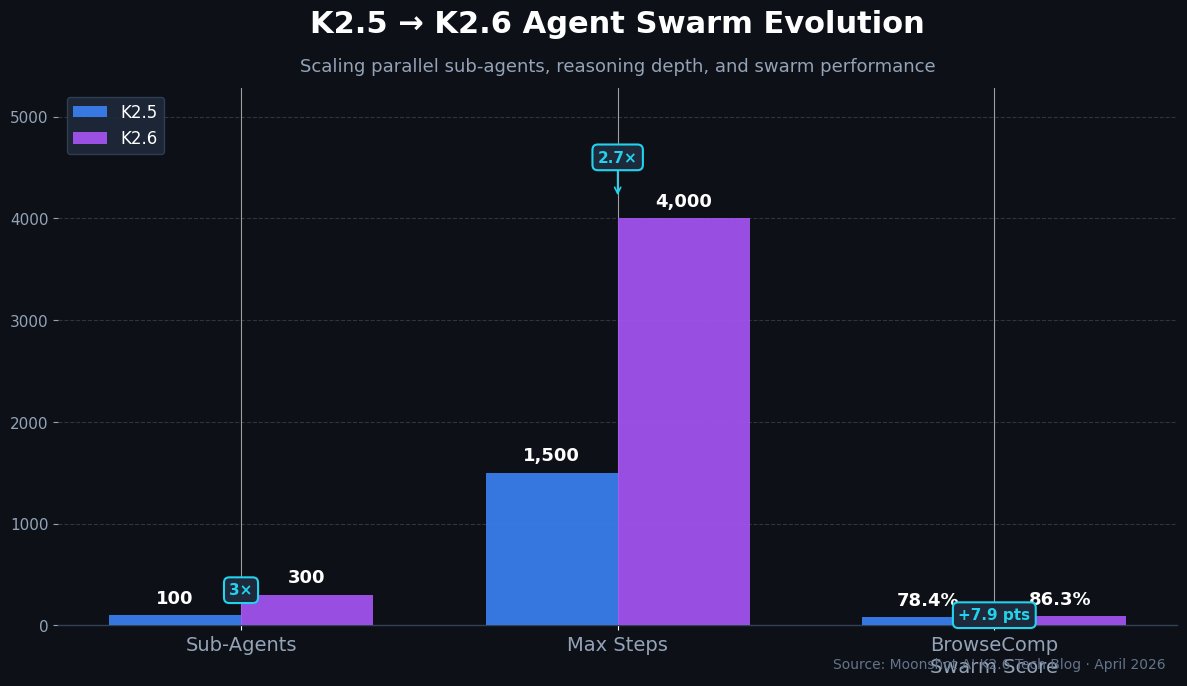
- 300 parallel sub-agents per run (up from 100 in K2.5)
- 4,000 coordinated steps per run (up from 1,500)
- 4.5x faster than single-agent on complex tasks
- 86.3% on BrowseComp Swarm (vs 78.4% in K2.5)
Model backbone:
- 1 trillion parameters, 32B active per token
- 256K to 262K context window with automatic compression
- $0.60 per million input tokens, $2.50 to $3.00 per million output tokens
- Open weights under Modified MIT License, available on Hugging Face
But the agentic numbers matter more than the raw benchmarks. K2.6 ran autonomously for 13 hours overhauling an 8-year-old financial matching engine. Over 1,000 tool calls, 4,000+ lines of code modified, 185% throughput improvement. Moonshot's own infrastructure team ran a K2.6 agent for five days straight handling monitoring and incident response without human input.
What changed: the unit of work is no longer a response. It's a project.
## The mental model: chat vs swarm
Chat AI works like one smart intern answering one question at a time. You ask, it answers, you ask again.
Agent Swarm works like a 300-person specialized firm running overnight while you sleep. You write a brief. The swarm decomposes the work into parallel subtasks. It dynamically routes each subtask to a specialized sub-agent (researcher, coder, designer, fact-checker, editor). Then it merges the outputs through a shared-state coordinator.
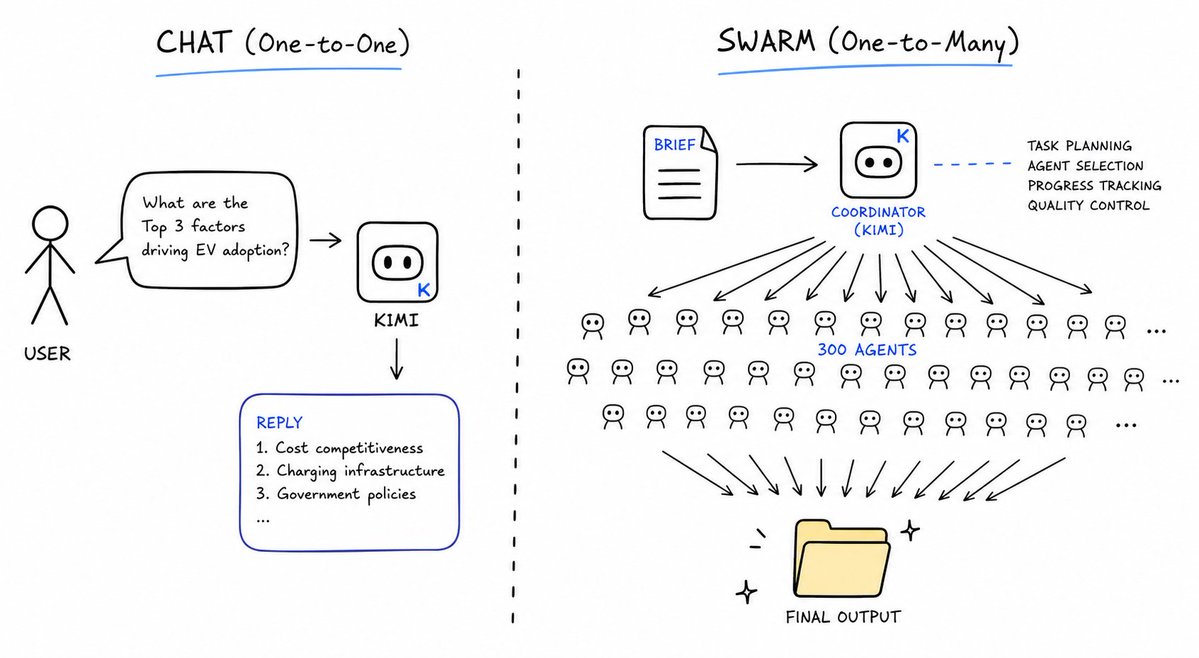
You're no longer a prompter. You're a project manager.
That sounds like marketing. Here's what makes it real: the deliverable is a folder, not a paragraph. A single swarm run produces documents, spreadsheets, slide decks, websites, and datasets simultaneously, then packages them into downloadable files.
## Six use cases where swarm beats everything else
> 1. Academic research at book-length
This is where swarm is most quietly disruptive.

One documented run: 40 social psychology PDFs in, a 100-page two-column academic document out, complete with formatted citations, methodology charts, and citation network analysis. Each sub-agent owned a specific section, they wrote in parallel, the coordinator synthesized.
Another: an astrophysics paper turned into a 40-page, 7,000-word research output, a structured dataset with 20,000+ entries, and 14 astronomy-grade charts. All from a single run.
If you're writing a thesis, doing a systematic literature review, or building a meta-analysis dataset, this collapses weeks of work into hours. You still need to verify claims. But you get a first draft with sources organized and the messy structural work already done.
> 2. Heatmaps, charts, and visualizations at scale
Swarm handles visual generation in parallel with everything else. The same run that produces a 7,000-word paper can also produce 14 publication-grade charts. Heatmaps from your dataset. Correlation matrices. Pivot tables. Histograms across 20 different lenses.
The trick is that visual generation runs in parallel with the analysis sub-agents, not as a serial follow-up step. By the time you read the methodology section, the charts that belong to it already exist as PNG and SVG files.
> 3. LaTeX, papers, and reproducible academic output
Because the swarm produces real files, LaTeX is just another output format. You can ask for a paper in .tex with a BibTeX file, methodology charts as .pdf figures, and a supplementary data table as .csv. All in one run.
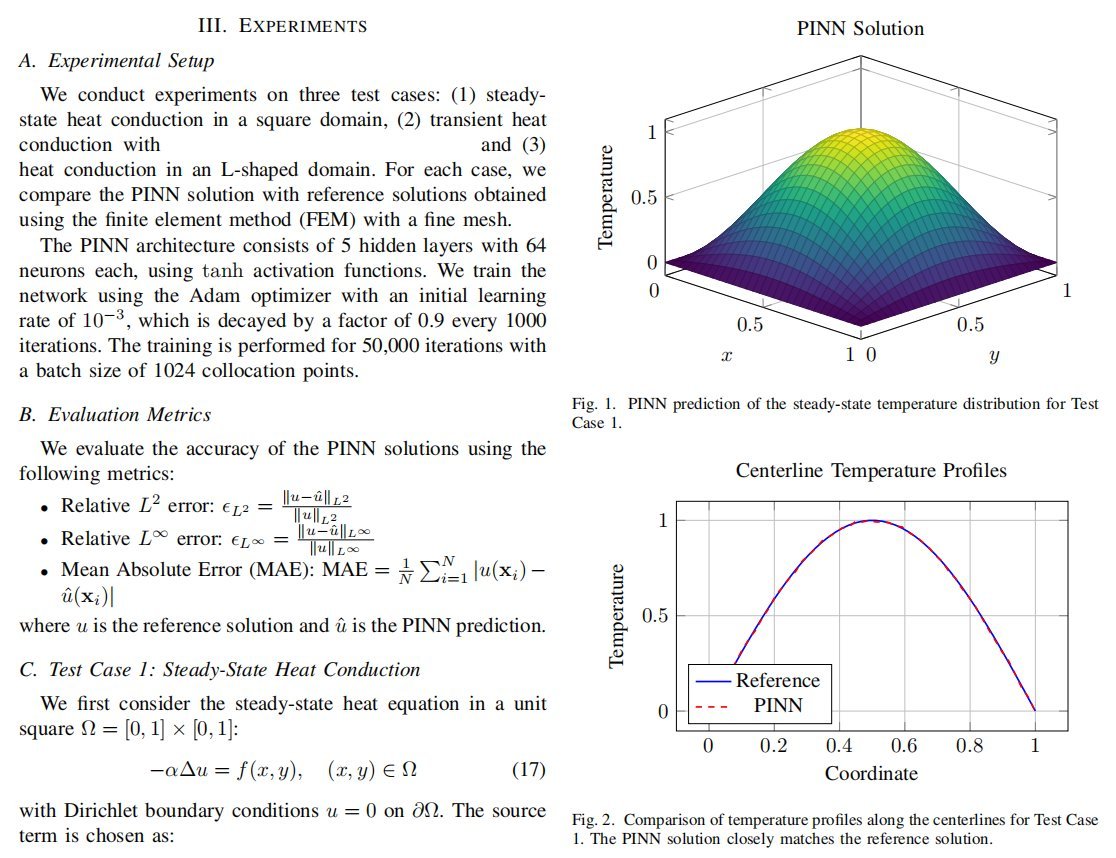
The Skills capability sharpens this further. Upload a high-quality paper (yours or a published exemplar) and K2.6 captures its structural and stylistic DNA as a reusable Skill. Future runs replicate the same formatting, citation style, and section structure automatically.
> 4. Bulk websites and landing pages
The most cited demo: 100 sub-agents matched a single uploaded CV against 100 California job postings and returned 100 customized resumes. Another: K2.6 identified 30 LA retail stores without websites from Google Maps and generated landing pages for each.
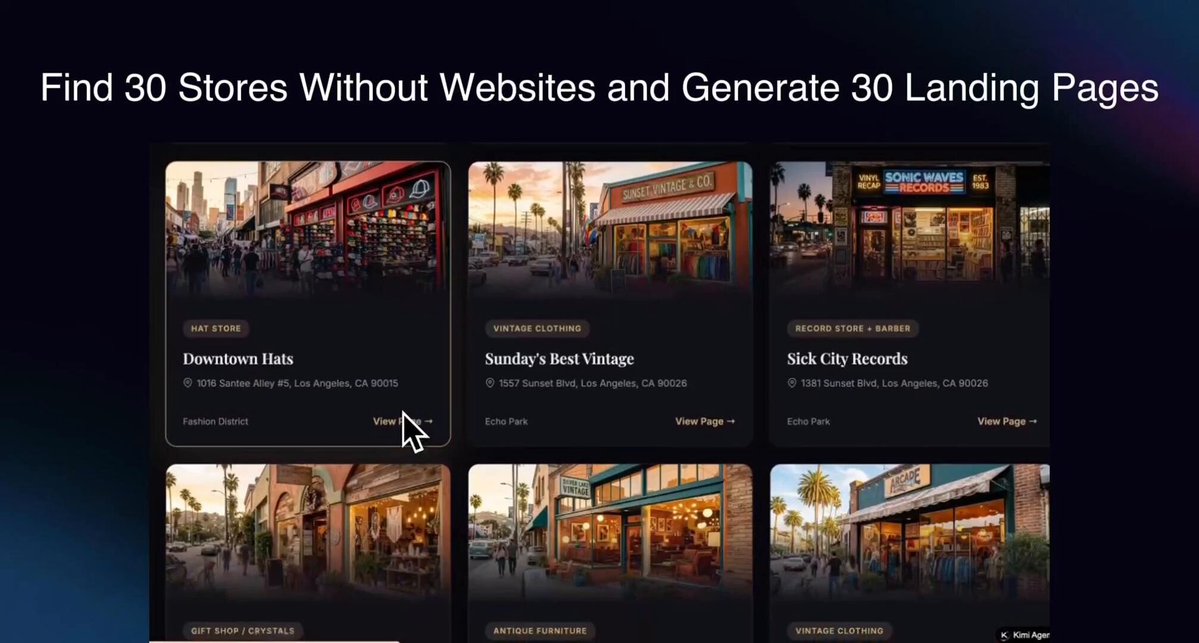
For agencies this is a deliverable factory. One brief, 50 niche landing pages overnight, each with unique copy, structured sections, and design tokens shared across the set. The swarm handles layout, copy, forms, and animations in parallel, with different specialized sub-agents on each.
> 5. Long-form content factories
Anything where the unit of work repeats is a swarm candidate. 100 blog posts. 100 personalized cover letters. 100 product descriptions. 100 outreach emails tailored to 100 prospects.
The Three-Body Problem was rewritten in 20 distinct literary styles by 20 "writer" sub-agents. One for Virginia Woolf, one for Borges, one for Kafka. All in a single run. The same shape works for content libraries: 50 angles on one topic, written in 50 voices.
> 6. Code at volume
For codebases, the swarm replaces a sprint. Generate test suites for 200 files. Migrate a codebase function by function. Refactor across multiple repos. Each sub-agent owns a file or a module, they work in parallel, the coordinator merges.
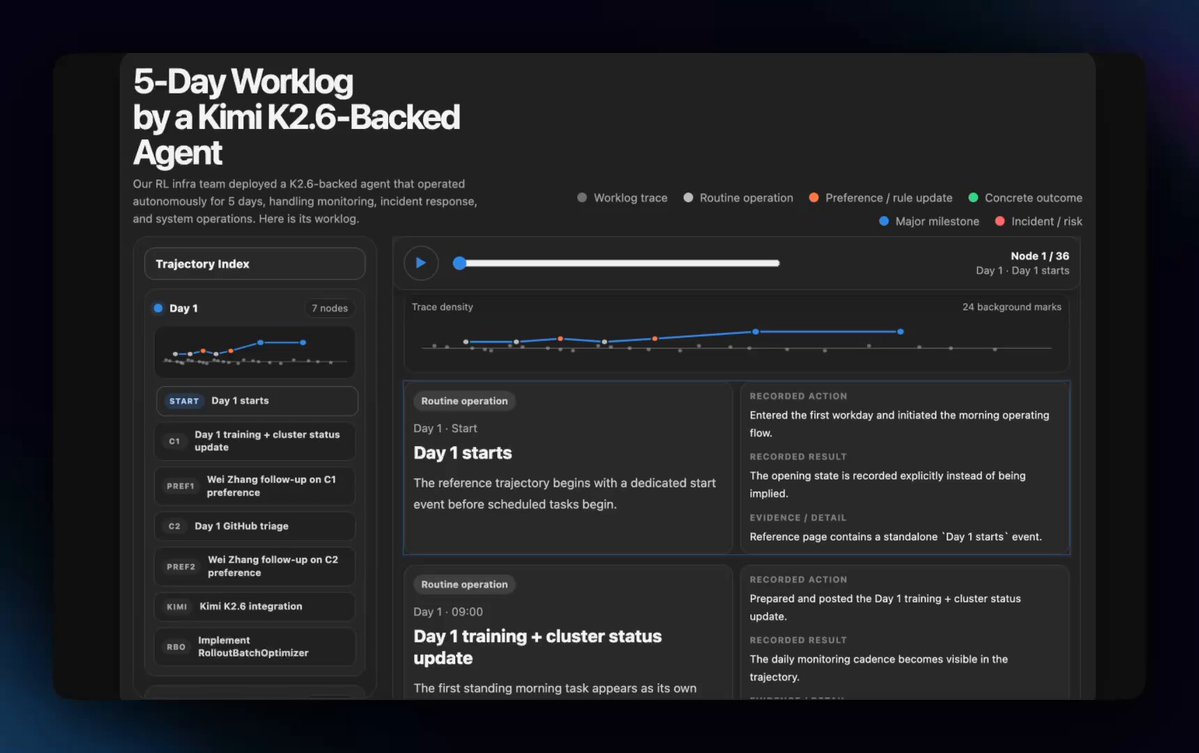
The 13-hour financial-engine demo is the proof-of-life. 1,000+ tool calls, 4,000+ lines modified, throughput improvement validated against benchmarks. All autonomous.
## Swarm vs single-agent vs traditional pipeline: a routing guide
Pick the wrong tool and you'll either burn tokens on tasks one model would crush, or wait three hours for a single agent to finish what 50 sub-agents would close in twenty minutes. The decision is easier than people think.
Use Agent Swarm when: The task fits the shape "do X for each of these N items." Bulk landing pages. Batch outreach. Parallel research across dozens of sources. 100 customized resumes from one CV. The unit of work repeats. The deliverable is a folder, not a paragraph. You care about wall-clock time more than per-output perfection.
Use a single high-quality model (Claude Opus 4.7) when: The task is sequential and tightly coupled. Single-file debugging where one wrong assumption cascades. Architecture decisions where the choice you make in step 2 changes step 7. Legal contracts where the wrong word costs money. Production code that needs to be right on the first pass. One careful agent beats 300 rushed ones here.
Use a traditional pipeline (LangGraph, AutoGen, n8n) when: The workflow needs to be deterministic and repeatable. Compliance audits need to point to specific tool calls. The same input must produce the same output every Tuesday at 9am. Swarms are non-deterministic by design. Traditional orchestration isn't.
The five-second decision tree:
- Does the task fit "do X for each of these N items"? Swarm.
- Does one wrong step cascade through everything else? Single model.
- Does the same input need the same output every time? Traditional pipeline.
The routing decision takes five seconds. The savings are permanent.
## The honest caveats
Swarms are not magic. The same architecture that scales output also scales risk.
Three hundred agents means three hundred places bad information can enter. One sub-agent might summarize a weak source. Another might duplicate a claim. Another might miss nuance. When the coordinator merges everything into a polished document, the output looks more reliable than it is. Treat swarm output as a high-quality first pass, not a finished publication.
Linear tasks suffer. Swarms add 10 to 25% latency on tasks that don't actually parallelize. Single-file debugging. Tightly coupled refactors. Architecture decisions where one wrong assumption cascades. Keep these on a single high-quality model.
Orchestration is the binding constraint, not model capability. VentureBeat's analysis flagged this directly. Getting 300 parallel agents to actually finish without one blocking the others is the hard part. Start with smaller swarms (20 to 50 agents) on well-defined parallelizable tasks before scaling up.
## How to run your first swarm
Four steps.
1. Pick a parallelizable task. Bad: "fix this bug." Good: "generate landing pages for these 30 businesses." If you can describe the task as "do X for each of these N items," it's a swarm task.
2. Write a brief, not a prompt. Specify the goal, the deliverable format, the sub-agent roles you want, the verification requirements. The swarm needs structure, not vibes.
3. Define the deliverable. Files, not chat output. PDF, HTML, CSV, PPT, LaTeX. Tell the coordinator exactly what artifacts you want back and in what folder structure.
4. Verification pass. Run the swarm output through a separate verifier (Opus 4.7 or GPT-5.5) before treating it as final. Spot-check claims against original sources.
## Two prompts to install today
The swarm brief template:
```
Goal: [one sentence describing the deliverable]
Suggested sub-agent roles:
- [Role 1 with specialty]
- [Role 2 with specialty]
- [Role 3 with specialty]
- Fact-checker / verifier (always include)
- Duplicate and conflict checker (always include)
Deliverables:
- [Artifact 1, with format]
- [Artifact 2, with format]
- Quality report listing all low-confidence claims
Verification requirements:
- Every claim traceable to a source
- No duplicate content across sub-agent outputs
- Flag anything below [confidence threshold]
Output format: [folder structure with file types]
```
The swarm verifier (run on the output, in a different model):
```
You are reviewing the output of a 300-agent swarm run.
The output looks polished. Your job is to find where it isn't.
Check for:
- Claims without traceable sources
- Citations that don't match the claim they support
- Statistical numbers that don't reconcile across documents
- Duplicate paragraphs phrased differently
- Confident-sounding hedges that hide gaps
Output: a ranked list of every claim that should be verified manually
before publication, ordered by stakes.
```
## The frame
In 2025 you prompted. In 2026 you orchestrate.
Agent Swarm isn't a feature. It's a workflow change. The work that used to require four people, a project plan, and two weeks now runs overnight from a single brief and lands as a folder full of finished files in the morning.
The skill that matters now isn't writing better prompts. It's writing better briefs. Knowing how to decompose a project into parallel subtasks. Knowing which deliverables to ask for. Knowing how to verify what comes back.
The model is doing the work. You're doing the management.
That's the actual skill gap of 2026.
@shmidtqq.
## 相关链接
- [shmidt](https://x.com/shmidtqq)
- [@shmidtqq](https://x.com/shmidtqq)
- [26K](https://x.com/shmidtqq/status/2058914868086882710/analytics)
- [@shmidtqq](https://x.com/@shmidtqq)
- [Upgrade to Premium](https://x.com/i/premium_sign_up)
- [10:15 PM · May 25, 2026](https://x.com/shmidtqq/status/2058914868086882710)
- [26.8K Views](https://x.com/shmidtqq/status/2058914868086882710/analytics)
- [View quotes](https://x.com/shmidtqq/status/2058914868086882710/quotes)
---
*导出时间: 2026/5/26 12:26:58*
---
## 中文翻译
# Kimi K2.6 Agent Swarm:关于这款无人预见的秘密武器的 A-Z 指南
**作者**: shmidt
**日期**: 2026-05-25T14:15:31.000Z
**来源**: [https://x.com/shmidtqq/status/2058914868086882710](https://x.com/shmidtqq/status/2058914868086882710)
---

这并非夸张。也不是营销口号。这是实际的输出成果:一份 10 万字的文献综述,一个包含 2 万行的数据集,14 张出版级图表,以及一整套着陆页资源包——全部并行生成,经过合并,并打包可供下载。
这就是 Kimi K2.6 Agent Swarm。这是我们目前能通过文本框部署出的最接近一家完整研究机构的存在。

以下是它具体能做什么、不能做什么,以及真正重要的用例。
## 关键数据
Moonshot AI 于 2026 年 4 月 20 日发布了 Kimi K2.6。主要的升级亮点不在于基准测试分数,而在于直接内置在模型中的 Swarm(群控)原语。
Swarm 容量:
- 每次运行支持 300 个并行子代理(K2.5 为 100 个)
- 每次运行支持 4,000 个协调步骤(K2.5 为 1,500 个)
- 处理复杂任务的速度比单代理模式快 4.5 倍
- 在 BrowseComp Swarm 上得分 86.3%(K2.5 为 78.4%)
模型骨干:
- 1 万亿参数,每个 Token 激活 320 亿参数
- 256K 至 262K 上下文窗口,支持自动压缩
- 输入价格每百万 Tokens $0.60,输出价格每百万 Tokens $2.50 至 $3.00
- 基于 MIT 修改许可证开源权重,可在 Hugging Face 获取

但 Agent 的数据比原始跑分更重要。K2.6 曾自主运行 13 小时,重构了一个已有 8 年历史的金融撮合引擎。期间进行了 1,000 多次工具调用,修改了 4,000 多行代码,最终吞吐量提升了 185%。Moonshot 自身的基础设施团队也曾让一个 K2.6 代理连续运行 5 天,全程无需人工干预即可处理监控和事故响应。
变局在于:工作单位不再是一次回复,而是一个项目。
## 思维模型:聊天 vs Swarm
聊天型 AI 就像一个聪明的实习生,一次回答一个问题。你问,它答,你再问。
Agent Swarm 就像一个 300 人的专业公司,在你睡觉时通宵运行。你撰写一份简报。Swarm 将工作分解为并行的子任务。它通过动态路由将每个子任务分配给专门的子代理(研究员、程序员、设计师、事实核查员、编辑)。然后通过一个共享状态的协调器合并输出。

你不再是一个提示词输入者,而是一个项目经理。
听起来像营销话术?但这才是让它成真的地方:交付物是一个文件夹,而不是一段话。单次 Swarm 运行可以同时生成文档、电子表格、幻灯片、网站和数据集,然后将它们打包成可下载的文件。
## Swarm 胜过一切的六种用例
> 1. 书籍体量的学术研究
这是 Swarm 最具颠覆性的低调应用场景。

一个 documented 实例:输入 40 份社会心理学 PDF,输出一份 100 页双栏格式的学术文档,包含格式化的引用、方法论图表和引文网络分析。每个子代理负责特定章节,它们并行撰写,最后由协调器综合。
另一个案例:一篇天体物理学论文被转化为一篇 40 页、7,000 字的研究成果,一个包含 2 万多条条目的结构化数据集,以及 14 张天文级图表。全部来自单次运行。
如果你在写论文、做系统性文献综述或构建元分析数据集,这能将数周的工作压缩到数小时。你仍然需要核实主张。但你会得到一份初稿,来源已整理好,繁琐的结构性工作也已搞定。
> 2. 大规模热力图、图表与可视化
Swarm 在处理其他任务的同时并行处理视觉生成。同一运行在生成 7,000 字论文的同时,也能生成 14 张出版级图表。基于你的数据集生成的热力图。相关性矩阵。透视表。跨越 20 个不同维度的直方图。
诀窍在于,视觉生成与分析子代理是并行运行的,而不是作为串行的后续步骤。当你阅读方法论部分时,属于它的图表已经作为 PNG 和 SVG 文件存在了。
> 3. LaTeX、论文与可复现的学术成果
因为 Swarm 生成的是真正的文件,LaTeX 只是另一种输出格式。你可以要求获得 .tex 格式的论文、BibTeX 文件、.pdf 格式的方法论图表以及 .csv 格式的补充数据表。全部在一次运行中完成。

Skills(技能)功能进一步强化了这一点。上传一篇高质量论文(你自己的或已发表的范文),K2.6 会提取其结构和风格的 DNA 作为可复用的 Skill。未来的运行会自动复制相同的格式、引用风格和章节结构。
> 4. 批量网站与着陆页
被引用最多的演示:100 个子代理将一份上传的简历与加州的 100 个职位匹配,并返回 100 份定制简历。另一个案例:K2.6 从 Google Maps 上识别了 30 家没有网站的洛杉矶零售店,并为每家生成了着陆页。

对于代理公司来说,这是一个交付工厂。一份简报,50 个细分着陆页隔夜交付,每个页面都有独特的文案,结构化的章节,以及贯穿全站的设计 Token。Swarm 并行处理布局、文案、表单和动画,由不同的专门子代理负责。
> 5. 长篇内容工厂
任何工作单位重复的任务都是 Swarm 的候选对象。100 篇博客文章。100 封个性化求职信。100 条产品描述。100 封针对 100 位潜在客户的开发信。
《三体》被重写为 20 种不同的文学风格,由 20 个“作家”子代理完成。一个写弗吉尼亚·伍尔夫风格,一个写博尔赫斯,一个写卡夫卡。全部在单次运行中。同样的架构适用于内容库:一个主题的 50 个角度,用 50 种声音写出来。
> 6. 大规模代码开发
对于代码库,Swarm 替代了一个冲刺(Sprint)。为 200 个文件生成测试套件。逐函数迁移代码库。跨多个 Repo 进行重构。每个子代理负责一个文件或模块,他们并行工作,协调器负责合并。

那个 13 小时的金融引擎 Demo 就是生命力的证明。1,000 多次工具调用,4,000 多行代码修改,吞吐量提升经过基准验证。全部自主完成。
## Swarm vs 单代理 vs 传统管道:路由指南
选错了工具,你要么在用单个模型就能轻松解决的任务上浪费 Tokens,要么要么花 3 小时等待一个单代理完成 50 个子代理 20 分钟就能搞定的工作。决策比人们想象的要简单。
**使用 Agent Swarm 当:** 任务符合“为这 N 个项目中的每一个做 X”的形式。批量着陆页。批量外联。跨越数十个源的并行研究。从一份简历生成 100 份定制简历。工作单位重复。交付物是文件夹,不是段落。你更关心墙钟时间而不是单次输出的完美度。
**使用单一大模型(Claude Opus 4.7)当:** 任务是顺序且紧密耦合的。单文件调试,一个错误的假设会引发连锁反应。架构决策,第 2 步的选择会改变第 7 步。法律合同,一个词的错误都要付出代价。需要一次通过的代码。在这里,一个细心的代理胜过 300 个匆忙的代理。
**使用传统管道(LangGraph, AutoGen, n8n)当:** 工作流需要确定性和可重复性。合规审计需要指向具体的工具调用。同样的输入必须在每个周二上午 9 点产生相同的输出。Swarm 在设计上是不确定性的。传统编排则不是。
五秒决策树:
- 任务符合“为这 N 个项目中的每一个做 X”吗? -> Swarm。
- 一个错误的步骤会引发连锁反应吗? -> 单一模型。
- 同样的输入每次都需要同样的输出吗? -> 传统管道。
路由决策只需五秒。但收益是永久的。
## 诚忠告
Swarm 不是魔法。同样的架构能扩展输出,也能扩展风险。
300 个代理意味着有 300 个地方可能混入错误信息。一个子代理可能总结了一个弱信源。另一个可能复制了某个主张。还有一个可能遗漏了细微差别。当协调器将所有内容合并成一份精美的文档时,输出看起来比实际上更可靠。应将 Swarm 输出视为高质量的初稿,而非最终出版物。
线性任务会受罪。对于无法真正并行的任务,Swarm 会增加 10% 到 25% 的延迟。单文件调试。紧密耦合的重构。一个错误假设会引发连锁反应的架构决策。这些任务请保留在单个高质量模型上。
编排是主要约束,而非模型能力。VentureBeat 的分析直接指出了这一点。让 300 个并行代理真正完成而不互相阻塞才是难事。在扩展之前,先在定义明确的可并行任务上使用较小的 Swarm(20 到 50 个代理)。
## 如何运行你的第一个 Swarm
四个步骤。
1. **选择一个可并行任务。** 坏例子:“修复这个 Bug”。好例子:“为这 30 家企业生成着陆页”。如果你能把任务描述为“为这 N 个项目中的每一个做 X”,那就是 Swarm 任务。
2. **写一份简报,而不是提示词。** 指定目标、交付格式、你想要的子代理角色、验证要求。Swarm 需要结构,而不是氛围。
3. **定义交付物。** 是文件,不是聊天输出。PDF, HTML, CSV, PPT, LaTeX。确切告诉协调器你想要什么工件以及什么文件夹结构。
4. **验证环节。** 在将 Swarm 输出作为定稿之前,通过单独的验证器(Opus 4.7 或 GPT-5.5)运行一次。对照原始源抽查主张。
## 两个今天即可安装的提示词
Swarm 简报模板:
```
Goal: [一句话描述交付物]
Suggested sub-agent roles:
- [角色 1 及其专长]
- [角色 2 及其专长]
- [角色 3 及其专长]
- Fact-checker / verifier (务必包含)
- Duplicate and conflict checker (务必包含)
Deliverables:
- [工件 1, 格式]
- [工件 2, 格式]
- Quality report listing all low-confidence claims
Verification requirements:
- Every claim traceable to a source
- No duplicate content across sub-agent outputs
- Flag anything below [confidence threshold]
Output format: [包含文件类型的文件夹结构]
```
Swarm 验证器(在不同模型上对输出运行):
```
You are reviewing the output of a 300-agent swarm run.
The output looks polished. Your job is to find where it isn't.
Check for:
- Claims without traceable sources
- Citations that don't match the claim they support
- Statistical numbers that don't reconcile across documents
- Duplicate paragraphs phrased differently
- Confident-sounding hedges that hide gaps
Output: a ranked list of every claim that should be verified manually
before publication, ordered by stakes.
```
## 框架
2025 年你写提示词。2026 年你做编排。
Agent Swarm 不是一个功能,而是一场工作流变革。过去需要四个人、一份项目计划和两周时间的工作,现在只需一份简报就能隔夜运行,第二天早上作为一堆完工的文件交付。
现在重要的技能不是写出更好的提示词,而是写出更好的简报。知道如何将项目分解为并行子任务。知道该要求什么样的交付物。知道如何验证返回的结果。
模型在做工。你在做管理。
这就是 2026 年真正的技能鸿沟。
@shmidtqq.
## 相关链接
- [shmidt](https://x.com/shmidtqq)
- [@shmidtqq](https://x.com/shmidtqq)
- [26K](https://x.com/shmidtqq/status/2058914868086882710/analytics)
- [@shmidtqq](https://x.com/@shmidtqq)
- [Upgrade to Premium](https://x.com/i/premium_sign_up)
- [10:15 PM · May 25, 2026](https://x.com/shmidtqq/status/2058914868086882710)
- [26.8K Views](https://x.com/shmidtqq/status/2058914868086882710/analytics)
- [View quotes](https://x.com/shmidtqq/status/2058914868086882710/quotes)
---
*导出时间: 2026/5/26 12:26:58*