# 20 Claude Opus 4.8 Workflows That Make Money While You Sleep
**作者**: Rahul
**日期**: 2026-05-30T08:58:00.000Z
**来源**: [https://x.com/sairahul1/status/2060646901524156778](https://x.com/sairahul1/status/2060646901524156778)
---
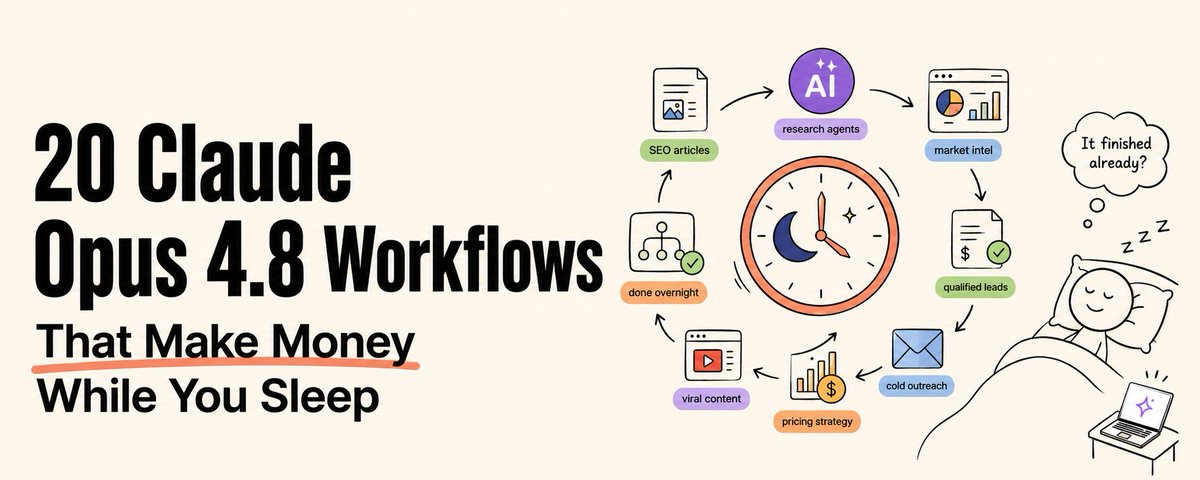
Anthropic dropped Opus 4.8 while most of us were sleeping.
Most people saw "better coding model."
The builders who looked closer saw something else entirely.
Claude can now work toward a defined completion state instead of waiting for your next prompt.
We just moved from:
"Write me 10 ad ideas."
to
"Don't come back until you've found the best ad idea in my category."
That single shift changes everything about how you use AI to make money.
## WHAT ACTUALLY CHANGED — OPUS 4.8 IN 60 SECONDS
Not a full model rewrite. A targeted upgrade that fixes the right things.
→ 69.2% SWE-bench Pro (up from 64.3% on 4.7)
→ 4x less likely to miss its own mistakes
→ Admits uncertainty instead of fabricating answers
→ Works independently longer without going off track
→ Same price as before: $5/$25 per million tokens
→ Fast mode: 2.5x speed, 3x cheaper than before
But the model upgrade isn't the story.
Dynamic Workflows is the story.
## WHAT DYNAMIC WORKFLOWS ACTUALLY ARE
One agent working step by step is the old way.
Dynamic Workflows is different.
You describe a goal. Claude writes its own orchestration script. Hundreds of parallel subagents spin up. They work simultaneously. They verify each other's work adversarially - agents actively try to break each other's findings. Results combine into one answer before anything reaches you.
You come back to finished work. Not a draft. Not a half-done task. A completed output that Claude verified before handing back.
The proof that this is real:
> Jarred Sumner used Dynamic Workflows to rewrite Bun from Zig to Rust.
> 750,000 lines of Rust. 99.8% of the existing test suite passing. 11 days from first commit to merge. Hundreds of agents working in parallel with two reviewers on each file.
> Work that engineering teams plan in quarters finished in days.
How to trigger it:
→ Need Claude Code v2.1.154 or later
→ Max, Team, or Enterprise plan
→ Type "workflow" in your prompt — Claude plans and confirms before running
→ OR set /effort ultracode — Claude decides automatically when to trigger it
→ Turn on auto mode first: /permissions → select auto mode
Token warning: Dynamic Workflows use significantly more tokens than a normal session. Start with a scoped task. Use /cost to monitor usage.
## THE SHIFT NOBODY IS TALKING ABOUT
Before Dynamic Workflows, every AI task ended the same way.
Claude finished. Stopped. Waited for you.
You reviewed. Decided what was missing. Prompted again. Reviewed again.
You were the loop.
Dynamic Workflows removes you from the loop.
You define the completion state — what "done" actually looks like — and Claude runs until it gets there. Verifying its own work. Catching its own mistakes. Iterating until the answer converges.
The founders who learn to define completion states instead of just prompts are about to gain a significant advantage over everyone still doing it one prompt at a time.
Here are 20 completion states worth setting tonight.
## MAKING MONEY
1. Google Maps Lead Generation — 200 Businesses, One Prompt
Old way: research one business, write one brief, repeat for weeks.
New way:
> Create a workflow to search Google Maps in [city] for [niche — HVAC, plumbers, dentists, roofers]. Find 200 businesses with ratings above 4.0 but no website or an outdated one. For each business: pull their services, their best reviews, their contact details, and their trust signals. Generate a complete outreach brief and website mockup brief for every single one. Don't stop until all 200 are done.
You wake up to 200 qualified leads with personalized briefs ready to send.
Close 5% at $800 average = $8,000 from one overnight prompt.
2. Cold Email Sequences — Personalized for Every Prospect
Generic emails get deleted.
> Create a workflow to write personalized cold email sequences for every business in this list [attach CSV]. For each one: research their specific situation, identify the exact problem my product solves for them, write a 3-email sequence personalized to their company. Don't use templates. Each email should reference something specific about that business. Don't stop until every prospect has a complete sequence.
500 personalized sequences. Ready to send. While you slept.
3. Competitor Pricing Intelligence — Full Market Map
> Create a workflow to research every competitor in [your market]. For each one: find their current pricing, their positioning, their main offer, their weakest reviews, and the gaps in what they provide. Build a complete competitive intelligence report with a clear map of where I can undercut, differentiate, or own a position they're missing. Don't stop until you've covered every major player.
The output: a complete market map with specific gaps to exploit.
4. Affiliate Content Machine — 30 Articles in One Run
> Create a workflow to research and write 30 SEO-optimized articles for [affiliate niche]. For each article: find the target keyword, research the top 5 ranking pages, identify what they're missing, and write a complete article that covers those gaps. Each article should be 1,200-1,500 words. Include internal linking suggestions between articles. Don't stop until all 30 are complete and verified for quality.
30 articles. Overnight. Ready to publish.
5. Pricing Page Optimization — Find the Revenue You're Leaving Behind
> Create a workflow to audit my onboarding funnel and pricing page. Research the top 20 companies in my category and analyze their pricing structure, anchoring strategy, and conversion elements. Cross-reference with 100 pricing psychology studies. Then audit my current page against all findings. Don't stop until you've identified every specific change that would increase conversion — with the evidence for each one.
The output: a prioritized list of changes with conversion impact estimates.
## MARKETING AND GROWTH
6. Find 100 Viral Hooks — Don't Stop Until You Have Them
> Create a workflow to find 100 viral hooks for content about [your topic]. Search for the top-performing posts in this niche across Twitter, LinkedIn, and YouTube. Analyze what makes each one work — the emotional trigger, the format, the specific language pattern. Then generate 100 hooks using those exact patterns, categorized by type. Don't stop until you have 100 hooks with documented evidence of why each one should work.
Not 10 hooks you have to guess about. 100 hooks reverse-engineered from what already went viral.
7. Ad Account Audit — Categorize Every Winner
> Create a workflow to analyze every ad in my account [attach export]. Categorize every ad by: belief being challenged, emotional angle, format type, offer framing, and hook structure. Identify the patterns in the top 20% of performers. Find what the bottom 20% have in common. Build a complete creative brief for the next 10 ads based on what the data actually shows. Don't stop until every ad is categorized and the brief is complete.
You stop guessing what works in your ads. The data tells you.
8. 5,000 App Store Reviews — Every Insight Extracted
> Create a workflow to analyze every review of [app name] on the App Store and Google Play. Cluster every objection, desire, feature request, and compliment by theme. Find the exact language customers use to describe their problems. Identify the top 5 reasons people leave and the top 5 reasons people stay. Don't stop until every review is processed and the insights are ranked by frequency and impact.
The output replaces a $10,000 user research project.
9. Onboarding Funnel Investigation
> Create a workflow to audit my onboarding funnel from signup to first value moment. Research the best onboarding flows in my category. Map every step in my current flow. Identify every drop-off point. For each drop-off: find 3 specific fixes that similar companies have used successfully. Don't stop investigating until you've found the single biggest conversion bottleneck and documented exactly how to fix it.
One overnight run. The biggest revenue leak in your product identified and fixed.
10. Top 20 Competitor Messaging Matrix
> Create a workflow to research my top 20 competitors. For each one: analyze their homepage, their ads, their top content, and their customer reviews. Build a complete messaging matrix comparing: core positioning, primary hook, main offer, proof points, and CTAs. Then identify the messaging gap — the position none of them own that I could. Don't stop until all 20 are analyzed and the matrix is complete.
The positioning gap your competitors left open. Found overnight.
## CONTENT
11. 50 UGC Concepts — Every Awareness Stage Covered
> Create a workflow to generate 50 UGC video concepts for [product]. Cover every awareness stage: completely unaware, problem aware, solution aware, product aware, and most aware. For each stage generate 10 concepts with: hook, core message, format, and call to action. Don't stop until all 50 are complete with documented reasoning for why each one fits that awareness stage.
A full UGC content calendar. One run.
12. Scan Every Landing Page in Your Category
> Create a workflow to find and analyze every landing page in [your category]. For each page: identify the headline structure, the proof elements, the offer framing, and the CTA. Find the patterns that appear in the highest-converting pages. Find what the lowest-converting pages have in common. Build a conversion pattern report with specific recommendations for my landing page. Don't stop until you've covered at least 50 pages.
The highest-converting patterns in your market. Documented. Overnight.
13. 30-Day Content Calendar — Researched and Drafted
> Create a workflow to build a complete 30-day content calendar for [platform] in [niche]. For each day: research what's currently performing in this niche, identify the angle with the highest engagement potential, write a complete post draft. Include hook, body, and CTA for every post. Don't stop until all 30 days are drafted and every post has been checked against current top performers in the niche.
A month of content. One overnight run.
14. YouTube Script Package — 10 Videos Ready to Record
> Create a workflow to research and write 10 complete YouTube scripts for [channel topic]. For each video: find a topic with proven search demand and engagement, research the top competing videos and what they're missing, write a complete word-for-word script with hook, open loop, body, and CTA. Include thumbnail concept and title variations for each. Don't stop until all 10 scripts are complete and verified against top performers.
10 videos. Researched, scripted, and ready to record.
15. Newsletter Issue — Fully Researched and Written
> Create a workflow to research and write a complete newsletter issue about [topic]. Search for every major development in this space from the last 7 days. Find the 5 most important stories. For each story: verify across multiple sources, extract the key insight for my audience, and write a 200-word section. Write a complete introduction and conclusion. Don't stop until the full issue is written and every fact is verified.
A fully researched newsletter. Written and verified. While you slept.
## RESEARCH AND STRATEGY
16. Market Research Report — 100 Sources, One Document
> Create a workflow to produce a complete market research report for [market]. Research the market size, growth rate, key players, customer segments, and emerging trends. Synthesize findings from at least 100 sources. Verify every statistic against its original source. Flag any conflicting data. Don't stop until the report is complete with a full source list and every claim verified.
A $5,000 market research report. One prompt. One night.
17. Investment or Partnership Due Diligence
> Create a workflow to conduct due diligence on [company]. Research their founding team, funding history, product, customer reviews, press coverage, and competitive position. Find every red flag and every positive signal. Cross-reference claims against independent sources. Build a complete due diligence report with a clear recommendation. Don't stop until every major question is answered and documented.
The research that normally takes a team two weeks. Done overnight.
18. Pricing Strategy — Full Analysis
> Create a workflow to build a complete pricing strategy for [product]. Research how every major competitor prices their product. Find every pricing psychology study relevant to my category. Analyze my current pricing against customer willingness to pay signals in reviews and support tickets [attach]. Build 3 complete pricing models with projected revenue impact for each. Don't stop until all 3 models are fully built and stress-tested.
Three pricing models. With projected revenue impact. Ready to decide from.
━━━
19. SEO Opportunity Map — Every Gap in Your Market
> Create a workflow to find every SEO content gap in [niche]. Research the top 50 keywords in this space. For each keyword: analyze the top 10 ranking pages, identify what they're missing, and assess the realistic difficulty of ranking. Find the 20 keywords where I can rank in under 6 months with quality content. Don't stop until every opportunity is documented with difficulty score and content brief.
20 SEO opportunities with content briefs. One overnight run.
20. Business Idea Validation — Full Market Test
> Create a workflow to validate [business idea]. Research: market size, existing competitors, customer pain points from forums and reviews, willingness to pay signals, regulatory considerations, and distribution channels. Find 50 potential customers and analyze what they're currently paying for alternatives. Build a complete validation report with a clear go/no-go recommendation. Don't stop until every major assumption is tested.
Full validation of a business idea. Before you spend a dollar building it.
## THE PATTERN ACROSS ALL 20
Look at every prompt above.
They all end the same way.
"Don't stop until."
That's the unlock.
You're not asking Claude to do a task anymore.
You're giving it a completion state and letting it run until it gets there.
The agents work in parallel. They verify each other's findings. They iterate until the answers converge. You come back to finished work.
Before Dynamic Workflows: you were the loop between every AI task. After Dynamic Workflows: Claude closes the loop itself.
That's the shift.
The founders who figure out how to define completion states — not just write prompts — are about to pull ahead of everyone still doing it one message at a time.
## HOW TO START TONIGHT
You need:
→ Claude Code v2.1.154 or later (claude update)
→ Max ($100/month), Team, or Enterprise plan
→ Auto mode on: run /permissions
→ select auto mode
Pick one prompt from the list above.
Start scoped — not your entire business, one specific task.
Use /cost to monitor token usage as it runs.
The first workflow will feel slow.
By the third one you'll wonder how you ever worked without it.
If this was useful:
→ Repost so other builders see it
→ Follow @sairahul1 for more systems that run without you
→ Bookmark this - the 20 prompts are worth keeping
## 相关链接
- [Rahul reposted](https://x.com/sairahul1)
- [Rahul](https://x.com/sairahul1)
- [@sairahul1](https://x.com/sairahul1)
- [216K](https://x.com/sairahul1/status/2060646901524156778/analytics)
- [@sairahul1](https://x.com/@sairahul1)
- [Upgrade to Premium](https://x.com/i/premium_sign_up)
- [4:58 PM · May 30, 2026](https://x.com/sairahul1/status/2060646901524156778)
- [216.3K Views](https://x.com/sairahul1/status/2060646901524156778/analytics)
- [View quotes](https://x.com/sairahul1/status/2060646901524156778/quotes)
---
*导出时间: 2026/5/31 10:21:28*
---
## 中文翻译
# 20 个 Claude Opus 4.8 工作流:在你睡觉时赚钱
**作者**: Rahul
**日期**: 2026-05-30T08:58:00.000Z
**来源**: [https://x.com/sairahul1/status/2060646901524156778](https://x.com/sairahul1/status/2060646901524156778)
---

Anthropic 在我们大多数人熟睡时发布了 Opus 4.8。
大多数人只看到了“更好的代码模型”。
那些看得更深入的构建者则看到了完全不同的东西。
Claude 现在可以朝着明确的“完成状态”工作,而不是等待你的下一个提示词。
我们刚刚从:
“给我写 10 个广告创意。”
转变为:
“在我品类中找到最好的广告创意,在此之前不要回来。”
这一转变彻底改变了你利用 AI 赚钱的方式。
## 到底变了什么 —— 60 秒看懂 Opus 4.8
这不是一次完整的模型重写,而是一次修复了关键点的针对性升级。
→ SWE-bench Pro 得分 69.2%(较 4.7 的 64.3% 有所上升)
→ 出错概率降低 4 倍
→ 承认不确定性,而不是编造答案
→ 能够独立工作更长时间而不偏离轨道
→ 价格保持不变:每百万 token $5/$25
→ 快速模式:速度提升 2.5 倍,成本降低 3 倍
但模型升级并不是重点。
**动态工作流(Dynamic Workflows)** 才是重点。
## 动态工作流到底是什么
一个代理按部就班地工作是旧模式。
动态工作流则不同。
你描述一个目标。Claude 编写它自己的编排脚本。数百个并行子代理启动。它们同时工作。它们以一种对抗的方式相互验证工作——代理们积极尝试推翻彼此的发现。结果汇总为一个答案,才会呈现在你面前。
你回来时看到的是已完成的工作。不是草稿。不是半成品。是 Claude 在交付前已验证过的完整产出。
证明这并非虚言:
> Jarred Sumner 使用动态工作流将 Bun 从 Zig 重写为 Rust。
> 75 万行 Rust 代码。99.8% 的现有测试套件通过。从首次提交到合并仅用时 11 天。数百个代理并行工作,每个文件有两名审查员。
> 工程团队规划数季度才能完成的工作,几天内搞定。
如何触发它:
→ 需要 Claude Code v2.1.154 或更高版本
→ Max、Team 或 Enterprise 计划
→ 在提示词中输入“workflow”——Claude 会在运行前规划并确认
→ 或设置 /effort ultracode —— Claude 自动决定何时触发
→ 首先开启自动模式:/permissions → 选择自动模式
Token 警告:动态工作流比普通会话消耗显著更多的 token。从范围明确的任务开始。使用 /cost 监控用量。
## 没人在谈论的转变
在动态工作流之前,每个 AI 任务都以同样的方式结束。
Claude 完成。停止。等待你。
你审查。决定缺什么。再次提示。再次审查。
你就是那个循环。
动态工作流将你从循环中移除。
你定义完成状态——即“完成”到底是什么样子——然后 Claude 一直运行直到达到目标。验证它自己的工作。捕捉它自己的错误。不断迭代直到答案收敛。
那些学会定义完成状态而不是仅仅编写提示词的创始人,将获得相比于那些仍在一条条发消息的人的巨大优势。
这里有 20 个值得今晚设置的完成状态。
## 赚钱
1. Google Maps 潜客开发 —— 200 家企业,一个提示词
旧方式:研究一家企业,写一份简报,重复数周。
新方式:
> 创建一个工作流,在 Google Maps 上搜索 [城市] 的 [细分行业 —— 暖通空调、水管工、牙医、屋顶维修]。找到 200 家评分 4.0 以上但没有网站或网站过时的企业。对于每家企业:提取他们的服务、最佳评价、联系方式和信任信号。为每一家生成一份完整的推广简报和网站模型简报。在完成全部 200 家之前不要停止。
你醒来时就有 200 个准备发送的带个性化简报的合格线索。
按 800 美元的平均客单价成交 5% = 一个晚上的提示词赚取 8,000 美元。
2. 冷邮件序列 —— 为每个潜在客户个性化
通用邮件会被删除。
> 创建一个工作流,为名单 [附件 CSV] 中的每家企业撰写个性化的冷邮件序列。对于每一家:研究他们的具体情况,确定我的产品为他们解决的确切问题,撰写一封针对其公司的 3 封邮件序列。不要使用模板。每封邮件应引用关于该业务的具体内容。在每位潜在客户都有完整序列之前不要停止。
500 封个性化序列。准备发送。在你睡觉时完成。
3. 竞争对手定价情报 —— 完整的市场图谱
> 创建一个工作流,研究 [你的市场] 中的每一个竞争对手。对于每一个:找到他们当前的定价、定位、主要优惠、最差的评价以及他们服务中的空白。建立一份完整的竞争情报报告,并清晰绘制出我可以进行低价竞争、差异化或占据他们遗漏位置的地图。在覆盖每个主要参与者之前不要停止。
输出:一份完整的市场图谱,标有可利用的具体空白。
4. 联盟内容机器 —— 一次运行生成 30 篇文章
> 创建一个工作流,为 [联盟细分领域] 研究并撰写 30 篇经过 SEO 优化的文章。对于每篇文章:找到目标关键词,研究排名前 5 的页面,确定它们遗漏了什么,并撰写一篇涵盖这些空白点的完整文章。每篇文章应为 1,200-1,500 字。包含文章间的内部链接建议。在全部 30 篇完成并经过质量验证之前不要停止。
30 篇文章。过夜。准备发布。
5. 定价页面优化 —— 找到你流失的收入
> 创建一个工作流,审计我的引导流程和定价页面。研究我品类中排名前 20 的公司,分析他们的定价结构、锚定策略和转化元素。与 100 项定价心理学研究进行交叉比对。然后根据所有发现审计我当前的页面。在确定每一个能提高转化的具体变更(附带每项的证据)之前不要停止。
输出:一份按转化影响力排序的变更清单。
## 市场营销与增长
6. 找到 100 个病毒式传播钩子 —— 不找到不罢休
> 创建一个工作流,为关于 [你的主题] 的内容找到 100 个病毒式传播钩子。在 Twitter、LinkedIn 和 YouTube 上搜索该细分领域表现最好的帖子。分析每一个成功的原因——情感触发点、格式、特定的语言模式。然后使用这些确切的模式生成 100 个钩子,并按类型分类。在你拥有 100 个钩子并记录了每个为何有效的证据之前不要停止。
不是 10 个让你猜测的钩子。100 个从已传播内容中逆向工程的钩子。
7. 广告账户审计 —— 对每个获胜者分类
> 创建一个工作流,分析我账户 [附件导出] 中的每一个广告。按以下标准对每个广告分类:被挑战的信念、情感角度、格式类型、优惠框架和钩子结构。识别表现最好的前 20% 广告中的模式。找出表现最差的后 20% 广告的共性。根据数据实际显示的内容,为接下来的 10 个广告建立一份完整的创意简报。在分类每个广告并完成简报之前不要停止。
你不再猜测广告中什么有效。数据会告诉你。
8. 5,000 条应用商店评论 —— 提取每一个洞察
> 创建一个工作流,分析 App Store 和 Google Play 上 [应用名称] 的每一条评论。按主题聚类每一个异议、愿望、功能请求和赞扬。找到客户用来描述问题的确切语言。确定用户离开的前 5 个原因和留存的前 5 个原因。在处理完每条评论并按频率和影响力排序洞察之前不要停止。
其输出替代了一个 10,000 美元的用户研究项目。
9. 引导流程调查
> 创建一个工作流,审计从注册到首次价值时刻的引导流程。研究我品类中最好的引导流程。绘制当前流程的每一步。确定每一个流失点。对于每个流失点:找到 3 个类似公司成功使用的具体修复方案。在找到最大的转化瓶颈并准确记录如何修复之前不要停止调查。
一次夜间运行。你产品中最大的收入漏洞被识别并修复。
10. 前 20 名竞争对手信息矩阵
> 创建一个工作流,研究我的前 20 名竞争对手。对于每一个:分析他们的主页、广告、顶级内容和客户评价。建立一份完整的信息矩阵,比较:核心定位、主要钩子、主推优惠、证明点和 CTA(行动号召)。然后确定信息空白——即他们都没有占据而我可能拥有的位置。在分析完所有 20 家并完成矩阵之前不要停止。
竞争对手留下的定位空白。一夜之间找到。
## 内容
11. 50 个 UGC 概念 —— 覆盖每一个认知阶段
> 创建一个工作流,为 [产品] 生成 50 个 UGC 视频概念。覆盖每一个认知阶段:完全不知道、问题 aware、解决方案 aware、产品 aware 和最 aware。为每个阶段生成 10 个概念,包含:钩子、核心信息、格式和行动号召。在全部 50 个完成并为每个为何适合该阶段提供理由之前不要停止。
一份完整的 UGC 内容日历。一次运行。
12. 扫描你品类中的每个落地页
> 创建一个工作流,找到并分析 [你的品类] 中的每一个落地页。对于每个页面:识别标题结构、证明元素、优惠框架和 CTA。找到高转化页面中出现的模式。找出低转化页面的共同点。建立一份转化模式报告,并为我的落地页提供具体建议。在覆盖至少 50 个页面之前不要停止。
你市场上转化率最高的模式。被记录下来。过夜完成。
13. 30 天内容日历 —— 经过研究和起草
> 创建一个工作流,为 [平台] 在 [细分领域] 建立一份完整的 30 天内容日历。对于每一天:研究该细分领域目前表现好的内容,确定具有最高参与潜力的角度,撰写一篇完整的帖子草稿。包含每个帖子的钩子、正文和 CTA。在 30 天全部起草完毕并每篇帖子都经过与该细分领域当前顶级内容比对之前不要停止。
一个月的内容。一次夜间运行。
14. YouTube 脚本包 —— 10 个视频 ready to record
> 创建一个工作流,为 [频道主题] 研究并撰写 10 个完整的 YouTube 脚本。对于每个视频:找到一个具有搜索需求证明和互动性的主题,研究顶级竞争视频及其遗漏点,撰写一个完整的逐字脚本,包含钩子、开放循环、正文和 CTA。包含每个视频的缩略图概念和标题变体。在全部 10 个脚本完成并经过与顶级表现比对验证之前不要停止。
10 个视频。经过研究、脚本化,准备录制。
15. 通讯期刊 —— 完全研究和撰写
> 创建一个工作流,研究并撰写一份关于 [主题] 的完整通讯期刊。搜索该领域过去 7 天的每一个重大进展。找到 5 个最重要的故事。对于每个故事:通过多个来源验证,为我的受众提取关键洞察,并撰写一个 200 字的章节。撰写完整的介绍和结论。在整期撰写完成且每个事实得到验证之前不要停止。
一份完全研究的通讯。撰写并验证。在你睡觉时。
## 研究与策略
16. 市场研究报告 —— 100 个来源,一份文档
> 创建一个工作流,为 [市场] 生成一份完整的市场研究报告。研究市场规模、增长率、关键参与者、客户细分和新兴趋势。综合至少 100 个来源的发现。根据原始来源验证每个统计数据。标记任何冲突的数据。在报告完成并附上完整来源列表及每项声明得到验证之前不要停止。
一份价值 5,000 美元的市场研究报告。一个提示词。一晚。
17. 投资或合作尽职调查
> 创建一个工作流,对 [公司] 进行尽职调查。研究他们的创始团队、融资历史、产品、客户评价、媒体报道和竞争地位。找到每一个红旗和每一个积极信号。根据独立来源交叉验证声明。建立一份包含明确建议的完整尽职调查报告。在回答并记录每一个主要问题之前不要停止。
通常需要团队两周的研究。一晚完成。
18. 定价策略 —— 全面分析
> 创建一个工作流,为 [产品] 建立一份完整的定价策略。研究每个主要竞争对手如何为其产品定价。找到与我品类相关的每一项定价心理学研究。根据评论和支持工单 [附件] 中的客户支付意愿信号分析我当前的定价。建立 3 个完整的定价模型,并预测每个模型的收入影响。在全部 3 个模型完全建立并经过压力测试之前不要停止。
三个定价模型。附带预测的收入影响。准备从中决策。
━━━
19. SEO 机会地图 —— 你市场中的每一个空白
> 创建一个工作流,找到 [细分领域] 中的每一个 SEO 内容空白。研究该领域的前 50 个关键词。对于每个关键词:分析排名前 10 的页面,确定他们遗漏了什么,并评估排名的现实难度。找到我可以通过优质内容在 6 个月内排名的 20 个关键词。在记录每个机会(附带难度评分和内容简报)之前不要停止。
20 个 SEO 机会及内容简报。一次夜间运行。
20. 商业想法验证 —— 完整的市场测试
> 创建一个工作流,验证 [商业想法]。研究:市场规模、现有竞争对手、来自论坛和评论的客户痛点、支付意愿信号、监管考量因素和分销渠道。找到 50 个潜在客户并分析他们目前为替代方案支付的费用。建立一份包含明确的 Go/No-Go 建议的完整验证报告。在测试每一个主要假设之前不要停止。
商业想法的完整验证。在你花一分钱构建它之前。
## 所有 20 个案例的模式
看看上面的每一个提示词。
它们的结尾都一样。
“不……不要停止。”
这就是解锁的关键。
你不再要求 Claude 去做一项任务。
你给它一个完成状态,让它一直运行直到达到目标。
代理们并行工作。它们相互验证发现。它们迭代直到答案收敛。你回来时看到的是完成的工作。
动态工作流之前:你是每个 AI 任务之间的循环。动态工作流之后:Claude 自己闭合循环。
这就是转变。
那些弄懂如何定义完成状态——而不仅仅是编写提示词——的创始人,将拉开与那些仍在一条条发消息的人的差距。
## 今晚如何开始
你需要:
→ Claude Code v2.1.154 或更高版本 (claude update)
→ Max ($100/月)、Team 或 Enterprise 计划
→ 开启自动模式:运行 /permissions
→ 选择自动模式
从上面的列表中选择一个提示词。
从范围开始——不是你的整个业务,而是一个具体任务。
在运行时使用 /cost 监控 token 用量。
第一个工作流可能会感觉慢。
到了第三个,你会想知道以前没有它怎么工作。
如果这对你有用:
→ 转发,让其他构建者看到
→ 关注 @sairahul1 获取更多无需你介入即可运行的系统
→ 收藏此文 —— 这 20 个提示词值得保留