The Instinct Thesis: Why Memory Is Becoming the Moat Ashwin Gopinath 2026-08-28 16.2 KB 187.5K 462 ☆ 收藏 𝕏 文章列表 作者提出假设:Instinct 产品的魔力不在于其 agentic 引擎,而在于其记忆架构。基础模型已经商品化,自主执行(如 Devin、Claude Code)也在快速商品化,而效用驱动的记忆正成为真正的护城河。作者认为 Instinct 携带类似笔记本的原则性记忆架构,通过'准入效用'和'行动效用'两个效用函数有选择地遗忘和压缩信息,将经验编译为多层状态模型:临时摄取层、选择性语义账本和演化的信念与偏好地图。记忆不是数据库或录音机,而是一种编译器,其意义在于支持未来的智能决策,而非高保真地传递过去。 Agent记忆架构LLMInstinctHermesOpenclawReflexion基础模型自主执行认知科学 76 值得读 ▶ 作者以第一手观察和计算神经科学视角提出'记忆即护城河'的架构假设,论述深入且观点新颖,时效性极强,但偏理论推测,缺乏可直接落地的实现细节。 # The Instinct Thesis: Why Memory Is Becoming the Moat **作者**: Ashwin Gopinath **日期**: 2026-08-27T17:22:47.000Z **来源**: [https://x.com/ashwingop/status/2093026452929405356](https://x.com/ashwingop/status/2093026452929405356) --- 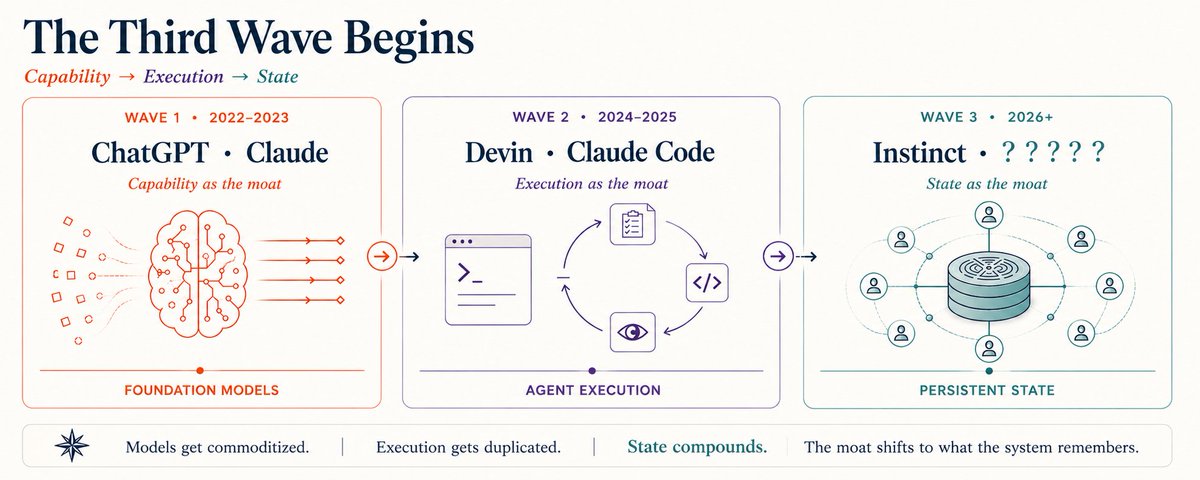 TL;DR: My hypothesis is that Instinct feels magical not because of an inimitable agentic engine, but because of its memory architecture. Just as ChatGPT marked the era of foundation models and Devin/Claude Code marked the era of autonomous execution, Instinct signals a third wave: foundation models have already commoditized, execution is rapidly going down the same path, and utility-driven memory is becoming the real wow-factor as well as the moat. Back in 2023, Noah and I spent about 3 months playing with an embarrassingly simple idea: "what happens if you let an LLM Agent look back at its own mistakes and introspect?" That experiment became [Reflexion](https://arxiv.org/abs/2303.11366v1), which eventually took a life of its own. But, in all honesty we didn't start intending to create a complex reasoning engine, it was an attempt at giving AI working memory for the sake of self-critique because we figured the critique could nudge the next attempt to be more right. Keep this in mind, we will come back to this idea later towards the end. Before I go further, necessary grain of salt upfront: Instinct is an awesome product, Noah was a student of mine, I worked with him during my time at MIT and we have lightly kept in touch since then, but I have no inside knowledge of Instinct's internals. I also carry obvious biases for him being my student as well as someone who spends time wresting with agents and their memories, albiet for enterprises rather than personal ones. What follows is purely my attempt to make sense of a magical product from experiencing it. Watching the multitude of tasks that people have been doing with instinct is truly fascinating and also a little odd since individually nothing it has done is particularly surprising compared to hermes or openclaw, but why then are people shouting "Look at this breakthrough agent". I believe on the surface it seems that way but one experiences the difference only when you play with the tool for a bit and as you play with it more unlike other agents that seem to degrade this one doesn't, it seems to somehow improve and lies the clue. 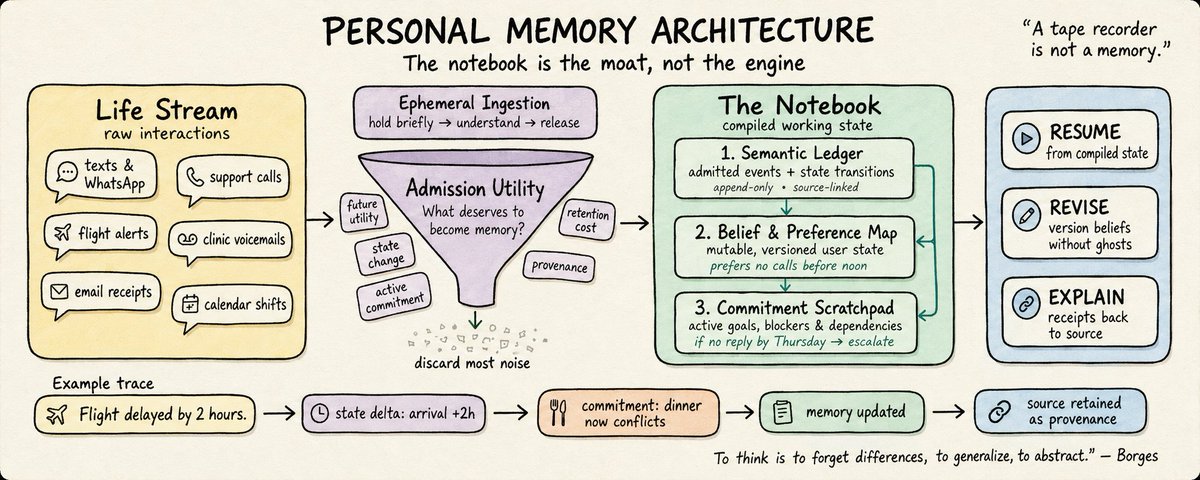 Personal memory architecture. A long-running agent does not need an attic full of raw history; it needs a selective working state. Ephemeral observations are admitted only when useful, compiled into durable beliefs and commitments, and retained with provenance so the agent can resume, revise, and explain itself. The Commoditization of the Engine I have a different take, I don't think instinct's core agentic loop is likely to be particularly special. I say this because standard agentic execution has already commoditized. Also, any large foundation model paired with even a mildly competent tool-use harness can execute API calls, follow instructions, and generate multi-step plans. And, while the permissions, details of computer use, and execution reliability can vary, its execution has rapidly become an engineering problem while the memory is the scarce architectural asset. My working hypothesis is that Instinct’s real breakthrough is a notebook, or something like it, that its agent carries on its side: it's a principled memory architecture operating under the hood. It's the first time I have personally experienced an ordinary agent, outside of my own agents, sitting on top of a personal-memory architecture this good. And, if I'm right about how the notebook works, it explains the most uncanny thing about Instinct, not what it does when you ask, but what it does when you don't. To understand why the notebook is the load-bearing wall, look at the difference between a toy agent and a long-running one. A transactional agent runs for a few operational turns, fetches some answer, does some tool calls and then terminates. A long-running agent has to survive in the real world across days and weeks of asynchronous friction. Take the most mundane task imaginable: lowering a cable bill. One calls, sits on hold, listen to a vague retention offer, wait for a callback, check back a few days later, and then escalate. The hard part of an agent doing such a long-running task isn't the running; it's the waiting, it’s holding state, staying oriented, and knowing what matters while nothing is happening. Memory Is a Compiler of Sorts, Not a Database or a Graph People have tried to solve these issues by treating memory like a database: store every transcript and receipt, hoping some shitty vector search or graph RAG will fish out the needed information later, all the while forgetting that a tape recorder is not a memory. Borges wrote the definitive story about this, "Funes the Memorious", the man who forgets nothing and, precisely because of it, can no longer think. The act of thinking is to forget differences, to generalize, to abstract. If you record every photon hitting your eye and every sound wave entering your ear, you don't have understanding, or a brain, you just have whitewashed noise. Memory makes no sense at all without a utility function, an active bet about what will be useful tomorrow. This isn't just a programmer's metaphor, it reflects a well accepted computational-neuroscience perspective championed by researchers like Richards and Frankland who argued this point succinctly when they said (I'm paraphrasing),"the point of memory is not to transmit the past with high fidelity, but to support intelligent decisions in the future". This is exactly why healthy brains work so hard at forgetting. When you or I go through about our lives, we discard almost all the noise, compress the remaining experiences into a few durable facts, and store those because we are constantly making a bet that they will matter. Real memory isn't brute-force retrieval, instead it's the active, disciplined choice of what to throw away via two distinct utility functions: 1. Admission Utility: Evaluating whether a new observation holds enough expected value for future decisions to justify the maintenance cost of storing and indexing it. 2. Action Utility (The Interruption Gate): Deciding whether an observed state change justifies action. This isn't just weighing convenience against annoyance, it must evaluate risk, irreversibility, and authority. If an action is high-value, authorized, and reversible (e.g., updating a calendar hold), the agent acts silently. If it is consequential or irreversible (e.g., sending an email or initiating a payment), it asks. If the net expected value is low, the optimal mathematical action is silence So what is Instinct actually doing? Based on all that I can see in its behavior, I believe, and I could be very wrong here, the instinct agent has a continuous, utility-driven loop running quietly in the background. It enables the agent to avoid repeatedly compacting an ever-growing conversation at inference time, or treating retrieval (RAG or graph or whatever) over raw history as memory. Instead the agent is asking three questions as it digests the episodic stream of personal life, texts, tool calls, inbound receipts etc: 1. What here changes our understanding of the user? 2. What active task just moved forward? 3. What can be safely discarded? The answers get compiled into a multi-tiered state model: 1. An Ephemeral Ingestion Layer: Raw transcripts and receipts held only long enough for semantic digestion, then discarded. 2. A Selective Semantic Ledger: An append-only log of admitted events and state transitions ('Retention offer promised within 48h'), retaining provenance metadata without hoarding raw payload exhaust. 3. An Evolving Belief & Preference Map: A mutable, versioned state of habits and constraints ('User hates morning calls'). 4. A Procedural Commitment Scratchpad: Dynamic tracking of unresolved subgoals and dependencies ('If silent by Thursday, escalate'). This approach would ensure that when the agent acts, it doesn't drown due to context rot or re-read a giant corpus, instead it picks up instantly from a clean, consolidated state. The memory system also, I bet, understands the mechanics of forgetting. The ledger itself most likely would be append-only, but every belief derived from it carries provenance, which conversation snippet, source and inference. When you update a preference or revoke a connected source, traditional RAG systems struggle, so even if you delete a vector its inferences persist across summaries and derived graph edges. An explicit provenance model paired with temporal check allows the system to invalidate an entire dependency branch cleanly, retiring outdated facts without leaving ghost hallucinations. 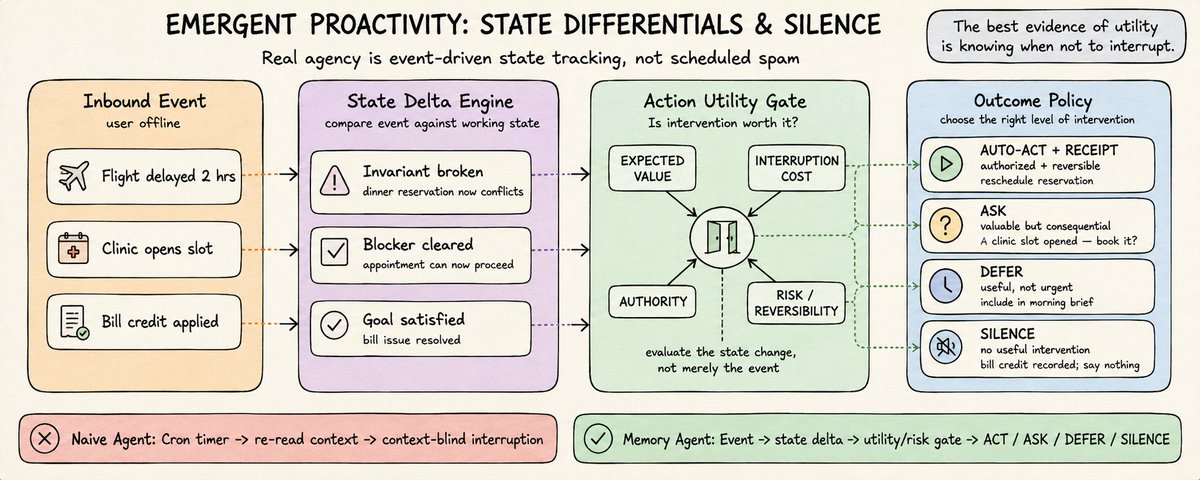 Proactivity as a state differential. Genuine proactivity is not a timer. New events are compared against persistent state; only meaningful changes pass through a utility and risk gate into action, escalation, deferral or deliberate silence. Now, here is the most exciting consequence of such an architecture: a utility-driven compressed memory is the key to genuine agentic proactivity. Almost every agent today is purely reactive, when you poke it, back it pokes. Most of the others mimic proactivity with crude timers and scheduled check-ins, producing a recognizable pattern. So, paradoxically the proactivity features one adds, the less proactive the thing feels. Natural proactivity is not a scheduled cron job you bolt onto an agent loop. Memory provides the necessary substrate, but genuine proactivity emerges from the full stack: stateful memory + continuous event observation + explicit commitment tracking + a risk-aware action policy. It requires a dynamic sense of state differentials. So, while you're asleep if an email arrives, the background engine digests it and notices a delta against the notepad leading to action or silence. The three structures cooperate seamlessly: the scratchpad detects the delta, the habit map judges the interruption, i.e. is the state change worth waking you up, or is it a note for the morning? and lastly, the ledger supplies the receipts when the agent explains itself. Now, notice the corollary, because it's the part I find most elegant: the deepest evidence of a working utility function isn't the well-timed ping. It's the silence. An agent that knows when not to reach out understands you better than one that always does. Standing on the Shoulders of the Field Now, here comes the even more interesting part and it's worth saying so. While prior systems laid essential groundwork, Generative Agents with importance reflection, MemGPT and Letta with tiered and sleep-time memory, and recent work like Mem0 and A-MAC formalizing memory admission, the industry has spent years obsessing over retrieval. The frontier is moving earlier in the pipeline: deciding what deserves admission, how it compiles into mutable state, and knowing when to stay quiet. The only other place I’ve seen similar behavior is in our own internal enterprise agents at Sentra (My startup). If I am right about Instinct, we arrived at simlar conclusions while trying to solve very different problems. To Noah's credit he pointed Instinct at personal agents, something we totally ignored as we obsessed with enterprise agents and issues around shared organizational memory. That framing also makes everything I have written a testable prediction rather than a vibe. If I'm right, three things should hold: 1. Instinct should degrade gracefully as the user history grows, because it acts from consolidated state rather than raw scrollback. 2. It should handle reversals like "actually, I'm vegetarian now" without old preferences bleeding through, because provenance makes pruning real. 3. It should sometimes, deliberately, do nothing. If it's pinging like a needy app in month three, I'm wrong. A final note on the discourse surrounding data collection, screen capture, and training licenses. While terms of service across the industry evolve weekly in response to user pushback, the architectural point remains: a system built on utility-driven compilation is fundamentally aligned with data minimization. When you extract semantic state and discard the raw stream, durable facts become the asset, and uncompressed exhaust becomes an unnecessary liability. Aggressive compilation and selective retention can become the core trust story. The better the notebook, the less of your life anyone needs to keep. The attic model doesn't just make worse agents, it makes worse privacy and depending on what kind of bullshit retrieval mechanism you choose it can be a tech debt. As this category matures and I hope it does for my own sake, aggressive forgetting becomes the primary trust story, not a limitation buried in the fine print. The Third Wave Three years ago, when Noah and I were playing with Reflexion, it felt like a trick for one task at a time: fail, digest the failure into plain words, and try again. If my read is right, what is striking about Instinct is seeing a related intuition appear at an entirely different scale: reflection running continuously over a messy personal life instead of a single benchmark episode. It is genuinely wonderful to watch him chase personal memory this deeply, especially knowing where some of our earliest conversations started. If what I laid out above is indeed what he has built (and only time will tell), it would be a delightful coincidence that we both arrived at the exact same conclusion about memory while applying it to completely different worlds. I say this because we see the exact behavior every day in our internal agents at Sentra, where we have taken the approach described above but pointed it at the enterprise agents. But, that is a story for another day :-) That points to a broader progression in the current AI cycle. The first wave was about capability: foundation models made machines unexpectedly competent at thinking in language. The second was about execution: systems such as Devin and Claude Code wrapped those models in loops that could plan, use tools, and finish work. The third is about state: agents that remain situated in the world long enough to know what has happened, what matters now, and what should happen next. And, the wave has just begun, people have been talking about it for the last year calling it loop engineering, graphs, context-graph and a whole lot of things that beats around the bush. The reality is that memory is a compiler, not a database, not a graph, not a filesystem either. And, I believe Instinct showed us exactly why this looks magical. The enterprise version should go a step further, a personal agent needs persistent memory of only one person. An organization needs this across thousands of humans and agents maintaining personal and shared state built from communications, systems of record, documents and a whole lot more. It’s a very similar architecture as above with many more bells and whistles combined on top. Field notes from building that for a 20,000-person company will come later, but that is a story for a different day :-) . The bigger picture is that the enduring problem is therefore no longer merely teaching machines how to think or how to act. It’s teaching them what the world currently is and what is worth remembering about it. ---- Note: I am CEO of Sentra and deal with some of the issues that I wrote about here. At [Sentra](https://www.sentra.app/), where we are building a singular foundational layer that is a shared "memory" (as defined in the article) in service of enabling a company brain: a shared, living model of the entire org. It absorbs all data, structured and unstructured in an org and services humans and agents alike. ## 相关链接 - [Ashwin Gopinath](https://x.com/ashwingop) - [@ashwingop](https://x.com/ashwingop) - [4.7K](https://x.com/ashwingop/status/2093026452929405356/analytics) - [Reflexion](https://arxiv.org/abs/2303.11366v1) - [Sentra](https://www.sentra.app/) - [Upgrade to Premium](https://x.com/i/premium_sign_up) - [1:22 AM · Aug 28, 2026](https://x.com/ashwingop/status/2093026452929405356) - [4,724 Views](https://x.com/ashwingop/status/2093026452929405356/analytics) --- *导出时间: 2026/8/28 08:52:07* --- ## 中文翻译 # 本能论题:为什么记忆正在成为护城河 **作者**: Ashwin Gopinath **日期**: 2026-08-27T17:22:47.000Z **来源**: [https://x.com/ashwingop/status/2093026452929405356](https://x.com/ashwingop/status/2093026452929405356) ---  TL;DR:我的假设是,Instinct 之所以让人觉得神奇,并不是因为它拥有什么无法复制的智能体引擎,而是因为它的记忆架构。正如 ChatGPT 标志着基础模型时代的到来、Devin/Claude Code 标志着自主执行时代的到来,Instinct 则预示着第三波浪潮:基础模型已经商品化,执行也正迅速走上同样的道路,而以效用驱动的记忆正在成为真正的惊艳之处,也是真正的护城河。 回到 2023 年,Noah 和我花了大约三个月的时间研究一个简单得有点不好意思的想法:“如果我们让一个 LLM 智能体回顾自己的错误并自我反思,会发生什么?”那个实验成为了 [Reflexion](https://arxiv.org/abs/2303.11366v1),后来它有了自己的生命。但说实话,我们一开始并不打算造一个复杂的推理引擎,那只是为了让 AI 拥有用于自我批评的工作记忆,因为我们认为批评可以推动下一次尝试更接近正确。请记住这一点,我们会在文章末尾回到这个想法。在继续之前,先打个必要的预防针:Instinct 是一款很棒的产品,Noah 曾是我的学生,我在 MIT 期间与他共事过,此后我们也一直保持着轻度联系,但我对 Instinct 的内部实现一无所知。我也显然带有偏见——他既是我的学生,也是一个和我一样花时间与智能体及其记忆打交道的人,尽管他面向的是企业而非个人。以下内容纯粹是我通过使用体验来理解一款神奇产品的尝试。看着人们用 Instinct 完成的各种任务着实令人着迷,也有些奇怪:与 hermes 或 openclaw 相比,它单独完成的每件事都不算特别惊人,但为什么人们在高喊“看看这个突破性的智能体”?我认为表面上看确实如此,但只有你把玩这个工具一段时间才能体会到差异——而且随着使用加深,其他智能体似乎会退化,而它不会,它似乎在以某种方式变得更好,这就是线索所在。  个人记忆架构。一个长期运行的智能体不需要塞满原始历史的阁楼;它需要一种有选择性的工作状态。短暂的观察只有在有用时才被接纳,被编译成持久的信念和承诺,并连同来源信息一起保留,以便智能体能够恢复、修订和解释自己。 ## 引擎的商品化 我的看法不同,我认为 Instinct 的核心智能体循环不太可能特别特殊。我这么说是因为标准化的智能体执行已经商品化了。而且,任何大型基础模型搭配哪怕只是勉强合格的工具使用框架,都能执行 API 调用、遵循指令并生成多步骤计划。虽然权限、计算机使用的细节以及执行可靠性会有所不同,但执行已迅速成为一个工程问题,而记忆才是稀缺的架构资产。 我的工作假设是,Instinct 真正的突破是一个笔记本,或类似的东西,它的智能体随身携带:这是一个在幕后运行的有原则的记忆架构。这是我第一次亲身体验到,一个普通的智能体——在我自己的智能体之外——坐在如此出色的个人记忆架构之上。而且,如果我对这个笔记本工作方式的判断是对的,它就解释了 Instinct 最不可思议的地方:不是你在提问时它做什么,而是你不提问时它做什么。要理解为什么这个笔记本是承重墙,先看看玩具智能体与长期运行智能体之间的区别。事务型智能体运行几个操作回合,取回某个答案,执行一些工具调用,然后终止。长期运行的智能体则必须经受住现实世界中数天数周的异步摩擦。拿一个最平凡的任务来说:降低有线电视账单。你得打电话,排队等待,听一个含糊的挽留报价,等待回电,几天后再跟进,然后再升级处理。智能体完成这种长期任务的难点不在于运行,而在于等待——在于保持状态、保持方向,以及在什么都没发生的时候知道什么才是重要的。 ## 记忆是某种编译器,不是数据库,也不是图 人们曾试图通过把记忆当作数据库来解决这些问题:存储每一份对话记录和每一张收据,指望某个蹩脚的向量搜索或图 RAG 以后能捞取出所需的信息,却忘了录音机并不等于记忆。博尔赫斯写过关于此事的定论之作——《博闻强记的富内斯》,那个什么都忘不掉、也恰恰因此无法再思考的人。思考的行为就是遗忘差异、泛化、抽象。如果你记录下进入你眼睛的每一个光子和进入你耳朵的每一道声波,你拥有的不是理解力,不是大脑,你拥有的只是未加修饰的噪音。记忆若没有效用函数——一个关于什么明天会有用的主动赌注——就完全没有意义。这不只是程序员的比喻,它反映了 Richards 和 Frankland 等研究者所倡导的、广为接受的计算神经科学视角,他们曾简洁地阐述过这一点(意译):“记忆的意义不在于高保真地传递过去,而在于支持未来的智能决策。”这正是健康的大脑如此努力地遗忘的原因。当你我度过日常生活时,我们几乎丢弃所有的噪音,把剩余的经验压缩成少数持久的事实并储存起来,因为我们一直在打赌它们会有用。真正的记忆不是暴力检索,而是通过两种不同的效用函数,主动地、有纪律地选择丢弃什么: 1. **准入效用**:评估一个新观察是否具有足够的预期未来决策价值,以证明存储和索引的维护成本是合理的。 2. **行动效用(打断门控)**:决定一个观察到的状态变化是否值得采取行动。这不仅仅是权衡便利与打扰,它必须评估风险、不可逆性和权限。 如果某个行动高价值、已获授权且可逆(例如更新日历占位),智能体就静默行动。如果它影响重大或不可逆(例如发送邮件或发起付款),它会先询问。如果净预期价值很低,最优的数学行动就是沉默。那么 Instinct 到底在做什么?根据我从其行为中能看到的一切,我相信——尽管我可能大错特错——Instinct 智能体在后台安静地运行着一个持续的、效用驱动的循环。它使智能体避免了在推理时反复压缩不断增长的对话,也避免了把对原始历史的检索(RAG、图或别的什么)当作记忆。相反,智能体在消化个人生活的情景流——短信、工具调用、收到的收据等——时,会问三个问题: 1. 这里面有什么改变了我们对用户的理解? 2. 哪个正在进行的任务刚刚向前推进了? 3. 什么可以被安全地丢弃? 答案会被编译成一个多层级的状态模型: 1. **短暂摄入层**:原始对话记录和收据仅保留到语义消化完成,然后丢弃。 2. **选择性语义账本**:一个只追加的已接纳事件和状态转换日志(“挽留报价承诺在 48 小时内给出”),保留来源元数据而不囤积原始载荷的废料。 3. **不断演化的信念与偏好地图**:一个可变的、带版本的习惯与约束状态(“用户讨厌早晨来电”)。 4. **程序性承诺草稿板**:动态跟踪未解决的子目标和依赖关系(“如果周四前没有消息,就升级处理”)。 这种方法可以确保当智能体行动时,它不会因上下文腐化而淹没,也不必重读庞大的语料,而是从一个干净的、整合后的状态中即刻恢复。我敢打赌,这个记忆系统也理解遗忘的机制。账本本身很可能是只追加的,但从它派生的每个信念都带有来源信息——哪段对话片段、哪个来源、哪次推理。当你更新一个偏好或撤销一个已连接的来源时,传统 RAG 系统会很吃力——即使你删除了一个向量,它的推论仍然会残留在摘要和派生的图边中。一个显式的来源模型配合时间校验,可以让系统干净地使整条依赖分支失效,淘汰过时的事实而不留下幽灵般的幻觉。  主动性作为状态差分。真正的主动性不是一个定时器。新事件与持久状态进行比较;只有有意义的变化才会通过效用与风险门控,进入行动、升级、延后或刻意的沉默。 现在,这种架构最令人兴奋的结果来了:效用驱动的压缩记忆是实现真正智能体主动性的关键。如今几乎每个智能体都是纯反应式的——你戳它一下,它才回戳一下。其余大多数则用粗糙的定时器和定期签到来模拟主动性,产生一种可辨识的模式。于是出现了一个悖论:你添加的主动性功能越多,这东西感觉越不主动。自然的主动性不是你加装到智能体循环上的定时 cron 任务。记忆提供了必要的基底,但真正的主动性来自完整的技术栈:有状态记忆 + 持续的事件观察 + 显式的承诺跟踪 + 风险感知的行动策略。它需要对状态差分的动态感知。所以,当你睡觉时如果一封邮件到达,后台引擎会消化它,并注意到它与记事本之间的差异,从而决定行动还是沉默。这三种结构无缝协作:草稿板检测差异,习惯地图判断是否打断——这个状态变化值得叫醒你吗,还是留作早晨的备注?——最后,账本在智能体解释自己时提供凭据。现在,请注意这个推论,因为它是我认为最精妙的部分:一个运转良好的效用函数的最深层证据,不是那次恰到好处的提醒,而是沉默。一个知道什么时候不该来打扰你的智能体,比一个总是来打扰的智能体更懂你。 ## 站在该领域的肩膀上 现在,更有趣的部分来了,而且值得专门说出来。虽然之前的系统奠定了必要的基础——具有重要性反思的生成式智能体(Generative Agents)、拥有分层和睡眠期记忆的 MemGPT 和 Letta,以及像 Mem0 和 A-MAC 这样将记忆准入形式化的近期工作——但整个行业多年来一直痴迷于检索。前沿正在向流水线的更上游移动:决定什么值得准入、它如何编译成可变状态,以及知道什么时候该保持安静。我见过的唯一另一个类似行为的地方,是我们在 Sentra(我的创业公司)自己的内部企业智能体。如果我对 Instinct 的判断是对的,那么我们在解决完全不同的问题时得出了相似的结论。值得为 Noah 称道的是,他把 Instinct 指向了个人智能体,而当我们痴迷于企业智能体和共享组织记忆的问题时,完全忽略了这一点。这个框架也让我写的一切变成了一个可检验的预测,而不是一种感觉。如果我是对的,以下三件事应该成立: 1. 随着用户历史增长,Instinct 应该优雅地退化,因为它是从整合后的状态而非原始滚动记录中行动的。 2. 它应该能处理像“其实,我现在是素食者了”这样的反转,而不会让旧偏好渗透出来,因为来源信息使剪除成为现实。 3. 它应该有时刻意地什么都不做。如果三个月后它还像一个黏人的应用一样不断提醒,那我就错了。 关于数据收集、屏幕捕获和训练许可的讨论,最后说几句。虽然全行业的服务条款都在随着用户反弹而每周演变,但架构上的要点依然成立:一个建立在效用驱动编译之上的系统,从根本上与数据最小化原则保持一致。当你提取语义状态并丢弃原始流时,持久的事实成为资产,而未压缩的废料成为不必要的负债。激进的编译和选择性保留可以成为核心的信任故事。笔记本越好,任何人需要保留的你的生活就越少。阁楼模式不仅造就更糟糕的智能体,还造就更糟糕的隐私,而且根据你选择什么样的糟糕检索机制,它还可能变成技术债。随着这个品类走向成熟——为了我自己的利益,我希望如此——激进的遗忘将成为主要的信任故事,而不是埋在细则里的局限。 ## 第三波浪潮 三年前,当 Noah 和我摆弄 Reflexion 时,它感觉像是一种一次只能处理一个任务的技巧:失败,把失败消化成平实的语言,然后再试一次。如果我的解读是对的,Instinct 令人瞩目之处在于看到一个相关的直觉出现在一个完全不同的尺度上:反思不再针对单个基准测试片段,而是持续运行在纷乱的个人生活之上。看着他如此深入地追求个人记忆,着实令人欣喜,尤其是想到我们最早的一些对话是从哪里开始的。如果我在上面阐述的确实是他所构建的东西(只有时间能证明),那将是一个令人愉快的巧合:我们在完全不同的世界中应用记忆,却得出了完全相同的结论。我这么说是因为我们在 Sentra 的内部智能体中每天都看到完全相同的行为——我们采用了上述方法,但把它指向了企业智能体。不过,那是另一天的故事了 :-) 这指出了当前 AI 周期中一个更宏观的演进。第一波是关于能力:基础模型让机器在语言思考上出人意料地胜任。第二波是关于执行:Devin 和 Claude Code 这样的系统把这些模型包裹在能够规划、使用工具并完成工作的循环中。第三波是关于状态:那些能在这个世界上持续驻留足够久、从而知道发生了什么、什么现在重要、接下来应该发生什么的智能体。而这波浪潮才刚刚开始——过去一年人们一直在谈论它,称之为循环工程、图、上下文图,以及一大堆绕圈子的说法。现实是:记忆是一个编译器,不是数据库,不是图,也不是文件系统。我相信 Instinct 正是向我们展示了为什么这看起来如此神奇。 企业版应该更进一步:个人智能体只需要记住一个人。而一个组织需要在数千个人类和智能体之间维持个人与共享的状态——这些状态由通信、记录系统、文档等等构建而成。它与上述架构非常相似,只是在上面叠加了更多的 bells and whistles。为一家两万人公司构建这套系统的实地笔记稍后会分享,但那是另一天的故事 :-)。更大的图景是:因此,永恒的问题不再仅仅是教机器如何思考或如何行动,而是教它们世界目前是什么样子,以及其中什么值得记住。 ---- 注:我是 Sentra 的 CEO,处理着我在这篇文章中所写的一些问题。在 [Sentra](https://www.sentra.app/),我们正在构建一个独特的基础层,它是一个共享的“记忆”(如本文所定义),服务于打造公司大脑:整个组织的共享的、活生生的模型。它吸收组织内所有的结构化和非结构化数据,并同时服务于人类和智能体。 ## 相关链接 - [Ashwin Gopinath](https://x.com/ashwingop) - [@ashwingop](https://x.com/ashwingop) - [4.7K](https://x.com/ashwingop/status/2093026452929405356/analytics) - [Reflexion](https://arxiv.org/abs/2303.11366v1) - [Sentra](https://www.sentra.app/) - [升级到 Premium](https://x.com/i/premium_sign_up) - [2026年8月28日 凌晨1:22](https://x.com/ashwingop/status/2093026452929405356) - [4,724 次浏览](https://x.com/ashwingop/status/2093026452929405356/analytics) --- *导出时间: 2026/8/28 08:52:07*
A Agent 记忆架构指南:为什么你需要 Wiki 和 录音 文章探讨了 AI Agent 开发中的记忆瓶颈,指出单纯扩大上下文窗口并不足以解决遗忘问题。作者提出了 GBrain 和 Lossless 两个核心模式:GBrain 像公司 Wiki,用于跨会话查询事实和决策;Lossless 像会议录音,允许在长对话中无损检索原始细节。文章详细解释了二者的区别、应用场景以及如何在 OpenClaw 和 Hermes 运行时中集成。 技术 › Agent Vox 2026-05-18 AgentGBrainLosslessOpenClawHermes上下文管理记忆架构RAGLLM开发指南
H Hermes 登顶背后:一个 Web3 团队的进阶之路 本文深度剖析了 Hermes Agent 在 OpenRouter 上登顶的现象,指出其成功并非源于技术代差,而是精准闭合了“挑战者增长系统”:承接 OpenClaw 教育成熟的用户池,建立“可委托性”体验差异。文章对比了 Hermes 与 OpenClaw 在 Crypto 问题上的不同取向,阐述了 Hermes 作为任务总控层与 Claude Code 等专业 Agent 的分层协作关系,并分析了其商业模式与用户价值公式,揭示了 Web3 背景在组织层面提供的独特优势。 技术 › Agent Jacob Zhao 2026-08-11 HermesOpenClawAgentWeb3AILLM产品分析商业模式增长策略技术架构
A AI 神经系统诊断:Agent 运行时的六种病症 文章提出了一个新的视角来理解和调试 AI Agent:将其错误类比为人类神经系统疾病。作者指出,所谓的“AI 幻觉”在医学上更接近于“虚构症”。文章详细列举了 Agent 运行时中的六种病症,包括“遗忘症”、“幻肢状态”等,并针对每种症状提供了具体的诊断工具(如 gbrain, Mem0)和解决方案,强调通过检查“器官”(记忆、环境、工具链)来优化 Agent 性能。 技术 › Agent Vox 2026-05-25 AgentOpenClawHermes调试心理学LLM记忆自动化幻觉工具推荐
给 给 Agent 发工资前,先给它一个工作邮箱:在 Hermes 上跑通 ClawEmail 的这段实践 本文探讨了 AI 自动化中权限隔离的重要性。作者分享了在 Hermes Agent 平台上接入 ClawEmail 的实践,通过为 AI 配置独立工作邮箱和子邮箱(GitHub、客服、商务),实现了邮件的自动化分级处理与工作流编排。文章详细对比了 CLI(规则搬运)与 Channel(语义理解)两种模式的优劣,并分享了四个高价值应用方向。 技术 › Agent huangserva 2026-04-16 AgentHermesClawEmail邮件自动化OpenClaw工作流LLM技术实践隐私安全
H Hermes-Agent vs 自建OpenClaw Harness:Agent操作系统的记忆与架构实战对比 文章基于 Harness Engineering 三大支柱(评估闭环、架构约束、记忆治理),深度对比了 Nous Research 的 Hermes-Agent 与作者基于 OpenClaw 自建的 MemOS 系统。Hermes 主打“有界热记忆 + CLI 优先”,适合个人快速启动;自建方案则采用“无界记忆 + Hook 机制强制捕获”,实现多 Agent 协作与权限隔离,适合团队长期积累。 技术 › Agent huangserva 2026-04-10 AgentHarness记忆治理HermesOpenClaw架构设计实战对比MemOSLLM多Agent系统
H Hermes、Claude Code 与 OpenClaw 的区别对比 本文对比分析了近期热门的 Hermes Agent 与 Claude Code、OpenClaw 的区别。Hermes Agent 是一个轻量级、可自我学习的通用 Agent,定位介于三者之间。与 Claude Code 相比,它不绑定 IDE,支持多平台和 18+ 模型;与 OpenClaw 相比,它采用独特的“有限记忆”哲学和自学习循环机制,能自动沉淀个人技能笔记,更适合个人开发者私有化部署。 技术 › Agent Xiao Tan 2026-04-07 HermesOpenClawClaude CodeAgentLLM自学习记忆管理开发工具开源对比评测
浅 浅谈 AI 进化史 作者以个人技术视角回顾了 2022 年底 ChatGPT 上线至 2026 年约四年的 AI 发展历程。从最初围绕聊天框的 Prompt Engineering,到 2023-2024 年 RAG、工具调用与工作流编排(LangChain、n8n、Dify、MCP);2025 年 Codex CLI、Claude Code 等编程 Agent 兴起,本地部署与浏览器 Agent 出现,长任务催生上下文工程与 Harness 机制;2026 年 Skills 生态、OpenClaw 个人助手、多 Agent 协作与电脑操作能力成熟。文章梳理了从聊天框到完整任务执行系统的演进脉络,展示了 Agent 工具、技能与协作形态的迭代过程。 技术 › LLM lencx 2026-09-28 AI发展史LLMAgentPrompt EngineeringContext EngineeringHarness EngineeringMCPComputer UseSkillsOpenClaw
美 美区云居民第一指南:通过Muse这个大模型LLM,注册美国各类热门APP 文章介绍了如何利用 Muse(基于 OpenClaw 的个人 Agent 软件)成为“美区云居民”。Muse 为每个账户提供纯净美国 IP 的云服务器和免费 Token,风控率极低。作者演示了通过提示词全自动注册美区 Claude、ChatGPT、Apple ID、甲骨文及亚马逊免费服务器,以及 TikTok、Crypto 钱包、币安海外版、1Password、NordVPN 等各类美国账户的方法。文章还介绍了使用 dev.meta.ai 进行 IP 风控检测,并建议注册银行相关信息时使用储蓄卡(如招行万事达)以保障安全,最后鼓励社群分享邀请码。 技术 › Agent DaBin.Binah 2026-09-27 MuseOpenClawAgent美区账号LLM云服务器自动化注册风控检测
W We built a 20x faster Grok bot Cerebras 团队测试了主流 AI 个人助理完成订餐任务的表现,发现现有助理耗时过长(如 Grok Bot 需 7 分 40 秒)。团队使用 Qwen 3.8 27B 模型运行在 Cerebras 硬件上,以 Pi 作为 Agent Harness,通过三项优化将任务压缩至 22 秒:1) 并行执行独立的检查操作;2) 借助 Cerebras 快速推理加速模型调用;3) 将探索网站的经验固化为 Skill 复用,减少 80% 以上的工具调用。文章展示了 Harness Engineering、快速推理和经验沉淀对 Agent 效率的巨大提升潜力。 技术 › Agent Cerebras (Sarah Chieng, @0xSero) 2026-09-26 CerebrasAgentGrokHarness EngineeringSkillQwenLLM推理加速OpenClaw性能优化
国 国产模型年底跑不到 3T 模型就可能出局 文章梳理了曾鸣对颠覆性技术演化的三段论:AI 先成为通用基础设施,再催生海量新应用,最终诞生原生级现象级应用。2025 年 Token 成为 AI 时代共识度量衡,标志基础设施成熟;Open Claw 爆火开启 Agent 第二阶段;Agentic OS 属第三阶段,还需三五年。作者认为大模型公司本质是 AI 云公司,未来两年核心机会是打造 Agent 入口级产品,OpenAI 和 Anthropic 未必成为 AI 原生应用大赢家。另附曾鸣的公司四层分类:机会、战略、远见、使命驱动,强调使命须发自内心,外部认可驱动易受估值波动冲击。 技术 › LLM 向 向阳乔木 (@vista8) 2026-09-23 LLMAgentToken曾鸣OpenAIAnthropicOpenClawAgentic OS行业趋势商业模式
多 多租户 Agent Dashboard:小团队共享 Agent 平台 Octop 文章介绍了一个面向小企业、小团队的多租户 Agent Dashboard——腾讯开源的 Octop。团队可以在内部共享一个 Agent 平台来创建技能和 Agent。亮点包括:支持单点登录和简单的多租户权限控制;支持 Docker 服务端部署并提供 Web Dashboard;可对接不同的存储后端、数据库以及沙盒服务。作者将其定位为 Grok Bot 的小团队版,与面向个人的 OpenClaw/Hermes 和桌面端的 WorkBuddy 形成差异化。作者表示非广告,如果领导要求做类似系统可直接参考。 技术 › Agent 九原客 (@9hills) 2026-09-20 AgentOpenClawHermes多租户Docker自托管开源团队协作Octop
H How we built Hermes to support our entire team Artie 团队(17人)分享了如何将 Hermes——NousResearch 的开源 AI agent harness——部署为全团队共享的 AI 助手。文章讲述了从工程师个人 WhatsApp 使用的起步,到选择 Hermes 而非 OpenClaw 并加入护栏的决策;用每年 60 美元的 Hetzner 物理服务器承载全部运行。团队为每个部门设计了独立 profile:工程(Plan 分派任务、Code 执行开 PR)、销售、设计、BizOps 等,并强调人类始终在环节中审核。Skills 以代码形式版本化进 Git 仓库,严控数量以省 token。受人类 REM 睡眠启发,Hermes 每晚'做梦'复盘当日工作,将有价值内容晋升到长期记忆。 技术 › Hermes Jacqueline Cheong 2026-09-17 HermesAgentNousResearchSkillOpenClaw团队协作基础设施成本优化记忆管理自动化