# Company Brain: Why Most Companies Have Data But No Memory
**作者**: Ashwin Gopinath
**日期**: 2026-04-30T00:08:04.000Z
**来源**: [https://x.com/ashwingop/status/2049641901410955694](https://x.com/ashwingop/status/2049641901410955694)
---
One of the hardest parts of any organization is institutional friction. Conversations lose context. Meetings create ambiguous follow-ups. People leave with different versions of what was decided. Over time, the group stops sharing reality. This is not an agent problem first. It is a human coordination problem. Coordination is hard even when everyone is smart, aligned, and trying. AI makes the problem more visible because it increases the speed at which work can move, while the shared context behind that work often remains just as fragile. For a founder or CEO, this is the difference between staying in founder mode and managing through summaries. Paul Graham framed founder mode as something different from treating org-chart “subtrees” as black boxes; to me, it is contact with company truth: customer pain, product tradeoffs, unresolved commitments, and weak signals before they become metrics (Link).
One of the reasons I started sentra over a year ago was having gone through the friction in more than a few large institutions and as a founder a couple of times over. I tried calling the idea with a few different names: enterprise intelligence, enterprise general intelligence, and AI chief of staff. The naming kept changing, but the problem did not: can an organization remember enough to reason and act coherently? Over the last few days, after YC’s call for a “company brain,” people have been messaging me with: isn’t this what you’re building? The answer is yes. We just did not start by calling it that. It is hard to hold a precise idea before it has a name, and sometimes simplicity travels faster than accuracy.
Sentra has not been the only thing I’ve watched grow over the last year. My daughter Satakshi was born a week after Sentra was incorporated, and watching her learn made the problem obvious. She doesn’t start with a strategy document. No schema, ontology, or roadmap. She starts with fragments: faces, sounds, gestures, reaching and being picked up. Something falls, someone reacts, and the world gets stored. At first, it’s memory. Then memory becomes a model. She begins to expect, test, and eventually reason about her own reasoning when she’s unsure, mistaken, or surprised.
Companies are not so different. They grow by accumulating fragments: meetings, Slack threads, emails, customer calls, support tickets, roadmap debates, sales objections, investor updates, code reviews, and hallway context.
The problem is that companies accumulate fragments faster than they turn them into memory. Organizational-memory researchers define memory as stored information from an organization’s history that can bear on present decisions, while transactive-memory research explains why groups depend on “who knows what,” not just what is written down (OLK5 review, PubMed). The company works because Sarah remembers why the customer needed SSO, Ravi remembers why onboarding got delayed, and the founder remembers why one deal mattered more than the dashboard.
That is why YC’s framing matters. YC described the blocker to AI automation as domain knowledge scattered across people’s heads, emails, Slack threads, tickets, and databases. It made a useful distinction: this is not company-wide search or a chatbot over documents, but a living map of how a company works (Y Combinator). I think that’s mostly right, but the phrase needs a sharper definition. A company brain is not one thing, because a brain is not one thing either. It remembers, associates, predicts, reflects, and coordinates action. A company brain needs the same layered structure, so my definition is simple: a company brain is a living, permissioned model of how an organization remembers, reasons, and acts.
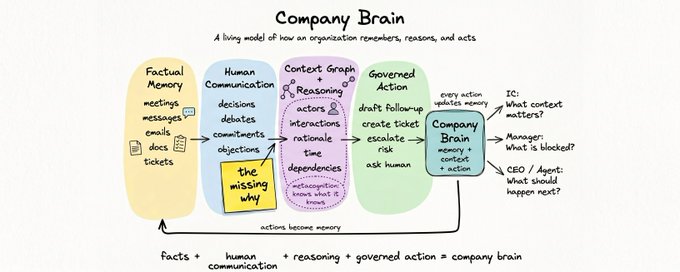
That sounds abstract, so let’s make it concrete. The first layer is factual memory: the record of what happened across meetings, messages, emails, documents, tickets, CRM notes, commits, incidents, dashboards, customer calls, and support conversations. It needs provenance, permissions, timestamps, and grounding. Most people start here because it looks like the obvious problem. The company has data everywhere, so the instinct is to connect tools, index documents, and let an agent search across everything. That is useful, but it is why many “company brain” attempts quietly become search products with better branding. Factual memory can tell you that a customer asked for SSO. It may tell you when, who was on the call, and where the transcript lives. But it may not tell you why SSO mattered, what alternatives were considered, who objected, or what tradeoff was made. A company doesn’t run on facts alone. It runs on interpreted facts.
The second layer is the context graph, or reasoning layer. This is where facts become a model of the company. A customer call connects to an opportunity. The opportunity connects to a product gap, the gap connects to an engineering tradeoff, the tradeoff connects to a roadmap decision, and the decision connects to strategy. Most systems store those as separate artifacts. A company brain needs to preserve their relationships. This is also where metacognition belongs: reasoning about reasoning. A company brain should know when evidence is weak, when context is stale, when teams have conflicting assumptions, when a commitment has no owner, and when an agent needs help.Companies forget in strange ways. They don’t just forget facts; they forget why a fact mattered, the argument that led to the decision, the counterfactuals, what was tried, and who had the dissenting view that later turned out to be right. That is why organizational memory has always been more than storage; it is memory brought to bear on decisions (Walsh and Ungson PDF).
The third layer is action coordination. A brain doesn’t only remember and think. It coordinates action. It decides when to move, wait, ask for help, escalate, and stop. The same should be true for a company brain: it should not only answer questions, but help the organization do the next right thing. That might mean drafting a follow-up because the last call created a commitment, creating a ticket because the same complaint appeared in support conversations, warning the CEO that three teams are making inconsistent assumptions, or telling an agent that one refund can be processed automatically while a pricing exception needs approval. This is different from normal automation. Automation executes a known workflow. A company brain coordinates action from context. This matters because companies are trying to build agents on fragmented data, while McKinsey argues that agentic AI needs stronger data foundations, lineage, access control, and governance to scale (McKinsey).
This is where the current agent conversation runs into the deeper company-brain problem. Giving agents access to tools is useful. Giving them access to indexed company data is useful. But neither one is enough if the organization has not preserved the reasoning behind the data. Agents don’t fail only because companies lack data. They fail because companies lack memory of why the data means what it means.
The missing substrate is human communication. Meetings, messages, and emails are where organizational reality is created. A roadmap comes out of debates, customer pressure, technical constraints, judgment, and tradeoffs. A CRM field doesn’t explain why a deal slipped; the call does. A ticket doesn’t explain why an issue matters; the escalation does.
This gets missed when people talk about agents as if the company were already legible. Most company knowledge is not sitting neatly in a document. It is created between people, in the moment, while they are deciding what matters. By the time it becomes a ticket or PRD, much of the “why” has been compressed away.
This is why meeting notes matter more than people think, but also why meeting notes alone are probably not enough as a category. When many of these companies were formed, transcription itself was still a meaningful product wedge. That is changing fast. I would not be surprised if, in an upcoming macOS release, a Granola-like transcription feature is simply available by default. When that happens, the question for meeting-note companies becomes much harder: if transcription and basic summaries are free, what is the durable product? Granola talks about back-to-back meetings as a documentation gap where context evaporates (Granola), Otter describes meetings as searchable insights and workflows (Otter.ai), and TechCrunch noted that meeting notetakers are already moving beyond transcription into workspace-wide search and connected apps (TechCrunch). That move makes sense because the prize is not transcription. The prize is turning human interactions into organizational memory.
That move makes sense because transcription is not the destination, and summaries are not the destination. The prize is turning human interactions into organizational memory without pretending that a transcript alone contains the judgment, uncertainty, disagreement, and counterfactuals behind the decision.
Enterprise search companies are moving from retrieval toward synthesis and agents. Glean describes its knowledge graph as a model of company content, people, and activity across more than 100 connectors (Glean). Workflow companies are moving toward agentic orchestration: Zapier Agents work across thousands of apps with triggers, actions, and approvals (Zapier), while ServiceNow describes its platform as uniting AI, data, workflows, and governance (ServiceNow). Dust is building agents that know your company and do work rather than just find things (Dust).
Everyone is moving toward the same center from a different wedge. Knowledge tools know what exists, meeting tools know what was said, workflow tools know how to act, and agent tools know how to attempt tasks. A company brain sits at the intersection, because the useful question is not just “what happened?” It is: why did it happen, what should happen next, who has the context, and what should the company remember?
That’s the hard part. The company brain sits at the nexus of four things:
Factual memory
+ human communication
+ context graph and reasoning
+ governed action
= company brain
If one of these is missing, you get something useful but incomplete. Facts without communication become a searchable archive. Communication without structure becomes transcripts and summaries. Reasoning without provenance becomes plausible guesses. Action without context becomes brittle automation. The company brain is the integration point.
There’s still an open question about how this gets built. One path is aggregation. The company brain connects to the tools a company already uses: email, calendar, Slack, docs, CRM, project management, support, code, and workflows. This is probably how large companies start, because their context is already scattered; McKinsey makes a similar distinction between incremental integration and more comprehensive agentic transformation (McKinsey).
The other path is vertical integration. A young company adopts memory, reasoning, and action as part of its operating system from the beginning. Meetings, decisions, commitments, and agent actions are captured in one substrate before knowledge fragments. I don’t know which architecture wins, but companies that start earlier will have an advantage.
One question I keep coming back to is: who is this for? It can’t only be for leadership. If the company brain is just an executive dashboard, it becomes surveillance with better UX. It can’t only be for individuals either. If it is just a personal assistant, it does not become organizational memory.
The answer, I think, is that a company brain serves the organization by serving each role at the right level of abstraction. For an individual contributor, it answers: what context do I need? Why was this decision made? What has been tried? Who owns the next step? What customer promise am I about to affect?
For a manager, it answers: what commitments are at risk, which decisions are blocked, which assumptions conflict, and which follow-ups never became work? For a CEO, it answers: where is the company drifting, what are customers saying, which decisions had weak evidence, and what does the company know that has not reached leadership? For agents, it answers: what can I safely do, what context must I use, and when should I ask a human?
This is why it is easier to grow a company brain than to retrofit one. In an old company, context is already fragmented. The decisions happened years ago. The people who knew the rationale have left. The documents contradict each other. The dashboards are clean, but memory is gone.
In a young company, the brain can form as the company forms. Every meeting, decision, customer signal, commitment, and agent action can become memory from the beginning. The company does not need to “implement AI” later. It can grow up with memory, reasoning, and action as primitives.
This is the direction I’m building toward with Sentra. Not a chatbot over company docs, not another dashboard, not just meeting notes, and not just agents. The opportunity is to build the memory substrate for the company: a system that captures facts, preserves human context, reconstructs reasoning, and coordinates action. I have written elsewhere about this as System 3 thinking: cognition above individual reasoning, at the level of groups and institutions. The companies that become truly AI-native will not be the ones that bolt agents onto scattered data. They will be the ones that remember why their work means what it means.
At Sentra, where we are building enterprise general intelligence: a shared intelligence/memory layer that sits on all communication channels, knowledge bases and agent traces to understand how everyone in an organization actually works as well as how work actually gets done, constructing a living world model of the entire company in near real time.
## 相关链接
- [Ashwin Gopinath](https://x.com/ashwingop)
- [@ashwingop](https://x.com/ashwingop)
- [33K](https://x.com/ashwingop/status/2049641901410955694/analytics)
- [Link](https://www.paulgraham.com/foundermode.html)
- [OLK5 review](https://warwick.ac.uk/fac/soc/wbs/conf/olkc/archive/olk5/papers/paper8.pdf)
- [PubMed](https://pubmed.ncbi.nlm.nih.gov/18020808/)
- [Y Combinator](https://www.ycombinator.com/rfs)
- [Walsh and Ungson PDF](https://skat.ihmc.us/rid=1255442505000_1811726224_21686/OrganizationalMemory-Walsh.pdf)
- [McKinsey](https://www.mckinsey.com/capabilities/mckinsey-technology/our-insights/building-the-foundations-for-agentic-ai-at-scale)
- [Granola](https://www.granola.ai/blog/meeting-notes-back-to-back-meetings-context)
- [Otter.ai](http://otter.ai/)
- [TechCrunch](https://techcrunch.com/2026/04/28/otters-new-feature-lets-users-search-across-their-enterprise-tools/)
- [Glean](https://www.glean.com/resources/guides/glean-knowledge-graph)
- [Zapier](https://zapier.com/blog/zapier-agents-guide/)
- [ServiceNow](https://www.servicenow.com/platform.html)
- [Dust](https://dust.tt/home/enterprise)
- [McKinsey](https://www.mckinsey.com/capabilities/mckinsey-technology/our-insights/rethinking-enterprise-architecture-for-the-agentic-era)
- [System 3 thinking](https://x.com/ashwingop/status/2009705958709309528)
- [level of groups and institutions](https://x.com/ashwingop/status/2018378072987512894)
- [Sentra](https://www.sentra.app/)
- [Upgrade to Premium](https://x.com/i/premium_sign_up)
- [8:08 AM · Apr 30, 2026](https://x.com/ashwingop/status/2049641901410955694)
- [33.1K Views](https://x.com/ashwingop/status/2049641901410955694/analytics)
- [View quotes](https://x.com/ashwingop/status/2049641901410955694/quotes)
---
*导出时间: 2026/5/1 10:31:35*
---
## 中文翻译
# 公司大脑:为什么大多数公司有数据却没记忆
**作者**: Ashwin Gopinath
**日期**: 2026-04-30T00:08:04.000Z
**来源**: [https://x.com/ashwingop/status/2049641901410955694](https://x.com/ashwingop/status/2049641901410955694)

任何组织最难应对的部分之一就是内部摩擦。对话会丢失上下文。会议会产生模棱两可的后续行动。人们带着对决策的不同理解离开。久而久之,群体不再共享现实。这首先不是一个代理问题,而是一个人类协调问题。即使每个人都聪明、目标一致且全力以赴,协调仍然很难。AI 使这个问题变得更加明显,因为它提高了工作的推进速度,而工作背后的共享上下文往往依然脆弱。对于创始人或 CEO 来说,这就是停留在“创始人模式”与通过“摘要”进行管理之间的区别。Paul Graham 将创始人模式描述为不同于将组织架构图中的“子树”视为黑盒;对我来说,它是与公司真相的接触:客户的痛点、产品的权衡、未解决的承诺,以及尚未转化为指标的微弱信号(链接)。
我在一年多前创立 Sentra 的原因之一,是我曾经历过不止几个大型机构的摩擦,并且自己也做过几次创始人。我曾尝试用几个不同的名字来称呼这个想法:企业智能、企业通用智能,以及 AI 幕僚长。名字一直在变,但问题没变:一个组织能否记住足够多的内容,从而进行连贯的推理和行动?在过去几天里,在 YC 呼吁构建“公司大脑”之后,人们一直给我发私信问:这不就是你在构建的东西吗?答案是肯定的。我们只是没有一开始就这样称呼它。在一个概念有了名字之前,很难精确地把握它,而有时简练的表达比准确的定义传播得更快。
在过去一年里,Sentra 并不是我唯一看着成长起来的事物。我的女儿 Satakashi 在 Sentra 成立一周后出生,看着她学习让我意识到这个问题是多么显而易见。她不是从一份战略文档开始的。没有模式、本体或路线图。她从碎片开始:面孔、声音、手势、伸手和被抱起。东西掉落,有人做出反应,世界就被存储了下来。起初,这只是记忆。然后记忆变成了模型。她开始预期、测试,并最终在不确定、犯错或感到惊讶时,对自己的推理进行推理。
公司也没什么不同。它们通过积累碎片而成长:会议、Slack 线程、电子邮件、客户通话、支持工单、路线图辩论、销售异议、投资者更新、代码审查和走廊里的闲聊。
问题在于,公司积累碎片的速度超过了将其转化为记忆的速度。组织记忆研究者将记忆定义为组织历史中存储的信息,这些信息能够影响当下的决策;而交互记忆研究则解释了为什么群体依赖“谁知道什么”,而不仅仅是写下来的东西(OLK5 review, PubMed)。公司之所以能运转,是因为 Sarah 记得客户为什么需要 SSO,Ravi 记得为什么入职被推迟,而创始人记得为什么一笔交易比那个仪表盘更重要。
这就是为什么 YC 的提法很重要。YC 将 AI 自动化的阻碍描述为分散在人们头脑、电子邮件、Slack 线程、工单和数据库中的领域知识。它做了一个有用的区分:这不是全公司范围的搜索或文档之上的聊天机器人,而是一张关于公司如何运作的活地图(Y Combinator)。我认为这基本正确,但这个短语需要一个更清晰的定义。公司大脑不是单一的事物,因为大脑本身也不是单一的。它能记忆、联想、预测、反思和协调行动。公司大脑需要同样的分层结构,所以我的定义很简单:公司大脑是一个组织如何记忆、推理和行动的活的、有权限控制的模型。
这听起来很抽象,让我们具体化。第一层是事实记忆:跨越会议、消息、电子邮件、文档、工单、CRM 备注、提交记录、事件、仪表盘、客户通话和支持对话的记录。它需要来源、权限、时间戳和 grounding(基础依据)。大多数人从这里开始,因为它看起来是显而易见的问题。公司的数据到处都是,所以直觉反应是连接工具、索引文档,并让代理搜索所有内容。这很有用,但也正是许多“公司大脑”尝试悄悄变成品牌更好看一点的搜索产品的原因。事实记忆可以告诉你客户要求了 SSO。它可能会告诉你时间、谁在通话中以及文字记录存放在哪里。但它可能不会告诉你为什么 SSO 很重要,考虑过哪些替代方案,谁反对了,或者做了什么权衡。公司的运行不仅仅靠事实。它靠的是经过解读的事实。
第二层是上下文图,或推理层。这是事实转化为公司模型的地方。客户通话连接到一个机会。这个机会连接到一个产品缺口,缺口连接到一个工程权衡,权衡连接到一个路线图决策,决策连接到战略。大多数系统将这些存储为独立的工件。公司大脑需要保留它们之间的关系。这也是元认知归属的地方:对推理的推理。公司大脑应该知道证据何时薄弱,上下文何时过时,团队何时有相互冲突的假设,承诺何时没有负责人,以及代理何时需要帮助。公司的遗忘方式很奇怪。它们不仅忘记事实;它们忘记为什么一个事实很重要,导致决策的论据,反事实情况,尝试过什么,以及谁持有后来被证明是正确的反对意见。这就是为什么组织记忆不仅仅是存储;它是应用于决策的记忆(Walsh and Ungson PDF)。
第三层是行动协调。大脑不仅记忆和思考。它协调行动。它决定何时移动、等待、寻求帮助、升级和停止。公司大脑也应该如此:它不仅应该回答问题,还应该帮助组织做下一件正确的事。这可能意味着起草后续跟进,因为上一次通话产生了承诺;创建一个工单,因为支持对话中出现了同样的投诉;警告 CEO 三个团队正在做出不一致的假设;或者告诉代理,某笔退款可以自动处理,而定价例外需要批准。这与正常的自动化不同。自动化执行已知的工作流。公司大脑基于上下文协调行动。这很重要,因为公司正试图在碎片化的数据上构建代理,而麦肯锡认为代理型 AI 需要更强的数据基础、血统、访问控制和治理才能扩展(McKinsey)。
这就是当前关于代理的讨论遇到更深层的“公司大脑”问题的地方。赋予代理访问工具的权限是有用的。赋予他们访问索引公司数据的权限是有用的。但是,如果组织没有保留数据背后的推理,这两者都不够。代理失败不仅仅是因为公司缺乏数据。他们失败是因为公司缺乏关于为什么数据意味着其当前含义的记忆。
缺失的底层是人类沟通。会议、消息和电子邮件是组织现实被创造的地方。路线图产生于辩论、客户压力、技术约束、判断和权衡。一个 CRM 字段不能解释为什么一笔交易拖延了;通话可以。一个工单不能解释为什么一个问题很重要;升级沟通可以。
当人们谈论代理,仿佛公司已经是清晰可读的时候,这一点就被忽略了。大多数公司知识并没有整齐地放在文档中。它是在人们决定什么很重要的时刻,在人与人之间创造的。当它变成工单或 PRD 时,许多“为什么”已经被压缩掉了。
这就是为什么会议笔记比人们认为的更重要,但也为什么仅靠会议笔记作为一个类别可能是不够的。当许多这类公司成立时,转录本身仍然是一个有意义的产品切入点。这正在迅速改变。如果即将到来的 macOS 版本中,一个类似 Granola 的转录功能默认可用,我不会感到惊讶。当这种情况发生时,会议笔记公司面临的问题将变得困难得多:如果转录和基本摘要都是免费的,持久的产品是什么?Granola 谈到了背靠背会议是一个上下文蒸发的文档空白(Granola),Otter 将会议描述为可搜索的见解和工作流,而 TechCrunch 指出会议记录工具已经超越了转录,转向工作区范围的搜索和连接的应用程序。这种举动是有道理的,因为奖赏不是转录。奖赏是将人类互动转化为组织记忆。
这种举动是有道理的,因为转录不是终点,摘要也不是终点。奖赏是将人类互动转化为组织记忆,而不是假装仅仅一份记录就包含了决策背后的判断、不确定性、分歧和反事实情况。
企业搜索公司正从检索向合成和代理发展。Glean 将其知识图谱描述为跨 100 多个连接器的公司内容、人员和活动的模型(Glean)。工作流公司正朝着代理编排发展:Zapier Agents 在数千个应用程序中工作,具有触发器、操作和批准,而 ServiceNow 将其平台描述为统一 AI、数据、工作流和治理。Dust 正在构建了解你的公司并做工作的代理,而不仅仅是查找东西。
每个人都在从不同的切入点向同一个中心移动。知识工具知道存在什么,会议工具知道说了什么,工作流工具知道如何行动,代理工具知道如何尝试任务。公司大脑处于交叉点,因为有用的问题不仅仅是“发生了什么?”而是:为什么发生,接下来应该发生什么,谁拥有上下文,公司应该记住什么?
这才是困难的部分。公司大脑处于四件事物的枢纽:
事实记忆
+ 人类沟通
+ 上下文图和推理
+ 受管制的行动
= 公司大脑
如果缺少其中之一,你会得到有用但不完整的东西。没有沟通的事实变成可搜索的存档。没有结构的沟通变成记录和摘要。没有来源的推理变成合理的猜测。没有上下文的行动变成脆弱的自动化。公司大脑是集成点。
关于如何构建它,仍然是一个悬而未决的问题。一条路径是聚合。公司大脑连接到公司已经使用的工具:电子邮件、日历、Slack、文档、CRM、项目管理、支持、代码和工作流。这可能是大公司的起步方式,因为它们的上下文已经分散;麦肯锡对增量集成和更全面的代理转型做了类似的区分。
另一条路径是垂直集成。一家年轻的公司从一开始就将记忆、推理和行动作为其操作系统的一部分采用。会议、决策、承诺和代理行动在知识碎片化之前被捕获在一个底座中。我不知道哪种架构会胜出,但较早开始的公司将拥有优势。
我一直在思考的一个问题是:这是为谁服务的?它不能仅仅为领导层服务。如果公司大脑只是一个执行仪表盘,它就会变成 UX 更好的监控工具。它也不能仅仅为个人服务。如果它只是一个个人助理,它就不会成为组织记忆。
我认为,答案是公司大脑通过在适当的抽象层面为每个角色服务,从而服务整个组织。对于个人贡献者,它回答:我需要什么上下文?为什么做出这个决定?尝试过什么?谁负责下一步?我即将影响什么客户承诺?
对于经理,它回答:哪些承诺面临风险,哪些决策被阻止,哪些假设相互冲突,哪些后续跟进从未转化为工作?对于 CEO,它回答:公司正在向何处漂移,客户在说什么,哪些决策证据薄弱,公司知道哪些尚未传达给领导层的信息?对于代理,它回答:我可以安全地做什么,我必须使用什么上下文,我什么时候应该询问人类?
这就是为什么培养一个公司大脑比事后改造一个要容易。在一家老公司中,上下文已经碎片化。决策发生在几年前。知道理由的人已经离开。文件相互矛盾。仪表盘很干净,但记忆消失了。
在一家年轻的公司中,大脑可以随着公司的形成而形成。每一个会议、决策、客户信号、承诺和代理行动从一开始就可以成为记忆。公司不需要稍后“实施 AI”。它可以伴随着记忆、推理和行动作为原语一起成长。
这就是我在 Sentra 正在构建的方向。不是公司文档之上的聊天机器人,不是另一个仪表盘,不仅仅是会议笔记,也不仅仅是代理。机会在于为公司的记忆底座:一个捕获事实、保留人类上下文、重构推理并协调行动的系统。我在其他地方将其写为系统 3 思维:群体和机构层面的、高于个人推理的认知。真正成为 AI 原生的公司,不会是那些将代理生硬地拼接到碎片化数据上的公司。它们将是那些记住为什么其工作意味着其当前含义的公司。
在 Sentra,我们正在构建企业通用智能:一个位于所有沟通渠道、知识库和代理跟踪之上的共享智能/记忆层,以了解组织中的每个人实际上是如何工作的,以及工作实际上是如何完成的,从而在近乎实时的情况下构建整个公司的活的世界模型。
## 相关链接
- [Ashwin Gopinath](https://x.com/ashwingop)
- [@ashwingop](https://x.com/ashwingop)
- [33K](https://x.com/ashwingop/status/2049641901410955694/analytics)
- [Link](https://www.paulgraham.com/foundermode.html)
- [OLK5 review](https://warwick.ac.uk/fac/soc/wbs/conf/olkc/archive/olk5/papers/paper8.pdf)
- [PubMed](https://pubmed.ncbi.nlm.nih.gov/18020808/)
- [Y Combinator](https://www.ycombinator.com/rfs)
- [Walsh and Ungson PDF](https://skat.ihmc.us/rid=1255442505000_1811726224_21686/OrganizationalMemory-Walsh.pdf)
- [McKinsey](https://www.mckinsey.com/capabilities/mckinsey-technology/our-insights/building-the-foundations-for-agentic-ai-at-scale)
- [Granola](https://www.granola.ai/blog/meeting-notes-back-to-back-meetings-context)
- [Otter.ai](http://otter.ai/)
- [TechCrunch](https://techcrunch.com/2026/04/28/otters-new-feature-lets-users-search-across-their-enterprise-tools/)
- [Glean](https://www.glean.com/resources/guides/glean-knowledge-graph)
- [Zapier](https://zapier.com/blog/zapier-agents-guide/)
- [ServiceNow](https://www.servicenow.com/platform.html)
- [Dust](https://dust.tt/home/enterprise)
- [McKinsey](https://www.mckinsey.com/capabilities/mckinsey-technology/our-insights/rethinking-enterprise-architecture-for-the-agentic-era)
- [System 3 thinking](https://x.com/ashwingop/status/2009705958709309528)
- [level of groups and institutions](https://x.com/ashwingop/status/2018378072987512894)
- [Sentra](https://www.sentra.app/)
- [Upgrade to Premium](https://x.com/i/premium_sign_up)
- [8:08 AM · Apr 30, 2026](https://x.com/ashwingop/status/2049641901410955694)
- [33.1K Views](https://x.com/ashwingop/status/2049641901410955694/analytics)
- [View quotes](https://x.com/)