# AI Agents Have No Memory for Failure. So We Gave Them One.
**作者**: Nicholas
**日期**: 2026-04-14T16:21:08.000Z
**来源**: [https://x.com/dapanji_eth/status/2044088577773154722](https://x.com/dapanji_eth/status/2044088577773154722)
---

88% of AI agents never make it to production. Not because they're not smart enough, but because they keep breaking in the same ways, and never learn from it.
@ycombinator 's latest batch has more agent-first companies than any prior cohort. @a16z just published their "agents are the new apps" thesis. Everyone is building agents. Almost nobody is building the infrastructure to keep them running.
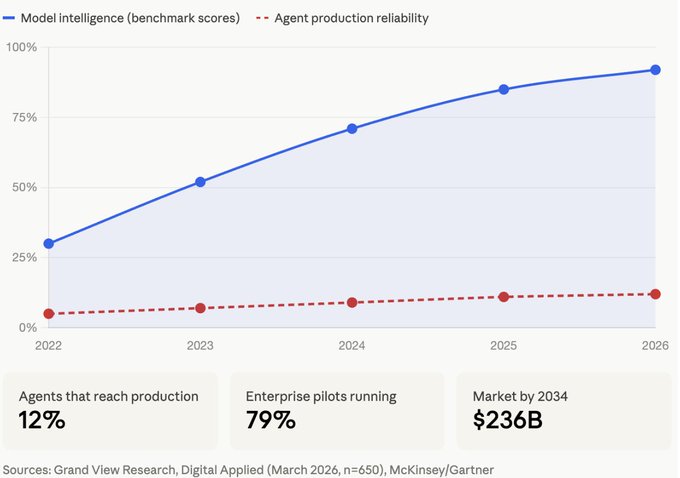
Models get smarter every year. Agent reliability barely moves
An agent that works in a demo breaks in production. An error that was fixed on Tuesday is rediscovered from scratch on Wednesday. Every agent, everywhere, is solving the same problems alone, no memory, no shared knowledge, no immune system.
The model got smarter. Your agent's memory still resets every time it runs.
We've been building agents with superhuman intelligence but goldfish memory. Today we're open sourcing the fix.
## Helix
Today, most teams handle agent failures in one of three ways:
Blind retry — works 30% of the time, wastes resources the other 70%
LLM diagnosis — works but slow (2+ seconds) and expensive at scale
Manual error handling — works but doesn't scale, breaks on new errors
Helix is the fourth option. It's a self-healing runtime that wraps any async function — API calls, x402 payments, tool use, database queries — and adds a 6-stage repair pipeline:
Error → Perceive → Construct → Evaluate → Commit → Verify → Gene Map
Perceive: What broke? Classify the error by type, platform, and context.
Construct: Generate candidate fixes — retry with backoff, refresh the token, adjust parameters, split the request.
Evaluate: Score each candidate by likelihood of success, cost, and safety.
Commit: Execute the highest-scoring fix.
Verify: Did it work? Feed the outcome back.
Gene Map: Store the fix in a local knowledge base, scored by reinforcement learning.
The Gene Map is the key idea. Every fix gets stored with a Q-value — a score that updates based on real outcomes. Strategies that work get promoted. Strategies that fail get demoted. The knowledge base gets smarter with every failure.
The first time your agent hits a new error: 2,140ms to diagnose and repair, 1 LLM call.
The second time: 1.1ms. Zero LLM calls. Zero cost. The Gene Map already knows.
That's not a retry. That's an immune system.
Example: x402 payment agent on Base hits a Uniswap swap revert. The EVM returns a bare "execution reverted" — no error message, no context. We tested 5 frontier LLMs including GPT-5.4 on this exact error: none could classify it correctly. Helix pattern-matches it to slippage_too_tight in under 50ms, lowers amountOutMinimum, resubmits. GPT-5.4 failed all 3. Helix succeeded all 3. Full study with 1,100+ on-chain transactions dropping soon.
## Three lines to use Helix
import { wrap } from '@helix-agent/core';
const safe = wrap(myFunction, { mode: 'auto' });
await safe(args);
Wrap any async function. Three modes: observe (monitor only), auto (fix and retry), full (restructure execution).
## The numbers
We ran Helix against 50 agentic payment error scenarios across four platforms (x402 by @coinbase , @tempo , @monad , and @privy_io ):
- Nonce: 6 · Gas/fee: 6 · Auth/session: 5 · Network: 8 · AA/paymaster: 5 · Novel: 10 · Repeat: 5 · Success: 5
Without Helix (naive retry): - 54 LLM calls for diagnosis - $0.49 inference cost - $3.65 wasted on failed executions - 2,140ms average time to repair
With Helix (Gene Map warm): - 0 LLM calls - $0.00 inference cost - $2.26 total cost - 1.1ms average time to repair
2,000× faster. 100% cost reduction on diagnosis. The agent isn’t retrying, it’s recalling a proven fix from memory.
Costs modeled on Sonnet API pricing and network transaction fees. Full eval harness can be reproduced in 5 minutes.
## Won’t models just get better?
Even a brilliant doctor still has an immune system, not because the immune system is smarter, but because going to the doctor for every cold is slow, expensive, and doesn't scale. Helix handles routine failures in 1ms so the model only gets called when it's actually needed.
## What’s next
The current release is a local runtime — the Gene Map lives on your machine. But the vision is bigger.
Imagine a shared Gene Map where every agent’s failure makes every other agent more resilient. Your agent hits an error that 10,000 other agents have already solved. Instead of diagnosing from scratch, it pulls a verified fix in 1ms.
That’s the network effect we’re building toward: a collective immune system for the agent economy. Every failure, everywhere, makes the entire network stronger. With protocols like x402 enabling agents to pay for tools, data, and compute at request time, the Gene Map learns more than technical fixes — it learns when spending $0.02 on a paid fallback provider beats 5 free retries. Self-healing meets economic autonomy.
## Try it
npm install @helix-agent/core
Also available on PyPI (pip install helix-agent-sdk) and Docker.
GitHub: https://github.com/adrianhihi/helix
Built by Nicholas (@dapanji_eth) and Adrian (@HaimoBai).
If you’re building AI agents and tired of debugging the same failures, try wrapping one function. That’s all it takes.
const safe = wrap(yourFunction, { mode: 'auto' });
Fix once, immune forever.
Sources: Digital Applied / McKinsey / Gartner (88% failure rate); Deloitte 2026 State of AI in Enterprise.
## 相关链接
- [Nicholas](https://x.com/dapanji_eth)
- [@dapanji_eth](https://x.com/dapanji_eth)
- [165K](https://x.com/dapanji_eth/status/2044088577773154722/analytics)
- [@ycombinator](https://x.com/@ycombinator)
- [@a16z](https://x.com/@a16z)
- [@helix](https://x.com/@helix)
- [@coinbase](https://x.com/@coinbase)
- [@tempo](https://x.com/@tempo)
- [@monad](https://x.com/@monad)
- [@privy_io](https://x.com/@privy_io)
- [Full eval harness](https://github.com/adrianhihi/helix/tree/main/experiments)
- [@helix](https://x.com/@helix)
- [https://github.com/adrianhihi/helix](https://github.com/adrianhihi/helix)
- [@dapanji_eth](https://x.com/@dapanji_eth)
- [@HaimoBai](https://x.com/@HaimoBai)
- [Upgrade to Premium](https://x.com/i/premium_sign_up)
- [12:21 AM · Apr 15, 2026](https://x.com/dapanji_eth/status/2044088577773154722)
- [165.5K Views](https://x.com/dapanji_eth/status/2044088577773154722/analytics)
- [View quotes](https://x.com/dapanji_eth/status/2044088577773154722/quotes)
---
*导出时间: 2026/4/15 19:30:50*
---
## 中文翻译
# AI 智能体没有失败记忆。所以我们给了它们一个。
**作者**: Nicholas
**日期**: 2026-04-14T16:21:08.000Z
**来源**: [https://x.com/dapanji_eth/status/2044088577773154722](https://x.com/dapanji_eth/status/2044088577773154722)
---

88% 的 AI 智能体从未进入生产环境。不是因为它们不够聪明,而是因为它们总以相同的方式出错,且从不从中学习。
@ycombinator 最新一批的 agent-first 公司数量超过以往任何一批。@a16z 刚刚发布了他们的“智能体是新的应用”论点。人人都在构建智能体,却几乎没人在构建让它们持续运行的基础设施。

模型一年比一年聪明,智能体的可靠性却几乎原地踏步
在演示中运行正常的智能体,一到生产环境就崩溃。周二修复的错误,周三又被从零开始重新发现。每一个智能体,无论在哪里,都在独自解决同样的问题——没有记忆,没有共享知识,没有免疫系统。
模型更聪明了,但你智能体的记忆在每次运行时仍然会清零。
我们一直在构建拥有超人智能却只有金鱼记忆的智能体。今天,我们开源了修复方案。
## Helix
如今,大多数团队用以下三种方式之一处理智能体失败:
盲目重试——30% 的情况下有效,另外 70% 在浪费资源
LLM 诊断——有效但慢(2 秒以上),且大规模使用成本高
手动错误处理——有效但无法扩展,遇到新错误就失效
Helix 是第四种选择。它是一个自愈运行时,可封装任意异步函数——API 调用、x402 支付、工具使用、数据库查询——并添加一条 6 阶段修复流水线:
错误 → 感知 → 构建 → 评估 → 提交 → 验证 → 基因图谱(Gene Map)
感知:什么坏了?按类型、平台和上下文对错误进行分类。
构建:生成候选修复方案——带退避的重试、刷新令牌、调整参数、拆分请求。
评估:按成功可能性、成本和安全性对每个候选方案打分。
提交:执行得分最高的修复方案。
验证:有效吗?将结果反馈回去。
基因图谱:将修复方案存入本地知识库,并通过强化学习进行评分。
基因图谱是核心思想。每个修复方案都会附带一个 Q 值存储——这个分数会根据真实结果不断更新。有效的策略会被提升,失败的策略会被降级。知识库随着每一次失败变得更聪明。
你的智能体第一次遇到新错误时:2,140 毫秒完成诊断和修复,1 次 LLM 调用。
第二次:1.1 毫秒。零 LLM 调用。零成本。基因图谱已经知道了。
那不是重试,那是免疫系统。
举个例子:Base 上的 x402 支付智能体遇到 Uniswap 兑换回滚。EVM 只返回一个干巴巴的 "execution reverted"——没有错误信息,没有上下文。我们用这个确切的错误测试了 5 个前沿 LLM,包括 GPT-5.4:没有一个能正确分类。Helix 在 50 毫秒内将其模式匹配为 slippage_too_tight(滑点过紧),降低 amountOutMinimum 后重新提交。GPT-5.4 三次全失败。Helix 三次全成功。包含 1,100 多笔链上交易的完整研究即将发布。
## 三行代码使用 Helix
import { wrap } from '@helix-agent/core';
const safe = wrap(myFunction, { mode: 'auto' });
await safe(args);
封装任意异步函数。三种模式:observe(仅监控)、auto(修复并重试)、full(重构执行)。
## 数据
我们在四个平台(@coinbase 的 x402、@tempo、@monad 和 @privy_io)上针对 50 个智能体支付错误场景运行了 Helix:
- Nonce:6 · Gas/手续费:6 · 认证/会话:5 · 网络:8 · AA/paymaster:5 · 新型错误:10 · 重复错误:5 · 成功案例:5
不使用 Helix(盲目重试):- 诊断需要 54 次 LLM 调用 - 推理成本 0.49 美元 - 失败执行浪费 3.65 美元 - 平均修复时间 2,140 毫秒
使用 Helix(基因图谱已预热):- 0 次 LLM 调用 - 推理成本 0.00 美元 - 总成本 2.26 美元 - 平均修复时间 1.1 毫秒
快 2,000 倍。诊断成本降低 100%。智能体不是在重试,而是在从记忆中调用一个已被验证有效的修复方案。
成本基于 Sonnet API 定价和网络交易费建模。完整的评估工具可在 5 分钟内复现。
## 模型不会自己变得更好吗?
再优秀的医生也有免疫系统——不是因为免疫系统比医生更聪明,而是因为每次感冒都去看医生又慢又贵,也无法扩展。Helix 在 1 毫秒内处理常规故障,这样模型只在真正需要时才被调用。
## 接下来是什么
当前版本是一个本地运行时——基因图谱存储在你的机器上。但我们的愿景更大。
想象一个共享的基因图谱,每个智能体的失败都能让所有其他智能体变得更有韧性。你的智能体遇到了一个错误,而其他 10,000 个智能体早已解决过它。它不需要从零开始诊断,而是在 1 毫秒内拉取一个经过验证的修复方案。
这就是我们正在构建的网络效应:智能体经济的集体免疫系统。任何地方的每一次失败,都会让整个网络更强大。随着 x402 等协议让智能体能够在请求时为工具、数据和算力付费,基因图谱学到的将不只是技术修复——它还会学到什么时候花 0.02 美元使用付费的备用服务,胜过 5 次免费重试。自愈机制与经济自主性的结合。
## 试试看
npm install @helix-agent/core
也可在 PyPI(pip install helix-agent-sdk)和 Docker 上获取。
GitHub:https://github.com/adrianhihi/helix
由 Nicholas(@dapanji_eth)和 Adrian(@HaimoBai)构建。
如果你正在构建 AI 智能体,并且厌倦了调试同样的失败,试着封装一个函数。就这么简单。
const safe = wrap(yourFunction, { mode: 'auto' });
修复一次,永久免疫。
数据来源:Digital Applied / McKinsey / Gartner(88% 失败率);德勤 2026 企业 AI 现状报告。
## 相关链接
- [Nicholas](https://x.com/dapanji_eth)
- [@dapanji_eth](https://x.com/dapanji_eth)
- [16.5万](https://x.com/dapanji_eth/status/2044088577773154722/analytics)
- [@ycombinator](https://x.com/@ycombinator)
- [@a16z](https://x.com/@a16z)
- [@helix](https://x.com/@helix)
- [@coinbase](https://x.com/@coinbase)
- [@tempo](https://x.com/@tempo)
- [@monad](https://x.com/@monad)
- [@privy_io](https://x.com/@privy_io)
- [完整评估框架](https://github.com/adrianhihi/helix/tree/main/experiments)
- [@helix](https://x.com/@helix)
- [https://github.com/adrianhihi/helix](https://github.com/adrianhihi/helix)
- [@dapanji_eth](https://x.com/@dapanji_eth)
- [@HaimoBai](https://x.com/@HaimoBai)
- [升级到高级版](https://x.com/i/premium_sign_up)
- [2026年4月15日 上午12:21](https://x.com/dapanji_eth/status/2044088577773154722)
- [16.55万次浏览](https://x.com/dapanji_eth/status/2044088577773154722/analytics)
- [查看引用](https://x.com/dapanji_eth/status/2044088577773154722/quotes)
---
*导出时间: 2026/4/15 19:30:50*