It's Time to Deploy Robots. The Technology Isn't Finished. Paige 2026-09-12 13.6 KB 12.5K 94 ☆ 收藏 𝕏 文章列表 作者基于两年与机器人OEM合作部署的经验,讨论人形机器人从演示走向真实商业部署的差距。作者指出,演示视频只能证明可能性,而真实部署需要可靠性、速度和成本达标;许多场景下四足机器人或成熟专用方案比人形机器人更实际。文章区分了模块化技术栈与VLA通用模型、POC验证与商业交付,并以Skild AI突破1亿美元ARR为例,强调部署应纳入研究反馈循环,通过真实环境的评估数据推动通用机器人模型迭代,最终实现规模化。 机器人人形机器人具身智能部署POC商业交付VLASkild AI波士顿动力自动化 71 值得读 ▶ 作者结合一线部署经验,清晰区分demo、POC与商业交付,观点务实有洞察,引用Skild AI、Sergey Levine等最新案例,时效性强,但缺乏具体可操作的方法细节。 # It’s Time to Deploy Robots. The Technology Isn’t Finished. **作者**: Paige **日期**: 2026-09-10T05:00:01.000Z **来源**: [https://x.com/paigeinsf/status/2098274765400338835](https://x.com/paigeinsf/status/2098274765400338835) --- 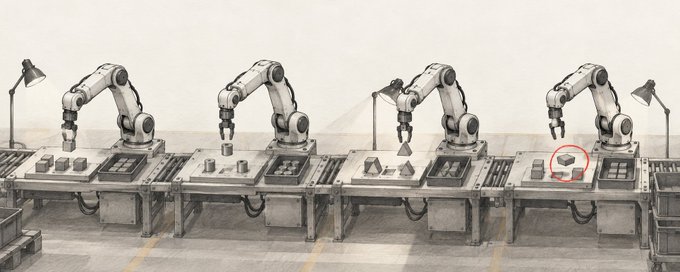 For the past two years, I've been working with numerous robotics OEMs on getting their hardware out there with US-based software solution. While doing deployments, I kept having the same conversation with customers. A customer had seen a humanoid demo online. "Could we bring one into the factory for inspection and patrol? Perhaps it could handle a few “easy” tasks like sorting along the way?" I would show them a robot dog instead. 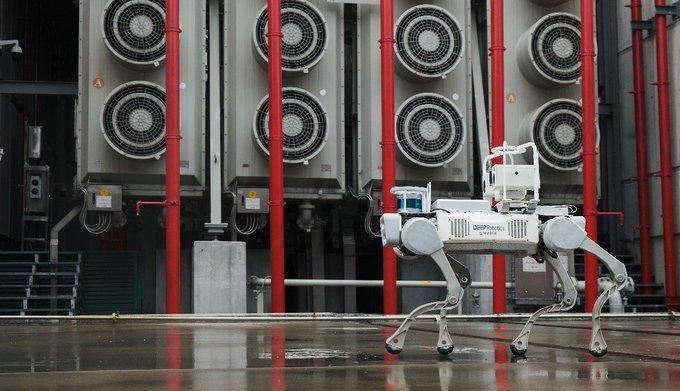 For the inspection work we were discussing, a quadruped with autonomous navigation and the right vision system offered a more ready and reliable solution. The humanoid in the video looked more capable. But in reality it's still far from meeting the customer's needs and doing job reliably at a justifiable cost. [@SkildAI](https://x.com/@SkildAI) recently reported crossing $100 million in ARR, ten months after its first commercial deployment. [@deepakpathak](https://x.com/@deepakpathak) and Abhinav Gupta argue that deployment belongs inside the research process. Installation, integration, maintenance, and changing customer requirements help determine what the model needs to learn. [Revenue announcement coverage](https://ng.investing.com/news/stock-market-news/skild-ai-hits-revenue-milestone-on-growing-customer-base--bloomberg-93CH-2691964) I think this is really promising news for the whole industry: the first signs that humanoid robots are finding real use cases. The question worth making explicit though is how we judge progress along that path. Getting into the real world is necessary. Understanding what worked, what made it work, and what carries over is how we get closer to scale. ## A demo is evidence of possibility Before we compare a viral demo with a real deployment, we need to understand what’s making the robot work: its hardware, control systems, task-specific models, or a more general robot policy. These can look almost identical on video, but tell us very different things about progress in robot learning. In his recent interview with Ryan Peterman, [@svlevine](https://x.com/@svlevine) distinguished the extraordinary hardware and control of classic Boston Dynamics robots from the challenge of responding intelligently to the surrounding world. Balancing and executing a movement are different problems from handling an unfamiliar object in an unfamiliar situation. [Interview](https://www.developing.dev/p/sergey-levine-current-state-of-humanoid) The World Humanoid Robot Games in Beijing, often called the “robot Olympics,” make that distinction visible. China has built a formidable hardware, manufacturing, and supply chain ecosystem. That achievement is real. It does not, by itself, tell us how well a robot will generalize in a new customer environment. [World Humanoid Robot Games](https://english.beijing.gov.cn/latest/news/202508/t20250811_4170955.html) > **Reuters@Reuters**: [原文链接](https://x.com/Reuters/status/2097912957657055438) > > China's Tiangong Ultra made headlines in August after smashing multiple records at the World Humanoid Robot Games in Beijing. Reuters gets behind-the-scenes access to the Beijing Humanoid Robot Innovation Center. Eduardo Baptista has more https://reut.rs/4gUmlNn > > 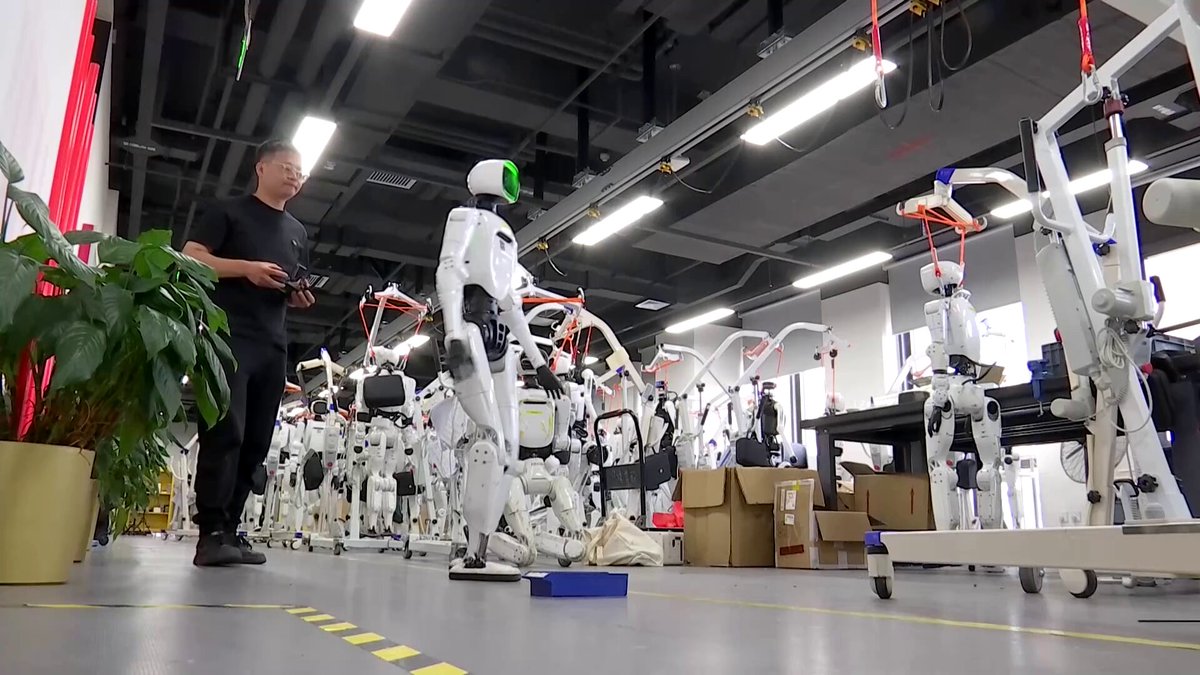 The word “deployment” also leaves open what is actually running. A modular stack with separate perception models, SLAM, and planners can look much like a vision language action (VLA) model mapping observations and instructions to actions. The demo video shows the behavior. It rarely tells us how much engineering specific to the task sits around the model. Either approach can deliver useful work. But a working system and a model that generalizes are different claims, and we need enough detail to judge each one. Change the lighting. Move the object. Substitute a slightly different component. Then report all the attempts, the failures, and the human rescues. Videos travel easily. Those evaluation metrics tell us much more about whether the progress will travel too. > **York Yang@YorkYang5050**: [原文链接](https://x.com/YorkYang5050/status/2098148654276296843) > > First of all, ARR means Annual Recurring Revenue. Piloting and R&D fees don't count. > Secondly, deployment can only be done with clear infrastructure support. > Thirdly, what can really be deployed is very visible if you've ever done any serious deployment. The video can easily ## Getting into a factory is not the finish line Factories have been paying for useful robotic automation for decades. Established vision, navigation, and control can solve many operational problems without a general purpose model. > **Li Zexin 李泽欣@XH_Lee23**: [原文链接](https://x.com/XH_Lee23/status/2095806928018653469) > > A Chinese tech company has integrated humanoid robots with industrial robot arms. The company is from China's tech hub Shenzhen. > > 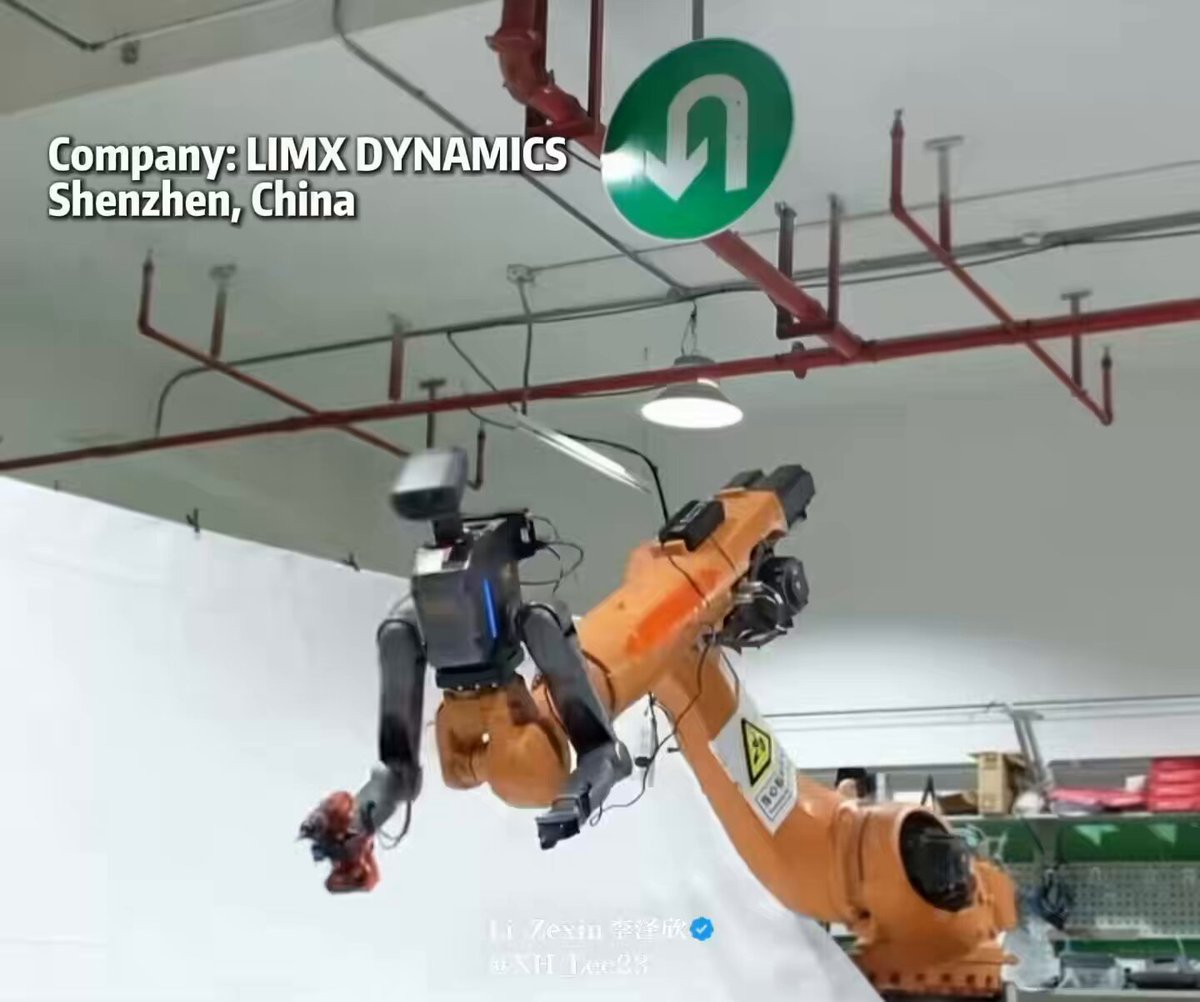 Then why do we need one? My answer is that a stronger general purpose model should expand the range of tasks robots can handle while reducing the work needed to adapt them. The promise is that experience from one application helps with the next, instead of every new workflow requiring another substantial engineering effort. But broader capability does not automatically translate into better performance on a particular job. A general purpose model still has to meet the reliability, speed, and cost requirements that a specialized solution is designed around. The hardware, integration, and ongoing support matter too. As Skild emphasizes, speed matters alongside accuracy: a robot that holds up the line can undermine the economics even when it completes the task. This is why I would distinguish a deployment POC from commercial delivery. - A POC tests whether a system can work in a particular customer workflow and identifies what needs improving. - Commercial delivery commits to doing that work at an agreed quality, pace, and cost. The useful unit is a defined workflow at a site, including how much human support it requires. A robot installed or a number of hours logged tells us much less. There are increasing number of customers for the POC stage too. Teams in the automotive industry I have spoken with were interested in testing new robot models in their own environments and gradually building the capability to adopt them. A model comparison or a clearer understanding of what it would take to automate a workflow can be useful before the system is ready for production. Both stages create value. A POC helps the customer decide what to build toward. Commercial delivery has to make that investment pay off. This feedback loop was also clearly explained by [@oyhsu](https://x.com/@oyhsu) > **Oliver Hsu@oyhsu**: [原文链接](https://x.com/oyhsu/status/2044421868015534332) > > For decades, value in robotics accrued to the mechanical system itself, and while that remains a key part of the stack, as learned policies become more standard, value migrates to models, training infrastructure, and data flywheels. But robotics also feeds back into the primitives previously discussed: every real-world trajectory is training data for better world models, every deployment failure reveals gaps in simulation coverage, and every new embodiment tested expands the diversity of physical experience available for pretraining. Robotics is both the most demanding consumer of the primitives and one of their most important sources of improvement signal. ## Deployment eval is the bridge This is the comparison I still cannot make: how much progress are Physical Intelligence, Skild, Figure, and 1X making relative to one another? I have not found a shared public benchmark with comparable results from all four. Their videos and individual evaluations do not give us that common reference point. There are useful research benchmarks, including LIBERO and BEHAVIOR, and companies publish results of their own. The missing piece is comparable coverage across these systems, with clear task conditions, hardware, adaptation budgets, and rules for human assistance. A single headline score would not resolve all of that. 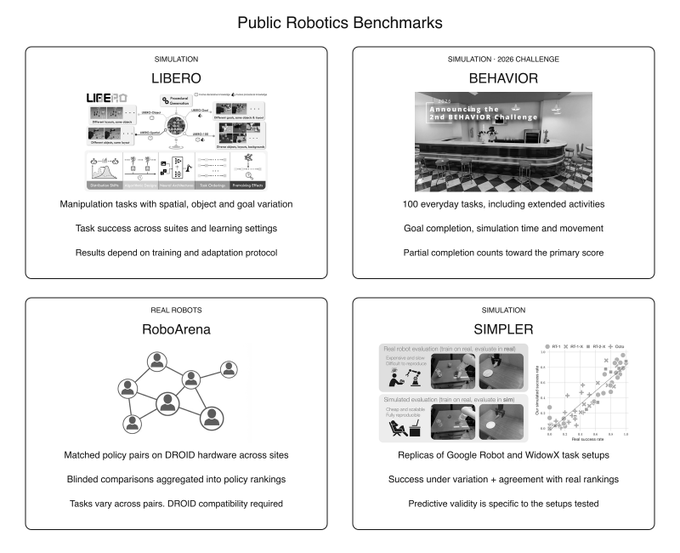 Robotics needs a new evaluation paradigm. I call it Deployment Evaluation: judging models not only by benchmarks or demos, but by how they hold up in the field. Model evaluation asks what the policy can do: task success, completion time, and performance when objects, layouts, or lighting change. To assess generalization, we also need to know how the test differs from training. To compare models, we need to know what the rest of the system contributed. Deployment evaluation asks what it takes to keep the whole system useful: acceptable outputs per hour, intervention frequency and duration, recovery time, and the cost of adapting it to the site. These are the numbers that connect capability to ROI. 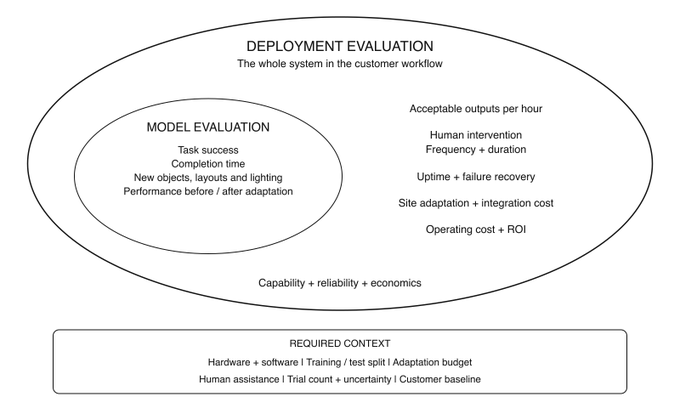 A faster policy is a research result. It becomes valuable to the factory when it delivers enough reliable throughput with manageable support. Independent evaluation can help make those comparisons credible. Report the number of trials and the uncertainty around the result, alongside the operating conditions. A success rate without that context can be almost as hard to interpret as a video. Fewer interventions in the original factory could come from a local fix. Stronger evidence comes from better performance at a new site with the same adaptation budget, or the same performance with less data and tuning. ## Now is the best time to deploy and the worst time to assume the technology is finished I agree with Skild's argument for making deployment part of research: we can't wait for a finished model to start learning how to make it useful. The choice is not whether to deploy robots or keep doing research, but how to weave deployment evaluation into research meaningfully. Deployment exposes the problems research needs to solve. Research, in turn, helps each deployment find the model that fits its scenario faster and pushes generalization closer. The flywheel only spins if FDEs go in before the models are ready, with human in the loop built in from the top down. [@physical_int](https://x.com/@physical_int) has also been championing the integrator ecosystem, backing application-layer companies that carry its state-of-the-art models into real environments. Every deployment is a new testbed. > **Physical Intelligence@physical_int**: [原文链接](https://x.com/physical_int/status/2026447989959762079) > > General-purpose AI models are behind some of the most exciting applications we now can't live without. We envision that an analogous “physical intelligence layer” built with models like π0.6 will similarly spur a new wave of applications for the physical world. > We’ve recently Comparable evaluations and an honest record of failures show where the system falls short, and training turns some of those failures into capabilities the model didn't have before. Start early, learn fast, and over time customers will ask less about what the robot might someday do and depend more on the work it already gets done. If you are working in real world evaluation or want to have your policy tested in real factory environment, please dm me. Thanks to [@hunterharloff](https://x.com/@hunterharloff) [@caseykcaruso](https://x.com/@caseykcaruso) for the feedback, and to the many integrators and labs who shared their insights ## 相关链接 - [Paige](https://x.com/paigeinsf) - [@paigeinsf](https://x.com/paigeinsf) - [6.8K](https://x.com/paigeinsf/status/2098274765400338835/analytics) - [@SkildAI](https://x.com/@SkildAI) - [@deepakpathak](https://x.com/@deepakpathak) - [Revenue announcement coverage](https://ng.investing.com/news/stock-market-news/skild-ai-hits-revenue-milestone-on-growing-customer-base--bloomberg-93CH-2691964) - [@svlevine](https://x.com/@svlevine) - [Interview](https://www.developing.dev/p/sergey-levine-current-state-of-humanoid) - [World Humanoid Robot Games](https://english.beijing.gov.cn/latest/news/202508/t20250811_4170955.html) - [Sep 10](https://x.com/Reuters/status/2097912957657055438) - [75K](https://x.com/Reuters/status/2097912957657055438/analytics) - [Sep 11](https://x.com/YorkYang5050/status/2098148654276296843) - [10K](https://x.com/YorkYang5050/status/2098148654276296843/analytics) - [Sep 4](https://x.com/XH_Lee23/status/2095806928018653469) - [211K](https://x.com/XH_Lee23/status/2095806928018653469/analytics) - [@oyhsu](https://x.com/@oyhsu) - [Apr 15](https://x.com/oyhsu/status/2044421868015534332) - [118K](https://x.com/oyhsu/status/2044421868015534332/analytics) - [@physical_int](https://x.com/@physical_int) - [Feb 25](https://x.com/physical_int/status/2026447989959762079) - [190K](https://x.com/physical_int/status/2026447989959762079/analytics) - [@hunterharloff](https://x.com/@hunterharloff) - [@caseykcaruso](https://x.com/@caseykcaruso) - [Upgrade to Premium](https://x.com/i/premium_sign_up) - [12:57 PM · Sep 11, 2026](https://x.com/paigeinsf/status/2098274765400338835) - [6,884 Views](https://x.com/paigeinsf/status/2098274765400338835/analytics) - [View quotes](https://x.com/paigeinsf/status/2098274765400338835/quotes) --- *导出时间: 2026/9/12 09:42:20* --- ## 中文翻译 # 是时候部署机器人了,但技术尚未成熟。 **作者**: Paige **日期**: 2026-09-10T05:00:01.000Z **来源**: [https://x.com/paigeinsf/status/2098274765400338835](https://x.com/paigeinsf/status/2098274765400338835) ---  过去两年里,我一直在与众多机器人OEM厂商合作,推动他们的硬件与美国的软件解决方案结合落地。在执行部署的过程中,我不断和客户进行同样的对话。 客户在网上看到了一个人形机器人演示。“我们能把它带进工厂做巡检和巡逻吗?也许它还能顺带处理一些‘简单’的任务,比如分拣?” 我会向他们展示一台机器狗。  就我们讨论的巡检工作而言,一台具备自主导航和合适视觉系统的四足机器人能提供更成熟、更可靠的解决方案。视频里的人形机器人看起来能力更强。但实际上,它离满足客户需求、以合理的成本可靠地完成工作还很远。 [@SkildAI](https://x.com/@SkildAI) 最近宣布其年经常性收入(ARR)突破1亿美元,距离其首次商业部署仅十个月。[@deepakpathak](https://x.com/@deepakpathak) 和 Abhinav Gupta 主张将部署纳入研究过程之中。安装、集成、维护以及不断变化的客户需求,有助于确定模型需要学习什么。[收入公告报道](https://ng.investing.com/news/stock-market-news/skild-ai-hits-revenue-milestone-on-growing-customer-base--bloomberg-93CH-2691964) 我认为对整个行业来说,这是非常有前景的消息:这是人形机器人找到真实用例的初步迹象。不过,值得明确提出的问题是:我们应如何评判这条道路上的进展。 进入真实世界是必要的。理解哪些做法有效、为什么有效、哪些可以推广,才是我们接近规模化应用的途径。 ## 演示只是可能性的证明 在我们将一个病毒式传播的演示与一次真实部署进行比较之前,我们需要弄清楚是什么让机器人运转起来:是它的硬件、控制系统、任务专用模型,还是一个更通用的机器人策略。这些在视频上看起来几乎一模一样,但它们对机器人学习进展的说明却截然不同。 在最近接受 Ryan Peterman 的采访时,[@svlevine](https://x.com/@svlevine) 区分了波士顿动力经典机器人卓越的硬件与控制能力,以及对周围环境做出智能响应的挑战。保持平衡和执行动作,与在陌生环境中处理陌生物体是不同的问题。[访谈](https://www.developing.dev/p/sergey-levine-current-state-of-humanoid) 在北京举办的、常被称为“机器人奥运会”的世界人形机器人运动会,恰恰体现了这种区别。中国已经建立了一个强大的硬件、制造和供应链生态系统。这一成就是实实在在的。但仅凭这一点,并不能告诉我们机器人在新的客户环境中泛化能力如何。[世界人形机器人运动会](https://english.beijing.gov.cn/latest/news/202508/t20250811_4170955.html) > **Reuters@Reuters**: [原文链接](https://x.com/Reuters/status/2097912957657055438) > > 中国的天工Ultra在8月北京世界人形机器人运动会上打破多项纪录后登上新闻头条。路透社探访了北京人形机器人创新中心的幕后。Eduardo Baptista 带来更多报道 https://reut.rs/4gUmlNn > >  “部署”一词也没有说明实际运行的到底是什么。 一个由独立的感知模型、SLAM和规划器组成的模块化技术栈,可能与一个将观察和指令映射为动作的视觉-语言-动作(VLA)模型看起来非常相似。演示视频展示的是行为表现,但很少告诉我们模型之外还有多少针对特定任务的工程工作。 这两种方式都可以交付有用的工作。但“一个能运行的系统”和“一个能泛化的模型”是两种不同的主张,我们需要足够的细节来分别评判。 改变光照。移动物体。换成一个略有不同的部件。然后报告所有的尝试、失败和人工救援。视频很容易传播。而这些评估指标才能更好地告诉我们,这些进展是否也能随之推广。 > **York Yang@YorkYang5050**: [原文链接](https://x.com/YorkYang5050/status/2098148654276296843) > > 首先,ARR指的是年度经常性收入,试点和研发费用不算在内。 > 其次,部署只有在明确的基础设施支持下才能完成。 > 第三,如果你做过任何认真的部署,什么才能真正被部署是一目了然的。视频很容易…… ## 进入工厂不是终点 几十年来,工厂一直在为有用的机器人自动化买单。成熟的视觉、导航和控制技术无需通用模型就能解决许多运营问题。 > **Li Zexin 李泽欣@XH_Lee23**: [原文链接](https://x.com/XH_Lee23/status/2095806928018653469) > > 一家中国科技公司已将人形机器人与工业机械臂集成。该公司来自中国的科技中心深圳。 > >  那为什么我们还需要通用模型呢? 我的回答是,更强大的通用模型应该能够扩展机器人可以处理的任务范围,同时减少适配所需的工程工作。其愿景在于:一个应用中积累的经验能帮助下一个应用,而不是每条新的工作流程都需要再来一次大规模的工程投入。 但更广泛的能力并不会自动转化为在特定任务上的更好表现。通用模型仍然必须满足专用解决方案所围绕的可靠性、速度和成本要求。硬件、集成和持续支持同样重要。正如 Skild 所强调的,速度与准确性同样重要:一台拖慢产线的机器人,即便完成了任务,也会损害经济效益。 这就是为什么我要区分部署POC(概念验证)和商业交付。 - POC测试系统在特定客户工作流程中能否运行,并找出需要改进的地方。 - 商业交付则承诺以约定的质量、速度和成本完成这项工作。有意义的计量单位是某个场地上一条明确的工作流程,包括它需要多少人工支持。装了一台机器人或记录了多少小时,说明不了太多。 POC阶段的客户也在不断增加。我交谈过的汽车行业团队有兴趣在自己的环境中测试新的机器人模型,并逐步建立采用它们的能力。在系统为生产做好准备之前,模型对比或更清楚地了解自动化某条工作流程所需的条件,都可能是有价值的。 这两个阶段都能创造价值。POC帮助客户决定未来的建设方向。商业交付则必须让那笔投资获得回报。 这个反馈循环,[@oyhsu](https://x.com/@oyhsu) 也解释得很清楚: > **Oliver Hsu@oyhsu**: [原文链接](https://x.com/oyhsu/status/2044421868015534332) > > 几十年来,机器人技术的价值都归属于机械系统本身。虽然这仍然是技术栈中的关键部分,但随着学习策略日益成为标准,价值正在向模型、训练基础设施和数据飞轮迁移。但机器人技术也反哺之前讨论的底层要素:每一条真实世界轨迹都是训练更好世界模型的数据,每一次部署失败都揭示了仿真覆盖的缺口,每一次测试新的具身形态都扩展了可用于预训练的物理经验多样性。机器人技术既是对这些底层要素要求最苛刻的消费者,也是其改进信号最重要的来源之一。 ## 部署评估是桥梁 这是我一直无法做出的比较:Physical Intelligence、Skild、Figure 和 1X 相互之间究竟取得了多大的进展?我没有找到一个共享的公开基准,能提供这四家都可比较的结果。它们的视频和各自的评估并没有给我们提供共同的参照点。 有一些有用的研究基准,包括 LIBERO 和 BEHAVIOR,各公司也会发布自己的结果。缺失的是覆盖这些系统的可比性:明确的任务条件、硬件、适配预算和人工干预规则。单一的头条分数并不能解决所有这些问题。  机器人领域需要一种新的评估范式。我称之为部署评估:不仅依据基准测试或演示来评判模型,还要依据它们在现场的实际表现来评判。 模型评估关注的是策略能做什么:任务成功率、完成时间,以及在物体、布局或光照变化时的表现。为了评估泛化能力,我们还需要了解测试与训练的差异。为了比较模型,我们需要知道系统的其余部分贡献了什么。 部署评估关注的是让整个系统持续有用需要什么:每小时可接受的产出、干预的频率和时长、恢复时间,以及将系统适配到现场的成本。这些才是将能力与投资回报率(ROI)联系起来的数字。  更快的策略只是一个研究结果。只有当它能在可控的支持下提供足够可靠的吞吐量时,它对工厂才变得有价值。 独立的评估有助于让这些比较可信。报告试验次数和结果的不确定性,同时附上运行条件。缺乏这些背景的成功率,可能和一段视频一样难以解读。 在原工厂减少干预可能来自某个局部修补。更有力的证据是:在相同的适配预算下,在新场地上表现更好;或者用更少的数据和调优达到同样的表现。 ## 现在是部署的最佳时机,也是假设技术已经成熟的最糟时机 我同意 Skild 将部署作为研究一部分的主张:我们不能等一个完美的模型出现后才开始学习如何让它变得有用。 问题不在于要不要部署机器人还是继续做研究,而在于如何有意义地将部署评估融入研究。部署暴露出研究需要解决的问题。反过来,研究帮助每一次部署更快地找到适合其场景的模型,并推动泛化能力的进步。只有让FDE(前沿部署工程师)在模型成熟之前就投入现场,并自上而下地内置人在回路机制,这个飞轮才会转动起来。 [@physical_int](https://x.com/@physical_int) 也一直在倡导集成商生态系统,支持那些将其最先进模型带入真实环境的应用层公司。每一次部署都是一个新的试验场。 > **Physical Intelligence@physical_int**: [原文链接](https://x.com/physical_int/status/2026447989959762079) > > 通用AI模型支撑着一些我们如今已离不开的最令人兴奋的应用。我们设想,用 π0.6 这样的模型构建的类似“物理智能层”,同样会为物理世界催生新一波应用。 > 我们最近…… 可比较的评估和诚实的失败记录揭示了系统的不足之处,而训练将其中一些失败转化为模型此前不具备的能力。尽早开始、快速学习,久而久之,客户将减少追问机器人未来可能做什么,而更多依赖它已经完成的工作。 如果你正在从事真实世界评估工作,或者希望让你的策略在真实的工厂环境中接受测试,请私信我。 感谢 [@hunterharloff](https://x.com/@hunterharloff) [@caseykcaruso](https://x.com/@caseykcaruso) 的反馈,也感谢众多分享见解的集成商和实验室。 ## 相关链接 - [Paige](https://x.com/paigeinsf) - [@paigeinsf](https://x.com/paigeinsf) - [6.8K](https://x.com/paigeinsf/status/2098274765400338835/analytics) - [@SkildAI](https://x.com/@SkildAI) - [@deepakpathak](https://x.com/@deepakpathak) - [收入公告报道](https://ng.investing.com/news/stock-market-news/skild-ai-hits-revenue-milestone-on-growing-customer-base--bloomberg-93CH-2691964) - [@svlevine](https://x.com/@svlevine) - [访谈](https://www.developing.dev/p/sergey-levine-current-state-of-humanoid) - [世界人形机器人运动会](https://english.beijing.gov.cn/latest/news/202508/t20250811_4170955.html) - [9月10日](https://x.com/Reuters/status/2097912957657055438) - [75K](https://x.com/Reuters/status/2097912957657055438/analytics) - [9月11日](https://x.com/YorkYang5050/status/2098148654276296843) - [10K](https://x.com/YorkYang5050/status/2098148654276296843/analytics) - [9月4日](https://x.com/XH_Lee23/status/2095806928018653469) - [211K](https://x.com/XH_Lee23/status/2095806928018653469/analytics) - [@oyhsu](https://x.com/@oyhsu) - [4月15日](https://x.com/oyhsu/status/2044421868015534332) - [118K](https://x.com/oyhsu/status/2044421868015534332/analytics) - [@physical_int](https://x.com/@physical_int) - [2月25日](https://x.com/physical_int/status/2026447989959762079) - [190K](https://x.com/physical_int/status/2026447989959762079/analytics) - [@hunterharloff](https://x.com/@hunterharloff) - [@caseykcaruso](https://x.com/@caseykcaruso) - [升级至Premium](https://x.com/i/premium_sign_up) - [2026年9月11日 下午12:57](https://x.com/paigeinsf/status/2098274765400338835) - [6,884次浏览](https://x.com/paigeinsf/status/2098274765400338835/analytics) - [查看引用](https://x.com/paigeinsf/status/2098274765400338835/quotes) --- *导出时间: 2026/9/12 09:42:20*
机 机器人研发开源算法与工具全景图(含资源) 文章指出机器人研发正处于开源红利期,个人开发者可借助成熟开源框架在数周内跑通从仿真训练到真机部署的完整闭环。作者按技术栈分层整理了经过工程验证的开源项目:足式强化学习(rsl-rl、AMP、TienKung-Lab、unitree_rl_gym)、模仿学习(ALOHA-ACT、Diffusion Policy)、VLA 具身大模型(OpenVLA、Octo、LingBot)、一站式框架 LeRobot、传统动力学求解库(Pinocchio、Acados)、MuJoCo 仿真模型库,以及 Awesome 学习资源清单,并给出四步最简上手顺序建议。 技术 › 机器人 yishan 2026-09-22 机器人具身智能强化学习模仿学习VLA开源MuJoCoSim-to-Real人形机器人资源清单
机 机器人研究的隐藏支柱:部署 Skild AI 创始人 Deepak Pathak 宣布公司实现 1 亿美元 ARR,并阐述部署为何是机器人研究的隐藏支柱。文章指出机器人无法像 LLM 那样先研究后部署,演示视频会掩盖真实准确率,部署中必须同时考虑速度、精度和对变化的适应能力。这些实践催生了 S1 模型——通过单视频上下文学习即可掌握新任务而无需微调。作者还探讨了演示文化与部署文化的冲突,并提出物理 RSI(递归自我改进)路线:将各专业部署的数据反哺通用基础模型,形成持续改进的飞轮。 技术 › 机器人 Deepak Pathak 2026-09-11 机器人具身智能Skild AI基础模型S1部署物理AINVIDIA上下文学习RSI
A Abundance 2029:机器人时代的富足与失业困境 文章作者以其公司 microagi 计划部署十亿台机器人为引,探讨机器人普及将带来物质极大丰裕的"富足世界",从根本上消除经济学赖以成立的资源稀缺假设。但同时指出,通用机器人将取代大量体力劳动岗位,若经济制度不变,数百万人将失去收入、地位与人生意义。作者认为机器人界回避了这一困境:若不解决分配问题,公众与政府将联合阻止机器人部署,富足将无法实现。文章回顾机器人技术的快速进展(Figure AI、Generalist、Gemini Robotics 等),并指出当前可验证任务最易被自动化,最后以欧洲为焦点讨论三种未来路径。 技术 › LLM Bercan 2026-10-21 机器人具身智能物质丰裕就业替代经济模型人形机器人AI经济学欧洲AnthropicGPT时刻
把 把硅谷和北上杭深的机器人公司放到 5 张地图上,城市之间的差异一下就出来了 作者用 5 张地图对比了硅谷与北上杭深的机器人产业格局:硅谷 67 家、深圳 36 家、北京 32 家、上海 25 家、杭州 25 家。各城市产业结构差异明显:北京依托高校与 AI 公司,具身智能和人形机器人集中;上海偏工业与制造,国际厂商与本土公司并存;杭州生态集中、产品化速度快;深圳覆盖从零部件到整机的完整链条,人形机器人公司数量国内最高。硅谷擅长定义未来,中国城市正以不同方式把未来造出来。 技术 › 机器人 AI Will (@FinanceYF5) 2026-10-13 机器人具身智能人形机器人硅谷深圳北京上海杭州产业地图Unitree
美 美国机器人公司物理地图和市场地图 作者整理了一份美国机器人公司的物理地图和市场地图,按业务类别系统梳理了约40家机器人公司的进展,包括人形/通用机器人与基础模型类(Figure、1X、Physical Intelligence、Skild AI等)、自动驾驶/移动机器人类(Tesla、Waymo、Zoox、Skydio等)、工业/物流/仓储机器人类(NVIDIA、Dexterity、Nimble等)、农业/建筑/专业场景类以及平台/软件/硬件类。每家公司附带融资规模、估值、CEO及官方X账号等信息,方便跟踪研究美国机器人行业的发展动态。 投资 › 宏观经济 头 头雁 2026-10-12 机器人人形机器人融资自动驾驶具身智能机器人基础模型美国市场行业地图物流机器人创业公司
L Language Will Eat Robotics, Slowly, Then Suddenly 本文是 Saturday Robotics 读书会第33期的观点总结,主讲人 Tonghe Zhang(CMU)提出:当 GPT-6 Astra 等前沿语言模型能力'溢出'后,机器人学的经典瓶颈将不再是研究问题,而是编码智能体可解决的工程循环。文章总结12个核心观点:灵巧性本质是奖励问题、上下文学习免费获得、硬件即代码、Sim-to-Real 是优化问题、验证是关键货币、低层控制无需思维链等。核心论断是端到端方案在可行处总是胜出,结构化只是临时脚手架,语言模型将缓慢而突然地'吞噬'机器人学。 技术 › 机器人 Junfan Zhu 朱俊帆 2026-10-12 机器人LLMGPT-6具身智能Sim-to-RealVLA编码智能体CoRL世界模型端到端
G GPT-6 Astra 在 RoboDojo 中的具身智能评测 RoboDojo 团队对 GPT-6 Astra 作为具身智能体进行了全面评测,涵盖 RoboDojo 仿真与真实环境(对比 GPT-5.5 和 DeepSeek-Flash)、人形机器人高层控制、灵巧钢琴演奏(RoboPianist)以及上下文学习(ICL)的系统性研究。关键结论:GPT-6 Astra 展现出极强的语义与空间理解能力以及出色的上下文适应能力,但物理常识仍是明显瓶颈,揭示了理解世界与真正推理物理规律之间的重要差距。完整报告与演示发布于 robodojo-benchmark.com。 技术 › 具身智能 Tianxing Chen (@MarioChan2002) 2026-09-17 GPT-6具身智能机器人评测ICL人形机器人大模型
R Reward AI 发布机器人基础模型 OM-1:直接从人类操作数据学习 Reward AI(脱胎于斯坦福 DexCap 项目)发布机器人基础模型 OM-1,核心创新是仅从人类操作数据中学习,无需遥操作和机器人专属数据。通过 7 自由度可穿戴设备 Omnibody Hand 采集视觉、触觉、力度等多模态数据,训练后可直接部署到桌面机械臂、工业机械臂和人形机器人,无需针对硬件微调。这与 π0、Helix 等依赖遥操作数据的主流方案路线不同,大幅降低数据采集成本。演示显示 OM-1 能完成四臂协作包装手机、调酒、叠衣、拔网线等精细任务,学习新任务仅需不到 30 分钟人类演示数据,并展现自发补偿与重试行为。目前处于研发展示阶段。 技术 › LLM 宝玉 (@dotey) 2026-09-15 机器人基础模型OM-1具身智能人类数据学习DexCap多模态机械臂人形机器人Reward AI
投 投资数据中心,还是投资机器人? 文章从算力角度分析机器人产业的投资逻辑:前沿机器人模型(VLA、WAM)参数量大,边缘芯片无法承载,将认知层卸载到数据中心成为必然趋势。通过对比卸载方案与端侧方案的资本开支和TCO,指出卸载方案在规模化后成本更低。受网络与安全回退条件限制,云端方案适用于工厂、仓库、家庭等场景。作者认为算力是机器人的大脑前提,XAI等算力投入会优先于具身智能量产,看好机器人未来等同于看好算力投资,本质上是同一个问题。 投资 › 股票 Zoe_yiqifacai 2026-09-10 机器人算力数据中心具身智能VLA投资逻辑TCO边缘计算AI基础设施
从 从金字塔到沙漏:机器人产业链的形状之变 文章提出机器人产业链正从传统制造业的金字塔结构演变为沙漏形态:整机端价格持续下探(宇树、优必选降价,本土份额升至57%),零部件端已现过剩(谐波减速器产能利用率仅一半),而腰部的主控芯片与基础模型环节集中度最高、利润最厚——英伟达占据69%的机器人主控SoC市场,基础模型类公司吸走具身智能领域44.9%的资金。作者分析腰部靠资本门槛与工具链生态锁定,但指出技术路线(如VLA)和数据瓶颈尚未收敛,沙漏腰部还未硬化,价值正向中间流动但最终形态仍不确定。 投资 › 宏观经济 John Liu 2026-08-31 机器人具身智能产业链英伟达人形机器人谐波减速器基础模型国产化行业分析
一 一个VC的宇树投资往事 文章讲述了前祥峰投资合伙人、现SevenUp Capital创始人赵楠投资宇树科技的经历。2020年3月,赵楠初次见到王兴兴,被其务实的量产能力打动,两个月后推动祥峰以投前1.5亿元估值参与宇树Pre-A轮融资。赵楠复盘了当年判断王兴兴能'统治地面机器人'的逻辑:看重创始人的vision、技术积累、履约能力和生态延展性。他还揭示了王兴兴'nerd'外表下的成熟商业认知,以及2023年果断进军人形机器人的决策力。文章同时探讨了VC圈以结果论英雄的现象、非共识投资方法论,并展望宇树成为'机器人领域的苹果'的潜力。 投资 › 股票 腾 腾讯科技 2026-08-29 宇树科技王兴兴风险投资祥峰投资机器人具身智能人形机器人赵楠Pre-A轮投资复盘
P Physical AI淘金热:机器人技术为何是下一个万亿美元前沿 本文探讨了机器人技术从风险投资坟墓到万亿美元前沿的转变,核心在于基础模型与具身智能的结合。文章通过实例展示了机器人技术的进步,并分析了VLA模型如何使机器人控制从硬编码转向预测问题。最后,作者提出了四种不依赖硬件制造的盈利模式,包括硬件无关的AI中间件、物理数据变现、垂直微自动化以及远程操作基础设施,强调软件和中间件是当前机器人领域的高利润机会。 技术 › LLM Rich Odin 2026-08-15 机器人物理AIVLA模型具身智能投资中间件数据自动化创业