深度扩展视角:Looped LLM 与 Claude Mythos 架构解析 ✍ Rui-Jie Zhu🕐 2026-04-22📦 16.1 KB 🟢 已读 𝕏 文章列表 本文深入探讨了 Looped LLM(循环大语言模型)的演进及其在 Claude Mythos 中的潜在应用。作者从字节跳动实习期间的研究出发,分析了循环架构在多跳推理任务上的优势,并指出 Anthropic 新发布的 Mythos 在 GraphWalk BFS 基准上的异常提升可能与底层状态跟踪能力有关。文章进一步探讨了将 Looped LLM 扩展至大规模应用时面临的“三道门槛”:深度稳定性(借鉴 RNN/SSM 理论解决梯度问题)、推理效率(结合 Diffusion Forcing 和 YOCO 优化并行度)以及单位 FLOPs 的有效性,强调了在算力预算有限时架构选择的重要性。 LLM架构设计ClaudeAnthropicDeep LearningScaling Law推理模型字节跳动Diffusion ForcingParcae # Claude Mythos、Looped LLM, and the Depth Scaling Axis **作者**: Rui-Jie Zhu **日期**: 2026-04-21T23:44:09.000Z **来源**: [https://x.com/RidgerZhu/status/2046736781035618602](https://x.com/RidgerZhu/status/2046736781035618602) ---  In October 2024, I was fortunate to join ByteDance Seed as an intern under @GeZhang86038849 , doing research on foundational LLM architectures. At the time, reasoning models had just emerged, and I felt that latent reasoning could be a path toward raising the ceiling on reasoning ability. After a month of experimentation, I found that the simplest strategy was to stack the model on itself. The Looped LLMs was born from this insight. By January 2025, we realized the Looped LLMs could be more than a latent reasoning framework; it could serve as a new foundational architecture for LLMs. We went heads-down for a year on scale-up. During that time I learned firsthand what it means for people to follow the GPUs: my sleep quality was directly correlated with how often metrics collapsed. Thankfully, the paper finally shipped in November 2025. ## Why Are Looped LLMs Suddenly Linked to Mythos? In April 2026, Anthropic released Claude Mythos Preview, which achieved SOTA on nearly all benchmarks at massive scale. What stands out, as first noted by @ChrisHayduk, is that Mythos showed an unusually large performance leap on tasks like GraphWalk BFS, while the improvements on other benchmarks were relatively modest. GraphWalk BFS deserves special attention because it is designed to strip away world knowledge entirely: nodes and edges are randomly generated, node names carry no stable semantics, and the task requires the model to trace paths step by step, maintain a frontier, and execute a full BFS iteration. In other words, these benchmarks primarily test whether a model can maintain an internal state and continuously update it, probing capabilities closer to state tracking and iterative computation. This phenomenon echoes the mechanistic analysis in our Scaling Looped LLM paper. In that work, we analyzed the distribution of benchmark improvements brought by looping and found that gains are concentrated in tasks requiring multi-hop reasoning and fact composition, rather than pure knowledge recall. We first validated the advantage of looping on knowledge manipulation (multi-hop) reasoning using synthetic tasks:  and then extended these findings to large-scale natural language / reasoning benchmarks. 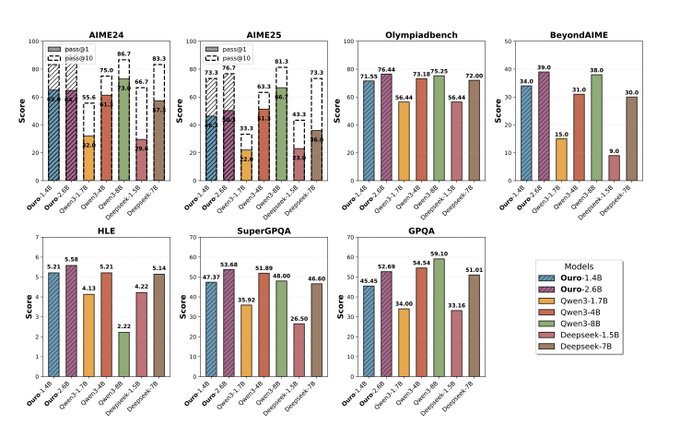 That said, there is a gap between a promising inductive bias and an architecture that may truly scale. The advantages Loop shows in controlled experiments do not directly answer a more practical question: > When we need to continue following the scaling law trajectory and commit real compute budgets to training and inference at the 10T/100T LLM scale, how should we incorporate Loop into next-generation model infrastructure? History is full of precedents where "beautiful results at small scale collapse at large scale." Before MoE was truly adopted, it went through a long phase where parameter efficiency was theoretically better, yet training was unstable, routing collapsed, and inference scheduling was complex. Loop faces a very similar situation: weight tying in controlled settings can indeed trade fewer parameters for deeper effective computation, but once you enter the scaling-up phase, all these problems follow close behind. ## What Kind of Loop Is Worth Scaling Up? Scaling up Loop requires clearing three gates simultaneously. Depth stability determines whether the model can be trained at all; inference efficiency determines whether it can be served at acceptable cost; per-FLOPs effectiveness determines whether it deserves the compute budget in the first place. These three problems are tightly coupled: without stable deep loops, there is no way to push recurrence far enough to measure FLOPs effectiveness; without efficient inference, a well-trained looped LLM remains impractical to deploy; and without demonstrated FLOPs returns, solving the first two problems yields an architecture with no economic justification. We examine each in turn. Depth Stability Deeper loops eventually lead to excessively deep network structures, creating a situation where "the loop itself works fine, but the network is simply too deep." When the model passes through the same set of blocks repeatedly, the hidden state forms a dynamical system. If this system is unstable across recurrent depth, deeper loops can cause residual explosion, loss spikes, and extreme sensitivity to hyperparameters. One viable approach is from the @hayden_prairie Parcae work to directly apply the lens of RNNs to loops, solving Loop problems with the methods that once solved RNN problems - the stability challenges of Looped Transformers closely resemble those of traditional RNNs and SSMs. In an RNN, if the spectral radius of the recurrent matrix is too large, the hidden state explodes over time; in an SSM, if the eigenvalues of the state transition matrix are uncontrolled, the system shifts from bounded dynamics to divergent dynamics. The Looped LLMs simply moves this problem from the sequence dimension to the depth dimension. Deeper loops mean longer unrolls; if the recurrent transition is unconstrained, the model easily accumulates error along the depth axis, amplifies residual norms, and triggers loss spikes. Of course, there are also newer approaches to solving this: instead of viewing the loop as an RNN, we can treat it as depth side Attention, which aligns well with Kimi's Attention Residuals and Mixture of Depth Attention. Inference Efficiency On the inference side, Looped LLM's bottleneck is very direct: in vanilla looping, each token must serially run through multiple loop iterations, and both latency and KV cache can grow with loop count. If this problem is handled poorly, Loop's parameter efficiency is easily offset by serving cost. A natural idea here is to adopt a diffusion-forcing-like architecture. In one sentence: the model simultaneously predicts the next token and computes the next loop. Examples include the Parallel Looped Transformer and the parallel sampler for Looped LLM. 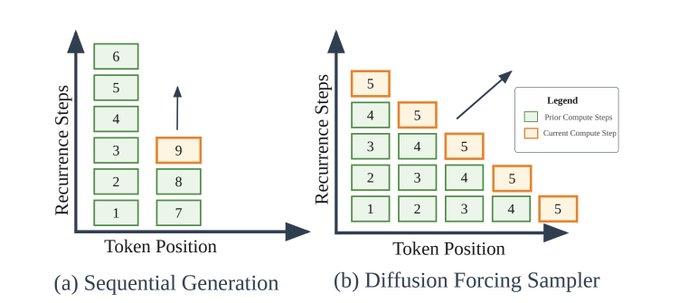 Solving the looped LLM inference bottleneck with Diffusion Forcing. Figure (a) shows vanilla sequential looping, while Figure (b) reveals the trick to parallelism: a diagonal compute pattern (orange boxes). In a single cycle, the model deepens older tokens (like step 5 on the left) while simultaneously processing the shallow layers of new tokens. this approach gives advantages in decoding, but prefilling requires combining with a YOCO scheme (later loops share the KV cache of earlier loops, killing two birds with one stone by reducing KV cache and improving prefilling efficiency). Universal YOCO is a representative case along these lines. Training FLOPs Effectiveness The most important scale-up metric in training, and arguably the most critical evaluation criterion for Looped LLMs, is per-FLOPs effectiveness. In an iso-parameter setting, Looped LLMs tends to show advantages more easily, because it reuses the same set of parameters, increasing effective depth. But this is insufficient. In real training and deployment, what we care about is: given one unit of FLOPs, should we buy more tokens, a larger model, longer context, more CoT tokens, or more latent loop depth? In practice, most mainstream Looped LLMs have failed to address this properly, because nearly all comparisons use iso-parameter settings, and when you are scaling up, every FLOP is real money spent. Recently, Parcae and Sparse Growing Transformer are both showing the improvement under iso-flops setting, though still in a relatively small scale, it shows with proper design, we can achieve better performance on iso-FLOPs settings. 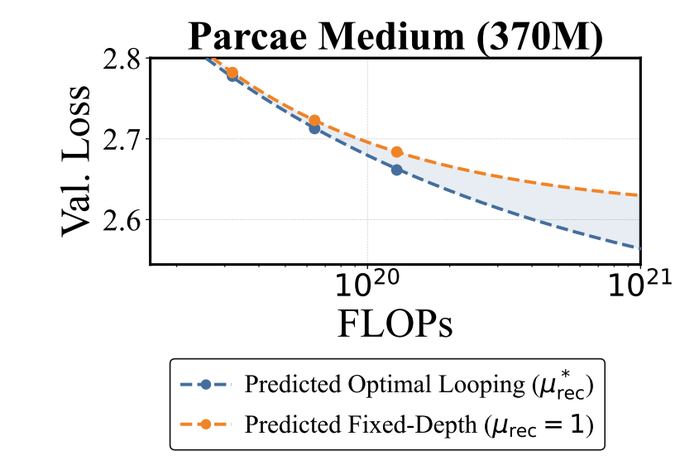 iso-FLOPs settings on Parcae paper. Of course, for pretraining loops from scratch, iso-FLOPs effectiveness would be the holy grail. But there is a more practical route: start with a strong base model, then gradually inject recurrent depth through continue pre-training, annealing, upcycling, depth curriculum, and similar techniques. A good example is Retrofitted Recurrence, where they apply continue pre-training on a non-looped LLM and transfer it to a looped LLM. Ouro's training pipeline itself includes stages such as stable training, CT annealing, LongCT, mid-training, upcycling, and Reasoning SFT, illustrating that the introduction of loop depth is more like a training process question. By adding loops in the later stages, you can improve model performance through a small amount of cheap training FLOPs: given a fixed training FLOPs budget, how much compute should be spent on loop depth? This may be the approach that most directly solves the problem, though it is less elegant. We can still hope for a direct solution to the first problem. ## If we do not have 100K B200 for loop, what should we do? Closing all three gaps in one shot would be the dream experiment, but compute budgets have a way of waking people up from dreams. The more productive framing is: which pieces of the puzzle can we solve today with modest resources, so that when the big run eventually happens, we already know what to build? FLOPs-effective Loop Scaling Law If Looped LLM is to become a scaling axis, it needs to enter the efficient frontier under fixed compute. This requires building a more complete Looped LLM scaling law. Traditional scaling laws study the optimal ratio of parameters to data; Loop scaling laws need to incorporate recurrent depth. Perhaps we also need to compare CoT and Loop: CoT spends compute in text space, while Loop spends compute in latent space. The marginal returns of each may vary by task. GraphWalk, code execution, and formal reasoning may be better suited to latent recurrence; tasks that require interpretable intermediate steps or external tool calls may still be better served by token-level reasoning. A more realistic system would likely use both: first use loops to strengthen internal state, then use a small number of explicit tokens to expose key reasoning. Attention-level State Update: Implicit Loop Loop does not have to appear only in full-stack weight tying. Another path is to introduce stronger state updates at the attention or memory mechanism level. Work like DeltaFormer offers a relevant perspective: starting from kernel functions and the delta rule, it interprets the delta rule as an update mechanism for associative memory and attempts to give Transformers an implicit state space. Such mechanisms could enhance state-tracking capabilities at the attention level. This means future Loop-like models might involve more than a set of transformer blocks being called repeatedly; they might also form some kind of recurrent memory update inside attention itself. Explicit loops unfold along the depth dimension, while Delta-style attention leans more toward updating state along the sequence/memory dimension. From this angle, Loop and attention improvements are unlikely to be in competition. The more probable direction is to introduce stronger attention-level state updates within a more stable recurrent-depth architecture, letting the model simultaneously benefit from depth recurrence and memory recurrence. CPT / Upcycling / Depth Curriculum From a training practice perspective, pretraining a very deep looped LLM from scratch may not be the most economical route. A more realistic path is to first train a strong base model, then gradually introduce recurrent depth during continual pretraining or mid-training stages. This can take several forms. The first is loop-CPT: using loop depth primarily for data in math, code, graph-like reasoning, and long-context state tracking. The second is depth curriculum: start with shallow recurrence to stabilize training, then gradually increase recurrent step, letting the model learn to continue refinement at deeper steps. The third is upcycling: converting some blocks of an existing fixed-depth transformer into recurrent blocks, especially in a middle-looped architecture where the prelude handles embedding, the recurrent middle handles iterative updates, and the coda handles output. Parcae's observations on training depth and test-time scaling ceilings also make depth curriculum more compelling. Another important direction is distillation. High-recurrence models may produce higher quality output, but they are more expensive to serve. A viable route is to train a deep loop, then distill it into a shallow loop or parallelized structure, preserving as much of the representational capacity from deep recurrence as possible while reducing inference-time steps. This corresponds precisely to the future problem raised by Parcae: how to reduce test-time steps while maintaining quality. Inference Infrastructure Even with the various inference optimizations mentioned above (such as diffusion-forcing-style parallel decoding and YOCO KV cache sharing), Looped LLMs still face unique system-level challenges during inference. The core difficulty lies at two levels. First, continuous batching must handle both real tokens and latent loop iterations simultaneously: different requests may be at different loop depths, and the scheduler must coordinate these two heterogeneous types of compute units within a batch. Second, KV cache lifecycle management becomes significantly more complex: whether each loop layer needs an independent KV cache, when intermediate loop caches can be released, and how to remain compatible with existing frameworks like PagedAttention are all engineering problems that require dedicated design. We believe these challenges, though serious, are solvable. Personally, I see them as analogous to the EP/TP scheduling problems MoE faced in its early days: the kind of systems engineering challenge that can be progressively conquered once it receives serious attention ## Closing the Loop So... returning to the original question: does Mythos actually use Loop? This may not be what matters most. What truly matters is that Loop, as an inductive bias, theoretically offers elegant properties such as parameter-compute decoupling, state-tracking enhancement, and test-time adaptive depth, while also demonstrating viable engineering paths in practice. From controlling depth stability, to optimizing inference parallelism, to the gradual introduction via CPT/upcycling, the engineering ecosystem around Loop is taking shape. We hope that reusable depth has the potential to become the next scaling axis after parameter count, data scale, and context length. Thanks for @vhjf36495872 bring this idea to me to write the blog, and also thanks to @Zixin_Wen and @zzZixuanWang for reading drafts of this post. ## 相关链接 - [Rui-Jie Zhu](https://x.com/RidgerZhu) - [@RidgerZhu](https://x.com/RidgerZhu) - [6.7K](https://x.com/RidgerZhu/status/2046736781035618602/analytics) - [@GeZhang86038849](https://x.com/@GeZhang86038849) - [@ChrisHayduk](https://x.com/@ChrisHayduk) - [@hayden_prairie](https://x.com/@hayden_prairie) - [Parcae](https://arxiv.org/abs/2604.12946) - [Attention Residuals](https://arxiv.org/abs/2603.15031) - [Mixture of Depth Attention](https://arxiv.org/abs/2603.15619) - [Parallel Looped Transformer](https://arxiv.org/abs/2510.24824) - [parallel sampler](https://arxiv.org/abs/2510.14961v1) - [Universal YOCO](https://arxiv.org/abs/2604.01220) - [Parcae](https://arxiv.org/abs/2604.12946) - [Sparse Growing Transformer](https://arxiv.org/abs/2603.23998) - [Retrofitted Recurrence](https://arxiv.org/abs/2511.07384) - [DeltaFormer](https://openreview.net/forum?id=GSE3oaiDL2) - [@vhjf36495872](https://x.com/@vhjf36495872) - [@Zixin_Wen](https://x.com/@Zixin_Wen) - [@zzZixuanWang](https://x.com/@zzZixuanWang) - [Upgrade to Premium](https://x.com/i/premium_sign_up) - [7:44 AM · Apr 22, 2026](https://x.com/RidgerZhu/status/2046736781035618602) - [6,782 Views](https://x.com/RidgerZhu/status/2046736781035618602/analytics) - [View quotes](https://x.com/RidgerZhu/status/2046736781035618602/quotes) --- *导出时间: 2026/4/22 14:37:00*
L Looped LLM 与深度缩放:解析 Claude Mythos 的架构演变 文章基于作者在 ByteDance Seed 的研究经历,探讨了 Looped LLM 架构的起源与演进。作者通过分析 Anthropic 发布的 Claude Mythos 在 GraphWalk BFS 基准上的异常表现,指出 Looped 架构在多跳推理和状态追踪上的优势。文章进一步深入讨论了 Looped LLM 在扩展至 10T/100T 规模时面临的深度稳定性、推理效率和 FLOPs 有效性的三大挑战,并对比了 RNN 视角与 Parallel Looped Transformer 等解决方案。 技术 › LLM ✍ Rui-Jie Zhu🕐 2026-04-22 LLMLooped LLMClaude Mythos模型架构Scaling Law推理模型深度学习Anthropic研究RNN
A Anthropic内部分享:别再造Agent了,造Skills就够了 Anthropic 内部分享指出,与其为每个场景构建新 Agent,不如给通用 Agent 配置“Skills”。Skills 是打包程序化知识的文件夹,通过渐进式加载解决上下文窗口问题。文章介绍了 Skills 与 MCP 的互补关系,及其在金融、科研等领域的生态发展,类比将其比作“应用层”,强调通过知识积累让模型不断进化。 技术 › Agent ✍ Jason Zhu🕐 2026-04-03 AnthropicClaudeAgentSkillsMCP架构设计软件开发LLM生态技术趋势
炸 炸裂,Anthropic 给 Opus 5 删掉了 80% 的系统提示词 Anthropic 团队将 Claude Code 的系统提示词删减了 80%,但编码评测没有损失。文章指出,许多规则是为老模型打的补丁,已过时。最佳实践转向:用锚点代替禁令,用接口设计代替举例,以及渐进披露。建议开发者清理“拐杖”型规则,保留护栏与品味,用评测集支撑删除决策。 技术 › LLM ✍ 码良🕐 2026-07-25 ClaudePrompt Engineering系统提示词AnthropicLLM最佳实践上下文管理
H How to master graph engineering 本课程教授如何构建 AI 智能体图,涵盖图的基本概念、关键模式(如菱形模式)、停止规则及人工审批环节。包含三个实战案例:深度研究台、SEO 内容生成器和市场推广套件,旨在提升业务效率并控制成本。 技术 › Agent ✍ Machina🕐 2026-07-23 AgentGraphLLMClaudeWorkflow工程化自动化架构设计效率实战
C Claude Skills: 如何通过 Anthropic 的新功能节省 Token 并提升效率 文章介绍了 Anthropic 推出的 Claude Skills 功能,通过文件夹和 YAML 配置实现渐进式披露,显著减少 Token 消耗和重复解释。详细说明了技能的构建规则、命名规范、测试方法及分发策略,帮助用户将聊天机器人转化为高效的专业工程团队。 技术 › Skill ✍ Mr. Buzzoni🕐 2026-07-17 ClaudeSkillTokenAnthropicDevOps工具与效率LLMMCPAgent
C Claude Code Dynamic Workflows:把编排逻辑搬进代码的新原语 Anthropic 推出的 Claude Opus 4.8 引入了 Dynamic Workflows 功能,旨在解决大型代码库迁移和复杂任务编排的难题。该功能通过将编排过程生成本地 JavaScript 脚本,利用运行时管理逻辑,突破了传统 Agent 上下文窗口的限制,实现了对海量并行任务的高效处理。文章详细解析了其与 Subagent 和 Agent Teams 的区别、核心架构、脚本编写规范以及触发机制。 技术 › Claude ✍ riba2534🕐 2026-05-30 ClaudeClaude CodeDynamic WorkflowsAgentLLM架构设计开发工具自动化
A Agent Harness 拆解:AI Agent 的工程化基础设施 本文深入探讨了 Agent Harness 的概念,即包裹在 LLM 外部、将无状态模型转化为可用智能体的完整软件基础设施。文章引用了 Anthropic、OpenAI 和 LangChain 的实践,详细拆解了生产级 Harness 的 12 个核心组件(如编排循环、记忆系统、上下文管理、验证循环等),并阐述了如何通过优化这层“操作系统”来解决遗忘、工具调用失败和上下文腐烂等工程难题。 技术 › Harness Engineering ✍ 土豆本豆🕐 2026-05-21 AgentHarnessLLM架构设计LangChainClaudeOpenAI上下文管理工程化Agent拆解
深 深度拆解:AI Agent Harness 的构造 文章深入探讨了“AI Agent Harness”的概念,即包裹在大语言模型之外、使其转变为智能体的完整软件架构。作者详细拆解了生产级 Harness 的 12 个核心组件(如编排循环、工具、记忆、上下文管理等),对比了 Anthropic、OpenAI 和 LangChain 的不同实现路径,并指出 Harness 工程是决定 AI 应用性能的关键。 技术 › Harness Engineering ✍ 宝玉🕐 2026-05-12 AI AgentLLMHarness架构设计OpenAIAnthropicLangChain工程化
A AI Agent 从零开发指南:构建你的第一个智能体 本文是一篇从零开始构建 AI Agent 的实战教程。作者整合了 Anthropic 和 OpenAI 等资源,详细介绍了 Agent 的工作原理(核心循环)、五种核心工作流模式(如提示链、路由、并行化等),并提供了从构思、设计工具与记忆机制到落地的完整步骤。文章还探讨了如何利用 LLM 自身辅助设计 Agent,帮助开发者快速构建实用型的自动化智能体。 技术 › Agent ✍ hoeem🕐 2026-04-28 AI AgentLLM开发教程AnthropicOpenAI提示工程工作流自动化LangChainClaude
如 如何在 AI Agents 中正确使用 MCP 服务器 文章讨论了 MCP 服务器在 AI Agents 中的应用。盲目启用 MCP 会导致上下文膨胀、成本增加和性能下降。文章提出了两种有效的使用模式:一是显式 MCP 服务器(内联工具注入),通过 @mention 按需加载工具,适合用户驱动的临时需求;二是子代理 MCP 服务器,将 MCP 服务器声明在子代理定义中,利用 allowed_tools 进行最小权限范围限定,适合代码审查或支持代理等特定场景。 技术 › Agent ✍ Philipp Schmid🕐 2026-04-28 MCPAI AgentTool UseLLM架构设计开发指南SubagentClaude
S Sub-Agents vs Agent Teams: 决定性架构决策 本文探讨了 AI 系统中“子代理”与“代理团队”的区别。子代理适用于并行、隔离的任务,专注执行且无状态;代理团队则用于需要上下文共享的协作任务。文章指出架构设计应基于上下文边界而非单纯的角色拆分,并总结了 Prompt 链、路由、并行化等 5 种关键模式。 技术 › Agent ✍ Suryansh Tiwari🕐 2026-04-25 AgentLLM架构设计多智能体Claude
你 你用的中转到底是怎么运行的? 本文深度拆解了 AI API 中转服务的运行原理,以开源网关 new-api 为例,详细阐述了从请求诞生到结果返回的全链路。文章涵盖了路由、鉴权、分发、转换、计费及容错等核心机制,并解析了渠道选择算法、流式传输及适配器模式等底层技术,揭示了中转站如何实现省钱、省事且稳定的 AI 服务调用。 技术 › 工具与效率 ✍ 来碗牛肉粉, Sunny🕐 2026-04-24 LLM中转new-apiAPI网关计费系统架构设计OpenAIClaude渠道管理技术原理