# McKinsey Won’t Make You AI-Native. Agents Will.
**作者**: Raphaël Dabadie (YC P26)
**日期**: 2026-04-26T16:04:42.000Z
**来源**: [https://x.com/RaphaelDabadie/status/2048433094198231296](https://x.com/RaphaelDabadie/status/2048433094198231296)
---
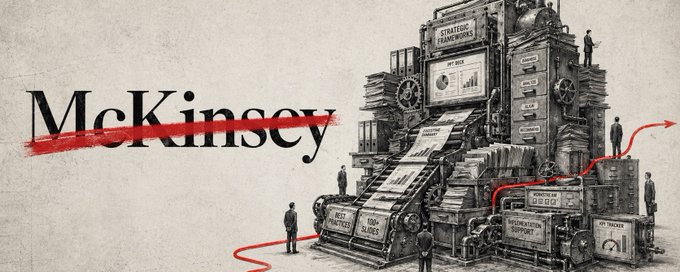
Every company wants to become AI-native. Most are still using the same method: hire consultants, run workshops, write a roadmap, and hope the organization changes.
That model was built for a slower world.
If AI is the transformation, AI also has to be the method.
## Adoption is not transformation
Most companies confuse AI adoption with AI transformation.
AI adoption is easy. It means giving people better tools. Sales gets a writing assistant. Engineers get Claude Code. HR gets a chatbot. Everyone gets ChatGPT.
This can be useful. But the company itself remains mostly unchanged: same workflows, same meetings, same approval chains, same reporting lines, same blind spots.
The machine runs faster, but it is still the same machine.
That is not what it means to become AI-native.
Jack Dorsey and Roelof Botha describe an AI-native company as something closer to an intelligence system than a traditional hierarchy. AI is not just added to individual jobs. It changes how information moves, how work is coordinated, how decisions are made, and how the company learns.
AI adoption adds tools to the existing company. AI transformation redesigns the company around what AI now makes possible.
The same mistake happened with electricity. In the 1890s, factories replaced steam engines with electric motors, but productivity barely moved because the factory was still organized around steam. The real gains came in the 1920s, when factories were redesigned around electricity itself.
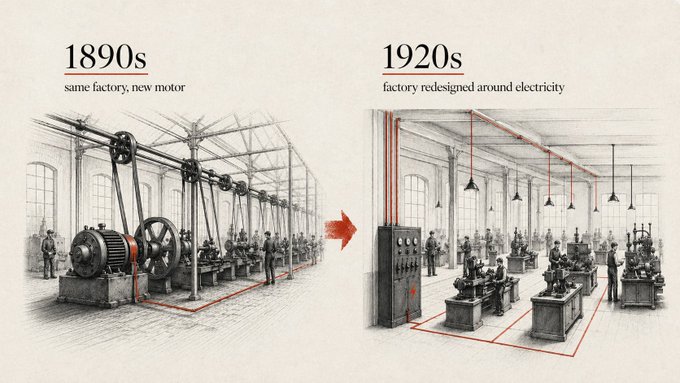
Same factory, new motor. Real gains came from redesigning the system.
As @gsivulka put it:
> “We’ve swapped the motor; we have not yet redesigned the factory.”
That is where most companies are with AI. They have swapped the motor but they have not redesigned the factory.
## McKinsey Was Never Built for AI Transformation
Neither were the other consulting firms.
Beyond being absurdly slow and costing a fortune, consulting is built on sampling by default. A small team interviews a limited part of the organization, runs workshops with selected stakeholders, synthesizes what it heard, and turns that into a roadmap.
That can work when the problem is narrow enough but AI transformation is not narrow.
It touches every function, every workflow, every team, every tool, and almost every role inside the company.
When led internally, the transformation doesn't get any simpler. A small group of key people suddenly has to understand how the entire company works, decide where AI should be integrated, convince teams to change, and keep updating the plan as models improve.
That is an impossible amount of context to hold manually.
## You Cannot Redesign What You Cannot See
This is the painful part of AI transformation.
AI-native startups get to think forward. They start from a blank page and design the company around AI from day one.
Incumbents have to think backward first. Before deciding what the AI-native version of the company should look like, they have to understand how the current company actually works, in all its messy detail.
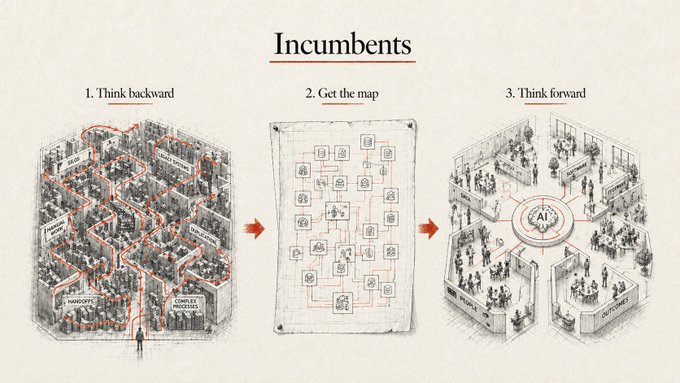
AI-native startups start from a blank page. Incumbents have to map the old system first.
Most companies avoid this because, through a human-first lens, the task feels impossible: too many teams, too many workflows, too many tools, too much hidden context.
So they jump straight to the future: tools, pilots, roadmaps. But that skips the thing that matters most. Org charts, dashboards, and process docs are not enough. The real company lives in handoffs, workarounds, dependencies, approval loops, and context trapped in people’s heads.
If you only see a sample, you only transform the visible parts.
To redesign the whole system, you need a map of the whole system.
## AI Has to Become the Method
This is why AI transformation cannot stay human-led.
AI should not only be the thing companies are trying to adopt. It should become the method used to transform them.
Humans cannot scale their time. It would make no sense to send a small team to interview hundreds or thousands of people one by one, then expect them to connect every workflow, spot every bottleneck, and keep the plan alive as the company changes.
That limitation shaped the old world. Interviews stayed partial. Training stayed generic. Adoption was tracked through surveys, workshops, and dashboards.
AI agents do not have that constraint. They can interview 500, 1,000, or 10,000 people in parallel, structure far more context than any human team, much faster and keep updating the map as the company changes.
They can also support each person individually, based on their role, workflows, and level with AI.
So why are we still asking humans to do this part of the work that AI is obviously better suited to handle?
## The new model is software plus service
AI transformation requires a new model, built around software and service from day one.
Software layer
The software layer uses AI to rebuild the company’s operational graph: a map of how work actually happens across teams, tools, workflows, handoffs, bottlenecks, and informal habits.
This is the thinking-backward phase most companies avoid. It contains some of the most valuable context in the company, but until now it was almost impossible to collect at scale because it lived in people’s heads and daily routines.
Agents can now make that context visible, keep it updated, and use it to personalize support for every employee based on their actual work.
Service layer
The service layer keeps what was actually valuable in consulting: expert humans who bring judgment, experience, and domain expertise to a complex transformation while removing the parts that no longer make sense.
Humans decide what matters, prioritize the roadmap, validate recommendations, handle sensitive trade-offs, guide adoption, and help teams implement the changes.
They shouldn't do anything AI can do better.
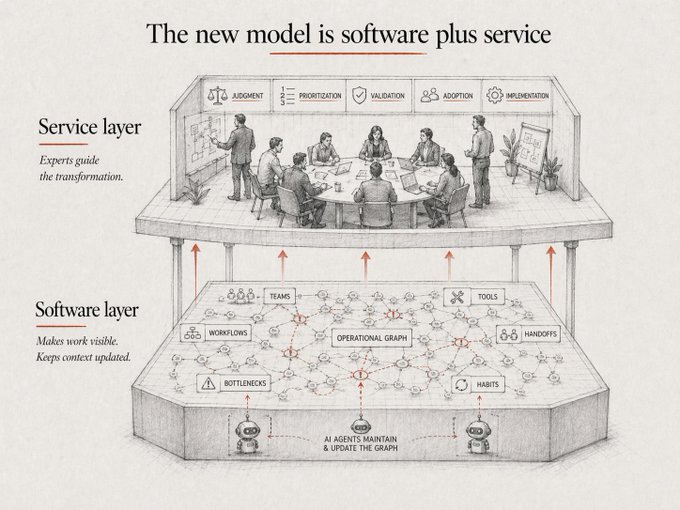
Agents collect and structure the context. Humans bring judgment where it matters.
## How to make it work in practice
This is the thesis we joined Y Combinator with, and the system we are now building at Foaster.
Make the company legible
We start the engagement with 30 to 45-minute AI-led interviews that run in parallel across the organization and rebuild an operational map of how work actually happens.
Agents then reason on top of that map to identify bottlenecks, inefficiencies, hidden dependencies, and the first places AI should be integrated, aligned with the company’s goals.
Keep the transformation alive
From there, we stay embedded inside the company throughout the transformation. Agents keep the map updated and, every month, generate tailored upskilling, feedback, and recommendations for each role based on a precise understanding of how each person actually works.
This helps move the whole company in one direction while supporting everyone at individual scale.
It also changes the business model. Instead of one-off consulting projects, which are not suited to something as broad, operational, and fast-moving as AI transformation, companies pay a monthly subscription for a system that stays active over time.
That subscription gives access to the system and agents doing the work, but also to what we call Forward Deployed Advisors (FDAs): human experts sized to the company who bring the judgment, experience, and domain expertise that made consulting valuable in the first place.
When implementation is needed, Forward Deployed Engineers (FDEs) can step in with the same operational context and go directly to the highest-value work.
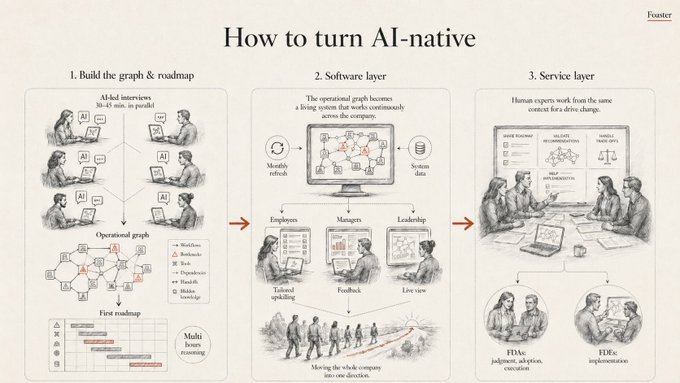
Map the company, identify where AI matters, and keep the transformation alive.
In both cases, the goal is the same: agents do everything they can do better, and humans step in only where they are truly needed. That is how this model can go deeper, move faster, and serve more companies than traditional consulting ever could.
Consulting was an optimization of the capabilities we had before AI. AI now makes a completely new model possible, ironically far better suited to AI transformation itself.
## 相关链接
- [Raphaël Dabadie (YC P26)](https://x.com/RaphaelDabadie)
- [@RaphaelDabadie](https://x.com/RaphaelDabadie)
- [44K](https://x.com/RaphaelDabadie/status/2048433094198231296/analytics)
- [@gsivulka](https://x.com/@gsivulka)
- [Upgrade to Premium](https://x.com/i/premium_sign_up)
- [12:04 AM · Apr 27, 2026](https://x.com/RaphaelDabadie/status/2048433094198231296)
- [44.6K Views](https://x.com/RaphaelDabadie/status/2048433094198231296/analytics)
- [View quotes](https://x.com/RaphaelDabadie/status/2048433094198231296/quotes)
---
*导出时间: 2026/4/27 21:45:05*