# Zero to AI Engineer — The Roadmap Nobody Explains Properly
**作者**: Shruti Codes
**日期**: 2026-05-16T15:45:39.000Z
**来源**: [https://x.com/Shruti_0810/status/2055676059480395990](https://x.com/Shruti_0810/status/2055676059480395990)
---
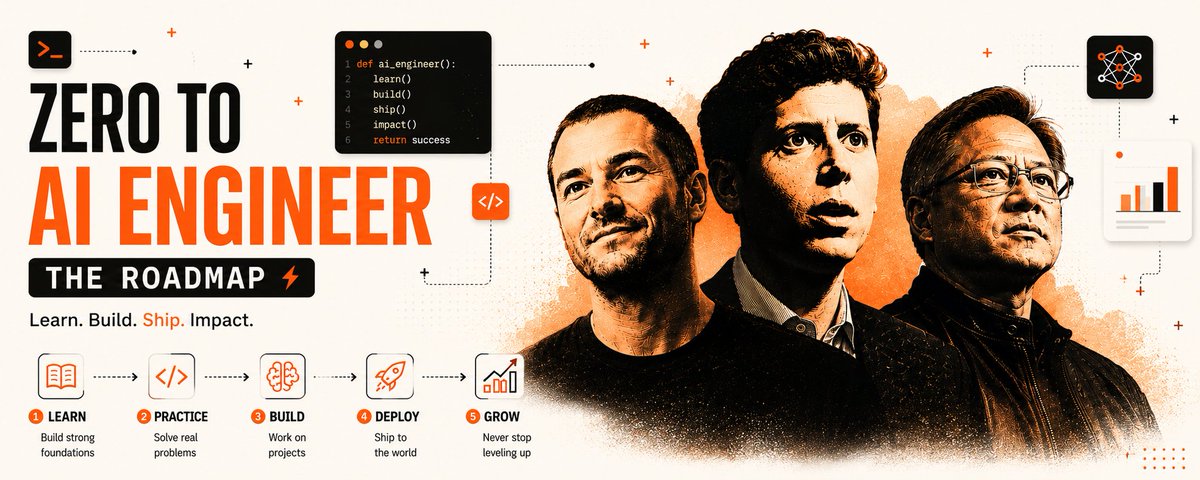
Most people trying to learn AI in 2026 are stuck in the same loop: buying expensive courses, collecting certificates, watching endless tutorials, and still having no idea how to actually build something real.
The truth is weirdly simple.
The best AI education on the internet is already free.
Not beginner fluff. Not “What is ChatGPT?” videos. Actual engineering knowledge from the companies building modern AI systems — OpenAI, Anthropic, Google, NVIDIA, Microsoft combined with open-source repositories that teach better than most paid bootcamps.
And almost nobody follows the resources in the correct order.
That’s why people jump into agents before understanding transformers, try building RAG apps without understanding embeddings, or copy-paste LangChain tutorials without knowing what’s happening underneath.
This roadmap fixes that.
Not with “50 resources you’ll never open,” but with a practical system designed to take someone from absolute beginner to building production-grade AI systems in around 14 weeks.
The goal isn’t to become someone who simply uses AI tools. The goal is to understand how modern AI actually works, how to build with it, and how to deploy systems that solve real problems.
The first step is setting up a proper environment. Install Python 3.11+, VS Code, GitHub, Obsidian, and Ollama. Ollama is especially important because it lets you run powerful language models locally, which becomes incredibly valuable later when working with LLMs, embeddings, quantization, and agents.
Tools:
- Python → https://python.org/downloads
- VS Code → https://code.visualstudio.com
- GitHub → https://github.com
- Obsidian → https://obsidian.md
- Ollama → https://ollama.com
After setup, create free accounts on:
- Anthropic Academy → https://anthropic.skilljar.com
- OpenAI Academy → https://academy.openai.com
- Google AI → https://grow.google/ai
- Coursera → https://coursera.org
One important trick: on Coursera, always use “Audit this course.” Most people don’t realize the full learning material is usually free.
The roadmap starts with AI fundamentals because understanding the vocabulary of AI changes everything. Google’s AI Professional Certificate is one of the best starting points because it explains AI workflows, prompting, and practical use cases without overwhelming beginners with math immediately.
After that, Anthropic Academy’s “AI Fluency” course provides one of the cleanest explanations of modern AI systems available online right now. Short, practical, and surprisingly high quality for a completely free program.
Then comes the first major GitHub repository:
https://github.com/microsoft/generative-ai-for-beginners
This repo alone is better than many paid AI programs. It covers prompts, transformers, embeddings, chat applications, and how large language models actually behave in production systems.
At this stage, the goal is simple: understand tokens, embeddings, transformers, and context windows well enough to explain them in plain English.
The next phase is machine learning foundations, which is where most people quit because the tutorials stop feeling magical and the real engineering starts.
This is also the point where beginners separate from future AI engineers.
The best free resource here is:
https://github.com/microsoft/ML-For-Beginners
It teaches regression, classification, clustering, model evaluation, overfitting, and gradient descent in a very practical way.
Alongside it, IBM’s Machine Learning Professional Certificate on Coursera is excellent when used in audit mode:
https://coursera.org/professional-certificates/ibm-machine-learning
For math foundations specifically related to AI, this repository is incredibly valuable:
https://github.com/mlabonne/llm-course
Instead of forcing unnecessary academic theory, it focuses on the exact linear algebra, calculus, and probability concepts needed for modern ML and LLM work.
By the end of this phase, at least one machine learning project should be pushed to GitHub. Not because recruiters care about toy projects, but because building things is the fastest way to understand why models fail.
Then comes the stage that changes how people think about AI completely: deep learning.
Andrej Karpathy’s “Neural Networks: Zero to Hero” remains one of the greatest AI learning resources ever created:
https://karpathy.ai/zero-to-hero.html
Instead of hiding behind frameworks, it teaches neural networks from scratch using raw Python and math. Backpropagation, activations, tokenization, transformers, attention mechanisms — everything becomes understandable because the systems are built piece by piece.
The accompanying GitHub repo:
https://github.com/karpathy/nn-zero-to-hero
During this stage, it’s incredibly useful to run local models with Ollama:
ollama run llama3
Watching a locally running LLM while simultaneously building smaller transformer systems creates a bridge between theory and real-world AI systems that most courses never provide.
Once deep learning fundamentals are clear, the roadmap shifts into modern LLM engineering.
This is where concepts like RAG, fine-tuning, LoRA, QLoRA, quantization, vector databases, and evaluation start making sense.
Again, one of the best free resources available is:
https://github.com/mlabonne/llm-course
It’s arguably the closest thing the AI world currently has to a complete open-source LLM engineering curriculum.
At the same time, prompt engineering should be studied directly from the companies building frontier models:
OpenAI Academy:
https://academy.openai.com
Anthropic Prompt Engineering:
https://docs.anthropic.com
Anthropic’s documentation is especially valuable because it explains prompting like an engineering discipline rather than “magic words.”
A strong project during this phase is building a RAG system over personal notes using ChromaDB or LanceDB. This creates a searchable second brain powered by local AI models and embeddings.
After that comes AI agents — the area currently changing the industry fastest.
Microsoft’s free course:
https://github.com/microsoft/ai-agents-for-beginners
covers tool use, orchestration, memory systems, workflows, and multi-agent architectures.
Anthropic’s MCP (Model Context Protocol) courses are equally important because MCP is rapidly becoming the standard way AI systems connect to tools, APIs, and external environments:
https://anthropic.skilljar.com
This is the stage where projects become genuinely impressive:
- autonomous research agents
- AI file systems
- browser agents
- workflow automations
- local assistants
- memory-enabled AI systems
Finally comes deployment, evaluation, and portfolio building — the area most tutorials completely ignore.
A deployed AI system without evaluation is basically a hallucination machine waiting to fail.
That’s why tools like DeepEval, RAGAS, and LLM-as-a-Judge matter so much.
Projects should eventually be deployed using:
- Hugging Face Spaces
- Gradio
- Streamlit
- Vercel
And every serious project should include:
- evaluation
- safety checks
- architecture diagrams
- GitHub documentation
- public demos
Because in modern AI hiring, GitHub often matters more than résumés.
The most important part of this roadmap is that it avoids the biggest mistake beginners make: consuming endlessly without building.
The people who actually become AI engineers aren’t the ones bookmarking 200 tutorials.
They’re the ones opening a terminal, breaking things, fixing them, deploying projects, and repeating that process until the systems finally make sense.
Right now, the greatest free AI education in history is available online.
The only real question is who’s willing to go deep enough to use it.
## 相关链接
- [Shruti Codes](https://x.com/Shruti_0810)
- [@Shruti_0810](https://x.com/Shruti_0810)
- [11K](https://x.com/Shruti_0810/status/2055676059480395990/analytics)
- [https://python.org/downloads](https://python.org/downloads)
- [https://code.visualstudio.com](https://code.visualstudio.com/)
- [https://github.com](https://github.com/)
- [https://obsidian.md](https://obsidian.md/)
- [https://ollama.com](https://ollama.com/)
- [https://anthropic.skilljar.com](https://anthropic.skilljar.com/)
- [https://academy.openai.com](https://academy.openai.com/)
- [https://grow.google/ai](https://grow.google/ai)
- [https://coursera.org](https://coursera.org/)
- [https://github.com/microsoft/generative-ai-for-beginners](https://github.com/microsoft/generative-ai-for-beginners)
- [https://github.com/microsoft/ML-For-Beginners](https://github.com/microsoft/ML-For-Beginners)
- [https://coursera.org/professional-certificates/ibm-machine-learning](https://coursera.org/professional-certificates/ibm-machine-learning)
- [https://github.com/mlabonne/llm-course](https://github.com/mlabonne/llm-course)
- [https://karpathy.ai/zero-to-hero.html](https://karpathy.ai/zero-to-hero.html)
- [https://github.com/karpathy/nn-zero-to-hero](https://github.com/karpathy/nn-zero-to-hero)
- [https://github.com/mlabonne/llm-course](https://github.com/mlabonne/llm-course)
- [https://academy.openai.com](https://academy.openai.com/)
- [https://docs.anthropic.com](https://docs.anthropic.com/)
- [https://github.com/microsoft/ai-agents-for-beginners](https://github.com/microsoft/ai-agents-for-beginners)
- [https://anthropic.skilljar.com](https://anthropic.skilljar.com/)
- [Upgrade to Premium](https://x.com/i/premium_sign_up)
- [11:45 PM · May 16, 2026](https://x.com/Shruti_0810/status/2055676059480395990)
- [11.2K Views](https://x.com/Shruti_0810/status/2055676059480395990/analytics)
- [View quotes](https://x.com/Shruti_0810/status/2055676059480395990/quotes)
---
*导出时间: 2026/5/17 16:08:12*
---
## 中文翻译
# 从零到 AI 工程师 —— 没人能正确解释的路线图
**作者**: Shruti Codes
**日期**: 2026-05-16T15:45:39.000Z
**来源**: [https://x.com/Shruti_0810/status/2055676059480395990](https://x.com/Shruti_0810/status/2055676059480395990)
---

2026年,大多数尝试学习 AI 的人都陷入了同样的怪圈:购买昂贵的课程,收集证书,观看无尽的教程,却仍然不知道如何真正构建出实实在在的东西。
事实真相简单得有些反直觉。
互联网上最好的 AI 教育资源其实早已免费开放。
不是那些给新手看的虚浮内容,也不是“什么是 ChatGPT?”之类的视频。而是来自构建现代 AI 系统的公司(如 OpenAI、Anthropic、Google、NVIDIA、Microsoft)的实际工程知识,结合那些教学效果优于大多数付费训练营的开源代码库。
但几乎没有人按正确的顺序去利用这些资源。
这就是为什么有人还没理解 Transformer 就去研究 Agent,还没理解 Embedding 就尝试构建 RAG 应用,或者完全不懂底层原理就照搬 LangChain 教程。
这份路线图就是为了解决这个问题。
它不会给你列出“50个你永远不会打开的资源”,而是提供一个实用的系统,旨在帮助学习者在约 14 周内从零基础小白成长为能够构建生产级 AI 系统的工程师。
目标不是成为一个只会使用 AI 工具的人。目标是理解现代 AI 的实际运作原理,如何基于它进行开发,以及如何部署能解决真实问题的系统。
第一步是搭建一个合适的环境。安装 Python 3.11+、VS Code、GitHub、Obsidian 和 Ollama。Ollama 尤其重要,因为它允许你在本地运行强大的大语言模型(LLM),这在后续处理 LLM、嵌入(embeddings)、量化和 Agent 时会变得非常有价值。
工具:
- Python → https://python.org/downloads
- VS Code → https://code.visualstudio.com
- GitHub → https://github.com
- Obsidian → https://obsidian.md
- Ollama → https://ollama.com
设置完成后,请在以下平台创建免费账号:
- Anthropic Academy → https://anthropic.skilljar.com
- OpenAI Academy → https://academy.openai.com
- Google AI → https://grow.google/ai
- Coursera → https://coursera.org
一个小技巧:在 Coursera 上,务必选择“Audit this course”(旁听/试听课程)。大多数人没有意识到,完整的学习材料通常是免费开放的。
路线图从 AI 基础开始,因为理解 AI 的相关术语能改变一切。Google 的 AI 专业证书是最佳起点之一,因为它清晰地解释了 AI 工作流、提示词工程(Prompting)和实际用例,而不会立刻用数学把新手淹没。
之后,Anthropic Academy 的“AI Fluency”课程提供了目前在线上能找到的最清晰的现代 AI 系统解释之一。短小、精悍、实用,对于一个完全免费的课程来说,质量高得惊人。
然后是第一个主要的 GitHub 代码库:
https://github.com/microsoft/generative-ai-for-beginners
单凭这个代码库,就胜过许多付费的 AI 课程。它涵盖了提示词、Transformer、嵌入、聊天应用程序,以及大语言模型在生产环境中的实际表现。
在这个阶段,目标很简单:理解 Token、嵌入、Transformer 和上下文窗口,并能够用通俗易懂的语言解释它们。
下一阶段是机器学习基础,这是大多数人放弃的地方,因为教程不再显得神奇,真正的工程开始了。
这也是初学者和未来的 AI 工程师分道扬镳的转折点。
这里最好的免费资源是:
https://github.com/microsoft/ML-For-Beginners
它以非常实用的方式教授了回归、分类、聚类、模型评估、过拟合和梯度下降。
配合学习的是 Coursera 上的 IBM 机器学习专业证书(使用旁听模式),非常出色:
https://coursera.org/professional-certificates/ibm-machine-learning
针对 AI 相关的数学基础,这个代码库极具价值:
https://github.com/mlabonne/llm-course
它没有强塞不必要的学术理论,而是专注于现代机器学习和 LLM 工作所需的线性代数、微积分和概率概念。
在这个阶段结束时,至少应该有一个机器学习项目推送到 GitHub。不是因为招聘者在乎这些玩具项目,而是因为亲手构建是理解模型为何失败的最快途径。
接着是彻底改变人们 AI 认知的阶段:深度学习。
Andrej Karpathy 的“Neural Networks: Zero to Hero”仍然是有史以来最伟大的 AI 学习资源之一:
https://karpathy.ai/zero-to-hero.html
它不依赖框架,而是使用原始的 Python 和数学从零开始教授神经网络。反向传播、激活函数、分词、Transformer、注意力机制——一切都变得易于理解,因为系统是逐块构建起来的。
配套的 GitHub 仓库:
https://github.com/karpathy/nn-zero-to-hero
在此期间,使用 Ollama 运行本地模型非常有用:
ollama run llama3
在构建小型 Transformer 系统的同时,观察本地运行的 LLM,这在理论和现实世界的 AI 系统之间架起了一座桥梁,这是大多数课程无法提供的。
一旦深度学习基础清晰,路线图将转向现代 LLM 工程。
在这里,RAG、微调、LoRA、QLoRA、量化、向量数据库和评估等概念开始变得有意义。
同样,最好的免费资源之一是:
https://github.com/mlabonne/llm-course
这可以说是目前 AI 世界中最接近完整的开源 LLM 工程课程的东西。
同时,提示词工程应该直接从构建前沿模型的公司学习:
OpenAI Academy:
https://academy.openai.com
Anthropic Prompt Engineering:
https://docs.anthropic.com
Anthropic 的文档特别有价值,因为它将提示词解释为一门工程学科,而不是“魔法咒语”。
在这个阶段,一个强有力的项目是使用 ChromaDB 或 LanceDB 基于个人笔记构建 RAG 系统。这能创建一个由本地 AI 模型和嵌入驱动的可搜索“第二大脑”。
之后是 AI Agent —— 目前改变行业最快的领域。
Microsoft 的免费课程:
https://github.com/microsoft/ai-agents-for-beginners
涵盖了工具使用、编排、记忆系统、工作流和多 Agent 架构。
Anthropic 的 MCP(模型上下文协议)课程同样重要,因为 MCP 正迅速成为 AI 系统连接工具、API 和外部环境的标准方式:
https://anthropic.skilljar.com
在这个阶段,项目会变得真正令人印象深刻:
- 自主研究 Agent
- AI 文件系统
- 浏览器 Agent
- 工作流自动化
- 本地助手
- 具备记忆功能的 AI 系统
最后是部署、评估和作品集构建 —— 大多数教程完全忽略的领域。
一个未经评估就部署的 AI 系统,基本上就是一个等待失败的幻觉机器。
这就是为什么 DeepEval、RAGAS 和 LLM-as-a-Judge 等工具如此重要的原因。
项目最终应使用以下方式部署:
- Hugging Face Spaces
- Gradio
- Streamlit
- Vercel
每个认真对待的项目都应包含:
- 评估
- 安全检查
- 架构图
- GitHub 文档
- 公共演示
因为在现代 AI 招聘中,GitHub 往往比简历更重要。
这份路线图最重要的部分是,它避免了初学者犯的最大错误:只顾学习(输入)而不去构建(输出)。
真正成为 AI 工程师的人,不是那些收藏了 200 个教程的人。
而是那些打开终端,搞坏东西,修复它们,部署项目,并重复这个过程直到系统完全合乎逻辑的人。
目前,历史上最伟大的免费 AI 教育资源就在网上。
唯一真正的问题是,谁愿意足够深入地去利用它们。