# 46 thoughts on the near future
**作者**: bayes
**日期**: 2026-06-30T20:37:30.000Z
**来源**: [https://x.com/bayeslord/status/2072056960430789032](https://x.com/bayeslord/status/2072056960430789032)
---
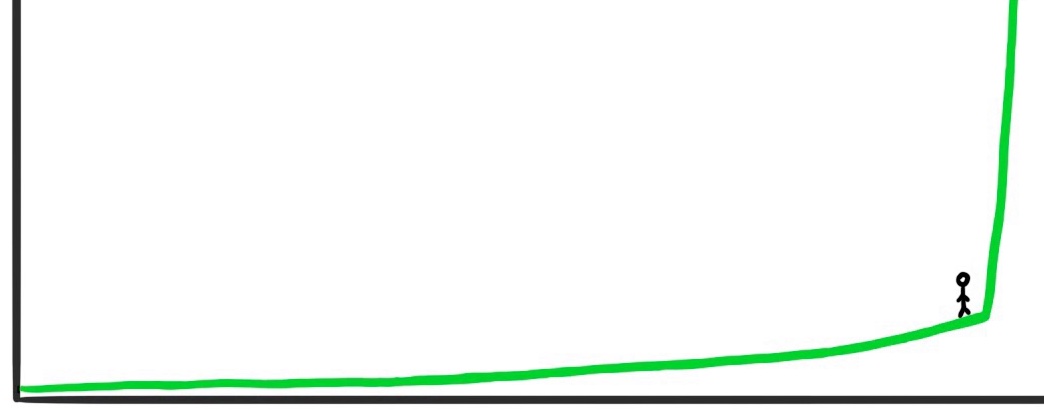
This list is based on a thread I posted on June 4th. A few edits and additions here and there. Several people asked me to make the thread easier to read, so here it is.
## Intelligence
1. I think people are going to be blindsided by algorithmic progress. The entire world, markets, governments, militaries, companies, people, etc. are all trying to make sense of AI and its impact in terms of the recent past’s production efficiencies and regularities, and how things appear to be going. Even several of the purportedly “RSI”pilled neolabs seem to think this will be business as usual but with Agent in a loop. No. My guess is there are many algorithmic OOMs left to go in the production of intelligence, maybe (maybe) up to ten, with four to seven seeming more likely. Going beyond even ten is possible in principle, but it strains hard against what I suspect the universe will actually let us do. Implausible but not impossible. If this is true then things aren’t actually going as they appear to be going and a big jump is coming. Anything along these lines happening would make things, far weirder than almost anyone seems to be pricing in.
2. We are in early takeoff. AI improving AI may end up being one of the most consequential steps of history. This isn’t certain because we don’t know how far from the physical and computational limits of intelligence we are, though I would bet it’s quite far from where we are today (as I said above, ~4-10 OOMs more intelligence output per unit of scale seems possible).
3. Now that we’re in takeoff, algorithmic research is accelerating. Compute is still a scarce resource, but researcher-time opportunity costs are lower because you can just send an agent on any quest or wild goose chase. It might come back with something. All new ideas come with optimization debt that can now be paid in unsupervised token spend. Vast numbers of research scaling law curves will be traversed.
4. AI models, especially the frontier, will keep getting better. The only true wall is physics. Models are increasingly autonomous, smart, and are getting better all the time. Math and code are falling to scale+RL, everything else is up next. Verifiable vs. non-verifiable as a meaningful distinction will fade. Automated AI research and AI learning are going to look more and more related as we go forward. Training models well is closely related to models learning well in general. Sample efficiency, creativity, and all other limitations will be solved and then start approaching algorithmic optimality at whatever scale.
5. The idea that long horizon agents always need equivalently long horizon training is wrong because generalization in time exists. Long tasks are not made of longness! This is related to LeCun’s fallacy of (1-e)^n error accumulation. What’s actually going on is error correction. This happens at multiple scales from the single token generation level up to steps in a long task. Part of the reason the METR graph goes up is that agents are starting to hit error correction escape velocity.
6. An engineering-grade science of deep learning is imminent. This will drive us to AI algorithmic maturity much more rapidly than people are expecting, though as I mentioned above it’s not clear how far this can go even in principle. For example, a science of scale-invariance dramatically increases the scale and returns of useful experimentation because experiments on one GPU can tell you how to use one hundred thousand.
7. There will be Move 37 moments for every domain of technical human endeavor and then, quite quickly, Move 37s will seem quaint. I mean for everything.
8. Compute is going to keep improving. Today’s best matmul machines are nowhere near the physical limits of AI accelerators. There’s a lot of room to get better at digital silicon. There are also many candidates for new substrates, and the algorithmic debt they owe will be automated to its limits, but we don’t yet know what the optimal one is for AI in space/energy/time/manufacturability/cost. Photonics and stochastic silicon are both interesting candidates, but I also expect the singularity to be surprising.
9. How far ahead the labs can get depends in part on the returns to automation and scale, which includes the returns to greater algorithmic depth. If deep learning practice (and theory) is forever shallow then the moat will mostly not be algorithmic on the longer term because secrets will be relatively cheap to discover. Eventually distillation + data + time can catch up to compute scale, potentially slowly. So far this seems partly where we’re at, but even if true there are no guarantees it will continue this way.
10. If things become less shallow as we scale then every increment of automation and scale buy you algorithmic secrets that are increasingly out of reach for anyone else. This too seems partly where we’re at. The end point in either case is when marginal utility returns to scale and research saturate. We don’t know where that is. Could be 2 OOMs or 20 away from where we are today. No one knows.
## The intelligence supply chain
1. Compute will be a highly contested resource for at least a few years. But in that time it will start commoditizing and we will laugh at the impoverished 2020s. Scale is increasing and working, capital is following to turn the wheel again and again. More matmul machines, more fabs and more energy are coming. Bottlenecks of intelligence production are temporary. Potential economic speed bumps notwithstanding.
2. The nature of the intelligence supply chain is changing. Right now it’s very centralized around labs. But labs are automating the main thing that makes them good: researchers and the discovery of algorithmic advantages. Once this starts happening, assuming open source trails not too far behind, and especially if the labs don’t lock down AI researcher models, the labs’ advantages will come from easier capital, having more compute, having special data, business relationships, and good products. This does depend on how the algorithmic depth point above resolves, among other things.
3. Distributed training will reduce the need for monolithic datacenter buildouts, offering some advantage to non-hyperscalers. This won’t outpace hyperscalers in pure single largest run scale terms, though.
4. Automated AI experimentation will enable widespread discovery of algorithmic secrets as these are naturally more distributable than full-scale training runs. It’s unclear how far this can go but I expect pretty far. As mentioned above the fundamental depth of deep learning is still unknown and the upper bounds on this point depends on that.
5. It’s possible that despite these forces apparently in its favor academic and open source will languish because of the cost and opportunity cost of compute. E.g. are GB300s more valuable serving GLM5.2, or Fable? Is it more valuable doing non-frontier research in some academic lab or building Mythos 2 inside of Anthropic? The market will solve for where demand is greatest, which right now does seem to be the labs. This means that open source labs could become even more compute starved *even if they have capital*, if they don’t already have compute capacity locked in. And even then they will be calculating opportunity cost of their research vs renting. See Colossus x Anthropic.
6. Open source may also begin to have a hard time socially in an environment where AI capabilities start getting spicier (in the next 0-18 months), particularly assuming we are slow to accelerate security, which we have been so far.
7. Open source might begin to languish as capital rushes into the labs. There is a coordination problem here where no one wants a token monopoly except the labs (and maybe the government), but if that can get solved and the regulatory environment is favorable maybe things work out.
## Robotics
1. There will be a ChatGPT style November 2022 moment, and then an Opus 4.5 style November 2025 moment for robotics. Neither has happened yet, but they’re coming and it will happen faster than people think as a function of fast AI progress, including AI-accelerated physical systems engineering. Seems likely that the gap between these two moments for robotics will not be three years.
2. To physically scale up the count of robots in the world, however, might take until 2030 or later. Although we do build ~100M cars per year and humanoids are much smaller than cars. Given that we also build 1B smartphones per year it seems reasonable to expect order of 100M robots/yr by 2030 if capital and algorithms move quickly. Definitely 10M/yr is achievable as we already do that for the drone market. Good software proving that humanoids are worth it at small scale can drive infinite capital, proportional to the quality of the proof.
3. Things that might look like hard limits today for robotics will disappear, including e.g. poor sample efficiency, relative data scarcity, expensive and or challenging hardware designs for hands and motors, fractal complexity of the physical world, and hidden unrecorded knowledge about how we do things in the world (like plumbing). World models seem useful but the particular thing doesn’t matter. The research scaling laws will be ground out until utility diminishes.
4. Global demand for robots is easily in the tens of billions of units, especially if we sum over form factors. There is so much physical work worth automating. The market will try to solve for this and people will probably not get in the way.
## Progress
1. Science is automating and virtualizing. This means much of the progress we need in the world is going to come from automated labs and simulations. We don’t know the full computational limits of virtualization, but such robotically-driven labs for biology, materials science, and more are going to remove a large number of the bottlenecks, and along the way they will push the limits of validated virtualization to increase sample efficiency and the net returns to reification. Basically in every area we will have some combination of neural models, explicit simulations, and real world experiments all contributing to improving the returns per dollar and per time in areas like biology, materials science, and the like.
2. There are progress laws everywhere. In deep learning they are called scaling laws. It’s hard to tell when the S-curve saturation will happen on any given line, it’s hard to tell when there are new S-curves just over the horizon. The thing to understand here is that the engine of civilizational progress itself has a progress law. Most likely our progress will be of the saturating type like most natural processes we observe, but we actually don’t know where that happens. Technological and civilizational maturity could be close or far. We are (a) in the part of history where we’ve barely put any resources to progress but that is rapidly changing, and (b) we are automating the machine that directly outputs more progress. Ours are interesting times.
3. Scale up vs scale out futures. Zero to one vs. one to n. How much progress in breadth and depth the universe will allow us to have is an open question. Breadth is easier to estimate because it’s something like “How many total steps of computation will the laws of physics let us do from here on?”. How “deep” that computation can be, in the generic sense of the word, is unknown. There are versions of the future where the tech tree is so deep and the reachable computational universe is so rich that we will just keep inventing and discovering and inventing until physics stops us, if it ever does. Other versions are flatter; we max out a shallower possible tech tree soon and reach technological maturity relatively easily, which we then scale out, again until contentment or physics stops us.
## Capital and Production
1. More capital and more intelligence means an intensified capitalism which means we drive to market equilibriums faster. Over time this naturally should imply deflation and competition to epsilon marginal cost for most important goods, including AI, food, housing, medicine, electronics, entertainment, and travel. This is assuming we don’t let people get in the way. They probably will in some cases.
2. Mining will be automated. Shipping, land, sea and air, will be automated. Factories will be automated. Factory workers will be automated. Distribution centers will be automated. The maintenance, improvement and scaling of the entire supply chain will be automated.
3. There will be humans with jobs for a long, long time. What percentage of humanity that will be is an open question. The people who claim the number will be high are overconfident, as are the people who claim the number will be zero. It does seem hard to imagine how humans will contribute on the margin to the knowledge part of knowledge work for much longer. Demand for some things, like doctors, might go down a lot if we have superhuman AI doctors for $20/month + a la carte testing + significantly improved health via better medical technology. However because we cartelize doctors now, we might keep doing it and being a doctor will remain a great profession. Demand for entertainment will probably increase, but the cost of production will go down and the technical need for humans in entertainment has already decreased significantly. However we care a lot about other humans, so maybe we’ll keep caring about them and being an actor will become more lucrative. One way to think about how this might shape up is how many intermediate layers there are in the supply chain between a worker of today and the consumer. For a TikTok influencer there are zero layers. For a doctor, there are zero. For a factory worker there are many. The extent to which a job (a) can be disintermediated, or (b) can be outcompeted or (c) is fungible will probably determine a lot of their outcome. This analysis is quite subtle and this paragraph is not going to do it justice, but the last thing to mention is that this assumes we don’t have precipitous demand side collapse, which could happen if too many people don’t work and productivity/government efficiency isn’t good enough for UBI/UHI.
4. Related to but not in contradiction to the above points: the “permanent underclass” could be a real thing. In better worlds where it’s real it may look more like highly limited agency rather than detrimentally restricted income. For most people this will ultimately be fine, our agency is already highly restricted by modern society, but it will require psychological adaptation which might take time and could be painful.
## Culture and Psychology
1. The human psyche is slow to grow and adapt right now but this will change. The key thing will be to change in ways that are good, which may not be easy for some people. As a result of abundant intelligence and automation we are going to engineer durable psychologies much better than the unfit-for-our-environment evolutionary hangover we have today. There will be a thousand years of innovation in psychiatry and psychology in no more than decades. Humans will be fundamentally well. Crude, degenerate wireheading is overrated as a risk because there will be much more skillful and varied mind engineering available to us.
2. In a world of intense uncertainty people will race for power, status, wealth more intensely than ever, and in the process will happily defect against their fellow man. They will invent all sorts of justifications for why their behavior is good, even great. Look around.
3. You will live to see cringe you can’t believe.
4. There is a certain obvious doublespeak going on right now where those who stand to be, or already are, top 0.01% wealthy say that AI will benefit everyone, don’t worry about jobs, etc., but then they also wouldn’t give up their wealth to live as a random person on Earth, or even in America, in one year, five years, or twenty. People can see this and are already beginning to react. To be clear I wouldn’t give up my position either, but I’m also not saying everything will be perfectly fine (and I’m also not top 0.01% wealthy). As a result we are at risk of building an unjust world. Some people care about this and I think it should be discussed more frequently. And to be perfectly clear, American politics is abysmal in its way of addressing this sort of concern.
5. Elon seems likely to be the first quadrillionaire. Broadly speaking it’s not hard to imagine >> 1000x demand for more chips, robots, and spaceships, which he can probably capture a lot of.
## Coordination
1. The need for better coordination at all scales of society is obvious. There are weaknesses and risks to better coordination as we currently understand it, but it seems likely we’ve hardly scratched the surface of what’s possible. Could there be a Satoshi for defeating Moloch?
2. At least some international coordination on AI is likely a good idea. We may want treaties and GPU counting. This can be designed to (a) slow spiraling adversarial military and governmental power accumulation and (b) to have minimal impact on science and other important areas of progress. We may not get this because the GPUs are too broadly powerful. We got it for nukes because no one except the insane actually want to use nukes.
3. An AI lab coordinated pause or slowdown of AI production seems more likely than it was in 2023. Lots of tradeoffs here but I think the arguable value of a pause is slightly greater today than it was in 2023. The argument that it will be squandered is harder to make when we have automated research, which we don’t quite have yet (we have automated engineering). For what it’s worth I’m not personally in favor of a pause at this time, mostly because it breaks too many other parts of the tight rope walk through the singularity, the tech tree might have dragons, and adversaries are real.
## Power, violence, security, liberty
1. I regret to inform you that our universe might be vulnerable in the Bostromian sense. It’s possible that the current world has degrees of freedom that we can’t coordinate on controlling quickly enough while also having a continuation of the norms of the governance and liberty that are sufficient for the truth of our world, other than a panopticon. Note that in such worlds power accumulation is a slippery slope. A lot of these worlds probably end up sucking for most people. It would be nice if it weren’t true, but it might be true.
2. AI diffusion will happen at some speed greater than zero regardless of various potential rate-limiting factors. There are a lot of computers in the world and FLOPs to intelligence exchange rate is the lowest it will ever be. Don’t bet on things coming to a standstill.
3. The idea of a permanent underclass implies the existence of a permanent overclass. This presupposes people with more rights, for some relatively unjustified reason. The ultimate reason is always implied or realized violence-backed domination. But perhaps a world with advanced AI is a world with humans that have no justifiable rights to govern, no agreed-upon merit or standing beyond anyone other humans. This isn’t going to ever be 100% true but it might become more important to think about. I suspect the moral and practical cases diverge in practice quite a bit here, perhaps rightly so.
4. Institutions will be under pressure to transform from all directions, and those forces might lead to tyranny. There are many paths to get there, some through the guise of safety, some through benign power-creep where the ceiling is powerful AI+fully automated military supply chain+fully automated weapons. We need better institutions.
5. There could be a lot of zero days out there. In cyber, bio, infra, neuro, memetics, physics. We simply don’t understand the returns to algorithmic depth and coherence in these domains, both on the side of defense and robustness, and on the side of destruction. The algorithmic depth of nukes wasn’t out of reach for the world’s smartest humans. Tomorrow our machines will reach the next rung, and the next. Right now we know something about the stochastic catastrophe rates of an algorithmically shallow nature, and almost nothing about what happens in an algorithmically deep civilization.
6. Related: there could be some really fucked up stuff in the tech tree. We really don’t know.
7. Robotics capability at scale presents real takeover and coup-style risks above computer-based models, as well as more mundane things like new surface area and vectors for cyberattacks. We should take these risks seriously and work to reduce them.
8. Mutually assured destruction is based on 20th and early 21st century technology. We are going to undergo rapid technology change, maybe a millennium’s worth, in a short period of time. This means MAD is not a given. This is solvable and not a perfectly certain or clean disruption because error rate tolerance for decisive advantage is very low and potentially infeasible. Some people have brought this topic up in the past quite an unserious way, and I think that was wrong, and irresponsible. This is one of the most serious topics we can discuss. People are rightly nervous about it but I think it’s time.
9. The military, the police and the primary mechanisms of government law enforcement will be automated and smarter than humans. Make of this what you will.
10. Finally: the AI labs could end up nationalized in the strong sense. The American system doesn’t really seem compatible with this, to me, but there are many paths to nationalization that don’t seem off-limits in either a conservative or liberal political environment. It seems that in principle the labs can maintain coordination with the military and intelligence services on the backend without making an even bigger show of it than has already been made. The federal government having unilateral power of the kind we’re talking about is also extremely risky. Private companies having this power is different because they won’t generally speaking directly enact violence, and aren’t legally allowed to. I’m not a huge fan of nationalization but this world is confusing and apparently becoming more treacherous.
## 相关链接
- [bayes](https://x.com/bayeslord)
- [@bayeslord](https://x.com/bayeslord)
- [1.2M](https://x.com/bayeslord/status/2072056960430789032/analytics)
- [thread](https://x.com/bayeslord/status/2062605149735129594)
- [Upgrade to Premium](https://x.com/i/premium_sign_up)
- [4:37 AM · Jul 1, 2026](https://x.com/bayeslord/status/2072056960430789032)
- [1.2M Views](https://x.com/bayeslord/status/2072056960430789032/analytics)
- [View quotes](https://x.com/bayeslord/status/2072056960430789032/quotes)
---
*导出时间: 2026/7/6 22:10:24*
---
## 中文翻译
**作者**: bayes
**日期**: 2026-06-30T20:37:30.000Z
**来源**: [https://x.com/bayeslord/status/2072056960430789032](https://x.com/bayeslord/status/2072056960430789032)
---

这份清单基于我6月4日发布的一条推文。这里进行了一些增补和修改。很多人希望我把这条推文整理成更易读的形式,所以这就来了。
## 智能
1. 我认为人们会被算法的进步打个措手不及。全世界——市场、政府、军队、公司、个人等等——都在试图根据过去的生产效率、规律以及事物目前的发展轨迹,来理解人工智能及其影响。即便是几家据说深信“递归自我改进”(RSI)的新兴实验室,似乎也认为这只是把智能体加入循环后的例行公事。不。我的猜测是,在智能生产方面,算法上还有数个数量级(OOM)的提升空间,可能(仅仅是可能)高达十个数量级,但四到七个似乎更有可能。在原则上,超过十个数量级也是可能的,但这已经触及了我怀疑宇宙允许我们做到的极限。虽然不太可能,但并非不可能。如果这是真的,那么事物的实际发展轨迹将与表象不同,一次巨大的飞跃即将到来。任何此类情况的发生,都会让事情变得比几乎任何人预期的都要怪异得多。
2. 我们正处于起飞的早期阶段。AI 改进 AI 可能会成为历史上最具决定性的步骤之一。这并不确定,因为我们不知道距离智能的物理和计算极限还有多远,尽管我敢打赌这离我们今天的位置还很远(正如我上面所说,每单位规模似乎可能产生多出约 4-10 个数量级的智能产出)。
3. 既然我们已经起飞,算法研究正在加速。算力仍然是一种稀缺资源,但研究人员的时间机会成本降低了,因为你只需派一个智能体去执行任何任务或进行某种徒劳的探索。它可能会带回一些成果。所有新想法都伴随着优化债务,而现在这些债务可以通过无监督的 token 花销来偿还。海量的研究缩放定律曲线将被遍历。
4. AI 模型,特别是前沿模型,将不断变得更好。唯一真正的壁垒是物理学。模型正变得越来越自主、越来越聪明,而且一直在进步。数学和代码正在被规模化+强化学习(Scale+RL)攻克,其他一切紧随其后。“可验证”与“不可验证”作为一个有意义的区别将逐渐模糊。随着我们的前进,自动化 AI 研究和 AI 学习看起来会越来越相关。训练好模型与模型在一般情况下的良好学习是密切相关的。样本效率、创造力以及所有其他局限性都将被解决,然后开始在任何规模上接近算法的最优状态。
5. 那种认为长视界智能体总是需要同等长度训练的观点是错误的,因为时间上的泛化是存在的。长任务并不是由“长度”构成的!这与 LeCun 关于 $(1-e)^n$ 误差积累的谬误有关。实际上发生的是误差纠正。这发生在从单个 token 生成层级到长任务中的步骤等多个尺度上。METR 图表上升的部分原因是,智能体开始达到误差纠正的逃逸速度。
6. 一门工程级的深度学习科学即将到来。这将推动我们比人们预期更快地达到 AI 算法的成熟期,尽管如上所述,即便在原则上这能走多远也不清楚。例如,关于尺度不变性(scale-invariance)的科学会戏剧性地增加有用实验的规模和回报,因为在一个 GPU 上进行的实验可以告诉你如何使用十万个 GPU。
7. 人类技术努力的每一个领域都将迎来“第 37 手”(Move 37,指 AlphaGo 对李世石那震惊世界的一手)时刻,而且很快,这些“第 37 手”时刻看起来会显得有些老派。我是指一切事物。
8. 计算将继续改进。今天最好的矩阵乘法机器远未达到 AI 加速器的物理极限。在数字硅片方面还有很大的提升空间。还有许多新基板的候选方案,它们所欠的算法债务将被自动偿尽,但我们尚不知道 AI 在空间/能源/时间/可制造性/成本方面的最优解是什么。光子学和随机硅片都是有趣的候选方案,但我同样预料奇点会出人意料。
9. 实验室能领先多远,部分取决于自动化和规模化的回报,这包括更深算法深度的回报。如果深度学习实践(和理论)永远停留在浅层,那么从长远来看,护城河将主要不再是算法层面的,因为秘密的发现成本相对较低。最终,蒸馏+数据+时间有可能赶上计算规模,可能会很慢。目前看来,我们部分处于这种情况,但即便如此,也不能保证会继续这样。
10. 如果随着我们扩大规模,情况变得不那么“浅”,那么每一次自动化和规模的增加都能为你买到别人越来越无法企及的算法秘密。这似乎也是我们部分所处的现状。无论哪种情况,终点都是当规模和研究的边际效用回报饱和时。我们不知道那在哪里。可能是距离今天 2 个数量级,也可能是 20 个。没人知道。
## 智能供应链
1. 算力至少在未来几年内仍将是一种争夺激烈的资源。但在此期间,它将开始 commoditize(商品化/普及化),我们会嘲笑那个贫乏的 2020 年代。规模正在扩大且行之有效,资本正随之而来,一次又一次地推动齿轮转动。更多的矩阵乘法机器,更多的晶圆厂,更多的能源正在到来。智能生产的瓶颈是暂时的。潜在的颠簸 notwithstanding( notwithstanding 意为“尽管如此”,但在句尾通常表示忽略上述小阻碍),经济可能会遇到一些减速带。
2. 智能供应链的性质正在改变。目前它非常集中在实验室周围。但实验室正在自动化使它们变得出色的核心要素:研究人员以及算法优势的发现。一旦这种情况开始发生,假设开源落后得不远,特别是如果实验室不锁死 AI 研究员模型,实验室的优势将来自于更轻松的资本获取、拥有更多算力、拥有特殊数据、商业关系以及优秀的产品。这在一定程度上取决于上述算法深度问题的解决结果,以及其他因素。
3. 分布式训练将减少对单体数据中心建设的需求,这为非超大规模厂商提供了一些优势。不过,在纯单一最大运行规模方面,这无法超越超大规模厂商。
4. 自动化的 AI 实验将使算法秘密的广泛发现成为可能,因为这些自然比全规模训练运行更易于分发。目前尚不清楚这能走多远,但我预期会相当远。如上所述,深度学习的根本深度仍然未知,这一点的上限取决于此。
5. 尽管有这些似乎对其有利的因素,学术界和开源可能会因为算力的成本和机会成本而陷入停滞。例如,GB300 用于服务 GLM5.2 更有价值,还是用于服务 Fable?在某学术实验室进行非前沿研究更有价值,还是在 Anthropic 内部构建 Mythos 2 更有价值?市场将解决需求最大的地方,目前看来确实是在实验室。这意味着,即使开源实验室拥有资本,如果没有锁定算力容量,它们的算力短缺可能会变得更加严重。即便如此,它们也会计算其研究与租用之间的机会成本。参见 Colossus 与 Anthropic 的合作案例。
6. 在 AI 能力开始变得“辣手”(spicier,指敏感或危险)的环境中(接下来的 0-18 个月),开源可能也会开始面临社会层面的困难,特别是假设我们在安全加速方面进展缓慢,而目前确实如此。
7. 随着资本涌入实验室,开源可能会开始衰退。这里存在一个协调问题:除了实验室(可能还有政府)之外,没有人想要 token 垄断,但如果这能解决且监管环境有利,也许事情会有转机。
## 机器人技术
1. 机器人领域将迎来一个 ChatGPT 式的 2022 年 11 月时刻,然后是一个 Opus 4.5 式的 2025 年 11 月时刻。这两个时刻都尚未发生,但它们正在到来,且作为快速 AI 进步(包括 AI 加速的物理系统工程)的函数,其发生速度将比人们想象的要快。看来机器人这两个时刻之间的间隔不太可能是三年。
2. 然而,要在物理上扩大全球机器人的数量,可能需要等到 2030 年或更晚。虽然我们确实每年制造约 1 亿辆汽车,而人形机器人比汽车小得多。鉴于我们每年还制造 10 亿部智能手机,如果资本和算法发展迅速,到 2030 年预计每年 1 亿台机器人的数量级似乎是合理的。如果资本和算法快速移动。每年 1000 万台绝对是可实现的,因为我们已经在无人机市场做到了这一点。良好的软件证明了人形机器人在小规模上是值得的,这可以驱动无限的资本,其数量与证明的质量成正比。
3. 今天对于机器人技术来说看起来像是硬限制的东西将会消失,例如:低下的样本效率、相对的数据稀缺、用于手部和电机昂贵且具有挑战性的硬件设计、物理世界的分形复杂性,以及关于我们在世界上如何做事(如管道工程)的未记录知识。世界模型似乎有用,但具体的形式并不重要。研究缩放定律将被充分挖掘,直到效用递减。
4. 全球对机器人的需求很容易达到数十亿台,特别是如果我们汇总各种形态规格。有太多体力工作值得自动化。市场将尝试解决这个问题,人们大概率不会挡路。
## 进步
1. 科学正在自动化和虚拟化。这意味着我们在世界上需要的大部分进步将来自自动化实验室和模拟。我们不知道虚拟化的全部计算极限,但这种用于生物学、材料科学等的机器人驱动实验室将消除大量瓶颈,在此过程中,它们将推动经过验证的虚拟化的极限,以提高样本效率和实体化的净回报。基本上在每个领域,我们将拥有神经模型、显式模拟和现实世界实验的某种组合,所有这些都旨在提高生物学、材料科学等领域的每美元和每单位时间的回报。
2. 到处都有进步定律。在深度学习中,它们被称为缩放定律。很难判断任何特定路线上的 S 型曲线饱和何时发生,也很难判断地平线上是否有新的 S 型曲线。这里需要理解的是,文明进步引擎本身有一条进步定律。很可能我们的进步会像我们观察到的大多数自然过程一样是饱和类型的,但我们实际上不知道那发生在哪里。技术和文明的成熟期可能很近也可能很远。我们处于(a)历史上几乎没投入任何资源去进步的阶段,但这正在迅速改变,以及(b)我们正在自动化直接输出更多进步的机器。我们处于有趣的时代。
3. 扩大规模与扩展范围的未来。从零到一与从一到多。宇宙在广度和深度上会允许我们拥有多少进步是一个开放性问题。广度更容易估计,因为它类似于“从现在开始,物理定律将允许我们进行多少总计算步骤?”。以该词的广义而言,计算的“深度”是未知的。在某些未来的版本中,科技树是如此深邃,可触及的计算宇宙是如此丰富,我们将不断地发明、发现、再发明,直到物理学阻止我们(如果它真的会阻止的话)。其他版本则更平坦;我们很快就会用尽较浅的潜在科技树并相对容易地达到技术成熟,然后我们再扩展范围,再次直到满足或物理学阻止我们。
## 资本与生产
1. 更多的资本和更多的智能意味着资本主义加剧,这意味着我们更快地驱动市场达到均衡。随着时间的推移,这自然意味着通胀率和对于大多数重要商品(包括 AI、食品、住房、医疗、电子产品、娱乐和旅行)竞争趋近于 epsilon($\epsilon$)边际成本。这是假设我们不让人阻碍。他们可能会在某些情况下这么做。
2. 采矿将被自动化。运输(陆、海、空)将被自动化。工厂将被自动化。工厂工人将被自动化。配送中心将被自动化。整个供应链的维护、改进和规模化都将被自动化。
3. 人类将在很长、很长的一段时间内有工作。这部分人口所占的百分比是一个开放性问题。那些声称这个数字会很高的人过于自信,那些声称数字为零的人也是如此。确实很难想象人类在边际上还能为知识工作中的“知识”部分贡献多久。如果我们要么有每月 20 美元的超人类 AI 医生 + 按需测试 + 通过更好的医疗技术显著改善的健康,那么对某些事情(如医生)的需求可能会大幅下降。然而,由于我们现在将医生卡特尔化,我们可能会继续这样做,医生仍将是一个伟大的职业。对娱乐的需求可能会增加,但生产成本会下降,而且娱乐中对人的技术需求已经显著下降。然而,我们在乎其他人,所以也许我们会继续在乎他们,演员会变得更加有利可图。思考这一问题如何形成的一种方式是,看今天的工人与消费者之间的供应链中有多少中间层。对于 TikTok 影响者来说,层数为零。对于医生,层数为零。对于工厂工人,层数很多。一份工作(a)可以被去中介化,或者(b)可以被淘汰,或者(c)是可替代的程度,很可能会决定其结果。这种分析相当微妙,本段无法尽述,但最后要提到的是,这假设我们没有出现剧烈的需求侧崩溃,如果太多人不工作且生产力/政府效率不足以支持 UBI/UHI,这种情况可能会发生。
4. 与上述观点相关但不矛盾:“永久底层阶级”可能成为现实。在这个成真的更好的世界里,它可能看起来更像是高度受限的自主权,而不是收入上的有害限制。对大多数人来说,这最终会没事,我们的自主权已经受到现代社会的高度限制,但这需要心理适应,这可能需要时间且可能是痛苦的。
## 文化与心理
1. 人类心灵目前生长和适应缓慢,但这将会改变。关键在于以好的方式改变,这对某些人来说可能并不容易。由于智能和自动化的丰富,我们将通过工程手段打造出比我们今天这种不适应环境的进化遗留产物更持久、更健康的心灵。在不超过几十年的时间里,精神病学和心理学将迎来一千年的创新。人类将从根本上身心安好。粗糙、堕落的“连线脑袋”作为风险被高估了,因为我们将拥有更熟练和更多样化的心灵工程可供选择。
2. 在一个充满剧烈不确定性的世界里,人们将比以往任何时候都更激烈地争夺权力、地位和财富,并在此过程中愉快地背叛他们的同胞。他们会编造各种各样的理由来证明他们的行为是好的,甚至是伟大的。环顾四周吧。
3. 你将活到你无法相信的尴尬时刻。
4. 目前存在某种明显的“双重话”,那些可能成为或已经是 0.01% 顶层财富的人(注:原文截断)