# /jtbd-market-canvas: position product faster
**作者**: George from prodmgmt.world
**日期**: 2026-07-23T10:28:31.000Z
**来源**: [https://x.com/nurijanian/status/2080238624222876157](https://x.com/nurijanian/status/2080238624222876157)
---
You have customer research and a product to position. But you might reach for a category that first comes to mind. That shortcut is risky because the category shapes who you treat as competitors and essentially what you build.
You may end up competing against products that share the category even though customers hire them for different work. Your real market is the job people hire your product to do. And product roadmaps are path-dependent, so pretty soon you're locked in to a set of features that don't fit your market.
A jobs-to-be-done market analysis uses your existing research to define the market around that job. Your competitors are the other products or workarounds customers consider to get the same job done.
The result is a snapshot for positioning. You can still choose to stay in that market or move elsewhere. Either way, you know which competitors are bidding for the same job.
## Run the canvas
Start with the current category. Write the name you'd normally give the product, so you have a definition to test.
List everyone who pulls value from the product. Every kind of user in your notes, as detailed as the feedback allows, not tidy personas.
Find the term that covers all of them. Step up one level until a single label fits every user on the list. That executor is the "who" of your market.
Name the core function in the shape [verb] + [object] + [clarifier]. "Heat water to a set temperature." Keep it plain and drop the adjectives.
List the complements: the tools customers use before, during, and after your product, and the job each one does for them. Customers do the job across that whole chain, not inside your feature alone.
Step the function up to the higher job the customer is trying to get done, in the same [verb] + [object] + [clarifier] shape. That sentence is your market.
Check it three ways. The job has to cover your product's function. It has to sit high enough that a better option could still serve it. And it has to trace back to something a customer said, not something you wanted to hear.
The result is one sentence: the job, the person who has it, and the other options bidding for the same work.
## It works on a single feature too
Run it on a feature, not only a whole product. Use the same eight moves, narrowed to that feature. Take one feature, the feedback attached to it, and the job it serves. You get the niche that one feature competes in.
Most PMs position a feature by the menu it sits in. On a feature you ask what job it's hired for and who else is bidding for that job. You leave the roadmap label and move to the market the feature plays in.
## Where it gets hard
The difficult part is deciding how much to generalize. There isn't a clear rule for this. Identifying the executor and the job requires judgment, not just looking up information. If you generalize too little, you have only changed the name of something without changing its function. If you generalize too much, you will be competing with every product available. You can determine the appropriate level of generalization by reading the research in a specific sequence. Following this sequence is the necessary effort.
If you believe you understand your market category, you should test it. This test shows if your category aligns with the reasons customers buy your product and if the competitors you identified are the ones customers actually compare you to. If either of these aligns differently than you expected, it indicates a different market.
I ran this on one research pile twice, using two different jobs as anchors. The feedback from customers was the same both times. The two canvases did not describe the same market. They identified different executors, different core functions, and different sets of competitors. If I had relied on the category definition, I would have assumed they were part of a single, growing market. Instead, they represented two distinct markets operating under one product name.
## Give your team this skill
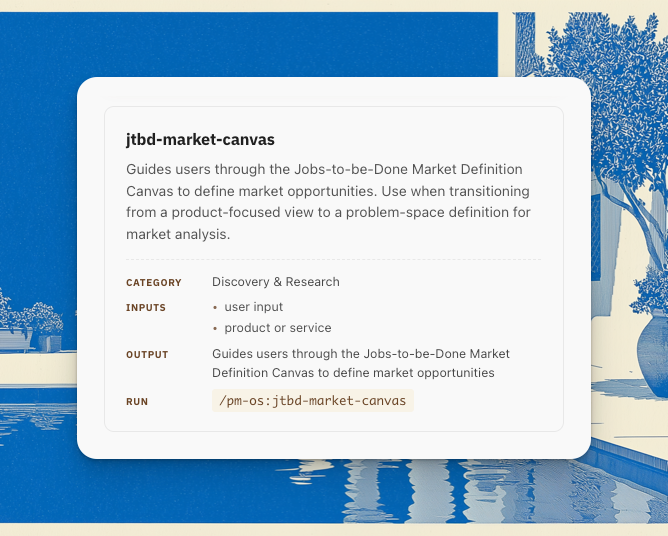
jtbd-market-canvas is one of the 243 PM skills inside AI PM OS, the shared operating system for product teams. It runs in Claude Code, Cowork or Cursor and is updated at least once every 2 weeks, on version 2.5.
Each PM keeps their own product context while the team shares workflows and review standards, so the market canvases and niche snapshots come back grounded in your product, your users, and your real constraints instead of generic PM advice.
You don't have to assemble any of it. AI PM OS wires jtbd-market-canvas into the team operating layer alongside workflows for strategy, research, decisions, stakeholder work, and measurement.
AI PM OS is $499/year for up to 10 PMs.
White-glove onboarding included. 60-day money back guarantee.
## 相关链接
- [George from prodmgmt.world](https://x.com/nurijanian)
- [@nurijanian](https://x.com/nurijanian)
- [AI PM OS is $499/year for up to 10 PMs.](https://prodmgmt.world/x/research-to-niche_220726)
- [Upgrade to Premium](https://x.com/i/premium_sign_up)
- [6:28 PM · Jul 23, 2026](https://x.com/nurijanian/status/2080238624222876157)
- [5,045 Views](https://x.com/nurijanian/status/2080238624222876157/analytics)
---
*导出时间: 2026/7/24 11:08:44*
---
## 中文翻译
# /jtbd-market-canvas: 更快地定位产品
**作者**: George from prodmgmt.world
**日期**: 2026-07-23T10:28:31.000Z
**来源**: [https://x.com/nurijanian/status/2080238624222876157](https://x.com/nurijanian/status/2080238624222876157)
---

你手头有客户调研,也有一个需要定位的产品。但你可能会下意识地想到一个现成的类别。这种捷径是有风险的,因为类别决定了你把谁视为竞争对手,从根本上也决定了你构建什么产品。
你最终可能会与那些共享同一类别的产品竞争,即使客户雇佣它们是为了完成不同的工作。你真正的市场是人们雇佣你的产品去做的那份工作。而且产品路线图具有路径依赖性,所以很快你就会被锁定在一套不适合你市场的功能特性上。
待办任务(JTBD)市场分析利用你现有的调研,围绕那份工作来定义市场。你的竞争对手是客户考虑用来完成同一份工作的其他产品或替代方案。
结果是一个用于定位的快照。你仍然可以选择留在这个市场或转移到别处。无论哪种方式,你都知道有哪些竞争对手在争取同一份工作。
## 运行画布
从当前的类别开始。写下你通常给产品的名称,这样你就有一个可以测试的定义。
列出所有从产品中获取价值的人。你笔记中提到的每一种用户,在反馈允许的范围内尽可能详细,而不是整洁的人物画像。
找到一个涵盖所有这些人的术语。向上提升一级,直到一个标签适合列表中的每一个用户。那个执行者就是你市场的“谁”。
以 [动词] + [对象] + [修饰语] 的形式命名核心功能。“将水加热到设定温度。”保持平实,去掉形容词。
列出互补品:客户在你产品之前、期间和之后使用的工具,以及每个工具为他们完成的工作。客户是跨整个链条完成工作的,而不是仅在你的功能内部。
将功能提升到客户试图完成的更高层级的工作,保持相同的 [动词] + [对象] + [修饰语] 形式。那句话就是你的市场。
用三种方式检查。工作必须涵盖你产品的功能。它必须足够高阶,以至于更好的方案仍然可以服务于它。而且它必须追溯到客户说过的话,而不是你想听到的内容。
结果是一句话:那份工作,拥有它的人,以及竞标同一份工作的其他选项。
## 它也适用于单一功能
在功能上运行它,而不仅仅是整个产品。使用相同的八个步骤,但缩小到该功能范围。选取一个功能,附带的反馈,以及它服务的工作。你会得到该功能竞争所在的细分领域。
大多数产品经理(PM)通过功能所在的菜单来定位功能。对于功能,你要问它被雇佣来做什么工作,还有谁在竞标那份工作。你放弃路线图标签,转向该功能所参与的市场。
## 困难之处
困难的部分是决定概括到什么程度。对此没有明确的规则。识别执行者和工作需要判断力,而不仅仅是查阅信息。如果你概括得太少,你只是改变了一个事物的名称而没有改变其功能。如果你概括得太多,你将与所有可用的产品竞争。你可以通过按特定顺序阅读调研来确定适当的概括程度。遵循这个顺序是必要的工作。
如果你认为自己了解你的市场类别,你应该测试它。这个测试显示你的类别是否与客户购买你产品的原因一致,以及你确定的竞争对手是否是客户实际上拿来与你比较的那些。如果这两者中任何一个与你预期的不同,这表明这是一个不同的市场。
我在一份调研资料上运行了两次,使用两个不同的工作作为锚点。客户的反馈两次都是一样的。这两个画布描述的不是同一个市场。它们识别出了不同的执行者、不同的核心功能和不同的竞争对手集合。如果我依赖于类别定义,我会假设它们是一个单一、不断增长的市场的一部分。相反,它们代表了在一个产品名称下运作的两个截然不同的市场。
## 赋予你的团队这项技能

jtbd-market-canvas 是 AI PM OS 内部 243 个 PM 技能之一,AI PM OS 是产品团队的共享操作系统。它在 Claude Code、Cowork 或 Cursor 中运行,至少每两周更新一次,目前版本为 2.5。
每个 PM 都保留自己的产品上下文,而团队共享工作流和审查标准,因此市场画布和细分领域快照能够立足于你的产品、你的用户和你的真实约束,而不是通用的 PM 建议。
你不需要组装任何东西。AI PM OS 将 jtbd-market-canvas 接入团队操作层,与战略、调研、决策、利益相关者工作和衡量相关的工作流并列。
AI PM OS 价格为每年 499 美元,支持多达 10 名 PM。
包含白手套式入职培训。60 天退款保证。
## 相关链接
- [George from prodmgmt.world](https://x.com/nurijanian)
- [@nurijanian](https://x.com/nurijanian)
- [AI PM OS is $499/year for up to 10 PMs.](https://prodmgmt.world/x/research-to-niche_220726)
- [升级到 Premium](https://x.com/i/premium_sign_up)
- [6:28 PM · Jul 23, 2026](https://x.com/nurijanian/status/2080238624222876157)
- [5,045 次浏览](https://x.com/nurijanian/status/2080238624222876157/analytics)
---
*导出时间: 2026/7/24 11:08:44*