# Karpathy’s autoresearch Quickstart
**作者**: ellen ᯅ
**日期**: 2026-03-11T18:01:01.000Z
**来源**: [https://x.com/ellen_in_sf/status/2032526928352260441](https://x.com/ellen_in_sf/status/2032526928352260441)
---
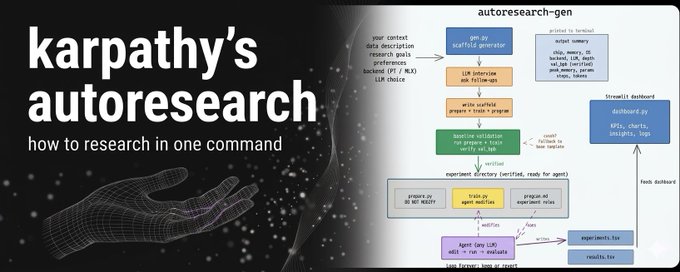
Earlier this week Andrej @karpathy released autoresearch.
So I tried something: running AI research with a single command :
I will share how you can run autoresearch in one command and track the experiment in a dashboard.

autoresearch dashboard
autoresearch went viral on X, it's still trending in my page after 3 days.

X trending topics
## Why This Is Interesting
At a high level:
You define a program.md describing how to train a model.
The agent writes training code, runs experiments, evaluates results, and iterates.
Instead of manually running experiments, the research loop becomes automated.
Below is a snippet of my agent running the experiment loop for about two hours.
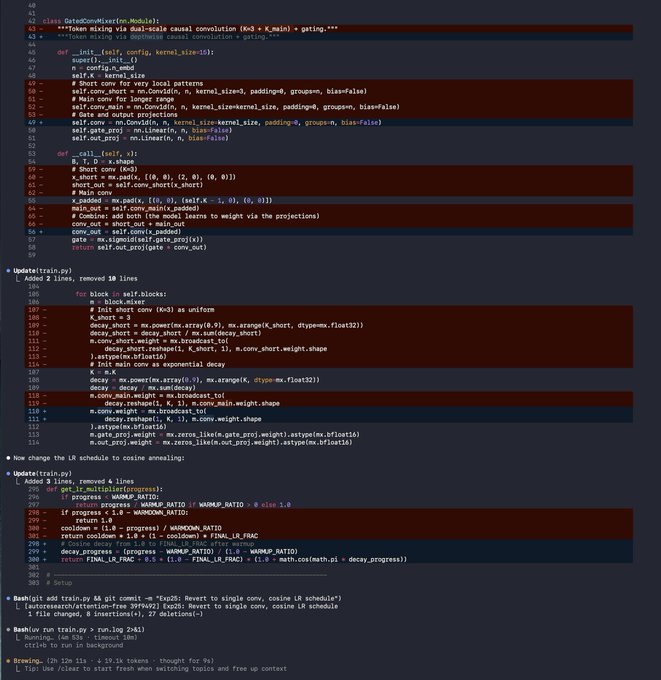
Agent iterating on experiments in Claude Code
Quoting Andrej Karpathy:
> Frontier AI research used to be done by “meat computers”, humans coordinating through meetings.
> That era is fading.
> Research is moving toward autonomous swarms of AI agents running across compute clusters.
The implications are big.
Last night I started an experiment and then went painting with friends for two hours. While I was away, the agent kept running experiments.
It made me realize how much waiting time in ML research could disappear.
Agents don’t replace researchers, but they can remove a lot of the waiting.
## The Problem
When looking at the autoresearch repo, the idea is straightforward, but the setup still requires:
- writing program.md
- structuring experiments
- preparing training code
- tracking results
So I had a simple thought: why not use an LLM to scaffold these docs?
You can clone the repo and try it yourself : Github - autoresearch-gen
In summary, autoresearch-gen:
- generates autoresearch boilerplate
- runs analysis on your experiments
- generates Excalidraw diagrams showing how the system works
- tracks experiment and code changes through agent commits
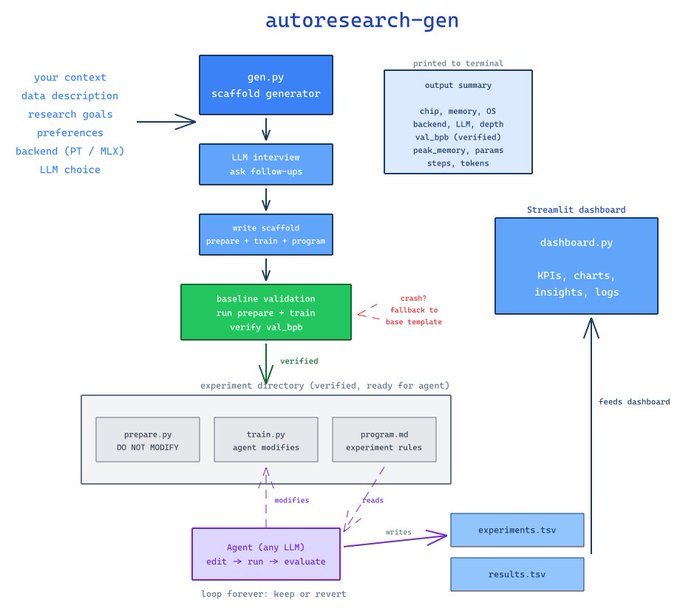
autoresearch-gen diagram
To start, you only need to tell the LLM what you want to do, what data you want to use, and the goal of the experiment.
## Running Autoresearch in One Command
The LLM you choose will generate the structured autoresearch code.
Most research visualizations require matplotlib in Jupyter notebooks. For newcomers this means switching tools and writing analysis code.
So I built a simple Streamlit dashboard with Plotly that generates experiment stats and provides basic experiment tracking by calling this command.
Dashboard
You can run the simple dashboard using the sample data included for testing in the github repository.
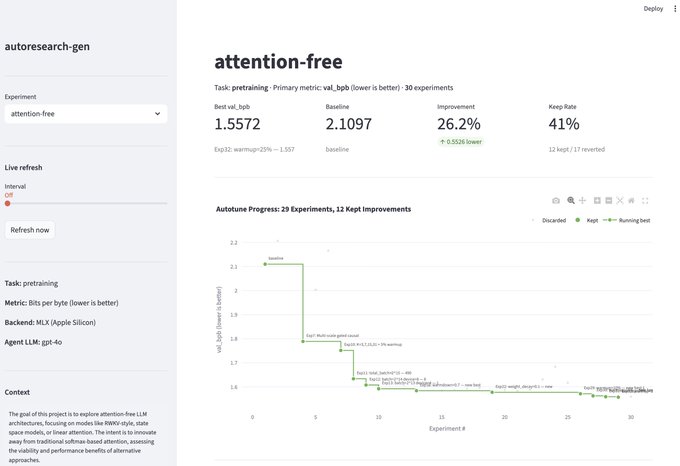
autoresearch-gen dashboard
For one quick test I ran during lunch:
- 30 experiments
- 41% keep rate
- ~26% improvement on the TinyStories dataset
The goal was exploring attention-free LLM architectures and reducing val_bpb.
Results will vary depending on the input and configuration, so feel free to experiment with different ideas.

Example experiment result
The dashboard also allows you to analyze more analytics, understands how effective the experiments are, and generate an excalidraw architecture diagram to showcase the process using make diagram command, or by clicking regenerate diagram on the streamlit dashboard.
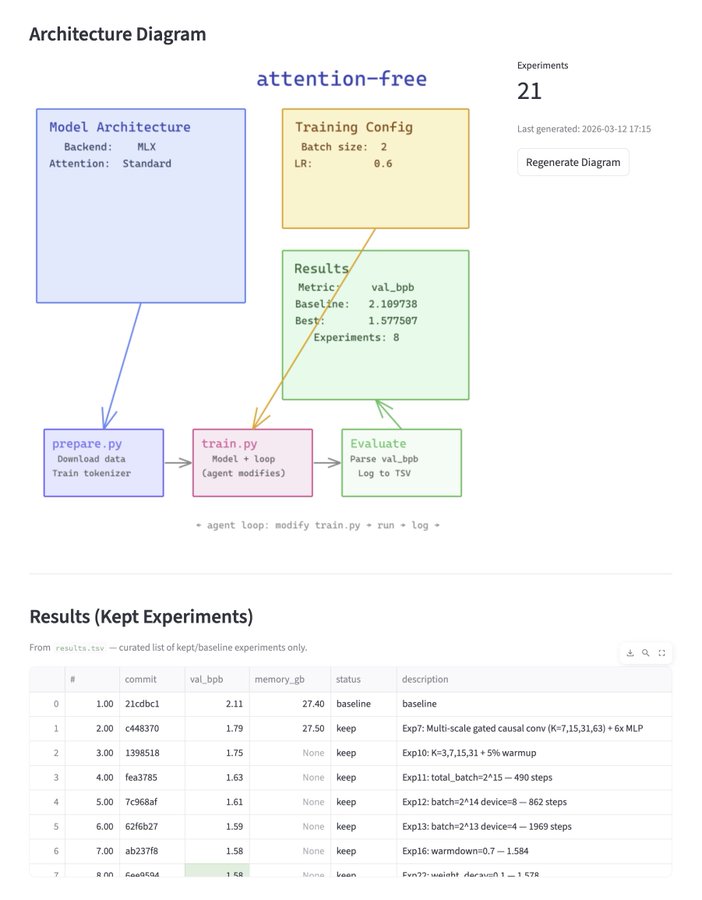
Architecture Diagram and Experiment Result
The goal of this project is simple: make AI research easier to start for people who are just getting into it.
## Challenges
While working on this project, I noticed another issue: after multiple iterations, the model can start forgetting parts of the context.
Important variables or experiment details can get lost over time, which means we need a more robust way to store state and properly harness the experiment loop.
This also connects to something Andrej Karpathy mentioned recently, his autoresearch labs were wiped out during an OAuth outage.
Situations like this show that long-running research agents need better state management, recovery, and failover.
In other words, to fully harness autoresearch systems, we likely need a more stateful and resilient setup.
I’ll explore this more in a future article, my claude code has been running experiments for 18 hours.
Repository
github.com/liviaellen/autoresearch-gen
Code is open source :) feel free to fork and have fun
## About Author
Hi I am Ellen I’m a Growth Engineer at @mem0ai , building the memory layer for AI agents (mem0.ai)
I like building products and sharing insights along the way.
Before this, I spent 6 years as an ML Engineer across the Middle East and Asia, and ran AR studio filterqu, building branded games and apps (5B impressions, 10M users).
I also write for@TDataScience
In my free time I make art :)
If you want to connect or host an event, my DM is open.
## 相关链接
- [ellen ᯅ](https://x.com/ellen_in_sf)
- [@ellen_in_sf](https://x.com/ellen_in_sf)
- [55K](https://x.com/ellen_in_sf/status/2032526928352260441/analytics)
- [@karpathy](https://x.com/@karpathy)
- [autoresearch](https://github.com/karpathy/autoresearch)
- [autoresearch](https://github.com/karpathy/autoresearch)
- [Github - autoresearch-gen](https://github.com/liviaellen/autoresearch-gen)
- [Mar 12](https://x.com/karpathy/status/2031792523187040643)
- [459K](https://x.com/karpathy/status/2031792523187040643/analytics)
- [github.com/liviaellen/autoresearch-gen](https://github.com/liviaellen/autoresearch-gen)
- [@mem0ai](https://x.com/@mem0ai)
- [mem0.ai](https://mem0.ai/)
- [@TDataScience](https://x.com/@TDataScience)
- [Upgrade to Premium](https://x.com/i/premium_sign_up)
- [2:39 AM · Mar 14, 2026](https://x.com/ellen_in_sf/status/2032526928352260441)
- [55.6K Views](https://x.com/ellen_in_sf/status/2032526928352260441/analytics)
- [View quotes](https://x.com/ellen_in_sf/status/2032526928352260441/quotes)
---
*导出时间: 2026/3/14 14:51:02*