# Let a billion mathematicians bloom
**作者**: Emad
**日期**: 2026-09-12T00:07:11.000Z
**来源**: [https://x.com/EMostaque/status/2098564039483719727](https://x.com/EMostaque/status/2098564039483719727)
---
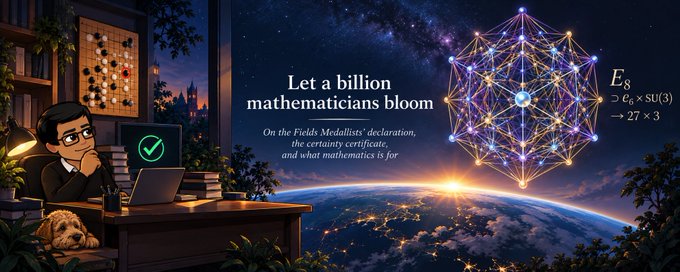
The Fields Medallists fear AI will break mathematics. I think it may let millions in.
## Move 37
On 10 March 2016, in the second game of its match against Lee Sedol, [AlphaGo](https://en.wikipedia.org/wiki/AlphaGo_versus_Lee_Sedol) played a move on the fifth line of the board that no professional would have played. The commentators laughed. It looked like a mistake; players had been taught for four hundred years not to go there. The move won the game, and it has been known ever since as move 37.
Lee lost the match. Three years later he retired, saying that AI was an entity that could not be defeated.
Most people know that part of the story. Fewer know what happened to everyone else. A [2023 study in PNAS](https://www.pnas.org/doi/10.1073/pnas.2214840120) took 5.8 million moves by professional Go players, from 1950 to 2021, and had a superhuman engine grade each one. For sixty-six years the quality of professional play had been almost flat. After AlphaGo it rose sharply and kept rising, and not through imitation: players began to introduce moves that had never appeared in the record, and the new moves were better than the old ones.
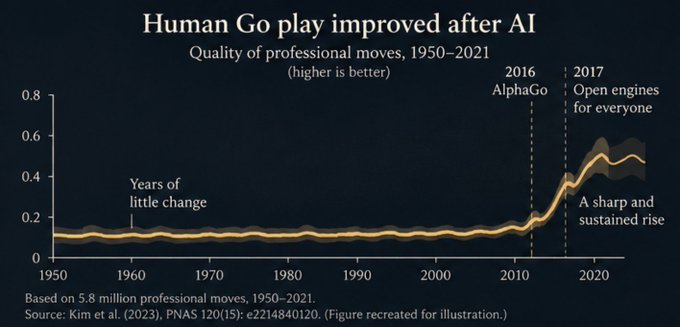
The rise did not come in 2016, when the world watched AlphaGo play. It came in 2017, when [open-source engines](https://escholarship.org/uc/item/6q05n7pz) put a superhuman teacher on every laptop and let players see how it rated every move they might have made instead. Watching the machine play changed little. Being able to ask it why changed everything.
## The declaration
On September 11th, twenty-five Fields Medallists signed [a declaration](https://mathandai.org/) on AI and mathematics. It opens by conceding that AI can now "solve major outstanding problems in many fields of mathematics." It goes on to call that "detrimental to the science of mathematics."
Terence Tao [posted it](https://terrytao.wordpress.com/2026/09/11/a-severe-misalignment-of-ai-in-mathematics/) with a note that it had been written in a week, because they felt the matter was urgent. These are the people at the top of the field, and the declaration deserves a real answer rather than a dismissal.
Their case, at its strongest, is stronger than they put it. For centuries a hard problem did two jobs at once. Solving it produced knowledge, and the years of struggle to solve it produced the mathematician: the understanding, the taste, the ability to ask the next question.
The famous problems were proxies for insight, and when one fell, the methods behind it were talked over, simplified and taught until they belonged to everyone.
The worry is that AI separates the product from the process. A machine can now deliver the theorem without the struggle that used to come with it, and results arrive in a rush, without proper writeups, without the earlier work named, without the human chain that turns a proof into part of mathematics. The letter says this is a threat to all intellectual work, and so it is.
They are right that the two are separating.
I think they are wrong about what follows.
The letter says, in its own words, that AI "offers the potential of enhancing and accelerating genuine mathematical study and understanding."
I agree with that sentence completely.
Nearest to hand, the letter fears that the companies will use mathematics as a scoreboard instead, and on that it is right: racing ten thousand agents at a famous problem for a press release is a cheap use of a great tool. The declaration is called "A Severe Misalignment of AI in Mathematics," and the misalignment it means is between what the companies want and what mathematicians want. That misalignment is real.
What the letter leaves out is a second change underneath the first. In a declaration about AI and mathematical truth, the words "verified," "certificate" and "Lean" do not appear. For all of recorded mathematics, guessing was cheap and checking was dear. That has just flipped.
Certainty used to be a person. Now it can be a certificate.
## The certainty certificate
Mathematics is the study of the structure of reality: the part that is fixed, that would be the same in any universe, that nobody gets to vote on.
There are infinitely many primes whether or not anyone counts them. The largest of the exceptional symmetries, called E8, had its 248 dimensions before anyone drew them, and it was waiting there when [Viazovska](https://arxiv.org/abs/1603.04246) used it to show the densest way to pack spheres in eight dimensions. One week after she posted that proof, [she and four others](https://arxiv.org/abs/1603.06518) used the same method to settle dimension twenty-four.
A structure, once seen, is fertile ground, and the point of studying mathematics is to see it. For the whole of history seeing was hard because checking was hard. Anyone could guess. Almost no one could check. Every institution the declaration defends grew up around that scarcity. Peer review rations the checkers. The long apprenticeship manufactures them. The prestige of being first to a proof is the price scarcity set.
Scarcity bundled things that are not the same. Finding an answer, checking it, understanding it, learning how to find the next one and deciding which questions matter were all done by the same few people, because trained human attention was the only instrument there was. The letter treats that bundle as the nature of mathematics. It was the economics of mathematics, and the machine is pulling it apart, checking first.
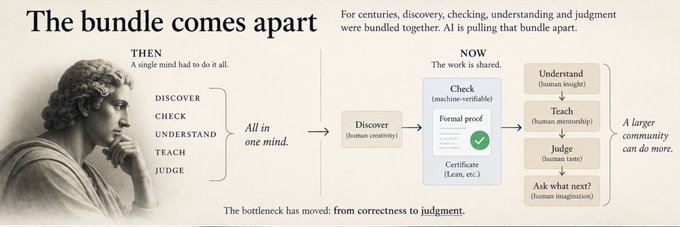
The scarcity is ending because certainty has changed form. It used to be a person, someone with the training to read your argument and the standing to say it was right. Now it can be a certificate, a file that one machine produces and any other machine can check, and a file can be copied without limit.
I have written [elsewhere](https://www.amazon.co.uk/Last-Economy-Guide-Intelligent-Economics-ebook/dp/B0FNDMWRZT) about the intelligence inversion, the moment intellect stops being the scarce input to an economy. The certainty certificate is the same event inside mathematics, and the purest case of it, because a formal proof is the rare intellectual product a machine can check all the way down.
Programs that check proofs line by line, called [proof assistants](https://en.wikipedia.org/wiki/Proof_assistant), have existed for decades. What is new is that AI models can write in their language, so a claim can be checked by one of them, [Lean](https://lean-lang.org/), in hours instead of years. And that is only the floor. A formal proof tells you that the steps follow; it does not tell you where the argument is fragile, or which assumption is carrying the weight.
Ask a model to attack a paper and it finds the weak seams: the step that assumes more than it says, the convention that flips a sign. Ask it to check a calculation and it redoes the calculation in a different program and compares. No human referee can do that in an afternoon, and a wrong turn now costs one.
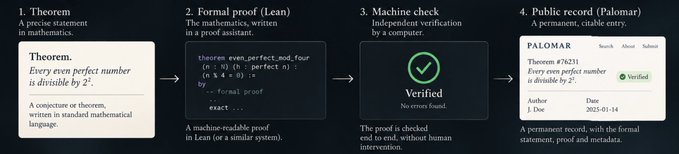
None of this is news to the signatories. Scholze asked the Lean community in 2020 to check a proof of his own that he did not fully trust, and in 2022 [they did](https://xenaproject.wordpress.com/2022/07/14/liquid-tensor-experiment-completed/). And a few weeks before the letter, Tao [opened Palomar](https://terrytao.wordpress.com/2026/08/18/palomar-a-registry-of-lean-verified-mathematics/), a public registry of Lean-verified mathematics that he helps maintain.
From idea to wisdom
A submission is accepted when the machine confirms that the proof proves the stated theorem using only the standard axioms, and a model checks that the formal statement corresponds to the author's informal description. Palomar does not ask who wrote the proof. It is the certificate, built by the mathematical community for itself, and the letter that followed it does not mention it.
A certificate does not make everything cheap. It makes correctness cheap. It says nothing about whether the assumptions were the right ones, or whether the theorem matters, and it does nothing for the next scarcity, which is attention. Ten million verified results are a harder sorting problem than ten thousand papers, and no file solves it. Sorting checked from unchecked is now the machine's job. Sorting deep from shallow was always the mathematician's, and there has never been more of it to do.
The bottleneck has not gone. It has moved, from correctness to judgment.
One condition, and it is the one I have spent years arguing for. If only a few companies can produce the certificate, the gate has moved rather than opened. The letter says the outcome will be decided by "the humans in control of this new technology." Then the humans in control should be everyone. The engines that lifted Go were open. The checkers, and the models that read them, have to be open too.
## Where the argument breaks
The declaration names its harms: rushed announcements, missing writeups, uncredited work, a broken chain. What it does not establish is that faster solution means less eventual understanding. Once a proof exists, people can study it, and the record says they do.
When [Perelman](https://en.wikipedia.org/wiki/Grigori_Perelman) proved the Poincaré conjecture he posted three terse papers online and walked away. Others turned them into hundreds of readable pages, and Tao himself [taught a year-long course](https://terrytao.wordpress.com/category/teaching/285g-poincare-conjecture/) on his blog explaining them.
The four colour theorem was proved by computer in 1976, to polite applause and fifty years of argument about whether it counted. [This week](https://www.quantamagazine.org/the-four-color-theorem-gets-a-rare-new-proof-20260910/) a new proof of it, also by computer, uncovered structure in planar graphs that nobody had seen, and one of its authors says he will never stop looking for the one-page argument. A result that has been true for half a century is still yielding new mathematics.
Mathematics has always had a gap between a result appearing and the community absorbing it. AI widens the gap. It does not create it.
What remains is institutional: the field rewards whoever is first, students learn by being stuck on hard problems for a long time, and the refereeing system was built for a slow trickle of papers.
This week's Navier–Stokes quarrel is the case in point. A rumour of Tristan Buckmaster and Levent Alpöge's year of work reached OpenAI, which ran ten thousand agents and announced a result twelve hours after they posted theirs. That was a quarrel about credit and conduct, and the profession has remedies for both. What was settled, on both sides, is a version of the problem with an outside force pushing the fluid; the original Navier–Stokes question, about a fluid left to itself, is still open. The Millennium problem is what the letter calls it, a lighthouse, and a lighthouse is not a harbour.
The letter says that "mathematics as a profession will need to adapt," and so it will. These arrangements will be fixed, if they are fixed, by mathematicians changing how they train, credit and referee. If the implied answer is to slow the production of results, that treats abundance as the problem instead of redesigning institutions that were built for scarcity.
That does not mean the companies have nothing to do, and since the letter addresses them, so should we. Do not race on rumours. When you finish a human's method, publish with the history intact and their names above yours. Open the checker. And build Leela, not Deep Blue. Build a teacher that shows its reasoning, rather than an engine that only wins.
## An old grief, and what shipping did
Under the declaration is a grief that mathematicians have stopped sharing ideas and started guarding them. That grief is very old. In 1535 Tartaglia worked out how to solve cubic equations and [kept it secret](https://en.wikipedia.org/wiki/Cubic_equation#History) so that he could win contests with it. Newton [sat on the calculus](https://en.wikipedia.org/wiki/Leibniz–Newton_calculus_controversy) for decades, and the dispute with Leibniz poisoned English mathematics for a century. Every generation has believed that secrecy was a new corruption.
Every generation has had its Trithemius, too. In 1492 the abbot [Johannes Trithemius](https://en.wikipedia.org/wiki/Johannes_Trithemius) wrote [In Praise of Scribes](https://en.wikipedia.org/wiki/De_laude_scriptorum), arguing that monks should keep copying by hand, despite the press, because the copying formed the copyist. He had it printed. He was right that something was lost and wrong about how much it mattered. There is an echo of Trithemius in the declaration's "crucial human transmission chain."
The new thing is an alternative to guarding that works at scale. Release the idea before anyone can take it, with your name in the commit history where nobody can remove it. Priority disputes are what you get when publication is slow and private; make it fast and public and there is much less left to dispute. The lesson of the week is that mathematicians should ship faster.
I know what shipping does because I have watched it. In August 2022 my company released [Stable Diffusion](https://en.wikipedia.org/wiki/Stable_Diffusion) as open weights and open code. The mathematics is the beautiful part. Let an image dissolve into noise the way ink spreads in water, then learn to run that process backwards. The forward direction is ordinary physics, the same equation that describes heat spreading through a metal bar. The reverse direction needs one extra ingredient, a quantity that says at every step which way is "more like a real picture," which nobody can write down and a neural network can learn.
Out of [an equation](https://en.wikipedia.org/wiki/Fokker–Planck_equation) Einstein would have recognised came the ability to paint, and tens of millions of people who had never drawn made pictures. The letter hopes that the best ideas become, "decades or centuries after, tools that are understood and used by the whole population." That took weeks. A piece of mathematics most of its users will never read gave them a form of agency, because it was open. We can send mathematics the same way.
## A small proof of the point
The letter names students and ideas as the profession's most precious resources. I was one of the students. I read mathematics at Oxford and then left pure mathematics for twenty years.
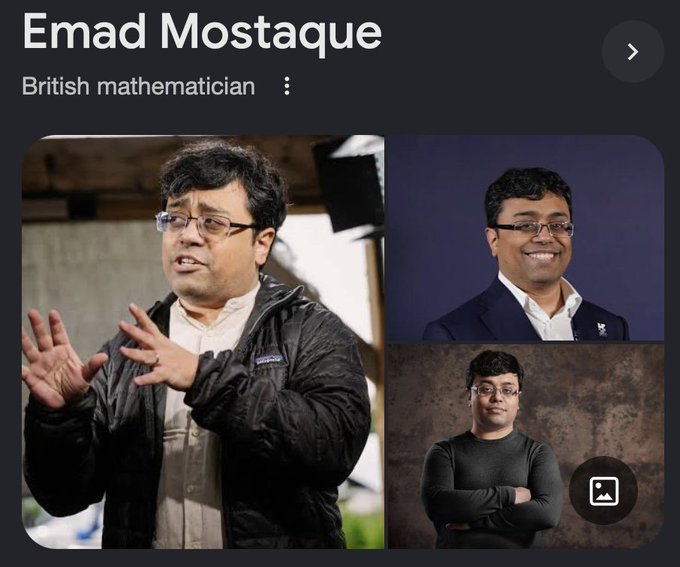
Google's panel for me says "British mathematician," and for most of those years I would have told you it was wrong. I had stopped seeing myself as one. I never stopped having ideas. I had nowhere to take them, because the hard part is not the idea; it is the months of checking that follow it, and I never had the months. The tools gave me the months, and somewhere in those months the panel became true. I feel like a mathematician again. Nothing about me changed; the cost of checking did.
it me
Every symmetry in nature has a grammar, called a [Lie algebra](https://en.wikipedia.org/wiki/Lie_algebra), and in the 1890s Killing and Cartan [wrote down every one there could be](https://en.wikipedia.org/wiki/Compact_Lie_algebra). The particles we have discovered match three symmetries from that list, arranged in a table, and the table repeats three times. Nobody has an accepted derivation of why those three symmetries, why that table, or why three copies. For fifty years theorists have chosen a larger symmetry and fitted the table inside it, and the choice goes in by hand. So does the three.
One fact about matter is not a choice. Matter is chiral: the particles that make us are different from their mirror images. If they were not, they could have paired off and vanished before there was anything to see. Chirality is not an ornament on the table; it is the reason there is a table at all. What if chirality were a filter on the symmetries themselves?
I [ran the filter](https://emad-ii.github.io/chirality-standard-model/), the way a diffusion model runs the ink back into the pen. Take every pair from the Killing–Cartan list, a smaller symmetry inside a larger one.
Keep only the pairs where what is left over is chiral, and where the quantum consistency condition that every real theory must obey holds on part of the smaller symmetry.
Everything falls.
Within the stated domain, one pair stands: [E8](https://en.wikipedia.org/wiki/E8_(mathematics)) with E6 and a small threefold symmetry inside it.
Read what is left over in the language of the particles we measure, and it is the Standard Model with a threefold symmetry: three chiral families. No extra dimensions, no landscape of ten-to-the-five-hundred universes to choose from. It matches the world we measure.
It is a classification with a full proof. The finite parts are [checked in Lean](https://github.com/emad-ii/chirality-standard-model/blob/main/verification/README.md) and the searches run in a [notebook anyone can open](https://colab.research.google.com/github/emad-ii/chirality-standard-model/blob/main/Cubic_Anomaly_Master_Verification.ipynb). The [paper](https://emad-ii.github.io/chirality-standard-model/paper.pdf) states its assumptions and its limits in full, so that anyone who disagrees knows where to aim. The certificate establishes that under these two conditions one pair survives. No certificate can say whether those conditions are nature's. That question belongs to people, and it is where the work begins.
The letter distinguishes ideas conceived by AI, which it fears will never come alive, from the human study it hopes AI will help. This is the second kind: human-conceived, machine-carried, certificate-checked, public. It is the thing the letter says it wants, made by the process it says it fears.
I know the pull of the old way from the inside. I had the core of this result in April, a two-page note I called [The Gauge Algebra of Chirality](https://x.com/EMostaque/status/2096611263719596330?s=20). I sat on it for five months, broadening the classification, adding the one-click checks, telling myself it was not ready. What moved me in the end was the certainty that a model would find it within the year, and that I wanted my name in the history when it did. Tartaglia would understand. The difference is that [I published](https://x.com/EMostaque/status/2096610030267085143).
Instead of a journal, it went to GitHub, with the proofs, the certificates and the Lean files, open to anyone: PR review in place of peer review. None of this is new to mathematics. [Polymath](https://polymathprojects.org/), which Gowers and Tao ran from 2009, solved problems in public comment threads with anyone who turned up; it was the fork before there was anything to fork. Loosen a requirement and see what appears; point a model at it and tell it to break it. Every fork is a review, and every extension is the understanding the declaration says is being lost.
The letter's fear is that AI will produce mathematics without producing mathematicians. My hope is that it produces mathematicians who could never have become mathematicians before. There are a great many of us, students who left with the ideas intact and no checker to take them to. The letter mourns its precious resources. We are about to come back.
## What the medallists are for
If machines can certify proofs, what are the mathematicians for? Correctness was never the interesting part. The moment worth being in the seminar for is when someone shows you why the thing was worth proving, and what to ask next. Taste, and the sense of which structures are deep, cannot be handed to a checker. The great mathematicians have it, and it is what a billion newcomers will need from them.
The letter holds that a machine cannot make mathematics live without mathematicians to take its ideas in and make them part of the canon. That is true, and it is an argument for more mathematicians rather than fewer machines.
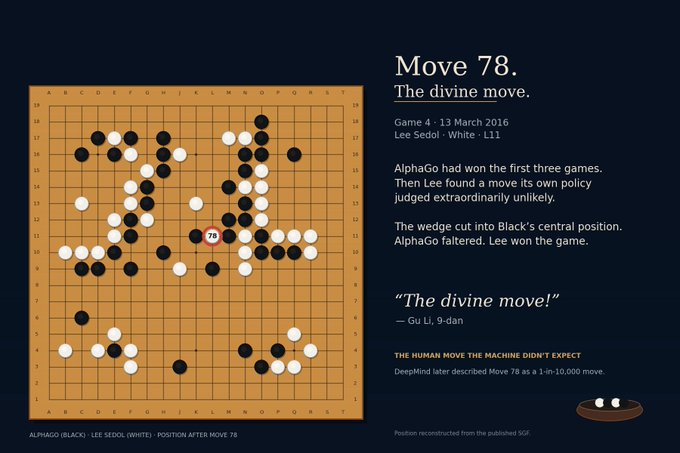
In the fourth game against AlphaGo, Lee Sedol played move 78, a wedge the machine had rated as a move no one would play, and won the only game a human has ever taken from it. Taste saw that move, and taste is what a guide gives. The role moves from gatekeeper to guide, from the person who decides whether you may enter to the person who walks the country with you and points at what is beautiful.
The letter is about the frontier, and so is this. The frontier is not a place a few people are permitted to stand. It is the edge of what is known, and the question is how many people get to stand at it. The letter calls the famous problems lighthouses. A lighthouse is built for the ships still at sea.
"I've never been congratulated so much because I've won one game." - Lee Sedol
In 1984 Benjamin Bloom showed that a student with a personal tutor outperforms ninety-eight per cent of students taught in a classroom, and for forty years nobody could afford a tutor for everyone. A public school district in Pasadena, where two thirds of the children qualify for free or reduced-price lunch, [built one](https://www.justinmath.com/math-academys-eurisko-sequence-5-years-later/), and its eighth-graders now sit the hardest calculus exam in America and most of them pass. The method is written up in a free book, [The Math Academy Way](https://www.justinmath.com/books/#the-math-academy-way), and it is not a secret: spaced practice, mastery before advancement, and a tutor who never lets a gap go unfilled. The machine can become that tutor, for everyone.
The letter's real worry is students, and it is right to worry about them. Nobody yet knows how the frontier trains its next generation when the machine can solve the problems students used to be stuck on; that is the question the letter raises but cannot answer, and neither side has it yet. What we do know is that a guide has never had more students, and no one is better placed to find the answer than the twenty-five. We have the tool to bring millions into mathematics. The only question is whether we pick it up.
## Ramanujan and the certificate
[Ramanujan](https://en.wikipedia.org/wiki/Srinivasa_Ramanujan) taught himself from a single book of theorems, worked as a clerk in Madras, and filled notebooks with results he could not prove and no one could check. In 1913 he wrote to three English mathematicians. Two did not reply. [Hardy](https://en.wikipedia.org/wiki/G._H._Hardy) did, because he saw that the formulas had to be true: no one, he said, could have had the imagination to invent them.
Hardy became the certificate Ramanujan lacked. He got five years in Cambridge before his health broke, and he died at thirty-two.
Now imagine him with a frontier model: every formula checked the night he wrote it, told the same day which of his formulas Euler had found two centuries earlier and which were his own. No letter to Hardy, because the certificate would have come with the notebook, and a great deal more for Hardy to do, because the only question left would have been what it meant.
Hardy once took a taxi to visit him in hospital and remarked that its number, 1729, was a dull one. No, said Ramanujan, it is the smallest number that is the sum of two cubes in two different ways. That is not checking. That is two people in a room, one of whom can see further, and it is what the certificate makes room for.
That collaborator now exists, and it is available to anyone with a phone. I have lost count of the people who have told me they cannot do mathematics. Most of them had the capacity. What they lacked was the months, the checker and the company, and all three have just become cheap.
The next Ramanujan is a clerk somewhere right now, and this time the letter will not have to be posted. Some of the billion will find things. Most will simply see, for the first time, how beautiful it is. All of them will need company, and the company they need is a fellow explorer who has been further in.
The signatories have written that the future of the field depends on human decisions.
I agree with every word. Let ours be to welcome everyone in.
May we all dream like Ramanujan.
Emad
## 相关链接
- [Emad](https://x.com/EMostaque)
- [@EMostaque](https://x.com/EMostaque)
- [10K](https://x.com/EMostaque/status/2098564039483719727/analytics)
- [AlphaGo](https://en.wikipedia.org/wiki/AlphaGo_versus_Lee_Sedol)
- [2023 study in PNAS](https://www.pnas.org/doi/10.1073/pnas.2214840120)
- [open-source engines](https://escholarship.org/uc/item/6q05n7pz)
- [a declaration](https://mathandai.org/)
- [posted it](https://terrytao.wordpress.com/2026/09/11/a-severe-misalignment-of-ai-in-mathematics/)
- [Viazovska](https://arxiv.org/abs/1603.04246)
- [she and four others](https://arxiv.org/abs/1603.06518)
- [elsewhere](https://www.amazon.co.uk/Last-Economy-Guide-Intelligent-Economics-ebook/dp/B0FNDMWRZT)
- [proof assistants](https://en.wikipedia.org/wiki/Proof_assistant)
- [Lean](https://lean-lang.org/)
- [they did](https://xenaproject.wordpress.com/2022/07/14/liquid-tensor-experiment-completed/)
- [opened Palomar](https://terrytao.wordpress.com/2026/08/18/palomar-a-registry-of-lean-verified-mathematics/)
- [Perelman](https://en.wikipedia.org/wiki/Grigori_Perelman)
- [taught a year-long course](https://terrytao.wordpress.com/category/teaching/285g-poincare-conjecture/)
- [This week](https://www.quantamagazine.org/the-four-color-theorem-gets-a-rare-new-proof-20260910/)
- [kept it secret](https://en.wikipedia.org/wiki/Cubic_equation#History)
- [sat on the calculus](https://en.wikipedia.org/wiki/Leibniz%E2%80%93Newton_calculus_controversy)
- [Johannes Trithemius](https://en.wikipedia.org/wiki/Johannes_Trithemius)
- [In Praise of Scribes](https://en.wikipedia.org/wiki/De_laude_scriptorum)
- [Stable Diffusion](https://en.wikipedia.org/wiki/Stable_Diffusion)
- [an equation](https://en.wikipedia.org/wiki/Fokker%E2%80%93Planck_equation)
- [Lie algebra](https://en.wikipedia.org/wiki/Lie_algebra)
- [wrote down every one there could be](https://en.wikipedia.org/wiki/Compact_Lie_algebra)
- [ran the filter](https://emad-ii.github.io/chirality-standard-model/)
- [checked in Lean](https://github.com/emad-ii/chirality-standard-model/blob/main/verification/README.md)
- [notebook anyone can open](https://colab.research.google.com/github/emad-ii/chirality-standard-model/blob/main/Cubic_Anomaly_Master_Verification.ipynb)
- [paper](https://emad-ii.github.io/chirality-standard-model/paper.pdf)
- [The Gauge Algebra of Chirality](https://x.com/EMostaque/status/2096611263719596330?s=20)
- [I published](https://x.com/EMostaque/status/2096610030267085143)
- [Polymath](https://polymathprojects.org/)
- [built one](https://www.justinmath.com/math-academys-eurisko-sequence-5-years-later/)
- [The Math Academy Way](https://www.justinmath.com/books/#the-math-academy-way)
- [Ramanujan](https://en.wikipedia.org/wiki/Srinivasa_Ramanujan)
- [Hardy](https://en.wikipedia.org/wiki/G._H._Hardy)
- [Upgrade to Premium](https://x.com/i/premium_sign_up)
- [8:07 AM · Sep 12, 2026](https://x.com/EMostaque/status/2098564039483719727)
- [10K Views](https://x.com/EMostaque/status/2098564039483719727/analytics)
- [View quotes](https://x.com/EMostaque/status/2098564039483719727/quotes)
---
*导出时间: 2026/9/12 10:12:54*
---
## 中文翻译
# 让十亿数学家绽放
**作者**: Emad
**日期**: 2026-09-12T00:07:11.000Z
**来源**: [https://x.com/EMostaque/status/2098564039483719727](https://x.com/EMostaque/status/2098564039483719727)
---

菲尔兹奖得主们担心AI会摧毁数学。而我认为,AI可能会让数百万人走进数学。
## 第37手
2016年3月10日,在与李世石对局的第二盘中,[AlphaGo](https://en.wikipedia.org/wiki/AlphaGo_versus_Lee_Sedol)在棋盘第五路下出了一手任何职业棋手都不会下的棋。解说员们笑了。这看起来像一个失误;四百年来棋手们一直被教导不要走那里。这手棋赢下了那局棋,从此被称为“第37手”。
李世石输掉了那场比赛。三年后他退役了,说AI是一个无法被战胜的存在。
大多数人都知道故事的这一部分。但很少有人知道其他人身上发生了什么。[2023年发表于PNAS的一项研究](https://www.pnas.org/doi/10.1073/pnas.2214840120)收集了1950年至2021年间职业围棋棋手的580万手棋,并用一个超越人类的引擎为每一手棋打分。六十六年来,职业棋手的水平几乎一直持平。AlphaGo出现之后,水平急剧上升并持续攀升,而且这并非通过模仿:棋手们开始引入棋谱中从未出现过的着法,而这些新着法比旧的更好。

水平的提升并非出现在2016年,即全世界观看AlphaGo对弈的那一年。它出现在2017年,那时[开源引擎](https://escholarship.org/uc/item/6q05n7pz)把一位超越人类的老师放到了每一台笔记本电脑上,让棋手们能够看到它如何评估自己本可以走的每一步棋。观看机器下棋改变甚微。能够询问它“为什么”,却改变了一切。
## 声明
9月11日,二十五位菲尔兹奖得主签署了[一份关于AI与数学的声明](https://mathandai.org/)。开篇便承认AI如今已能“解决数学诸多领域的重大未解问题”。接着它又声称这种现象“对数学科学有害”。
陶哲轩[发布了它](https://terrytao.wordpress.com/2026/09/11/a-severe-misalignment-of-ai-in-mathematics/),并注明声明是在一周内写成的,因为他们感到事态紧迫。他们是这个领域的顶尖人物,这份声明值得一个真正的回应,而不是一挥了之。
他们的论点,在其最强形态下,比他们所表述的还要有力。几个世纪以来,一道难题同时承担着两项职责。解决它产生了知识,而为解决它而进行的多年挣扎则造就了数学家:理解力、品味,以及提出下一个问题的能力。
著名的难题是洞察力的替代品,当一道难题被攻克时,其背后的方法会被反复讨论、简化并传授,直到属于所有人。
他们的担忧是,AI把产品与过程分离开了。如今机器可以交付定理,而无需伴随以往的挣扎,成果蜂拥而至,没有完善的成文报告,没有提及前人的工作,没有把一个证明变成数学一部分的人类链条。信中说这对一切智力工作都是威胁,事实确是如此。
他们说这两者正在分离,这一点是对的。
但我认为他们对随之而来的后果的判断是错的。
信中用他们自己的话说,AI“提供了增强和加速真正的数学研究与理解的可能”。
我完全同意这句话。
最直接的担忧是,信中担心企业反而会把数学当作记分板,在这一点上它是对的:为了发一篇新闻稿,让上万个智能体在某个著名问题上竞速,是对伟大工具的廉价使用。这份声明名为《AI在数学中的严重错位》,它所说的错位是指企业想要的与数学家想要的之间的错位。这种错位是真实存在的。
而这封信遗漏的,是在第一个变化之下的第二个变化。在这份关于AI与数学真理的声明中,“验证”、“证书”和"Lean"这些词一次都没有出现。在整个有记载的数学史上,猜测是廉价的,而检验是昂贵的。这一切刚刚被颠覆。
确定性曾经是一个人。现在它可以是一份证书。
## 确定性证书
数学是对现实结构的研究:那部分是固定的,在任何宇宙中都一样,不容任何人投票决定。
无论有没有人数过,素数都有无穷多个。最大的例外对称性,称为E8,在有人画出它之前就拥有它的248个维度,当[Viazovska](https://arxiv.org/abs/1603.04246)用它证明八维空间中球的最高密度堆积方式时,它一直在那里等待。在她发布那个证明一周后,[她和其他四人](https://arxiv.org/abs/1603.06518)用同样的方法解决了二十四维的情形。
一个结构一旦被看见,就是肥沃的土壤,而研究数学的意义就在于看见它。在整个人类历史中,“看见”之所以困难,是因为“检验”困难。任何人都可以猜想,但几乎没有人能够检验。声明所捍卫的每一个制度,都是在那种稀缺性周围成长起来的。同行评审是对检验者的配给。漫长的学徒制是在制造检验者。“首个证明”的声望是稀缺性定下的价格。
稀缺性把本不相同的东西捆绑在了一起。找到答案、检验它、理解它、学会如何找到下一个答案,以及决定哪些问题重要,这些都由同样少数几个人完成,因为受过训练的人类注意力是唯一可用的工具。这封信把这种捆绑当作数学的本质。它其实是数学的经济学,而机器正在把它拆开,先从检验开始。

稀缺性正在终结,因为确定性改变了形式。它曾经是一个人,一个有足够学养读懂你的论证、又有足够地位断言它正确的人。现在它可以是一份证书,一个由某台机器生成、任何其他机器都能检验的文件,而文件可以被无限复制。
我曾在[别处](https://www.amazon.co.uk/Last-Economy-Guide-Intelligent-Economics-ebook/dp/B0FNDMWRZT)写过“智能倒置”,即智力不再是经济体中稀缺投入的那一刻。确定性证书就是数学内部的同一事件,也是它最纯粹的案例,因为形式化证明是极少数机器能够从头验证到尾的智力产品。
逐行检查证明的程序,即所谓的[证明助手](https://en.wikipedia.org/wiki/Proof_assistant),已经存在了几十年。新的变化是AI模型能够用它们的语言写作,因此一个论断可以在几小时而不是几年内由其中之一——[Lean](https://lean-lang.org/)——完成检验。而这还只是下限。形式化证明告诉你每一步都成立;它不会告诉你论证在哪里脆弱,或者哪个假设在承担关键重量。
让一个模型攻击一篇论文,它会找出薄弱的接缝:那些假设多于其所述的步骤,那些会翻转正负号的约定。让它检验一个计算,它会在另一个程序中重做计算并进行比对。没有任何人类审稿人能在一个下午做到这些,而现在一个错误的转折只需付出一个下午的代价。
这些对签署者们来说都不是新闻。Scholze在2020年请Lean社区检验他自己都无法完全信任的一个证明,2022年[他们做到了](https://xenaproject.wordpress.com/2022/07/14/liquid-tensor-experiment-completed/)。而在声明发表前几周,陶哲轩[上线了Palomar](https://terrytao.wordpress.com/2026/08/18/palomar-a-registry-of-lean-verified-mathematics/),一个由他协助维护的经Lean验证的数学公共登记库。

从想法到智慧
当机器确认证明仅使用标准公理便证明了所述定理,且有一个模型检验该形式化陈述与作者的非形式化描述相对应时,一份提交便会被接受。Palomar不问证明是谁写的。它就是证书,由数学共同体为自己建造,而随后那封信却对它只字未提。
证书并不能让一切变得廉价。它让“正确性”变得廉价。它对假设是否正确、定理是否重要只字不提,也对下一个稀缺性——注意力——无能为力。一千万个已验证的结果是一个比一万篇论文更难的筛选问题,没有任何文件能解决它。区分“已验证”与“未验证”如今是机器的工作。区分“深刻”与“浅薄”从来都是数学家的工作,而这样的工作从来没有这么多。
瓶颈没有消失。它移动了,从正确性移到了判断力。
有一个条件,也是我多年来一直主张的条件。如果只有少数几家公司能够生成证书,那么大门只是移动了,而不是打开了。信中说,结果将由“掌控这项新技术的那些人”决定。那么掌控者就应该是所有人。 lifting 围棋的那些引擎是开放的。检验器,以及读懂它们的模型,也必须是开放的。
## 论证断裂之处
声明列举了它所认定的危害:仓促的公告、缺失的成文报告、未被署名的工作、断裂的传承链条。它没有证明的是:更快地解决问题意味着最终更少的理解。一旦证明存在,人们就可以研究它,而记录表明他们确实会这样做。
当[Perelman](https://en.wikipedia.org/wiki/Grigori_Perelman)证明庞加莱猜想时,他在网上发布了三篇简短的论文便转身离去。其他人把它们扩展成数百页可读的文字,而陶哲轩本人则在博客上[开设了一门为期一年的课程](https://terrytao.wordpress.com/category/teaching/285g-poincare-conjecture/)来讲解它们。
四色定理在1976年由计算机证明,收获了礼貌的掌声,以及五十年来关于它“算不算证明”的争论。[本周](https://www.quantamagazine.org/the-four-color-theorem-gets-a-rare-new-proof-20260910/),它的一个新证明,同样由计算机完成,发现了平面图中无人见过的结构,其中一位作者说他永远不会停止寻找那一页纸上的论证。一个已经成立半个世纪的结果,仍在产生新的数学。
数学一直存在一个结果出现与学界消化之间的时间差。AI拉大了这个差距,但并没有创造它。
剩下的是制度性的问题:这个领域奖励最先抵达者,学生靠在难题上长期受困来学习,而审稿系统是为论文的缓慢涓流而设计的。
本周关于Navier–Stokes方程的争执就是明证。关于Tristan Buckmaster和Levent Alpöge一年工作的传闻传到了OpenAI耳中,OpenAI运行了上万个智能体,并在他们发布结果的十二小时后宣布了自己的结果。那是一场关于署名与操守的争执,而这个行业对两者都有补救办法。双方都已确定的,是该问题的一个带外部力推动流体的版本;原始的Navier–Stokes问题——关于任其自然演化的流体——仍然未解。千禧年难题正如信中所说,是一座灯塔,而灯塔不是港湾。
信中说“数学作为一个职业将需要适应”,是的,它会的。如果这些安排要被修正,那也是靠数学家们改变他们的训练、署名和审稿方式。如果言下之意是放慢成果的产出,那是把丰裕当作问题本身,而不去重新设计那些为稀缺时代而建的制度。
这并不意味着企业无事可做,既然信是写给它们的,我们也应当对它们说几句。不要为传闻而竞速。当你完成一个人的方法时,连同完整的历史一起发布,把他们的名字放在你的名字之上。开放检验器。并且去构建Leela,而不是深蓝。构建一个展示自己推理的老师,而不是一个只会赢的引擎。
## 一场古老的悲恸,以及“发布”做了什么
声明之下潜藏着一种悲恸:数学家们不再分享想法,而是开始守护它们。这种悲恸由来已久。1535年,Tartaglia解出了三次方程的解法并[将其保密](https://en.wikipedia.org/wiki/Cubic_equation#History),以便靠它赢得竞赛。牛顿[把微积分捂了几十年](https://en.wikipedia.org/wiki/Leibniz%E2%80%93Newton_calculus_controversy),与莱布尼茨的争执毒害了英国数学一个世纪。每一代人都相信保密是一种新的堕落。
每一代人也都有自己的Trithemius。1492年,修道院长[Johannes Trithemius](https://en.wikipedia.org/wiki/Johannes_Trithemius)写下了[《赞美抄写员》](https://en.wikipedia.org/wiki/De_laude_scriptorum),主张尽管有了印刷机,僧侣们仍应继续手抄,因为抄写塑造了抄写者本人。而他把它付印了。他说有些东西失去了,这是对的;但他说这些东西有多重要,则是错的。声明中那条“至关重要的人类传递链条”里,回响着Trithemius的声音。
新出现的东西,是一种能够规模化运作的、替代守护的方法。在任何人都来不及窃取之前就发布想法,把你的名字留在没人能删除的提交历史中。署名之争是发表缓慢且私密时的产物;让它快速且公开,可供争执的余地就所剩无几了。本周的教训是:数学家应该更快地发布。
我知道“发布”能带来什么,因为我亲眼见过。2022年8月,我的公司以开放权重、开放代码的形式发布了[Stable Diffusion](https://en.wikipedia.org/wiki/Stable_Diffusion)。其数学是美妙的部分:让一幅图像溶解为噪声,如同墨水在水中扩散,然后学习把这一过程倒着运行。正方向是普通的物理学,与描述热量在一根金属棒中扩散的是同一个方程。反方向只需要一个额外的要素:一个在每个步骤指出哪个方向“更像一幅真实的图画”的量,这是没人能写下来的,而神经网络却能学会。
从一个爱因斯坦也能认出的[方程](https://en.wikipedia.org/wiki/Fokker%E2%80%93Planck_equation)中,诞生了绘画的能力,数千万从未画过画的人做出了图像。那封信期望最好的想法能在“数十年或数百年后,成为被全体人类理解和使用的工具”。而这只用了几周。一段它的多数用户永远不会去阅读的数学,赋予了他们一种能动性,因为它是开放的。我们可以用同样的方式传递数学。
## 一个小小的例证
那封信说学生和想法是这个职业最宝贵的资源。我曾是那些学生中的一员。我在牛津读数学,然后离开纯数学二十年。
谷歌给我的介绍面板上写着“英国数学家”,而在那些年的大多数时候,我都会告诉你这是错的。我已经不再把自己当作数学家了。我从未停止产生想法。我只是无处安放它们,因为困难的部分不是想法本身,而是随之而来的数月的检验,而我从来没有那几个月。工具给了我那几个月,而在那几个月中的某个时刻,面板上的话变成了真的。我再次感觉自己是数学家了。我什么都没变,变的只是检验的成本。

it me
自然界的每一种对称性都有一种语法,称为[Lie代数](https://en.wikipedia.org/wiki/Lie_algebra),19世纪90年代,Killing和Cartan[写下了所有可能存在的Lie代数](https://en.wikipedia.org/wiki/Compact_Lie_algebra)。我们已发现的粒子对应着那张列表中的三种对称性,排成一张表,而这张表重复了三次。没有人对“为什么是那三种对称性”、“为什么是那张表”、“为什么是三份拷贝”给出公认的推导。五十年来,理论家们一直选择一个更大的对称性,把那张表嵌进去,而这个选择是手工放进去的。那个“三”也是。
关于物质有一个事实不是选择。物质是手征性的:构成我们的粒子与其镜像并不相同。如果不是这样,它们本可以在有任何东西可看之前就配对湮灭。手征性不是表格上的装饰;它正是存在这张表的根本原因。那么,如果手征性本身就是对对称性本身的筛选条件呢?
我[运行了这个筛选](https://emad-ii.github.io/chirality-standard-model/),就像扩散模型把墨水倒推回笔尖那样。取Killing–Cartan列表中的每一对,即嵌套在更大对称性中的较小对称性。
只保留那些剩余部分是手征性的配对,且每个真实理论都必须满足的量子一致性条件在较小对称性的一部分上成立。
一切都坍缩了。
在所述的范围内,只剩下一对:[E8](https://en.wikipedia.org/wiki/E8_(mathematics))与嵌于其中的E6和一个小小的三重对称性。
用我们测量的粒子的语言去读这个剩余部分,它就是带三重对称性的标准模型:三代手征费米子家族。没有额外维度,没有十的五百次方个宇宙供人挑选的“景观”。它与我们所测量的世界吻合。
这是一个带完整证明的分类结果。有限的部分已[在Lean中检验](https://github.com/emad-ii/chirality-standard-model/blob/main/verification/README.md),搜索过程运行在一个[任何人都能打开的笔记本](https://colab.research.google.com/github/emad-ii/chirality-standard-model/blob/main/Cubic_Anomaly_Master_Verification.ipynb)中。[论文](https://emad-ii.github.io/chirality-standard-model/paper.pdf)完整陈述了它的假设与局限,任何不同意的人都知道该往哪里瞄准。证书确立的是:在这两个条件下,只有一对能幸存。没有任何证书能断言这些条件是否属于大自然。那个问题属于人类,而那正是工作开始的地方。
那封信区分了由AI构思的想法——它担心这些想法永远不会活起来——与它希望AI能够辅助的人类研究。这属于第二种:由人类构思、由机器承载、由证书检验、向公众开放。它是那封信说自己想要的东西,而它是由那封信说自己害怕的过程造出来的。
我从内部了解旧路的吸引力。我四月就有了这个结果的核心,一页纸的笔记,我称之为[《手征性的规范代数》](https://x.com/EMostaque/status/2096611263719596330?s=20)。我把它捂了五个月,扩展分类,添加一键检验,告诉自己它还没准备好。最终打动我的,是一个确定性:某个模型会在一年之内找到它,而我希望当那一刻到来时,历史上有我的名字。Tartaglia会理解的。不同之处在于,[我发布了](https://x.com/EMostaque/status/2096610030267085143)。
它没有投给期刊,而是发布到了GitHub,连同证明、证书和Lean文件,向所有人开放:以PR评审取代同行评审。这些对数学来说都不新鲜。Gowers和陶哲轩自2009年起主持的[Polymath](https://polymathprojects.org/)项目,就在公开的评论区里与所有到场的人一起解决问题;那是在存在可分叉之物之前的一次分叉。放宽一个条件,看看会出现什么;把模型指向它,让它去攻击它。每一次分叉都是一次评审,每一次扩展都是那份声明说正在消失的理解。
那封信的恐惧是,AI会产出数学而不产出数学家。我的希望是,它会产出那些从前永远不可能成为数学家的数学家。我们有很多人——那些带着完好的想法离开、却无处检验它们的学生。那封信哀悼它那些宝贵的资源。而我们即将归来。
## 菲尔兹奖得主的意义
如果机器能够认证证明,那数学家是用来做什么的?正确性从来不是有趣的部分。值得坐在研讨班里的那个时刻,是有人向你展示为什么这个东西值得证明,以及下一步该问什么。品味,以及对哪些结构深刻的直觉,无法交给一个检验器。伟大的数学家拥有它,而这正是十亿新来者将需要从他们那里获得的东西。
那封信认为,没有数学家去吸纳机器的想法并使之成为正典的一部分,机器就无法让数学活起来。这是真的,而这是“需要更多数学家”的论据,而不是“更少机器”的论据。
在对阵AlphaGo的第四局中,李世石下出了第78手,一个被机器评为“无人会下”的挖断,并赢下了人类从它那里夺走的唯一一局。是品味看见了那一手,而品味正是向导所给予的。角色从守门人变为向导,从决定你是否可以进入的人,变为陪你走遍这片土地、并指出何为美景的人。
那封信写的是前沿,本文也是。前沿不是一个少数人被允许站立的地方。它是已知的边缘,而问题是多少人能站在那里。那封信把著名的难题称为灯塔。而灯塔,是为仍在海上的船只而建的。

“因为我赢了一局,我从未受到过这么多祝贺。”——李世石
1984年,Benjamin Bloom证明,拥有私人导师的学生能胜过百分之九十八的在教室里学习的学生,而四十年来,没人能负担得起给每个人配一位导师。帕萨迪纳的一个公立学区——那里三分之二的孩子有资格享受免费或减价午餐——[建造了一位这样的导师](https://www.justinmath.com/math-academys-eurisko-sequence-5-years-later/),如今它的八年级学生去参加全美最难之一的微积分考试,而且大多数人通过了。这套方法写在一本免费的书中,[The Math Academy Way](https://www.justinmath.com/books/#the-math-academy-way),而且它不是什么秘密:间隔练习、先掌握再进阶,以及一位绝不允许留下任何知识空隙的导师。机器可以成为那位导师,为每一个人。
那封信真正担心的是学生,而担心学生是对的。当机器能解决学生们曾经受困其中的问题时,前沿如何培养下一代,还没有人知道;这是那封信提出却无法回答的问题,目前双方都没有答案。我们确实知道的是:一位向导从未拥有过这么多学生,而没有人比这二十五位更有条件找到答案。我们拥有让数百万人走进数学的工具。唯一的问题是我们是否会拿起它。
## 拉马努金与证书
[拉马努金](https://en.wikipedia.org/wiki/Srinivasa_Ramanujan)靠一本书的定理自学成才,在马德拉斯当职员,在笔记本上写满了他无法证明、也无人能够检验的结果。1913年,他写信给三位英国数学家。两位没有回信。[哈代](https://en.wikipedia.org/wiki/G._H._Hardy)回了,因为他看出这些公式必定为真:他说,没有人能凭空构想出它们。
哈代成为了拉马努金所缺失的那份证书。他在剑桥待了五年,之后健康崩溃,三十二岁便去世了。
现在想象一下,如果他有前沿模型:他写下的每一个公式当晚就被检验,同一天便被告知他的哪些公式欧拉两个世纪前已经发现、哪些是他自己的。不需要给哈代写信,因为证书会随笔记本一起到来,而哈代则有远多得多的事情可做,因为唯一剩下的问题将是:它意味着什么。
哈代曾乘出租车去医院探望他,随口说车牌号1729是个乏味的数字。不,拉马努金说,它是能用两种不同方式表示为两个立方数之和的最小数字。这不是检验。这是两个人同处一室,其中一个能看得更远,而这正是证书所腾出的空间。
那位合作者如今已经存在,而且任何拥有一部手机的人都可以使用。我已经数不清有多少人告诉我他们学不了数学。他们中的大多数是有能力的。他们缺少的是那几个月、那个检验器和那份陪伴,而这三样东西刚刚都变得廉价了。
下一个拉马努金此刻正在某处当职员,而这一次,那封信不必再通过邮局寄出了。十亿人中,有些人会有所发现。大多数人将第一次亲眼看到,它是多么美丽。所有人都需要陪伴,而他们需要的陪伴,是一位曾经走进更深处的同路人。
签署者们写道,这个领域的未来取决于人类的决定。
我同意每一个字。让我们的决定,是欢迎所有人进来。
愿我们都能像拉马努金那样做梦。
Emad
## 相关链接
- [Emad](https://x.com/EMostaque)
- [@EMostaque](https://x.com/EMostaque)
- [10K](https://x.com/EMostaque/status/2098564039483719727/analytics)
- [AlphaGo](https://en.wikipedia.org/wiki/AlphaGo_versus_Lee_Sedol)
- [2023 study in PNAS](https://www.pnas.org/doi/10.1073/pnas.2214840120)
- [open-source engines](https://escholarship.org/uc/item/6q05n7pz)
- [a declaration](https://mathandai.org/)
- [posted it](https://terrytao.wordpress.com/2026/09/11/a-severe-misalignment-of-ai-in-mathematics/)
- [Viazovska](https://arxiv.org/abs/1603.04246)
- [she and four others](https://arxiv.org/abs/1603.06518)
- [elsewhere](https://www.amazon.co.uk/Last-Economy-Guide-Intelligent-Economics-ebook/dp/B0FNDMWRZT)
- [proof assistants](https://en.wikipedia.org/wiki/Proof_assistant)
- [Lean](https://lean-lang.org/)
- [they did](https://xenaproject.wordpress.com/2022/07/14/liquid-tensor-experiment-completed/)
- [opened Palomar](https://terrytao.wordpress.com/2026/08/18/palomar-a-registry-of-lean-verified-mathematics/)
- [Perelman](https://en.wikipedia.org/wiki/Grigori_Perelman)
- [taught a year-long course](https://terrytao.wordpress.com/category/teaching/285g-poincare-conjecture/)
- [This week](https://www.quantamagazine.org/the-four-color-theorem-gets-a-rare-new-proof-20260910/)
- [kept it secret](https://en.wikipedia.org/wiki/Cubic_equation#History)
- [sat on the calculus](https://en.wikipedia.org/wiki/Leibniz%E2%80%93Newton_calculus_controversy)
- [Johannes Trithemius](https://en.wikipedia.org/wiki/Johannes_Trithemius)
- [In Praise of Scribes](https://en.wikipedia.org/wiki/De_laude_scriptorum)
- [Stable Diffusion](https://en.wikipedia.org/wiki/Stable_Diffusion)
- [an equation](https://en.wikipedia.org/wiki/Fokker%E2%80%93Planck_equation)
- [Lie algebra](https://en.wikipedia.org/wiki/Lie_algebra)
- [wrote down every one there could be](https://en.wikipedia.org/wiki/Compact_Lie_algebra)
- [ran the filter](https://emad-ii.github.io/chirality-standard-model/)
- [checked in Lean](https://github.com/emad-ii/chirality-standard-model/blob/main/verification/README.md)
- [notebook anyone can open](https://colab.research.google.com/github/emad-ii/chirality-standard-model/blob/main/Cubic_Anomaly_Master_Verification.ipynb)
- [paper](https://emad-ii.github.io/chirality-standard-model/paper.pdf)
- [The Gauge Algebra of Chirality](https://x.com/EMostaque/status/2096611263719596330?s=20)
- [I published](https://x.com/EMostaque/status/2096610030267085143)
- [Polymath](https://polymathprojects.org/)
- [built one](https://www.justinmath.com/math-academys-eurisko-sequence-5-years-later/)
- [The Math Academy Way](https://www.justinmath.com/books/#the-math-academy-way)
- [Ramanujan](https://en.wikipedia.org/wiki/Srinivasa_Ramanujan)
- [Hardy](https://en.wikipedia.org/wiki/G._H._Hardy)
- [Upgrade to Premium](https://x.com/i/premium_sign_up)
- [8:07 AM · Sep 12, 2026](https://x.com/EMostaque/status/2098564039483719727)
- [10K Views](https://x.com/EMostaque/status/2098564039483719727/analytics)
- [View quotes](https://x.com/EMostaque/status/2098564039483719727/quotes)
---
*导出时间: 2026/9/12 10:12:54*