# The Math Needed for AI/ML (Complete Roadmap)
**作者**: vixhaℓ
**日期**: 2026-07-05T15:20:46.000Z
**来源**: [https://x.com/TheVixhal/status/2073789188122837114](https://x.com/TheVixhal/status/2073789188122837114)
---
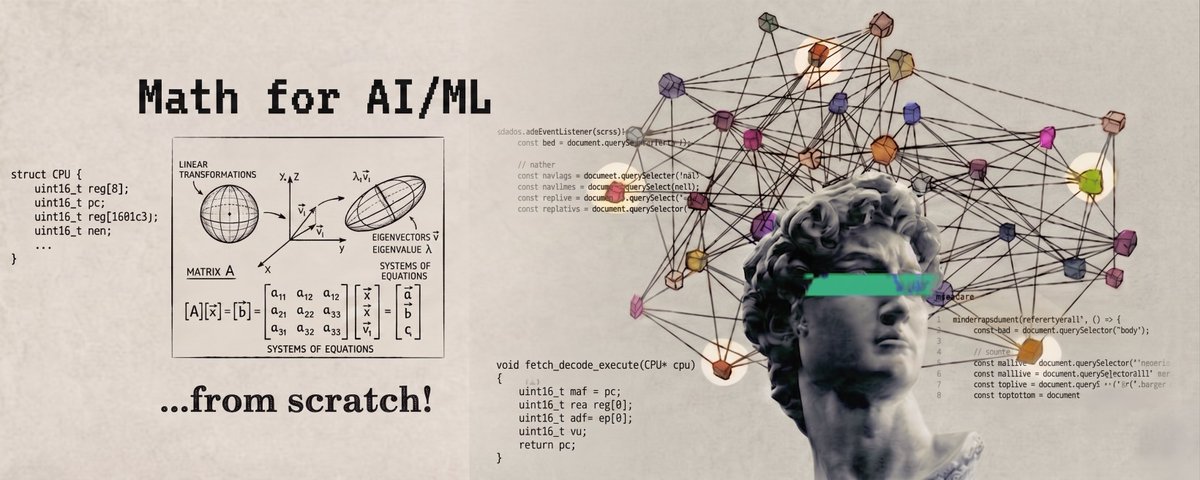
In this article, I’m going to break down the essential math you need for AI and machine learning. I’ll also share the exact roadmap and resources that helped me personally. Let’s get straight to it.
# 1. Statistics and Probability
The language of uncertainty, data, and inference
AI/ML systems learn from data that is noisy, incomplete, and uncertain. Probability and statistics provide the formal tools to reason under uncertainty and to extract reliable patterns from samples.
1.1 Populations and Sampling
- Population: The full set of possible data points (usually unobservable).
- Sample: A subset drawn from the population.
- Understanding sampling bias, representativeness, and variance is crucial for model generalization.
1.2 Descriptive Statistics
- Mean, Median, Mode: Measures of central tendency.
- Expected Value: The probabilistic average; foundational for loss functions and risk minimization.
1.3 Variance and Covariance
- Variance: Measures spread or uncertainty in data.
- Covariance: Measures how two variables vary together.
- Leads directly to understanding correlation, multicollinearity, and feature interactions.
1.4 Random Variables
- Discrete vs. continuous random variables.
- Probability mass functions (PMFs) and probability density functions (PDFs).
1.5 Common Probability Distributions
These define assumptions about how data is generated:
- Normal (Gaussian): Noise models, errors, CLT.
- Binomial: Binary outcomes, classification intuition.
- Uniform: Non-informative priors and randomness baselines.
1.6 Central Limit Theorem (CLT)
- Explains why Gaussian assumptions appear everywhere.
- Justifies many statistical methods even when data is not normally distributed.
1.7 Conditional Probability
- Probability given partial information.
- Essential for reasoning, prediction, and causal intuition.
1.8 Bayes Theorem
- Updates beliefs with evidence.
- Foundation of Bayesian inference, probabilistic models, and modern uncertainty-aware ML.
1.9 Maximum Likelihood Estimation (MLE)
- Framework for fitting model parameters to data.
- Loss functions like MSE and cross-entropy arise naturally from MLE.
1.10 Linear and Logistic Regression
- Linear regression: Continuous prediction under Gaussian noise.
- Logistic regression: Probabilistic binary classification.
- Both are gateways to understanding more complex models.
# 2. Linear Algebra
The structure of data and models
Almost everything in machine learning is a matrix operation. Data, parameters, activations, and gradients are all vectors, matrices, or tensors.
2.1 Scalars, Vectors, Matrices, Tensors
- Scalars: Single values.
- Vectors: Feature representations.
- Matrices: Datasets, weights, transformations.
- Tensors: High-dimensional generalizations (deep learning).
2.2 Matrix Operations
- Addition & Subtraction: Combining signals.
- Multiplication: Linear transformations and neural layers.
- Transpose: Shape alignment and symmetry.
- These operations define forward passes in models.
2.3 Determinants and Inverses
- Determinant: Volume scaling and singularity.
- Inverse: Solving linear systems (rarely computed directly in practice, but conceptually important).
2.4 Matrix Rank and Linear Independence
- Rank determines information content.
- Explains redundancy, feature collapse, and identifiability.
2.5 Eigenvalues and Eigenvectors
- Describe invariant directions of transformations.
- Central to stability, convergence, and dimensionality reduction.
2.6 Matrix Decompositions
Used to simplify, analyze, and compress data:
- Singular Value Decomposition (SVD): Core tool for numerical stability and low-rank approximation.
- Principal Component Analysis (PCA): Dimensionality reduction, noise filtering, and feature extraction.
# 3. Calculus
Learning as optimization
Training an AI model is an optimization problem. Calculus explains how models learn, how fast they learn, and whether they converge at all.
3.1 Derivatives and Gradients
- Derivative: Rate of change.
- Gradient: Direction of steepest ascent in high dimensions.
- Gradients drive learning through gradient descent.
3.2 Vector and Matrix Calculus
Modern models are multi-dimensional:
- Jacobian: First-order derivatives of vector-valued functions.
- Hessian: Second-order curvature information.
- Chain Rule: Backbone of backpropagation.
3.3 Fundamentals of Optimization
Understanding loss landscapes is critical:
- Local vs. Global Minima: Why training can get “stuck.”
- Saddle Points: Common in high-dimensional spaces.
- Convexity: Guarantees optimality and stability (rare but important).
# How I Actually Learned This Math (Resources)
Here’s the roadmap that worked for me.
1. Build Intuition First
Before textbooks, I focused on visual understanding.
- 3Blue1Brown
Especially:
- Essence of Linear Algebra
- Essence of Calculus
2. Structured Courses
- Imperial College London – Mathematics for Machine Learning on Coursera
Great for linear algebra and multivariable calculus, taught in a very practical way.
3. Statistics & Probability
- Khan Academy
Clear explanations and plenty of practice.
4. Connecting Math to ML
- Excellent for understanding how theory turns into real ML models.
Book: An Introduction to Statistical Learning
5. Tying Everything Together
- Shows how all the concepts fit together in actual algorithms.
Book: Mathematics for Machine Learning
## 相关链接
- [vixhaℓ](https://x.com/TheVixhal)
- [@TheVixhal](https://x.com/TheVixhal)
- [22K](https://x.com/TheVixhal/status/2073789188122837114/analytics)
- [An Introduction to Statistical Learning](https://www.amazon.com/Introduction-Statistical-Learning-Applications-Statistics/dp/3031387465)
- [Mathematics for Machine Learning](https://www.amazon.com/Mathematics-Machine-Learning-Peter-Deisenroth/dp/110845514X)
- [Upgrade to Premium](https://x.com/i/premium_sign_up)
- [11:20 PM · Jul 5, 2026](https://x.com/TheVixhal/status/2073789188122837114)
- [22.9K Views](https://x.com/TheVixhal/status/2073789188122837114/analytics)
- [View quotes](https://x.com/TheVixhal/status/2073789188122837114/quotes)
---
*导出时间: 2026/7/6 08:53:26*
---
## 中文翻译
# AI/ML 所需的数学知识(完整路线图)
**作者**: vixhaℓ
**日期**: 2026-07-05T15:20:46.000Z
**来源**: [https://x.com/TheVixhal/status/2073789188122837114](https://x.com/TheVixhal/status/2073789188122837114)
---

在本文中,我将为你分解人工智能和机器学习所需的核心数学知识。我还会分享帮助我个人的具体路线图和资源。让我们直奔主题。
# 1. 统计学与概率论
不确定性、数据与推理的语言
AI/ML 系统从充满噪声、不完整且不确定的数据中学习。概率和统计学为在不确定性下进行推理以及从样本中提取可靠模式提供了正式的工具。
1.1 总体与抽样
- 总体:所有可能数据点的完整集合(通常无法观测)。
- 样本:从总体中抽取的子集。
- 理解抽样偏差、代表性和方差对于模型的泛化能力至关重要。
1.2 描述性统计
- 均值、中位数、众数:集中趋势的度量。
- 期望值:概率意义上的平均值;是损失函数和风险最小化的基础。
1.3 方差与协方差
- 方差:衡量数据的离散程度或不确定性。
- 协方差:衡量两个变量如何一起变化。
- 直接引出对相关性、多重共线性特征相互作用的理解。
1.4 随机变量
- 离散型与连续型随机变量。
- 概率质量函数 (PMF) 和概率密度函数 (PDF)。
1.5 常见概率分布
这些定义了关于数据如何生成的假设:
- 正态分布:噪声模型、误差、中心极限定理 (CLT)。
- 二项分布:二分类结果、分类问题的直观理解。
- 均匀分布:无信息先验和随机性基线。
1.6 中心极限定理 (CLT)
- 解释了为什么高斯(正态)分布假设无处不在。
- 证明了即使在数据不是正态分布的情况下,许多统计方法也是合理的。
1.7 条件概率
- 基于部分信息的概率。
- 对于推理、预测和因果直觉至关重要。
1.8 贝叶斯定理
- 利用证据更新信念。
- 贝叶斯推断、概率模型和现代不确定性感知机器学习的基础。
1.9 极大似然估计 (MLE)
- 将模型参数拟合数据的框架。
- 像均方误差 (MSE) 和交叉熵这样的损失函数自然源于 MLE。
1.10 线性回归与逻辑回归
- 线性回归:高斯噪声下的连续预测。
- 逻辑回归:概率化的二分类。
- 两者都是理解更复杂模型的入门途径。
# 2. 线性代数
数据与模型的结构
机器学习中的几乎所有内容都是矩阵运算。数据、参数、激活和梯度都是向量、矩阵或张量。
2.1 标量、向量、矩阵、张量
- 标量:单一数值。
- 向量:特征表示。
- 矩阵:数据集、权重、变换。
- 张量:高维推广(深度学习)。
2.2 矩阵运算
- 加法与减法:信号组合。
- 乘法:线性变换和神经层。
- 转置:形状对齐和对称性。
- 这些运算定义了模型的前向传播。
2.3 行列式与逆矩阵
- 行列式:体积缩放和奇异性。
- 逆矩阵:求解线性系统(在实践中很少直接计算,但在概念上很重要)。
2.4 矩阵秩与线性无关
- 秩决定信息含量。
- 解释冗余、特征坍塌和可识别性。
2.5 特征值与特征向量
- 描述变换的不变方向。
- 对于稳定性、收敛性和降维至关重要。
2.6 矩阵分解
用于简化、分析和压缩数据:
- 奇异值分解 (SVD):数值稳定性和低秩近似的核心工具。
- 主成分分析 (PCA):降维、噪声过滤和特征提取。
# 3. 微积分
作为优化的学习
训练 AI 模型是一个优化问题。微积分解释了模型如何学习、学习速度有多快,以及它们是否真的会收敛。
3.1 导数与梯度
- 导数:变化率。
- 梯度:高维空间中最快上升的方向。
- 梯度通过梯度下降驱动学习。
3.2 向量与矩阵微积分
现代模型是多维的:
- 雅可比矩阵:向量值函数的一阶导数。
- 海森矩阵:二阶曲率信息。
- 链式法则:反向传播的支柱。
3.3 优化基础
理解损失地形至关重要:
- 局部最小值与全局最小值:为什么训练可能会“卡住”。
- 鞍点:在高维空间中很常见。
- 凸性:保证最优性和稳定性(罕见但重要)。
# 我实际上是如何学习这些数学的(资源)
这里有一条对我有效的路线图。
1. 先建立直觉
在看教科书之前,我专注于可视化理解。
- 3Blue1Brown
特别是:
- 线性代数的本质
- 微积分的本质
2. 结构化课程
- 伦敦帝国理工学院 – Coursera 上的机器学习数学
非常适合线性代数和多变量微积分,以非常实用的方式讲授。
3. 统计与概率
- Khan Academy(可汗学院)
解释清晰,练习丰富。
4. 将数学与机器学习联系起来
- 非常适合理解理论如何转化为实际的机器学习模型。
书籍:An Introduction to Statistical Learning(统计学习导论)
5. 将所有内容串联起来
- 展示所有概念如何在实际算法中融合在一起。
书籍:Mathematics for Machine Learning(机器学习数学)
## 相关链接
- [vixhaℓ](https://x.com/TheVixhal)
- [@TheVixhal](https://x.com/TheVixhal)
- [22K](https://x.com/TheVixhal/status/2073789188122837114/analytics)
- [An Introduction to Statistical Learning](https://www.amazon.com/Introduction-Statistical-Learning-Applications-Statistics/dp/3031387465)
- [Mathematics for Machine Learning](https://www.amazon.com/Mathematics-Machine-Learning-Peter-Deisenroth/dp/110845514X)
- [Upgrade to Premium](https://x.com/i/premium_sign_up)
- [11:20 PM · Jul 5, 2026](https://x.com/TheVixhal/status/2073789188122837114)
- [22.9K Views](https://x.com/TheVixhal/status/2073789188122837114/analytics)
- [View quotes](https://x.com/TheVixhal/status/2073789188122837114/quotes)
---
*导出时间: 2026/7/6 08:53:26*