构建多智能体系统的五种集成模式:A2A与MCP的协同 ✍ Google Cloud Tech🕐 2026-04-24📦 12.2 KB 🟢 已读 𝕏 文章列表 文章探讨了如何利用 A2A(Agent-to-Agent)和 MCP(Model Context Protocol)协议构建企业级多智能体系统。作者详细介绍了五种集成模式:Agent Card 发现机制、委派专业化模式、工具桥接模式(通过 MCP 连接数据源)、跨组织联邦模式以及环境事件网格。这些模式旨在实现智能体之间的互操作性、独立演化以及安全的数据访问,从而打破语言、团队和组织的界限。 A2AMCP多智能体系统Agent集成GoogleCloudADK架构模式Agent开发 # How A2A and MCP work together: five integration patterns for building multi-agent systems **作者**: Google Cloud Tech **日期**: 2026-04-24T06:45:57.000Z **来源**: [https://x.com/GoogleCloudTech/status/2047567704807346675](https://x.com/GoogleCloudTech/status/2047567704807346675) ---  No organization will build every agent it needs from scratch. The real value comes from discovering agents built by different teams, in different languages, across different organizations. That's what A2A and MCP enable: A2A for agent-to-agent communication. MCP for agent-to-tool communication. By @addyosmani and @Saboo_Shubham_ At Cloud Next 26, we shipped the infrastructure that makes this integration practical at enterprise scale. Here are five integration patterns for building multi-agent systems with both protocols. ## Pattern 1: Agent Card Discovery Before your agent can delegate to another agent, it needs to know that agent exists, what it can do, and how to communicate with it. A2A solves this with Agent Cards. Every A2A-compatible agent publishes a JSON document at a well-known URL that describes its capabilities, authentication requirements, and rate limits. Think of it as an OpenAPI spec, but designed for agent-to-agent interaction rather than client-server communication. In Agent Development Kit (ADK), exposing your agent as an A2A server is a single configuration. It automatically generates the Agent Card from your agent's definition. Consuming a remote agent is equally straightforward through the RemoteA2aAgent component, which handles authentication, data serialization, error handling, and result streaming. From the coordinator's perspective, a remote agent built by another team in another language feels like a local one. Agent Registry amplifies this. When you register agents in the central registry, other agents across your organization can discover them without knowing specific URLs. The registry becomes the service mesh for your agent ecosystem: a single place to find what capabilities are available, who maintains them, and how to access them.  ## Pattern 2: Delegated Specialization The most common integration pattern is delegation: your agent encounters a task outside its expertise and hands it to a specialist. This pattern builds on the Coordinator-Dispatcher architecture, but extends it across team and framework boundaries. The specialist doesn't need to be built with ADK. It doesn't need to be written in the same language. It doesn't need to be maintained by the same team. It just needs to speak A2A. Consider a customer onboarding workflow that spans five teams and four languages. The coordinator (your team, Python) delegates identity verification to the security team's Go agent, credit assessment to the risk team's Java agent, account provisioning to the platform team's Go agent, compliance documentation to the legal team's Python agent, and welcome communication to the marketing team's TypeScript agent. 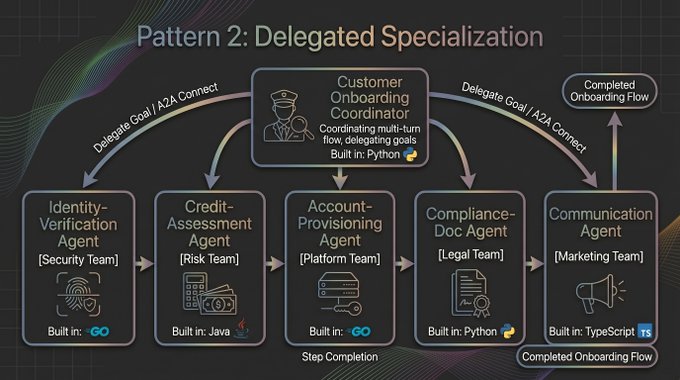 Each specialist is owned by a different team, maintained independently, and deployed on its own schedule. The coordinator doesn't know or care about internal implementations. It only knows their Agent Card capabilities and the A2A protocol. When the security team updates their verification agent to support new document types, no changes are needed in the coordinator. When the risk team improves their credit models, the coordinator automatically gets better assessments. Each team iterates independently, and the overall system improves. This is the same principle that made microservices successful: independent deployment, independent scaling, independent evolution. A2A provides the service contract that makes it work for agents. ## Pattern 3: Tool Bridge (Model Context Protocol) While A2A connects agents to agents, MCP connects agents to tools and data. The Tool Bridge pattern uses MCP to give your agents secure access to data sources, APIs, and enterprise systems without building custom connectors for each one. Without MCP, every data connection requires its own custom integration code. Your agent needs a Python connector for one REST API, a different connector for another database, yet another for a legacy system. Three data sources means three connectors to build, test, and maintain. MCP eliminates this by providing a single protocol that any tool can implement. The ADK integrations ecosystem provides more than 60 ready-to-use tools and integrations, such as GitHub, Notion, Hugging Face, AgentOps, and Stripe. These allow your agent to connect instantly through simple configuration, bypassing the need for lengthy custom development. For database connectivity specifically, MCP Toolbox for Databases connects over 30 different data sources to your agents through a single MCP interface. And Apigee API Hub takes this further: if you have existing REST APIs documented in Apigee, you can turn them into agent-accessible tools automatically. Your agents access data through the same governance layer that manages your existing API traffic. Rate limiting, authentication, logging, and access control are handled by infrastructure you already manage. 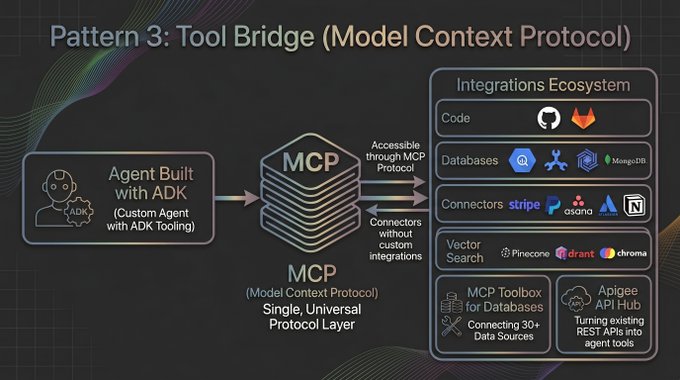 ADK supports MCP natively. When you add an MCP tool to your agent, the agent discovers the tool's capabilities, invokes it with structured parameters, and receives structured responses. From the agent's perspective, an MCP tool through Stripe looks the same as an MCP tool through BigQuery. The protocol is the interface. The backend is interchangeable. ## Pattern 4: Cross-Organization Federation The most ambitious pattern involves agents from different organizations collaborating on shared tasks. This is where A2A's open protocol design becomes essential, because you can't assume the other organization uses the same framework, language, or cloud provider. Agent Gallery in Gemini Enterprise makes this practical. Over 100 validated partner agents from Adobe, ServiceNow, Workday, Salesforce, and others are available directly within the platform. Every partner agent has been validated by Google Cloud for security and interoperability. The critical property is that each organization maintains its own governance. Your Agent Gateway policies control what data your agents can share with the partner agent, what actions they can take based on the partner's responses, and what information they can request. The partner agent operates under its own security model, validated by Google Cloud's integration requirements. Consider a multi-agent payment workflow where your agent needs to coordinate with external merchant agents and financial service agents. Each party maintains its own governance while collaborating on shared transactions through A2A. Your agent doesn't need to understand how the merchant's system works internally. It communicates through the A2A protocol, and each side enforces its own security boundaries independently. 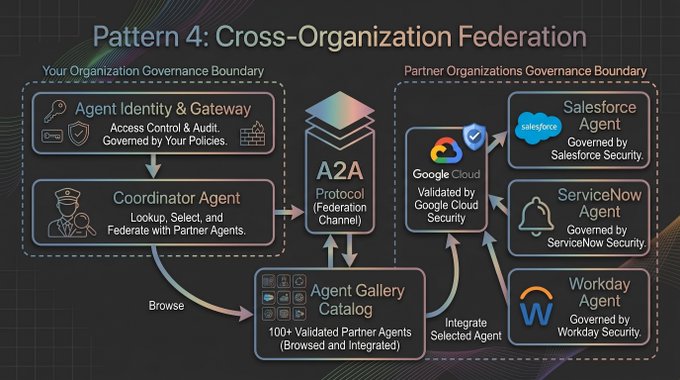 The same principle applies to any cross-organization integration. Your agent doesn't need to understand Salesforce's data model or ServiceNow's internal architecture. It delegates to the partner agent in Agent Gallery, which is maintained by the partner's team, validated by Google Cloud, and governed by your Agent Gateway policies. When the partner updates their platform, their agent is updated. Your system benefits without any changes on your end. ## Pattern 5: Ambient Event Mesh The final pattern combines A2A with event-driven architecture to create a mesh of ambient agents that react to events continuously in the background, without waiting for user requests. Batch and Event-Driven Agents in Gemini Enterprise Agent Platform connect directly to BigQuery tables and Pub/Sub streams. When you combine this with A2A, you create a network of agents that listen for events, process them, and delegate to specialist agents as needed - all running continuously in the background. Each agent in the mesh runs independently. When an event arrives, the receiving agent processes it and decides whether to handle it locally, delegate to a specialist via A2A, or escalate to a human via Mission Control. The mesh is self-organizing - adding a new specialist agent (say, a fraud detection specialist) requires only registering it in Agent Registry and updating the routing logic in the relevant ambient agents. 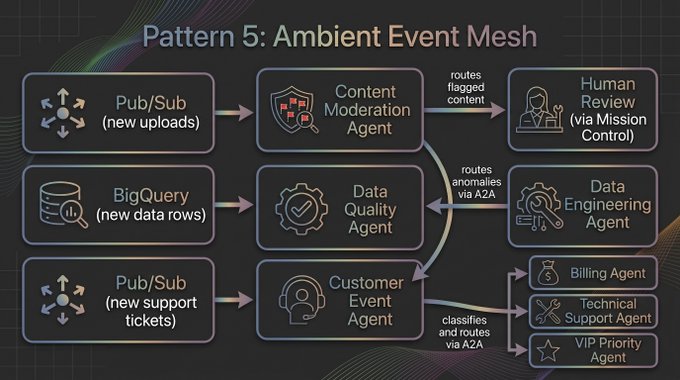 This pattern is particularly powerful for organizations with high event volumes. A content platform processing millions of uploads per day, a financial institution processing millions of transactions, an e-commerce platform processing millions of customer interactions - all can use ambient agent meshes to handle the long tail of events that require intelligent processing. The governance story is critical here. Every agent in the mesh has its own identity via Agent Identity. Every tool access is governed by Agent Gateway. Every interaction is traced through Agent Observability. The mesh is not a black box - it is a fully observable, governed network of specialized agents. ## Choosing the Right Pattern When building multi-agent systems, choose your integration pattern based on the relationship between agents: 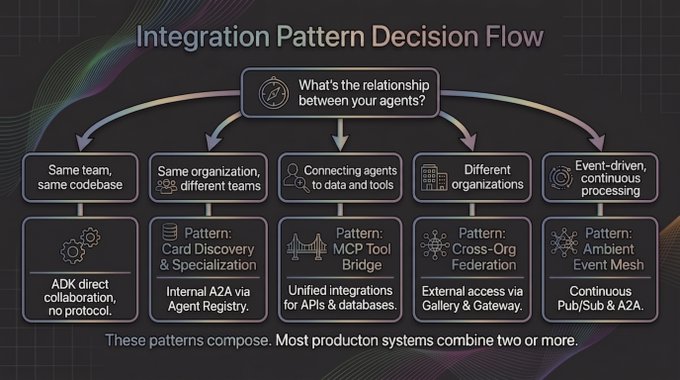 Get started today The interoperability stack is available now: - A2A protocol: Supported in ADK across Python, TypeScript, Go, and Java - MCP: Native support in ADK, managed support for GCP databases - Agent Gallery: 100+ validated partner agents in Gemini Enterprise - Native Ecosystem Integrations: Plug-and-play connectors for enterprise systems The A2A + MCP codelab walks through building a multi-agent system with cross-language collaboration: codelabs.developers.google.com/instavibe-adk-multi-agents ADK samples including multi-agent patterns: github.com/google/adk-samples The companies building isolated agents will be refactoring in twelve months. The companies building interoperable agent ecosystems will be compounding their advantage every day. Start building: adk.dev | https://cloud.google.com/products/gemini-enterprise-agent-platform Build Interoperable Agents: Google for Startups AI Agents Challenge Isolated agents are a dead end. Join our 6-week global challenge for startups to build, optimize or refactor AI Agents on the Gemini Enterprise Agent Platform. You'll get $500 in cloud credits, full platform access and a shot at the $90,000 prize pool. Sign up today to start building! ## 相关链接 - [Google Cloud Tech](https://x.com/GoogleCloudTech) - [@GoogleCloudTech](https://x.com/GoogleCloudTech) - [6.3K](https://x.com/GoogleCloudTech/status/2047567704807346675/analytics) - [@addyosmani](https://x.com/@addyosmani) - [@Saboo_Shubham_](https://x.com/@Saboo_Shubham_) - [Coordinator-Dispatcher architecture](https://developers.googleblog.com/developers-guide-to-multi-agent-patterns-in-adk/) - [ADK integrations ecosystem](https://developers.googleblog.com/supercharge-your-ai-agents-adk-integrations-ecosystem/) - [MCP Toolbox for Databases](https://adk.dev/integrations/mcp-toolbox-for-databases/) - [codelabs.developers.google.com/instavibe-adk-multi-agents](https://codelabs.developers.google.com/instavibe-adk-multi-agents) - [github.com/google/adk-samples](http://github.com/google/adk-samples) - [adk.dev](https://adk.dev/) - [https://cloud.google.com/products/gemini-enterprise-agent-platform](https://cloud.google.com/products/gemini-enterprise-agent-platform) - [Sign up today to start building](https://devpost.team/hackathon_guest_invites/4fb181b4-2722-415d-a442-285a57dcaba5?utm_source=twitter&utm_medium=social&utm_campaign=google-for-startups-ai-agents-challenge&utm_content=twitter-post) - [Upgrade to Premium](https://x.com/i/premium_sign_up) - [2:45 PM · Apr 24, 2026](https://x.com/GoogleCloudTech/status/2047567704807346675) - [6,339 Views](https://x.com/GoogleCloudTech/status/2047567704807346675/analytics) - [View quotes](https://x.com/GoogleCloudTech/status/2047567704807346675/quotes) --- *导出时间: 2026/4/24 17:32:34*
A A2A:当 Agent 开始自己找人干活 文章探讨了 A2A 协议如何让不同框架的 Agent 实现跨系统协作,以及 Agent 进入组织所需的六项情境信息。指出光有知识和工具不够,Agent 还需理解角色、目标、规则等动态上下文。未来组织需将人治转变为 Agent 可读的结构。 技术 › Agent ✍ Miles.Ma🕐 2026-07-20 A2AAgent组织架构情境感知协议MCPSkills
读 读 Google Cloud 多租户智能体 AI 系统参考架构 作者分享了阅读 Google Cloud 《多租户智能体 AI 系统》参考架构后的 5 个核心启发。文章指出企业级 Agent 落地需关注中心辐射模式、系统级安全防护(Model Armor)、MCP 的企业级用法以及完整的闭环流程。作者认为单纯依靠 Prompt 的时代即将结束,未来的重点在于系统架构设计与安全边界。 技术 › Agent ✍ lifcc🕐 2026-07-14 Agent多租户GoogleCloud系统架构安全防护MCP工程化
M MCP新规范:更灵活的协议 MCP新规范将协议从双向有状态改为请求/响应模型,服务端可部署在Serverless和边缘基础设施上。类比银行业务,以前需找固定柜员,现在任意柜员均可办理,提升了灵活性和效率。 技术 › 工具与效率 ✍ Gorden Sun🕐 2026-07-29 MCP协议Serverless边缘计算Cloudflare WorkersNetlifyHTTP服务负载均衡架构设计
B BestBlogs 早报 · 07-29|MCP 无状态化与多智能体编排成本 本期早报探讨 MCP 协议的无状态核心变化与 Claude 的生产化接入,分析 Codex 与 ChatGPT Work 共用的执行框架差异,并审视多智能体并行中上下文搬运的隐性成本“编排器的税”。同时涵盖图工程、vLLM 商业化及 Uber 零增长架构等速览内容。 技术 › LLM ✍ ginobefun🕐 2026-07-29 MCPAgentOpenAI架构多智能体上下文Claude早报DevOps工程化
如 如何(以及为何)构建 Agent First 应用 文章介绍了如何使用 Agent-Native 框架构建 Agent First 应用。通过统一的前端动作与 Agent 工具,实现 UI 与 Agent 的双向同步。应用支持通过聊天交互、集成外部 Agent、A2A 通信及自动化任务,且完全开源。 技术 › Agent ✍ Steve (Builder.io)🕐 2026-07-29 AgentAgent-NativeClaude前端A2A开源自动化框架UI
我 我把 TikTok 运营塞进了 Codex:选品、拆账号、找达人,一句话跑完整个流程 作者将 TikTok 运营工作流封装成 Codex Agent Skill,结合达人精灵 MCP 数据,实现选品、账号诊断、类目研究和增长规划的自动化。文章详细介绍了四个核心技能的安装、配置及具体 Prompt 使用方法,解决了 AI 运营中的幻觉与流程混乱问题。 技术 › Agent ✍ Aron厚玉🕐 2026-07-28 TikTok运营CodexSkillMCP自动化选品达人营销Agent技能工作流数据分析
2 2026最强 AI 组合之一:Codex + Figma,不会代码也能做产品! 本文介绍了 Codex 与 Figma 结合的 AI 产品开发工作流。通过 Figma MCP 连接两者,实现了从需求梳理、设计生成到代码开发及浏览器验证的闭环。文章详细讲解了如何利用 Codex 进行需求分析和代码编写,以及如何在 Figma 中进行双向协作与设计评审,大幅降低了产品原型开发的门槛。 技术 › Codex ✍ 云析🕐 2026-07-28 AI产品开发FigmaCodexMCP前端开发设计工作流
百 百度网盘 + 闲鱼 MCP 一键发布实战指南 本文介绍了如何通过 MCP 协议将百度网盘与闲鱼连接,利用 AI Agent 自动化完成从网盘选取资料、生成文案到闲鱼发布商品的流程。文章详细讲解了环境配置、接口接入及常见坑点,帮助读者建立自动变现系统。 技术 › Agent ✍ mousepotato🕐 2026-07-27 MCP自动化闲鱼百度网盘AgentPython实战教程
K Kimi K3 + Blender MCP: 可视化构建与修复3D场景 本文介绍了 Kimi K3 结合 Blender MCP 的工作流,它不仅生成3D资产,还能通过Python代码操作真实项目。AI能构建场景、检查渲染图并自主修复错误,将繁琐的准备工作自动化,让艺术家专注于视觉打磨。 技术 › Agent ✍ Rina🕐 2026-07-24 Kimi K3BlenderMCP3DAI代理视觉反馈Python自动化工具与效率
T The Graph Engineering Setup Guide 本文介绍了图工程如何为Agent提供复合记忆。通过双时态模型和MCP配置,Claude可获得持久的图记忆,相比向量搜索,多跳任务准确率提升36-46%,幻觉减少40%以上。 技术 › Agent ✍ darkzodchi🕐 2026-07-24 Graph EngineeringGraph RAGMemoryMCPClaude CodeNeo4jKnowledge GraphAgent
内 内置全网最全 Codex 做 PPT 手把手教程 本文介绍了使用 Codex 制作 PPT 的教程,适合小白用户,提供了多种业务场景的提示词,并建议搭配 Codex plugins、MCP 和 skills 提升效果。 技术 › Codex ✍ Tom Huang🕐 2026-07-23 PPTCodex教程AI业务场景插件MCP技能
O OpenCode 番外篇:驾驭 AI 的法典、军团与薄壳 文章指出 AI 编程的核心不是工具安装,而是建立权力结构与规则。作者通过 AGENTS.md、模型路由、MCP 和 Team Mode 等 OpenCode 机制,阐述如何通过立法、感官建立和验收来驾驭 AI 军团,强调开发者应成为立法者而非单纯的批准按钮。 技术 › OpenCode ✍ AI最严厉的父亲🕐 2026-07-22 AI编程OpenCodeAgent工程方法论模型路由AGENTSMCPTeamMode系统架构技术哲学