# Atomic agent blueprints on Google Cloud’s Agent Garden
**作者**: Google Cloud Tech
**日期**: 2026-04-25T15:49:07.000Z
**来源**: [https://x.com/GoogleCloudTech/status/2048066787233943773](https://x.com/GoogleCloudTech/status/2048066787233943773)
---

Building multi-agent systems from scratch presents complex design challenges, including; finding the optimized design pattern for your use-case, orchestration failures and evaluation loops. You can spend weeks reinventing the wheel, trying to get your agents to be ready for production—or you can start with architectures that already work, with our new Atomic Agents in Agent Garden.
Authored by Anant Nawalgaria and Naz Bayrak
At Google Cloud Next '26, we’re releasing a dozen core agent blueprints on Agent Garden that reduce friction for enterprise teams. These agents include Brand-Aligned Research & Presentations, On-Brand GenMedia, Cyber Guardian, YouBuddy, High-Volume Document Analyzer, Invoice Processing, Small Business Loans, Nurse Handover, Economic Research, Task Planner Agent, SDLC Technical Agent & User Story Refiner.
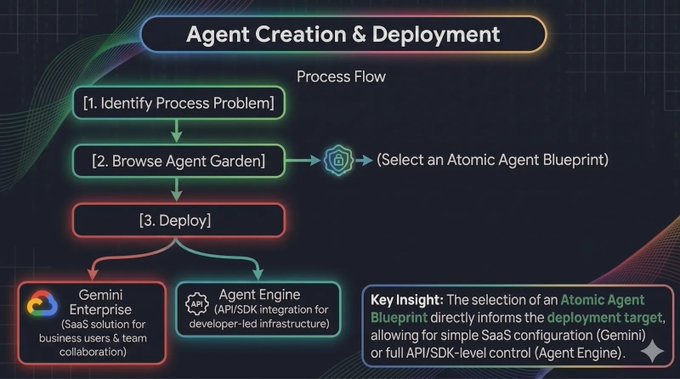
These Atomic Agents are production-ready templates and blueprints that offer proven approaches to standard design and implementation challenges. They are the exact production-grade patterns our customers are using today to accomplish specific tasks. Instead of starting from scratch, you follow a proven path to production using Agent Garden:
## Blueprint 1: The SDLC Suite
Product backlogs are often stalled by ambiguous, unstructured feature requests. Breaking down a massive technical design into manageable Jira tickets or Git merge requests is an administrative chore that drains engineering momentum.
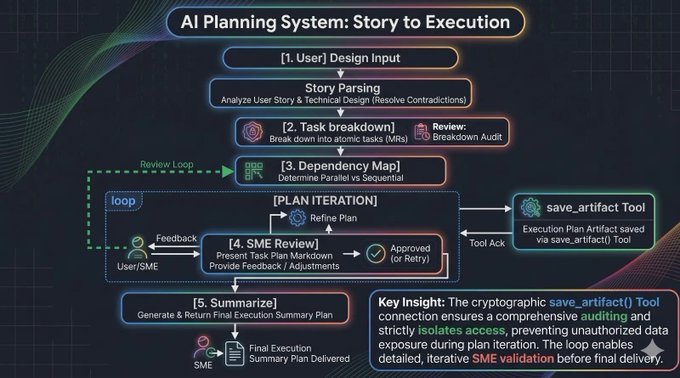
The SDLC Suite in Agent Garden is a chained architectural pattern composed of three atomic agents that take a feature from a vague idea to a structured execution plan:
1. User Story Refiner: An interactive product assistant. It interviews stakeholders to clarify raw requirements and automatically generates standardized Markdown user stories complete with strict Behavior-Driven Development (BDD) acceptance criteria.
2. Technical Designer: A planning co-pilot that converts those refined stories into Request for Comments (RFC) documents and Architecture Decision Records (ADRs). By leveraging Google Cloud Spanner via spanner_query_tools, it actively queries your project's Code Knowledge Graph to generate accurate Mermaid architecture diagrams that don't clash with existing infrastructure.
3. Task Planner: An embedded technical lead that tears through the generated documentation to map out a fully sequenced Execution Plan. It breaks broad features down into atomic tasks and intelligently charts out optimal Git branch strategies (e.g., parallel vs. sequential dependencies) before coding begins.
## Blueprint 2: On-Brand GenMedia
Marketing teams often struggle to scale asset production without compromising their corporate visual identity.

The On-Brand GenMedia agent resolves this tension by deploying a sequential, self-correcting creative engine. Beyond generating images; it actively evaluates and refines them using an LLM-as-a-judge framework to ensure strict brand alignment.
- RAG for Brand Governance: It dynamically searches and injects existing brand asset metadata and policy rules (get_policy, search_asset_bank) before hitting the generation model.
- The Self-Correction Loop: It manages a distinct toolset distributed across sub-agents. Crucially, it implements an automated loop governed by a check_condition_and_escalate_tool. A dedicated Checker Agent iteratively scores generated artifacts against a strict compliance rubric, regenerating any media that fails to meet the quantitative visual standards.
## Blueprint 3: Invoice Processing
Document extraction is notoriously brittle. When invoice formats change, parsing rules break, requiring developers to manually update the codebase.
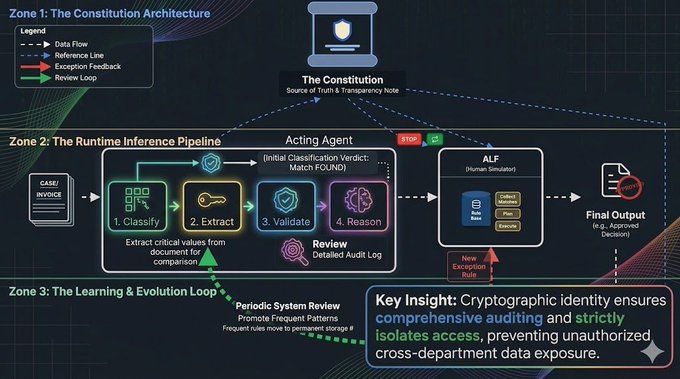
The Invoice Processing agent establishes a continuous improvement loop by isolating agent development from agent improvement. Powered by Gemini 2.5 (Flash + Pro), it processes invoices through a 9-stage pipeline, allowing domain experts to update extraction rules conversationally without altering the core codebase.
- Adaptive Learning Framework (ALF): Equipped with 24 deterministic condition operators and scope-based mutual exclusion, it allows finance analysts to teach the agent new rules via natural language.
- Risk-Free Rule Updates: It registers 18 specialized function tools on a single LlmAgent (divided into inference and learning tools). When a human expert proposes a new rule, an impact assessment protocol evaluates the rule against a random sample of existing ground-truth cases to prevent collateral damage before committing the changes to production.
## Querying Your Deployed Agent
Once you've selected and configured a blueprint, deploying it to Agent Engine allows you to seamlessly integrate it into your existing programmatic workflows.
## Get Started
You don't need to build from scratch. Head to Agent Garden within the Gemini Enterprise Agent Platform to explore these templates, view their architecture diagrams, and deploy them directly to your environment.
## 相关链接
- [Google Cloud Tech](https://x.com/GoogleCloudTech)
- [@GoogleCloudTech](https://x.com/GoogleCloudTech)
- [8.7K](https://x.com/GoogleCloudTech/status/2048066787233943773/analytics)
- [Anant Nawalgaria](https://www.linkedin.com/in/anant-nawalgaria/%20a)
- [Naz Bayrak](https://www.linkedin.com/in/naz-levent/)
- [Agent Garden](https://console.cloud.google.com/vertex-ai/agents/agent-garden)
- [Upgrade to Premium](https://x.com/i/premium_sign_up)
- [11:49 PM · Apr 25, 2026](https://x.com/GoogleCloudTech/status/2048066787233943773)
- [8,710 Views](https://x.com/GoogleCloudTech/status/2048066787233943773/analytics)
---
*导出时间: 2026/4/26 12:52:05*