# How Ruflo Turns Claude Code Into a Multi-Agent Platform With Memory, Swarms, and Federation
**作者**: AlphaSignal AI
**日期**: 2026-05-05T17:13:43.000Z
**来源**: [https://x.com/AlphaSignalAI/status/2051711952267718724](https://x.com/AlphaSignalAI/status/2051711952267718724)
---
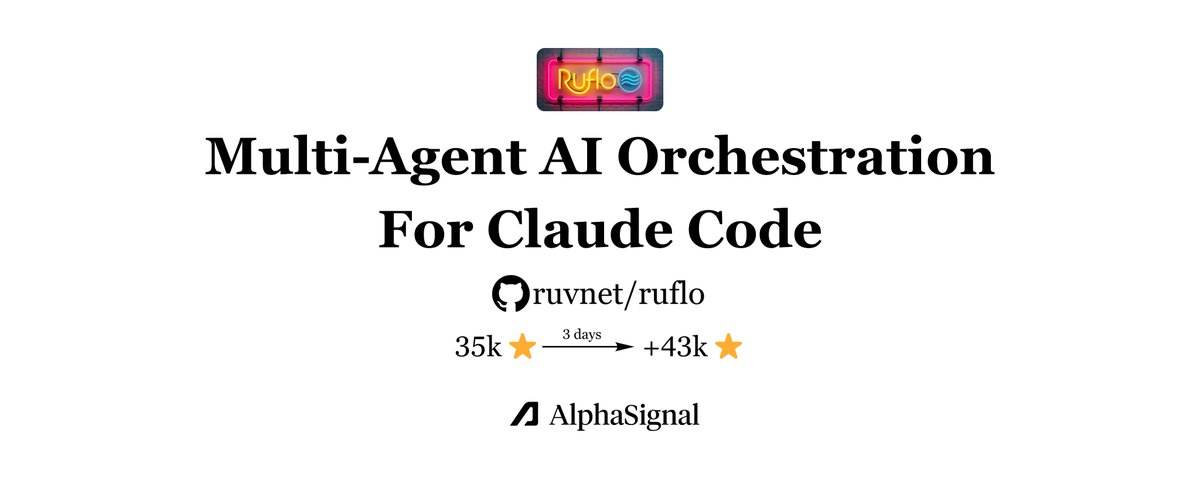
## Trending, MIT-licensed: HNSW vector memory, 32 Claude Code plugins, and a 300+ MCP tool surface.
Ruflo sells a "nervous system" for Claude Code: 100+ agents, 300+ MCP tools, swarm consensus, self-learning neural routes.
The project's own May 3 self-audit puts ~195 of ~240 tools in the "real code" column.
What works: memory, embeddings, task, claims, daa, workflow scheduling, most swarm and agent tools.
What's stubbed: agent execution, hive-mind transport, workflow runtime, WASM agent, neural prediction.
## Repo Snapshot
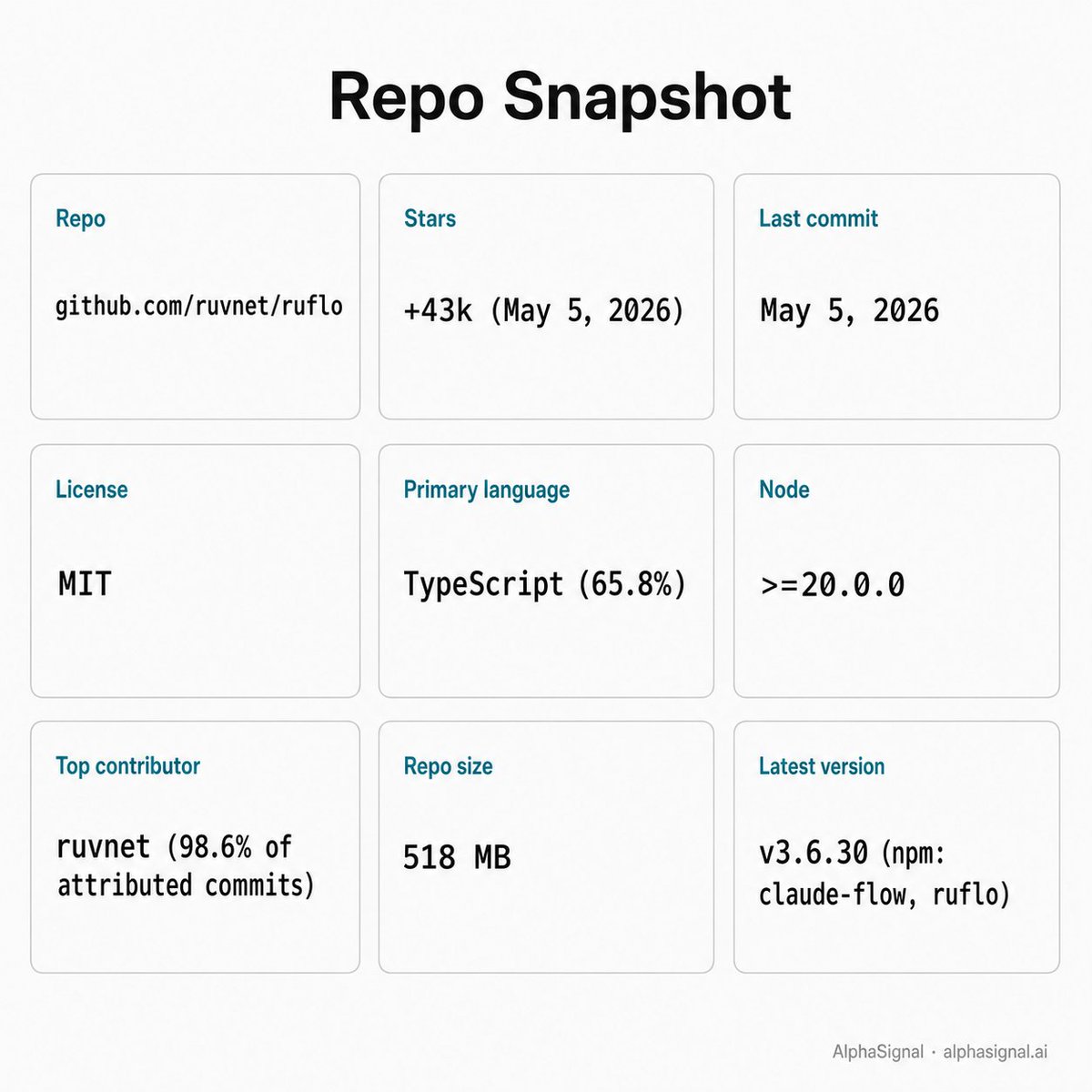
All numbers reflect v3.6.30 as of 2026-05-05. The repo ships frequently, so star counts, versions, and ADR statuses may have moved since.
## Context
Ruflo is built by @rUv . It originally shipped as Claude Flow and was renamed at v3.5.0 in February 2026, after 5,800+ commits and 55 alpha iterations.
The npm registry carries the same codebase under two names, claude-flow and ruflo, both at v3.6.30, with roughly 52,000 combined weekly downloads.
## Architecture, on Paper
The README presents Ruflo as a layered runtime sitting between Claude Code and the LLM providers. One init command is claimed to wire all of it.
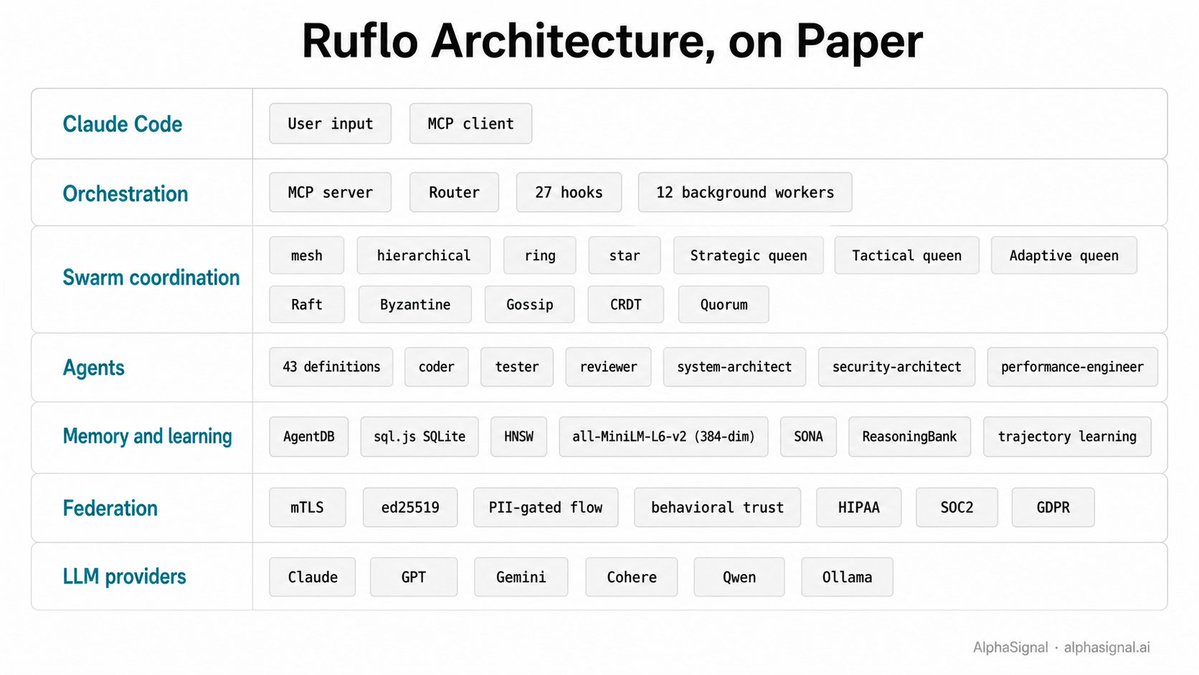
Ruflo ships 49 top-level commands, 32 Claude Code plugins, and a 300+ MCP tool surface exposed to Claude. Plugins group into eight README categories: core, memory, intelligence, code quality, security, architecture, DevOps, and domain-specific (with ruflo-iot-cognitum for IoT and ruflo-neural-trader for trading on the long tail).
Orchestration
An MCP server exposes the tool surface, a router decides which tool fires for each Claude request, and 27 hooks intercept tool calls to store context and trigger 12 background workers (audit, optimize, testgaps, and similar). The hooks are the surface Ruflo describes as session-to-session learning.
Swarm coordination
Agents are described as organizing into one of four topologies: mesh, hierarchical, ring, or star. A hive-mind mode adds three queen types (Strategic, Tactical, Adaptive) and eight worker roles. Five consensus protocols ship by name: Raft, Byzantine, Gossip, CRDT, and Quorum.
Agents
43 agent definitions ship as markdown files under .claude/agents/, covering coder, tester, reviewer, system-architect, security-architect, performance-engineer, and domain roles. The README counts these plus dynamic spawning as "100+ specialized agents."
Memory and learning
AgentDB handles vector storage on SQLite, with HNSW indexing on 384-dim embeddings via all-MiniLM-L6-v2. The self-learning surface adds SONA (Self-Optimizing Neural Adapter), ReasoningBank, and trajectory learning. Sessions persist via JSON key-value snapshots.
Federation
Cross-machine agent communication is described as mTLS plus ed25519 signatures, with a PII-gated data flow, behavioral trust scoring, and compliance audit trails marketed for HIPAA, SOC2, and GDPR.
LLM providers
Smart routing across Claude, GPT, Gemini, Cohere, Qwen, and Ollama, with failover. The ruvLLM plugin is described as routing to local LoRA adapters via SONA for offline use.
## Evidence: Claims vs. Reality (yet)
> Every classification below traces to the public roman-rr audit gist, ADR-093, or ADR-095. The article's findings are reproductions of the project's own published documentation, not independent test results
The April audit by roman-rr (v3.5.51) flagged ~290 of 300+ tools as stubs. One month and nine ADRs later, Ruflo's own May 3 verification swarm (ADR-093) re-checked the running server and the picture inverted.
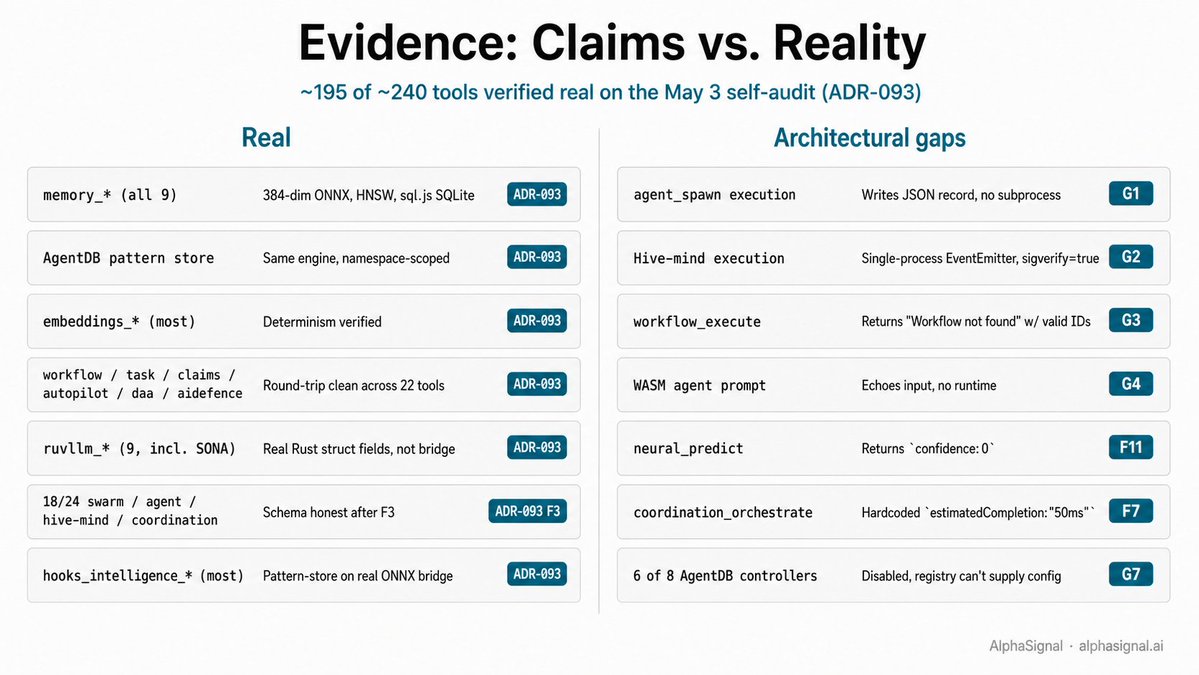
ADR-085 confirmed the historical await sleep(352) baseline and the += 100 hardcoded token-savings figures. ADR-093 fixed the contract honesty: no more silent "completed" lies, schemas that round-trip what callers pass. The execution-layer holes that remain are tracked in ADR-095 as G1 through G7.
On the May 3 self-audit, ~195 of ~240 tools verified real. The gaps are architectural, not surface-wide.
## How to Get Started
The README ships three install paths, 49 top-level commands, and 32 plugins. Most surfaces run real code, with specific execution-layer gaps tracked in ADR-095 (see Step 5). The minimal path that delivers value is install, verify, then use the memory layer.
Step 1: Install
```
# One-line install
curl -fsSL https://cdn.jsdelivr.net/gh/ruvnet/ruflo@main/scripts/install.sh | bash
# Or via npx (interactive setup)
npx ruflo@latest init wizard
```
The wizard installs the plugin set, registers the Claude Code hooks, and writes config under .claude/ and .swarm/ in the current project. About 30 to 60 seconds on a clean project.
or
```
/plugin marketplace add ruvnet/ruflo
/plugin install ruflo-core@ruflo
```
The Claude Code plugin path. Installs into Claude Code itself rather than a project directory. Useful if Ruflo should be available across every repo Claude Code touches.
```
claude mcp add ruflo -- npx -y @claude-flow/cli@latest
```
The MCP server path. Lightest install. Exposes only the MCP tool surface to Claude Code, which is the right scope for using the working memory and embeddings tools and ignoring the rest.
Step 2: Verify the install
```
ruflo verify
```
Cryptographic verification of the installed bytes against the published manifest. v3.6.x added this in response to issue #1375, where versions 3.1.0-alpha.55 through 3.5.2 shipped an obfuscated preinstall script that walked ~/.npm/_npx/ and deleted directories. Run it on every fresh install.
If the install reports problems:
```
ruflo doctor --fix
```
Checks Node 20+, npm 9+, the daemon, the memory database, MCP servers, and disk space. Apply suggested fixes one at a time rather than blanket-accepting.
Step 3: Store and search memory
This is the part the audit confirmed runs real code. HNSW-indexed embeddings, SQLite persistence, namespace-scoped storage.
Store a pattern:
```
npx ruflo@latest memory store --key "pattern-auth" --value "JWT authentication with refresh tokens"
```
Search it back semantically:
```
npx ruflo@latest memory search --query "authentication patterns"
```
The store generates 384-dim embeddings via all-MiniLM-L6-v2 and indexes them with HNSW. Search returns ranked hits by cosine similarity. List entries in a namespace with memory list --namespace patterns.
Step 4: Use it inside Claude Code
Once Ruflo is registered as an MCP server, the same memory surface appears as MCP tools the Claude Code agent calls directly: memory_store, memory_search, memory_retrieve. The agent can store learnings during one session and retrieve them in the next without the user repeating context.
Pair it with the embeddings tools (embeddings_generate, embeddings_compare) for ad-hoc semantic comparison and the session tools (session_save, session_restore) for persistence across context windows.
Step 5: Skip these surfaces
The following surfaces still have execution-layer gaps. They will not error loudly, but they will not deliver the coordination, training, or runtime the README implies:
- ruflo swarm * and ruflo hive-mind *. Schemas honest, execution still single-process (ADR-095 G2)
- ruflo neural train and ruflo neural predict. neural_predict returns confidence:0 (F11)
- ruflo workflow execute. Returns "Workflow not found" with valid IDs (G3)
- ruflo agent spawn. Writes a JSON record, no subprocess (G1)
The auto-memory hook also injects ~5,706 entries with ~20 unique into every Claude message (ADR-095 G6). ruflo doctor --fix does not yet dedupe this. The fix is tracked as a follow-up ADR.
## Compared To
Claude Code native is the baseline Ruflo claims to extend. The working subset (HNSW memory, embeddings, task, claims, session tools) adds capability Claude Code lacks. The hive-mind execution layer is still single-process per ADR-095 G2, so cross-machine swarm coordination does not yet work.
CrewAI is the closest open-source peer for explicit multi-agent orchestration. CrewAI is Python and role-based, with no built-in vector memory. The honest trade-off: CrewAI runs the coordination it advertises.
## Current Limitations
Agent execution is unwired. agent_spawn writes a JSON record into an in-memory Map. Provider classes exist but the agent / task / swarm code paths do not import them (ADR-095 G1).
Hive-mind is single-process. EventEmitter-based, no inter-node transport. The consensus parameter round-trips after ADR-093 F3, but the handler underneath has no sockets or distributed protocol (ADR-095 G2).
Workflow execution lacks a runtime. workflow_execute returns "Workflow not found" even with valid stored workflows. No executor walks the dependency graph (ADR-095 G3).
WASM agent echoes input. No runtime, no LLM call. Returns the input prefixed with "echo:" (ADR-095 G4).
Auto-memory injects 5,706 entries with ~20 unique into every Claude message. Trigram Jaccard graph instead of the 384-dim embeddings used elsewhere. PageRank uniform across nodes, meaningless at the graph's density (ADR-095 G6).
MCP tool descriptions don't always differentiate from native Claude Code tools. Issue #1748 #4 found 237 of 300 descriptions don't tell Claude when to use Ruflo's version over native (Bash, Read, Grep, Glob). v3.6.30 sharpened 7. The remaining 230 fall through to native, so Ruflo's tools fire less often than the install suggests.
Benchmark numbers are synthesized. simulate_benchmarks.py generates results with random.uniform(-0.05, 0.05) against hardcoded base rates. Ruflo does not appear on the official SWE-bench leaderboard.
Active remediation. Between April 4 and May 4, the project shipped nine ADRs (088 plus 092 through 099). Encryption at rest is implemented in four phases with 76 new tests (ADR-096). The architectural gaps above are the open items.
So the best recommendation is to use the working subset and watch the remediation track.
## AlphaSignal Take
The README sells a self-organizing swarm with consensus and neural routing. The May 3 self-audit puts ~195 of ~240 tools in the real column. The remaining gaps are architectural, not surface-wide: agent execution is unwired, hive-mind transport is single-process, workflow runtime is absent, WASM agent echoes input.
The remediation cycle is still active. v3.6.28 through v3.6.30 shipped today (5 May), including runtime-honesty fixes (the unverified "2.49× Flash Attention" recommendation was retagged as "in progress") and the plugin-install hook layout fix that had been loading zero hooks before. Nine ADRs in 30 days, encryption at rest with 76 tests, and an Ed25519-signed witness manifest covering 55 verified fixes.
Worth Watching. Use the memory, embeddings, task, and claims tools today. The architectural gaps are real but tracked. Re-evaluate when v3.7 ships the agent-execution wire (ADR-095 G1) and per-controller activations (G7).
## Who Benefits
Claude Code users who want a drop-in HNSW memory layer with persistent embeddings, teams testing semantic-search workflows on top of Claude, developers who want one MIT-licensed install for embeddings, agent definitions, and Claude Code hooks.
## Who Doesn't
Anyone counting on Byzantine consensus, multi-machine swarm coordination, end-to-end agent execution, or the workflow runtime for production work, teams that need verified benchmark numbers before adopting, engineers who would rather assemble lightweight pieces (a vector store plus a hook) than ship 518 MB.
## Practitioner Implication
Ruflo is usable today for memory, embeddings, task, and claims management on top of Claude Code. The multi-agent swarm runtime its README describes does not yet execute end-to-end.
## Links
- github.com/ruvnet/ruflo (repo, ~5 min skim)
- ADR-093 May audit remediation (project's six-agent verification swarm, ~10 min)
- ADR-095 architectural gaps (G1–G7 tracking, ~5 min)
- roman-rr audit gist (April audit that triggered the remediation, ~15 min)
Follow @AlphaSignalAI for more content like this.
Subscribe at AlphaSignal.ai for daily AI signals. Read by 280,000+ developers.
## Questions?
Q: Is Ruflo safe to install? A: v3.6.x patched the obfuscated preinstall and SQL injection flagged in issue #1375 from March 2026. Running ruflo verify after install confirms the bytes match the published manifest.
Q: Does Ruflo really hit 84.8% on SWE-bench? A: No. The number comes from simulate_benchmarks.py in the repo, which generates results with random.uniform(-0.05, 0.05) added to hardcoded base rates. Ruflo does not appear on the official SWE-bench leaderboard.
Q: What part of Ruflo actually works? A: Memory, embeddings, task, claims, daa, workflow scheduling, and most swarm and agent registry tools. The May 3 self-audit (ADR-093) verified ~195 of ~240 tools real. The execution-layer gaps are agent_spawn (no subprocess), hive-mind (single-process), workflow_execute (no runtime), and WASM agent (echo only).
Q: Should Ruflo replace CrewAI or AutoGen? A: Not for swarm coordination. As a Claude-Code-native memory, embeddings, task, and claims layer, yes.
## 相关链接
- [AlphaSignal AI](https://x.com/AlphaSignalAI)
- [@AlphaSignalAI](https://x.com/AlphaSignalAI)
- [3.2K](https://x.com/AlphaSignalAI/status/2051711952267718724/analytics)
- [@rUv](https://x.com/@rUv)
- [github.com/ruvnet/ruflo](https://github.com/ruvnet/ruflo)
- [ADR-093 May audit remediation](https://github.com/ruvnet/ruflo/blob/main/v3/docs/adr/ADR-093-mcp-audit-may-2026-remediation.md)
- [ADR-095 architectural gaps](https://github.com/ruvnet/ruflo/blob/main/v3/docs/adr/ADR-095-architectural-gaps-from-april-audit.md)
- [roman-rr audit gist](https://gist.github.com/roman-rr/ed603b676af019b8740423d2bb8e4bf6)
- [@AlphaSignalAI](https://x.com/@AlphaSignalAI)
- [AlphaSignal.ai](https://alphasignal.ai/)
- [Upgrade to Premium](https://x.com/i/premium_sign_up)
- [1:13 AM · May 6, 2026](https://x.com/AlphaSignalAI/status/2051711952267718724)
- [3,272 Views](https://x.com/AlphaSignalAI/status/2051711952267718724/analytics)
---
*导出时间: 2026/5/6 09:37:30*
---
## 中文翻译
# Ruflo 如何通过记忆、群体和联邦机制将 Claude Code 变成多智能体平台
**作者**: AlphaSignal AI
**日期**: 2026-05-05T17:13:43.000Z
**来源**: [https://x.com/AlphaSignalAI/status/2051711952267718724](https://x.com/AlphaSignalAI/status/2051711952267718724)
---

## 趋势所在,MIT 许可:HNSW 向量记忆,32 个 Claude Code 插件,以及 300+ 个 MCP 工具集。
Ruflo 旨在为 Claude Code 打造一套“神经系统”:包含 100+ 个智能体,300+ 个 MCP 工具,群体共识机制以及自学习的神经路由。
该项目在 5 月 3 日进行的自我审计显示,约 240 个工具中约有 195 个被归类为“真实代码”。
**部分可用功能**:记忆、嵌入、任务、声明、DAA、工作流调度,以及大部分群体和智能体工具。
**仍为存根的部分**:智能体执行、群体思维传输、工作流运行时、WASM 智能体、神经预测。
## 代码库快照

所有数据均反映截至 2026-05-05 的 v3.6.30 版本情况。该代码库发布频繁,因此 Star 数、版本和 ADR 状态可能已发生变化。
## 背景
Ruflo 由 @rUv 开发。它最初以 Claude Flow 的名义发布,在历经 5,800+ 次提交和 55 个 Alpha 迭代后,于 2026 年 2 月的 v3.5.0 版本更名为 Ruflo。
npm 注册表在 claude-flow 和 ruflo 两个名下承载了相同的代码库,版本均为 v3.6.30,两者合计周下载量约为 52,000 次。
## 纸上架构
README 文件将 Ruflo 描述为位于 Claude Code 和 LLM 提供商之间的分层运行时。据称只需一条初始化命令即可连接所有部分。

Ruflo 附带 49 个顶级命令、32 个 Claude Code 插件,以及向 Claude 开放的 300 多个 MCP 工具集。插件分为 README 中的八大类:核心、记忆、智能、代码质量、安全、架构、DevOps 和特定领域(包括用于 IoT 的 ruflo-iot-cognitum 和用于长尾交易的 ruflo-neural-trader)。
**编排**
一个 MCP 服务器暴露工具集,路由器决定针对每个 Claude 请求触发哪个工具,27 个钩子拦截工具调用以存储上下文并触发 12 个后台工作进程(审计、优化、测试覆盖等)。钩子是 Ruflo 描述为“跨会话学习”的接口层。
**群体协调**
智能体被描述为组织成四种拓扑结构之一:网状、分层、环形或星形。群体思维模式增加了三种女王类型(战略型、战术型、自适应型)和八种工作角色。命名发布的共识协议有五种:Raft、拜占庭、流言、CRDT 和法定人数。
**智能体**
43 个智能体定义以 markdown 文件形式存储在 .claude/agents/ 下,涵盖编码员、测试员、审查员、系统架构师、安全架构师、性能工程师以及特定领域角色。README 将这些加上动态生成统称为“100+ 个专业智能体”。
**记忆与学习**
AgentDB 基于 SQLite 处理向量存储,通过 all-MiniLM-L6-v2 在 384 维嵌入上使用 HNSW 索引。自学习层增加了 SONA(自优化神经适配器)、ReasoningBank 和轨迹学习。会话通过 JSON 键值快照持久化。
**联邦**
跨机器智能体通信被描述为 mTLS 加上 ed25519 签名,具有 PII 门控的数据流、行为信任评分,以及针对 HIPAA、SOC2 和 GDPR 的合规审计追踪。
**LLM 提供商**
在 Claude、GPT、Gemini、Cohere、Qwen 和 Ollama 之间进行智能路由,并支持故障转移。ruvLLM 插件被描述为通过 SONA 路由到本地 LoRA 适配器以供离线使用。
## 证据:宣传与现实(截至目前)
> 下面的每一个分类均可追溯至公开的 roman-rr audit gist、ADR-093 或 ADR-095。本文的发现是对项目自身已发布文档的复现,而非独立测试结果。
roman-rr 在 4 月份的审计(v3.5.51)将 300 多个工具中的约 290 个标记为存根。一个月和九个 ADR 之后,Ruflo 自己的 5 月 3 日验证群体(ADR-093)重新检查了运行中的服务器,情况发生了逆转。

ADR-085 确认了历史上 await sleep(352) 的基准线以及 += 100 硬编码的 Token 节省数值。ADR-093 修复了契约诚实度:不再有沉默的“已完成”谎言,模式能够往返传递调用者的输入。剩余的执行层漏洞在 ADR-095 中被追踪为 G1 至 G7。
在 5 月 3 日的自我审计中,约 240 个工具里有约 195 个经验证为真实代码。缺口是架构性的,而非表面层面的。
## 如何入门
README 提供了三种安装路径、49 个顶级命令和 32 个插件。大部分表面运行的是真实代码,具体的执行层缺口记录在 ADR-095 中(见步骤 5)。能产生价值的最小路径是:安装、验证,然后使用记忆层。
**步骤 1:安装**
```
# 一键安装
curl -fsSL https://cdn.jsdelivr.net/gh/ruvnet/ruflo@main/scripts/install.sh | bash
# 或通过 npx(交互式设置)
npx ruflo@latest init wizard
```
向导会安装插件集,注册 Claude Code 钩子,并在当前项目的 .claude/ 和 .swarm/ 下写入配置。在干净的项目上大约需要 30 到 60 秒。
或者
```
/plugin marketplace add ruvnet/ruflo
/plugin install ruflo-core@ruflo
```
Claude Code 插件路径。安装到 Claude Code 本身而非项目目录。如果希望 Ruflo 在 Claude Code 接触的每个仓库中都可用,此方法很有用。
```
claude mcp add ruflo -- npx -y @claude-flow/cli@latest
```
MCP 服务器路径。最轻量的安装。仅向 Claude Code 暴露 MCP 工具集,这是使用可用的记忆和嵌入工具并忽略其余部分的正确范围。
**步骤 2:验证安装**
```
ruflo verify
```
根据已发布的清单对安装的字节进行加密验证。v3.6.x 增加了此功能以回应 issue #1375,此前版本 3.1.0-alpha.55 到 3.5.2 交付了一个混淆的预安装脚本,遍历 ~/.npm/_npx/ 并删除目录。请在每次全新安装时运行它。
如果安装报告问题:
```
ruflo doctor --fix
```
检查 Node 20+、npm 9+、守护进程、内存数据库、MCP 服务器和磁盘空间。逐一应用建议的修复,而不是无差别接受。
**步骤 3:存储和搜索记忆**
这是审计确认运行真实代码的部分。HNSW 索引嵌入、SQLite 持久化、命名空间范围的存储。
存储一个模式:
```
npx ruflo@latest memory store --key "pattern-auth" --value "JWT authentication with refresh tokens"
```
通过语义搜索回溯:
```
npx ruflo@latest memory search --query "authentication patterns"
```
存储通过 all-MiniLM-L6-v2 生成 384 维嵌入,并使用 HNSW 进行索引。搜索通过余弦相似度返回排序后的命中结果。使用 memory list --namespace patterns 列出命名空间中的条目。
**步骤 4:在 Claude Code 内部使用**
一旦 Ruflo 注册为 MCP 服务器,相同的记忆表面就会作为 Claude Code 智能体直接调用的 MCP 工具出现:memory_store, memory_search, memory_retrieve。智能体可以在一个会话期间存储学习内容,并在下一个会话中检索,而无需用户重复上下文。
将其与嵌入工具(embeddings_generate, embeddings_compare)配对,进行临时语义比较,以及与会话工具(session_save, session_restore)配对,以实现跨上下文窗口的持久化。
**步骤 5:跳过这些表面**
以下表面仍存在执行层缺口。它们不会大声报错,但也不会交付 README 所暗示的协调、训练或运行时:
- ruflo swarm * 和 ruflo hive-mind *。模式是诚实的,执行仍然是单进程的(ADR-095 G2)
- ruflo neural train 和 ruflo neural predict。neural_predict 返回 confidence:0(F11)
- ruflo workflow execute。即使使用有效 ID 也返回“Workflow not found”(G3)
- ruflo agent spawn。写入一条 JSON 记录,没有子进程(G1)
自动记忆钩子还会向每条 Claude 消息注入约 5,706 个条目,其中约 20 个是唯一的(ADR-095 G6)。ruflo doctor --fix 尚未对此进行去重。修复工作被追踪为后续的 ADR。
## 对比
Claude Code 原生功能是 Ruflo 声称扩展的基线。可工作的子集(HNSW 记忆、嵌入、任务、声明、会话工具)增加了 Claude Code 缺乏的功能。群体思维执行层根据 ADR-095 G2 仍然是单进程的,因此跨机器群体协调尚不起作用。
CrewAI 是最接近的显式多智能体编排开源同类产品。CrewAI 是基于 Python 和角色的,没有内置的向量记忆。诚然的权衡是:CrewAI 运行其所宣传的协调功能。
## 当前限制
**智能体执行未连接。** agent_spawn 将 JSON 记录写入内存中的 Map。Provider 类存在,但 agent / task / swarm 代码路径并未导入它们(ADR-095 G1)。
**群体思维是单进程的。** 基于 EventEmitter,没有节点间传输。共识参数在 ADR-093 F3 之后能够往返传递,但底层的处理程序没有套接字或分布式协议(ADR-095 G2)。
**工作流执行缺乏运行时。** 即使存在有效的已存储工作流,workflow_execute 也返回“Workflow not found”。没有执行器遍历依赖图(ADR-095 G3)。
**WASM 智能体回显输入。** 没有运行时,没有 LLM 调用。返回带有“echo:”前缀的输入(ADR-095 G4)。
**自动记忆向每条 Claude 消息注入 5,706 个条目,其中约 20 个是唯一的。** 使用三元组 Jaccard 图,而不是其他地方使用的 384 维嵌入。PageRank 在节点间是均匀的,在该图的密度下毫无意义(ADR-095 G6)。
**MCP 工具描述并不总是能区分于原生 Claude Code 工具。** 问题 #1748 #4 发现 300 个描述中有 237 个没有告诉 Claude 何时使用 Ruflo 的版本而不是原生版本。v3.6.30 润色了 7 个。其余 230 个回退到原生工具,因此 Ruflo 的工具触发频率低于安装所暗示的频率。
**基准数字是合成的。** simulate_benchmarks.py 根据硬编码的基准速率,使用 random.uniform(-0.05, 0.05) 生成结果。Ruflo 未出现在官方 SWE-bench 排行榜上。
**积极修复中。** 在 4 月 4 日至 5 月 4 日之间,项目发布了九个 ADR(088 加上 092 至 099)。静态加密分四个阶段实施,新增 76 项测试(ADR-096)。上述架构缺口是待处理事项。
因此,最好的建议是使用可工作的子集并关注修复进度。
## AlphaSignal 观点
README 售卖的是一个具有共识和神经路由的自组织群体。5 月 3 日的自我审计将约 240 个工具中的约 195 个归入真实列。剩余的缺口是架构性的,而非表面层面的:智能体执行未连接,群体思维传输是单进程的,工作流运行时缺失,WASM 智能体仅回显输入。
修复周期仍然活跃。v3.6.28 到 v3.6.30 于今天(5 月 5 日)发布,包括运行时诚实度修复(未经证实的“2.49× Flash Attention”建议被重新标记为“进行中”)以及插件安装钩子布局修复,此前该问题导致加载了零个钩子。30 天内九个 ADR,附带 76 项测试的静态加密,以及涵盖 55 个已验证修复的 Ed25519 签名见证清单。
**值得关注。** 今天就使用记忆、嵌入、任务和声明工具。架构缺口是真实存在的,但已被追踪。当 v3.7 发布智能体执行连接(ADR-095 G1)和每个控制器的激活(G7)时,请重新评估。
## 谁受益
希望获得即插即用的 HNSW 记忆层和持久嵌入的 Claude Code 用户,在 Claude 之上测试语义搜索工作流的团队,以及希望通过一次 MIT 许可安装获得嵌入、智能体定义和 Claude Code 钩子的开发者。
## 谁不受益
任何依赖拜占庭共识、多机器群体协调、端到端智能体执行或工作流运行时进行生产工作的人员,在采用前需要经过验证的基准数字的团队,以及宁愿组装轻量级组件(向量存储加钩子)而不愿交付 518 MB 软件的工程师。
## 从业者启示
目前 Ruflo 可用于在 Claude Code 之上进行记忆、嵌入、任务和声明管理。其 README 中描述的多智能体群体运行时尚未端到端执行。
## 链接
- github.com/ruvnet/ruflo (代码库,约 5 分钟浏览)
- ADR-093 May audit remediation (项目的六个智能体验证群体,约 10 分钟)
- ADR-095 architectural gaps (G1–G7 追踪,约 5 分钟)
- roman-rr audit gist (引发修复的四月审计,约 15 分钟)
关注 @AlphaSignalAI 获取更多此类内容。
在 AlphaSignal.ai 订阅每日 AI 信号。拥有 280,000+ 开发者读者。
## 疑问?
**问:安装 Ruflo 安全吗?**
答:v3.6.x 修复了 2026 年 3 月 issue #1375 中标记的混淆预安装和 SQL 注入问题。安装后运行 ruflo verify 以确认字节与已发布的清单匹配。
**问:Ruflo 在 SWE-bench 上真的达到了 84.8% 吗?**
答:没有。该数字来自代码库中的 simulate_benchmarks.py,它在硬编码的基准速率上增加了 random.uniform(-0.05, 0.05) 生成的结果。Ruflo 未出现在官方 SWE-bench 排行榜上。
**问:Ruflo 的哪部分确实有效?**
答:记忆、嵌入、任务、声明、DAA、工作流调度以及大部分群体和智能体注册工具。5 月 3 日的自我审计(ADR-093)验证了约 240 个工具中有约 195 个是真实的。执行层缺口包括 agent_spawn(无子进程)、hive-mind(单进程)、workflow_execute(无运行时)和 WASM agent(仅回显)。
**问:Ruflo 应该取代 CrewAI 或 AutoGen 吗?**
答:就群体协调而言不应。作为原生于 Claude Code 的记忆、嵌入、任务和声明层,是的。
## 相关链接
- [AlphaSignal AI](https://x.com/AlphaSignalAI)
- [@AlphaSignalAI](https://x.com/AlphaSignalAI)
- [3.2K](https://x.com/AlphaSignalAI/status/2051711952267718724/analytics)
- [@rUv](https://x.com/@rUv)
- [github.com/ruvnet/ruflo](https://github.com/ruvnet/ruflo)
- [ADR-093 May audit remediation](https://github.com/ruvnet/ruflo/blob/main/v3/docs/adr/ADR-093-mcp-audit-may-2026-remediation.md)
- [ADR-095 architectural gaps](https://github.com/ruvnet/ruflo/blob/main/v3/docs/adr/ADR-095-architectural-gaps-from-april-audit.md)
- [roman-rr audit gist](https://gist.github.com/roman-rr/ed603b676af019b8740423d2bb8e4bf6)
- [@AlphaSignalAI](https://x.com/@AlphaSignalAI)
- [AlphaSignal.ai](https://alphasignal.ai/)
- [Upgrade to Premium](https://x.com/i/premium_sign_up)
- [1:13 AM · May 6, 2026](https://x.com/AlphaSignalAI/status/2051711952267718724)
- [3,272 Views](https://x.com/AlphaSignalAI/status/2051711952267718724/analytics)
---
*导出时间: 2026/5/6 09:37:30*