# How AI Agents Follow Senior-Engineer Production Workflows, How to Wire It Into Your Stack
**作者**: AlphaSignal AI
**日期**: 2026-04-04T09:16:16.000Z
**来源**: [https://x.com/AlphaSignalAI/status/2053887444588618079](https://x.com/AlphaSignalAI/status/2053887444588618079)
---
## 22 Markdown skills, 7 slash commands, and the author bet that the harness matters more than the model.
> After ~10 min reading, you will decide whether to install agent-skills, where to wire it in, and how to use every skill immediately.
Addy Osmani, engineering lead at Google Chrome, open-sourced agent-skills on February 15, 2026.
The repo has hit 39K+ stars in three months, with a 1K+ reported daily gain.
The bet is that agent reliability comes from the harness around the model, not from a smarter model.
What's different is that this is not another prompt library. It is a three-layer architecture (skill, persona, command), with anti-rationalization tables in 20 of 22 skills, a parallel fan-out command, and three hooks that give the pack real enforcement weight on Claude Code.
It does not make the model smarter. It makes skipping specs, tests, reviews, and security checks harder.
> **Charly Wargnier@DataChaz**: [原文链接](https://x.com/DataChaz/status/2040357775830814798)
>
> You need to see this.
> @addyosmani from Google just dropped his new Agent Skills and it's incredible.
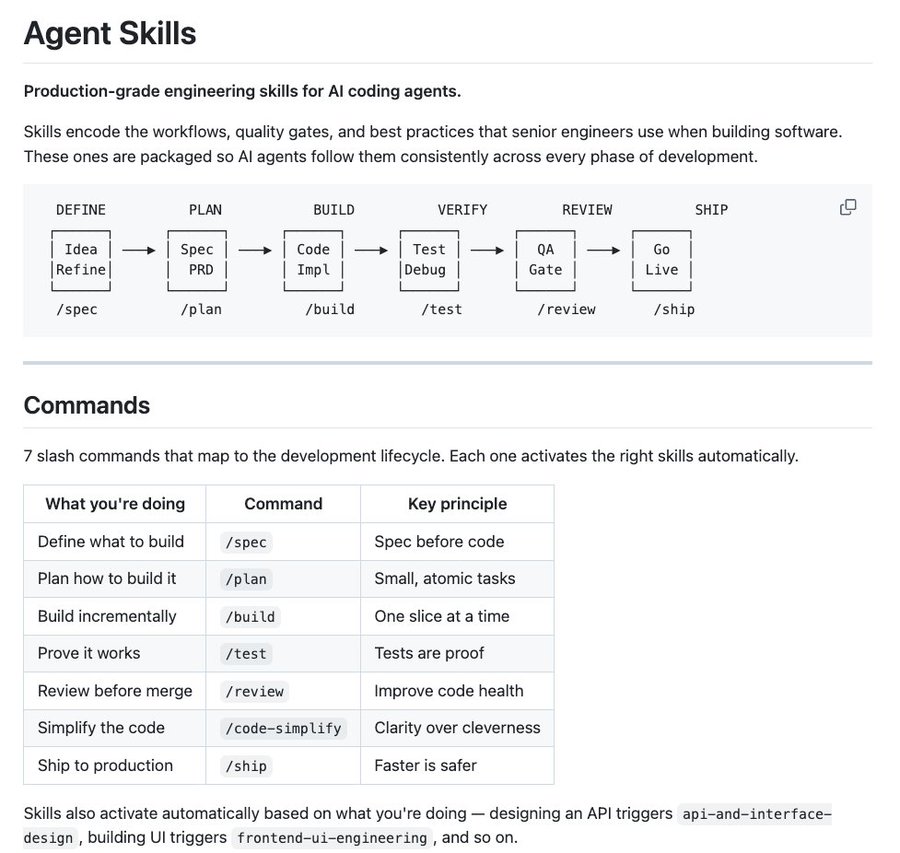
> It brings 19 engineering skills + 7 commands to AI coding agents, all inspired by Google best practices
> AI coding agents are powerful, but left alone, they take
>
> 
The single most screenshot-able thing in the repo is the table used across most lifecycle skills that names the agent's shortcut excuses and pairs each with a counter-argument:
> "I'll write tests after the code works" → "You won't. And tests written after the fact test implementation, not behavior."
> "It's just a prototype" → "Prototypes become production code. Tests from day one prevent the test-debt crisis."
> "I tested it manually" → "Manual testing doesn't persist. Tomorrow's change might break it with no way to know."
That table sits inside test-driven-development/SKILL.md. Most lifecycle skills in the repo ship one of their own. It is the single structural move that separates agent-skills from every other skills repo in the feed.
## Context
The author is @addyosmani, the author of Learning JavaScript Design Patterns and a Google Chrome engineering lead. He summarized the motivation in a May 3 research post:
"A senior engineer's job is mostly the parts that don't show up in the diff."
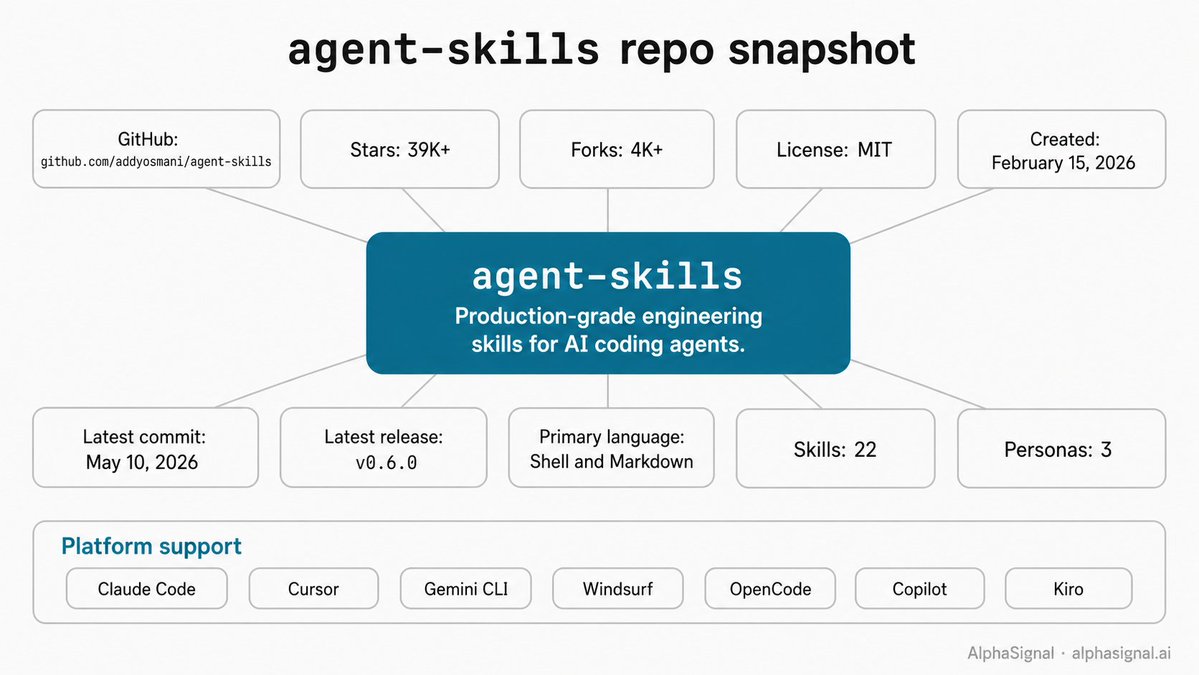
The repo was created on February 15, 2026 and has shipped 170+ commits from 20+ contributors since. The latest release is v0.6.0 on April 28. Growth went from 27K+ stars on May 4 to 39K+ on May 11.
## How it sits next to the other major skills repos
If you've been tracking the skills space, the question isn't "what is this." It's what this does that obra/superpowers and anthropics/skills don't.
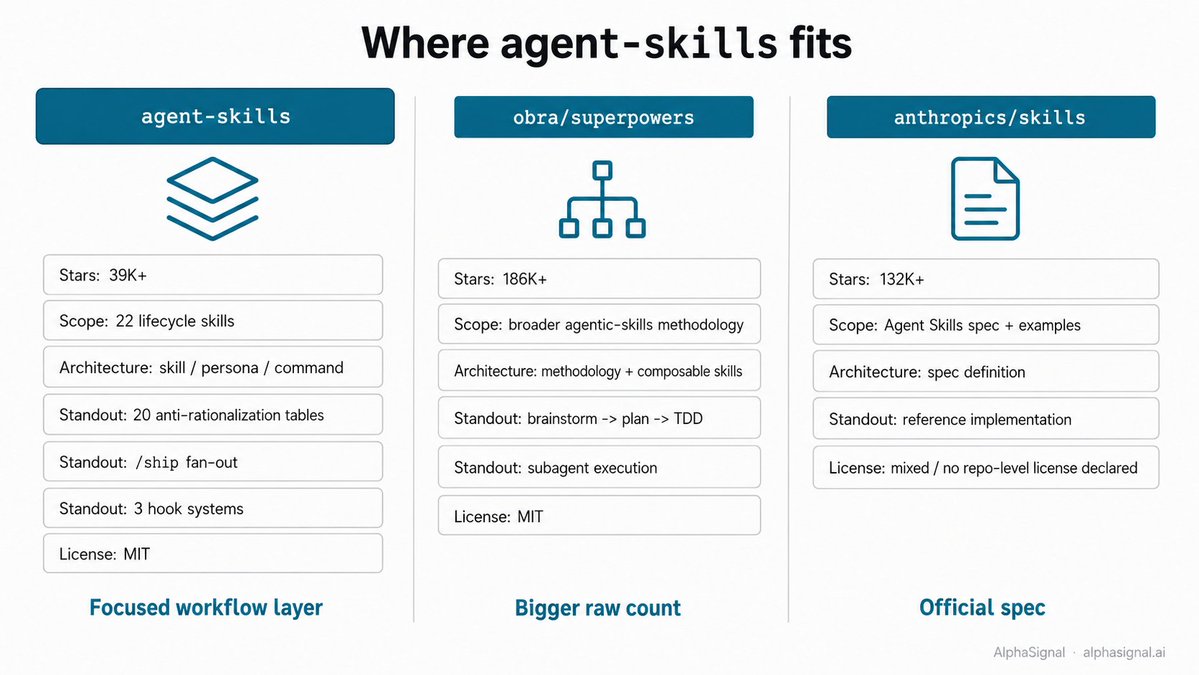
The star comparison cuts the other way: obra/superpowers is bigger by raw count, anthropics/skills is the official spec. The unique contribution of agent-skills is structural: 20 anti-rationalization tables, a parallel-fan-out command, and an enforcement hook layer.
## Repo snapshot
## Three composable layers
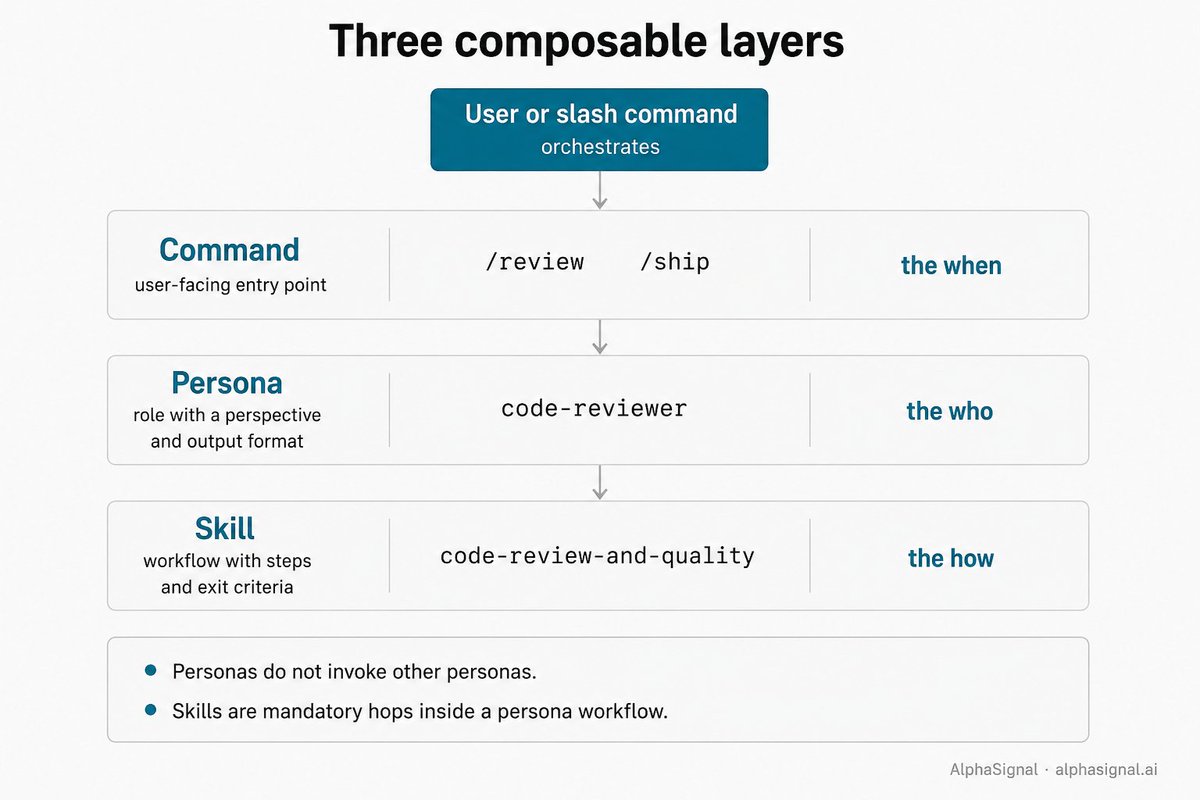
The governing rule is short and load-bearing. The user, or a slash command on the user's behalf, is the orchestrator. Personas do not invoke other personas. Skills are mandatory hops inside a persona's workflow.
This rule was formalized in the v0.6.0 release notes after a stretch of issues where contributors tried to write "meta-orchestrator" personas that routed work to other personas. The repo names this an anti-pattern and rejects it on two grounds. It loses information through paraphrasing hops, and on Claude Code it is impossible by platform constraint anyway, since subagents cannot spawn other subagents.
The only multi-persona pattern the repo endorses is parallel fan-out, used by /ship. More on that below.
## How it works
> You can skip to “How to get started” Section down below.
Inside the repo. Skills sit in skills/<name>/SKILL.md. Personas live in agents/ as plain Markdown files. Slash commands ship twice: .claude/commands/*.md for Claude Code and .gemini/commands/*.toml for Gemini CLI. Hooks are bash scripts in hooks/. Four reference checklists (testing, security, performance, accessibility) sit in references/, separate from any skill so they load on demand.
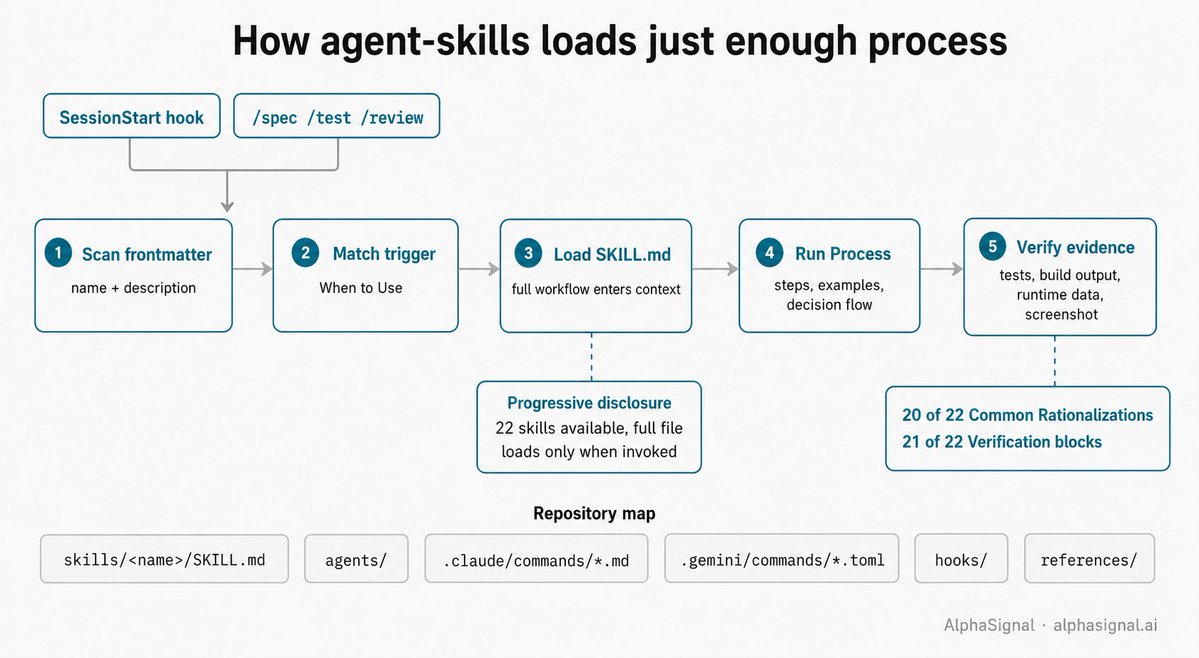
The SKILL.md format. Every skill file follows the same anatomy:
- YAML frontmatter (name + description). Only these two fields are loaded at session start, so the agent can scan all 22 skills cheaply. Full file content loads only when the skill is invoked. This is the progressive-disclosure mechanic that keeps the pack under context budget even with all skills installed.
- Overview and When to Use. Two short blocks. The first says what the skill does. The second lists the exact triggers that should activate it (for example, "implementing any new logic," "fixing a bug"). The agent matches the current task against the triggers.
- Process. The numbered step-by-step workflow. The largest section in every file, and the part the agent actually executes. Steps include inline code examples, decision flowcharts, and templates the agent fills in.
- Common Rationalizations. A two-column table of agent excuses paired with counter-arguments. The agent has to read its own most-likely shortcut before it can take it. 20 of the 22 skills ship one of these.
- Red Flags. A bullet list of observable signs the skill is being violated. The agent self-monitors against the list. The reviewer in /review also checks against it.
- Verification. A checklist of exit criteria the agent must satisfy before marking work done. Every checkbox is evidence-based: tests passing, build output, runtime data, screenshot. The repo's rule: "Seems right is never sufficient."
How a skill activates. Two paths. The agent auto-activates a skill by matching the current task against the When to Use triggers in the frontmatter. The meta-skill using-agent-skills holds the routing flowchart that does this matching, and is injected into every session by the session-start hook. The second path is explicit: the user invokes a skill via a slash command (/spec, /test, /review, etc.). Either path loads the full SKILL.md into context.
Length and structure rules. Every SKILL.md stays under 500 lines. Reference material that would push it over lives in references/, loaded only when a skill needs it. The longest skill file in the repo is ci-cd-and-automation at 390 lines. Verified from the local clone at SHA 3ff4b518: 22 of 22 skill files have valid YAML frontmatter, 21 of 22 have a ## Verification block, 20 of 22 have a ## Common Rationalizations table.
Start here. For most teams, the first three skills to load are spec-driven-development, test-driven-development, and code-review-and-quality. They cover the highest-risk agent failure loop: unclear task, untested change, and unreviewed diff.
> The full six-phase lifecycle map is near the end of this article for readers who want every skill by phase.
## Evidence: four structural moves that make it defensible
Osmani's frame is short: "Agents skip those steps for the same reason any junior would. They're invisible." The repo makes those steps visible in four places.
Anti-rationalization tables. test-driven-development is one of 20 skills with a table that names the shortcut and rejects it before the agent can take it.
The /ship fan-out. /ship spawns code-reviewer, security-auditor, and test-engineer concurrently, then merges their reports into a GO or NO-GO decision with a rollback plan. It skips fan-out only when the change touches two files or fewer, stays under 50 lines, and avoids auth, payments, data access, and config.
Three hook systems. session-start.sh injects using-agent-skills on new Claude Code sessions, uses jq for the JSON payload, falls back to INFO when jq is missing, and passes bash hooks/session-start-test.sh. sdd-cache-{pre,post}.sh caches source docs by sha256(url) and only serves cached bodies after 304 Not Modified against If-None-Match or If-Modified-Since. simplify-ignore.sh protects /* simplify-ignore-start: reason */ blocks with BLOCK_<hash> placeholders and reports 21 passed, 0 failed.
The newest skill, doubt-driven-development. Added in May 2026, it runs a fresh-context reviewer on non-trivial decisions using only the artifact plus the contract, not the original agent's reasoning. Cross-model review through Codex CLI or Gemini CLI requires explicit per-call authorization, so the check happens mid-flight before /review.
## How to install
Claude Code (the canonical path). Marketplace install:
```
/plugin marketplace add addyosmani/agent-skills
/plugin install agent-skills@addy-agent-skills
```
For teams without SSH keys on GitHub, force HTTPS (workaround for PR #108):
```
/plugin marketplace add https://github.com/addyosmani/agent-skills.git
/plugin install agent-skills@addy-agent-skills
```
For local development against an in-flight skill, clone and point Claude Code at the working copy:
```
git clone https://github.com/addyosmani/agent-skills.git
claude --plugin-dir /path/to/agent-skills
```
At runtime, the session-start.sh hook injects the using-agent-skills meta-skill on every new session, which routes the first message to the matching skill. The 7 slash commands become explicit lifecycle entries on top of that. CI on main is green for the workflow Test Plugin Installation at the verified SHA 3ff4b518.
OpenCode. No slash commands and no plugin system. The integration runs through AGENTS.md and the built-in skill tool. The repo ships .opencode/skills as a symlink to ../skills/ so OpenCode resolves the same skill set. The execution rule in AGENTS.md maps user intent (new feature triggers spec-driven-development, bug triggers debugging-and-error-recovery, code review triggers code-review-and-quality) to skills on every turn. Honest tradeoff per the repo's own docs/opencode-setup.md: skill invocation depends on model compliance with the AGENTS.md contract, with no hook layer.
Cursor. Copy selected SKILL.md files into .cursor/rules/. Start with the 2-to-3-essential set.
Gemini CLI. gemini skills install https://github.com/addyosmani/agent-skills.git --path skills. Native install. The repo also ships .gemini/commands/*.toml with the same 7 commands, except /plan is renamed /planning because /plan collides with a Gemini internal command.
Windsurf, Copilot, Kiro. Add skill content to .windsurfrules, .github/skills/, or .kiro/skills/ respectively. All three are plain-Markdown integrations with no hook layer.
## The six-phase lifecycle and 22 skills
> You can skip to Limitations and Links down below.
```
DEFINE → PLAN → BUILD → VERIFY → REVIEW → SHIP
/spec /plan /build /test /review /ship
/code-simplify
```
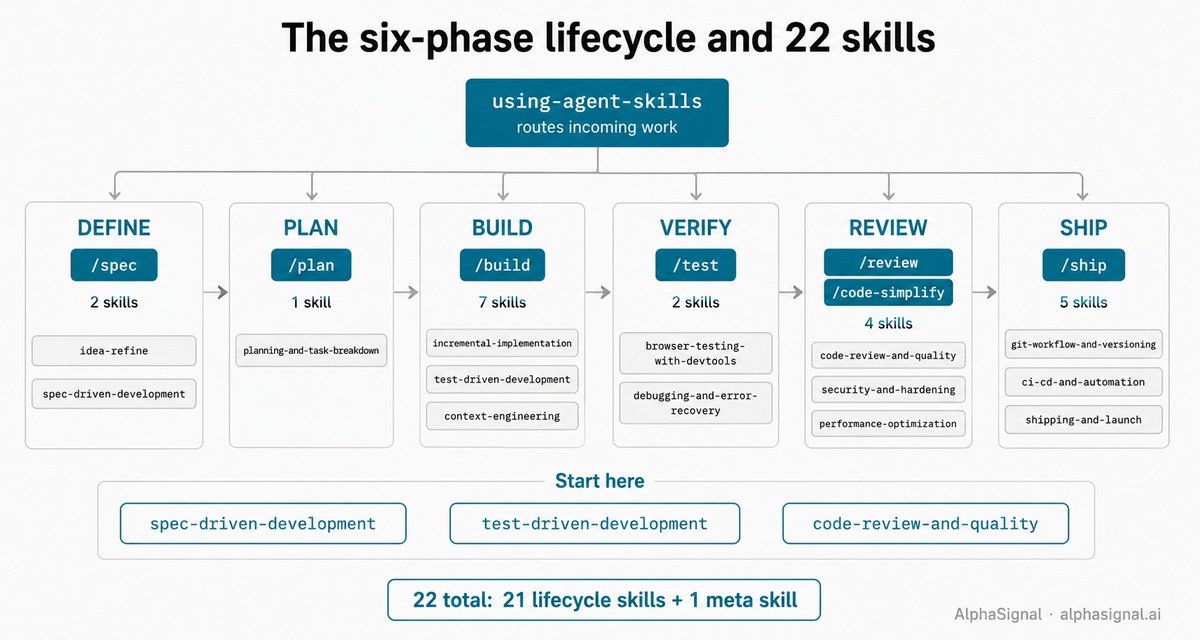
Skills auto-activate by context. The slash commands are explicit user entries on top. The 22 skills, with what each one does so the reader can pick:
## Meta
- using-agent-skills: Routes incoming work to the right skill via a flowchart. Auto-loaded by the session-start hook on every Claude Code session. Defines the shared operating behaviors (surface assumptions, manage confusion, push back, enforce simplicity, scope discipline, verify don't assume).
## Define
- idea-refine: Turns vague ideas into concrete proposals through structured divergent and convergent thinking. Output is a one-page markdown spec with problem statement, recommended direction, MVP scope, and a "Not Doing" list.
- spec-driven-development: Writes a PRD before code: objective, commands, project structure, code style, testing strategy, boundaries (always/ask-first/never). Four-phase gated workflow (specify, plan, tasks, implement) with human review at each gate.
## Plan
- planning-and-task-breakdown: Decomposes a spec into small verifiable tasks with acceptance criteria and dependency ordering. Cap of ~5 files per task. Each task includes its verification step.
## Build
- incremental-implementation: Builds thin vertical slices: implement, test, verify, commit. Caps at ~100 lines of unverified code. Feature flags, safe defaults, rollback-friendly changes.
- test-driven-development: Red-Green-Refactor, the test pyramid (80% unit / 15% integration / 5% E2E), DAMP over DRY in tests, the Beyonce Rule, and the Prove-It pattern for bug fixes (failing reproduction test before the fix).
- context-engineering: Loads the right context at the right time. Rules files, context packing, MCP integrations.
- source-driven-development: Grounds framework decisions in official documentation with required citations. Detects stack and versions, fetches the relevant docs, flags conflicts with existing code. Paired with the sdd-cache hook for cross-session HTTP caching.
- doubt-driven-development: Adversarial fresh-context review on every non-trivial in-flight decision. Five-step cycle: CLAIM, EXTRACT, DOUBT, RECONCILE, STOP. Optional cross-model escalation to Codex CLI or Gemini CLI with explicit per-call authorization.
- frontend-ui-engineering: Component architecture, design systems, state management, responsive design, WCAG 2.1 AA accessibility.
- api-and-interface-design: Contract-first design, Hyrum's Law, the One-Version Rule, error semantics, boundary validation.
## Verify
- browser-testing-with-devtools: Chrome DevTools MCP for live runtime data. DOM inspection, console errors, network traces, performance profiling, screenshots.
- debugging-and-error-recovery: Five-step triage: reproduce, localize, reduce, fix, guard. Stop-the-line rule for failing tests, safe fallbacks.
## Review
- code-review-and-quality: Five-axis review (correctness, readability, architecture, security, performance), change sizing ~100 lines, Critical/Important/Suggestion severity labels.
- code-simplification: Reduce complexity while preserving exact behavior. Chesterton's Fence, the Rule of 500. Paired with the simplify-ignore hook for protected code blocks.
- security-and-hardening: OWASP Top 10 prevention, auth patterns, secrets management, dependency auditing, three-tier boundary validation.
- performance-optimization: Measure-first approach. Core Web Vitals targets, profiling workflows, bundle analysis, anti-pattern detection.
## Ship
- git-workflow-and-versioning: Trunk-based development, atomic commits, change sizing ~100 lines, the commit-as-save-point pattern.
- ci-cd-and-automation: Shift Left, Faster is Safer, feature flags, quality gate pipelines, failure feedback loops.
- deprecation-and-migration: Code-as-liability mindset, compulsory vs advisory deprecation, migration patterns, zombie-code removal.
- documentation-and-adrs: Architecture Decision Records, API docs, inline documentation standards. Document the why, not the what.
- shipping-and-launch: Pre-launch checklists, feature flag lifecycle, staged rollouts, rollback procedures, monitoring setup.
The minimum viable set the community cites: spec-driven-development, test-driven-development, and code-review-and-quality. Add incremental-implementation and security-and-hardening for production work. Load others by phase as the task requires.
## Limitations
Opt-in scaffolding, not enforcement. The anti-rationalization tables live in the SKILL.md files, but nothing physically prevents an agent from generating code that ignores them. Adoption rests on the model honoring the contract.
Compliance-dependent on most harnesses. Only Claude Code's plugin manifest, session-start hook, and /ship fan-out give the pack hard teeth. Cursor, Windsurf, OpenCode, and Copilot fall back to rules files the model may or may not honor.
Plugin version drift. .claude-plugin/plugin.json declares plugin version 1.0.0, while the latest GitHub release is v0.6.0. Open issue #145 and PR #155 track the mismatch.
No empirical effectiveness benchmark. The repo provides workflows and verification checklists but no controlled experiment showing agents using these skills produce fewer bugs or higher-quality reviews than the same agents without it.
Shell hooks need review. The plugin includes shell hooks in hooks/ for session start, source-doc caching, and simplify-ignore protection. Teams should review those scripts before enabling the plugin inside production workspaces.
So the best recommendation is to adopt on Claude Code, with one caveat: treat it as scaffolding that needs the agent's cooperation, not a guarantee. On other harnesses, pilot the skills first and verify that the agent actually follows them.
## AlphaSignal Take
Verdict: Production Ready for Claude Code teams, Worth Watching elsewhere. The skills do what the README claims, maintenance health is strong (170+ commits, 20+ contributors, daily PR cadence, CI green on main), and the marketplace install path is one command on Claude Code.
On Cursor, Windsurf, OpenCode, Copilot, and rules-file setups, the value depends on whether the agent actually honors the loaded instructions. Forward-looking, v0.7 is the version to watch: open PRs and issues suggest it will formalize Kiro and Codex setup docs and resolve the plugin-version mismatch. The line that lands the design choice is Osmani's own:
> "If you put a 2,000-word essay on testing best practices into the agent's context, the agent reads it, generates plausible-looking text, and skips the actual testing. If you put a workflow there, the agent has something to do, and you have something to verify."
## Who benefits and who doesn't
Engineering teams running coding agents on production work, solo developers who want fewer agent fires by cherry-picking the minimum viable set (spec-driven-development + test-driven-development + code-review-and-quality), and platform teams designing internal agent frameworks (the three-layer model and parallel fan-out are reusable patterns).
It does not fit legacy codebases without specs or test infrastructure, teams whose primary harness is OpenCode without a strong AGENTS.md discipline, or anyone looking for a model upgrade rather than a workflow layer.
## Practitioner Implication
For teams already running a skills layer, the upgrade case is the three-layer model plus parallel fan-out. Neither exists in obra/superpowers or anthropics/skills.
## Links
- agent-skills repo (~5 min setup on Claude Code)
- Addy Osmani on Agent Skills (~10 min read)
- Agent Harness Engineering (~12 min read, optional context)
Follow @AlphaSignalAI for more content like this. Also, Check our Harness Engineering workshop, May 14th, 3 days left.
Subscribe at AlphaSignal.ai for daily AI signals. Read by 280,000+ developers.
## Questions?
Q: What does agent-skills do that obra/superpowers doesn't? A: Three things obra/superpowers does not document at the same structural depth. First, 20 of 22 skills include a Common Rationalizations table that names the excuses agents use to skip steps. Second, /ship is a parallel fan-out that runs code-reviewer, security-auditor, and test-engineer concurrently and merges their reports. Third, the repo ships three hook systems that give the pack enforcement weight on Claude Code.
Q: Which skill was added most recently, and why does it matter? A: doubt-driven-development, added in May 2026. It runs an adversarial fresh-context reviewer on every non-trivial in-flight decision using a five-step cycle (CLAIM, EXTRACT, DOUBT, RECONCILE, STOP), with optional cross-model escalation to Codex or Gemini. The point is to catch wrong-direction work mid-flight, while course correction is still cheap, not at /review time when the diff is already written.
Q: Which AI coding agents support agent-skills today? A: Claude Code (recommended path via plugin marketplace), Cursor, Gemini CLI (native skill install), Windsurf, OpenCode, GitHub Copilot, and Kiro IDE. The skills are plain Markdown and work with any agent that accepts system prompts or instruction files.
Q: What is the minimum set of skills to install first? A: The community-cited minimum is spec-driven-development, test-driven-development, and code-review-and-quality. Adding incremental-implementation and security-and-hardening covers most production-relevant workflows without saturating the context window.
Q: How does the /ship command work, and when does it skip the parallel review? A: /ship spawns three subagents in one turn: code-reviewer, security-auditor, and test-engineer. The main agent merges their reports into a GO or NO-GO decision with a mandatory rollback plan. It skips the fan-out only when the change touches two files or fewer, the diff is under 50 lines, and it does not touch auth, payments, data access, or config.
## 相关链接
- [AlphaSignal AI](https://x.com/AlphaSignalAI)
- [@AlphaSignalAI](https://x.com/AlphaSignalAI)
- [11K](https://x.com/AlphaSignalAI/status/2053887444588618079/analytics)
- [Apr 4](https://x.com/DataChaz/status/2040357775830814798)
- [@addyosmani](https://x.com/addyosmani)
- [417K](https://x.com/DataChaz/status/2040357775830814798/analytics)
- [@addyosmani](https://x.com/@addyosmani)
- [May 3 research post](https://addyosmani.com/blog/agent-skills/)
- [session-start.sh](https://session-start.sh/)
- [simplify-ignore.sh](https://simplify-ignore.sh/)
- [session-start.sh](https://session-start.sh/)
- [https://github.com/addyosmani/agent-skills.git](https://github.com/addyosmani/agent-skills.git)
- [agent-skills repo](https://github.com/addyosmani/agent-skills)
- [Addy Osmani on Agent Skills](https://addyosmani.com/blog/agent-skills/)
- [Agent Harness Engineering](https://addyosmani.com/blog/agent-harness-engineering/)
- [@AlphaSignalAI](https://x.com/@AlphaSignalAI)
- [Harness Engineering workshop](https://luma.com/t24o902x)
- [AlphaSignal.ai](https://alphasignal.ai/)
- [Upgrade to Premium](https://x.com/i/premium_sign_up)
- [1:18 AM · May 12, 2026](https://x.com/AlphaSignalAI/status/2053887444588618079)
- [11.7K Views](https://x.com/AlphaSignalAI/status/2053887444588618079/analytics)
---
*导出时间: 2026/5/12 21:10:45*
---
## 中文翻译
# AI 智能体如何遵循高级工程师的生产工作流,以及如何将其集成到你的技术栈中
**作者**: AlphaSignal AI
**日期**: 2026-04-04T09:16:16.000Z
**来源**: [https://x.com/AlphaSignalAI/status/2053887444588618079](https://x.com/AlphaSignalAI/status/2053887444588618079)
---

## 22 个 Markdown 技能,7 个斜杠命令,作者打赌“约束系统”比模型本身更重要。
> 阅读约 10 分钟后,你将决定是否安装 agent-skills,将其集成在何处,以及如何立即使用每一个技能。
Google Chrome 工程负责人 Addy Osmani 于 2026 年 2 月 15 日开源了 agent-skills。
该仓库在三个月内获得了 39,000+ Star,日增长报告达 1,000+。
核心赌注在于:智能体的可靠性来自于模型周围的约束系统,而非更聪明的模型。
不同之处在于,这不仅仅是另一个提示词库。它是一个三层架构(技能、人设、命令),其中 20/22 个技能包含反合理化表格,一个并行发散命令,以及三个让该工具包在 Claude Code 上具有真正执行力的钩子。
它并不会让模型变得更聪明。它让跳过规范、测试、审查和安全检查变得更困难。
> **Charly Wargnier@DataChaz**: [原文链接](https://x.com/DataChaz/status/2040357775830814798)
>
> 你得看看这个。
> Google 的 @addyosmani 刚刚发布了他新的 Agent Skills,简直令人难以置信。
> 它为 AI 编码智能体带来了 19 个工程技能 + 7 个命令,所有这些都受到 Google 最佳实践的启发。
> AI 编码智能体很强大,但如果放任不管,它们会...
>
> 
仓库中最值得截图的是跨大多数生命周期技能使用的表格,它列出了智能体的“捷径借口”并为每一个配上了反驳论据:
> “等代码能跑了我再写测试” → “你不会写的。事后写的测试是在测试实现细节,而不是行为。”
> “这只是个原型” → “原型最终会变成生产代码。从第一天起就开始测试可以防止测试债务危机。”
> “我已经手动测过了” → “手动测试无法持久化。明天的更改可能会破坏它,而你却无法察觉。”
该表格位于 test-driven-development/SKILL.md 中。仓库中的大多数生命周期技能都包含这样一个表格。这是将 agent-skills 与信息流中其他所有技能仓库区分开来的单一结构性举措。
## 背景
作者是 @addyosmani,也是《Learning JavaScript Design Patterns》一书的作者和 Google Chrome 的工程负责人。他在 5 月 3 日的一篇研究文章中总结了动机:
“高级工程师的工作主要在于那些不会出现在 diff(代码差异)中的部分。”
该仓库创建于 2026 年 2 月 15 日,此后已有 20 多位贡献者提交了 170 多次代码。最新版本是 4 月 28 日的 v0.6.0。星标数从 5 月 4 日的 27,000+ 增长到 5 月 11 日的 39,000+。
## 它与其他主要技能仓库的对比
如果你一直关注技能领域,问题不是“这是什么”。而是它所做的工作是 obra/superpowers 和 anthropics/skills 所不具备的。

星标数对比反过来了:obra/superpowers 在原始数量上更多,anthropics/skills 是官方规范。agent-skills 的独特贡献在于结构:20 个反合理化表格,一个并行发散命令,以及一个执行钩子层。
## 仓库快照

## 三个可组合的层

核心规则简短且承重关键。用户,或代表用户的斜杠命令,是编排者。人设不会调用其他人设。技能是人设工作流中的强制跳转点。
这条规则在 v0.6.0 发布说明中被正式化,此前有一系列问题,贡献者试图编写“元编排器”人设来将工作路由给其他人设。仓库将此命名为反模式,并基于两个理由拒绝它。它在转述跳转中会丢失信息,而且在 Claude Code 上由于平台约束这不可能实现,因为子智能体不能生成其他子智能体。
仓库唯一支持的多人设模式是并行发散,由 /ship 使用。更多内容见下文。
## 它是如何工作的
> 你可以跳到下面的“如何开始”部分。
在仓库内部。技能位于 skills/<name>/SKILL.md。人设位于 agents/ 中,是普通的 Markdown 文件。斜杠命令发布两次:.claude/commands/*.md 用于 Claude Code,.gemini/commands/*.toml 用于 Gemini CLI。钩子是 hooks/ 中的 bash 脚本。四个参考检查清单(测试、安全、性能、可访问性)位于 references/ 中,与任何技能分离,以便按需加载。

SKILL.md 格式。每个技能文件遵循相同的解剖结构:
- YAML 前置元数据(名称 + 描述)。会话开始时只加载这两个字段,以便智能体可以低成本扫描所有 22 个技能。完整文件内容仅在调用技能时加载。这是一种渐进式披露机制,即使安装了所有技能,也能保持工具包在上下文预算内。
- 概述和何时使用。两个简短的块。第一个说明技能的作用。第二个列出应激活它的确切触发器(例如,“实现任何新逻辑”,“修复错误”)。智能体将当前任务与触发器进行匹配。
- 流程。编号的分步工作流。每个文件中最大的部分,也是智能体实际执行的部分。步骤包括内联代码示例、决策流程图和智能体填写的模板。
- 常见合理化。一个两列的表格,列出智能体的借口并配以反驳论据。智能体在走捷径之前必须阅读自己最可能的借口。22 个技能中有 20 个包含这样的表格。
- 危险信号。一个项目符号列表,列出了违反技能的可观察迹象。智能体根据列表进行自我监控。/review 中的审查者也会根据它进行检查。
- 验证。一个退出标准检查清单,智能体在标记工作完成前必须满足。每个复选框都基于证据:测试通过、构建输出、运行时数据、屏幕截图。仓库的规则:“看起来对永远是不够的。”
技能如何激活。有两条路径。智能体通过将当前任务与前置元数据中的“何时使用”触发器相匹配来自动激活技能。元技能 using-agent-skills 保存了执行此匹配的流程图,并通过会话开始钩子注入到每个会话中。第二条路径是显式的:用户通过斜杠命令(/spec、/test、/review 等)调用技能。任何一条路径都会将完整的 SKILL.md 加载到上下文中。
长度和结构规则。每个 SKILL.md 保持在 500 行以内。会使其超出的参考材料位于 references/ 中,仅在技能需要时加载。仓库中最长的技能文件是 ci-cd-and-automation,共 390 行。从本地克隆的 SHA 3ff4b518 验证:22 个技能文件中有 22 个具有有效的 YAML 前置元数据,22 个中有 21 个具有 ## Verification 块,22 个中有 20 个具有 ## Common Rationalizations 表格。
从这里开始。对于大多数团队,首先要加载的三个技能是 spec-driven-development、test-driven-development 和 code-review-and-quality。它们覆盖了最高风险的智能体失败循环:任务不明确、更改未经测试和差异未经审查。
> 完整的六阶段生命周期图在本文末尾,供想要按阶段了解每个技能的读者参考。
## 证据:四个使其具有防御性的结构性举措
Osmani 的框架很简短:“智能体跳过这些步骤的原因和任何初级工程师一样。因为它们是不可见的。”该仓库在四个地方让这些步骤变得可见。
反合理化表格。test-driven-development 是 20 个技能之一,它有一个表格,列出了捷径并在智能体采用之前予以拒绝。
/ship 发散。/ship 并发生成 code-reviewer、security-auditor 和 test-engineer,然后将它们的报告合并为带有回滚计划的 GO 或 NO-GO 决策。只有当更改触及两个或更少的文件、保持在 50 行以内、并避免 auth、payments、data access 和 config 时,它才会跳过发散。
三个钩子系统。session-start.sh 在新的 Claude Code 会话中注入 using-agent-skills,对有效负载使用 jq,在缺少 jq 时回退到 INFO,并传递 bash hooks/session-start-test.sh。sdd-cache-{pre,post}.sh 通过 sha256(url) 缓存源文档,并且仅在 If-None-Match 或 If-Modified-Since 出现 304 Not Modified 时才提供缓存的内容。simplify-ignore.sh 使用 BLOCK_<hash> 占位符保护 /* simplify-ignore-start: reason */ 块,报告 21 个通过,0 个失败。
最新的技能,doubt-driven-development。添加于 2026 年 5 月,它仅基于产物加上合约(而不是原始智能体的推理)对非平凡决策运行全新上下文的审查者。通过 Codex CLI 或 Gemini CLI 进行跨模型审查需要明确的每次调用授权,因此检查发生在 /review 之前的中途。
## 如何安装
Claude Code(规范路径)。市场安装:
```
/plugin marketplace add addyosmani/agent-skills
/plugin install agent-skills@addy-agent-skills
```
对于在 GitHub 上没有 SSH 密钥的团队,强制使用 HTTPS(PR #108 的变通方法):
```
/plugin marketplace add https://github.com/addyosmani/agent-skills.git
/plugin install agent-skills@addy-agent-skills
```
对于针对正在进行的技能进行本地开发,克隆并指向 Claude Code 的工作副本:
```
git clone https://github.com/addyosmani/agent-skills.git
claude --plugin-dir /path/to/agent-skills
```
在运行时,session-start.sh 钩子在每个新会话上注入 using-agent-skills 元技能,它将第一条消息路由到匹配的技能。7 个斜杠命令在此基础上成为显式的生命周期入口。在已验证的 SHA 3ff4b518 处,主分支上的 CI 对工作流“Test Plugin Installation”显示为绿色。
OpenCode。没有斜杠命令,也没有插件系统。集成通过 AGENTS.md 和内置的技能工具运行。仓库将 .opencode/skills 作为符号链接发布到 ../skills/,以便 OpenCode 解析相同的技能集。AGENTS.md 中的执行规则将用户意图(新功能触发 spec-driven-development,错误触发 debugging-and-error-recovery,代码审查触发 code-review-and-quality)映射到每一轮的技能。根据仓库自己的 docs/opencode-setup.md 所述,诚实的权衡:技能调用取决于模型对 AGENTS.md 契约的遵守,没有钩子层。
Cursor。将选定的 SKILL.md 文件复制到 .cursor/rules/。从 2-3 个必备技能集开始。
Gemini CLI。gemini skills install https://github.com/addyosmani/agent-skills.git --path skills。原生安装。仓库还发布了 .gemini/commands/*.toml,包含相同的 7 个命令,除了 /plan 被重命名为 /planning,因为 /plan 与 Gemini 内部命令冲突。
Windsurf、Copilot、Kiro。将技能内容分别添加到 .windsurfrules、.github/skills/ 或 .kiro/skills/。这三者都是纯 Markdown 集成,没有钩子层。
## 六阶段生命周期和 22 个技能
> 你可以跳到下面的局限性和链接部分。
```
DEFINE → PLAN → BUILD → VERIFY → REVIEW → SHIP
/spec /plan /build /test /review /ship
/code-simplify
```

技能根据上下文自动激活。斜杠命令是显式的用户入口。以下是 22 个技能,以及每个技能的作用,以便读者选择:
## 元技能
- using-agent-skills:通过流程图将传入的工作路由到正确的技能。在每个 Claude Code 会话中通过会话开始钩子自动加载。定义共享的操作行为(显化假设、管理困惑、回击、强制简单性、范围纪律、验证而不假设)。
## 定义阶段
- idea-refine:通过结构化的发散和收敛思维,将模糊的想法转化为具体的提案。输出是一个单页 markdown 规范,包含问题陈述、推荐方向、MVP 范围和“不做”列表。
- spec-driven-development:在编写代码之前先写 PRD:目标、命令、项目结构、代码风格、测试策略、边界(总是/先问/从不)。四阶段门控工作流(规范、计划、任务、实施),每个门控都有人工审查。
## 计划阶段
- planning-and-task-breakdown:将规范分解为小的可验证任务,具有验收标准和依赖顺序。每个任务上限约 5 个文件。每个任务包括其验证步骤。
## 构建阶段
- incremental-implementation:构建薄的垂直切片:实施、测试、验证、提交。未验证代码上限约 100 行。功能标志、安全默认值、回滚友好的更改。
- test-driven-development:红-绿-重构,测试金字塔(80% 单元 / 15% 集成 / 5% E2E),测试中的 DAMP 优于 DRY,Beyonce 规则,以及错误修复的证明模式(修复前有失败的重现测试)。
- context-engineering:在正确的时间加载正确的上下文。规则文件、上下文打包、MCP 集成。
- source-driven-development:基于带有必需引用的官方文档来确定框架决策。检测堆栈和版本,获取相关文档,标记与现有代码的冲突。与 sdd-cache 钩子配对以进行跨会话 HTTP 缓存。
- doubt-driven-development:对每个非平凡的进行中决策进行对抗性的全新上下文审查。五步循环:CLAIM(主张)、EXTRACT(提取)、DOUBT(质疑)、RECONCILE(调和)、STOP(停止)。可选的跨模型升级到 Codex CLI 或 Gemini CLI,需要明确的每次调用授权。
- frontend-ui-engineering:组件架构、设计系统、状态管理、响应式设计、WCAG 2.1 AA 可访问性。
- api-and-interface-design:契约优先设计、Hyrum 定律、单版本规则、错误语义、边界验证。
## 验证阶段
- browser-testing-with-devtools:用于实时运行时数据的 Chrome DevTools MCP。DOM 检查、控制台错误、网络跟踪、性能分析、屏幕截图。
- debugging-and-error-recovery:五步分流:重现、定位、缩减、修复、防护。失败测试的停线规则、安全回退。
## 审查阶段
- code-review-and-quality:五轴审查(正确性、可读性、架构、安全性、性能),更改大小约 100 行,严重性标签(严重/重要/建议)。
- code-simplification:在保持精确行为的同时降低复杂性。切斯特顿栅栏、500 规则。与 simplify-ignore 钩子配对以保护代码块。
- security-and-hardening:OWASP Top 10 防范、身份验证模式、机密管理、依赖审计、三层边界验证。
- performance-optimization:测量优先方法。Core Web Vitals 目标、分析工作流、包分析、反模式检测。
## 发布阶段
- git-workflow-and-versioning:基于主干的开、原子提交、更改大小约 100 行、提交即保存点模式。
- ci-cd-and-automation:左移、更快即更安全、功能标志、质量门控管道、失败反馈循环。
- deprecation-and-migration:代码即责任心态、强制性与建议性弃用、迁移模式、僵尸代码删除。
- documentation-and-ads:架构决策记录、API 文档、内联文档标准。记录为什么,而不是什么。
- shipping-and-launch:发布前检查清单、功能标志生命周期、分阶段推出、回滚程序、监控设置。
社区引用的最小可行集:spec-driven-development、test-driven-development 和 code-review-and-quality。对于生产工作,添加 incremental-implementation 和 security-and-hardening。根据任务要求按阶段加载其他技能。
## 局限性
可选的脚手架,而非强制执行。反合理化表格存在于 SKILL.md 文件中,但没有任何东西能从物理上阻止...