# Four Agent Orchestration Patterns You Should Know About
**作者**: AlphaSignal AI
**日期**: 2026-05-05T14:01:01.000Z
**来源**: [https://x.com/AlphaSignalAI/status/2051663458114887718](https://x.com/AlphaSignalAI/status/2051663458114887718)
---
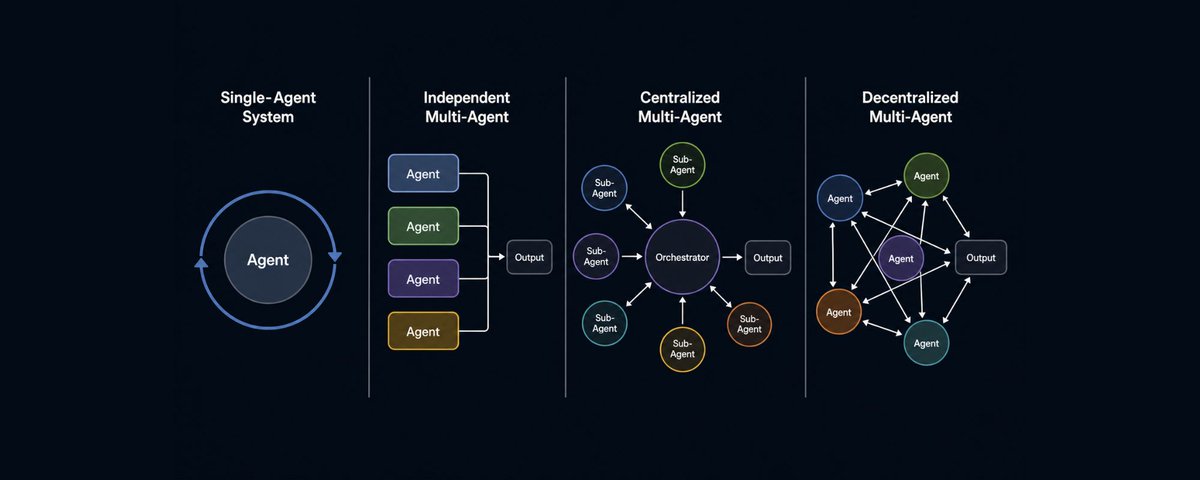
Let’s talk about agent orchestration.
Single-prompt LLM workflows can become difficult to manage once the task grows beyond a simple instruction and response. Context windows still create limits when working with large documents. Complex tasks can increase hallucination risk. Error detection also becomes harder when the system has no built-in verification layer.
This is where multi-agent architectures become useful. Instead of asking one model to handle everything, you break a large goal into smaller specialized tasks. But adding more agents is not enough by itself. The real design challenge is defining how those agents share state, communicate with each other, verify outputs, and recover from errors.
Siddhant and Yukta Kulkarni from NYU recently published a large benchmark on this problem. They tested 10,000 documents across five frontier and open-weight LLMs and evaluated four orchestration patterns.
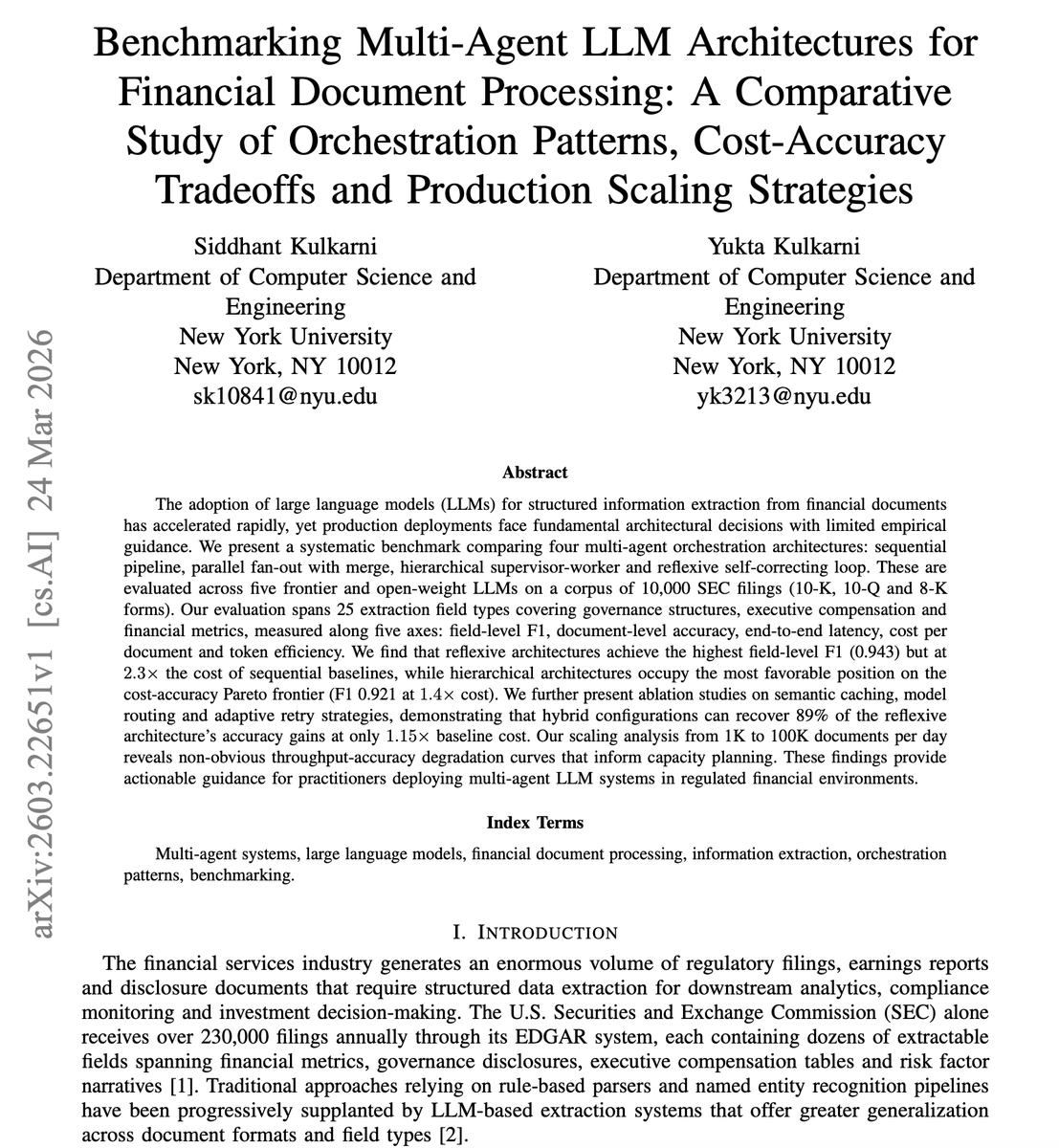
The researchers evaluated four multi-agent orchestration architectures:
1. Sequential pipeline
2. Parallel fan-out with merge
3. Hierarchical supervisor-worker
4. Reflexive self-correcting loop
Each architecture used the same basic set of agents, including a document parser, field extractor, table analyzer, cross-reference resolver, confidence scorer, and output formatter.
The difference was not the agents themselves, but how those agents were connected and coordinated.
Here is a technical breakdown of how each pattern works, where it can fail, and when it makes sense in production.
## 1. Sequential Pipeline
This is the simplest baseline.
Agents process tasks in a fixed chain. Agent A completes its assigned step and passes the accumulated context to Agent B. Agent B then adds its output and passes everything to Agent C.
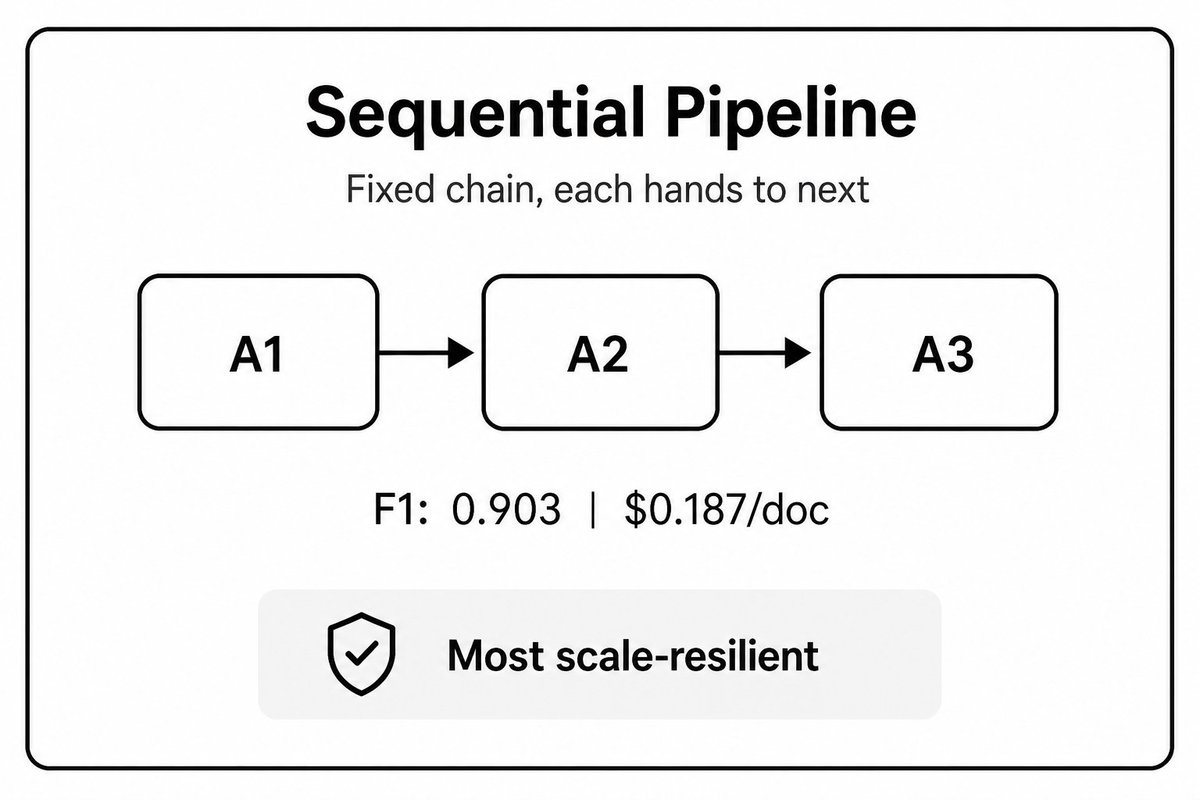
The main advantage is predictability.
The execution order is deterministic, and latency scales in a linear way. Since there is no complex coordination between agents, this pattern is highly resilient at scale. When task volume increases to around 100,000 tasks per day, the sequential pipeline shows the smallest drop in accuracy.
The downside is token inefficiency.
Every downstream agent has to process the growing context from all previous steps. This means token usage increases as the chain gets longer.
Error propagation is another concern. If the first agent extracts the wrong value or hallucinates a detail, every agent after it inherits that mistake. The system has no natural correction point unless you add one manually.
When to use it: Use this pattern when your tasks are simple, budgets are strict, or you are operating at massive scale. It works best when predictable throughput matters more than peak accuracy.
## 2. Parallel Fan-Out with Merge
This pattern is designed for speed.
A router sends independent tasks to multiple domain-specific workers at the same time. Once the workers finish, a merge agent collects their outputs and reconciles them into a final result.
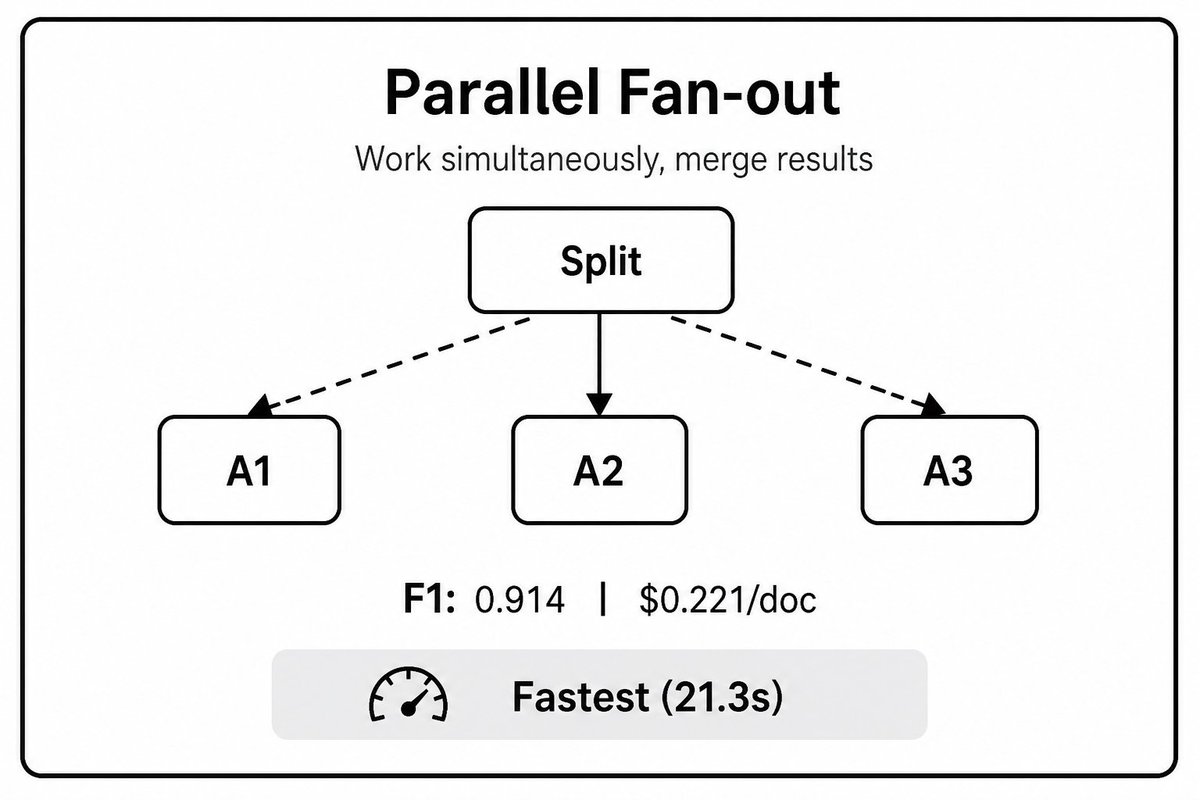
The benefit is lower latency.
Since the workers run concurrently, total latency is mostly limited by the slowest branch plus the time needed for the merge step. It also gives you better fault isolation. If one worker fails or produces a bad result, it does not automatically contaminate the other branches.
The trade-off is cost.
This is often the least token-efficient architecture of the four. Parallel workers usually need overlapping context to complete their tasks, which means the same input may be processed several times.
The merge step can also become difficult. Independent agents may produce conflicting outputs, incomplete reasoning, or mismatched assumptions. When that happens, the merge agent has to resolve those conflicts without always having enough context to know which answer is correct.
When to use it: Use this pattern when latency is the highest priority or when the tasks are naturally independent. It is a good fit for extraction tasks that do not require shared memory across workers.
## 3. Hierarchical Supervisor-Worker
This pattern works more like a manager coordinating a specialized team.
A supervisor agent plans the task and assigns specific work to different agents. Each worker returns an output, often with a confidence score. If the confidence score falls below a defined threshold, the supervisor can reassign the task, request a second pass, or escalate it to a stronger model.
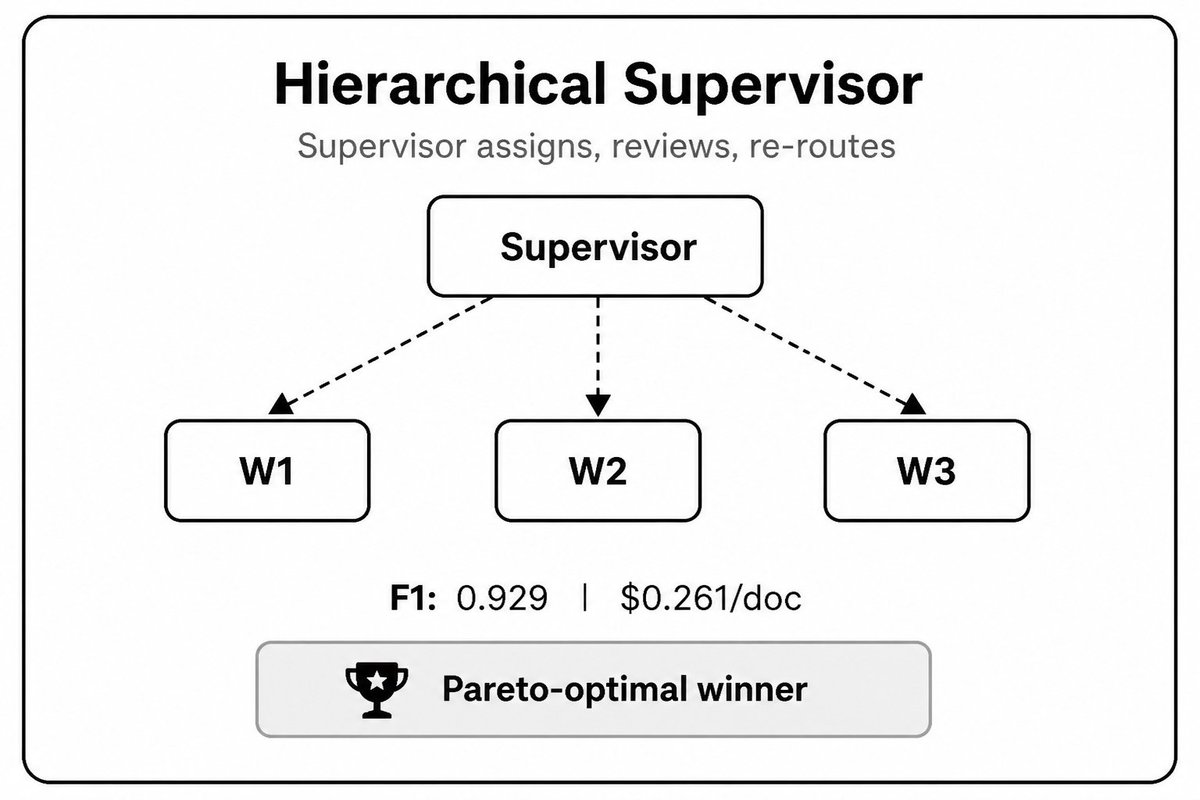
This is usually the most balanced architecture. It reaches 98.5% of the maximum F1 accuracy in the benchmark while costing about 60% of a fully reflexive system.
It is also more token-efficient because workers only receive the context they need. You do not have to send the full accumulated context to every agent. This makes it easier to control cost, especially when the workload has many different task types.
Another advantage is model routing.
Simple tasks can be sent to cheaper models, while harder tasks can be escalated to stronger models such as GPT-4o or Claude 3.5 Sonnet. This makes the architecture more flexible for real production systems where cost and accuracy both matter.
The downside is added coordination complexity.
The supervisor introduces decision-making latency, and the system becomes more dependent on message passing between agents. If the routing logic is poorly designed, tasks can be assigned incorrectly or agents can fail to return outputs in the expected format.
When to use it: Use this pattern for generalized, moderate-scale production workloads. It is especially useful when you need strong accuracy without letting cost grow out of control.
## 4. Reflexive Self-Correcting Loop
This pattern relies on explicit verification.
An agent produces an output. A separate verifier reviews it and critiques the result. If the output fails the check, the verifier sends structured feedback back to the original agent for revision. This loop continues until the output passes or the system reaches a fixed iteration limit, often three rounds.
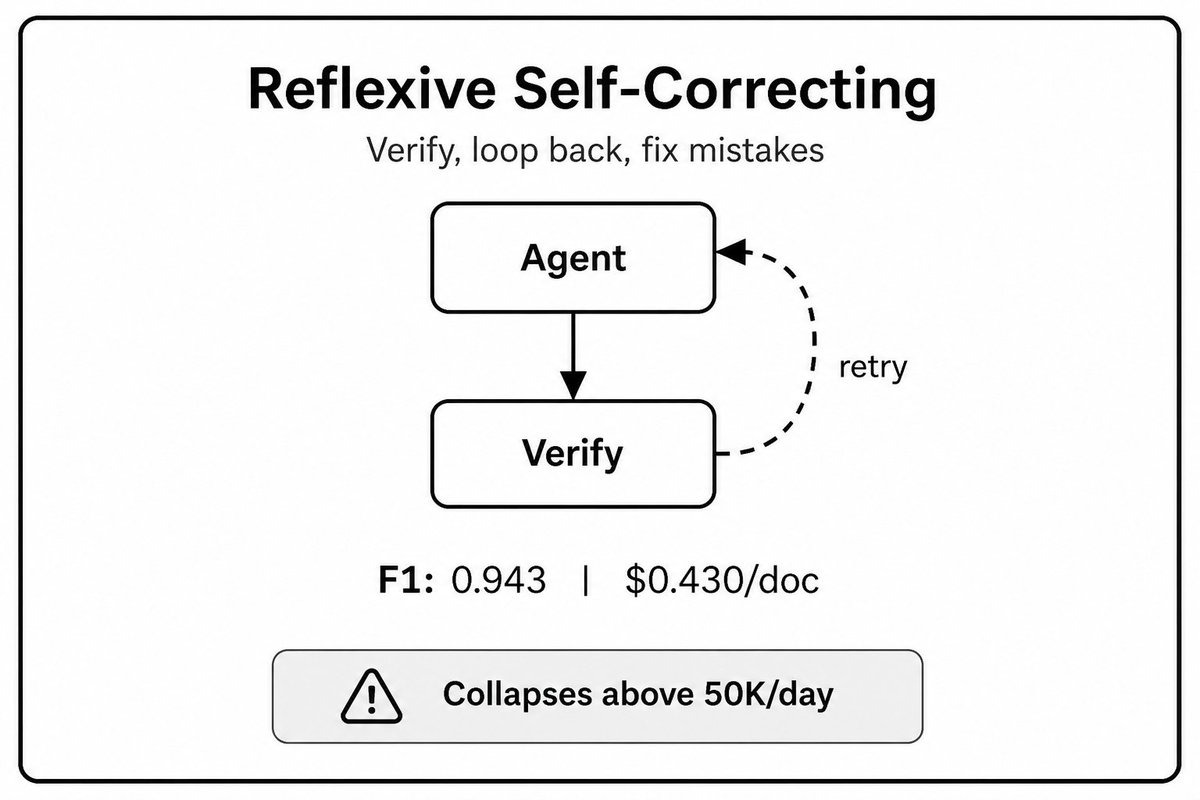
This pattern achieves the highest absolute accuracy in the benchmark. The reason is simple. The system has a built-in mechanism for catching errors, revising weak outputs, and improving the final answer before it reaches the user.
But that accuracy comes with a major cost.
The benchmark shows that this pattern can cost up to 2.3 times more than the sequential baseline.
The bigger issue appears at scale.
Once this pattern is pushed beyond 25,000 tasks per day, performance starts to degrade. Correction loops create queueing delays. Systems hit timeouts. Some iterations get cut short. Eventually, accuracy can fall below the sequential baseline.
It is also more vulnerable to excessive revision. The system can keep changing its interpretation of ambiguous text instead of settling on the most reasonable answer. In some cases, the correction loop adds complexity without improving reliability.
When to use it: Use this pattern only for low-volume, high-stakes workloads where mistakes are unacceptable and cost is less important. It should not be the default architecture for large-scale production systems.
## Performance results
According to the paper, the researchers tested the four orchestration patterns on 10,000 SEC filings using five LLMs: GPT-4o, Claude 3.5 Sonnet, Gemini 1.5 Pro, Llama 3 70B, and Mixtral 8x22B.
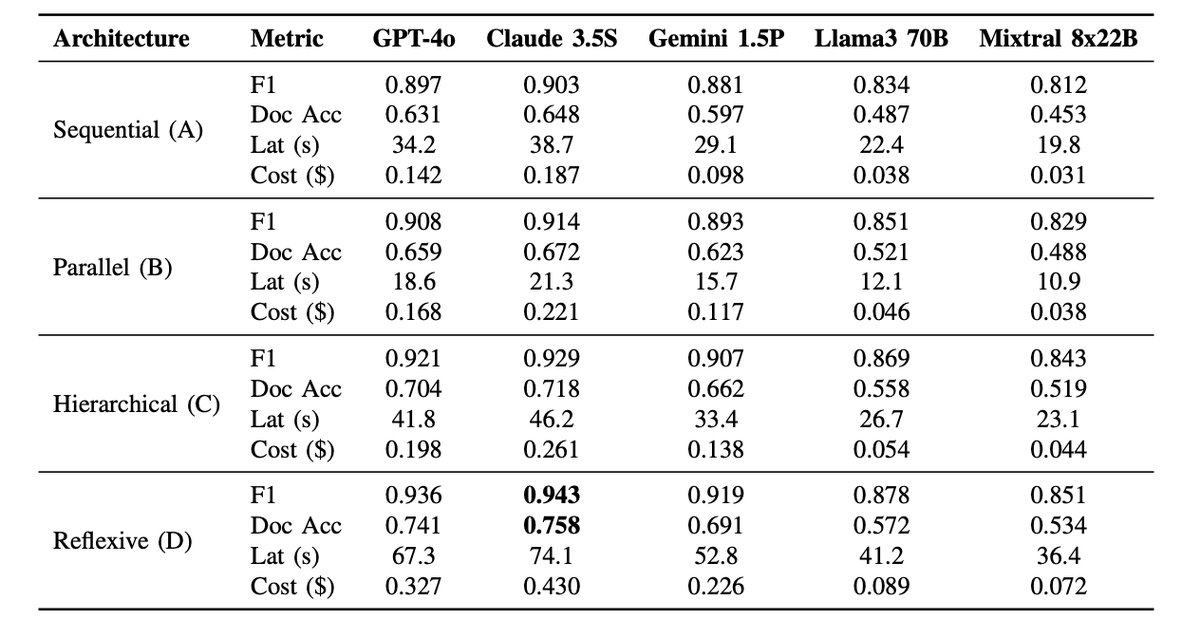
The reflexive self-correcting loop achieved the highest accuracy, reaching 0.943 F1 with Claude 3.5 Sonnet. But it was also the most expensive, costing 2.3 times more than the sequential baseline.
The hierarchical supervisor-worker pattern gave the best balance. It reached 0.929 F1, which is 98.5% of the reflexive score, while costing only 60.7% as much.
Parallel fan-out was the fastest pattern, making it useful when latency matters most.
Sequential pipeline was the cheapest and most stable at large scale, especially when the workload reached up to 100,000 documents per day.
The main takeaway is simple: reflexive wins on accuracy, parallel wins on speed, sequential wins on cost and scale, and hierarchical is the best default choice for most production workloads.
## Which Pattern Should You Choose?
The right orchestration pattern depends on what you are trying to optimize.
If you are working at massive scale or need the lowest possible cost, use a sequential pipeline.
If real-time speed is the main requirement, use parallel fan-out with merge.
If accuracy is the top priority and the workload volume is low, use a reflexive self-correcting loop.
For most enterprise workloads, the hierarchical supervisor-worker pattern is the safest default choice. It gives you a cleaner balance between accuracy, cost, latency, and operational control.
A separate study of 70 real-world agent projects also raised an important warning: stronger models do not automatically create safer or more reliable systems.
Paper => https://arxiv.org/abs/2604.18071
The architecture around the model plays a huge role. A pattern that looks impressive in a small demo can become expensive, slow, or unstable once it is pushed into production.
That is why the simpler choice is often the better starting point. Use the least complex pattern that can handle the workload. Add hierarchy when you need smarter routing. Add reflexive verification only when the risk is high enough to justify the extra cost.
In production, agent orchestration is not just about making agents work together. It is about designing the system around the real limits of the workload: cost, latency, accuracy, scale, and failure recovery.
Are you currently planning an architecture for a specific workload where we could apply one of these patterns?
Follow @AlphaSignalAI for more content like this.
Subscribe at AlphaSignal.ai for daily AI signals. Read by 280,000+ developers.
## 相关链接
- [AlphaSignal AI](https://x.com/AlphaSignalAI)
- [@AlphaSignalAI](https://x.com/AlphaSignalAI)
- [1.5K](https://x.com/AlphaSignalAI/status/2051663458114887718/analytics)
- [published a large benchmark](https://arxiv.org/abs/2603.22651)
- [https://arxiv.org/abs/2604.18071](https://arxiv.org/abs/2604.18071)
- [@AlphaSignalAI](https://x.com/@AlphaSignalAI)
- [AlphaSignal.ai](https://alphasignal.ai/)
- [Upgrade to Premium](https://x.com/i/premium_sign_up)
- [10:01 PM · May 5, 2026](https://x.com/AlphaSignalAI/status/2051663458114887718)
- [1,570 Views](https://x.com/AlphaSignalAI/status/2051663458114887718/analytics)
---
*导出时间: 2026/5/6 00:13:59*
---
## 中文翻译
# 你应该了解的四种智能体编排模式
**作者**: AlphaSignal AI
**日期**: 2026-05-05T14:01:01.000Z
**来源**: [https://x.com/AlphaSignalAI/status/2051663458114887718](https://x.com/AlphaSignalAI/status/2051663458114887718)
---

我们来聊聊智能体编排。
一旦任务超越了简单的指令与响应,单一提示词的 LLM(大语言模型)工作流就会变得难以管理。在处理大型文档时,上下文窗口依然会造成限制。复杂的任务会增加幻觉风险。当系统没有内置的验证层时,错误检测也会变得更加困难。
这就是多智能体架构发挥作用的地方。不再要求一个模型处理所有事情,而是将一个大目标分解为更小的、专门化的任务。但是,仅仅增加更多的智能体本身是不够的。真正的设计挑战在于定义这些智能体如何共享状态、相互通信、验证输出以及从错误中恢复。
来自纽约大学的 Siddhant 和 Yukta Kulkarni 最近就这个问题发布了一个大规模基准测试。他们在五个前沿和开源权重的 LLM 上测试了 10,000 份文档,并评估了四种编排模式。

研究人员评估了四种多智能体编排架构:
1. 顺序流水线
2. 并行发散与合并
3. 分层管理者-工作者
4. 反思式自纠正循环
每种架构使用了相同的基础智能体组,包括文档解析器、字段提取器、表格分析器、交叉引用解析器、置信度评分器和输出格式化器。
区别不在于智能体本身,而在于这些智能体是如何连接和协调的。
以下是关于每种模式如何工作、可能会在哪里失败,以及在生产环境中何时合理的详细技术分析。
## 1. 顺序流水线
这是最简单的基线。
智能体按固定的链条处理任务。智能体 A 完成其分配的步骤,并将累积的上下文传递给智能体 B。然后智能体 B 添加其输出,并将所有内容传递给智能体 C。

主要优势在于可预测性。
执行顺序是确定性的,延迟以线性方式扩展。由于智能体之间没有复杂的协调,该模式在高规模下具有很高的弹性。当任务量增加到每天约 100,000 个任务时,顺序流水线的准确率下降幅度最小。
缺点是 Token 效率低下。
每个下游智能体都必须处理来自之前所有步骤的不断增长的上下文。这意味着随着链条变长,Token 使用量也会增加。
错误传播是另一个问题。如果第一个智能体提取了错误的值或产生幻觉编造了细节,其后的每个智能体都会继承该错误。除非你手动添加一个检查点,否则系统没有自然的纠错点。
**适用场景**:当你的任务简单、预算严格,或者你在大规模运营时,请使用此模式。当可预测的吞吐量比峰值精度更重要时,它的效果最好。
## 2. 并行发散与合并
这种模式专为速度设计。
路由器同时将独立的任务发送给多个特定领域的工作者。一旦工作者完成,合并智能体会收集它们的输出,并将其协调为最终结果。

好处是延迟更低。
由于工作者并发运行,总延迟主要受限于最慢的分支加上合并步骤所需的时间。它还提供了更好的容错隔离。如果一个工作者失败或产生了糟糕的结果,它不会自动污染其他分支。
代价是成本。
这通常是四种架构中 Token 效率最低的。并行工作者通常需要重叠的上下文来完成任务,这意味着同一个输入可能被处理多次。
合并步骤也可能变得困难。独立的智能体可能产生冲突的输出、不完整的推理或不匹配的假设。当这种情况发生时,合并智能体必须在没有足够上下文来判断哪个答案正确的情况下解决这些冲突。
**适用场景**:当延迟是最高优先级或任务天然独立时,请使用此模式。它非常适合不需要工作者之间共享内存的提取任务。
## 3. 分层管理者-工作者
这种模式更像是一个经理在协调一个专业团队。
管理者智能体规划任务,并将具体工作分配给不同的智能体。每个工作者返回一个输出,通常带有置信度分数。如果置信度分数低于定义的阈值,管理者可以重新分配任务、请求重试,或将其升级到更强的模型。

这通常是最平衡的架构。它在基准测试中达到了 98.5% 的最大 F1 准确率,而成本约为完全反思式系统的 60%。
它的 Token 效率也更高,因为工作者只接收它们需要的上下文。你不必将完整的累积上下文发送给每个智能体。这使得控制成本更容易,特别是当工作负载有许多不同的任务类型时。
另一个优势是模型路由。
简单的任务可以发送到更便宜的模型,而更难的任务可以升级到更强的模型,如 GPT-4o 或 Claude 3.5 Sonnet。这使得架构对于成本和准确性都很重要的实际生产系统更加灵活。
缺点是增加了协调的复杂性。
管理者引入了决策延迟,并且系统更加依赖于智能体之间的消息传递。如果路由逻辑设计不当,任务可能会被错误分配,或者智能体无法按预期格式返回输出。
**适用场景**:将此模式用于通用的、中等规模的生产工作负载。当你需要高精度而又不想让成本失控时,它特别有用。
## 4. 反思式自纠正循环
这种模式依赖于显式验证。
一个智能体产生输出。一个单独的验证者审查它并批评结果。如果输出未通过检查,验证者会将结构化的反馈发送回原始智能体进行修订。这个循环持续进行,直到输出通过或系统达到固定的迭代限制(通常是三轮)。

该模式在基准测试中实现了最高的绝对准确率。原因很简单。系统有一个内置机制来捕捉错误、改进薄弱的输出,并在结果到达用户之前提高最终答案的质量。
但这种准确率伴随着巨大的代价。
基准测试表明,此模式的成本可能比顺序基线高出 2.3 倍。
更大的问题出现在大规模情况下。
一旦此模式每天超过 25,000 个任务,性能就会开始下降。纠正循环会产生排队延迟。系统会遇到超时。有些迭代会被缩短。最终,准确率可能会低于顺序基线。
它也更容易过度修订。系统可能不断改变对模糊文本的解释,而不是确定最合理的答案。在某些情况下,纠正循环增加了复杂性,却并没有提高可靠性。
**适用场景**:仅将此模式用于低容量、高风险的工作负载,其中错误是不可接受的,且成本不太重要。它不应该作为大规模生产系统的默认架构。
## 性能结果
根据论文,研究人员使用五种 LLM 在 10,000 份 SEC 文件上测试了四种编排模式:GPT-4o、Claude 3.5 Sonnet、Gemini 1.5 Pro、Llama 3 70B 和 Mixtral 8x22B。

反思式自纠正循环实现了最高的准确率,使用 Claude 3.5 Sonnet 达到了 0.943 F1。但它也是最昂贵的,成本比顺序基线高出 2.3 倍。
分层管理者-工作者模式提供了最佳的平衡。它达到了 0.929 F1,是反思式得分的 98.5%,而成本仅为 60.7%。
并行发散是最快的模式,当延迟最重要时,它非常有用。
顺序流水线是最便宜且在大规模下最稳定的,特别是当工作负载达到每天 100,000 份文档时。
主要结论很简单:反思式在准确性上获胜,并行在速度上获胜,顺序在成本和规模上获胜,而分层是大多数生产工作负载的最佳默认选择。
## 你应该选择哪种模式?
正确的编排模式取决于你试图优化什么。
如果你在超大规模工作或需要尽可能低的成本,请使用顺序流水线。
如果实时速度是主要要求,请使用并行发散与合并。
如果准确性是重中之重且工作负载量较低,请使用反思式自纠正循环。
对于大多数企业工作负载,分层管理者-工作者模式是最安全的默认选择。它在准确性、成本、延迟和运营控制之间提供了更清晰的平衡。
另一项针对 70 个真实智能体项目的研究也提出了一个重要的警告:更强的模型并不自动创造更安全或更可靠的系统。
论文 => https://arxiv.org/abs/2604.18071
模型周围的架构起着巨大的作用。在一个小型演示中看起来令人印象深刻的模式,一旦投入生产,可能会变得昂贵、缓慢或不稳定。
这就是为什么更简单的选择往往是更好的起点。使用能处理工作负载的最不复杂的模式。当你需要更智能的路由时,再增加分层结构。只有当风险足够高以证明额外成本合理时,才添加反思式验证。
在生产中,智能体编排不仅仅是让智能体协同工作。它是围绕工作负载的实际限制(成本、延迟、准确性、规模和故障恢复)来设计系统。
你目前是否正在为特定的应用场景规划架构,我们可以应用这些模式之一?
关注 @AlphaSignalAI 获取更多类似内容。
在 AlphaSignal.ai 订阅以获取每日 AI 信号。超过 280,000+ 名开发者阅读。
## 相关链接
- [AlphaSignal AI](https://x.com/AlphaSignalAI)
- [@AlphaSignalAI](https://x.com/AlphaSignalAI)
- [1.5K](https://x.com/AlphaSignalAI/status/2051663458114887718/analytics)
- [published a large benchmark](https://arxiv.org/abs/2603.22651)
- [https://arxiv.org/abs/2604.18071](https://arxiv.org/abs/2604.18071)
- [@AlphaSignalAI](https://x.com/@AlphaSignalAI)
- [AlphaSignal.ai](https://alphasignal.ai/)
- [Upgrade to Premium](https://x.com/i/premium_sign_up)
- [10:01 PM · May 5, 2026](https://x.com/AlphaSignalAI/status/2051663458114887718)
- [1,570 Views](https://x.com/AlphaSignalAI/status/2051663458114887718/analytics)
---
*导出时间: 2026/5/6 00:13:59*