非向量 RAG 框架 PageIndex:用 LLM 推理替代 Embedding AlphaSignal AI 2026-05-08 11.9 KB 11.3K 165 ☆ 收藏 𝕏 文章列表 文章介绍了 VectifyAI 开源的 PageIndex 框架,这是一种不使用向量嵌入的 RAG(检索增强生成)方法。它通过构建文档的层次树结构,利用 LLM 的推理能力来精确定位答案页面。该框架在 GitHub 获得了超过 2.9 万星,其构建的 Mafin 2.5 在金融问答基准测试中取得了 98.7% 的高准确率。 RAGLLMPageIndex向量数据库开源项目检索增强生成AI应用 87 强烈推荐 ▶ 文章详实地剖析了无向量RAG框架PageIndex的原理、实操步骤与局限性,作为2026年5月的最新技术资讯极具时效性和实用价值。 # +29k Stars, No Vectors: How PageIndex Replaces Embeddings With LLM Reasoning **作者**: AlphaSignal AI **日期**: 2026-05-07T17:42:40.000Z **来源**: [https://x.com/AlphaSignalAI/status/2052444016185426036](https://x.com/AlphaSignalAI/status/2052444016185426036) ---  ## VectifyAI's tree-based RAG hits 98.7% on FinanceBench. The MCTS the docs mention isn't in the open-source code. PageIndex is a vectorless RAG framework that builds a hierarchical tree from a document and lets the LLM reason which pages answer a query. VectifyAI open-sourced it on April 1, 2025. The repo has crossed +29k GitHub stars and hit #1 of the day on GitHub Trending. Mafin 2.5, a financial-QA system built on top of PageIndex, hit 98.7% on FinanceBench's full 10,231-question set, with the eval code public in a separate repo. Evidence down below. ## Repo Snapshot 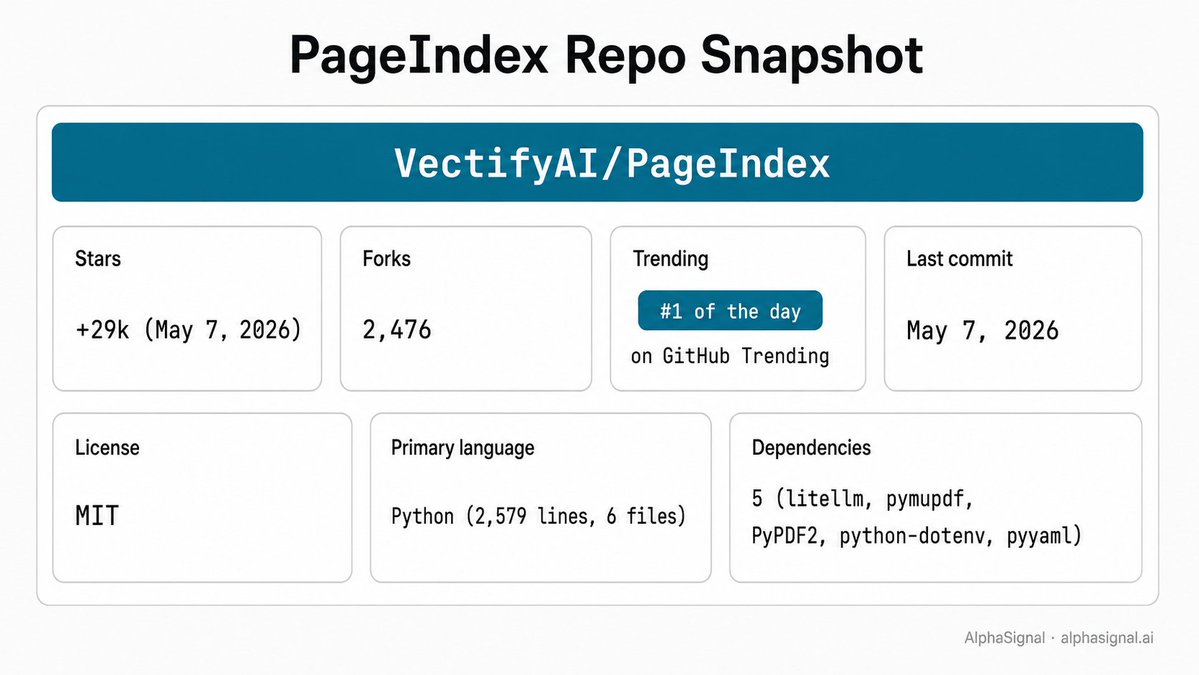 ## Why this matters Vector RAG retrieves text that looks like the query, not text that answers it. The cosine-similarity match between an embedded chunk and an embedded question is a syntactic neighbor, not a semantic answer. The gap shows up where developers most need RAG to work: 600-page 10-Ks, multi-thousand-page compliance binders, dense technical specs. PageIndex flips the framing. The document gets a structural tree, the LLM picks which nodes to read, and the answer comes from reasoning over structure rather than nearest-neighbor recall. ## Context VectifyAI, founded by Mingtian Zhang and Yu Tang, released PageIndex on April 1, 2025. Thirteen months later, the repo has +29k stars, 2,476 forks, 138 open issues, 11 contributors, and a #1-of-the-day spot on GitHub Trending. Two of those contributors, rejojer and zmtomorrow, account for 89.3% of the 281 total commits. The license is MIT. The package is 2,579 lines of Python across six files in the pageindex/ directory. ## How PageIndex works The pipeline runs in two phases.  Phase 1: Tree index construction. PyPDF2 (default) or PyMuPDF parses the PDF into per-page text. An LLM scans the first 20 pages to detect a table of contents. Three processing modes branch from there: TOC with page numbers, TOC without page numbers, or no TOC at all. The system runs verify_toc() with LLM-based fuzzy title matching on every TOC item against its assigned physical page. fix_incorrect_toc_with_retries() reattempts mismatched items up to 3 times. If accuracy stays below 60%, the system falls back to the next processing mode. Nodes spanning more than 10 pages AND 20,000 tokens are recursively split using the same LLM-based extraction. Phase 2: Reasoning-based retrieval. The retrieval module exposes three tool functions for an agent runtime: get_document() for metadata, get_document_structure() for the tree minus text content, and get_page_content() for specific pages. The LLM receives the tree, picks node IDs in a JSON response, the system fetches text for those nodes, and the LLM writes the final answer. A node looks like this: ``` { "title": "Financial Stability", "node_id": "0006", "start_index": 21, "end_index": 22, "summary": "The Federal Reserve...", "nodes": [ { "title": "Monitoring Financial Vulnerabilities", "node_id": "0007", "start_index": 22, "end_index": 28, "summary": "..." } ] } ``` One thing the docs reference but the open-source code does not implement: MCTS. The tree-search tutorial states that the cloud dashboard and retrieval API use "a combination of LLM tree search and value function-based Monte Carlo Tree Search (MCTS)." The open-source code ships only the LLM-prompt tree-search variant. MCTS lives in the hosted service. ## How to get started Five steps from clone to a working agentic retrieval demo. 1. Clone and install. ``` git clone https://github.com/VectifyAI/PageIndex.git cd PageIndex pip3 install --upgrade -r requirements.txt ``` 2. Set the API key. Create a .env file in the project root with OPENAI_API_KEY=your_key. CHATGPT_API_KEY is supported as a backward-compatible alias. 3. Generate a tree from a PDF. ``` python3 run_pageindex.py --pdf_path /path/to/document.pdf ``` The output JSON lands in ./results/{filename}_structure.json. Default model is gpt-4o-2024-11-20, overridable with --model. 4. Run the agentic RAG demo. This is the load-bearing example for understanding why a tree-only retrieval format earns its keep. ``` pip3 install openai-agents python3 examples/agentic_vectorless_rag_demo.py ``` The demo downloads an arXiv PDF, indexes it through PageIndexClient with workspace persistence, creates an OpenAI Agent wired to the three retrieval tools, then streams the agent's reasoning and tool calls as it answers a question. 5. Optional: programmatic API. ``` from pageindex import PageIndexClient client = PageIndexClient(workspace="./workspace") doc_id = client.index("document.pdf") structure = client.get_document_structure(doc_id) content = client.get_page_content(doc_id, "5-7") ``` ## Evidence: 98.7% on FinanceBench Mafin 2.5, VectifyAI's PageIndex-powered financial-QA system, reports 98.7% accuracy on the full 10,231-question FinanceBench benchmark (arXiv:2311.11944). The eval code (eval.py) and raw results JSON are public in the VectifyAI/Mafin2.5-FinanceBench repo. The 98.7% figure holds across two base LLMs, GPT-4o and DeepSeek v3. 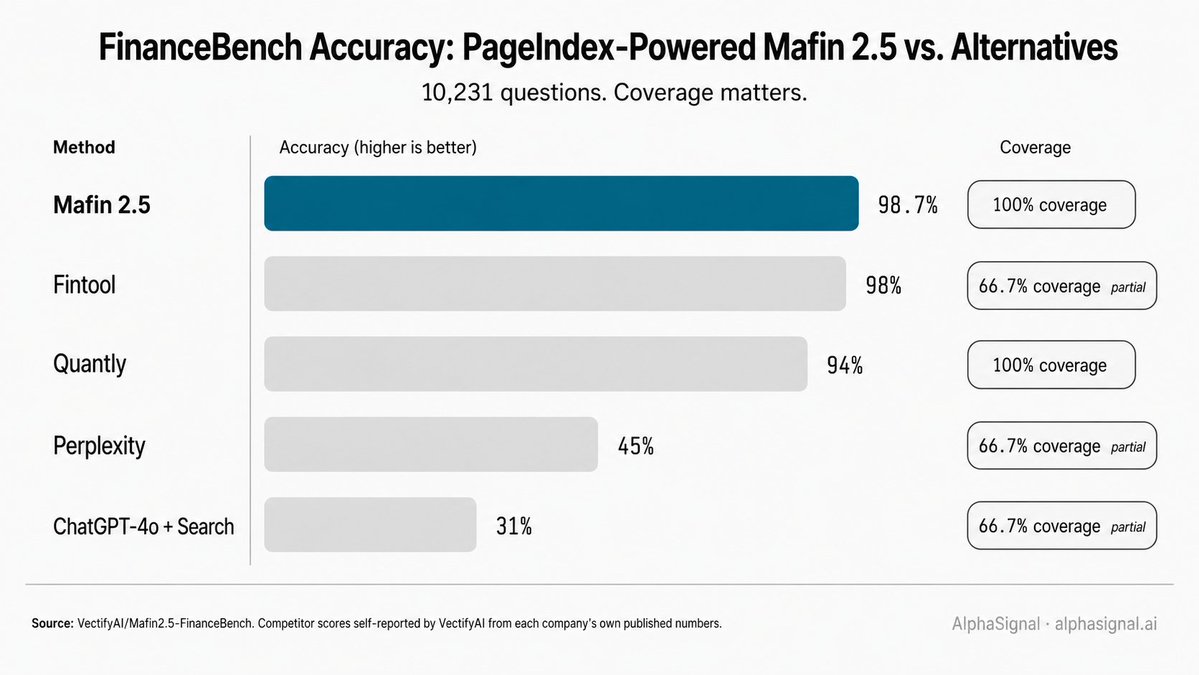 A reading note. VectifyAI self-reports the comparison table. Competitor scores are pulled from those companies' own published numbers, not independently re-run. The coverage column matters: three of the comparators only ran 66.7% of the benchmark, while Mafin 2.5 covered 100%. ## PageIndex vs. vector RAG vs. long-context LLMs PageIndex is a framework, not a model, so it does not slot into a leaderboard. The architectural comparison that does matter: 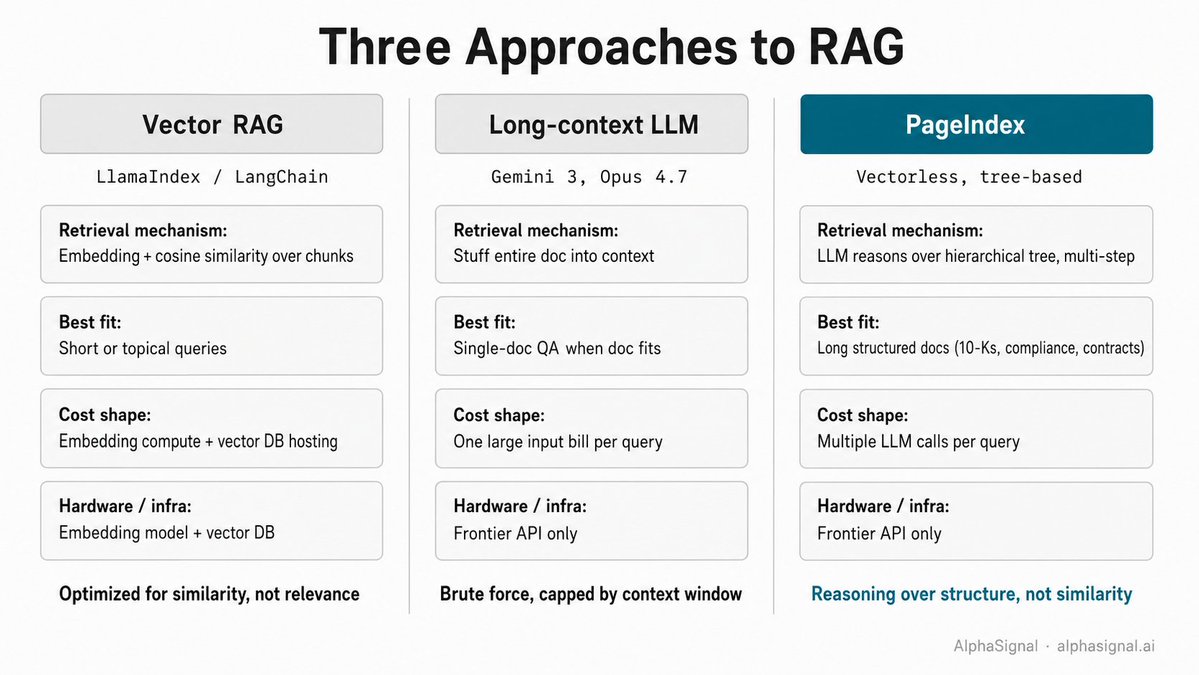 Also, a vectorless RAG example with self-hosted PageIndex, using OpenAI Agents SDK. PageIndex's win condition is the long-and-structured corner. The document has a TOC or hierarchical headings, the answer lives in a specific section, and a vector store would surface neighbors that look like the query but skip the section that contains the answer. ## Current Limitations MCTS retrieval is cloud-only. The README and tutorials reference a value-function MCTS retrieval layer. The open-source code ships only the LLM-prompt tree-search variant. Practitioners pulling the repo expecting the same retrieval depth as the cloud service will be working with a thinner version. OSS PDF parsing has no OCR. Standard PyPDF2 and PyMuPDF are the only parsers shipped. Scanned PDFs, image-only documents, and noisy financial filings need pre-processing or the cloud OCR service. Self-host stability ceilings. The TOC verification loop is capped at 3 fix attempts (fix_incorrect_toc_with_retries in pageindex/page_index.py). If accuracy stays at or below 60% after all three processing modes, the system raises a Processing failed exception. The README's only stability hedge is the line "for use cases with complex PDFs, our Cloud Service offers enhanced OCR, tree building, and retrieval." Real-world PDFs with unusual layouts can land in the failure path. No SECURITY.md, six open security issues. The repo has no documented security policy. Six open issues request one (#85, #240) or report findings (#79, #80, #81, #174). The LiteLLM supply-chain incident is patched: requirements.txt pins litellm==1.83.7, above the compromised threshold. ## AlphaSignal Take Verdict: Worth Watching. PageIndex does what the README's headline promise claims for tree construction. The retrieval story is partial: the open-source code gives developers the prompts and the three tool functions, but the MCTS layer that the docs name as part of the system is not in the public code. Maintenance health is mixed. Eleven contributors with 89.3% of commits coming from two people, 138 open issues (including a stability fix request, #188, with 36 comments), and no SECURITY.md. The verdict moves to Production Ready when four things land: MCTS in the open-source path, a SECURITY.md plus an external audit, a published latency benchmark from the team itself, and OCR in the open-source parser. Until then, the framework's structural-doc accuracy is good enough to test on a real workload, but not yet good enough to bet a production system on. Watch for PageIndex 2.0 or an MCTS-OSS release as the trigger. ## Who benefits and who doesn't Benefits: ML and backend engineers building QA over long structured documents (10-Ks, compliance binders, contracts, technical manuals), teams hitting recall ceilings on vector RAG over long docs, and teams already paying for frontier-model API calls who can trade query latency for retrieval accuracy. Doesn't fit: latency-sensitive real-time chat over short documents, teams without LLM API budgets at retrieval scale, scanned-document workflows that need OCR, and production deployments where an undocumented security posture is a blocker. ## Practitioner Implication You can now answer questions over a 600-page 10-K without embedding a single vector, now that PageIndex's tree-reasoning approach has hit 98.7% on FinanceBench's full 10,231-question set. ## Links - PageIndex repo (+29k stars, MIT, ~5 min setup) - Agentic RAG demo (OpenAI Agents SDK integration) - Mafin2.5-FinanceBench eval repo (public eval code and raw results) - pageindex-mcp (MCP server) - PageIndex framework intro (official deep dive) Follow @AlphaSignalAI for more content like this. Subscribe at AlphaSignal.ai for daily AI signals. Read by 280,000+ developers. ## Questions? Q: What is PageIndex? A vectorless tree-based RAG framework by VectifyAI. It builds a hierarchical tree from a document and lets the LLM reason which nodes contain the answer, with no embeddings or vector store in the loop. Q: How is PageIndex different from vector RAG? Vector RAG retrieves chunks by embedding similarity, which optimizes for syntactic neighbors. PageIndex skips embeddings entirely, relying on LLM reasoning over a structural tree to pick the sections most likely to answer the query. Q: What benchmark has PageIndex hit? Mafin 2.5, built on PageIndex, reports 98.7% on FinanceBench's full 10,231-question set, per VectifyAI's public eval repo. The figure holds across both GPT-4o and DeepSeek v3 base LLMs. Q: Can I self-host PageIndex? Yes. The repo is MIT-licensed. git clone plus pip3 install -r requirements.txt plus an OpenAI API key in .env is the full path. OCR for scanned PDFs is cloud-only. Q: Is PageIndex production-ready? Worth watching, not yet production-grade. The README flags early beta. There is no SECURITY.md, and the MCTS retrieval layer the docs reference is not in the open-source code. ## 相关链接 - [AlphaSignal AI](https://x.com/AlphaSignalAI) - [@AlphaSignalAI](https://x.com/AlphaSignalAI) - [4.2K](https://x.com/AlphaSignalAI/status/2052444016185426036/analytics) - [eval.py](https://eval.py/) - [example](https://github.com/VectifyAI/PageIndex/blob/main/examples/agentic_vectorless_rag_demo.py) - [PageIndex repo](https://github.com/VectifyAI/PageIndex) - [Agentic RAG demo](https://github.com/VectifyAI/PageIndex/blob/main/examples/agentic_vectorless_rag_demo.py) - [Mafin2.5-FinanceBench eval repo](https://github.com/VectifyAI/Mafin2.5-FinanceBench) - [pageindex-mcp](https://github.com/VectifyAI/pageindex-mcp) - [PageIndex framework intro](https://pageindex.ai/blog/pageindex-intro) - [@AlphaSignalAI](https://x.com/@AlphaSignalAI) - [AlphaSignal.ai](https://alphasignal.ai/) - [Upgrade to Premium](https://x.com/i/premium_sign_up) - [1:42 AM · May 8, 2026](https://x.com/AlphaSignalAI/status/2052444016185426036) - [4,267 Views](https://x.com/AlphaSignalAI/status/2052444016185426036/analytics) --- *导出时间: 2026/5/8 13:35:11* --- ## 中文翻译 # +29k Stars,无向量:PageIndex 如何用 LLM 推理替代嵌入 **作者**: AlphaSignal AI **日期**: 2026-05-07T17:42:40.000Z **来源**: [https://x.com/AlphaSignalAI/status/2052444016185426036](https://x.com/AlphaSignalAI/status/2052444016185426036) ---  ## VectifyAI 的基于树的 RAG 在 FinanceBench 上达到 98.7% 准确率。文档中提到的 MCTS 未包含在开源代码中。 PageIndex 是一个无向量的 RAG 框架,它从文档构建分层树,并让 LLM 推理哪些页面能回答查询。 VectifyAI 于 2025 年 4 月 1 日对其进行了开源。该仓库的 GitHub Stars 数已超过 2.9 万,并登上了 GitHub Trending 日榜第一名。 Mafin 2.5 是一个基于 PageIndex 构建的金融问答系统,在 FinanceBench 全部 10,231 个问题集上达到了 98.7% 的准确率,评估代码在一个单独的仓库中公开。证据见下文。 ## 仓库快照  ## 为何重要 向量 RAG 检索的是**看起来**像查询的文本,而不是**能回答**查询的文本。嵌入块与嵌入问题之间的余弦相似度匹配只是语法上的邻居,而非语义上的答案。 这种差距恰恰出现在开发者最需要 RAG 发挥作用的场景中:600 页的 10-K 报告、数千页的合规手册、密集的技术规范。PageIndex 颠覆了这一框架。文档被构建成结构树,LLM 选择读取哪些节点,答案源于对结构的推理,而非最近邻召回。 ## 背景 PageIndex 由 Mingtian Zhang 和 Yu Tang 创立的 VectifyAI 于 2025 年 4 月 1 日发布。十三个月后,该仓库已获得超过 2.9 万颗星,2,476 个 Fork,138 个开放的 Issue,11 位贡献者,并曾登上 GitHub Trending 日榜第一。其中两位贡献者 rejojer 和 zmtomorrow 贡献了 281 次提交中的 89.3%。 许可证为 MIT。该软件包包含 pageindex/ 目录下 6 个文件中的 2,579 行 Python 代码。 ## PageIndex 的工作原理 该流程分为两个阶段运行。  **阶段 1:树索引构建。** PyPDF2(默认)或 PyMuPDF 将 PDF 解析为逐页文本。LLM 扫描前 20 页以检测目录。由此分出三种处理模式:带页码的目录、不带页码的目录或根本没有目录。 系统针对每个目录项及其分配的物理页面,运行基于 LLM 的模糊标题匹配 verify_toc()。fix_incorrect_toc_with_retries() 会重试不匹配的项目最多 3 次。如果准确率仍保持在 60% 以下,系统将回退到下一种处理模式。跨度超过 10 页**且** 20,000 个 token 的节点将使用相同的基于 LLM 的提取方法进行递归拆分。 **阶段 2:基于推理的检索。** 检索模块为代理运行时暴露了三个工具函数:用于获取元数据的 get_document(),用于获取不含文本内容的树的 get_document_structure(),以及用于获取特定页面内容的 get_page_content()。 LLM 接收树结构,在 JSON 响应中选择节点 ID,系统获取这些节点的文本,然后 LLM 撰写最终答案。一个节点如下所示: ``` { "title": "Financial Stability", "node_id": "0006", "start_index": 21, "end_index": 22, "summary": "The Federal Reserve...", "nodes": [ { "title": "Monitoring Financial Vulnerabilities", "node_id": "0007", "start_index": 22, "end_index": 28, "summary": "..." } ] } ``` 有一件事文档提到了,但开源代码并未实现:MCTS。 树搜索教程指出,云仪表板和检索 API 使用了“LLM 树搜索和基于价值函数的蒙特卡洛树搜索(MCTS)的结合”。开源代码仅包含基于 LLM 提示的树搜索变体。MCTS 存在于托管服务中。 ## 如何入门 从克隆到运行可工作的代理式检索演示,只需五步。 1. 克隆并安装。 ``` git clone https://github.com/VectifyAI/PageIndex.git cd PageIndex pip3 install --upgrade -r requirements.txt ``` 2. 设置 API 密钥。在项目根目录下创建一个 .env 文件,内容为 OPENAI_API_KEY=your_key。作为向后兼容的别名,CHATGPT_API_KEY 也受支持。 3. 从 PDF 生成树。 ``` python3 run_pageindex.py --pdf_path /path/to/document.pdf ``` 输出的 JSON 文件位于 ./results/{filename}_structure.json。默认模型是 gpt-4o-2024-11-20,可通过 --model 覆盖。 4. 运行代理式 RAG 演示。这是理解为何仅树的检索格式具有价值的承载示例。 ``` pip3 install openai-agents python3 examples/agentic_vectorless_rag_demo.py ``` 该演示下载一篇 arXiv PDF,通过带工作区持久化的 PageIndexClient 对其进行索引,创建一个连接到三个检索工具的 OpenAI Agent,然后在其回答问题时流式输出代理的推理过程和工具调用。 5. 可选:编程式 API。 ``` from pageindex import PageIndexClient client = PageIndexClient(workspace="./workspace") doc_id = client.index("document.pdf") structure = client.get_document_structure(doc_id) content = client.get_page_content(doc_id, "5-7") ``` ## 证据:FinanceBench 98.7% 准确率 Mafin 2.5 是 VectifyAI 基于页索引的金融问答系统,据报道在完整的 10,231 个问题的 FinanceBench 基准测试 中准确率达到 98.7%。评估代码 (eval.py) 和原始结果 JSON 在 VectifyAI/Mafin2.5-FinanceBench 仓库中公开。98.7% 这一数据在 GPT-4o 和 DeepSeek v3 这两个基础 LLM 上均成立。  阅读提示:VectifyAI 自行报告了该对比表。竞争对手的得分摘录自这些公司自己发布的数字,并非独立重新运行。覆盖率一栏很重要:三个对比模型仅运行了基准测试的 66.7%,而 Mafin 2.5 覆盖了 100%。 ## PageIndex 对比向量 RAG 对比长上下文 LLM PageIndex 是一个框架,而非模型,因此它不直接进入排行榜。真正重要的架构对比:  此外,还有一个使用 OpenAI Agents SDK 的自托管 PageIndex 无向量 RAG 示例。 PageIndex 的制胜条件在于“长文档且结构化”这一领域。文档具有目录或分层标题,答案位于特定章节,而向量存储会提取看起来像查询的邻居,却跳过包含答案的章节。 ## 当前局限性 MCTS 检索仅限云端。 README 和教程提到了基于价值函数的 MCTS 检索层。开源代码仅包含基于 LLM 提示的树搜索变体。拉取仓库期望获得与云服务相同检索深度的从业者将会使用一个功能较弱的版本。 开源版 PDF 解析没有 OCR。 仅提供了标准的 PyPDF2 和 PyMuPDF 解析器。扫描的 PDF、纯图片文档和嘈杂的金融文件需要预处理或云 OCR 服务。 自托管稳定性上限。 目录验证循环最多尝试 3 次修复 (pageindex/page_index.py 中的 fix_incorrect_toc_with_retries)。如果在所有三种处理模式后准确率保持在 60% 或以下,系统将抛出 Processing failed 异常。README 中唯一的稳定性对冲建议是“对于复杂 PDF 的使用场景,我们的云服务提供增强的 OCR、树构建和检索。”具有异常布局的现实世界 PDF 可能会进入失败路径。 没有 SECURITY.md,存在 6 个开放的安全问题。 该仓库没有记录在案的安全策略。六个开放的 Issue 请求制定策略 (#85, #240) 或报告发现 (#79, #80, #81, #174)。LiteLLM 供应链事件已修补:requirements.txt 固定了 litellm==1.83.7,高于受感染的阈值。 ## AlphaSignal 观点 结论:值得关注。 PageIndex 实现了 README 标题承诺的树构建功能。检索方面则只有一部分:开源代码为开发者提供了提示词和三个工具函数,但文档中作为系统一部分命名的 MCTS 层并未包含在公共代码中。 维护健康状况参半。11 位贡献者,其中 2 人贡献了 89.3% 的提交,138 个开放的 Issue(包括一个稳定性修复请求 #188,有 36 条评论),并且没有 SECURITY.md。 当以下四点落实时,结论将变为“生产就绪”:MCTS 进入开源路径、SECURITY.md 加上外部审计、团队自己发布的延迟基准测试、以及开源解析器中的 OCR。 在此之前,该框架对结构化文档的准确性足以在真实工作负载中测试,但还不足以以此押注生产系统。可以关注 PageIndex 2.0 或 MCTS-OSS 版本发布的节点。 ## 谁受益,谁不受益 受益人群:正在为长结构化文档(10-K 报告、合规手册、合同、技术手册)构建问答系统的 ML 和后端工程师;在长文档向量 RAG 上遇到召回上限的团队;已经在支付前沿模型 API 费用并愿意用查询延迟换取检索准确率的团队。 不适合人群:对延迟敏感的短文档实时聊天;没有检索规模 LLM API 预算的团队;需要 OCR 的扫描文档工作流;以及安全策略未成文档即成为阻碍的生产环境部署。 ## 从业者启示 既然 PageIndex 的树推理方法已在 FinanceBench 完整的 10,231 个问题集上达到 98.7% 的准确率,你现在无需嵌入任何向量,就能针对 600 页的 10-K 报告回答问题。 ## 链接 - PageIndex 仓库(+29k 星,MIT,约 5 分钟设置) - 代理式 RAG 演示(OpenAI Agents SDK 集成) - Mafin2.5-FinanceBench 评估仓库(公开的评估代码和原始结果) - pageindex-mcp (MCP 服务器) - PageIndex 框架介绍(官方深度解析) 关注 @AlphaSignalAI 获取更多此类内容。 在 AlphaSignal.ai 订阅以获取每日 AI 信号。拥有 280,000+ 开发者读者。 ## 常见问题 问:什么是 PageIndex? 答:这是 VectifyAI 推出的一个无向量的基于树的 RAG 框架。它从文档构建分层树,并让 LLM 推理哪些节点包含答案,整个循环中没有嵌入或向量存储。 问:PageIndex 与向量 RAG 有何不同? 答:向量 RAG 通过嵌入相似度检索块,这优化的是语法上的邻居。PageIndex 完全跳过嵌入,依靠 LLM 对结构树的推理来选择最有可能回答查询的章节。 问:PageIndex 在哪些基准测试中取得了成绩? 答:根据 VectifyAI 的公共评估仓库,基于 PageIndex 构建的 Mafin 2.5 在 FinanceBench 完整的 10,231 个问题集上报告了 98.7% 的准确率。该数据在 GPT-4o 和 DeepSeek v3 基础 LLM 上均成立。 问:我可以自托管 PageIndex 吗? 答:可以。该仓库采用 MIT 许可证。git clone 加上 pip3 install -r requirements.txt 再加上 .env 中的 OpenAI API 密钥就是全部步骤。针对扫描 PDF 的 OCR 仅限云端。 问:PageIndex 是否已准备好投入生产? 答:值得关注,但尚未达到生产级标准。README 标注为早期测试版。没有 SECURITY.md,且文档中提到的 MCTS 检索层不在开源代码中。 ## 相关链接 - [AlphaSignal AI](https://x.com/AlphaSignalAI) - [@AlphaSignalAI](https://x.com/AlphaSignalAI) - [4.2K](https://x.com/AlphaSignalAI/status/2052444016185426036/analytics) - [eval.py](https://eval.py/) - [example](https://github.com/VectifyAI/PageIndex/blob/main/examples/agentic_vectorless_rag_demo.py) - [PageIndex repo](https://github.com/VectifyAI/PageIndex) - [Agentic RAG demo](https://github.com/VectifyAI/PageIndex/blob/main/examples/agentic_vectorless_rag_demo.py) - [Mafin2.5-FinanceBench eval repo](https://github.com/VectifyAI/Mafin2.5-FinanceBench) - [pageindex-mcp](https://github.com/VectifyAI/pageindex-mcp) - [PageIndex framework intro](https://pageindex.ai/blog/pageindex-intro) - [@AlphaSignalAI](https://x.com/@AlphaSignalAI) - [AlphaSignal.ai](https://alphasignal.ai/) - [Upgrade to Premium](https://x.com/i/premium_sign_up) - [1:42 AM · May 8, 2026](https://x.com/AlphaSignalAI/status/2052444016185426036) - [4,267 Views](https://x.com/AlphaSignalAI/status/2052444016185426036/analytics) --- *导出时间: 2026/5/8 13:35:11*
1 12个开源项目,4条技术路线:Agent记忆系统完整选型指南 针对 LLM 无状态导致的“失忆”痛点,文章深入探讨了当前 Agent 记忆系统的四条主流技术路线:纯文件存储、向量数据库+RAG、知识图谱及混合检索。文章梳理了从轻量级 hooks 集成到企业级独立平台的 12 个开源项目,涵盖 claude-memory-compiler、agentmemory、Hermes Agent 等代表性工具,并提供了针对不同用户阶段(新手、个人开发者、团队、企业)的选型建议。作者指出,未来的核心竞争将集中在“如何遗忘”、“保证正确性”和“控制成本”三个维度。 技术 › Agent Jason Zhu 2026-04-09 Agent记忆系统RAG选型指南Claude Code知识图谱向量数据库开源项目开发工具LLM
A Agent 高频题 01. 讲讲你的 RAG 链路 本文是 Agent 高频面试题详解系列第一篇,聚焦 RAG(检索增强生成)链路。文章基于近两个月牛客网 82 场面试的统计,指出 RAG 是最常被追问的题目。内容先给出 RAG 整体架构图,解释为什么需要 RAG 及其与长上下文、grep、微调、工具调用、记忆等方案的边界;再沿离线、在线两条线逐环讲解:离线部分涵盖文档解析、切分策略、embedding 向量化、HNSW/IVF 索引原理;在线部分讲解问题改写、BM25 与向量多路召回、RRF 融合、交叉编码器重排等环节。每个环节均附上面试常见追问,并提供复习优先级参考。 技术 › Agent 码良 2026-10-20 RAG面试检索增强生成向量检索embeddingBM25HNSW重排LLMAgent
J Jev WeChat 微信群聊助手开源项目分享 作者分享了一个开源的 Jev WeChat 微信群聊助手项目,可用 AI 自动分析群聊意图并生成候选回复,解决不懂人情世故、微信客服和群助手自动化等场景。项目发布后引发热议,网友讨论了封号风险(建议用小号测试安卓设备)、适用场景(私域运营、客服、销售、情侣群聊)、技术实现(使用 DeepSeek 生成回复)等。文中还附带分享了 Agent Space 订阅管理产品和 6 个大模型写 Space Invaders 的横向评测 benchmark,以及出海增长工作坊推荐等内容。 技术 › Agent 李韭二 (@li9292) 2026-09-22 开源项目微信AgentAI应用微信群助手LLMDeepSeek自动化客服
如 如果你想做 AI 应用不妨考虑一下 Harness 开发 作者结合实际工作经验,整理出一份 AI Harness 开发的 11 条技能清单,涵盖后端与系统设计、RAG 与向量数据库、记忆与上下文管理、工具调用与 MCP、Agent 编排、护栏校验、评测、可观测性、模型路由降级、排队负载均衡以及推理部署引擎。作者指出 Harness 开发是硅谷热门方向(如 YC Demo Day 上大量项目),建议普通开发者从 AI 应用入手,把模型接入具体业务,并给出将清单交给 AI 逐项学习的 prompt 方法。 技术 › Harness Engineering 美研芒格君 (@Kay2289123) 2026-09-14 AI应用HarnessRAGAgentMCP模型部署可观测性向量数据库学习路线YC
H How to Build Agent Memory: Where Does Knowledge Live? 本文是 Agent 记忆系列文章的第二篇,探讨知识的存储位置与表示形式。作者将记忆拆解为表示与存储、提取、检索、维护四个环节,重点讨论第一个问题:知识存放在哪里。文章指出表示(知识形态)与物理存储是两个独立决策,文件系统因编程代理擅长 bash 而成为极佳起点。作者提出应区分“产物”(发生过的记录)与“知识”(当前应相信的事实),知识应像物化视图一样回指来源产物。知识会过时,需要版本控制、分支与合并机制;且知识应被视为缓存而非全量存储,因为维护成本高昂。 技术 › Agent Devin Stein 2026-09-01 Agent MemoryLLM知识表示RAG向量数据库Git知识缓存DosuClaude存储架构
M Memory Is a Compiler:记忆是一个编译器 作者通过一次融资会议记忆被重新解读的经历,指出记忆的本质不是固定表示,而是一个持久系统:保留过去的证据,并随新证据不断重新编译其意义。文章批评将向量数据库、知识图谱、上下文窗口等当作记忆的常见误解,认为它们只是从记忆编译出的临时表示。作者提出记忆编译产生三类产物:状态(按序折叠事件得到)、检索(查找相关证据的工具)和上下文(为单次调用组装的有界视图),并类比编译器的中间表示(IR),指出每种表示只适合特定操作,记忆本身应是唯一不可丢弃的持久层。 技术 › LLM Ashwin Gopinath 2026-09-01 AI记忆RAG向量数据库知识图谱上下文窗口AgentLLM系统设计
R RAG架构详解:检索、增强与生成 本文深入解析了生产级RAG(检索增强生成)系统的完整架构。文章首先指出LLM的局限性——无法访问私有数据,而RAG通过外部知识检索来弥补这一缺陷。然后详细介绍了系统的两大核心平面:知识平面(离线索引)和运行时平面(在线问答)。知识平面涵盖数据源、解析-分块-嵌入流水线以及向量索引;运行时平面则描述了用户查询、检索重排、LLM生成和答案引用的完整流程。文章还逐步拆解了查询生命周期,包括查询嵌入、Top-K检索、重排增强和生成,并强调了监控指标的重要性。 技术 › LLM Vikas gupta 2026-08-20 RAGLLM向量数据库嵌入检索架构知识管理AI
私 私有知识库实战:查询改写、混合检索与重排优化 RAG 本文是私有知识库构建系列的第 3 篇,旨在解决基础 RAG 系统在短问题召回、关键词匹配及结果排序上的缺陷。作者详细介绍了通过 LLM 进行查询改写以补全上下文,利用 PostgreSQL 结合 Jieba 实现混合检索(向量+BM25),以及使用 RRF 算法融合检索结果,从而显著提升知识库的日常可用性。 技术 › LLM A Ando 2026-07-08 RAG混合检索查询改写向量数据库PostgreSQLBM25搜索优化知识库LLMPython
阿 阿里开源 Zvec:像 SQLite 一样极简的嵌入式向量数据库 阿里开源了一款名为 Zvec 的向量数据库项目,主打“纯本地、内嵌式”极简体验,号称向量界的 SQLite。该项目基于 C++ 编写,支持零配置安装,性能强悍(毫秒级搜索数十亿向量),同时兼容稠密、稀疏向量及全文检索。它非常适合本地大模型、RAG 和个人知识库开发,彻底免去了部署繁琐的后端向量服务。 技术 › 后端 智享 2026-07-08 向量数据库阿里ZvecRAG本地大模型开源LLMAgent数据库工具
P Pydantic fixed my Agent's Memory 文章探讨了如何解决 AI Agent 记忆系统的多跳推理问题。传统的向量数据库在处理跨块事实连接时失效,而通用知识图谱常因缺乏结构导致查询噪音。作者提出的解决方案是使用 Pydantic 提前定义本体(Schema),明确实体类型、关系和属性。通过 Zep 框架强制执行这些约束,可以显著提升提取的准确性和数据的可查询性,从而实现有效的多跳推理。 技术 › Agent Akshay 2026-05-26 AgentPydantic知识图谱RAGLLMSchema多跳推理Zep向量数据库Ontology
A Agentic Memory: 详解 Agent 记忆系统的架构与实现 文章通过生动的类比,指出缺乏记忆是当前 LLM Agent 的主要短板。作者详细拆解了 Agent 记忆系统的三个核心功能:连续性、上下文和学习。文章重点介绍了四种记忆类型:上下文记忆、外部记忆、情景记忆和参数记忆,并深入探讨了如何通过检索增强(RAG)和反思循环来构建持久的智能。 技术 › Agent Ramakrishna (techwith_ram) 2026-05-17 AgentLLMMemoryArchitectureRAGVectorStoreContextEpisodic向量数据库系统设计
A AI Agent 记忆机制原理与实战解析 文章深入浅出地讲解了 AI Agent 记忆系统的工作原理,从基础的单会话与多会话记忆保持切入,引出 Google 提出的情景、语义与程序性记忆三分法。通过对比 OpenClaw 的实现方式与存在的问题,重点剖析了企业级方案 EverOS 的架构。EverOS 将记忆细分为六大类,并通过语义巩固、主动上下文重建等技术优化记忆的抽取、更新与检索。文章还包含 EverOS 的 API 调用示例及 20 个真实落地场景,为开发者提供了 Agent 记忆系统的全景指南。 技术 › Agent 铁锤人 2026-05-14 AI Agent记忆系统OpenClawEverOSRAG向量数据库长上下文自进化LLM实战案例