# Loop Engineering: A Dummies' Guide to /loop
**作者**: AI Edge
**日期**: 2026-07-24T15:50:17.000Z
**来源**: [https://x.com/aiedge_/status/2080681984708518330](https://x.com/aiedge_/status/2080681984708518330)
---
TL;DR: how anyone can 10x their Claude productivity with loops - even if you're not technical at all.
If you've heard people talking about "loops" with Claude and had no idea what they meant, this article is for you.
No coding background needed, and no technical jargon. This is a plain-English walkthrough of what a loop actually is, how to run your very first one, and the mistakes almost everyone makes when they're starting out.
At the very end of this guide, I've also put together a 15+ page PDF guide that covers loop engineering - a 100% free resource you can download to make sure you never forget the fundamentals of loop engineering.
With that said, let's get right into things.
## What Is Loop Engineering? (ELI5)
Let's start with the simplest possible explanation.
For the last couple of years, using AI worked like this:
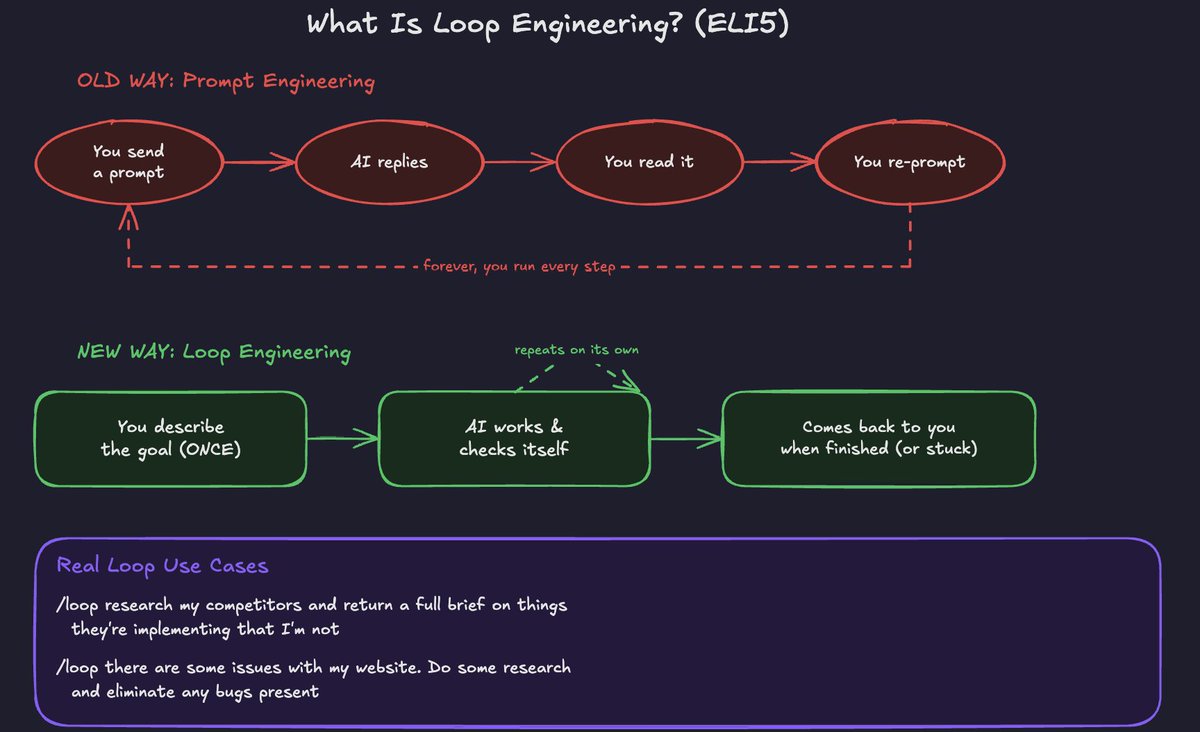
You send a prompt → AI replies → You read it → You re-prompt
This is classic prompt engineering - where you're the one running every step of getting good AI responses.
Loop engineering automates this entire process.
Instead of typing message after message, you set up a goal once, and the AI keeps working on it by itself.
The simplest way to think about it
Old way: you prompt, AI answers, you prompt again (forever).
New way: you describe the goal once, it works & checks itself, and only comes back to you when it's finished (or stuck).
wtf is a /loop? ELI5
Real loop use cases
/loop research my competitors and return a full brief on things they're implementing that I'm not
'/loop there are some issues with my website. Do some research and eliminate any bugs present
Luckily for us, AI harnesses like Claude Code make it extremely easy to set up and use loops (more on this later).
## The Anatomy of a Claude Loop
Every Claude loop, no matter how simple or complex, is built from the same basic parts. Once you understand these, you can build effective loops.
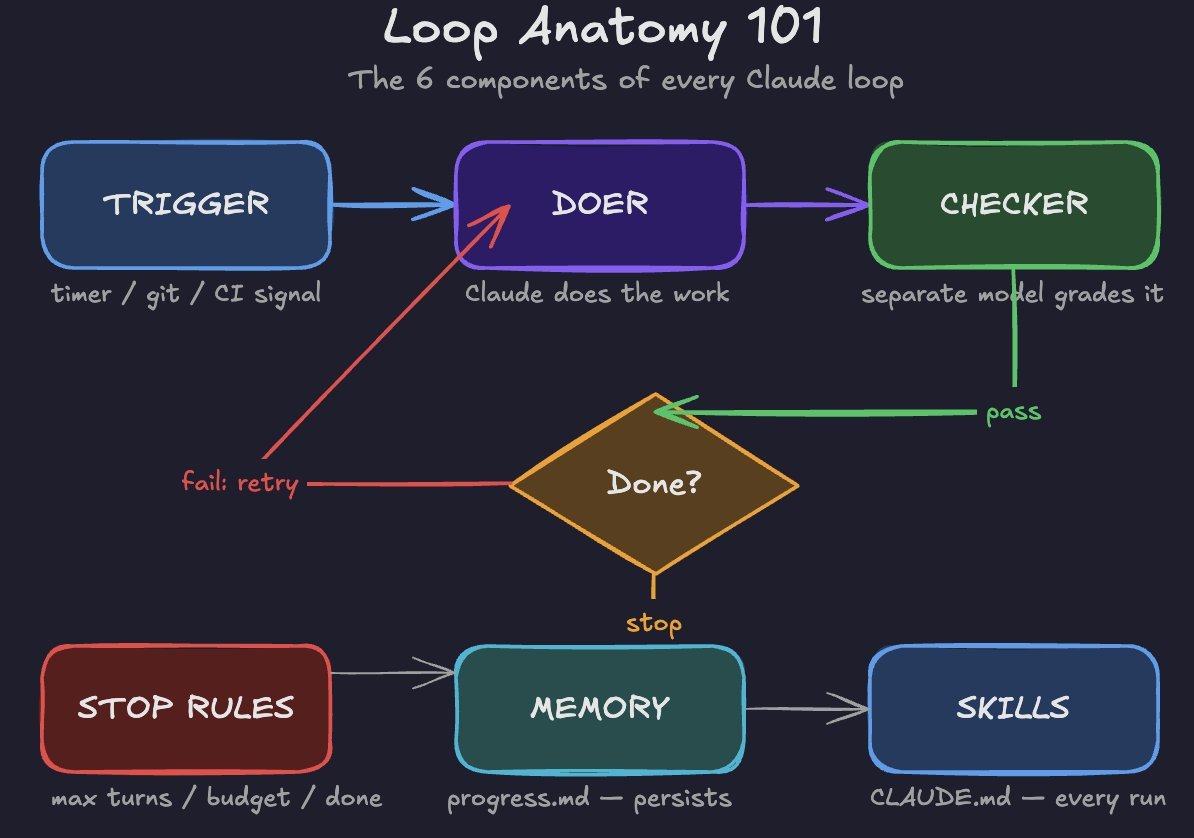
Image from my Fable 5 loop engineering guide *
1. The Trigger
This is what starts the loop without you clicking anything. It could be a timer ("every morning at 8 am"), or it could just start immediately when you type your command.
Either way, the point is that the trigger kicks off a loop workflow.
2. The Doer
This is Claude actually doing the work.
Think: Reading, writing, researching, coding - or whatever the task is.
3. The Checker
This is what decides whether the work is actually good enough and/or finished.
Without this, Claude has no way of knowing if it did a good job; it just assumes it's done and stops.
A good checker might be: does this pass a test? Does this match what I asked for? Is the number correct?
4. Stop Rules
Every loop needs to know when to stop, both when it succeeds and when it fails.
Success stopping might be "all tasks are complete," and failure stopping might be "if this fails 5 times in a row, stop and tell me."
Without stop rules, a loop can either run forever or keep failing the same way over and over without ever telling you.
5. Memory
This is a simple file where the loop writes down what it did and what it learned. Next time the loop runs, it reads this file first, so it doesn't repeat the same mistakes or forget what it already figured out.
Think of it as the loop's diary.
6. Instructions
This is where you tell the loop the rules it should always follow, your preferences, your constraints, how you want things done.
This gets read every single time the loop runs, so the loop always "remembers" who you are and how you like things.
A loop is really just this simple structure:
```
Something starts it (trigger)
→ Claude does the work (doer)
→ Something checks if it's actually right (checker)
→ It either stops (success) or tries again (failure)
→ It writes down what happened (memory)
→ It always follows your basic rules (instructions)
```
## How to Run Your First Loop
You have two options for running your first loop:
1. Standard Prompting (the easiest way to start)
Open Claude Code (or desktop) and type:
/loop
If you're on desktop, you should see the loop command pop up:
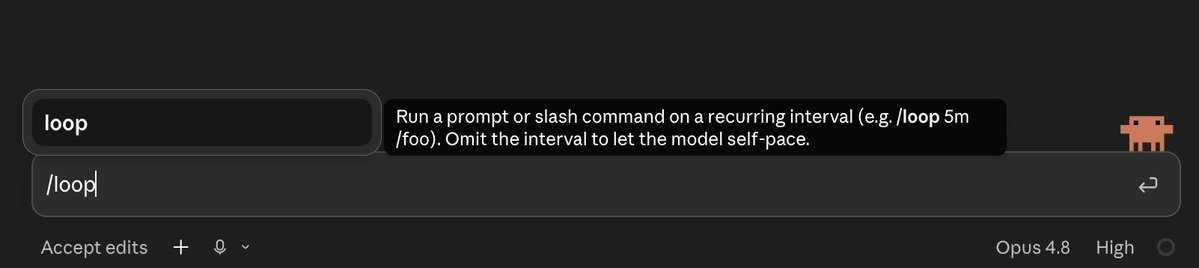
From here, just go ahead and type your goal.
Example: /loop do some research on the robotics sector - I'm looking for some potential investment opportunities and basic exposure.
2. Scheduled Loops
Standard prompting runs until the goal is met, then stops. But sometimes you want a loop that keeps running on a repeating basis, checking in over and over, not just once.
That's what scheduled loops are for - you add a time interval to your /loop command, and instead of running once and stopping, it keeps repeating on that schedule until you tell it to stop.
This is a good way to set up recurring workflows.
Prompting structure
```
/ loop [time interval]
Example: /loop everyday at 9am do [x]
```
/loop Slash Commands Cheat Sheet
A quick reference for the core commands you'll actually use once you start running loops regularly.
Start a loop = /loop [your goal]
Start a scheduled loop = /loop every [time interval], [your goal]
Stop a specific loop = /loop stop [loop name]
List all active loops = /loop list
Check the status of a loop = /loop status [loop name]
Pause a loop = /loop pause [loop name]
Resume a paused loop = /loop resume [loop name]
## Common Mistakes to Avoid
A few beginner pitfalls to avoid (based on experience):
1. No clear finish line
You need to be able to spell out what your ideal end state actually looks like.
2. No stop rules
Without a limit on how many times a loop can try, or how much it's allowed to spend, a loop can run far longer (and cost far more) than you intended.
Always set a cap, a maximum number of attempts, or a budget, before you walk away from it.
3. Verification
Tip: Set up subagents to make sure verification and general quality control are actually high.
4. Scope creep
A loop with no boundaries can wander into places you didn't intend, edit files it shouldn't, and touch things outside the original task.
Always be specific about what the loop is and isn't allowed to touch (especially if you're running Fable 5 and GPT-5.6 Sol because they are extremely autonomous models).
## Closing
I hope you found this breakdown of the basics of loop engineering valuable.
As a token of appreciation for making it this far, as promised, I put together a free 15+ page loop engineering ultimate guide that you can download now.
It covers the principles discussed in this article + more.
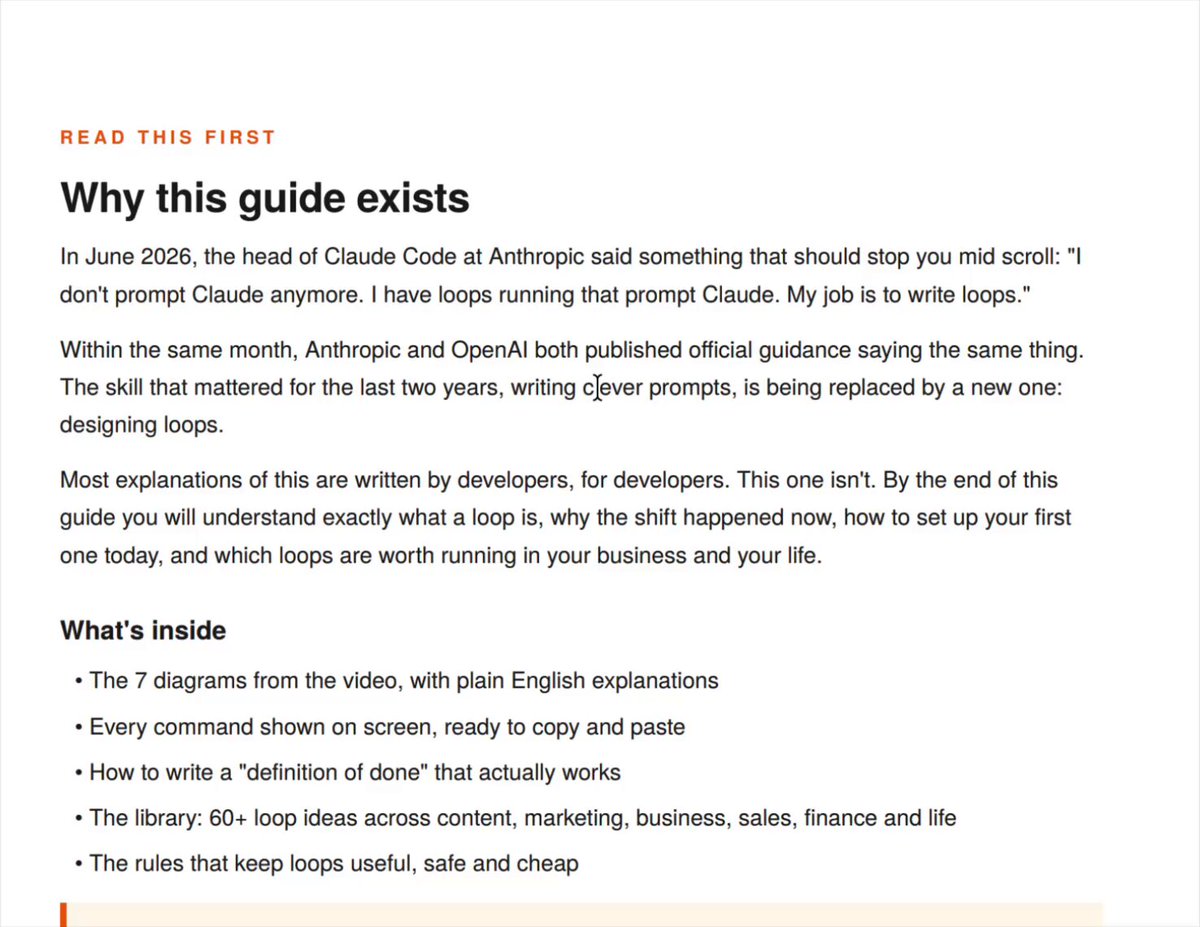
To claim this free guide, just click the link below, and I'll send it to you 100% for free (grab it by signing up for the newsletter):
https://www.aiedgehq.co/ythti5
Lastly, if you enjoy AI articles like this one, be sure to follow me here @aiedge_ - every single week I post various deep dive articles covering the hottest topics in AI.
Thank you for making it this far. 💙
## 相关链接
- [AI Edge](https://x.com/aiedge_)
- [@aiedge_](https://x.com/aiedge_)
- [17K](https://x.com/aiedge_/status/2080681984708518330/analytics)
- [https://www.aiedgehq.co/ythti5](https://www.aiedgehq.co/ythti5)
- [@aiedge_](https://x.com/@aiedge_)
- [Upgrade to Premium](https://x.com/i/premium_sign_up)
- [11:50 PM · Jul 24, 2026](https://x.com/aiedge_/status/2080681984708518330)
- [17.8K Views](https://x.com/aiedge_/status/2080681984708518330/analytics)
---
*导出时间: 2026/7/25 11:35:33*
---
## 中文翻译
# 循环工程:/loop 的傻瓜指南
**作者**: AI Edge
**日期**: 2026-07-24T15:50:17.000Z
**来源**: [https://x.com/aiedge_/status/2080681984708518330](https://x.com/aiedge_/status/2080681984708518330)
---

TL;DR: 任何人如何通过循环将 Claude 的生产力提升 10 倍——即使你完全不懂技术。
如果你听到人们谈论关于 Claude 的 "loops"(循环)却不知道他们指的是什么,这篇文章就是为你准备的。
不需要编程背景,也没有技术术语。这是一篇通俗的讲解,介绍循环到底是什么、如何运行你的第一个循环,以及几乎所有初学者开始时会犯的错误。
在本指南的最后,我还整理了一份超过 15 页的 PDF 指南,涵盖了循环工程——这是一个 100% 免费的资源,你可以下载它,以确保你永远不会忘记循环工程的基础。
话不多说,让我们直接进入正题。
## 什么是循环工程?(ELI5)
让我们从最简单的解释开始。
在过去几年里,使用 AI 的方式是这样的:
你发送提示词 → AI 回复 → 你阅读 → 你再次提示
这就是经典的提示词工程——在这一过程中,由你来运行获得良好 AI 响应的每一步。
循环工程将整个过程自动化了。
你不再需要一条接一条地输入消息,只需设定一次目标,AI 就会自动持续进行这项工作。
最简单的理解方式
旧方式:你提示,AI 回答,你再次提示(永无止境)。
新方式:你描述一次目标,它会工作并进行自我检查,只有在完成(或卡住)时才会回到你这里。

wtf is a /loop? ELI5
真实的循环用例
/loop 调研我的竞争对手,并返回一份简报,列出他们正在实施而我未实施的项目
'/loop 我的网站有一些问题。做一些研究并消除存在的任何错误
幸运的是,像 Claude Code 这样的 AI 工具让设置和使用循环变得极其容易(稍后会详细说明)。
## Claude 循环的剖析
每一个 Claude 循环,无论简单还是复杂,都由相同的基本部分构成。一旦你理解了这些,你就可以构建有效的循环。

图片来自我的 Fable 5 循环工程指南 *
1. 触发器
这是无需你点击任何操作即可启动循环的机制。它可以是一个定时器(“每天早上 8 点”),也可以在你输入命令后立即启动。
无论哪种方式,重点在于触发器会启动一个循环工作流。
2. 执行者
这是 Claude 实际进行工作的部分。
可以理解为:阅读、写作、调研、编码——或者是任何任务。
3. 检查者
这是决定工作是否足够好和/或是否完成的部分。
如果没有它,Claude 就无法知道自己是否做得好;它只会假设自己已完成并停止。
一个好的检查者可能是:这通过测试了吗?这符合我的要求吗?数字正确吗?
4. 停止规则
每个循环都需要知道何时停止,包括在成功时和在失败时。
成功停止可能是“所有任务都已完成”,而失败停止可能是“如果连续失败 5 次,则停止并告诉我”。
没有停止规则,循环可能会永远运行下去,或者一遍又一遍地以同样的方式失败,却从不通知你。
5. 记忆
这是一个简单的文件,循环在其中记录它做了什么以及学到了什么。下次循环运行时,它会先读取这个文件,这样它就不会重复同样的错误或忘记已经弄清楚的事情。
可以把它看作是循环的日记。
6. 指令
这是你告诉循环应该始终遵循的规则、你的偏好、你的约束以及你希望如何完成任务的地方。
每次循环运行时都会读取这部分内容,因此循环总是“记得”你是谁以及你喜好的处理方式。
一个循环实际上就是这种简单的结构:
```
有东西启动它(触发器)
→ Claude 进行工作(执行者)
→ 有东西检查它是否真的正确(检查者)
→ 它要么停止(成功),要么再次尝试(失败)
→ 它记录发生了什么(记忆)
→ 它始终遵循你的基本规则(指令)
```
## 如何运行你的第一个循环
你有两个选择来运行你的第一个循环:
1. 标准提示(最简单的开始方式)
打开 Claude Code(或桌面版)并输入:
/loop
如果你在桌面版上,应该会看到循环命令弹出:

从这里开始,直接输入你的目标即可。
示例:/loop 对机器人领域做一些调研——我正在寻找一些潜在的投资机会和基础接触。
2. 定时循环
标准提示会运行直到达成目标,然后停止。但有时你需要一个循环在重复的基础上持续运行,一遍又一遍地检查,而不仅仅是一次。
这就是定时循环的用途——你在 /loop 命令中添加一个时间间隔,它不会运行一次就停止,而是按照该时间表不断重复,直到你告诉它停止。
这是设置定期工作流的好方法。
提示词结构
```
/ loop [时间间隔]
示例:/loop everyday at 9am do [x]
```
/loop 斜杠命令速查表
一旦你开始定期运行循环,这里有一份你实际会用到的核心命令的快速参考。
启动循环 = /loop [你的目标]
启动定时循环 = /loop every [时间间隔], [你的目标]
停止特定循环 = /loop stop [循环名称]
列出所有活动循环 = /loop list
检查循环状态 = /loop status [循环名称]
暂停循环 = /loop pause [循环名称]
恢复暂停的循环 = /loop resume [循环名称]
## 要避免的常见错误
一些需要避免的初学者陷阱(基于经验):
1. 没有明确的终点线
你需要能够清楚地说明你理想的最终状态是什么样的。
2. 没有停止规则
如果没有限制循环可以尝试的次数,或者允许它花费多少,一个循环运行的时间(和成本)可能会远远超出你的预期。
在离开之前,始终设置一个上限、最大尝试次数或预算。
3. 验证
提示:设置子代理以确保验证和一般质量控制真正到位。
4. 范围蔓延
一个没有边界的循环可能会游走到你意想不到的地方,编辑它不应该编辑的文件,并触及原始任务之外的事情。
始终明确说明循环允许和不允许接触什么(特别是如果你正在运行 Fable 5 和 GPT-5.6 Sol,因为它们是极度自主的模型)。
## 结语
我希望你发现这篇关于循环工程基础的拆解是有价值的。
作为感谢你读到这里的一点心意,正如承诺的那样,我整理了一份免费的 15 页以上的循环工程终极指南,你现在就可以下载。
它涵盖了本文讨论的原则以及更多内容。

要获取这份免费指南,只需点击下面的链接,我会 100% 免费发送给你(通过注册时事通讯获取):
https://www.aiedgehq.co/ythti5
最后,如果你喜欢这样的 AI 文章,请务必在这里关注我 @aiedge_——我每周都会发布各种深度文章,涵盖 AI 领域最热门的话题。
谢谢你读到了最后。💙
## 相关链接
- [AI Edge](https://x.com/aiedge_)
- [@aiedge_](https://x.com/aiedge_)
- [17K](https://x.com/aiedge_/status/2080681984708518330/analytics)
- [https://www.aiedgehq.co/ythti5](https://www.aiedgehq.co/ythti5)
- [@aiedge_](https://x.com/@aiedge_)
- [Upgrade to Premium](https://x.com/i/premium_sign_up)
- [11:50 PM · Jul 24, 2026](https://x.com/aiedge_/status/2080681984708518330)
- [17.8K Views](https://x.com/aiedge_/status/2080681984708518330/analytics)
---
*导出时间: 2026/7/25 11:35:33*