# How to Build a Personal AI System With Claude That Knows Everything About You
**作者**: Nav Toor
**日期**: 2026-05-15T11:29:19.000Z
**来源**: [https://x.com/heynavtoor/status/2055249160782389690](https://x.com/heynavtoor/status/2055249160782389690)
---
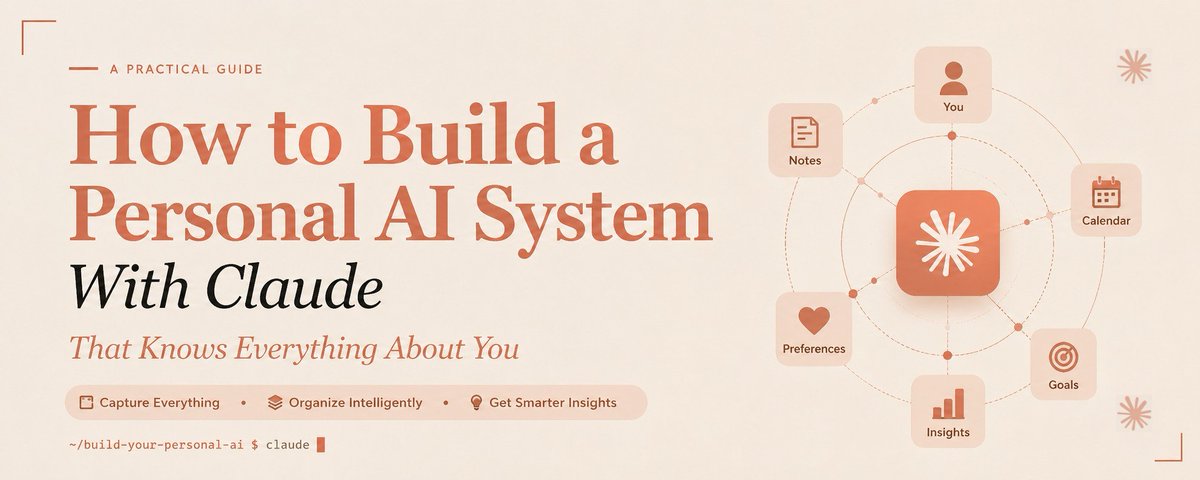
Most people open Claude, explain who they are, what they do, and what they need. Every single time.
Claude forgets them overnight. They start from zero every morning. They retype the same context. They re-explain their voice. They re-describe their business. They waste 15 to 20 minutes before they even get to the real work.
That is the old way.
The new way is building a personal AI system that knows you. Your name. Your business. Your writing voice. Your clients. Your preferences. Your goals. Your communication style. Your pet peeves. Everything.
You build it once. It remembers forever. Every conversation after that starts at mile 10, not mile zero.
I set this up three months ago. The difference is night and day. Claude finishes my sentences. It writes in my voice without me asking. It knows which client I am talking about from context. It remembers decisions I made last month. It catches mistakes based on patterns it has seen before.
It is not a chatbot anymore. It is a personal AI that knows me better than most of my coworkers do.
This is the full course on how to build the same thing. Step by step. File by file. No coding. No technical skills. Just follow the steps exactly.
By the end of this article, your Claude will be a different tool than the one you are using right now.
# Layer 1: Tell Claude Who You Are (5 minutes)
This is the foundation. Everything else builds on it.
Go to Claude. Click your profile icon. Click Settings. Find the section called Personal Preferences.
This is where you tell Claude who you are in every conversation. Whatever you write here loads automatically every time you open Claude. You never have to repeat it.
Here is exactly what to write. Fill in your own details:
```
WHO I AM
Name: [Your name]
Role: [Your job title and what you actually do day to day]
Company: [Your company name and what it does in one sentence]
Industry: [Your industry]
Experience: [Years of experience and your core skill]
HOW I WORK
I prefer [short/detailed] responses unless I ask otherwise.
I communicate in a [casual/professional/direct] tone.
When I ask for help with writing, match my voice. Do not sound like AI.
I use [list your main tools: Notion, Slack, Google Docs, etc].
WHAT I DO NOT WANT
Never start responses with 'Great question!' or 'Absolutely!'
Never use em dashes.
Never use the phrases 'dive deep into' or 'in today's world' or 'it's worth noting.'
Do not ask 'would you like me to continue?' Just continue.
Do not give generic advice. Be specific to my situation.
MY CURRENT GOALS
[Goal 1: what you are working toward right now]
[Goal 2: your second priority]
[Goal 3: your third priority]
```
Keep it under 500 words. This loads into every conversation so shorter is better.
The "What I Do Not Want" section is the most powerful part. Most people skip it. But telling Claude what NOT to do is what makes the output feel human instead of robotic.
Practice: Fill this in right now. Open Claude. Go to Settings. Paste your version. Start a new conversation and ask Claude anything. Notice how different the response feels.
That difference is what personal context does. And we are just getting started.
# Layer 2: Build Separate Brains for Separate Work (15 minutes)
Here is the mistake most people make. They use one Claude conversation for everything. Marketing questions, coding problems, client emails, personal research. All in one messy thread.
Claude gets confused. The context from your marketing question bleeds into your coding answer. Your client's tone leaks into your personal writing.
The fix is Projects.
A Project in Claude is a separate workspace with its own instructions, its own files, its own memory, and its own conversations. Think of each Project as a different brain for a different area of your life.
Here is how I have mine set up:
Project 1: Content Creation. This Project knows my writing voice, my audience, my content calendar, and my best-performing posts. When I ask it to write something, it sounds like me.
Project 2: Client Work. This Project knows my clients, their businesses, their preferences, and our project history. When I ask it to draft a client email, it knows which client and what we discussed last week.
Project 3: Business Operations. This Project knows my SOPs, my pricing, my tools, and my workflows. When I ask it to draft a proposal, it pulls from my actual pricing tiers.
Project 4: Research and Learning. This Project knows what I am currently studying, my skill gaps, and my learning goals. When I ask it to explain something, it adjusts to my current level.
Project 5: Personal. This Project knows my personal goals, my schedule preferences, my health targets, and my reading list. This is my personal assistant.
To set up a Project: Click the Projects icon in Claude. Click New Project. Give it a name. Then open the Project settings and write custom instructions specific to that area.
The custom instructions for each Project are different from your global preferences. Global preferences tell Claude who you are. Project instructions tell Claude what this specific workspace is for.
Example Project instruction for Content Creation:
This Project is for content creation.
My audience is AI professionals and Claude users on X.
My tone is direct, practical, no jargon.
My best-performing content is practical how-to guides with specific numbers.
When writing for me, use short sentences. No filler. Lead with value.
Reference my previous posts when relevant.
Practice: Create 3 Projects right now. Content, Client Work, and Personal. Write 3-5 lines of custom instructions for each one. This takes 10 minutes and changes everything.
# Layer 3: Turn On Memory So Claude Learns From You (2 minutes)
This is the layer most people do not know exists.
Claude has a memory system. It learns from your conversations. It remembers your preferences, your patterns, and your corrections over time. It gets smarter every week.
But for many users, it is turned off by default.
Go to Settings. Find Memory. Turn it on.
That is it. Two clicks.
From this point forward, Claude will start building a profile of you automatically. It notices things like:
You always ask for bullet points instead of paragraphs. Claude remembers and starts using bullets automatically.
You corrected a formatting preference three times. Claude remembers and never makes that mistake again.
You mentioned your company name in five conversations. Claude remembers it and uses it naturally.
You can also tell Claude to remember specific things manually. Just say: "Remember that my client Sarah prefers formal emails with no exclamation marks." Claude saves it.
To see what Claude remembers about you: Go to Settings. Click Memory. You will see a list of everything Claude has learned. You can edit or delete anything.
The power of memory is that it compounds. After one week, Claude knows your basics. After one month, it knows your patterns. After three months, it anticipates what you need before you finish typing the question.
Practice: Turn on Memory right now. Then have 3 normal conversations with Claude inside your Projects. After 24 hours, go back to Settings and check Memory. You will see Claude has already started learning.
# Layer 4: Teach Claude Your Exact Voice (10 minutes)
This is the layer that makes people say "how did it know to write like me?"
Claude's default writing voice is polite, balanced, and slightly formal. It sounds like AI. Everyone's output sounds the same.
To fix this, you need to give Claude samples of YOUR writing.
Here is how:
Step 1: Collect 5 to 10 pieces of your best writing. Blog posts, emails, social media posts, reports. Anything that sounds like you at your best.
Step 2: Open your Content Creation Project. Upload these files as Project Knowledge. Claude will read them and learn your patterns.
Step 3: Add a voice instruction to your Project:
```
VOICE PROFILE
When writing for me, match the tone, rhythm, and vocabulary of the uploaded writing samples.
My sentences are short. Rarely over 15 words.
I use simple words. Never say 'utilize' when 'use' works.
I start paragraphs with action, not throat-clearing.
I never use filler phrases like 'in order to' or 'it is important to note.'
I end articles with a clear action step, not a summary.
```
Step 4: Create a style in Claude. Go to Settings. Click Styles. Create a custom style. Paste your voice rules. Name it "My Voice." You can now select this style in any conversation.
The difference between generic Claude output and voice-matched Claude output is the difference between getting content you edit for 30 minutes and getting content you edit for 30 seconds.
Practice: Upload 5 writing samples to your Content Project right now. Add the voice instruction above. Then ask Claude to write a LinkedIn post about something you care about. Compare the output to what Claude wrote before the voice setup. You will not go back.
# Layer 5: Upload Your World Into Claude (15 minutes)
This is where the system becomes genuinely powerful.
Each Project can hold files. These files become part of Claude's knowledge. It reads them. It references them. It uses them to give you better, more specific answers.
Here is what to upload into each Project:
Content Project: Your content calendar. Your best-performing posts. Your audience research. Your brand guidelines. Your tone dos and don'ts.
Client Project: Your client list with key details. Your pricing tiers. Your proposal template. Your SOW template. Past project summaries.
Operations Project: Your SOPs for recurring tasks. Your tool stack documentation. Your meeting templates. Your onboarding checklist.
Learning Project: Your current reading list. Your skill gap analysis. Your learning goals for the quarter. Course notes.
Personal Project: Your goals for the year. Your daily routine. Your health targets. Your reading backlog.
The more context Claude has, the better its answers get. A question like "draft a proposal for my next client" goes from a generic template to a customized document that uses your actual pricing, your actual scope format, and your actual terms.
Do not upload everything at once. Start with the 3 most important files per Project. Add more as you use each Project and notice what context Claude is missing.
Practice: Open each of your 3 Projects. Upload 2-3 files into each one. Ask Claude a question that requires that context. Watch how specific the answer becomes.
# Layer 6: Connect Claude to Your Tools (10 minutes)
Claude can connect to the tools you already use. Gmail. Google Calendar. Google Drive. Slack. And more through MCP connectors.
Each connection multiplies the value of every other one.
Connect Gmail: Claude can read your emails, draft replies, and surface urgent messages.
Connect Google Calendar: Claude can see your schedule, prep you for meetings, and suggest time blocks.
Connect Google Drive: Claude can read your documents, reference your files, and save outputs directly.
Connect Slack: Claude can scan your channels, surface threads that need your attention, and post updates.
To connect: Go to Settings. Click Connectors. Add each tool. Authorize access. Done.
Once connected, your Morning Briefing becomes real. Claude reads your actual emails, your actual calendar, and your actual Slack. Not hypothetical examples. Your real life.
Practice: Connect Gmail and Google Calendar today. Tomorrow morning, ask Claude: "What does my day look like and what should I focus on?" The answer will be specific to YOUR schedule, YOUR emails, and YOUR deadlines. That is the moment it clicks.
# Layer 7: Make It Work While You Sleep (5 minutes)
This is the final layer. The one that turns your personal AI system from something you use into something that works for you.
Claude Cowork has scheduled tasks. Claude Code has Routines. Both let you set up automations that run on a schedule without you pressing a button.
Here are the 3 scheduled tasks I run every day:
6:30 AM: Morning Briefing. Claude reads my Gmail, Calendar, and Slack. It generates a one-page briefing and posts it to my personal Slack channel. By the time I open my laptop, my entire day is laid out.
4:00 PM Friday: Weekly Report. Claude compiles my week's accomplishments, metrics, and next week's priorities. Saves it to Google Drive. I review for 5 minutes and send it.
8:00 PM Sunday: Content Plan. Claude reads my analytics, identifies what performed best, and generates next week's content plan with hooks and outlines. Monday morning I start executing instead of planning.
To set up a scheduled task in Cowork: Open Settings. Find Scheduled Tasks. Click Add. Write the prompt. Set the time. Choose which connectors it can use. Save.
To set up a Routine in Claude Code: Type /schedule in the CLI. Describe the task. Set the cadence. Done.
Practice: Set up one scheduled task today. Start with the Morning Briefing. Set it for tomorrow at 6:30 AM. Connect Gmail and Calendar. Tomorrow morning, open your laptop and check Slack. Your briefing is waiting.
That is the moment you realize you are not using a chatbot anymore. You are running a personal AI system.
# The Compound Effect
Here is what happens after you build all 7 layers.
Week 1: Claude knows your name, your role, and your preferences. It stops sounding generic.
Week 2: Claude has learned your voice from uploaded samples. Your content sounds like you wrote it.
Week 3: Memory has built up. Claude remembers your clients, your projects, and your patterns. You stop re-explaining things.
Month 1: Your scheduled tasks are running. Your mornings are faster. Your reports write themselves. Your content plan appears every Sunday night.
Month 2: Claude starts anticipating what you need. It suggests things before you ask. It catches mistakes based on patterns it has seen. It references conversations from three weeks ago.
Month 3: You cannot imagine going back. Opening a blank AI chat feels like going back to a flip phone. The system knows you. It works for you. It gets smarter every single day without you doing anything extra.
That compound effect is the entire point. Each layer makes every other layer more powerful. Memory makes Projects more useful. Projects make voice matching more accurate. Voice matching makes content creation faster. Connectors make scheduled tasks smarter. Everything reinforces everything else.
This is not a one-time setup. It is a system that grows with you.
# What To Do Right Now
Do not try to build all 7 layers today. That is the mistake that kills motivation.
Here is the order:
Today (5 minutes): Layer 1. Fill in your Personal Preferences. This is the foundation.
Today (15 minutes): Layer 2. Create 3 Projects with custom instructions.
Today (2 minutes): Layer 3. Turn on Memory.
Tomorrow (10 minutes): Layer 4. Upload 5 writing samples and create your voice profile.
This week (15 minutes): Layer 5. Upload key files to each Project.
This week (10 minutes): Layer 6. Connect Gmail and Google Calendar.
Next week (5 minutes): Layer 7. Set up your first scheduled task.
Total time: about 60 minutes spread across one week.
60 minutes to build a personal AI system that saves you 5 to 10 hours every single week for the rest of your life.
That is the trade. 60 minutes now for thousands of hours later.
Most people will read this article and think about doing it someday.
The ones who open Claude right now and start typing their Personal Preferences will wonder why they waited.
Your AI does not know you yet. Go fix that.
## Follow for the Next One
If this gave you something , follow @heynavtoor
One of these every Tuesday and Friday. Skills, sub-agents, overnight agents, the workflows that make Claude actually run your business while you live your life.
Bookmark this.
hope this was useful.
Nav ❤️
## 相关链接
- [Nav Toor](https://x.com/heynavtoor)
- [@heynavtoor](https://x.com/heynavtoor)
- [87K](https://x.com/heynavtoor/status/2055249160782389690/analytics)
- [@heynavtoor](https://x.com/@heynavtoor)
- [Upgrade to Premium](https://x.com/i/premium_sign_up)
- [7:29 PM · May 15, 2026](https://x.com/heynavtoor/status/2055249160782389690)
- [87.6K Views](https://x.com/heynavtoor/status/2055249160782389690/analytics)
- [View quotes](https://x.com/heynavtoor/status/2055249160782389690/quotes)
---
*导出时间: 2026/5/16 18:42:07*
---
## 中文翻译
# 如何使用 Claude 构建一个了解你一切的个性化 AI 系统
**作者**: Nav Toor
**日期**: 2026-05-15T11:29:19.000Z
**来源**: [https://x.com/heynavtoor/status/2055249160782389690](https://x.com/heynavtoor/status/2055249160782389690)
---

大多数人打开 Claude 时,会解释自己是谁,做什么工作,以及需要什么。每一次都是如此。
Claude 一夜之间就会把你忘了。每天早上都得从零开始。他们得重新输入背景信息。重新解释他们的语调。重新描述业务。在真正开始工作之前,他们浪费了 15 到 20 分钟。
那是旧的方式。
新的方式是建立一个了解你的个人 AI 系统。你的名字。你的业务。你的写作语调。你的客户。你的偏好。你的目标。你的沟通风格。你的雷区。所有一切。
你只需构建一次。它会永远记住。此后的每一次对话都是从第 10 英里开始,而不是第 0 英里。
我在三个月前搭建了这个系统。简直是天壤之别。Claude 能补全我的句子。即使我不要求,它也能用我的语调写作。它能从上下文中判断出我在谈论哪个客户。它记得我上个月做的决定。它根据以前见过的模式捕捉错误。
它不再是一个聊天机器人了。它是一个比我的大多数同事更了解我的个人 AI。
这是关于如何构建同样系统的完整教程。一步一步来。一个文件接一个文件。不需要写代码。不需要技术技能。只要严格按照步骤操作。
读到最后,你的 Claude 将变成一个与现在完全不同的工具。
# 第 1 层:告诉 Claude 你是谁(5 分钟)
这是基础。其他一切都建立在此之上。
打开 Claude。点击你的头像图标。点击设置。找到“个人偏好”部分。
在这里告诉 Claude 你在每次对话中是谁。你在这里写的任何内容都会在每次打开 Claude 时自动加载。你永远不需要重复它。
以下是确切要写的内容。填入你自己的详细信息:
```
我是谁
姓名:[你的名字]
角色:[你的职位头衔和你每天实际在做什么]
公司:[你的公司名称和它的一句简介]
行业:[你的行业]
经验:[工作年限和你的核心技能]
我的工作方式
除非我另有要求,否则我更喜欢[简短/详细]的回答。
我以[随意/专业/直接]的语气沟通。
当我请求写作帮助时,要匹配我的语调。不要听起来像 AI。
我使用[列出你的主要工具:Notion, Slack, Google Docs 等]。
我不想要的
永远不要以“好问题!”或“绝对是!”开始回答。
永远不要使用破折号。
永远不要使用“深入探讨”、“在当今世界”或“值得注意的是”这些短语。
不要问“你想让我继续吗?”直接继续即可。
不要给通用的建议。要针对我的具体情况。
我当前的目标
[目标 1:你目前正致力于实现的事情]
[目标 2:你的第二优先级]
[目标 3:你的第三优先级]
```
控制在 500 字以内。这会加载到每个对话中,所以越短越好。
“我不想要的”部分是最强大的。大多数人跳过了它。但告诉 Claude 不要做什么,才是让输出感觉像人而不是机器人的关键。
练习:现在就填写。打开 Claude。进入设置。粘贴你的版本。开始一个新对话并问 Claude 任何问题。注意回答的感觉有什么不同。
这种差异就是个人语境的作用。而我们才刚刚开始。
# 第 2 层:为不同的工作建立独立的大脑(15 分钟)
这是大多数人犯的错误。他们用一个 Claude 对话搞定所有事情。营销问题、代码问题、客户邮件、个人研究。全都混在一个杂乱的线程里。
Claude 会感到困惑。你的营销问题的上下文会渗透到你的代码回答中。你客户的语调会泄漏到你的私人写作中。
解决方法是“项目”。
Claude 中的一个项目是一个独立的工作空间,拥有自己的指令、文件、记忆和对话。把每个项目想象成你生活中不同领域的不同大脑。
以下是我的设置方式:
项目 1:内容创作。这个项目知道我的写作语调、我的受众、我的内容日历和我表现最好的帖子。当我让它写东西时,听起来就像我。
项目 2:客户工作。这个项目知道我的客户、他们的业务、他们的偏好和我们的项目历史。当我让它起草客户邮件时,它知道是哪个客户以及我们上周讨论了什么。
项目 3:业务运营。这个项目知道我的 SOP(标准作业程序)、我的定价、我的工具和我的工作流程。当我让它起草提案时,它会引用我实际的定价等级。
项目 4:研究和学习。这个项目知道我目前正在学习什么、我的技能差距和我的学习目标。当我让它解释某事时,它会调整到我目前的水平。
项目 5:个人。这个项目知道我的个人目标、我的日程偏好、我的健康目标和我的阅读清单。这是我的私人助理。
要设置项目:点击 Claude 中的项目图标。点击新项目。给它起个名字。然后打开项目设置并编写针对该领域的自定义指令。
每个项目的自定义指令与你的全局偏好不同。全局偏好告诉 Claude 你是谁。项目指令告诉 Claude 这个特定工作区是做什么用的。
内容创作项目的示例指令:
此项目用于内容创作。
我的受众是 X 上的 AI 专业人士和 Claude 用户。
我的语调直接、实用、无行话。
我表现最好的内容是带有具体数字的实用操作指南。
为我写作时,使用短句。无废话。直击痛点。
相关时引用我以前的帖子。
练习:现在创建 3 个项目。内容、客户工作和个人。为每个项目写 3-5 行自定义指令。这需要 10 分钟,但会改变一切。
# 第 3 层:开启记忆功能让 Claude 向你学习(2 分钟)
这是大多数人不知道存在的一层。
Claude 有一个记忆系统。它从你的对话中学习。它记住你的偏好、你的模式和你的修正。它每周都会变得更聪明。
但对于许多用户来说,它默认是关闭的。
进入设置。找到记忆。打开它。
就这样。两次点击。
从现在开始,Claude 将开始自动建立你的个人资料。它会注意到这样的事情:
你总是要求使用要点而不是段落。Claude 记住了并开始自动使用要点。
你修正了三次格式偏好。Claude 记住了并且再也不会犯那个错误。
你在五个对话中提到了你的公司名称。Claude 记住了并自然地使用它。
你也可以手动告诉 Claude 记住具体的事情。只要说:“记住我的客户 Sarah 喜欢没有感叹号的正式邮件。”Claude 会保存它。
要查看 Claude 记住了关于你的什么:进入设置。点击记忆。你会看到 Claude 学到的所有内容的列表。你可以编辑或删除任何内容。
记忆的力量在于它会复利。一周后,Claude 知道你的基本情况。一个月后,它知道你的模式。三个月后,它能在你打完问题之前预判你的需求。
练习:现在开启记忆。然后在你的项目内与 Claude 进行 3 次正常对话。24 小时后,回到设置并检查记忆。你会看到 Claude 已经开始学习了。
# 第 4 层:教给 Claude 你确切的语调(10 分钟)
这一层会让人们说“它怎么知道这样像我一样写?”
Claude 默认的写作语调是礼貌、平衡和略带正式的。听起来像 AI。每个人的输出看起来都一样。
要解决这个问题,你需要给 Claude 提供**你**的写作样本。
方法如下:
第 1 步:收集 5 到 10 篇你最好的作品。博客文章、电子邮件、社交媒体帖子、报告。任何听起来像处于最佳状态的你。
第 2 步:打开你的内容创作项目。将这些文件作为项目知识上传。Claude 会阅读它们并学习你的模式。
第 3 步:向你的项目添加语调指令:
```
语调档案
为我写作时,要匹配上传的写作样本的语调、节奏和词汇。
我的句子很短。很少有超过 15 个字的。
我使用简单的词。当“使用”管用时,绝不说“利用”。
我以行动开始段落,而不是废话。
我从不使用“为了”或“值得注意的是”等填充短语。
我以清晰的行动步骤结束文章,而不是总结。
```
第 4 步:在 Claude 中创建一种风格。进入设置。点击风格。创建自定义风格。粘贴你的语调规则。将其命名为“我的语调”。你现在可以在任何对话中选择这种风格。
通用 Claude 输出与语调匹配的 Claude 输出之间的区别,就在于获得你要编辑 30 分钟的内容和获得你要编辑 30 秒的内容之间的区别。
练习:现在将 5 个写作样本上传到你的内容项目。添加上面的语调指令。然后让 Claude 写一篇关于你关心的任何事的 LinkedIn 帖子。将输出与语调设置之前的输出进行比较。你不会再回去了。
# 第 5 层:将你的世界上传到 Claude(15 分钟)
这是系统真正变得强大的地方。
每个项目都可以容纳文件。这些文件成为 Claude 知识的一部分。它阅读它们。它引用它们。它利用它们为你提供更好、更具体的答案。
以下是每个项目要上传的内容:
内容项目:你的内容日历。你表现最好的帖子。你的受众研究。你的品牌指南。你的语调注意事项。
客户项目:你的客户列表及关键细节。你的定价等级。你的提案模板。你的工作说明书(SOW)模板。过往项目摘要。
运营项目:你重复性任务的 SOP。你的工具栈文档。你的会议模板。你的入职清单。
学习项目:你当前的阅读清单。你的技能差距分析。你本季度的学习目标。课程笔记。
个人项目:你今年的目标。你的日常惯例。你的健康目标。你的积压阅读。
Claude 拥有的上下文越多,它的答案就越好。像“为我的下一个客户起草提案”这样的问题,会从一个通用模板转变为一个使用你实际定价、你实际范围格式和你实际条款的定制文档。
不要一次上传所有内容。从每个项目最重要的 3 个文件开始。随着你使用每个项目并注意到 Claude 缺少什么上下文,再添加更多。
练习:打开你的 3 个项目。向每个项目上传 2-3 个文件。问 Claude 一个需要该上下文的问题。观察答案变得多么具体。
# 第 6 层:将 Claude 连接到你的工具(10 分钟)
Claude 可以连接你已经使用的工具。Gmail。Google 日历。Google 云端硬盘。Slack。以及更多通过 MCP 连接器。
每个连接都会成倍增加其他每个连接的价值。
连接 Gmail:Claude 可以阅读你的邮件,起草回复,并突出显示紧急消息。
连接 Google 日历:Claude 可以查看你的日程,为你准备会议,并建议时间段。
连接 Google 云端硬盘:Claude 可以阅读你的文档,引用你的文件,并直接保存输出。
连接 Slack:Claude 可以扫描你的频道,突出显示需要你关注的线程,并发布更新。
要连接:进入设置。点击连接器。添加每个工具。授权访问。完成。
连接后,你的“晨间简报”就成真了。Claude 阅读你真正的邮件、你真正的日历和你真正的 Slack。而不是假设的例子。你真实的生活。
练习:今天连接 Gmail 和 Google 日历。明天早上,问 Claude:“我的一天是什么样的,我应该关注什么?”答案将针对**你的**日程、**你的**邮件和**你的**截止日期。那一刻你就会豁然开朗。
# 第 7 层:让它在你睡觉时工作(5 分钟)
这是最后一层。它将你的个人 AI 系统从你使用的东西转变为为你工作的东西。
Claude Cowork 有定时任务。Claude Code 有例程。两者都允许你设置按计划运行的自动化,而无需你按按钮。
这是我每天运行的 3 个定时任务:
早上 6:30:晨间简报。Claude 阅读我的 Gmail、日历和 Slack。它生成一份单页简报并将其发布到我的个人 Slack 频道。当我打开笔记本电脑时,我一整天都安排好了。
周五下午 4:00:每周报告。Claude 汇编我本周的成就、指标和下周的优先事项。将其保存到 Google 云端硬盘。我审查 5 分钟并发送它。
周日晚上 8:00:内容计划。Claude 阅读我的分析,找出表现最好的内容,并生成下周的内容计划,包括钩子和大纲。周一早上我开始执行,而不是规划。
要在 Cowork 中设置定时任务:打开设置。找到定时任务。点击添加。编写提示词。设置时间。选择它可以使用的连接器。保存。
要在 Claude Code 中设置例程:在 CLI 中输入 /schedule。描述任务。设置频率。完成。
练习:今天设置一个定时任务。从晨间简报开始。设置为明天早上 6:30。连接 Gmail 和日历。明天早上,打开笔记本电脑并检查 Slack。你的简报正在等待。
那一刻你会意识到你不再使用聊天机器人了。你正在运行一个个人 AI 系统。
# 复利效应
当你构建了所有 7 层后,会发生以下情况。
第 1 周:Claude 知道你的名字、你的角色和你的偏好。它不再听起来那么通用。
第 2 周:Claude 已经从上传的样本中学习了你的语调。你的内容听起来就像你写的。
第 3 周:记忆已经建立。Claude 记住你的客户、你的项目和你的模式。你停止重复解释事情。
第 1 个月:你的定时任务正在运行。你的早晨更快了。你的报告自己写自己。你的内容计划每星期日晚上出现。
第 2 个月:Claude 开始预判你需要什么。它在你询问之前就提出建议。它根据见过的模式捕捉错误。它引用三周前的对话。
第 3 个月:你无法想象回去。打开一个空白的 AI 聊天感觉就像回到翻盖手机。系统了解你。它为你工作。它每一天都变得更聪明,而你不需要做任何额外的事情。
这种复利效应是全部意义所在。每一层都让其他每一层更强大。记忆让项目更有用。项目让语调匹配更准确。语调匹配让内容创作更快。连接器让定时任务更智能。一切都在强化其他一切。
这不是一次性设置。这是一个与你共同成长的系统。
# 现在做什么
不要试图今天构建所有 7 层。那是扼杀动力的错误。
顺序如下:
今天(5 分钟):第 1 层。填写你的个人偏好。这是基础。
今天(15 分钟):第 2 层。创建 3 个具有自定义指令的项目。
今天(2 分钟):第 3 层。开启记忆。
明天(10 分钟):第 4 层。上传 5 个写作样本并创建你的语调档案。
本周(15 分钟):第 5 层。将关键文件上传到每个项目。
本周(10 分钟):第 6 层。连接 Gmail 和 Google 日历。
下周(5 分钟):第 7 层。设置你的第一个定时任务。
总时间:大约 60 分钟,分散在一周内。
60 分钟用于构建一个个人 AI 系统,在余生中每周为你节省 5 到 10 小时。
这就是交易。现在投入 60 分钟,换取以后数千小时。
大多数人会阅读这篇文章并想某天再做。
那些现在就打开 Claude 并开始输入他们的个人偏好的人,会纳闷自己为什么要等。
你的 AI 还不了解你。去解决这个问题。
## 关注下一篇
如果这对你有帮助,请关注