# 60 Claude Cowork Commands, Skills, and Workflows That Most Users Don't Know
**作者**: Nav Toor
**日期**: 2026-04-30T10:54:46.000Z
**来源**: [https://x.com/heynavtoor/status/2049804650904498501](https://x.com/heynavtoor/status/2049804650904498501)
---
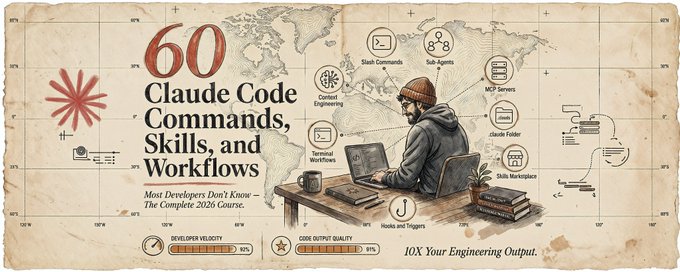
I have been running Claude Cowork as my full operating system since January 2026.
Save this. You will need it later this week.
These 60 moves are the ones that turned Cowork from "AI assistant I open sometimes" into the thing I open before my email. Most people use maybe 6 of them. The other 54 are sitting right there, waiting.
Cowork has 6 layers most users never touch: slash commands, custom skills, scheduled tasks, connector chains, sub-agent patterns, and the .claude/ folder convention. Each one alone is useful. Stack them together and Cowork stops feeling like a chatbot and starts feeling like an operating system that runs your work while you focus on the part only you can do.
Every item below is labeled by skill level. Beginner means you can do it tonight. Intermediate means 30 minutes of setup. Pro means you have done this before. Elite means almost nobody is doing this yet, but they will be in 6 months.
# If you only learn 3 things from this list
Most readers will scroll. If you do, at minimum learn these three. They are the highest leverage moves in the entire article.
- Number 8 (/plan): Saves you from token disasters on complex tasks. The single most important command in Cowork.
- Number 31 (Custom Skills folder): The hidden feature that turns Cowork into your personal AI. Once you learn this, you will use Cowork twice as often.
- Number 46 (Daily 7am inbox automation): The first scheduled task you should set up. Pays for the entire $20/month plan in week one.
Now the full list.
# Section 1: Slash Commands That Most Users Don't Know (1 to 12)
01. /schedule [Beginner]. The single most underused feature in Cowork. Type /schedule, describe the task, set the cadence. The task runs in the background even when your laptop is closed (Max plan) or when Cowork is open (Pro). Your 7am inbox triage. Your Friday status report. Your Monday calendar prep. Set them once, never set them again.
/schedule> Every weekday 7:30am: triage Gmail, summarize calendar, save to /Daily/[date].md
02. /loop [Beginner]. The lighter cousin of /schedule. Polls something at an interval inside your current session. Stops when the session ends. Use it when you want Claude watching one specific thing while you work on another. "Every 3 minutes, check if the deploy log shows green and tell me." No more babysitting builds.
03. /plan [Beginner]. Forces Cowork to write a step-by-step plan before touching anything. Review it. Approve it. Then execute. The cost of typing /plan is 3 seconds. The cost of skipping it is sometimes a corrupted folder. Always /plan if a task touches more than 3 files.
04. /compact [Beginner]. When the conversation drags and Claude starts hallucinating earlier context, /compact compresses the chat while keeping the meaningful parts. Saves 40 to 60% of your context window. Run it before Claude starts repeating mistakes, not after.
05. /clear [Beginner]. Nuclear reset. Wipes the thread. Use when context is so polluted that Claude is fighting you. Do not be sentimental about a long thread. Start clean.
06. /resume [Intermediate]. Pick up exactly where you left a previous conversation. Pair with /rename so you can find it later by something other than "New chat 47." This is how you make Cowork feel persistent across days.
07. /rename [Intermediate]. Auto-renames the current thread based on its content. Without this, your sidebar fills up with identical "New chat" entries. With it, your sidebar becomes a searchable index of your work.
08. /cost [Intermediate]. Shows estimated token cost before you run a task. On Pro plan, this is the difference between finishing your week and burning out your allocation by Wednesday. If a task shows 3x normal cost, scope it down before you run it.
09. /memory [Intermediate]. Shows which memory files and context Claude has loaded. The first thing to check when Claude is acting weird. If the context you assumed was loaded is not, you found your bug.
10. /doctor [Intermediate]. Diagnostic command. Lists connected apps, loaded skills, available commands, current permissions. Run this when something is broken and you do not know why. Faster than asking on Reddit.
11. /voice [Pro]. Push-to-talk dictation directly into the Cowork input. Hold Space, talk, release. Your speech becomes text live as you speak. Mix typing and voice in the same prompt. The fastest input method on the platform. Once you try it, you stop typing long prompts forever.
12. /agents [Pro]. Spawns a project-specific sub-agent that lives inside your repo or folder. Example: a "test writer" agent that knows your testing conventions, or a "PR reviewer" agent that knows your team's code style. Type /agents inside any project, generate-with-Claude, and you get a focused specialist that Cowork uses automatically when relevant.
# Section 2: Custom Skills That Replace Entire Workflows (13 to 24)
Skills are reusable mini-programs Cowork loads automatically when relevant. Drop a SKILL.md into your /skills folder and Claude uses it whenever the request matches. Smart loading means skills do not eat your context window. The Claude Skills marketplace now hosts 2,300+ free skills. Most users have installed zero. The opportunity gap is enormous.
13. Brand voice skill [Beginner]. Drop 5 to 10 of your best articles into /skills/brand-voice/examples. Add a SKILL.md that says "match the tone of these examples." Now every writing task sounds like you, not Claude. The single highest-leverage skill for anyone who writes online.
14. Email triage skill [Beginner]. Defines your personal triage rules: what counts as urgent, what gets a one-line reply, what gets archived without reading. Once installed, every email task uses your judgment, not Claude's defaults.
15. Meeting transcript skill [Beginner]. Takes any raw transcript and outputs structured notes: decisions made, action items with owners and deadlines, open questions, follow-ups. Triggers automatically whenever you upload a transcript file.
16. PDF report generator skill [Beginner]. Generates branded PDF reports from markdown with title page, table of contents, and footer. Pair with your brand-voice skill and every report looks like your team produced it.
17. Code review skill [Intermediate]. A SKILL.md that encodes your team's coding standards, naming conventions, and common review comments. Every PR review uses it automatically. Replaces the senior engineer's monthly "remember our style guide" reminder.
18. Customer support response skill [Intermediate]. Trained on your past Zendesk or Intercom replies. Drafts every new response in your team's voice with your team's solutions. Saves the average support agent 4+ hours per week.
19. Proposal generator skill [Intermediate]. Reads a client brief and your proposal template. Generates a customized proposal in your tone, with your pricing logic. Train it on 3 winning proposals. Now every new proposal takes 10 minutes instead of 3 hours.
20. Investor update skill [Pro]. Encodes your KPIs, your narrative arc, your structure. Every monthly investor update follows the same logic. Pull metrics from your dashboard, format the update, attach the right context. 2-hour task becomes 15 minutes.
21. Contract review skill [Pro]. Reads any contract PDF and flags key terms, deadlines, auto-renewals, liability caps, and unusual clauses. Not legal advice. A first-pass review that saves 1 to 2 hours per contract before you send it to your lawyer.
22. Hiring screen skill [Pro]. Reads any resume against your role description and outputs a structured assessment: strengths, gaps, red flags, suggested interview questions. Replaces the hour you spent on each first-pass screen.
23. Stakeholder communication skill [Elite]. One skill, four output formats: 50-word summary for the CEO, 200-word version for your manager, 500-word technical version for engineering, public-facing version for the blog. Every announcement gets all four versions in one prompt.
24. Pricing skill [Elite]. Reads any product description, generates 3 pricing tiers with rationale, anchored to comparable products in the market. Used by SaaS founders to price-test before launch.
# Section 3: File System Power Moves (25 to 33)
25. Screenshot library organizer [Beginner]. "Read every screenshot in /Screenshots. Use OCR to detect what each one is: a code error, a chart, a UI design, a meeting slide. Move each into the matching subfolder. Add a description as the filename." Turns the 800-screenshot pile into a searchable archive in 5 minutes.
26. Smart attachment processor [Beginner]. "Look in /Attachments. Group emails-attachments by sender, contracts-attachments into /Legal, invoices into /Finance/[year]/[month], everything else into /Misc. Rename invoices with vendor + amount + date." Inbox attachments stop being a black hole.
27. Code repo cleanup [Intermediate]. "Read all my project repos in /Code. Identify dead branches, unused dependencies, abandoned experiments older than 90 days. Move abandoned repos to /Code/archive. Generate a cleanup report." Reclaims tens of GB and zero mental load.
28. PDF metadata extractor [Intermediate]. "For every PDF in /Research, extract: title, authors, publication date, abstract, key findings. Save as a CSV index. When I ask for research on [topic], use this index first." Turns a 200-PDF dump into an instantly searchable knowledge base.
29. Photo library curator [Intermediate]. "Look at every photo in /Photos taken this year. Find blurry duplicates and near-duplicates. Identify the best version of each shot using sharpness and composition heuristics. Move the rest to /Photos/cull-review for final approval." Replaces the 4 hours you would spend culling manually.
30. Voice note to article pipeline [Pro]. "Read all transcripts in /Voice-Notes from this week. For each, draft a 1,500-word article in my brand voice. Keep my natural cadence but cut rambling and add structure. Save publication-ready drafts to /Drafts." Solo content shop, fully voice-driven.
31. Custom skill folder setup [Pro]. Create ~/skills with subfolders for each skill: brand-voice, email-triage, pdf-report, etc. Each subfolder has a SKILL.md describing when and how Claude should use it. Cowork auto-discovers and uses them whenever the request matches. This single setup turns Cowork from a chat app into your personal AI. The most underrated configuration on the platform.
~/skills/brand-voice/SKILL.md~/skills/email-triage/SKILL.md~/skills/pdf-report/SKILL.md~/skills/proposal/SKILL.md
32. Git history miner [Pro]. "Read the last 90 days of git history across all my projects. Identify which features I shipped, which bugs I fixed, what skills I used most. Generate a quarterly engineering self-review I can paste into my performance doc." Annual review writes itself.
33. Backup audit with intelligence [Elite]. "Compare /Documents to my last backup. Show me which files changed, which are new, which were deleted. Flag any deletion of files modified in the last 30 days as suspicious. Estimate how long a full backup will take given my files are X size." Backup hygiene without thinking about it.
# Section 4: Connector Workflows That Replace Real Jobs (34 to 45)
34. Calendar conflict resolver [Beginner]. "Look at my Google Calendar for next week. Identify meeting conflicts, back-to-back meetings with no buffer, and meetings I should probably decline based on relevance. Suggest reschedules with proposed alternative times." Replaces the 30 minutes you spend on calendar Tetris every Sunday.
35. Slack thread to executive brief [Beginner]. "Read this Slack thread. Identify the decision being debated, the positions of each participant, the emerging consensus, and the open questions. Output a 1-paragraph brief I can forward to my boss." Long threads become decisions in seconds.
36. Gmail to CRM logger [Intermediate]. "Scan my Gmail for emails sent to or received from any contact in our HubSpot CRM. Log each email as an activity against the matching contact record. Include subject, snippet, and timestamp. Skip anything already logged." Sales rep activity logging on autopilot.
37. Drive to data warehouse pipeline [Intermediate]. "Read every Google Sheet in /Drive/Reports. For each, infer the schema, normalize column names, and append the data to the matching table in BigQuery. Note any sheets that do not match an existing table." Replaces the data engineer's ETL ticket queue.
38. Notion to Linear ticket pipeline [Intermediate]. "Read this Notion PRD. Generate Linear tickets for each requirement. Group by component, assign by team based on our team-component mapping, add to the current sprint. Output a summary of tickets created." Specs become work in 90 seconds.
39. Multi-source weekly status report [Pro]. "Pull this week's sales numbers from Salesforce. Pull product metrics from Mixpanel. Pull customer feedback from Intercom. Pull team activity from GitHub. Combine into a 1-page weekly status report. Save as PDF." Replaces a full-time RevOps coordinator.
40. Cross-platform context retrieval [Pro]. "I am about to start a meeting with [client]. Pull all relevant context: recent emails from them, related Drive docs, mentions in Slack, open Linear tickets they care about, last call notes. Compile a 1-page meeting prep doc." Walk in fully briefed every time.
41. Salesforce pipeline hygiene [Pro]. "Query opportunities in Salesforce. If stage is Proposal Sent and last activity was 14+ days ago with no response logged, move to Needs Review. Show preview of all changes before executing." 3 hours of manual cleanup becomes 8 minutes.
42. GitHub PR auto-review [Pro]. "Watch our GitHub repo. When a new PR opens, run our code-review skill against it. Post structured review comments. Approve if it passes our checklist. Tag a senior engineer if it fails." First-pass review, automated.
43. Stripe to bookkeeping reconciliation [Elite]. "Pull all Stripe transactions from last month. Match each to an invoice in our Google Sheet. Flag mismatches: payments without invoices, invoices without payments. Update the bookkeeping sheet with reconciliation status." Replaces a part-time bookkeeper.
44. Customer churn early warning [Elite]. "Cross-reference Intercom support tickets, Mixpanel usage data, and Stripe payment history. Identify accounts showing 3+ churn signals (declining usage, support friction, payment delays). Output a list ranked by ARR at risk." A retention team in one prompt.
45. Investor pipeline tracker [Elite]. "Read every email I have exchanged with investors in the last 6 months. Categorize each conversation by stage: cold intro, first meeting, second meeting, due diligence, term sheet, closed, passed. Identify investors who have gone quiet for 21+ days and draft a follow-up. Output a CRM-style pipeline view." Replaces a fundraising-ops hire.
# Section 5: Scheduled Automations That Run While You Sleep (46 to 53)
46. Daily 7am inbox processor [Beginner]. Schedule daily 7am: "Triage Gmail. Categorize unread. Draft responses for routine emails. Flag urgent ones. Save the summary to /Daily/inbox-[date].md." Wake up to a triaged inbox every single day. The first automation everyone should set up.
47. Sunday week-ahead brief [Beginner]. Schedule Sunday 6pm: "Pull next week's calendar. For every meeting, attach the relevant prep docs from Drive. Flag any meeting where I have no context yet. Generate a 1-page weekly brief with priorities, prep gaps, and outstanding action items. Save to /Weekly/brief-[date].md." Walk into Monday already informed.
48. Daily metric snapshot [Intermediate]. Schedule daily 8am: "Pull yesterday's key metrics from Mixpanel, Stripe, and our database. Calculate week-over-week and month-over-month deltas. Flag anything outside expected ranges. Save to /Metrics/[date].md and post a summary to our #metrics Slack channel." Replaces the daily metrics standup.
49. Weekly content recycler [Intermediate]. Schedule Friday 5pm: "Read every article I published this week. Generate 8 standalone tweets, 2 LinkedIn posts, 3 short-form video scripts, and 1 newsletter teaser per article. Save to /Content/recycled/[week]." One article becomes 14 distribution assets, automatically.
50. Monthly competitor scan [Pro]. Schedule first of every month: "Search news, ProductHunt, Crunchbase, and X for updates on [3 named competitors]. Track pricing changes, product launches, hiring, and funding. Compare to last month. Output a competitive landscape brief saved to /Intelligence/[month].md." Strategic intelligence on autopilot.
51. Quarterly OKR self-review [Pro]. Schedule first day of each quarter: "Read all Q[X] OKRs. Pull progress data from Notion, Linear, and Drive. For each OKR, calculate completion percentage, identify blockers, recommend Q[X+1] adjustments. Save to /OKRs/Q[X]-review.md." Replaces the consultant.
52. Annual highlights compiler [Elite]. Schedule December 28: "Read every weekly status doc, every quarterly review, and every shipped feature from the year. Identify the 10 highest-impact moves I made. Generate a year-end wrap that I can use for performance review, social posts, and personal reflection. Save to /Annual/[year].md." Year ends with the highlight reel already done.
53. Birthday and relationship maintenance [Elite]. Schedule weekly Sunday 4pm: "Look up everyone in my contacts whose birthday or work anniversary falls in the next 14 days. Draft a personal message for each one based on our last conversation. Save to /Relationships/[week].md for me to review and send." The hardest soft skill, automated.
# Section 6: Pro Patterns Most People Don't Know Exist (54 to 60)
54. Sub-agent parallelization [Pro]. Spawn sub-agents for any task that would pollute your main thread. "Run 3 sub-agents in parallel: one researches competitor pricing, one drafts the strategy memo, one prepares the slide outline. Return only the final outputs to me." Massive parallel work, clean main context.
55. Connector chains for compound output [Pro]. Chain multiple connectors in one command. "Read the latest email from [client]. Search Drive for related contracts. Check Slack for any team discussion of them. Pull their open Linear tickets. Compile a complete client status doc." 4 tools, 1 prompt, 1 deliverable.
56. Skill stacking for compounding leverage [Pro]. Combine multiple skills in a single task. "Use the brand-voice skill plus the email-triage skill plus the meeting-notes skill to draft a follow-up email to yesterday's call." Skills compose like Lego. Stack 3 skills and you have a function nobody else has built.
57. Plan mode for token discipline [Pro]. Always /plan before tasks on Pro plan. The plan output shows you the full token budget upfront. Adjust scope before execution. The single move that saves the most token allocation each week.
58. The .claude/ folder convention [Elite]. Every serious Cowork user keeps a .claude/ folder in each project. Inside: commands/, skills/, agents/, and CLAUDE.md (project context). When you open Cowork in this project, all of it loads automatically. Your .claude/ folder is your real resume now. Hiring managers in 2026 will check it before checking your LinkedIn.
59. Off-peak scheduling for 2x throughput [Elite]. Anthropic doubled off-peak usage limits in March 2026. Schedule heavy automations for evenings and weekends. You get 2x throughput on the same plan. Most users do not know this and waste their best automations on peak hours.
60. Persistent Dispatch threads across devices [Elite]. Cowork Dispatch (March 2026) keeps a persistent thread that survives across devices. Start a task on your laptop. Pick it up on your phone during your commute. Finish it on your tablet at home. The thread retains all context, all memory, all skill state. The closest thing to a real personal AI yet built.
# 5 Pro Tips That Multiply Everything Above
1. Treat Cowork like a junior employee, not a search box. Junior employees need context, examples, and clear acceptance criteria. So does Cowork. The 30 seconds you spend setting context save the 5 minutes of bad output you would otherwise correct.
2. Build your skill library in the first month, not as you go. Spending 4 hours on day 1 setting up 5 to 8 personal skills returns hundreds of hours over the next year. Most people build skills only when they are already overloaded. Do it before.
3. /plan is free insurance. The cost of typing /plan is 3 seconds. The cost of skipping it on a complex task is sometimes a corrupted folder, a deleted file, or a wasted day. Type /plan.
4. Schedule the boring stuff first. Your 7am inbox triage, your Friday status report, your Sunday week-ahead brief. These are not glamorous. They are the foundation. Once they run automatically, you have hours each week to do work only you can do.
5. The .claude/ folder is your new resume. Every serious project should have one. Hiring managers in 2026 already check for it. Your Cowork setup signals how you work better than any LinkedIn bio.
# Where to Start Based on Your Level
Beginner (this week): Pick 5 commands from Section 1. Use them daily. Once they are automatic, move up.
Intermediate (next 3 weeks): Set up your /skills folder. Build 3 custom skills for your most repeated tasks. Schedule the daily 7am inbox processor and the Sunday week-ahead brief.
Pro (month 2): Set up connector chains. Run weekly automations across multiple tools. Use /agents to specialize Cowork for each project. Track your token budget with /cost.
Elite (month 3+): Build the .claude/ folder convention into every project. Use Dispatch for persistent threads across devices. Schedule heavy work off-peak. Stack skills for compound output.
# TL;DR
60 commands, skills, and workflows. Tested daily for 4 months. Most users know maybe 8 of them.
Cowork is not a chatbot with file access. It is an autonomous operating system. The people who win in 2026 are the ones who treat it that way.
Save this list. Bookmark the 3 you will try this week. Come back when you have learned them. There are 57 more waiting.
I post stuff like this every week. Real workflows, real numbers, real results from daily use. No fluff. Follow if you want the next one.
## 相关链接
- [Nav Toor](https://x.com/heynavtoor)
- [@heynavtoor](https://x.com/heynavtoor)
- [238K](https://x.com/heynavtoor/status/2049804650904498501/analytics)
- [#metrics](https://x.com/search?q=%23metrics&src=hashtag_click)
- [Upgrade to Premium](https://x.com/i/premium_sign_up)
- [6:54 PM · Apr 30, 2026](https://x.com/heynavtoor/status/2049804650904498501)
- [238.3K Views](https://x.com/heynavtoor/status/2049804650904498501/analytics)
- [View quotes](https://x.com/heynavtoor/status/2049804650904498501/quotes)
---
*导出时间: 2026/5/1 14:48:55*
---
## 中文翻译
# 60 个大多数用户不知道的 Claude Cowork 指令、技能与工作流
**作者**: Nav Toor
**日期**: 2026-04-30T10:54:46.000Z
**来源**: [https://x.com/heynavtoor/status/2049804650904498501](https://x.com/heynavtoor/status/2049804650904498501)
---

自 2026 年 1 月以来,我一直在将 Claude Cowork 作为我的全功能操作系统使用。
收藏这篇文章。本周晚些时候你会用到它。
这 60 个操作让 Cowork 从一个“我有时打开的 AI 助手”变成了我优先于邮件打开的工具。大多数人可能只会用其中的 6 个。剩下的 54 个就静静待在那里,等你发掘。
Cowork 有大多数用户从未触及的 6 个层级:斜杠命令、自定义技能、定时任务、连接器链、子代理模式以及 .claude/ 文件夹规范。单独使用每一个都很有用。将它们堆叠在一起,Cowork 就不再像是一个聊天机器人,而更像是一个能替你运行工作的操作系统,让你专注于只有你自己能完成的部分。
下面的每一项都标注了技能等级。初级意味着你今晚就能上手。中级意味着需要 30 分钟的设置。专业级意味着你以前做过类似的事情。精英级意味着几乎还没人在做,但 6 个月后大家都会做。
# 如果你只从这份清单中学 3 件事
大多数读者会直接划走。如果你也是,至少请学会这三条。它们是整篇文章中杠杆率最高的操作。
- 第 8 条 (/plan):让你在处理复杂任务时免于陷入 token 灾难。这是 Cowork 中最重要的指令。
- 第 31 条 (自定义技能文件夹):将 Cowork 变成你的个人 AI 的隐藏功能。一旦学会,你使用 Cowork 的频率会翻倍。
- 第 46 条 (每天早上 7 点的收件箱自动化):你应该设置的第一个定时任务。在第一周就能赚回整个 $20/月的订阅费。
以下是完整清单。
# 第 1 部分:大多数用户不知道的斜杠命令 (1 到 12)
01. /schedule [初级]。Cowork 中利用率最低的功能。输入 /schedule,描述任务,设定频率。即使你的笔记本电脑合上了(Max 套餐)或者 Cowork 是关闭的(Pro 套餐),任务也会在后台运行。早上 7 点的收件箱分类、周五的状态报告、周一的日程准备。设置一次,一劳永逸。
/schedule> 每个工作日早上 7:30:分类 Gmail,总结日历,保存到 /Daily/[date].md
02. /loop [初级]。/schedule 的轻量级“表亲”。在当前会话中按一定间隔轮询某事。会话结束时停止。当你需要 Claude 盯着某件事,而你同时在做另一件事时使用它。“每 3 分钟检查一次部署日志是否显示绿色,并告诉我。”再也不用像保姆一样守着构建了。
03. /plan [初级]。强制 Cowork 在做任何操作之前先写一个分步计划。审查它。批准它。然后执行。输入 /plan 的成本是 3 秒。跳过它的成本有时是一个被弄乱的文件夹。如果任务涉及 3 个以上的文件,务必使用 /plan。
04. /compact [初级]。当对话变得冗长,Claude 开始对之前的上下文产生幻觉时,/compact 会在保留有意义部分的同时压缩聊天记录。可节省 40% 到 60% 的上下文窗口。要在 Claude 开始重复错误*之前*运行它,而不是之后。
05. /clear [初级]。核爆式重置。清除当前线程。当上下文混乱不堪,Claude 在和你“对着干”时使用。不要对长线程感情用事。重新开始。
06. /resume [中级]。从你上次对话中断的地方准确接续。配合 /rename 使用,这样你以后可以通过“新聊天 47”以外的名字找到它。这是让 Cowork 感觉在跨天持续工作的方法。
07. /rename [中级]。根据内容自动重命名当前线程。没有它,你的侧边栏会充满一模一样的“新聊天”条目。有了它,你的侧边栏就变成了工作的可搜索索引。
08. /cost [中级]。在运行任务前显示预估的 token 成本。在 Pro 套餐上,这决定了一周够用还是周三就耗尽配额。如果任务显示 3 倍于正常成本,请在运行前缩小范围。
09. /memory [中级]。显示 Claude 加载了哪些记忆文件和上下文。当 Claude 表现异常时首先要检查这个。如果你以为加载了的上下文实际上没有加载,你就找到 bug 了。
10. /doctor [中级]。诊断命令。列出已连接的应用、已加载的技能、可用指令、当前权限。当东西坏了而你不知道原因时运行这个。比在 Reddit 上提问快。
11. /voice [专业]。直接通过按住对讲的方式在 Cowork 输入框进行语音听写。按住空格键,说话,松开。你的语音会实时转成文字。在同一条提示词中混合打字和语音。这是平台上最快的方法。一旦试过,你就永远不会再输入长篇提示词了。
12. /agents [专业]。生成一个存在于你的仓库或文件夹中的特定项目子代理。例如:一个了解你测试约定的“测试编写员”代理,或者一个了解你团队代码风格的“PR 审查员”代理。在任何项目内输入 /agents,生成由 Claude 创建,你会得到一个专注的专家,当相关时 Cowork 会自动使用它。
# 第 2 部分:取代整个工作流的自定义技能 (13 到 24)
技能是 Cowork 在相关时自动加载的可复用微型程序。将一个 SKILL.md 放入你的 /skills 文件夹,每当请求匹配时 Claude 就会使用它。智能加载意味着技能不会占用你的上下文窗口。Claude 技能市场现 hosted 2300 多个免费技能。大多数用户安装数为零。机会缺口巨大。
13. 品牌语调技能 [初级]。将 5 到 10 篇你最好的文章放入 /skills/brand-voice/examples。添加一个 SKILL.md,说明“匹配这些示例的语调”。现在每一次写作任务听起来都像你,而不是 Claude。对于任何在线写作的人来说,这是杠杆率最高的技能。
14. 邮件分类技能 [初级]。定义你的个人分类规则:什么算紧急,什么得到一行回复,什么直接归档不读。一旦安装,每个邮件任务都会使用你的判断,而不是 Claude 的默认设置。
15. 会议记录技能 [初级]。获取任何原始记录并输出结构化笔记:所做的决定、包含负责人和截止日期的行动项、未解决的问题、后续跟进。当你上传记录文件时自动触发。
16. PDF 报告生成器技能 [初级]。从带有封面、目录和页脚的 markdown 生成品牌化 PDF 报告。结合你的品牌语调技能,每份报告看起来都像是你的团队制作的。
17. 代码审查技能 [中级]。一个编码了你团队编码标准、命名约定和常见审查评论的 SKILL.md。每次 PR 审查都会自动使用它。取代了高级工程师每月“记住我们的风格指南”的提醒。
18. 客户支持回复技能 [中级]。基于你过去的 Zendesk 或 Intercom 回复进行训练。以你团队的声音和你团队的解决方案起草每一条新回复。平均为每个支持代理每周节省 4 小时以上。
19. 提案生成器技能 [中级]。阅读客户简报和你的提案模板。以你的语调、按照你的定价逻辑生成定制提案。用 3 个成功的提案训练它。现在每一个新提案只需 10 分钟,而不是 3 小时。
20. 投资人更新技能 [专业]。编码你的 KPI、你的叙事弧线、你的结构。每次月度投资人更新都遵循同样的逻辑。从你的仪表盘拉取指标,格式化更新,附加正确的上下文。2 小时的任务变成 15 分钟。
21. 合同审查技能 [专业]。阅读任何合同 PDF 并标记关键条款、截止日期、自动续约、责任上限和异常条款。不是法律建议。这是在发给律师之前的一份初步审查,每份合同节省 1 到 2 小时。
22. 招聘筛选技能 [专业]。对照你的职位描述阅读任何简历,并输出结构化评估:优势、差距、危险信号、建议的面试问题。取代你花在每一份初步筛选上的 1 小时。
23. 利益相关者沟通技能 [精英]。一个技能,四种输出格式:给 CEO 的 50 字摘要,给经理的 200 字版本,给工程部门的 500 字技术版本,给博客的公开版本。每次公告都能在一个提示词中获得全部四个版本。
24. 定价技能 [精英]。阅读任何产品描述,生成 3 个定价层级及理由,并锚定到市场上的同类产品。被 SaaS 创始人用于在发布前进行价格测试。
# 第 3 部分:文件系统强力操作 (25 到 33)
25. 截图库整理器 [初级]。“阅读 /Screenshots 中的每一张截图。使用 OCR 检测每张图是什么:代码错误、图表、UI 设计、会议幻灯片。将每张移动到匹配的子文件夹中。添加描述作为文件名。”在 5 分钟内将 800 张杂乱的截图堆变成可搜索的存档。
26. 智能附件处理器 [初级]。“查看 /Attachments。将邮件附件按发件人分组,合同附件放入 /Legal,发票放入 /Finance/[year]/[month],其他所有东西放入 /Misc。用供应商+金额+日期重命名发票。”收件箱附件不再是个黑洞。
27. 代码仓库清理 [中级]。“阅读 /Code 中我所有的项目仓库。识别死分支、未使用的依赖项、超过 90 天的废弃实验。将废弃的仓库移动到 /Code/archive。生成一份清理报告。”回收数十 GB 空间,零精神负担。
28. PDF 元数据提取器 [中级]。“对于 /Research 中的每个 PDF,提取:标题、作者、出版日期、摘要、关键发现。保存为 CSV 索引。当我询问关于 [主题] 的研究时,首先使用这个索引。”将 200 个 PDF 的堆砌变成即时可搜索的知识库。
29. 照片库策展人 [中级]。“查看 /Photos 中今年拍摄的所有照片。找到模糊的重复项和近似重复项。使用清晰度和构图启发式算法识别每张照片的最佳版本。将其余的移动到 /Photos/cull-review 进行最终批准。”取代你手动筛选的 4 小时。
30. 语音笔记转文章流水线 [专业]。“阅读 /Voice-Notes 中本周的所有转录稿。对于每一份,用我的品牌语调起草一篇 1500 字的文章。保持我的自然节奏,但删减废话并添加结构。将准备发布的草稿保存到 /Drafts。”单人内容工作室,完全由语音驱动。
31. 自定义技能文件夹设置 [专业]。创建 ~/skills,并为每个技能设置子文件夹:brand-voice、email-triage、pdf-report 等。每个子文件夹都有一个 SKILL.md,描述 Claude 应何时以及如何使用它。当请求匹配时,Cowork 会自动发现并使用它们。这单一设置将 Cowork 从聊天应用变成了你的个人 AI。这是平台上被低估程度最高的配置。
~/skills/brand-voice/SKILL.md~/skills/email-triage/SKILL.md~/skills/pdf-report/SKILL.md~/skills/proposal/SKILL.md
32. Git 历史挖掘器 [专业]。“阅读我所有项目过去 90 天的 git 历史。识别我交付了哪些功能,修复了哪些 bug,我最常使用哪些技能。生成一份季度工程自我评估,我可以将其粘贴到我的绩效文档中。”年终总结自己就写出来了。
33. 带有智能的备份审计 [精英]。“将 /Documents 与我上次备份进行比较。告诉我哪些文件更改了,哪些是新的,哪些被删除了。将过去 30 天内修改的文件的任何删除标记为可疑。鉴于我的文件大小为 X,估计完整备份需要多长时间。”不用动脑的备份卫生管理。
# 第 4 部分:取代真实工作的连接器工作流 (34 到 45)
34. 日程冲突解决器 [初级]。“查看我下周的 Google 日历。识别会议冲突、没有缓冲时间的背靠背会议,以及根据相关性我可能应该拒绝的会议。建议重新安排时间并提出备选时段。”取代你每个周日花 30 分钟玩日历俄罗斯方块的时间。
35. Slack 线程转执行摘要 [初级]。“阅读这个 Slack 线程。识别正在辩论的决定、每个参与者的立场、正在形成的共识以及未解决的问题。输出一份我可以转发给老板的一页摘要。”长线程在几秒钟内变成决策。
36. Gmail 到 CRM 记录器 [中级]。“扫描我的 Gmail,查找发送给或接收自我们 HubSpot CRM 中任何联系人的电子邮件。将每封邮件记录为对相应联系人记录的活动。包括主题、片段和时间戳。跳过任何已记录的内容。”销售代表的活动记录自动化。
37. Drive 到数据仓库流水线 [中级]。“读取 /Drive/Reports 中的每个 Google 表格。对于每个表格,推断架构,规范化列名,并将数据附加到 BigQuery 中匹配的表。注意任何与现有表不匹配的表格。”取代数据工程师的 ETL 工单队列。
38. Notion 到 Linear 工单流水线 [中级]。“阅读这个 Notion PRD。为每个需求生成 Linear 工单。按组件分组,根据我们的团队-组件映射分配给团队,添加到当前的冲刺中。输出创建的工单摘要。”规格在 90 秒内变成工作。
39. 多来源周状态报告 [专业]。“从 Salesforce 拉取本周的销售数字。从 Mixpanel 拉取产品指标。从 Intercom 拉取客户反馈。从 GitHub 拉取团队活动。合并成一份 1 页的周状态报告。保存为 PDF。”取代一名全职 RevOps 协调员。
40. 跨平台上下文检索 [专业]。“我即将开始与 [客户] 的会议。拉取所有相关上下文:来自他们的近期邮件、相关的 Drive 文档、Slack 中的提及、他们关心的未结 Linear 工单、上次通话记录。汇编一份 1 页的会议准备文档。”每次都带着充分的信息入场。
41. Salesforce 流水线卫生管理 [专业]。“查询 Salesforce 中的机会。如果阶段是“提案已发送”且上次活动是 14 天前以上且未记录回复,则移动至“需审查”。在执行前显示所有更改的预览。”3 小时的手动清理变成 8 分钟。
42. GitHub PR 自动审查 [专业]。“监控我们的 GitHub 仓库。当打开新的 PR 时,对我们的代码审查技能运行它。发布结构化的审查评论。如果通过我们的检查清单则批准。如果失败则标记高级工程师。”初步审查,自动化。
43. Stripe 到记账对账 [精英]。“拉取上个月的所有 Stripe 交易。将每一笔与我们的 Google 表格中的发票进行匹配。标记不匹配项:没有发票的付款,没有付款的发票。用对账状态更新记账表格。”取代一名兼职记账员。
44. 客户流失预警 [精英]。“交叉参考 Intercom 支持工单、Mixpanel 使用数据和 Stripe 付款历史。识别显示 3 个以上流失信号(使用量下降、支持摩擦、付款延迟)的账户。输出按 ARR 风险排名的列表。”一个提示词搞定一个留存团队。
45. 投资人流水线追踪器 [精英]。“阅读我在过去 6 个月中与投资人交换的每封电子邮件。按阶段对每个对话进行分类:陌生介绍、第一次会议、第二次会议、尽职调查、条款清单、成交、已通过。识别沉默 21 天以上的投资人并起草跟进信。输出 CRM 风格的流水线视图。”取代一名融资运营雇员。
# 第 5 部分:在你睡觉时运行的定时自动化 (46 到 53)
46. 每天 7am 的收件箱处理器 [初级]。每日定于早上 7 点:“分类 Gmail。归类未读邮件。为常规邮件起草回复。标记紧急邮件。将摘要保存到 /Daily/inbox-[date].md。”每天醒来面对的都是一个已分类的收件箱。每个人都应该设置的第一个自动化。
47. 周日一周前瞻简报 [初级]。每周日定于下午 6 点:“拉取下周的日历。对于每个会议,附加 Drive 中相关的准备文档。标记我尚无上下文的任何会议。生成一份 1 页的周简报,包含优先事项、准备缺口和未完成的行动项。保存到 /Weekly/brief-[date].md。”周一上班时就已经心中有数。
48. 每日指标快照 [中级]。每日定于早上 8 点:“拉取昨天的关键指标