# The McKinsey Pyramid Principle: 4 Prompts That Make Every Email Impossible to Ignore
**作者**: Nav Toor
**日期**: 2026-07-23T10:27:16.000Z
**来源**: [https://x.com/heynavtoor/status/2080238307813040398](https://x.com/heynavtoor/status/2080238307813040398)
---
Nobody is telling you the truth about why nobody reads what you write.
Save this :)
You spent 40 minutes writing that email.
You added the context. You explained the background. You walked them through your logic. You built up to your ask like a story. You hit send. You waited.
They replied in 6 seconds. Two words. "Can you clarify?"
You stared at your screen and did what everyone does. You blamed the reader. Too busy. Too distracted. Not paying attention. Maybe skimming on their phone.
The reader was not the problem.
You wrote it backwards.
Every email, every Slack message, every doc, every report you have ever sent. You wrote it the way a story is told. Setup first. Payoff last. You made the reader dig for the point. And the reader, who has 47 unread messages waiting, gave up before you got there.
There is a fix. It has existed since 1985. It costs nothing. And it is why McKinsey consultants get paid $500 an hour to write documents that a founder cannot put down.
It is called the Pyramid Principle. And once you turn it into 4 Claude prompts, every message you send for the rest of your life becomes impossible to ignore.
# The Woman Who Cracked It
In 1963 a woman named Barbara Minto walked into Harvard Business School as one of only 8 women in a class of 600. When she graduated, McKinsey hired her as the first female MBA in the firm's history. They put her in the Cleveland office. Her job was to edit reports. (Wikipedia biography of Barbara Minto)
She noticed something everyone else had missed.
Every McKinsey consultant, no matter how brilliant, wrote reports the same way. They started with the background. They walked through the analysis. They built to the recommendation on the last page. And the partners, who were reading 20 of these a week, kept complaining about the same thing. They could not find the answer.
Minto started reorganizing every report she edited into a pyramid. The recommendation at the top. The supporting arguments in the middle. The data at the bottom. The Cleveland office manager, John Tomb, watched her method work so consistently that he made her train every associate in the firm. (Supernormal, Inside McKinsey's playbook)
By 1973 the Pyramid Principle was mandatory training at every McKinsey office in the world. She left the firm to teach it full time. She wrote the book in 1985. It has never gone out of print. (BetterUp explanation)
Today, 63 years later, every new McKinsey consultant still spends their first weeks learning her method. Amazon rebuilt its meeting culture around a version of it. Jeff Bezos banned PowerPoint at Amazon and required 6 page memos that follow her structure. (Management Consulted on the Amazon memo) Google analysts teach it. BCG and Bain teach it. Every consulting firm you have heard of teaches it.
And almost nobody outside those firms has ever heard of it.
That is the market gap. That is why you are still writing emails that get ignored while a McKinsey associate 2 years out of college writes a slide deck that a CEO reads in 90 seconds and says yes to.
The gap is not talent. The gap is a method she wrote down 40 years ago.
# What You Are Doing Right Now
Here is what most people write when they need to make a point.
Hi team. So I have been thinking about our Q3 numbers. As you know, we have been running the same email cadence since March. I looked at the open rates. I looked at the click rates. I talked to the sales team. I ran the numbers three different ways. And I noticed a pattern. Weekday sends are underperforming. Weekend sends are outperforming. I think we should switch our schedule.
Read it again. Now count how many words the reader had to process before they got to the point.
87 words. The point was in the last 6.
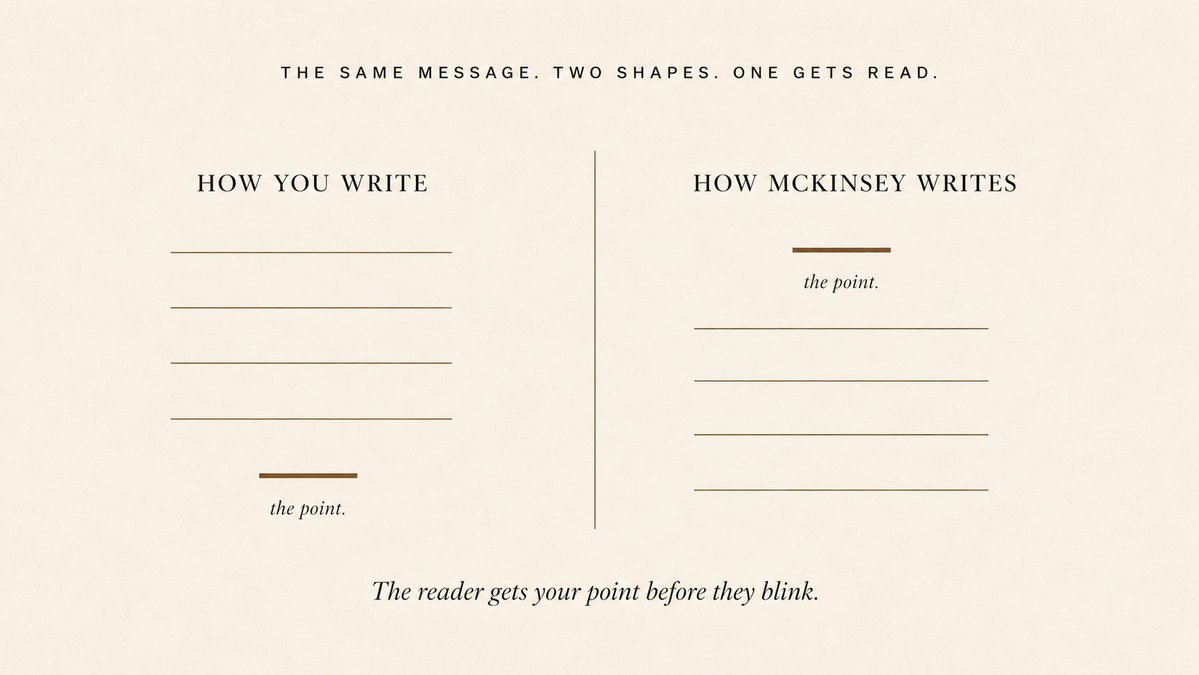
That is the shape of a story. Setup. Middle. Payoff. It works when someone is watching a movie. It kills you when someone is scanning their inbox at a red light.
Minto's method flips this. Same message. Rewritten the McKinsey way.
We should move our email sends from weekdays to weekends. Three reasons. Weekday open rates dropped 34 percent since March. Weekend rates rose 22 percent over the same period. The sales team confirmed weekend replies convert 2 times faster. Data attached.
53 words. The point is in the first 7. Every following word answers a question the reader now cares about because they know where the story is going.
This is not a stylistic choice. This is a completely different technology for moving ideas from one brain to another. And you have been using the wrong one your entire career.
# Phase 1: The Pyramid
Before you touch Claude, you need to see the shape.
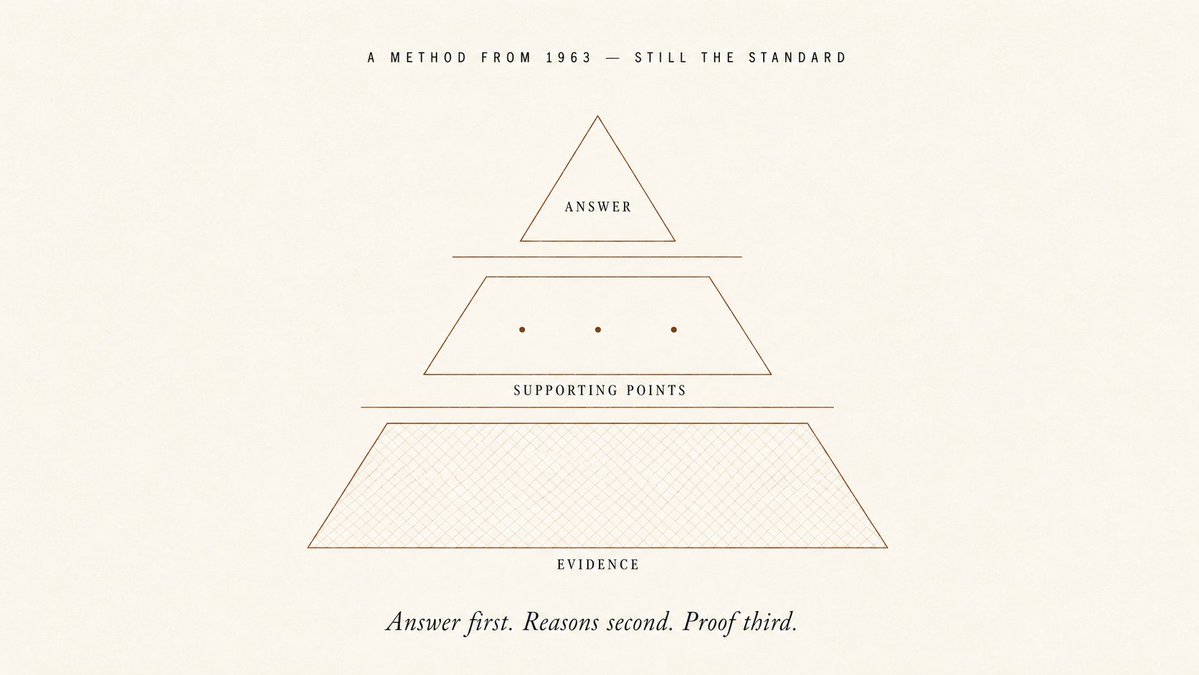
A pyramid has three levels. Just three. Not five. Not seven.
Top: Your one answer. The recommendation. The bottom line. Written as a single sentence someone could tattoo on their arm.
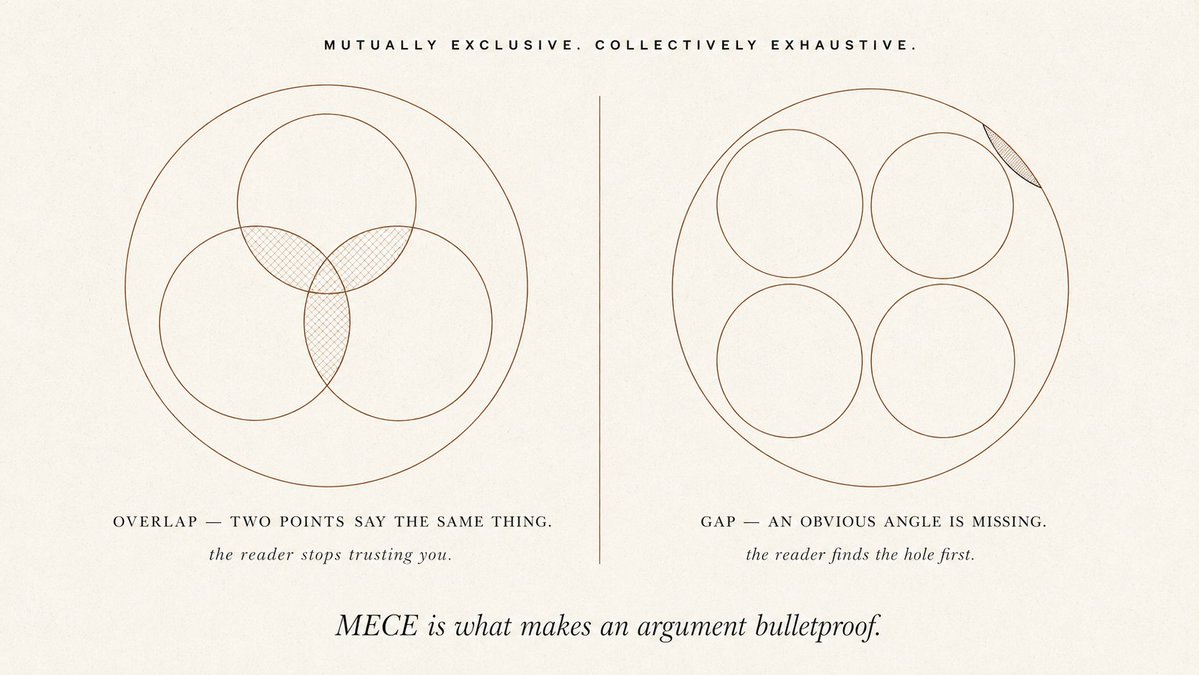
Middle: 2 to 4 supporting points. Each one is a reason the top is true. They must be MECE. That word matters. Barbara invented it. MECE stands for Mutually Exclusive, Collectively Exhaustive. Your supporting points cannot overlap with each other. And together, they must cover every angle. No gaps. No repeats. (BetterUp on MECE)
Bottom: The data. The proof. The numbers, quotes, screenshots, and evidence that back up each middle point.
That is the whole shape. Three levels. Two rules. No exceptions.
The magic is in what this shape does to a reader's brain. Minto argued that humans naturally impose hierarchy on any information they receive. If you do not give them a hierarchy, they will invent one badly. If you give them yours, they trust you before they finish the first sentence.
The pyramid is not a template. It is a promise. Every word you write is either the answer, a reason for the answer, or proof of a reason. Nothing else survives.
# Phase 2: The 4 Prompts
Here is the exact system. Copy the prompts. Save them. Use them today.
## Prompt 1: The Answer First Prompt
This is the one you will use most. Every email. Every message. Every doc. Every proposal.
```
You are trained in the Barbara Minto Pyramid Principle.
I need to communicate this idea. Rewrite it in pyramid form.
Rules:
1. Line 1 is the single sentence answer or recommendation.
2. Then list 2 to 4 supporting points. They must be MECE.
3. Under each point, list the proof or data.
4. Cut every word that is not the answer, a reason, or proof.
5. If I have not given you the answer clearly, ask me one question that surfaces it.
Here is my idea: [PASTE YOUR MESSY DRAFT]
```
What this does. You paste 400 words of tangled thinking. Claude gives you back a 90 word pyramid. The answer sits on line one. The reader gets the point before they blink. The supporting logic follows like stairs.
Use this on every email longer than 3 sentences. Use this on every doc before you send it. Use this on every Slack message where you need a real answer.
You will feel a small pain the first ten times you do this. The pain is the story instinct dying. Let it die. Nobody has ever complained that a message was too clear.
## Prompt 2: The SCQA Opener Prompt
The Pyramid tells you how to structure the middle and the bottom. The opening is a separate craft. Minto invented a framework for it called SCQA. Situation. Complication. Question. Answer. (Slideworks, Pyramid Principle guide)
Every McKinsey deck opens this way. Every good proposal opens this way. Every persuasive doc you have ever admired opens this way. You just did not have a name for it.
```
You are trained in Barbara Minto's SCQA framework.
Write me the opening for this document using SCQA.
Rules:
1. Situation. One sentence the reader already agrees with.
2. Complication. One sentence about what changed or what broke.
3. Question. The implied question the complication creates.
4. Answer. My recommendation in one sentence.
Total length: 4 sentences maximum.
Here is my topic: [PASTE YOUR TOPIC]
Here is my recommendation: [PASTE YOUR RECOMMENDATION]
```
What this does. The reader nods at line one because you are stating something they know. They lean in at line two because you named a problem they feel. They form the question in their head at line three before you ask it. And when you deliver the answer at line four, they receive it like a gift instead of a pitch.
This is how proposals get funded. This is how promotions get approved. This is how bad news gets accepted. Four sentences. In that order.
## Prompt 3: The MECE Audit Prompt
Once you have your pyramid, one thing kills it faster than anything else. Your supporting points overlap. Or they leave a hole.
If two of your points say the same thing in different words, a smart reader spots it in 4 seconds and stops trusting you. If your points miss an obvious angle, a smart reader spots the gap and asks the question you were hoping to avoid.
MECE fixes both. Mutually Exclusive. Collectively Exhaustive. Every McKinsey partner runs this check on every deck before it leaves the office.
```
You are trained in Barbara Minto's MECE principle.
Audit these supporting points for MECE.
Rules:
1. Are any two points saying the same thing? Flag overlaps.
2. Is there an obvious angle missing? Flag gaps.
3. Suggest a rewritten set of 2 to 4 supporting points that are fully MECE.
4. Explain each suggested change in one sentence.
Here are my current supporting points: [PASTE YOUR 3 TO 5 POINTS]
Here is the top-level recommendation they support: [PASTE YOUR RECOMMENDATION]
```
What this does. Claude becomes your McKinsey partner. It stress tests your logic before your reader does. You either walk out with a bulletproof pyramid or you find the hole in your thinking before it embarrasses you in the meeting.
Run this on every important doc. Every board memo. Every proposal above . Every strategy note. Five minutes here saves you a career mistake.
## Prompt 4: The Executive Test Prompt
The final McKinsey secret. Every good consultant has a partner who reads their draft and grades it brutally. Most people do not. This prompt gives you that partner.
Before you send anything important, run it through Claude one more time. Not to polish it. To find out if a busy executive would actually act on it.
```
You are a busy CEO with 200 unread emails.
You have 3 minutes before your next meeting.
Read this communication and answer honestly:
1. After reading only the first 2 sentences, do you know
what I want you to do? Yes or no.
2. After reading the full document, name the weakest,
most redundant, or missing argument.
3. Would you act on this, ask for more information,
or ignore it? Be brutal.
4. If you would ignore it, rewrite the first 2 sentences
so a busy CEO would not.
Here is my communication: [PASTE YOUR FINAL DRAFT]
```
What this does. You get the judgment of your harshest reader before the real one sees it. If Claude says a CEO would act, you send. If Claude says a CEO would ignore, you get a rewrite of the exact 2 sentences that failed.
This is the difference between shipping something and shipping something that works. Use it before every email above $1K in value. Every board memo. Every proposal. Every ask that matters.
# The 10 Minute Workflow
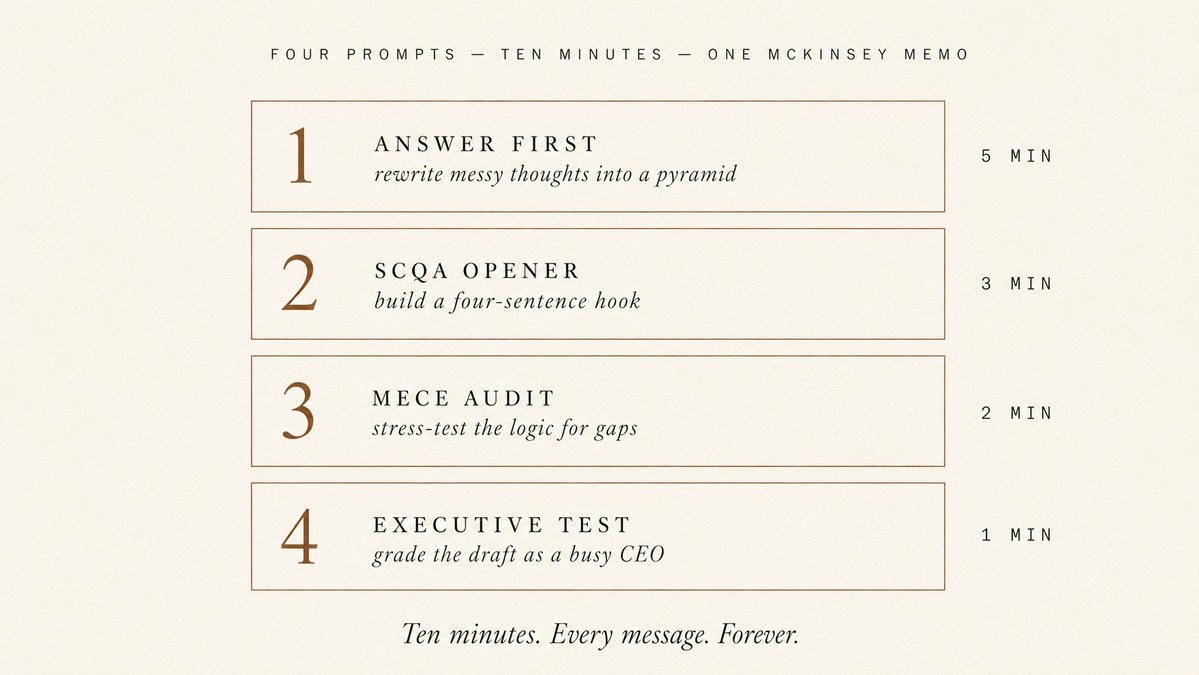
All 4 prompts in one loop. Ten minutes. Every important document.
Minutes 1 to 5. Prompt 1. The Answer First Prompt. Your messy thoughts become a clean pyramid.
Minutes 5 to 8. Prompt 2. The SCQA Opener Prompt. Your pyramid gets a narrative opening.
Minutes 8 to 10. Prompt 3. The MECE Audit Prompt. Your logic gets stress tested.
Final minute. Prompt 4. The Executive Test Prompt. A simulated CEO grades whether you would get the yes.
Total: 10 minutes to turn any communication into something that reads like it came from a $500 an hour consultant. Not because the words are fancier. Because the structure is clearer.
Think bottom up. Communicate top down. That is the whole system in seven words.
# Phase 3: The One Rule That Runs the Whole System
Every McKinsey consultant learns this rule in their first week. Once you learn it, you cannot unlearn it.
Lead with the answer.
Not the setup. Not the context. Not the background. Not the caveat. Not the polite throat clearing. The answer.
Your reader has a question. Whether they said it or not. Every message you send should answer that question in the first line. Then, and only then, do you get to explain why.
This is called BLUF in the military. Bottom Line Up Front. Same idea. Different acronym. (BetterUp explanation)
Every other habit in the McKinsey playbook flows from this one. One idea per slide. One recommendation per memo. One ask per email. Ruthless subtraction of anything that is not the answer, a reason, or proof.
The Pyramid Principle is not a writing tip. It is a rewiring of who you are as a communicator.
Once you internalize it, you cannot write the old way even if you try. Every time you start with background, a voice in your head will ask, where is the answer. Every time you bury the ask on line 6, that voice will move it to line 1. Every time you list 5 supporting points that repeat each other, that voice will demand MECE.
That voice is worth $500 an hour.
# Phase 4: A Real Example
Here is a real transformation. Names changed. Everything else is what a real professional sent, before and after.
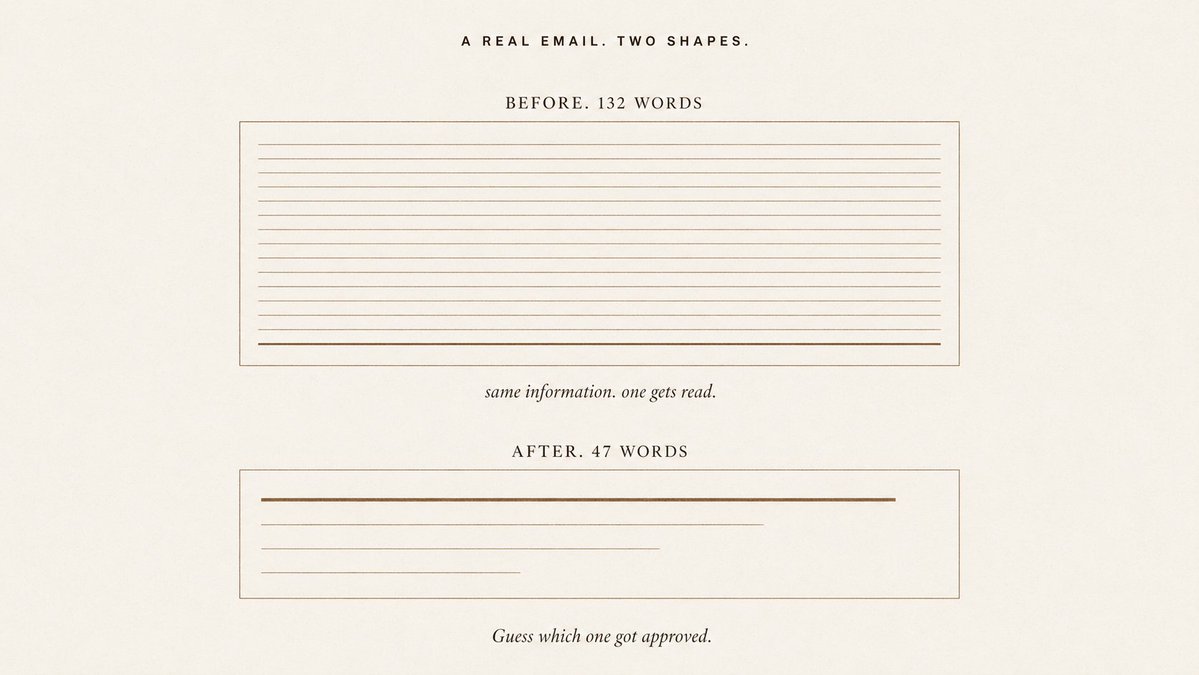
Before, the way most people write.
Hey Jamie, hope you had a great weekend. I wanted to circle back on the vendor conversation from last month. As we discussed, we have been evaluating three options for the new CRM. I have been going deep on each one over the past two weeks, and I wanted to share what I found. So, Vendor A is the cheapest but the integrations are limited. Vendor B has better features but the pricing is higher. Vendor C sits in the middle. I talked to references at each. I looked at the pricing carefully. I mapped out our must-haves. Based on all of that, I think we should probably go with Vendor B. But I wanted to run it by you first. Let me know what you think.
After, the McKinsey way.
Recommend Vendor B for our new CRM. Three reasons.
One. Vendor B is the only option with native Salesforce and Slack integrations, which our sales team uses daily.
Two. Total cost over 3 years is $4,200 higher than Vendor A but saves an estimated 12 hours per week across the team.
Three. All 4 reference customers at similar scale to us renewed after year 1.
Decision needed by Friday to lock the launch date. Full analysis attached.
Same information. Same recommendation. One reads like a memo. One reads like a whisper. Guess which one gets approved.
# The Persona Test
You know who does this well already? Not the productivity influencers. Not the LinkedIn writers with their 900 word carousels. Not the founders who send Slack messages that look like blog posts.
The people who use the Pyramid Principle well share one habit. They put their conclusion first. Every single time.
You have met one of these people. Their emails end in 3 lines. Their DMs contain a question and nothing else. Their memos start with the recommendation in bold. You feel calm when you read what they write, even when the content is complicated.
That is not a personality trait. That is a habit trained by a book from 1985.
If you are not doing this right now, you are doing the other thing. And the other thing is what makes people quietly stop reading you.
# 7 Things to Rewrite With This Method Today
Before you close this article, here are 7 things sitting in your life right now that will change if you rewrite them with the 4 prompts.
1. Your most important pending email. The one in your drafts folder. The one you keep opening and closing. Run all 4 prompts on it tonight. Send it. Watch the reply come back different.
2. Your LinkedIn summary. Most LinkedIn profiles open with 5 years of background before you learn what the person does. Flip it. Value first. Background second. Your profile views will jump within a week.
3. Your next presentation. Every slide should lead with the insight, not the setup. If the CEO reads only the slide titles, they should already know your entire argument.
4. Your weekly status report. Recommendation first. Progress second. Risks third. Your manager reads the first line and knows exactly what to focus on. No more skipping to page 3.
5. Your product or service description. What does the customer get. Say that first. How does it work. Say that second. Watch your conversion rate change.
6. Your next Slack message to your team. Even a 3 sentence Slack message has a pyramid. Lead with what you need. Add why below. Add context only if asked.
7. Your resume. Most resumes are bottom up. Education first. Experience next. Skills last. Flip it. What value do you deliver, proven with a number. Then the rest. Recruiters spend 7 seconds on a resume. Make the first sentence count.
Pick one. Do it in the next 20 minutes. That is how habits get built.
# Why This Framework Has Survived 60 Years
The reason this method still works in 2026 is not magic. It is 3 things psychologists have measured for decades.
Cognitive load. The brain processes top down information faster than bottom up information. When you lead with the answer, the reader builds a mental frame that organizes everything after. When you bury the answer, the brain holds unorganized information in memory until the point arrives. That is strain. Strain makes people stop reading.
The primacy effect. People remember the first thing they read more than anything else. If the first thing is your conclusion, they remember your conclusion. If the first thing is your greeting, they remember your greeting. The Pyramid Principle weaponizes this by making sentence 1 the most important sentence.
Decision fatigue. Executives make hundreds of choices a day. Every email that needs decoding uses decision energy. A pyramided message needs zero decoding. The answer is there. The decision is made. The next email opens. That is why pyramid messages get faster replies and higher action rates.
Barbara Minto did not invent these effects. She just built the first communication system that respects them.
# The 60 Second Test
Here is the fastest way to know if you are already in trouble.
Go to your Sent folder. Open the last 5 emails you wrote that were longer than 3 sentences. Read only the first sentence of each.
If those first sentences tell someone what you want, what you decided, or what needs to happen next, you are already halfway there.
If those first sentences say things like, "Hope your week is going well" or "I wanted to circle back" or "Just following up on our last conversation", you have been writing backwards. All of them. For years.
The good news is you can fix every future email starting with the next one. The 4 prompts are above. The rule is one line. Lead with the answer.
The people who will run the room in the next 10 years are not the smartest people in it. They are the ones whose messages nobody skips.
## The Sources Behind Every Claim
Every fact and quote in this article traces back to a primary source. Here they are, in one place, so you can check them yourself.
- Wikipedia biography of Barbara Minto. Class of 600, 8 women, first female MBA hired by McKinsey in 1963.
- Supernormal, Inside McKinsey's presentation playbook. John Tomb, Cleveland office, firmwide adoption. SCQA structure at slide level.
- BetterUp on the Minto Pyramid Principle. MECE definition. BLUF equivalence. Three level structure.
- Slideworks Pyramid Principle guide. Lead with the answer. Every new McKinsey hire drilled on this.
- Management Consulted, Amazon Memo. Bezos banned PowerPoint. Six pager follows Pyramid logic.
- BusinessInsider on Amazon 6 page memos. Structure and adoption.
- Morgan Depenbusch on the Pyramid Principle at Google. Google analysts taught this method.
- Minto, Barbara. The Pyramid Principle: Logic in Writing and Thinking. 1985. The original book. Still in print. Available anywhere books are sold.
If any of this changes your mind, do not let it sit there. Pick one email in your drafts folder right now. Rewrite it with Prompt 1. Send it. Watch what happens.
## The Uncomfortable Truth
The next 18 months will split people into two groups.
One group will keep writing the way they were taught in school. Story arc. Setup first. Payoff last. Context before conclusion. They will keep sending emails that get ignored, docs that get skimmed, and messages that get "can you clarify" replies. They will blame the reader. They will blame the algorithm. They will blame the culture. They will not blame the shape of their sentences. So the shape will never change.
The other group will change one thing. They will lead with the answer. In every message. In every doc. In every meeting. In 18 months they will be the person the CEO forwards. The person the board reads first. The person the team quotes back. Not because they got smarter. Because they got clearer.
The gap between these two groups is not talent. It is not experience. It is not IQ. It is a 40 year old book by a woman named Barbara Minto and 4 prompts you already have.
You know which group you want to be in. Every message you send from now on votes for one or the other.
Pick one draft in your inbox right now. Rewrite it. Send it. Start.
hope this was useful. Nav ❤️
## 相关链接
- [Nav Toor](https://x.com/heynavtoor)
- [@heynavtoor](https://x.com/heynavtoor)
- [53K](https://x.com/heynavtoor/status/2080238307813040398/analytics)
- [Upgrade to Premium](https://x.com/i/premium_sign_up)
- [6:27 PM · Jul 23, 2026](https://x.com/heynavtoor/status/2080238307813040398)
- [53.9K Views](https://x.com/heynavtoor/status/2080238307813040398/analytics)
- [View quotes](https://x.com/heynavtoor/status/2080238307813040398/quotes)
---
*导出时间: 2026/7/24 15:18:50*
---
## 中文翻译
# 麦肯锡金字塔原理:让每封邮件都无法被忽视的 4 个提示词
**作者**: Nav Toor
**日期**: 2026-07-23T10:27:16.000Z
**来源**: [https://x.com/heynavtoor/status/2080238307813040398](https://x.com/heynavtoor/status/2080238307813040398)
---

没有人告诉你关于为什么没人看你写的东西的真相。
把这个存下来 :)
你花了 40 分钟写那封邮件。
你添加了背景。你解释了来龙去脉。你一步步引导对方了解你的逻辑。你像讲故事一样铺垫到了你的请求。你点击了发送。你等待着。
他们在 6 秒内回复了。只有两个字。“能澄清一下吗?”
你盯着屏幕,做了每个人都会做的事。你怪罪读者。太忙了。太分心了。没专心看。也许是在手机上草草浏览。
问题不在读者。
你把顺序写反了。
你发出的每一封邮件、每一条 Slack 消息、每一份文档、每一份报告。你都是用讲故事的方式写的。先铺垫。最后给结果。你让读者自己去挖掘要点。而那个还有 47 条未读消息等着处理的读者,在你写到那里之前就已经放弃了。
有一个补救方法。它自 1985 年就存在了。它不需要任何成本。这就是为什么麦肯锡顾问写一份文档每小时能赚 500 美元,而创业者却爱不释手。
它被称为金字塔原理。一旦你把它转化为 4 个 Claude 提示词,你这辈子发送的每一条信息都将变得让人无法忽视。

# 破解这一点的女人
1963 年,一个名叫芭芭拉·明托的女人走进哈佛商学院,她是 600 人的班级中仅有的 8 名女性之一。毕业时,麦肯锡聘用了她,她是公司历史上第一位女性 MBA。他们把她安排在克利夫兰办事处。她的工作是编辑报告。(芭芭拉·明托的维基百科传记)
她注意到了其他人都忽略的一点。
每一位麦肯锡顾问,无论多么才华横溢,写报告的方式都一样。他们从背景开始。他们过一遍分析过程。他们在最后一页才给出建议。而那些每周要看 20 份这种报告的合伙人,一直在抱怨同一件事。他们找不到答案。
明托开始把她编辑的每一份报告都重新组织成一个金字塔。建议在顶部。支撑论点在中间。数据在底部。克利夫兰办事处的经理约翰·托姆看着她的方法屡试不爽,于是让她培训公司的每一位副理。(Supernormal,麦肯锡内部操作手册)
到 1973 年,金字塔原理已成为全球麦肯锡办事处必修的培训课程。她离开公司全职教授这一方法。她在 1985 年写了这本书。这本书从未绝版过。(BetterUp 的解释)
63 年后的今天,每一位新入职的麦肯锡顾问仍然要在前几周学习她的方法。亚马逊围绕它的一个版本重建了会议文化。杰夫·贝佐斯在亚马逊禁用了 PowerPoint,要求撰写遵循她结构的 6 页备忘录。(Management Consulted 关于亚马逊备忘录的文章)谷歌的分析师教授它。BCG 和贝恩教授它。你听说过的每一家咨询公司都在教授它。
而在这些公司之外,几乎没人听说过它。
这就是市场空白。这就是为什么你写的邮件仍然被忽视,而一个大学毕业仅两年的麦肯锡副理写的一份幻灯片,CEO 只看 90 秒就会点头同意。
差距不在于天赋。差距在于她 40 年前写下的那个方法。
# 你现在正在做的事
这是大多数人在需要表达观点时写的东西。
嗨团队。所以我一直在思考我们的 Q3 数据。如你所知,自三月以来我们一直保持相同的邮件发送节奏。我查看了打开率。我查看了点击率。我和销售团队谈过了。我用三种不同的方式计算了数据。我注意到了一个模式。工作日的发送表现不佳。周末的发送表现优于平时。我认为我们应该调整我们的时间表。
再读一遍。现在数一数读者在看到要点之前需要处理多少个词。
87 个词。要点在最后 6 个词里。
这就是故事的形状。铺垫。中间。结果。这在看电影时很有效。但这会在读者在红灯前浏览收件箱时扼杀你的机会。
明托的方法颠覆了这一点。同样的信息。用麦肯锡的方式重写。
我们应该将邮件发送从工作日改为周末。三个原因。自三月以来工作日打开率下降了 34%。同期周末比率上升了 22%。销售团队确认周末回复的转化速度快两倍。数据已附上。
53 个词。要点在前 7 个词里。接下来的每一个词都在回答读者现在关心的问题,因为他们知道故事的发展方向。
这不是一种风格选择。这是一种将思想从一个人大脑转移到另一个人大脑的完全不同的技术。而你在整个职业生涯中一直在用错误的那一种。

# 第一阶段:金字塔
在你使用 Claude 之前,你需要看到这个形状。
金字塔有三个层级。就三个。不是五个。不是七个。
顶部:你的唯一答案。建议。底线。写成一句话,这句话要让人能把它纹在手臂上。
中部:2 到 4 个支撑点。每一个都是顶部为真的理由。它们必须是 MECE 的。这个词很重要。芭芭拉发明的这个词。MECE 代表“相互独立,完全穷尽”。你的支撑点不能相互重叠。而且合在一起,它们必须覆盖所有角度。没有遗漏。没有重复。(BetterUp 关于 MECE 的解释)
底部:数据。证据。数字、引言、截图和支持每一个中部观点的证据。
这就是整个形状。三个层级。两条规则。没有例外。
魔力在于这个形状对读者大脑的作用。明托认为,人类自然会对自己接收的任何信息施加层级。如果你不给他们一个层级,他们会自己编造一个糟糕的。如果你给他们你的,他们在读完第一句话之前就会信任你。
金字塔不是模板。它是承诺。你写的每一个字要么是答案,要么是答案的理由,要么是理由的证据。其他任何东西都活不下来。
# 第二阶段:4 个提示词
这是一个精确的系统。复制提示词。保存它们。今天就使用它们。
## 提示词 1:答案优先提示词
这是你最常使用的一个。每一封邮件。每一条信息。每一份文档。每一份提案。
```
你接受过芭芭拉·明托金字塔原理的训练。
我需要传达这个想法。把它改写成金字塔形式。
规则:
1. 第一行是单句的答案或建议。
2. 然后列出 2 到 4 个支撑点。它们必须是 MECE 的。
3. 在每个点下,列出证据或数据。
4. 删去每一个不是答案、理由或证据的词。
5. 如果我没有清楚地给你答案,问我一个问题以揭示它。
这是我的想法:[粘贴你混乱的草稿]
```
它的作用。你粘贴 400 字纠缠不清的想法。Claude 还给你一个 90 字的金字塔。答案坐在第一行。读者眨眼间就得到了要点。支撑逻辑像台阶一样紧随其后。
在每一封超过 3 句话的邮件上使用它。在每一份文档发送前使用它。在每一条你需要真实答案的 Slack 消息上使用它。
你会感到一点小痛苦,在前十次你这样做的时候。这种痛苦是故事本能的消亡。让它死吧。从来没有人抱怨过一条信息太清晰了。
## 提示词 2:SCQA 开头提示词
金字塔告诉你如何构建中部和底部。开头是一门单独的手艺。明托为此发明了一个叫做 SCQA 的框架。情境。冲突。问题。答案。(Slideworks,金字塔原理指南)
每一份麦肯锡幻灯片都以这种方式开头。每一份好的提案都以这种方式开头。你曾经欣赏过的每一份有说服力的文档都以这种方式开头。你只是不知道它的名字。
```
你接受过芭芭拉·明托 SCQA 框架的训练。
使用 SCQA 为我写这份文档的开头。
规则:
1. 情境。一句读者已经同意的话。
2. 冲突。一句关于什么改变了或什么出了问题的句子。
3. 问题。冲突引发的隐含问题。
4. 答案。我在一句话里的建议。
总长度:最多 4 句话。
这是我的主题:[粘贴你的主题]
这是我的建议:[粘贴你的建议]
```
它的作用。读者在第一行点头,因为你在陈述他们知道的事情。他们在第二行身体前倾,因为你指出了他们感觉到的问题。他们在你在第三行提问之前就在脑海中形成了这个问题。当你在第四行给出答案时,他们把它当作礼物而不是推销来接收。
这就是提案获得资助的方式。这就是升职获得批准的方式。这就是坏消息被接受的方式。四句话。按这个顺序。

## 提示词 3:MECE 审计提示词
一旦你有了金字塔,有一件事比任何其他东西都更快地毁掉它。你的支撑点重叠了。或者它们留下了一个漏洞。
如果你的两点用不同的词说同一件事,聪明的读者会在 4 秒内发现并不再信任你。如果你的点漏掉了一个明显的角度,聪明的读者会发现缺口并问出你希望避开的问题。
MECE 修复了这两点。相互独立。完全穷尽。每一位麦肯锡合伙人在每一份幻灯片离开办公室前都会进行这项检查。
```
你接受过芭芭拉·明托 MECE 原则的训练。
审计这些支撑点的 MECE 性。
规则:
1. 是否有任何两点在说同一件事?标记重叠。
2. 是否缺少明显的角度?标记缺口。
3. 建议一套重写的 2 到 4 个完全 MECE 的支撑点。
4. 用一句话解释每一个建议的变更。
这是我当前的支撑点:[粘贴你的 3 到 5 个点]
它们支持的高级建议是:[粘贴你的建议]
```
它的作用。Claude 成为了你的麦肯锡合伙人。它在你的读者之前对你的逻辑进行压力测试。你要么带着一个无懈可击的金字塔走出,要么在会议让你难堪之前发现你思维中的漏洞。
在每一份重要文档上运行它。每一份董事会备忘录。每一份超过的提案。每一份战略笔记。在这里花五分钟能挽救你的职业生涯错误。
## 提示词 4:高管测试提示词
麦肯锡的最后一个秘密。每一位优秀的顾问都有一位合伙人阅读他们的草稿并无情地给它打分。大多数人没有。这个提示词给你那位合伙人。
在你发送任何重要东西之前,再通过 Claude 运行一次。不是为了润色它。是为了弄清一位忙碌的高管是否会真的采取行动。
```
你是一位有 200 封未读邮件的忙碌 CEO。
你离下次会议还有 3 分钟。
阅读这份沟通并诚实回答:
1. 在只读了前 2 句话后,你知道
我想要你做什么吗?是或否。
2. 在阅读了整份文档后,指出最薄弱、
最多余或缺失的论点。
3. 你会对此采取行动,要求更多信息,
还是忽略它?要残酷。
4. 如果你会忽略它,重写前 2 句话,
以便忙碌的 CEO 不会忽略它。
这是我的沟通内容:[粘贴你的最终草稿]
```
它的作用。你在真正的读者看到之前,就得到了最严厉的读者的评判。如果 Claude 说 CEO 会采取行动,你就发送。如果 Claude 说 CEO 会忽略,你会得到对失败的那确切 2 句话的重写。
这就是发送某样东西和发送起作用的东西之间的区别。在每一封价值超过 1000 美元的邮件前使用它。每一份董事会备忘录。每一份提案。每一个重要的请求。

# 10 分钟工作流程
所有 4 个提示词在一个循环中。十分钟。每一份重要文档。
第 1 到 5 分钟。提示词 1。答案优先提示词。你混乱的想法变成了一个清晰的金字塔。
第 5 到 8 分钟。提示词 2。SCQA 开头提示词。你的金字塔得到了一个叙事性的开头。
第 8 到 10 分钟。提示词 3。MECE 审计提示词。你的逻辑接受了压力测试。
最后一分钟。提示词 4。高管测试提示词。一位模拟的 CEO 评判你是否能得到那个“是”。
总共:10 分钟,将任何沟通转化为读起来像是来自每小时 500 美元的顾问写的东西。不是因为词藻更华丽。而是因为结构更清晰。
自下而上思考。自上而下沟通。这就是用七个字概括的整个系统。
# 第三阶段:运行整个系统的一条规则
每一位麦肯锡顾问在第一周都会学到这条规则。一旦你学会了它,你就无法忽视它。
以答案开头。
不是铺垫。不是背景。不是来龙去脉。不是警告。不是礼貌的清嗓子。是答案。
你的读者有一个问题。不管他们是否说了出来。你发送的每一条信息都应该在第一行回答那个问题。然后,且只有在那时,你才能解释为什么。
这在军队中被称为 BLUF。结论先行。同样的想法。不同的缩写。(BetterUp 的解释)
麦肯锡手册中的所有其他习惯都源于这一点。每张幻灯片一个观点。每份备忘录一个建议。每封邮件一个请求。无情删减任何不是答案、理由或证据的东西。
金字塔原理不是一个写作技巧。它是对你作为沟通者身份的重写。
一旦你内化了它,即使你想尝试,你也无法用旧的方式写作。每当你以背景开始,脑海里的一个声音会问,答案在哪里。每当你把请求埋在第 6 行,那个声音会把它移到第 1 行。每当你列出 5 个相互重复的支撑点,那个声音会要求 MECE。
那个声音值一小时 500 美元。
# 第四阶段:一个真实的例子
这是一个真实的转变。名字已更改。其他一切都是一位真正的专业人士发送的,前后对比。
之前,大多数人的写法。
嘿 Jamie,希望你周末过得愉快。我想回过头聊聊上个月关于供应商的谈话。正如我们讨论的,我们一直在评估新 CRM 的三个选项。在过去两周里,我深入研究了每一个,我想分享我的发现。所以,供应商 A 最便宜但集成有限。供应商 B 功能更好但价格更高。供应商 C 处于中间。我和每一个的参考客户谈过了。我仔细看了定价。我列出了我们的必备项。基于所有这些,我认为我们可能应该选供应商 B。但我想先和你确认一下。告诉我你的想法。
之后,麦肯锡的方式。
为我们的新 CRM 推荐供应商 B。三个原因。
一。供应商 B 是唯一拥有原生 Salesforce 和 Slack 集成的选项,我们的销售团队每天都用。
二。3 年的总成本比供应商 A 高 4200 美元,但全团队每周节省约 12 小时。
三。4 家与我们规模相似的参考客户都在第一年后续约了。
需在周五前做出决定以锁定发布日期。详细分析已附上。
相同的信息。相同的建议。一个读起来像备忘录。一个读起来像耳语。猜猜哪一个会被批准。

# 人格测试
你知道谁已经做得很好了吗?不是那些效率网红。不是那些写 900 字轮播图的 LinkedIn 作者。不是那些发送看起来像博客文章的 Slack 消息的创始人。
那些擅长使用金字塔原理的人有一个共同的习惯。他们把结论放在第一位。每一次。
你见过这样的人。他们的邮件 3 行就结束。他们的私信只包含一个问题,没有别的。他们的备忘录以加粗的建议开头。当你读他们写的东西时,你会感到平静,即使内容很复杂。
这不是一种性格特征。这是一种由 1985 年的一本书训练出来的习惯。
如果你现在没有这样做,你就在做另一件事。而另一件事就是让人们悄悄不再读你东西的原因。
# 今天用这个方法重写的 7 件事
在你关闭这篇文章之前,这里有 7 件现在就在你生活中的事情,如果你用 4 个提示词重写它们,就会发生改变。
1. 你最重要的待发邮件。在你草稿箱里的那一封。你一直打开又关闭的那一封。今晚对它运行所有 4 个提示词。发送它。看着回复变得不同。
2. 你的 LinkedIn 简介。大多数 LinkedIn 简历在你了解这个人做什么之前,先以 5 年的背景开头。翻转它。价值优先。背景第二。你的资料浏览量会在一周内激增。
3. 你的下一个演示文稿。每一张幻灯片都应该以见解开头,而不是铺垫。如果 CEO 只读幻灯片标题,他们应该已经知道你的整个论点。
4. 你的周报。建议优先。进度第二。风险第三。你的经理读第一行就知道该关注什么。不再跳到第 3 页。
5. 你的产品或服务描述。客户得到什么。先说那个。它是如何工作的。再说那个。看着你的转化率改变。
6. 你下一条发给团队的 Slack 消息。即使是一句 3 句话的 Slack 消息也有一个金字塔。以你需要什么开头。在下面加原因。只有被要求时才加背景。
7. 你的简历。大多数简历是自下而上的。教育第一。经历其次。技能最后。翻转它。你交付什么价值,用一个数字证明。然后是其他的。招聘人员在一份简历上花 7 秒。让第一句算数。
选一个。在接下来的 20 分钟内做它。习惯就是这样养成的。
# 为什么这个框架存活了 60 年
这个方法在 2026 年仍然有效的原因不是魔法。它是心理学家测量了几十年的三件事。
认知负荷。大脑处理自上而下的信息比自下而上的信息更快。当你以答案开头,读者建立一个心理框架来组织之后的所有东西。当你埋没答案,大脑会在记忆中保存未组织的信息直到要点出现。那是负担。负担让人停止阅读。
首因效应。人们记住他们读的第一件事胜过其他任何事。如果第一件事是你的结论,他们记住你的结论。如果第一件事是你的问候,他们记住你的问候。金字塔原理通过让第一句话成为最重要的话来利用这一点。
决策疲劳。高管每天做几百个选择。每一封需要解码的邮件都消耗决策能量。金字塔化的信息需要零解码。答案就在那里。决策已做出。下一封邮件打开。这就是为什么金字塔信息得到更快的回复和更高的行动率。
芭芭拉·明托没有发明这些效应。她只是构建了第一个尊重这些效应的沟通系统。
# 60 秒测试
这是知道你是否已经陷入麻烦的最快方法。
去你的已发送文件夹。打开你写的最后 5 封超过 3 句话的邮件。只读每一封的第一句话。
如果那些第一句话告诉某人你想要什么,你决定了什么,或者接下来需要发生什么,你已经成功了一半。
如果那些第一句话说的是“希望你的一周过得顺利”或“我想回过头聊聊”或“只是跟进我们上一次的谈话”,你一直在倒着写。它们全部。多年来。
好消息是,你可以从下一封开始修正未来的每一封邮件。4 个提示词在上面。规则是一行。以答案开头。
在未来 10 年里掌控局面的人不是房间里最聪明的。他们是那些没人跳过其信息的人。
## 每个主张背后的来源
这篇文章中的每一个事实和引言都追溯到原始来源。它们都在这里,方便你自己查证。
- 芭芭拉·明托的维基百科传记。600 人的班级,8 名女性,1963 年麦肯锡雇佣的第一位女性 MBA。
- Supernormal,麦肯锡内部演示操作手册。约翰·托姆,克利夫兰办事处,全公司采用。幻灯片级别的 SCQA 结构。
- BetterUp 关于明托金字塔原理。MECE 定义。BLUF 等价性。三级结构。
- Slideworks 金字塔原理指南。以答案开头。每一位新麦肯锡雇员都要接受这方面的训练。
- Management Consulted,亚马逊备忘录。贝佐斯禁用 PowerPoint。六页纸遵循金字塔逻辑。
- BusinessInsider 关于亚马逊 6 页备忘录。结构和采用情况。
- Morgan Depenbusch 关于谷歌的金字塔原理。谷歌分析师教授这种方法。
- Minto, Barbara. The Pyramid Principle: Logic in Writing and Thinking. 1985. 原著。仍在印刷。在任何卖书的地方都能买到。
如果这其中任何一点改变了你的想法,不要让它停留在那里。现在就在你的草稿箱里选一封邮件。用提示词 1 重写它。发送它。看着会发生什么。

## 令人不适的真相
接下来的 18 个月将把人分成两组。
一组将继续沿用学校教的方式写作。故事弧。铺垫优先。结果最后。结论在背景之后。他们将继续发送被忽视的邮件、被略读的文档,以及收到“能澄清一下吗”回复的信息。他们会怪罪读者。他们会怪罪算法。他们会怪罪文化。他们不会怪罪他们句子的形状。所以形状永远不会改变。
另一组将改变一件事。他们将以答案开头。在每一条信息中。在每一份文档中。在每一次会议中。18 个月后,他们将成为 CEO 转发的人。董事会优先阅读的人。团队引用的人。不是因为他们变聪明了。是因为他们变清晰了。
这两组之间的差距不是天赋。不是经验。不是智商。这是一本由一个名叫芭芭拉·明托的女人写的 40 年前的书,以及你已经拥有的 4 个提示词。
你知道你想成为哪一组。从现在起你发送的每一条信息都在为其中一组投票。
现在就在你的收件箱里选一份草稿。重写它。发送它。开始。
希望这有用。Nav ❤️
## 相关链接
- [Nav Toor](https://x.com/heynavtoor)
- [@heynavtoor](https://x.com/heynavtoor)
- [53K](https://x.com/heynavtoor/status/2080238307813040398/analytics)
- [Upgrade to Premium](https://x.com/i/premium_sign_up)
- [6:27 PM · Jul 23, 2026](https://x.com/heynavtoor/status/2080238307813040398)
- [53.9K Views](https://x.com/heynavtoor/status/2080238307813040398/analytics)
- [View quotes](https://x.com/heynavtoor/status/2080238307813040398/quotes)
---
*导出时间: 2026/7/24 15:18:50*