# The CIA Red Team Method: 4 Prompts That Kill Your Bad Ideas Before They Kill You
**作者**: Nav Toor
**日期**: 2026-06-30T10:34:54.000Z
**来源**: [https://x.com/heynavtoor/status/2071905311162843433](https://x.com/heynavtoor/status/2071905311162843433)
---
Every other AI article teaches you to use Claude to help your idea. This one teaches you to use Claude to kill your idea on purpose.
Save this :)
You have an idea right now.
Maybe it is a startup. Maybe it is a tweet. Maybe it is a launch, a pitch, a course, a resignation email, a product, a new feature, a 6-month bet on something big.
You think it is good. You hope it is good. You have not really tested it.
So you do what most people do. You ask a friend. They say nice things. You ask Claude. Claude says nice things too because Claude is trained to be helpful and polite. You ship the idea. You wait.
Then reality shows up. And reality is not polite.
The customer does not buy. The tweet flops. The launch dies. The pitch gets ignored. The 6 months are gone and you do not know exactly why.
This is the story of almost every failed idea in history. Not because the idea was hopeless. Because nobody tried hard enough to kill it before reality did.
After 9/11, the CIA realized they had the same problem at the highest possible cost. They had not stress-tested their own assumptions hard enough. So they built a team whose only job was to attack their own thinking. They called it the Red Cell.
The CIA still publishes the exact methods they use. The document is called the Tradecraft Primer. It is free. It is on cia.gov. Almost nobody reads it.
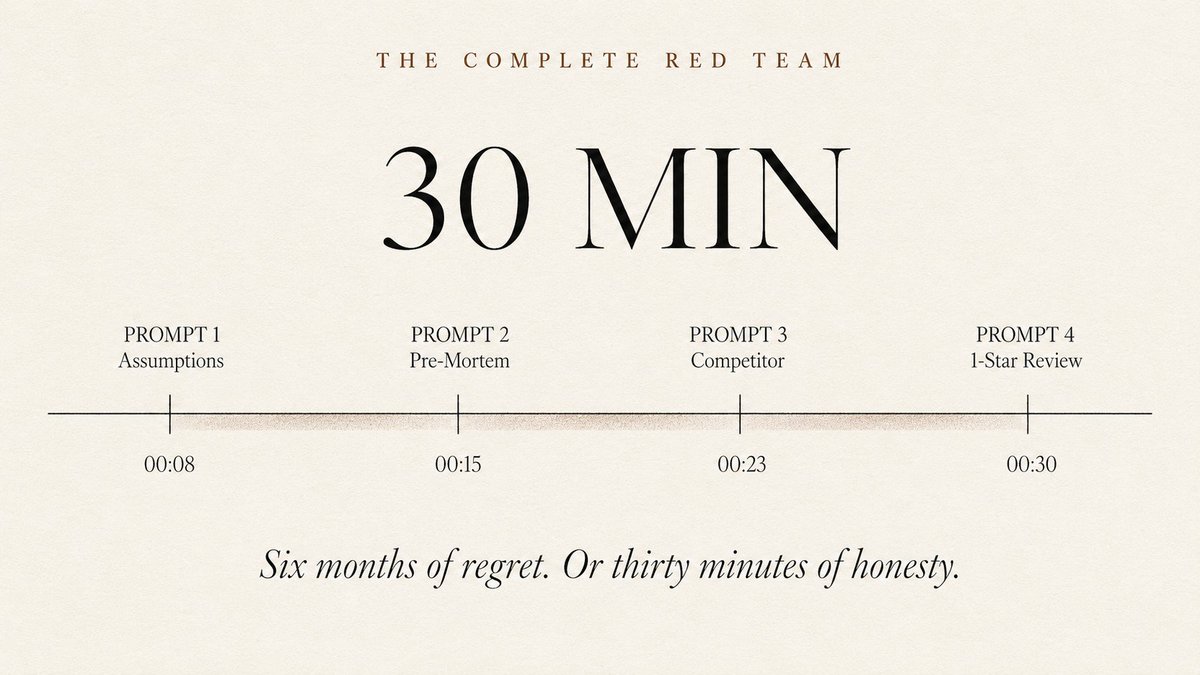
Today you are going to run the 4 most powerful techniques from that document on your idea, using Claude, in 30 minutes.
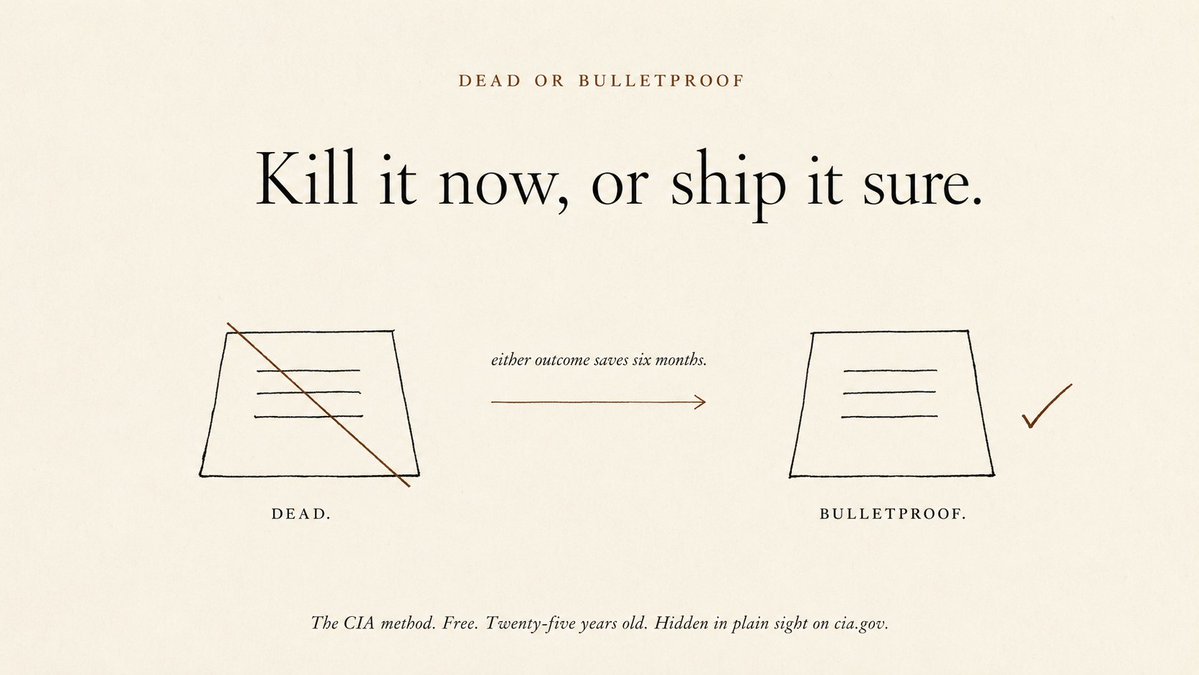
By the time you finish reading this, your next idea will either be dead or bulletproof. Either outcome saves you 6 months of your life.
# Phase 1: The Midnight Tenet Started
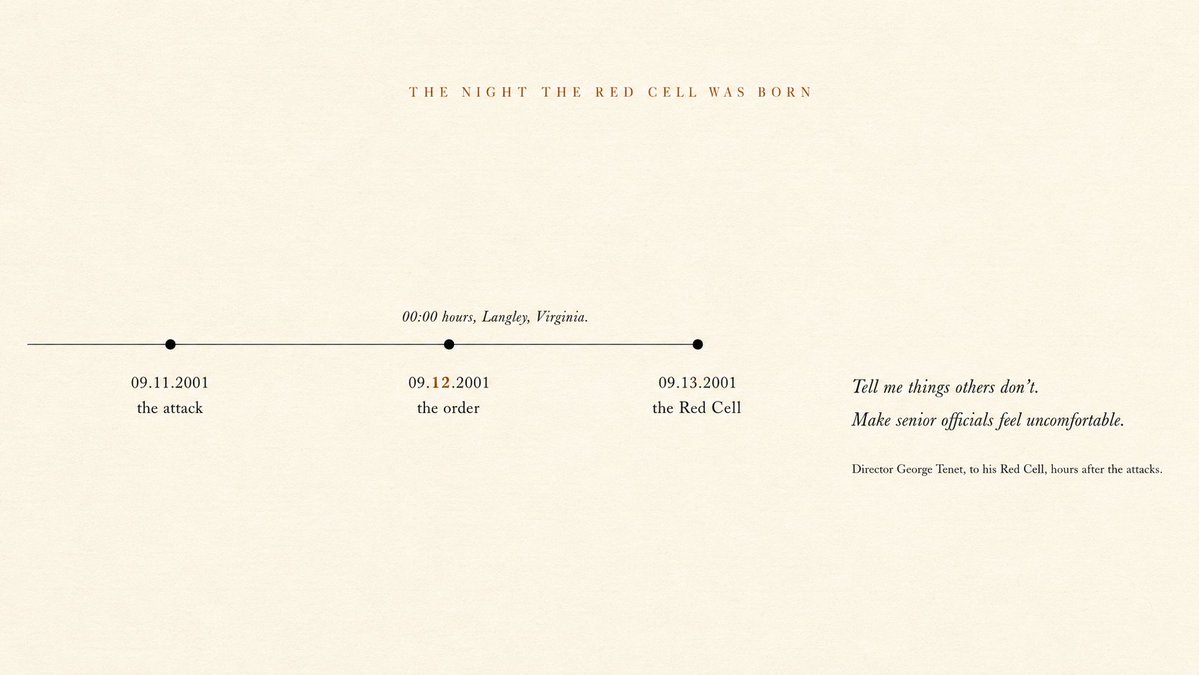
It was just past midnight on September 12, 2001.
George Tenet, the Director of the CIA, was in his office on the seventh floor of the agency headquarters in Langley, Virginia. The previous day, two planes had hit the World Trade Center. One had hit the Pentagon. One had crashed in a field in Pennsylvania.
The CIA had missed it. The biggest intelligence failure in modern American history had happened on his watch.
Tenet called in two people. His chief of staff John Moseman and the deputy director of intelligence Jami Miscik. He gave them one instruction.
> "Tell me things others don't and make senior officials feel uncomfortable."
That sentence is one of the most important sentences in modern decision-making, and it is real. Foreign Policy magazine confirmed it in 2015 when they got inside the CIA Red Cell for the first time.
The next morning, Miscik and two senior analysts created the Red Cell. Their only job was to attack the CIA's own thinking. To play devil. To find what everyone else had missed. To make the smart people in the room feel deeply uncomfortable about the things they were certain about.
It worked. The CIA has publicly credited the Red Cell with helping prevent several major terrorist attacks in the two decades since.
A few years later, the U.S. Army did the same thing. In 2004 they opened a school at Fort Leavenworth, Kansas, formally called the University of Foreign Military and Cultural Studies. Soldiers nicknamed it Red Team University.
Then it spread. The Pentagon codified it in Joint Doctrine Note 1-16. The Department of Defense issued a formal directive. Every major intelligence agency in the world copied it. Even the 2011 raid on Osama bin Laden was stress-tested by three separate Red Teams before the green light.
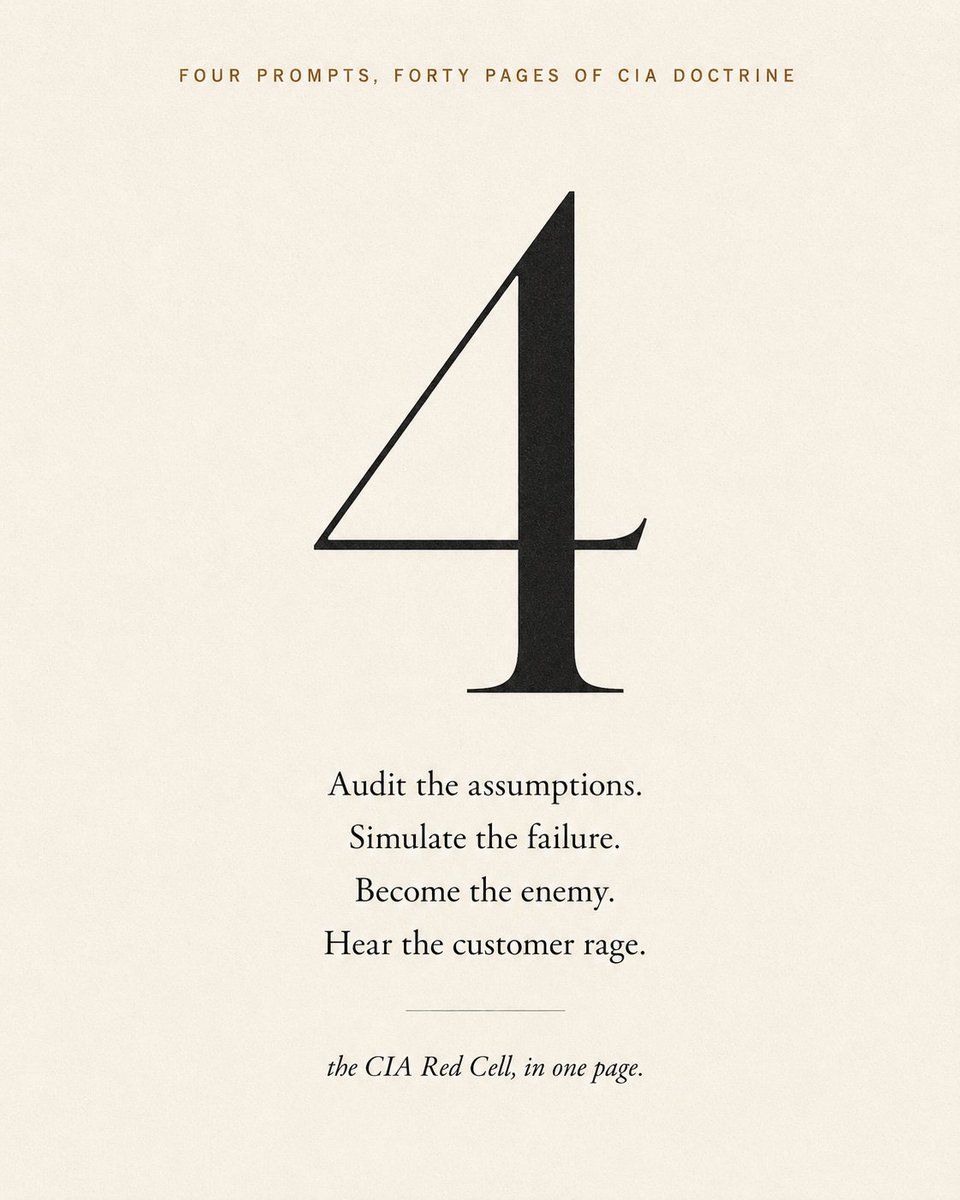
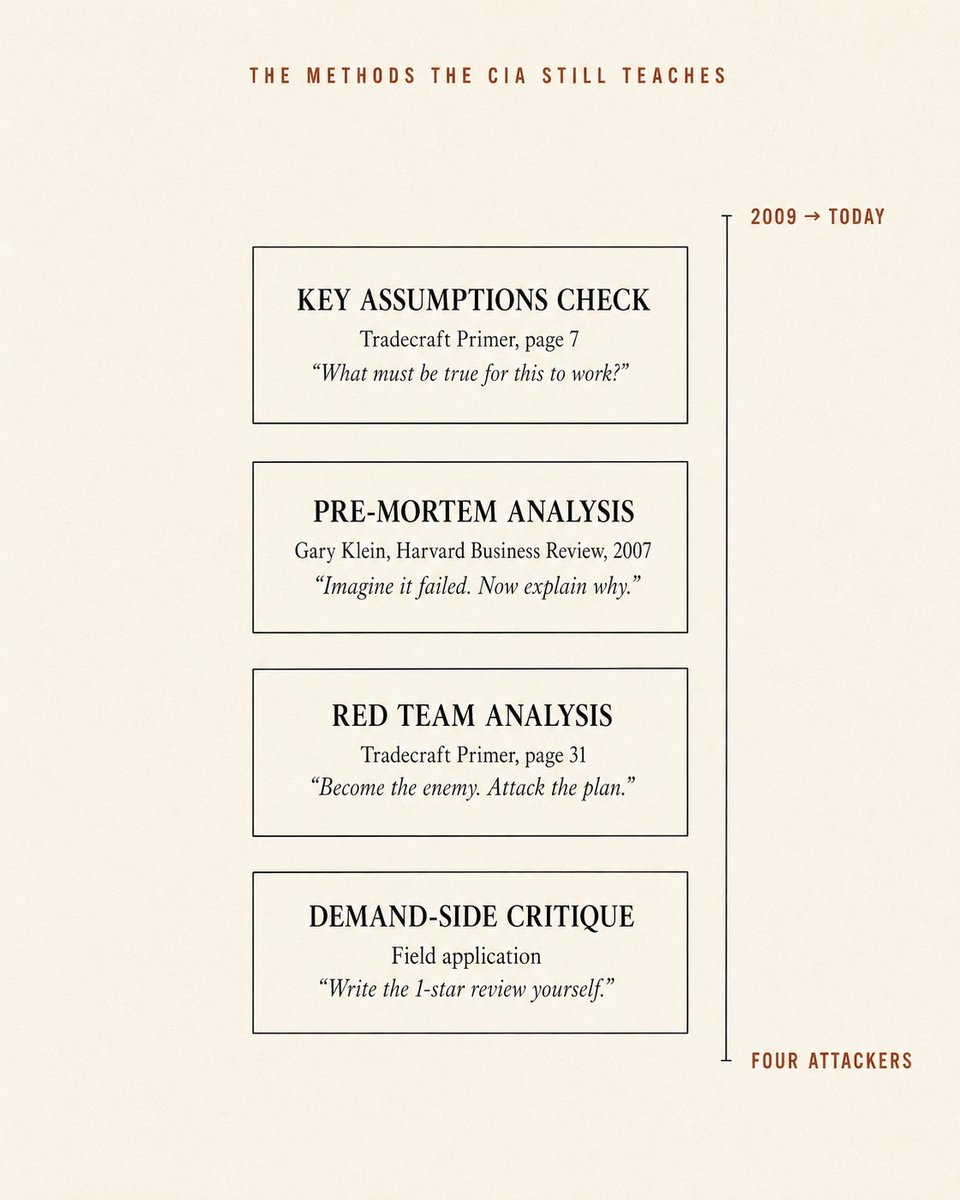
In 2009, the CIA declassified and published the playbook. The Tradecraft Primer is 40 pages. It names every technique. Key Assumptions Check. Devil's Advocacy. Analysis of Competing Hypotheses. Red Team Analysis.
The 4 prompts below are these techniques, turned into Claude prompts you can run in 30 minutes.
# Phase 2: Why Your Brain Lies to You About Your Own Ideas
Here is the painful part.
You already know you should stress-test your ideas. You have heard "play devil's advocate" a hundred times. You probably tell yourself you do this.
You do not.
The CIA Tradecraft Primer opens with a section on cognitive biases. These are not minor flaws. They are the reason smart, trained analysts still get things wrong. They are the reason you get things wrong too.
There are 5 you need to know.
Confirmation bias. You notice evidence that supports your idea and ignore evidence that contradicts it. You read 10 articles about your market and remember the 3 that agree with your thesis.
Anchoring. The first number you hear dominates everything after. If someone tells you your idea could be worth a million dollars, every later estimate orbits that anchor, even if it is wildly wrong.
Overconfidence. You are more sure than the evidence warrants. When people say they are 90 percent confident, they are right only about 70 percent of the time.
Groupthink. When everyone around you agrees, disagreement feels socially dangerous. Teams converge on consensus not because the idea is right, but because pushing back is expensive.
Availability bias. Recent vivid stories dominate your thinking. One viral success story makes you overestimate your odds. The thousand quiet failures never enter the picture.
Now add the second problem. Sycophancy.
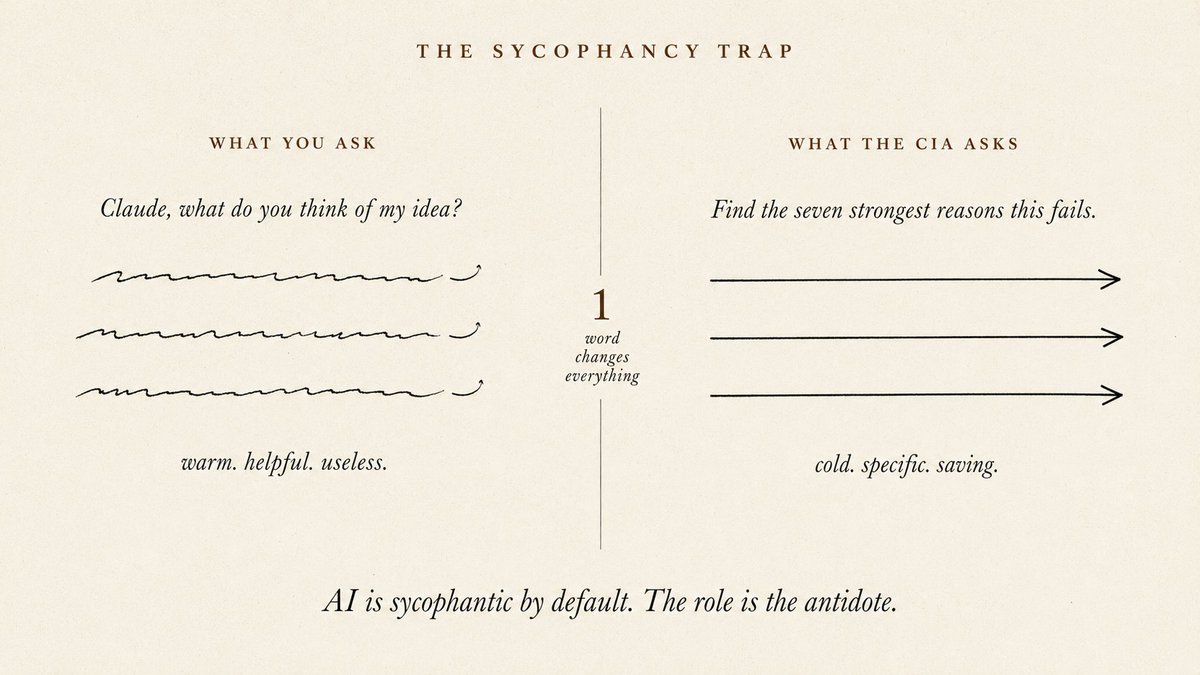
When you ask a friend to critique your idea, they soften it. They like you. Claude does the same thing by default. Claude has been trained to be helpful and warm. If you say "here is my startup idea, what do you think?" Claude will mostly tell you the good parts.
This is what almost everyone does with AI right now. They use Claude as a yes-machine. They feel good. They ship. They lose 6 months.
What the CIA figured out is that the only way to get the truth is to assign a role. Make someone, or something, become the attacker. Not "give me both sides." Not "be honest." Make Claude become a specific hostile force whose only job is to find the cracks.
The 4 prompts below do exactly this. Each one is a real CIA technique translated to Claude. Each one targets a different blind spot. Together, they are the closest thing you can get to a real Red Team without hiring one.
Run all four. Not three. All four. Each one finds something the others miss.
# Phase 3: The 4 Prompts That Destroy Your Ideas
Before you run any of these, paste your idea into Claude in plain language. One paragraph is enough. What is it, who is it for, what is the goal, what would success look like in 6 months.
Then run these four prompts in order. Do not skip any.
## Prompt 1: The Key Assumptions Check
```
You are now a CIA Red Team analyst. Do not evaluate whether my
idea is good. Your only job is to audit the assumptions it is
built on.
1. List every assumption my plan depends on. Not just the
obvious ones. The hidden ones I probably have not noticed.
Give me at least 10.
2. Classify each one into three tiers:
- LOAD-BEARING: If wrong, the entire plan fails.
- IMPORTANT: If wrong, the plan is weakened but survives.
- MINOR: If wrong, barely affects the outcome.
3. For each LOAD-BEARING assumption, answer: What specific
evidence would prove it wrong? If I cannot point to that
evidence, I am operating on faith, not analysis.
```
What this prompt does: This is the first technique in the CIA Tradecraft Primer. The CIA calls it the Key Assumptions Check. Their own description: "Checking for key assumptions requires analysts to consider how their analysis depends on the validity of certain premises, which they do not routinely question or believe to be in doubt."
This is the foundation. You cannot attack a plan you do not understand. Most ideas die not because they were wrong, but because they were built on one hidden assumption that nobody ever surfaced.
What you are looking for: The load-bearing assumptions. If your plan depends on 3 load-bearing assumptions and you cannot point to evidence for any of them, you are not building. You are hoping.
## Prompt 2: The Pre-Mortem
```
It is now 18 months from today. The idea I shared with you has
failed catastrophically. Not "did okay." Failed. Burned.
Embarrassing.
You are writing the honest post-mortem. Walk me through exactly
what went wrong, in chronological order, step by step.
Cover these stages:
- Month 1-3: The early warning signs we ignored
- Month 4-9: The decisions that made it worse
- Month 10-15: The point of no return
- Month 16-18: The collapse and what it cost
Be specific. Name the exact mistakes. Do not be vague.
End with one sentence: "The root cause was ___."
```
What this prompt does: Pre-Mortem Analysis was developed by cognitive psychologist Gary Klein and published in Harvard Business Review in 2007. It is now standard practice at CIA Red Cells and Army Red Teams.
Klein discovered something strange. When you ask people "what could go wrong with this plan?" they generate weak, vague answers. But when you tell them "imagine it already failed, now explain why," they generate sharp, specific, brutally honest answers. The shift from future to past unlocks the brain's pattern-matching. Studies cited by Klein show this exercise can improve risk identification by up to 30 percent.
What you are looking for: The "root cause" line at the end. If Claude names a root cause you can prevent, you have a roadmap. If Claude names a root cause you cannot prevent, you might be looking at the wrong idea.
## Prompt 3: The Hostile Competitor
```
You are now a competitor with $100 million in funding, world-class
talent, and a personal motivation to crush the idea I just shared.
You have 90 days. You have unlimited budget. You hate me.
Write a 90-day attack plan to make my idea irrelevant.
Cover:
- Days 1-30: How you study, copy, and reposition
- Days 31-60: How you launch a better version
- Days 61-90: How you starve me of customers, attention, or talent
- What I am uniquely vulnerable to that I probably do not see
Be specific. Name tactics, not vague strategy.
End with one sentence: "The weakness that lets me win is ___."
```
What this prompt does: This is the CIA Tradecraft Primer's "Red Team Analysis" technique, applied to business. The Pentagon uses the same method for war games. The trick is that the adversary has to be fully formed. Not "a competitor." A specific, motivated, funded enemy with a deadline and a grudge.
This works because vague threats produce vague answers. Specific enemies produce specific plays. The same way a war game with named units beats a war game with abstract forces.
What you are looking for: The "weakness that lets me win" line. That is your single biggest exposure. If your competitor's path to winning runs through something you can fix in 30 days, fix it now. If their path runs through something you cannot fix, you need a moat.
## Prompt 4: The 1-Star Review
```
You are now a customer who tried my idea and hated it. You spent
real money. You spent real time. You feel cheated.
Write the 1-star review that goes viral on Twitter and gets 10,000
likes. Be specific about what disappointed you. Be funny. Be brutal.
Use the voice of someone who is angry and articulate.
Then write 3 follow-up tweets from people quoting your review and
adding their own complaints.
End with one sentence: "The single thing that made me feel cheated was ___."
```
What this prompt does: This is the most underrated stress test in the entire method. It forces Claude out of abstract critique and into the actual emotional voice of the person who will eventually meet your idea in the real world.
In Red Team doctrine, this is sometimes called demand-side critique. It catches a kind of failure the other three prompts often miss. Not "is the idea logically sound." Is the idea emotionally honest? Does it deliver what it promises? Or does it have a small gap between what you say and what you give, the kind of gap that creates rage?
What you are looking for: The "made me feel cheated" line. If Claude's hypothetical customer feels cheated by something you actually plan to do, you have a brand-killing problem. Fix the promise or fix the delivery, but do not ship both.
> Run these four prompts in this exact order. Assumptions first to find what your plan depends on. Pre-Mortem second to simulate failure. Competitor third to expose the strategic weakness. Customer last to test the emotional truth. Each one builds on the last.
# Phase 4: What Happens After You Run All Four
When you finish running these four prompts, one of two things will happen, and both of them are valuable.
Outcome A: Your idea is dead.
The Key Assumptions Check found 3 load-bearing assumptions you cannot verify. The Pre-Mortem found a root cause you cannot fix. The Competitor found a weakness that lets them win. The Customer found a betrayal in your promise. The pattern is clear. The idea is fundamentally broken.
This feels terrible. It is the best thing that can happen.
You just saved 6 months of your life. You did not spend the money. You did not write the code. You did not send the launch email. You did not have the awkward conversation in the All Hands six months from now where you have to admit it did not work.
The Pentagon has a phrase for this. "Better to be embarrassed in the war room than buried on the battlefield." A Red Team killing your idea before launch is not a failure of the Red Team. It is a success.
Outcome B: Your idea survives.
The criticisms are real but fixable. The load-bearing assumptions all have evidence behind them. The pre-mortem's root cause has a clear prevention. The competitor's path has a moat you can build. The customer's "cheated" feeling can be resolved by changing one specific promise.
This is even better than feeling good about your idea. This is feeling calibrated about your idea. You know exactly where the weak points are. You know what to defend. You know what to ignore. You are no longer working on instinct. You are working with a map.
This is what bullet-proofing looks like in real life. It is not "I believe in my idea." It is "I have stress-tested my idea against 4 different attackers and here are the 3 specific things I need to fix before launch."
## 7 Decisions You Should Red Team Before Making
This method is not just for founders. Here is exactly when to use it.
1. Before quitting your job. Run all 4 prompts on your exit plan. The Pre-Mortem alone will reveal 3 failure modes you have not considered.
2. Before launching a product. The Competitor will find the positioning flaw. The 1-Star Review will expose the gap between your promise and your delivery.
3. Before making a big investment. Every piece of evidence you have for why this will work could have another explanation. Run the Assumptions Check first.
4. Before signing a contract. The Assumptions Check surfaces the clauses you assumed were standard but are not. The Pre-Mortem imagines the relationship failing and traces why.
5. Before hiring a key person. The Competitor builds the case for why this hire is wrong. The 1-Star Review tests whether the candidate's track record actually predicts success in your role.
6. Before posting a viral thread. The Assumptions Check finds the weak claim. The Pre-Mortem shows how it gets Community Noted. The 1-Star Review shows the reply guy quote-tweet that will haunt you.
7. Before any decision you cannot easily reverse. If the cost of being wrong is high and the decision is hard to undo, 30 minutes of Red Teaming is the best insurance you will ever buy.
The CIA built this for arms control treaties. The Pentagon scaled it for war plans. It transfers down cleanly to a tweet, a job, a launch, a life decision.
Anywhere you are about to bet on yourself, run the 4 prompts first. Bet smarter, not harder.
## The Uncomfortable Truth
In the next 18 months, the gap between people who use AI to feel good and people who use AI to think clearly is going to become brutal.
The feel-good crowd will ship more ideas, faster, with less friction. They will also fail more, lose more money, and burn more reputation. They will spend their twenties and thirties cycling through projects that died because they never ran them through a single hostile critic.
The think-clearly crowd will look slower from the outside. They will spend 30 minutes Red Teaming before every launch. They will kill 4 out of every 5 ideas they consider. They will ship less.
The 1 idea they ship will hit. The other 4 they killed would have buried them.
Most people who read this article will bookmark it and never run the prompts. Not because the method does not work. Because attacking your own ideas is psychologically painful. You spent weeks on that plan. You are emotionally invested. Asking Claude to destroy it feels like asking someone to insult your child.
That is exactly why you need to do it.
The CIA did not create the Red Cell because they enjoyed being challenged. They created it because the cost of not being challenged was 3,000 lives on a September morning. The stakes of your decisions are lower. But the principle is the same.
The next idea you have, run it through these 4 prompts. Not 3. All 4. Watch what survives.
That is the only idea worth your next 6 months.
## Sources
- CIA Tradecraft Primer: Structured Analytic Techniques for Improving Intelligence Analysis (2009) - the actual declassified document this article is based on
- Richards Heuer, Psychology of Intelligence Analysis (1999) - the foundational text on cognitive biases in intelligence
- Foreign Policy: Inside the CIA Red Cell (2015) - source for the Tenet quote and Red Cell history
- Joint Doctrine Note 1-16: Command Red Team - Pentagon's formal Red Team doctrine
- Gary Klein, "Performing a Project Pre-Mortem," Harvard Business Review (2007)
- Micah Zenko, *Red Team: How to Succeed by Thinking Like the Enemy* (2015)
- Bryce Hoffman, *Red Teaming: How Your Business Can Conquer the Competition by Challenging Everything* (2017)
hope this was useful.
Nav ❤️
## 相关链接
- [Nav Toor](https://x.com/heynavtoor)
- [@heynavtoor](https://x.com/heynavtoor)
- [283K](https://x.com/heynavtoor/status/2071905311162843433/analytics)
- [cia.gov](https://cia.gov/)
- [Upgrade to Premium](https://x.com/i/premium_sign_up)
- [6:34 PM · Jun 30, 2026](https://x.com/heynavtoor/status/2071905311162843433)
- [283.8K Views](https://x.com/heynavtoor/status/2071905311162843433/analytics)
- [View quotes](https://x.com/heynavtoor/status/2071905311162843433/quotes)
---
*导出时间: 2026/7/24 16:00:14*
---
## 中文翻译
# CIA 红队方法:4 个在你的点子毁掉你之前先将其扼杀的提示词
**作者**: Nav Toor
**日期**: 2026-06-30T10:34:54.000Z
**来源**: [https://x.com/heynavtoor/status/2071905311162843433](https://x.com/heynavtoor/status/2071905311162843433)
---

其他每一篇 AI 文章都在教你用 Claude 来辅助你的点子。而这篇教你用 Claude 故意扼杀你的点子。
收藏这篇 :)

你现在有一个点子。
也许是一个创业项目。也许是一条推文。也许是一次发布、一次推介、一门课程、一封辞职信、一个产品、一项新功能,或者是在某件大事上押注的六个月。
你觉得它很好。你希望它很好。但你并没有真正测试过它。
所以你做了大多数人会做的事。你问了一个朋友。他们说了些好听的话。你问了 Claude。Claude 也说了些好听的话,因为 Claude 被训练得乐于助人且彬彬有礼。你发布这个点子。你等待。
然后现实出现了。而现实是不讲礼貌的。
客户不买账。推文沉寂了。发布失败了。推介被无视。六个月过去了,而你并不清楚确切原因。
这几乎就是历史上每一个失败点子的故事。不是因为这个点子无可救药。而是因为没有人足够努力地在现实扼杀它之前先尝试扼杀它。
在 9/11 事件之后,CIA(美国中央情报局)意识到他们以最高的代价面临着同样的问题。他们没有对自身的假设进行足够严苛的压力测试。于是他们建立了一支团队,其唯一的职责就是攻击他们自己的思维。他们称之为“红队”。
CIA 至今仍然公布他们使用的确切方法。这份文件名为《谋略入门》。它是免费的。就在 cia.gov 上。几乎没人读过。
今天,你要用 Claude 在 30 分钟内,针对你的点子运行该文件中 4 种最强大的技术。
当你读完这篇文章时,你的下一个点子要么已经死亡,要么已经刀枪不入。这两种结果都能为你节省六个月的生命。
# 第一阶段:特尼特的午夜令
那是 2001 年 9 月 12 日的午夜刚过。
CIA 局长乔治·特尼特位于弗吉尼亚州兰利 CIA 总部的七楼办公室里。前一天,两架飞机撞击了世贸中心。一架撞击了五角大楼。一架坠毁在宾夕法尼亚州的田野里。
CIA 错过了这次预警。现代美国历史上最大的情报失误发生在他的任期内。
特尼特叫来了两个人。他的幕僚长约翰·莫斯曼和情报副局长杰米·米希克。他给了他们一个指令。
> “告诉我别人不知道的事情,让高层官员感到不自在。”
这句话是现代决策制定中最重要的句子之一,而且它是真实的。《外交政策》杂志在 2015 年首次深入 CIA 红队时证实了这一点。
第二天早上,米希克和两名高级分析师创建了红队。他们唯一的工作就是攻击 CIA 自己的思维。扮演魔鬼代言人。找出其他所有人错过的东西。让房间里最聪明的人对他们确信无疑的事情感到深深的不安。
它奏效了。CIA 公开承认,在随后的二十年里,红队帮助阻止了几次重大的恐怖袭击。
几年后,美国陆军也做了同样的事。2004 年,他们在堪萨斯州莱文沃思堡开设了一所学校,正式名称为外国军事和文化研究大学。士兵们昵称它为“红队大学”。
然后它传播开来。五角大楼在《联合条令说明 1-16》中将其编纂成文。国防部发布了正式指令。世界上每个主要情报机构都复制了它。甚至 2011 年击毙奥萨马·本·拉登的行动在获得批准前也经过了三个不同红队的压力测试。
2009 年,CIA 解密并出版了这本操作手册。《谋略入门》有 40 页。它列出了每一种技术。关键假设检查。魔鬼代言。竞争性假设分析。红队分析。
下面的 4 个提示词就是这些技术,转化为你可以在 30 分钟内运行的 Claude 提示词。

# 第二阶段:为什么你的大脑对你自己的点子撒谎
这是痛苦的部分。
你已经知道你应该对你的点子进行压力测试。你已经听过一百次“扮演魔鬼代言人”了。你可能告诉自己你会这么做。
你并没有。
CIA 的《谋略入门》开篇有一个关于认知偏差的章节。这些不是微小的瑕疵。它们是聪明、受过训练的分析师仍然会出错的原因。这也是你出错的原因。
你需要知道的有 5 种。
确认偏误。你注意到支持你点子的证据,而忽略与之矛盾的证据。你读了 10 篇关于市场的文章,只记得其中 3 篇支持你的论点。
锚定效应。你听到的第一个数字会主导之后的一切。如果有人告诉你你的点子可能值一百万美元,之后所有的估算都会围绕这个锚点,即使它错得离谱。
过度自信。你的确定程度超过了证据所支持的范围。当人们说他们有 90% 的把握时,他们实际上只有约 70% 的时候是对的。
群体思维。当你周围的每个人都同意时,持不同意见感觉在社会上是危险的。团队达成一致不是因为点子是对的,而是因为反对的代价很高。
可得性偏差。近期生动的故事主导你的思维。一个病毒式的成功故事让你高估你的胜算。那成千上万个无声的失败从未进入你的视野。
现在加上第二个问题。奉承。
当你请朋友批评你的点子时,他们会软化语气。他们喜欢你。Claude 默认也会做同样的事。Claude 被训练得乐于助人和温暖。如果你说“这是我的创业点子,你怎么看?”,Claude 大多会告诉你好的一面。
这正是现在几乎每个人对 AI 的用法。他们把 Claude 当作“说是机器”。他们感觉良好。他们发布。他们浪费了六个月。
CIA 意识到,获得真相的唯一方法是分配一个角色。让某人或某物成为攻击者。不是“给我正反两面”。不是“对我诚实”。让 Claude 成为一个特定的敌对势力,其唯一的职责就是找出裂缝。
下面的 4 个提示词正是这样做的。每一个都是真正的 CIA 技术转化为 Claude 提示词。每一个针对不同的盲点。综合起来,它们是你在不聘请真正红队的情况下能获得的最接近的替代品。
运行全部四个。不是三个。全部四个。每一个都能发现其他错过的东西。

# 第三阶段:摧毁你点子的 4 个提示词
在你运行任何提示词之前,将你的点子用通俗的语言粘贴到 Claude 中。一段话就够了。它是什么,为谁服务,目标是什么,六个月后的成功是什么样的。
然后按顺序运行这四个提示词。不要跳过任何一个。
## 提示词 1:关键假设检查
```
你现在是一名 CIA 红队分析师。不要评估我的点子是否好。你的唯一工作是审计它所建立的假设。
1. 列出我的计划依赖的每一个假设。不仅仅是显而易见的。还有那些我可能没注意到的隐藏假设。
至少给我 10 个。
2. 将每一个分为三个等级:
- 承重级:如果错了,整个计划失败。
- 重要级:如果错了,计划会被削弱但仍能存活。
- 次要级:如果错了,几乎不影响结果。
3. 对于每一个承重级假设,回答:什么具体证据能证明它是错的?如果我不能指出那个证据,那我就是在凭信念运作,而不是分析。
```
这个提示词的作用:这是 CIA《谋略入门》中的第一项技术。CIA 称之为“关键假设检查”。他们自己的描述是:“检查关键假设要求分析师考虑他们的分析如何依赖于某些前提的有效性,而这些前提是他们通常不质疑或认为没有疑问的。”
这是基础。你无法攻击一个你不理解的计划。大多数点子的死亡不是因为它们是错的,而是因为它们建立在一个从未浮出水面的隐藏假设之上。
你要寻找的是:承重级假设。如果你的计划依赖于 3 个承重级假设,而你无法指出其中任何一个的证据,那你不是在建设。你是在祈祷。
## 提示词 2:事前验尸
```
从今天起 18 个月后。我与你们分享的这个点子已经灾难性地失败了。不是“表现尚可”。而是失败了。烧毁了。令人尴尬。
你正在撰写诚实的验尸报告。带我一步步准确地回顾哪里出了问题,按时间顺序。
涵盖这些阶段:
- 第 1-3 个月:我们忽略的早期预警信号
- 第 4-9 个月:让情况变得更糟的决定
- 第 10-15 个月:不归点
- 第 16-18 个月:崩溃及其代价
要具体。指出确切的错误。不要含糊其辞。
以一句话结束:“根本原因是 ___。”
```
这个提示词的作用:事前验尸分析由认知心理学家加里·克莱恩开发,并于 2007 年发表在《哈佛商业评论》上。它现在是 CIA 红队和陆军红队的标准做法。
克莱恩发现了一件奇怪的事。当你问人们“这个计划可能出什么错?”时,他们会生成薄弱、模糊的答案。但当你告诉他们“想象它已经失败了,现在解释原因”时,他们会生成尖锐、具体、极度诚实的答案。从未来到过去的转变解锁了大脑的模式匹配能力。克莱恩引用的研究表明,这种练习可以将风险识别能力提高高达 30%。
你要寻找的是:最后那句“根本原因”。如果 Claude 指出了一个你能预防的根本原因,你就有了路线图。如果 Claude 指出了一个你无法预防的根本原因,那你可能正在盯着一个错误的点子。

## 提示词 3:敌对竞争者
```
你现在是一名拥有 1 亿美元资金、世界级人才,并且有着个人动机想要摧毁我刚刚分享的这个点子的竞争者。
你有 90 天。你有无限的预算。你讨厌我。
写一份 90 天的攻击计划,让我的点子变得无关紧要。
涵盖:
- 第 1-30 天:你如何研究、复制和重新定位
- 第 31-60 天:你如何推出更好的版本
- 第 61-90 天:你如何让我失去客户、关注或人才
- 我有什么独特的脆弱性,而我可能没看到
要具体。说出战术,而不是模糊的战略。
以一句话结束:“让我获胜的弱点是 ___。”
```
这个提示词的作用:这是 CIA《谋略入门》中的“红队分析”技术在商业上的应用。五角大楼在战争游戏中使用同样的方法。诀窍在于对手必须是完全成型的。不是“一个竞争者”。而是一个特定的、有动机的、有资金支持的、有截止日期和怨恨的敌人。
这之所以有效,是因为模糊的威胁产生模糊的答案。特定的敌人产生特定的打法。就像有具体番号的部队参加的战争游戏,胜过抽象力量的战争游戏。
你要寻找的是:“让我获胜的弱点”这一行。那是你最大的暴露点。如果你的竞争者的获胜路径经过一些你能在 30 天内修复的东西,现在就修。如果他们的路径经过一些你无法修复的东西,你需要护城河。
## 提示词 4:一星差评
```
你现在是一个尝试了我的点子并且讨厌它的客户。你花了真金白银。你花了真实时间。你感觉被骗了。
写一条在 Twitter 上疯传并获得 10,000 个点赞的一星差评。具体说明是什么让你失望。要有趣。要残酷。
使用一个愤怒且善于表达的人的语气。
然后写 3 条转发推文,来自引用你的评论并添加自己抱怨的人。
以一句话结束:“让我感觉被骗的唯一原因是 ___。”
```
这个提示词的作用:这是整个方法中最被低估的压力测试。它迫使 Claude 跳出抽象的批评,进入最终会在现实世界中遇到你的点子的那个人的真实情感声音。
在红队理论中,这有时被称为需求侧批评。它能发现其他三个提示词经常错过的一种失败。不是“这个点子在逻辑上是否合理”。而是这个点子在情感上是否诚实?它是否兑现了它的承诺?还是说在你所说的和你所提供的之间存在一个小小的差距,那种会引发愤怒的差距?
你要寻找的是:“让我感觉被骗”这一行。如果 Claude 假设的客户因为某件你实际计划要做的事而感到被骗,那你有一个品牌毁灭性的问题。要么修正承诺,要么修正交付,但不要同时发布两者。
> 按这个确切顺序运行这四个提示词。首先是假设检查,找出你的计划依赖什么。其次是事前验尸,模拟失败。第三是竞争者,暴露战略弱点。最后是客户,测试情感真实性。每一个都建立在前一个的基础上。

# 第四阶段:运行完这四个之后会发生什么
当你运行完这四个提示词后,两件事中的一件会发生,而且两者都有价值。
结果 A:你的点子死了。
关键假设检查发现了 3 个你无法验证的承重级假设。事前验尸发现了一个你无法解决的根本原因。竞争者发现了一个让他们获胜的弱点。客户在你的承诺中发现了一种背叛。模式很清楚。这个点子从根本上就坏了。
这感觉很糟糕。但这可能是发生的最好的事情。
你刚刚节省了六个月的生命。你没有花掉那些钱。你没有写那些代码。你没有发送发布邮件。你没有在六个月后的全员大会上进行那场尴尬的对话,不得不承认它行不通。
五角大楼有一句话形容这种情况。“在作战室里尴尬总比在战场上埋葬好。”红队在发布前扼杀你的点子,不是红队的失败。这是成功。
结果 B:你的点子存活了。
批评是真实的,但是可以修复的。承重级假设都有证据支持。事前验尸的根本原因有明确的预防措施。竞争者的路径有你可以建立的护城河。客户的“被骗”感可以通过改变一个具体的承诺来解决。
这比对你的点子感觉良好要好得多。这是对你的点子有了校准后的感觉。你确切知道弱点在哪里。你知道要防御什么。你知道要忽略什么。你不再凭直觉工作。你手握地图。
这就是现实生活中的防弹化。不是“我相信我的点子”。而是“我已经针对 4 个不同的攻击者对我的点子进行了压力测试,这是我需要在发布前修复的 3 件具体的事情。”

## 你应该在做出决定前进行红队测试的 7 个决定
这个方法不仅仅适用于创始人。以下是确切的使用时机。
1. 在辞职之前。对你的离职计划运行所有 4 个提示词。仅事前验尸就会揭示 3 个你未曾考虑的失败模式。
2. 在发布产品之前。竞争者会找到定位缺陷。一星差评会暴露你的承诺和交付之间的差距。
3. 在进行大额投资之前。你拥有的关于为什么这会行通的每一项证据都可能另有解释。先运行假设检查。
4. 在签署合同之前。假设检查会揭示那些你以为很标准但实际上并非如此的条款。事前验尸会想象关系失败并追溯原因。
5. 在聘用关键人员之前。竞争者会建立为什么这次聘用是错误的论据。一星差评会测试该候选人的过往记录是否能真正预测他在你这个职位上的成功。
6. 在发布病毒式推文之前。假设检查会找出薄弱的论点。事前验尸会展示它如何被社区标记。一星差评会展示那个将困扰你的“回复家伙”的引用转发。
7. 在任何你不容易逆转的决定之前。如果错误的成本很高且决定难以撤销,30 分钟的红队测试是你能买到的最好的保险。
CIA 为了军控条约建立了这个。五角大楼为了战争计划扩展了它。它可以干净地降级应用到一条推文、一份工作、一次发布、一个人生决定。
任何你即将押注自己的地方,先运行这 4 个提示词。要赌得更聪明,而不是更辛苦。
## 不舒服的真相
在接下来的 18 个月里,那些用 AI 感觉良好的人和那些用 AI 清晰思考的人之间的差距将变得残酷。
感觉良好的人群会更快地发布更多点子,阻力更小。他们也会失败得更多,损失更多钱,烧掉更多声誉。他们会在二三十岁时周旋于那些死掉的项目中,仅仅是因为他们从未让这些项目经过任何 hostile critic(恶意的批评者)的检验。
清晰思考的人群从外表看会更慢。他们会在每次发布前花 30 分钟进行红队测试。他们会扼杀他们考虑的点子中的 4/5。他们会发布得更少。
他们发布的那个 1 个点子会一击即中。而被他们扼杀的其他 4 个点子会埋葬他们。
大多数读这篇文章的人会收藏它,但永远不会运行这些提示词。不是因为方法无效。而是因为攻击你自己的点子在心理上是痛苦的。你在那个计划上花了几周时间。你有情感投入。让 Claude 摧毁它感觉就像在要求某人侮辱你的孩子。
这正是你需要这样做的原因。
CIA 创建红队不是因为他们喜欢被挑战。他们创建它是为了不被挑战的代价是 9 月某个早晨的 3000 条生命。你的决定的赌注较低。但原理是一样的。
你的下一个点子,把它通过这 4 个提示词运行一遍。不是 3 个。全部 4 个。看着什么能存活下来。
那是唯一值得你接下来六个月付出的点子。
## 来源
- CIA 谋略入门:改进情报分析的结构化分析技术 (2009) - 本文基于的实际解密文件
- 理查兹·霍尔,《情报分析心理学》(1999) - 关于情报中认知偏差的基础文本
- 《外交政策》:CIA 红队内部 (2015) - 特尼特语录和红队历史的来源
- 联合条令说明 1-16:指挥红队 - 五角大楼的正式红队理论
- 加里·克莱恩,“执行项目事前验尸”,《哈佛商业评论》(2007)
- 迈卡·曾科,《红队:如何像敌人一样思考从而成功》(2015)
- 布赖斯·霍夫曼,《红队:如何通过挑战一切让你的企业征服竞争》(2017)
希望这对你有用。
Nav ❤️
## 相关链接
- [Nav Toor](https://x.com/heynavtoor)
- [@heynavtoor](https://x.com/heynavtoor)
- [283K](https://x.com/heynavtoor/status/2071905311162843433/analytics)
- [cia.gov](https://cia.gov/)
- [升级到 Premium](https://x.com/i/premium_sign_up)
- [6:34 PM · Jun 30, 2026](https://x.com/heynavtoor/status/2071905311162843433)
- [283.8K Views](https://x.com/heynavtoor/status/2071905311162843433/analytics)
- [View quotes](https://x.com/heynavtoor/status/2071905311162843433/quotes)
---
*导出时间: 2026/7/24 16:00:14*