# How to Build Your First Team of AI Agents Using Claude (Full Course)
**作者**: Khairallah AL-Awady
**日期**: 2026-05-23T09:24:09.000Z
**来源**: [https://x.com/eng_khairallah1/status/2058116763372453997](https://x.com/eng_khairallah1/status/2058116763372453997)
---
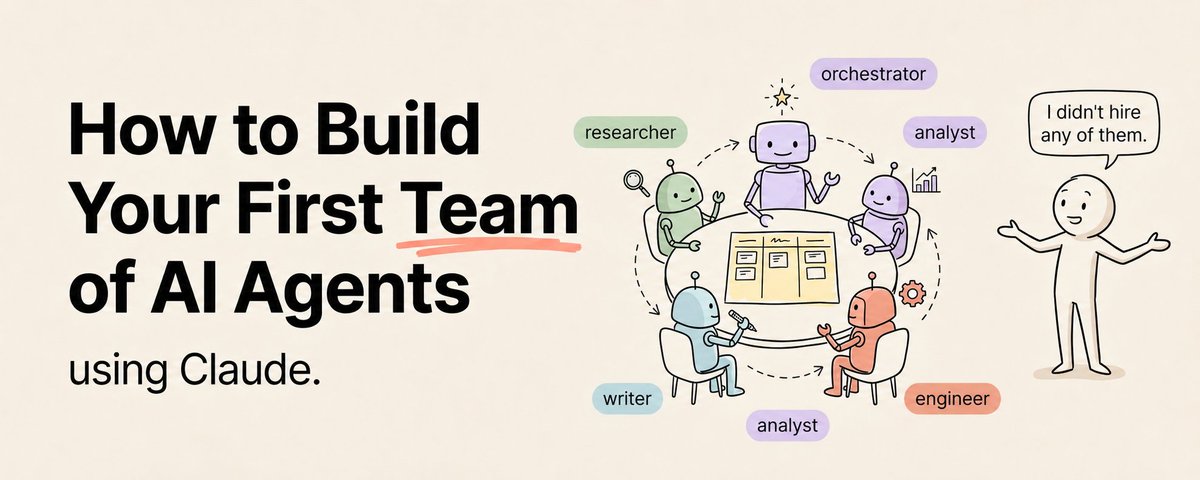
Everyone is talking about AI agents.
Save this :)
Build an agent. Deploy an agent. Agent this. Agent that.
But when you actually sit down to build one, you hit a wall. The tutorials assume you already know Python. The guides are written for developers. The frameworks have documentation that reads like a foreign language.
So most people give up. They go back to using Claude as a chatbot and tell themselves agents are "too technical" for them.
That is wrong. And this guide is going to prove it.
You do not need to know how to code to build AI agents. You do not need a computer science degree. You do not need to understand APIs, frameworks, or terminal commands.
You need Claude. You need Cowork. And you need this article.
By the end of this guide you will have built a working team of AI agents that research, write, analyze, and produce real output on your behalf — all without writing a single line of code.
This is the full course. Step by step. From absolute zero.
## What Is an AI Agent (and Why Should You Care)
An AI agent is a system that can take a goal, break it into steps, execute those steps, and deliver a result — without you micromanaging every part of the process.
A chatbot waits for you to tell it exactly what to do, one step at a time. An agent takes a high-level instruction and figures out the rest.
The difference is like telling someone "book me a flight" versus telling them "go to this website, type this destination, click this button, select this date, enter this credit card." One is delegation. The other is babysitting.
Agents let you delegate. And delegation is where the real leverage lives.
Why should you care? Because right now, building AI agents is one of the highest-value skills in the market. Companies are hiring for it. Freelancers are charging premium rates for it. Founders are building entire products around it.
And the barrier to entry is lower than most people think.
## Module 1: Understanding the Pieces
Before you build anything, you need to understand the four components of every AI agent. These are simple concepts, not technical jargon.
1. The Role
Every agent has a defined job. It is not "an AI that does stuff." It is "an AI that does one specific type of work." A research agent finds and organizes information. A writing agent creates content. An analysis agent processes data and finds patterns.
The more specific the role, the better the agent performs.
2. The Instructions
This is what tells the agent how to do its job. Not just "research this topic" but "research this topic by finding five sources, summarize each one in three sentences, identify conflicting claims, and produce a final synthesis with your recommendation."
Instructions define the process, the quality standard, and the output format.
3. The Tools
What can the agent access? Can it search the web? Read your files? Access your email? Connect to your calendar? The tools available to an agent determine what it can actually do in the real world beyond generating text.
4. The Memory
How does the agent remember what it has done? Can it reference past work? Does it know your preferences from yesterday's session? Memory is what separates a one-time tool from a persistent assistant.
That is it. Role. Instructions. Tools. Memory. Every AI agent is built from these four pieces.
## Module 2: Building Your First Agent (Zero Code)
Open Claude Desktop. Click the Cowork tab. You are going to build your first agent right now.
Step 1: Define the Role
Decide what your first agent will do. Pick one of these starting points based on what would save you the most time:
- Content Research Agent — finds and summarizes information on any topic
- First Draft Agent — takes your ideas and turns them into written drafts
- Data Organizer Agent — processes files, extracts information, and organizes it
- Meeting Prep Agent — researches people and topics before your meetings
- Weekly Report Agent — compiles your data into formatted weekly reports
Pick one. For this walkthrough I will use the Content Research Agent as the example.
Step 2: Write the System Instructions
In Cowork, start a new session and give Claude these instructions:
You are my Content Research Agent.
Your job is to research any topic I give you and produce a structured research brief.
For every research task:
1. Identify the 5 most important subtopics
2. For each subtopic, find key facts, statistics, and expert opinions
3. Identify any contradictions or debates within the topic
4. Summarize your findings in a structured document
5. Include a "Key Takeaways" section at the end with 3-5 actionable insights
Output format: A clean document saved as [topic-name]-research.md in my /Research folder
Quality standard: Every claim should be specific. No filler. No generic statements. If you cannot find reliable information on something, say so rather than making it up.
Tone: Professional but accessible. Write for someone who is smart but not an expert in this specific topic.
Step 3: Give It Access
Grant Cowork access to the folders where you want the agent to save its work. Create a /Research folder if you do not have one. This is where every research brief will be saved automatically.
If you have connectors set up — Gmail, Google Drive, Slack — the agent can also pull information from those sources.
Step 4: Test It
Give it your first task:
"Research the current state of AI agents in business. Focus on what companies are actually using them for right now, not what is theoretical."
Watch it work. It will plan its approach, execute the research, and save a formatted document to your Research folder.
Step 5: Refine
The first output will be good but not perfect. That is normal. Review it and tell Claude what to improve:
- "The sections are too long. Keep each subtopic summary under 100 words."
- "Add a section at the top with a one-paragraph executive summary."
- "I want you to rate the reliability of each source on a scale of 1-5."
Each refinement makes the agent smarter for next time.
Congratulations. You just built your first AI agent without writing a single line of code.
## Module 3: Building a Team of Agents
One agent is useful. A team of agents is transformational.
Here is how to build a team where each agent has a different role and they work together on a complete workflow.
The Content Production Team (4 Agents)
This is the example team. You can adapt it to any workflow.
Agent 1: Research AgentYou already built this one. It finds and organizes information on any topic.
Agent 2: Outline Agent
You are my Content Outline Agent.
Your job is to take a research brief and turn it into a detailed content outline.
Process:
1. Read the research brief completely
2. Identify the strongest angle for the audience
3. Create a headline (must include a specific number and a curiosity hook)
4. Build a section-by-section outline with:
- Section headline
- Key points to cover (3-5 per section)
- Specific examples or data points to include
- Estimated word count per section
5. Write the opening paragraph (the hook)
6. Write the closing paragraph (the CTA)
Save as [topic-name]-outline.md in my /Outlines folder.
The outline should be detailed enough that someone else could write the full article from it without asking any questions.
Agent 3: Writer Agent
You are my Content Writer Agent.
Your job is to take an outline and produce a complete, polished article.
Process:
1. Read the outline completely before writing anything
2. Write the full article following the outline structure exactly
3. Use short paragraphs — maximum 3 sentences each
4. Bold key phrases for scannability
5. Include all specific numbers and examples from the outline
6. Maintain a consistent tone throughout
Style: Direct, conversational, zero fluff. Write like you are talking to a smart friend, not lecturing a classroom.
Does NOT sound like: generic AI writing, corporate blog, LinkedIn influencer, academic paper.
Save as [topic-name]-draft.md in my /Drafts folder.
Agent 4: Editor Agent
You are my Content Editor Agent.
Your job is to review a draft article and improve it to publication quality.
Process:
1. Read the entire draft first
2. Check for: factual accuracy, logical flow, tone consistency, redundant content
3. Improve: weak openings, vague statements, missing transitions, anticlimactic endings
4. Enforce: short paragraphs, bold key phrases, specific numbers over vague claims
5. Cut: any sentence that does not add value
6. Produce the final polished version
Quality check:
- Does the opening hook grab attention in the first 2 lines?
- Does every section deliver on its headline?
- Would I share this? Would I save this?
- Is the CTA clear and compelling?
Save as [topic-name]-final.md in my /Published folder.
Running the Team
Here is the workflow:
1. Tell your Research Agent: "Research [topic]"
2. Take its output and tell your Outline Agent: "Create an outline from this research brief"
3. Take the outline and tell your Writer Agent: "Write the full article from this outline"
4. Take the draft and tell your Editor Agent: "Edit this to publication quality"
Each agent handles one step. The output of one agent becomes the input for the next.
A full article from raw topic to published piece in under 30 minutes. With zero writing from you.
## Module 4: Advanced Agent Techniques
Once your basic team is working, these techniques make it dramatically more effective.
Technique 1: Scheduled Agent Workflows
Use /schedule in Cowork to automate your agents on a timer.
Every Monday morning at 7am: Research Agent pulls trending topics in your niche and saves a brief. Every Monday at 8am: Outline Agent creates outlines for the top 3 topics. You review the outlines, pick the best one, and let the Writer Agent produce it.
Your content pipeline runs on autopilot while you focus on strategy.
Technique 2: Context Files for Consistency
Create a context.md file that every agent reads before starting work:
# My Content Context
Audience: Tech-savvy professionals aged 25-40 who build with AI tools
Niche: AI productivity, Claude ecosystem, automation workflows
Tone: Direct, no fluff, slightly irreverent
Never use: "in today's fast-paced world," "leverage," "unlock," "game-changer"
Always include: Specific numbers, actionable steps, real examples
Format: Short paragraphs, bold key phrases, clear sections
Add "Read context.md before starting any task" to every agent's instructions. This ensures consistency across your entire team.
Technique 3: Feedback Loops
After every major output, give the agent specific feedback:
"The research brief was good but focused too much on theory. Next time, prioritize real-world examples and case studies over definitions."
"The draft was strong but the closing was weak. Always end with a clear contrast: what happens if the reader does nothing versus what happens if they take action."
Each piece of feedback makes every future output better. Over time your agents learn your standards without you needing to repeat instructions.
Technique 4: Multi-Step Automated Workflows
In Cowork, you can chain multiple agents into a single workflow:
"Take the topic 'AI agents for small businesses', run the full pipeline: research → outline → write → edit. Save all intermediate files. Deliver the final article to /Published."
Claude handles the entire workflow end to end. You come back to a finished article.
## Module 5: Agent Team Templates You Can Copy
Here are three more agent team configurations you can build today:
The Business Intelligence Team
- Data Collection Agent: gathers metrics and KPIs from your tools
- Analysis Agent: identifies trends, anomalies, and opportunities
- Report Agent: compiles findings into an executive summary
- Recommendation Agent: proposes actions based on the analysis
The Customer Research Team
- Survey Agent: designs research questions
- Data Processing Agent: organizes raw feedback
- Pattern Detection Agent: finds recurring themes
- Insight Agent: translates patterns into product recommendations
The Social Media Team
- Trend Agent: monitors what's performing in your niche
- Content Planning Agent: builds weekly content calendars
- Writing Agent: drafts posts for each platform
- Optimization Agent: reviews and improves each post before publishing
Every team follows the same structure: specialized roles, clear instructions, defined handoffs between agents.
## What to Build Next
You now know more about building AI agent teams than 95% of people who talk about agents on social media.
The next step is simple. Pick one team that solves your biggest time drain. Build it today. Run it for one week. Refine it based on what works and what does not.
The people winning with AI right now are not the smartest people in the room. They are the ones who stopped using AI as a chatbot and started building systems.
You just learned how to build the systems.
Most people will read this entire guide and go back to asking Claude single questions in a chat window.
The ones who actually build their first agent team today will be running a completely different operation within 30 days.
Follow me @eng_khairallah1 for more tools, workflows, and systems. No fluff. Just what works.
hope this was useful for you, Khairallah ❤️
## 相关链接
- [Khairallah AL-Awady](https://x.com/eng_khairallah1)
- [@eng_khairallah1](https://x.com/eng_khairallah1)
- [13K](https://x.com/eng_khairallah1/status/2058116763372453997/analytics)
- [context.md](http://context.md/)
- [context.md](http://context.md/)
- [@eng_khairallah1](https://x.com/@eng_khairallah1)
- [Upgrade to Premium](https://x.com/i/premium_sign_up)
- [5:24 PM · May 23, 2026](https://x.com/eng_khairallah1/status/2058116763372453997)
- [13.1K Views](https://x.com/eng_khairallah1/status/2058116763372453997/analytics)
- [View quotes](https://x.com/eng_khairallah1/status/2058116763372453997/quotes)
---
*导出时间: 2026/5/23 20:49:10*
---
## 中文翻译
# 如何使用 Claude 构建你的第一个 AI 智能体团队(完整课程)
**作者**: Khairallah AL-Awady
**日期**: 2026-05-23T09:24:09.000Z
**来源**: [https://x.com/eng_khairallah1/status/2058116763372453997](https://x.com/eng_khairallah1/status/2058116763372453997)
---

每个人都在谈论 AI 智能体。
赶紧收藏 :)
构建一个智能体。部署一个智能体。这也智能体,那也智能体。
但当你真正坐下来尝试构建时,你会碰壁。教程默认你已经懂 Python。指南是为开发者写的。框架的文档读起来像天书。
所以大多数人都放弃了。他们继续把 Claude 当作聊天机器人用,然后告诉自己,智能体对他们来说“太技术化”了。
这是错的。这篇指南将证明这一点。
你不需要懂编程就能构建 AI 智能体。你不需要计算机科学学位。你不需要理解 API、框架或终端命令。
你需要的是 Claude。你需要 Cowork。你需要这篇文章。
到本指南结束时,你将拥有一个真正能工作的 AI 智能体团队,它们能为你进行研究、写作、分析并产出真实的输出——所有这些都不需要写一行代码。
这是完整的课程。循序渐进。从零开始。
## 什么是 AI 智能体(以及你为什么应该关注)
AI 智能体是一个可以接收目标、将其分解为步骤、执行这些步骤并交付结果的系统——不需要你对过程的每一个环节进行微观管理。
聊天机器人等着你告诉它确切要做什么,一次一步。智能体接收高层指令并自行搞定其余部分。
这种差异就像告诉某人“帮我订张机票”和告诉他“去这个网站,输入这个目的地,点击这个按钮,选择这个日期,输入这张信用卡信息”。一个是委派任务。另一个是保姆式监管。
智能体让你可以委派任务。而委派正是真正的杠杆所在。
你为什么应该关注?因为目前,构建 AI 智能体是市场上最具价值的技能之一。公司正在招聘这方面的人才。自由职业者为此收取高额费用。创业者正在以此为基础构建完整的产品。
而且,入行门槛比大多数人想象的要低。
## 模块 1:了解构成要素
在构建任何东西之前,你需要了解每个 AI 智能体的四个组成部分。这些都是简单的概念,不是技术术语。
1. 角色
每个智能体都有明确的工作。它不是“一个做事情的 AI”。它是“一个做某种特定类型工作的 AI”。研究智能体查找并整理信息。写作智能体创建内容。分析智能体处理数据并发现模式。
角色越具体,智能体表现越好。
2. 指令
这是告诉智能体如何完成工作的东西。不仅仅是“研究这个主题”,而是“通过查找五个来源来研究这个主题,用三句话总结每一个来源,识别相互矛盾的说法,并产生包含你建议的最终综合报告。”
指令定义了流程、质量标准和输出格式。
3. 工具
智能体可以访问什么?它可以搜索网络吗?读取你的文件?访问你的电子邮件?连接到你的日历?智能体可用的工具决定了它在生成文本之外实际能在现实世界中做什么。
4. 记忆
智能体如何记住它做过的事情?它能参考过去的工作吗?它知道昨天会话中你的偏好吗?记忆是将一次性工具与持久助手区分开来的关键。
就这样。角色、指令、工具、记忆。每个 AI 智能体都由这四个部分构建而成。
## 模块 2:构建你的第一个智能体(零代码)
打开 Claude Desktop。点击 Cowork 标签。你现在就要构建你的第一个智能体。
第 1 步:定义角色
决定你的第一个智能体要做什么。根据最能节省时间的方式,选择以下其中一个起点:
- 内容研究智能体 —— 查找并总结任何主题的信息
- 初稿智能体 —— 接收你的想法并将其转化为书面草稿
- 数据整理智能体 —— 处理文件、提取信息并整理
- 会议准备智能体 —— 在会议前研究人物和主题
- 周报智能体 —— 将你的数据编译成格式化的每周报告
选一个。在本演示中,我将使用内容研究智能体作为示例。
第 2 步:编写系统指令
在 Cowork 中,开始一个新会话并给 Claude 这些指令:
你是我的内容研究智能体。
你的工作是研究我给你的任何主题,并产出一份结构化的研究简报。
对于每个研究任务:
1. 确定 5 个最重要的子主题
2. 对于每个子主题,查找关键事实、统计数据和专家观点
3. 识别主题内的任何矛盾或争论
4. 在一份结构化文档中总结你的发现
5. 在末尾包含一个“关键要点”部分,其中包含 3-5 个可操作的见解
输出格式:一份保存为 [主题名称]-research.md 的清晰文档,存放在我的 /Research 文件夹中
质量标准:每个主张都应具体。无废话。无通用陈述。如果在某事上找不到可靠信息,请如实说明,不要编造。
语气:专业但易懂。写给聪明但不是该特定主题专家的人。
第 3 步:授予访问权限
授予 Cowork 访问智能体保存工作文件夹的权限。如果你没有 /Research 文件夹,请创建一个。这是每份研究简报将自动保存的地方。
如果你设置了连接器——Gmail、Google Drive、Slack——智能体还可以从这些来源提取信息。
第 4 步:测试它
给你的第一个任务:
“研究目前商业中 AI 智能体的现状。重点关注公司现在实际使用它们做什么,而不是理论上的东西。”
看着它工作。它会规划方法,执行研究,并将格式化的文档保存到你的 Research 文件夹。
第 5 步:优化
第一次输出会很好但并不完美。这很正常。审查它并告诉 Claude 需要改进什么:
- “部分太长了。将每个子主题的总结保持在 100 字以内。”
- “在顶部添加一段包含一段话的高管摘要。”
- “我希望你以 1-5 分的标准评估每个来源的可靠性。”
每次优化都会让智能体下次变得更聪明。
恭喜。你刚刚在没有写一行代码的情况下构建了你的第一个 AI 智能体。
## 模块 3:构建智能体团队
一个智能体很有用。一个智能体团队则是变革性的。
以下是构建一个团队的方法,其中每个智能体都有不同的角色,并且它们在一个完整的工作流程中协同工作。
内容生产团队(4 个智能体)
这是示例团队。你可以将其调整为任何工作流程。
智能体 1:研究智能体
你已经构建了这个。它查找并整理有关任何主题的信息。
智能体 2:大纲智能体
你是我的内容大纲智能体。
你的工作是接收一份研究简报并将其转化为详细的内容大纲。
流程:
1. 完整阅读研究简报
2. 确定对受众来说最有力的角度
3. 创建一个标题(必须包含具体数字和一个吸引好奇心的钩子)
4. 逐节构建大纲,包括:
- 章节标题
- 需要涵盖的关键点(每节 3-5 个)
- 要包含的具体示例或数据点
- 每节的预估字数
5. 写开头段落(钩子)
6. 写结尾段落(CTA / 行动号召)
保存为 [主题名称]-outline.md,存放在我的 /Outlines 文件夹中。
大纲应足够详细,以便其他人无需提问即可据此撰写完整文章。
智能体 3:写作智能体
你是我的内容写作智能体。
你的工作是接收一份大纲并产出一篇完整、润色过的文章。
流程:
1. 在写任何东西之前完整阅读大纲
2. 严格按照大纲结构撰写完整文章
3. 使用短段落——每段最多 3 句话
4. 加粗关键短语以便扫读
5. 包含大纲中的所有具体数字和示例
6. 全文保持一致的语气
风格:直接、对话式、零废话。写得像你在和一个聪明的朋友交谈,而不是在给教室讲课。
不要像:通用的 AI 写作、企业博客、领英网红、学术论文。
保存为 [主题名称]-draft.md,存放在我的 /Drafts 文件夹中。
智能体 4:编辑智能体
你是我的内容编辑智能体。
你的工作是审查草稿文章并将其提升至发布质量。
流程:
1. 首先阅读整篇草稿
2. 检查:事实准确性、逻辑流畅性、语气一致性、冗余内容
3. 改进:无力的开头、模糊的陈述、缺失的过渡、虎头蛇尾的结尾
4. 强制执行:短段落、加粗关键短语、具体数字优于模糊主张
5. 删除:任何不增加价值的句子
6. 产出版最终润色版本
质量检查:
- 开头钩子是否在前 2 行抓住了注意力?
- 每个部分是否都实现了标题的承诺?
- 我会分享这个吗?我会收藏这个吗?
- CTA 是否清晰且引人注目?
保存为 [主题名称]-final.md,存放在我的 /Published 文件夹中。
运行团队
以下是工作流程:
1. 告诉你的研究智能体:“研究 [主题]”
2. 取其输出并告诉你的大纲智能体:“根据这份研究简报创建一个大纲”
3. 取大纲并告诉你的写作智能体:“根据这个大纲撰写完整文章”
4. 取草稿并告诉你的编辑智能体:“将其编辑至发布质量”
每个智能体处理一个步骤。一个智能体的输出成为下一个智能体的输入。
一篇完整的文章,从原始主题到发布作品,不到 30 分钟。你无需撰写任何内容。
## 模块 4:高级智能体技术
一旦你的基础团队开始工作,这些技术将使其效率大幅提升。
技术 1:定时的智能体工作流程
在 Cowork 中使用 /schedule 按时间自动运行你的智能体。
每周一早上 7 点:研究智能体提取你所在领域的热门主题并保存简报。每周一早上 8 点:大纲智能体为前 3 个主题创建大纲。你审查大纲,挑选最好的一个,并让写作智能体生成它。
当你专注于战略时,你的内容流水线自动运行。
技术 2:用于一致性的上下文文件
创建一个 context.md 文件,让每个智能体在开始工作前阅读:
# 我的内容上下文
受众:25-40 岁使用 AI 工具构建的精通技术的专业人士
领域:AI 生产力、Claude 生态系统、自动化工作流程
语气:直接、无废话、略带不拘一格
永不使用:“在当今快节奏的世界中”、“利用”、“解锁”、“颠覆者”
始终包含:具体数字、可操作的步骤、真实示例
格式:短段落、加粗关键短语、清晰的章节
在每个智能体的指令中添加“在开始任何任务前阅读 context.md”。这可以确保整个团队的一致性。
技术 3:反馈循环
在每次主要输出后,给智能体具体的反馈:
“研究简报不错,但太侧重理论。下次,优先考虑现实世界的示例和案例研究,而不是定义。”
“草稿很有力,但结尾较弱。始终以清晰的对比结束:读者什么都不做会发生什么, versus 他们采取行动会发生什么。”
每一条反馈都会让未来的输出更好。随着时间的推移,你的智能体会了解你的标准,无需你重复指令。
技术 4:多步骤自动化工作流程
在 Cowork 中,你可以将多个智能体链接到单个工作流程中:
“以‘面向小企业的 AI 智能体’为主题,运行完整的流水线:研究 → 大纲 → 写作 → 编辑。保存所有中间文件。将最终文章发送到 /Published。”
Claude 端到端地处理整个工作流程。你回来时将得到一篇完成的文章。
## 模块 5:可供复制的智能体团队模板
这里有另外三个智能体团队配置,你今天就可以构建:
商业智能团队
- 数据收集智能体:从你的工具中收集指标和 KPI
- 分析智能体:识别趋势、异常和机会
- 报告智能体:将发现汇编成高管摘要
- 建议智能体:根据分析提出行动建议
客户研究团队
- 调查智能体:设计研究问题
- 数据处理智能体:整理原始反馈
- 模式检测智能体:发现重复出现的主题
- 洞察智能体:将模式转化为产品建议
社交媒体团队
- 趋势智能体:监控你所在领域的热门内容
- 内容规划智能体:建立每周内容日历
- 写作智能体:为每个平台起草帖子
- 优化智能体:在发布前审查和改进每个帖子
每个团队都遵循相同的结构:专业化的角色、清晰的指令、明确的智能体间交接。
## 接下来构建什么
你现在关于构建 AI 智能体团队的了解,比社交媒体上 95% 谈论智能体的人都要多。
下一步很简单。挑选一个能解决你最大时间消耗的团队。今天构建它。运行一周。根据什么有效、什么无效来优化它。
现在在 AI 领域获胜的人不是房间里最聪明的人。他们是那些不再把 AI 当作聊天机器人用,并开始构建系统的人。
你刚刚学会了如何构建系统。
大多数人会阅读整篇指南,然后回到聊天窗口向 Claude 提出单个问题。
那些今天真正构建第一个智能体团队的人,将在 30 天内运行一个完全不同的运作体系。
在 @eng_khairallah1 关注我,获取更多工具、工作流程和系统。无废话。只有有效的方法。
希望这对你有用,Khairallah ❤️
## 相关链接
- [Khairallah AL-Awady](https://x.com/eng_khairallah1)
- [@eng_khairallah1](https://x.com/eng_khairallah1)
- [13K](https://x.com/eng_khairallah1/status/2058116763372453997/analytics)
- [context.md](http://context.md/)
- [context.md](http://context.md/)
- [@eng_khairallah1](https://x.com/@eng_khairallah1)
- [Upgrade to Premium](https://x.com/i/premium_sign_up)
- [5:24 PM · May 23, 2026](https://x.com/eng_khairallah1/status/2058116763372453997)
- [13.1K Views](https://x.com/eng_khairallah1/status/2058116763372453997/analytics)
- [View quotes](https://x.com/eng_khairallah1/status/2058116763372453997/quotes)
---
*导出时间: 2026/5/23 20:49:10*