# How Honcho + Hermes-LCM Made Our Hermes Agent Smarter
**作者**: david bayendor
**日期**: 2026-04-22T00:57:06.000Z
**来源**: [https://x.com/bayendor/status/2046755138501800427](https://x.com/bayendor/status/2046755138501800427)
---
> We stopped treating agents like magic.
> We started treating them like systems.
An AI agent without memory is just a fancy autocomplete loop.
An AI agent without observability is a black box.
An AI agent without control is a liability.
That is why this stack matters.
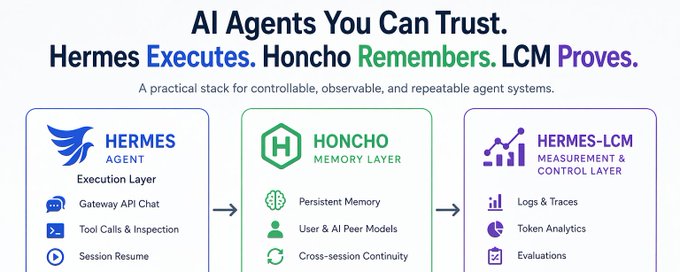
We built around three layers:
- Hermes Agent @NousResearch for execution
- Honcho, self-hosted @honchodotdev for persistent memory and user modeling
- hermes-lcm @SteveSchoettler for measurement, control, and repeatability
The goal was not to make a flashy demo. The goal was to create a system that produces repeatable results.
That is what “result by data” means.
## The problem we were solving
Most agent stacks fail in the same few ways:
They forget context too fast.
They are hard to inspect when something goes wrong.
They look smart, but you cannot measure what they are doing.
They drift from one session to the next.
They are impressive in a demo and unreliable in production.
We wanted the opposite.
We wanted a stack where the agent can act, the memory layer can persist, the control layer can verify, and the output can be audited.
## The real implementation we ship
Hermes Control Interface
Our dashboard is a self-hosted control surface for the Hermes AI agent stack.
It manages:
- terminals
- files
- sessions
- cron jobs
- token analytics
- multi-agent gateways
- team access behind a password gate
So this is not just "chat with an agent" It is infrastructure control for an agent system.
## What Hermes does
Hermes is the execution layer.
In the current implementation it provides:
- real-time Gateway API chat
- streamed responses over SSE
- tool-call cards with JSON inspection
- session resume
- stop controls
- multi-agent profile support
- CLI fallback when gateway chat is unavailable
That matters because it makes execution transparent and resumable.
## What self-hosted Honcho adds
Honcho is the persistent memory and user-model layer.
It gives Hermes three things:
Prompt-time context injection
Cross-session continuity
Durable writeback
Honcho is not a temporary chat buffer. It is the layer that remembers what should still matter later.
Dual-peer structure
Honcho models both sides of the relationship:
- User peer: learns preferences, goals, and communication style
- AI peer: builds the agent’s own knowledge representation
That means the system can keep track of both who it is talking to and what the agent itself has learned.
The documented local setup uses:
- baseUrl: http://localhost:8000
- recallMode: hybrid
- writeFrequency: async
- sessionStrategy: per-directory
- dialecticReasoningLevel: low
- dialecticDynamic: true
- messageMaxChars: 25000
Those settings matter because they define how memory is injected, how often it writes back, and how much context can be handled per message.
## Where Hermes-LCM fits
LCM is the layer that makes the system measurable.
Hermes can execute. Honcho can remember. LCM makes the stack easier to verify, compare, and improve.
Without that layer, you only have agent behavior. With it, you have a system you can inspect.
That is the difference between vibe-based automation and data-based execution.
## The architecture in one flow
User Input
↓
Hermes Agent
↓
Gateway API / CLI fallback
↓
Honcho Memory Layer
↓
LCM Measurement / Control Layer
↓
Session state, logs, usage, and results
The key idea is simple:
- Hermes acts
- Honcho remembers
- LCM proves
## Claim → mechanism → proof
That is the format this stack deserves.
The agent is more consistent
Claim: Self-hosted memory makes the system more consistent.
Mechanism: Honcho injects durable cross-session context and writes back stable facts.
Proof: The documented setup supports hybrid recall, async writeback, and a dual-peer model for stable memory across conversations.
2. The system is easier to inspect
Claim: We can see what the agent is doing instead of guessing.
Mechanism: Hermes Control Interface dashboard exposes streamed responses, tool-call cards, sessions, logs, and usage analytics.
Proof: The implementation includes Gateway API SSE streaming, session resume, real-time logs, and token analytics.
3. The stack is safer to operate
Claim: A self-hosted agent stack can still be controlled.
Mechanism: Authentication, RBAC, CSRF, rate limiting, and service controls are built in.
Proof: The system has 28 permissions, 12 groups, 21 CSRF-protected endpoints, and a password-gated admin surface.
## The actual result
The result is not “AI is smarter.”
The result is:
- less guesswork
- better continuity
- clearer session history
- visible tool execution
- measurable usage
- safer operations
That is what we wanted from the beginning.
A system that does not just produce output, but produces output we can trust.
## Why this stack is worth it
This approach works when you care about three things:
Continuity: the system should remember what matters.
Observability: the system should show its work.
Repeatability: the system should behave consistently across sessions.
If you care about those three things, Hermes Control Interface + self-hosted Honcho + LCM is a very strong pattern.
If you do not care about those three things, you probably only need a prompt.
## Final takeaway
Hermes executes. Honcho remembers. Hermes-LCM proves it.
That is the stack. That is the point. And that is the difference between an agent demo and an actual system.
Ref:
https://github.com/NousResearch/hermes-agent
https://github.com/NousResearch/hermes-agent
https://github.com/stephenschoettler/hermes-lcm
https://github.com/plastic-labs/honcho
## 相关链接
- [david bayendor](https://x.com/bayendor)
- [@bayendor](https://x.com/bayendor)
- [1.6K](https://x.com/bayendor/status/2046755138501800427/analytics)
- [@NousResearch](https://x.com/@NousResearch)
- [@honchodotdev](https://x.com/@honchodotdev)
- [@SteveSchoettler](https://x.com/@SteveSchoettler)
- [https://github.com/NousResearch/hermes-agent](https://github.com/NousResearch/hermes-agent)
- [https://github.com/NousResearch/hermes-agent](https://github.com/NousResearch/hermes-agent)
- [https://github.com/stephenschoettler/hermes-lcm](https://github.com/stephenschoettler/hermes-lcm)
- [https://github.com/plastic-labs/honcho](https://github.com/plastic-labs/honcho)
- [Upgrade to Premium](https://x.com/i/premium_sign_up)
- [8:57 AM · Apr 22, 2026](https://x.com/bayendor/status/2046755138501800427)
- [1,692 Views](https://x.com/bayendor/status/2046755138501800427/analytics)
---
*导出时间: 2026/4/22 14:04:57*