π0.7 与机器人数据公司的误区 ✍ Shreyas Gite🕐 2026-04-22📦 5.2 KB 🟢 已读 𝕏 文章列表 文章批评了仅靠堆砌人类数据解决机器人问题的观点,深度解析了 Physical Intelligence 的 π0.7 论文。π0.7 通过拒绝仿真数据、利用子目标图像作为引导(Affordances)、以及增加详细的任务元数据(如子目标、子任务指令)来解决数据冲突,实现了跨具身迁移和更好的指令遵循。作者指出,机器人数据公司应通过自建机器人并提供高质量注释来创造价值,而非单纯销售原始数据。 机器人π0.7Physical Intelligence世界模型具身智能数据工程迁移学习 # π0.7 and Everything Robot Data Companies Are Getting Wrong **作者**: Shreyas Gite **日期**: 2026-04-20T11:09:21.000Z **来源**: [https://x.com/shreyasgite/status/2046184441152684203](https://x.com/shreyasgite/status/2046184441152684203) --- 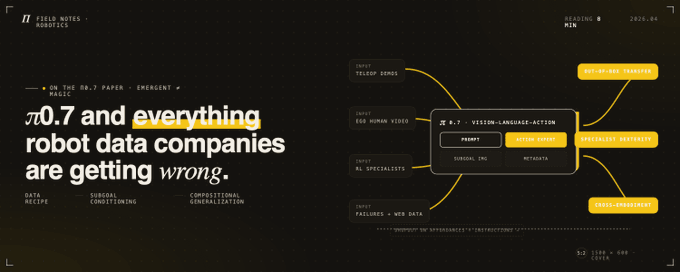 There is a popular view that if you collect enough human ego-data and throw it at a robot, the problem is solved. You would believe it too, if all you saw was the GEN-1 demo reel claiming 500K hours of human data and 1h of task-specific data without going into details about data engineering. Thank god for the Physical Intelligence team putting out the π0.7 paper. 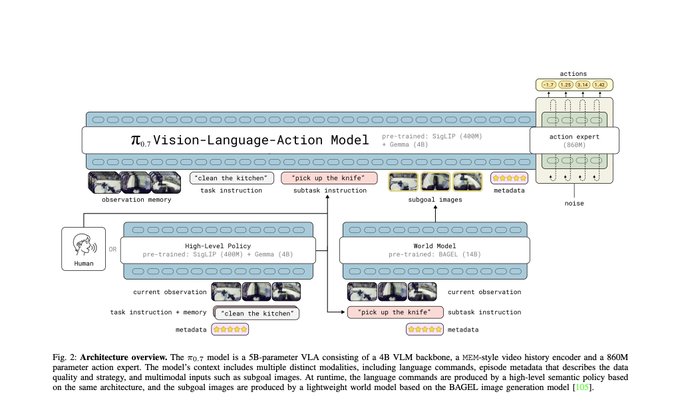 A small aside on the title. "Emergent Capabilities" is overselling. Most of the gains in the paper come from specific, nameable engineering choices. - All kinds of data (but not sim data) - You have PD control loops for joint angles. - Inverse kinematics for end effectors - Affordances, Affordances, affordances: subgoal images. Task breakdowns - Dropouts during training but on affordances & instructions ## The data π0.7 uses every kind of data except sim data. Teleop demos, autonomous rollouts, RL specialist trajectories, outright failures, egocentric human video, web data. The heavy lifting happens in the prompt itself. Subgoal images, subtask instructions, episode metadata. All of them get dropped out during training so the model learns to cope with any subset at test time. ## Why naive scaling does not work Annotation density of how the episode went is what unlocks scale. Without metadata, naive training averages across conflicting strategies. The paper's phrase is "averaging together different behaviors." You pour in more data, the model gets worse, because the strategies inside the data disagree with each other. Scale without context is a curse. 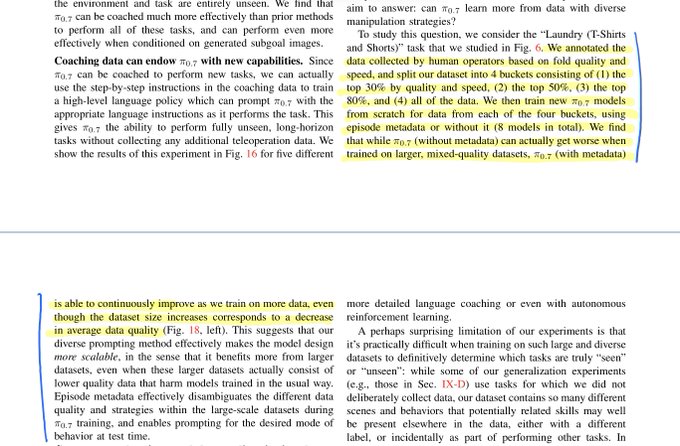 Adding a data-quality score to the metadata during training is the fix. You can now pour in a bigger, messier dataset and counter the data-quality curse at the same time. Metadata carries the signal that tells the model which examples to imitate and which to merely learn the state distribution from. ## Subgoal conditioning as a bootstrapped World Model 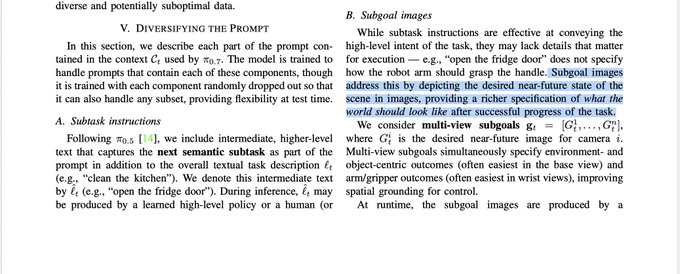 Running a world model to roll out full future trajectories is expensive. π0.7's workaround is to discretise this continuous future. Predict a single future frame, the subgoal, and condition the policy on that. 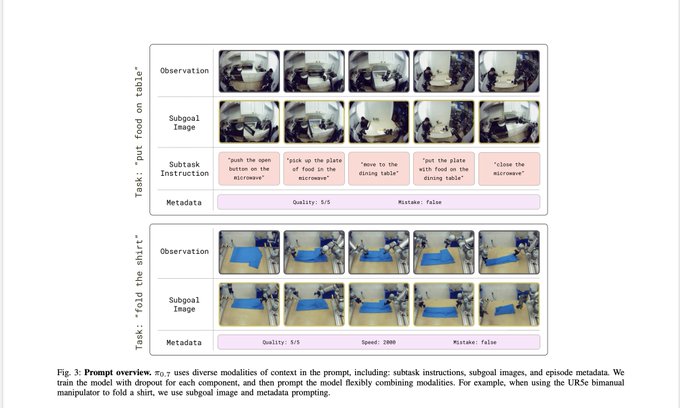 With a SuSIE-style subgoal image in the prompt, action prediction stops being open-loop planning and becomes inverse dynamics: "what action gets me from the current observation to this future observation?" The conditioning collapses the hypothesis space. ## Why instruction following finally works People have complained that π0 and π0.5 broke the moment you changed "drop x on the left" to "drop x on the right," because most of the training data drifted one direction. The policy learned the task distribution, not the language.  π0.7's answer is not just more linguistically diverse tasks. It is that subgoal image conditioning has a stronger effect than language in overriding the task prior. You tell the model what the world should look like after the action, and it will get there even when the language says something the training data rarely said. ## Cross-embodiment transfer The claim is "no task-specific data." It does not mean no embodiment data. The policy saw the target robot doing other things. It just never saw that robot doing this task. Nevertheless pretty cool and ties into compositional generalization. ## Compositional generalization is the north star This is the goal the whole field is now chasing. Russ Tedrake has been campaigning it for years. Physical Intelligence, Generalist, Skild, Sunday, basically every serious robotics company is pointing at the same target. The disagreement is only about which data source gets you there. π0.7's bet is that the answer is not more data of one kind, but much better-annotated data of many kinds. As a robot data company, you need to start building and training your own robots, and then make your learnings, annotations and models available. Only then the companies will buy data from you. Even Nvidia had a build an end-to-end selfing driving model and demo car in 2016 to sell their GPUs and services auto industry. ## 相关链接 - [Shreyas Gite](https://x.com/shreyasgite) - [@shreyasgite](https://x.com/shreyasgite) - [50K](https://x.com/shreyasgite/status/2046184441152684203/analytics) - [π0.7 paper.](https://www.pi.website/download/pi07.pdf) - [Upgrade to Premium](https://x.com/i/premium_sign_up) - [7:09 PM · Apr 20, 2026](https://x.com/shreyasgite/status/2046184441152684203) - [50.2K Views](https://x.com/shreyasgite/status/2046184441152684203/analytics) - [View quotes](https://x.com/shreyasgite/status/2046184441152684203/quotes) --- *导出时间: 2026/4/22 11:07:07*
A Alignment Unlocks Scaling:Qwen-Robot Suite 的设计原理和背后的思考 文章介绍了Qwen团队推出的Qwen-Robot Suite,包含Qwen-RobotNav、Qwen-RobotManip和Qwen-RobotWorld三项工作。核心思想是通过解决具身智能中异构数据的对齐问题,实现模型的规模化扩展,并在多项基准测试中取得SOTA结果。 技术 › LLM ✍ 青稞社区🕐 2026-07-29 Qwen具身智能机器人大模型VLA对齐世界模型导航操作直播预告
翻 翻译:李飞飞关于世界模型的分类 本文基于李飞飞的观点,深入探讨了“世界模型”这一AI术语在当前语境下的定义与功能。文章通过强化学习中的POMDP框架,将世界模型系统分为三类:输出视觉观察的“渲染器”、输出物理状态的“模拟器”以及输出行动指令的“规划器”。作者指出,尽管渲染器目前商业应用最成熟,但模拟器作为连接视觉与行动的桥梁,是实现空间智能和通用机器人的关键。文章最后预测,这三类功能的边界将逐渐坍缩,最终融合为一个统一的、能够理解并交互物理世界的基础模型。 技术 › LLM ✍ Mr Panda🕐 2026-06-05 世界模型空间智能李飞飞强化学习AI具身智能模拟器计算机视觉机器人
什 什么是具身智能?它跟 AI 的关系是什么? 文章深入解析了具身智能的定义、历史渊源及发展现状。作者区分了具身智能与传统机器人,指出其核心在于感知-行动闭环与物理世界的实时交互。文章回顾了从符号主义、行为主义到深度学习、Transformer时代的技术演进,分析了VLA模型如何继承大模型能力来突破泛化难题,探讨其与AI的本质关系及未来前景。 技术 › LLM ✍ snowboat🕐 2026-06-17 具身智能VLA机器人Transformer人工智能AI技术原理深度学习大模型
你 你不知道的具身智能:从小机器狗到 Optimus 本文记录了作者组装一台小机器狗的实践过程,并以此引出对具身智能技术栈的深度剖析。文章涵盖了从硬件选型(STM32, ESP32)到空间感知(SLAM, 3D表示),再到动作控制模型(VLA, RT系列)的演进,最后重点分析了 Tesla Optimus 在工程制造、时空分层与能耗上的技术难点。 技术 › 人工智能 ✍ Tw93🕐 2026-06-07 具身智能机器人VLASLAM硬件开发Tesla Optimus技术笔记机器狗
T The Next Intelligence Breakthrough Won’t Look Like the Last 本文记录了 AGI House 举办的一场关于前沿 AI 研究的晚宴讨论。参与嘉宾包括来自 OpenAI、Google DeepMind、Meta 及斯坦福等机构的顶尖研究人员与投资人。讨论重点从单纯的模型规模扩展转向系统化智能,核心观点包括:机器人仿真即将迎来类似 LLM 的突破时刻、智能将从目前的串行处理转向并行处理、AI 代理(尤其是编程 Agent)可能是通向 AGI 的路径,以及评估体系的滞后正成为新的瓶颈。 技术 › LLM ✍ AGI House🕐 2026-04-26 AGI机器人仿真世界模型编程AgentAI研究OpenAI并行智能评估体系智能架构
因 因子图与“世界模型”:统一的感知与规划框架 文章探讨了世界模型与因子图之间的深层联系。作者指出,因子图本质上是基于能量的模型,可用于状态估计和SLAM。通过将世界模型锚定在“现在”,文章提出了STAG框架,该框架利用统一的因子图优化机制,同时处理基于过去数据的感知和基于未来目标的规划,实现了感知与行动的无缝融合。 技术 › LLM ✍ Frank Dellaert🕐 2026-04-24 世界模型因子图机器人SLAM规划感知能量模型STAG优化论文
为 为什么 Strike Robot 是 Physical AI 时代的「OpenAI 时刻」? 文章探讨了 Strike Robot 在 Physical AI(具身智能)领域的重要地位。作者将其比作 OpenAI 时刻,认为该平台通过 SR Agentic 智能体和云端强化学习,实现了从仿真到现实世界的无缝迁移。Strike Robot 专注于高风险 BPO 业务,不仅解决了具身智能的落地难题,还通过 $SR 代币构建了共享生态,标志着 AI 从“思考”走向“行动”的普惠时代。 技术 › Agent ✍ 蓝|目标A9🕐 2026-04-22 Physical AIStrike Robot具身智能机器人AI Agent投资分析Web3SR Agentic
中 中国风投生态运作机制 文章分析了中国风险投资生态的独特性,指出尽管中国在开源AI、生物技术和机器人领域具有优势,但其资本市场对创始人更为严苛。文章解释了为何中国初创公司倾向于IPO而非被收购,并详细介绍了人民币基金、美元基金和外资基金这三种资本池的特点与差异。 投资 › 宏观经济 ✍ Bohan🕐 2026-07-29 中国风投IPO资本生态人工智能机器人生物科技
顶 顶尖VC 2026年动向观察:硬基建与深垂直的押注 文章分析了2026年顶尖独立VC机构的投资动向,指出资本正从浅层应用转向硬基建、物理世界和深垂直领域。通过分析赛道年龄、轮次和具体公司(如Atoms、Etched、Cognition等),揭示了AI创业窗口正在收窄,而推理芯片、机器人、企业Agent及特定垂直工作流成为投资热点。 投资 › 风投 ✍ snowboat🕐 2026-07-28 风投AI硬科技机器人Agent芯片垂直行业创业
T Telegram 用了几年还只会用来聊天 文章介绍了10个实用的Telegram Bot,包括邮件收发、多语言翻译、视频下载、群管理、贴纸制作等功能,帮助用户发掘Telegram的隐藏工具,提升使用效率。 技术 › 工具与效率 ✍ Suu🕐 2026-07-27 Telegram机器人效率工具翻译视频下载群管理贴纸
C Cosmic Robotics: 自主建造技术在地球与火星的应用 Cosmic Robotics 推出其首款 10,000 磅的自主建造机器人 Cosmic-1,旨在通过提升太阳能农场和数据中心的建造效率,最终实现火星城市的自动化建设。该机器人已在极端环境下投入使用,并显著提高劳动生产力。 技术 › 机器人 ✍ Ankit Gupta🕐 2026-07-24 机器人自动化火星建设太阳能数据中心Cosmic Robotics自主建造AI
P Proprio Robotics:实现自主数据中心 Proprio Robotics 推出新型机器人,能够处理服务器的组装、维护和退役全生命周期,使数据中心实现无人化运营。其创始人来自伯克利和哈佛机器人实验室,已成功在办公室建立并运行小型 AI 数据中心。 技术 › 机器人 ✍ Ankit Gupta🕐 2026-07-23 机器人数据中心自主运维AI服务器自动化Proprio Robotics硬件