因子图与“世界模型”:统一的感知与规划框架 ✍ Frank Dellaert🕐 2026-04-24📦 13.0 KB 🟢 已读 𝕏 文章列表 文章探讨了世界模型与因子图之间的深层联系。作者指出,因子图本质上是基于能量的模型,可用于状态估计和SLAM。通过将世界模型锚定在“现在”,文章提出了STAG框架,该框架利用统一的因子图优化机制,同时处理基于过去数据的感知和基于未来目标的规划,实现了感知与行动的无缝融合。 世界模型因子图机器人SLAM规划感知能量模型STAG优化论文 # Factor Graphs and "World Models" **作者**: Frank Dellaert **日期**: 2026-04-22T16:55:03.000Z **来源**: [https://x.com/fdellaert/status/2046996213669450096](https://x.com/fdellaert/status/2046996213669450096) --- 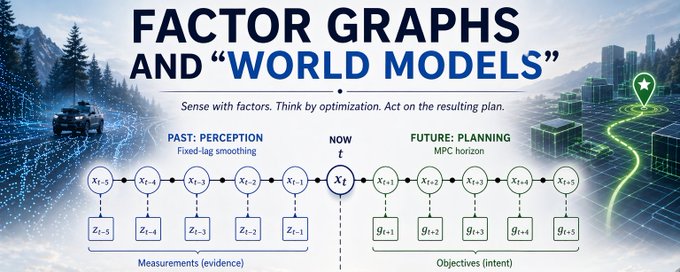 There is a lot of excitement right now around world models: learned latent-state representations that support prediction, imagination, and planning. The recent work around JEPA is especially interesting, as it aims to learn useful latent dynamics that can support downstream decision making and planning, as in the recent LeWorldModel [3] paper, and more broadly in @ylecun's 2022 position paper A Path Towards Autonomous Machine Intelligence [2]. This connects naturally to Yann's earlier work on energy-based models [1], where the central idea is not to generate outputs one token at a time, but to define an energy landscape and then minimize it. The jury is still out, but I’m a fan 🙂. More importantly, from a factor-graph point of view, this all feels very familiar. ## 1. Factor graphs are energy-based models A factor graph defines a probability distribution up to normalization: p(x | z) ∝ ∏ᵢ ϕᵢ(xᵢ) where each factor ϕᵢ expresses a local probabilistic relationship among some subset of variables xᵢ, conditioned on measurements z. Taking the negative log gives an energy: E(x) = −log p(x | z) = Σᵢ Eᵢ(xᵢ) + constant Hence, maximum a posteriori inference is energy minimization. That observation has been the basis of state estimation, smoothing, and SLAM for a long time. In robotics, we already know how to represent dynamics, measurements, priors, and constraints as factors. We already know how to optimize the resulting energy efficiently. In that sense, factor graphs are a very concrete and highly structured form of energy-based world modeling, exactly the perspective developed in the Dellaert and Kaess’s "Factor Graphs for Robot Perception" booklet [4]. ## 2. From estimation to planning 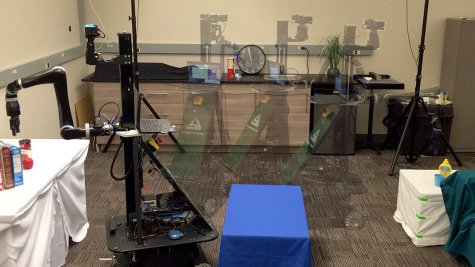 The Vector mobile manipulator, with an omni-drive base and a 6-DOF Kinova JACO2 arm, is solving the STEAP problem. The task involves picking up an object from the white table on the right and dropping it off on the white table on the left. The semi-transparent robots show the trajectory taken, while the solid robot is the goal configuration In our earlier STEAP work [5] (Simultaneous Trajectory Estimation And Planning), we extended the same factor-graph machinery to planning. There, estimation and planning were treated in a unified optimization framework over an entire trajectory. The same graph could encode what the robot had observed, how it could move, and what trajectory it should follow to get from point a to point b. That was an important step, but it still assumes a fixed interval [a, b]: there is a start, there is a goal, and we optimize over the trajectory connecting the two. The more interesting question is what happens if we anchor the whole construction at the current time t, rather than thinking in terms of one fixed offline interval. ## 3. Anchor the graph at “now” Suppose we center everything around the present time t. Then we can think of the robot’s world as split into two closely related factor graphs: - a graph over the recent past, used for perception and state estimation - a graph over the near future, used for planning and control Both graphs share the same state representation and the same dynamics model. The difference is what information they are tied to: - the past is tied to measurements - the future is tied to objectives This is exactly the kind of structure one would expect from a practical world model: infer the hidden state from recent evidence, then optimize the likely future under the same transition model. ## 4. Perception as fixed-lag smoothing  A fixed-lag smoothing graph for perception. Each dynamics factor connects neighboring states together with a known control input, while unary measurement factors summarize the sensor evidence over the last five seconds. For perception, consider a factor graph over the last five seconds: xₜ₋₅, xₜ₋₄, …, xₜ On this graph we place: - dynamics factors between successive states, each coupled to a known control input uₖ - unary measurement factors that connect each state to the relevant sensor observations Optimizing this graph gives a fixed-lag smoother. Rather than filtering only forward, we re-estimate the recent trajectory using all measurements within the lag window. That gives a better estimate of the current state xₜ, while still keeping the computation bounded and online. In this inference problem, the controls over the recent past are part of the observed history: commanded wheel velocities, torques, or thrusts are already known, and so they enter the graph as known variables attached to the dynamics factors. This is the standard factor-graph view of perception: the robot’s recent past is inferred by minimizing an energy defined by dynamics plus measurements. ## 5. Planning as a future factor graph  A model-predictive control (MPC) graph for planning. The *same* dynamics factors connect the future states, but now the controls are optimization variables, and the unary terms are goal or objective factors rather than measurements. Now look at the next five seconds: xₜ, xₜ₊₁, …, xₜ₊₅ Again, we use the same dynamics factors. That is important: the robot should think about the future using the same transition structure with which it interprets the past. But in the planning graph, the controls are no longer known. They are optimized jointly with the future states over the horizon. This is the familiar collocated optimal control view: states and controls live on the same time grid and are solved for together. The unary factors are also different. Instead of measurement factors, we introduce goal or objective factors. Let us denote these as gₜ₊₁, …, gₜ₊₅ over the horizon. These could represent: - goal-reaching costs - collision-avoidance costs - control-effort penalties - stability or balance objectives - task-specific preferences Optimizing this future graph gives a trajectory in the familiar model-predictive control style: solve over a short horizon, execute the first action, move forward in time, then rebuild and re-optimize. The structure is almost the mirror image of perception. In the past, unary factors tell us what the sensors observed. In the future, unary factors tell us what we want. ## 6. STAG: Sense-Think-Act via factor graphs 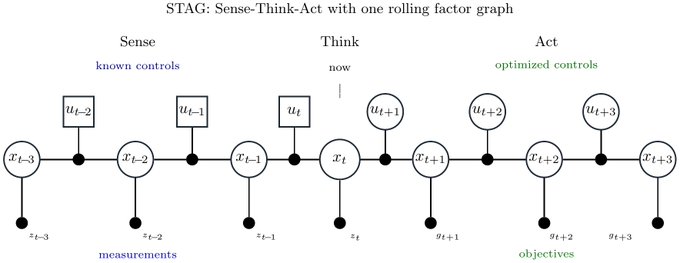 The combined picture: a single rolling factor graph centered on the current state. The left half explains the recent past from measurements and known controls, while the right half plans the near future with goal factors and optimized controls. Put these two pieces together and a simple picture emerges: - Sense: gather the recent evidence from measurements and controls - Think: optimize factor graphs over both the recent past and the near future - Act: execute the first part of the optimized future trajectory This is really Sense-Think-Act with factor Graphs. Both sensing and planning are carried out by optimization over factors; "thinking" is the optimization layer that spans both. Let us call it STAG. The appealing part is that STAG does not require a sharp separation between “perception” and “planning”. Both are instances of the same underlying idea: define a state write down dynamics add factors minimize energy Past and future are handled by nearly the same computational machinery, just with different unary terms. One graph explains evidence. The other graph expresses intent. The picture is clear: a single rolling graph spans both the recent past and near future, anchored at the current state xₜ. On the left are measurement factors. On the right are goal factors gₜ₊₁, …, gₜ₊₅. In the middle sits the current latent state, tying perception and planning together. ## 7. Open Questions Once stated this way, the core questions for any robot become very clear. For a given platform, what do we need to define, or perhaps learn? What is the state? Is it pose and velocity? Joint angles and contact models? A full belief state over robot and environment? Can we learn this representation? What is the dynamics model? Is it analytic, learned, or hybrid? Is it first-order, second-order, or manifold-valued? What is the measurement model? How do cameras, IMUs, force sensors, wheel encoders, or tactile signals connect to the latent state? What are the objectives for the future? What should the robot optimize for over the next few seconds? Is this where reinforcement learning enters the picture? One could also take issue with the specific topology of the factor graphs and whether they should even be probabilistic at all. Conditional random fields (CRFs), for example, do not insist on having unary factors for perception. And in general, joint states in the past and future could be hooked up to neural networks that measure their energy. Finally, optimization could be taken to be more general: sampling based methods like MPPI might just work just as well or better. I don’t have answers to all these questions, but we’ve started to play around with this model, and I think it is an interesting direction. ## Summary The current interest in world models, JEPA, and energy-based models is exciting. But from the perspective of factor graphs, there is also a deep continuity with ideas that robotics and estimation have used for years. Factor graphs are already energy-based models. Their negative log likelihood is already an energy. State estimation and SLAM have long exploited this fact. STEAP showed that planning can live in the same optimization framework. The next step is to anchor everything at the present and view the robot as carrying two tightly coupled graphs: - a past graph for perception - a future graph for planning Using the same state and the same dynamics on both sides gives a simple and powerful recipe for online robot intelligence: both sensing and planning are carried out by optimization over factors, and "thinking" is the optimization layer that spans them. We act on the resulting plan. That is STAG. ## Acknowledgements The STEAP work was done with Mustafa Mukadam, Jing Dong and Byron Boots. Recent thinking in this space benefited a lot from discussions with Andrew Wong, Aaron Bong, Yuxin Yang, Ali Hasnain, and Harish Ravichandrar. ## References "A Tutorial on Energy-Based Learning", Yann LeCun, Sumit Chopra, Raia Hadsell, Marc'Aurelio Ranzato, Fu-Jie Huang, in *Predicting Structured Outputs*, MIT Press, 2006. A Path Towards Autonomous Machine Intelligence, Yann LeCun, position paper, version 0.9.2, June 27, 2022. “LeWorldModel: Stable End-to-End Joint-Embedding Predictive Architecture from Pixels”, Lucas Maes, Quentin Le Lidec, Damien Scieur, Yann LeCun, Randall Balestriero, arXiv, March 13, 2026. “Factor Graphs for Robot Perception”, Frank Dellaert, Michael Kaess, Foundations and Trends in Robotics, 2017, Vol. 6, No. 1-2, pp. 1-139. “STEAP: Simultaneous Trajectory Estimation and Planning”, Mustafa Mukadam, Jing Dong, Frank Dellaert, Byron Boots, Autonomous Robots, 2019, Vol. 43, No. 2, pp. 415-434. This article was also posted on the GTSAM blog. ## 相关链接 - [Frank Dellaert](https://x.com/fdellaert) - [@fdellaert](https://x.com/fdellaert) - [22K](https://x.com/fdellaert/status/2046996213669450096/analytics) - [LeWorldModel [3] paper](https://doi.org/10.48550/arXiv.2603.19312) - [@ylecun](https://x.com/@ylecun) - [A Path Towards Autonomous Machine Intelligence](https://openreview.net/pdf?id=BZ5a1r-kVsf) - [Yann's earlier work on energy-based models](https://yann.lecun.org/exdb/publis/pdf/lecun-06.pdf) - [Dellaert and Kaess’s "Factor Graphs for Robot Perception" booklet [4].](https://doi.org/10.1561/2300000043) - [STEAP](https://doi.org/10.1007/s10514-018-9770-1) - ["A Tutorial on Energy-Based Learning"](https://yann.lecun.org/exdb/publis/pdf/lecun-06.pdf) - [A Path Towards Autonomous Machine Intelligence](https://openreview.net/pdf?id=BZ5a1r-kVsf) - [“LeWorldModel: Stable End-to-End Joint-Embedding Predictive Architecture from Pixels”](https://doi.org/10.48550/arXiv.2603.19312) - [“Factor Graphs for Robot Perception”](https://doi.org/10.1561/2300000043) - [“STEAP: Simultaneous Trajectory Estimation and Planning”](https://doi.org/10.1007/s10514-018-9770-1) - [GTSAM blog](https://gtsam.org/2026/04/21/factor-graphs-and-world-models.html) - [Upgrade to Premium](https://x.com/i/premium_sign_up) - [12:55 AM · Apr 23, 2026](https://x.com/fdellaert/status/2046996213669450096) - [22.7K Views](https://x.com/fdellaert/status/2046996213669450096/analytics) - [View quotes](https://x.com/fdellaert/status/2046996213669450096/quotes) --- *导出时间: 2026/4/24 10:56:53*
A Alignment Unlocks Scaling:Qwen-Robot Suite 的设计原理和背后的思考 文章介绍了Qwen团队推出的Qwen-Robot Suite,包含Qwen-RobotNav、Qwen-RobotManip和Qwen-RobotWorld三项工作。核心思想是通过解决具身智能中异构数据的对齐问题,实现模型的规模化扩展,并在多项基准测试中取得SOTA结果。 技术 › LLM ✍ 青稞社区🕐 2026-07-29 Qwen具身智能机器人大模型VLA对齐世界模型导航操作直播预告
你 你不知道的具身智能:从小机器狗到 Optimus 本文记录了作者组装一台小机器狗的实践过程,并以此引出对具身智能技术栈的深度剖析。文章涵盖了从硬件选型(STM32, ESP32)到空间感知(SLAM, 3D表示),再到动作控制模型(VLA, RT系列)的演进,最后重点分析了 Tesla Optimus 在工程制造、时空分层与能耗上的技术难点。 技术 › 人工智能 ✍ Tw93🕐 2026-06-07 具身智能机器人VLASLAM硬件开发Tesla Optimus技术笔记机器狗
翻 翻译:李飞飞关于世界模型的分类 本文基于李飞飞的观点,深入探讨了“世界模型”这一AI术语在当前语境下的定义与功能。文章通过强化学习中的POMDP框架,将世界模型系统分为三类:输出视觉观察的“渲染器”、输出物理状态的“模拟器”以及输出行动指令的“规划器”。作者指出,尽管渲染器目前商业应用最成熟,但模拟器作为连接视觉与行动的桥梁,是实现空间智能和通用机器人的关键。文章最后预测,这三类功能的边界将逐渐坍缩,最终融合为一个统一的、能够理解并交互物理世界的基础模型。 技术 › LLM ✍ Mr Panda🕐 2026-06-05 世界模型空间智能李飞飞强化学习AI具身智能模拟器计算机视觉机器人
T The Next Intelligence Breakthrough Won’t Look Like the Last 本文记录了 AGI House 举办的一场关于前沿 AI 研究的晚宴讨论。参与嘉宾包括来自 OpenAI、Google DeepMind、Meta 及斯坦福等机构的顶尖研究人员与投资人。讨论重点从单纯的模型规模扩展转向系统化智能,核心观点包括:机器人仿真即将迎来类似 LLM 的突破时刻、智能将从目前的串行处理转向并行处理、AI 代理(尤其是编程 Agent)可能是通向 AGI 的路径,以及评估体系的滞后正成为新的瓶颈。 技术 › LLM ✍ AGI House🕐 2026-04-26 AGI机器人仿真世界模型编程AgentAI研究OpenAI并行智能评估体系智能架构
π π0.7 与机器人数据公司的误区 文章批评了仅靠堆砌人类数据解决机器人问题的观点,深度解析了 Physical Intelligence 的 π0.7 论文。π0.7 通过拒绝仿真数据、利用子目标图像作为引导(Affordances)、以及增加详细的任务元数据(如子目标、子任务指令)来解决数据冲突,实现了跨具身迁移和更好的指令遵循。作者指出,机器人数据公司应通过自建机器人并提供高质量注释来创造价值,而非单纯销售原始数据。 技术 › Agent ✍ Shreyas Gite🕐 2026-04-22 机器人π0.7Physical Intelligence世界模型具身智能数据工程迁移学习
C ChatGPT Agent Loop 优化技术解析 本文深入解析了 ChatGPT 如何通过 Harness、API 和 Inference 三层架构优化 Agent 循环,重点介绍了持久化 WebSocket、增量 Token 化、KV 缓存管理和推测解码等技术,以降低成本并提升效率。 技术 › Harness Engineering ✍ Bytebytego🕐 2026-07-30 Agent优化LLM架构ChatGPTOpenAI性能成本控制WebSocketTokenization
P Pragmatic Leverage in the Software Factory 文章探讨了在软件开发中如何通过AI实现杠杆效应。仅用AI写代码只能加速部分流程,而结合规划与对齐才能获得更大效率提升。作者通过“预期痛苦”公式分析前期投入与返工成本的关系,强调在多层次规划中保持实用主义,以最大化减少返工概率。 技术 › 工具与效率 ✍ dex🕐 2026-07-30 AI软件工厂杠杆效应规划效率DevOps方法论
中 中国风投生态运作机制 文章分析了中国风险投资生态的独特性,指出尽管中国在开源AI、生物技术和机器人领域具有优势,但其资本市场对创始人更为严苛。文章解释了为何中国初创公司倾向于IPO而非被收购,并详细介绍了人民币基金、美元基金和外资基金这三种资本池的特点与差异。 投资 › 宏观经济 ✍ Bohan🕐 2026-07-29 中国风投IPO资本生态人工智能机器人生物科技
从 从一张好看的图,到一套能持续生产的画风:我为什么做 hand-drawn-styles 本文介绍了作者开发 hand-drawn-styles 项目的初衷,即为了解决 AI 生成视频时画风不一致的问题。文章以北欧纸雕风格为例,详细讲解了如何通过控制生图和视频提示词,以及严格的验收标准,来实现稳定、高质量的视觉输出。作者建议从简单的 5 秒视频开始测试,逐步优化生产流程。 技术 › Skill ✍ 多肉|AI 内容增长架构师🕐 2026-07-29 AI画风图生视频提示词生产力hand-drawn-styles视觉设计工作流优化实践
顶 顶尖VC 2026年动向观察:硬基建与深垂直的押注 文章分析了2026年顶尖独立VC机构的投资动向,指出资本正从浅层应用转向硬基建、物理世界和深垂直领域。通过分析赛道年龄、轮次和具体公司(如Atoms、Etched、Cognition等),揭示了AI创业窗口正在收窄,而推理芯片、机器人、企业Agent及特定垂直工作流成为投资热点。 投资 › 风投 ✍ snowboat🕐 2026-07-28 风投AI硬科技机器人Agent芯片垂直行业创业
T Telegram 用了几年还只会用来聊天 文章介绍了10个实用的Telegram Bot,包括邮件收发、多语言翻译、视频下载、群管理、贴纸制作等功能,帮助用户发掘Telegram的隐藏工具,提升使用效率。 技术 › 工具与效率 ✍ Suu🕐 2026-07-27 Telegram机器人效率工具翻译视频下载群管理贴纸
C Cosmic Robotics: 自主建造技术在地球与火星的应用 Cosmic Robotics 推出其首款 10,000 磅的自主建造机器人 Cosmic-1,旨在通过提升太阳能农场和数据中心的建造效率,最终实现火星城市的自动化建设。该机器人已在极端环境下投入使用,并显著提高劳动生产力。 技术 › 机器人 ✍ Ankit Gupta🕐 2026-07-24 机器人自动化火星建设太阳能数据中心Cosmic Robotics自主建造AI