# The Next Intelligence Breakthrough Won’t Look Like the Last
**作者**: AGI House
**日期**: 2026-04-26T02:20:36.000Z
**来源**: [https://x.com/agihouse_org/status/2048225702198288675](https://x.com/agihouse_org/status/2048225702198288675)
---
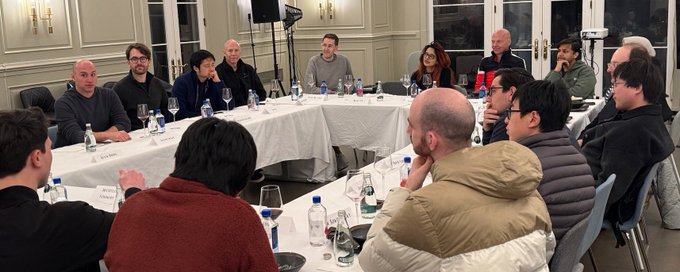
On Feburary 18, AGI House hosted a dinner on frontier AI research.
Around the table were researchers who helped build early RL systems at major labs, architects of open-source model ecosystems, distributed systems pioneers, robotics builders, AI-for-science founders, professors, investors, and infrastructure operators. The conversation spanned robotics simulation, parallel intelligence, self-improving systems, Chinese hardware supply chains, coding agents, world models, and whether someone in the room might accidentally trigger a $100B public company collapse within two months.
Who is in the room:
Sebastian Thrun (Co-founder @ Waymo), Peter Welinder (VP @ OpenAI), Thomas Kipf (Research Scientist @ Google DeepMind), Joseph Spisak (Director @ Meta Superintelligence), Ankur Handa (Co-lead, Dex Team @ NVIDIA), Robert Nishihara (Co-founder @ AnyScale), Tim Shi (Co-founder @ Cresta), Nazneen Rajani (CEO @ Collinear), Robert Yang (CEO @ Fundamental Research Labs), Carina Hong (CEO @ Axiom Math), Volodymyr Kuleshov (Co-founder @ Inception Labs), Joyee Wang (Researcher @ Stanford AI Lab), Jesus Lares (MTS @ AGI House), Kexin Huang (CEO @ Phylo Bio), Di Jin (Co-founder @ Eigen AI), Patrick McGovern (Chair @ McGovern Foundation), Lavanya Shukla (Head of AI @ CoreWeave), David Cahn (Partner @ Sequoia Capital), Rocky Yu (Founder @ AGI House, Host)📷
Below is a synthesis of the themes that emerged.
The Frontier Is Shifting: From Bigger Models to Better Systems
The conversation quickly moved beyond “just scale it.”
Yes, scaling laws still hold directionally. Yes, frontier training runs cost hundreds of millions of dollars. But the deeper questions now are:
- How do we move from sequential intelligence to parallel intelligence?
- How do we embed time, memory, and continual learning directly into architectures?
- How do we scale systems, not just models?
- How do we make AI operate robustly in the real world — not just benchmarks?
The tone wasn’t hype-driven. It was architectural.
Simulation Is About to Have Its LLM Moment
One of the strongest themes of the evening: we are dramatically underinvesting in simulation — especially for robotics.
Several participants argued:
- Physics engines are underutilized.
- Teleoperation doesn’t scale.
- We’re still overly dependent on real-world data collection.
Prediction: Within 2–3 years, robotics simulation will hit a breakthrough moment similar to what LLMs experienced with text generation.
World models and video generation systems are approaching visual indistinguishability (e.g., Sora-class systems), but they are not yet physically consistent enough for training robot controllers. Temporal coherence and contact dynamics remain bottlenecks.
That said:
- Within 1–2 years, training robot controllers primarily in simulation may become viable.
- Robotics will achieve impressive pick-and-place capabilities within ~2 years.
- The U.S. is underestimating China’s hardware and robotics supply chain advantage.
Intelligence: Sequential Today, Parallel Tomorrow
A provocative idea: today’s intelligence is fundamentally sequential — token by token, step by step.
But human cognition is massively parallel.
Diffusion-based language models generating ~1,000 tokens per second were cited as early signals of a shift away from strictly autoregressive thinking. The broader claim:
Intelligence will need to become parallel to break through current ceilings.
Related idea: Transformer architectures may not be sufficient for AGI without explicitly incorporating time and memory dynamics into their core design.
The Efficiency Gap Is Still Massive
One debate centered around computability and efficiency:
- The estimated lifetime electricity cost of a human brain is roughly ~$500 at retail energy prices.
- Frontier AI systems require training runs costing hundreds of millions to approach similar levels of competence in narrow domains.
Implication: There are still orders of magnitude of efficiency gains available.
Algorithmic improvements may ultimately matter more than raw compute expansion.
Coding Agents as a Path to AGI
A recurring thesis: intellectual work already happens on computers.
If AGI emerges first anywhere, it may not be in robotics — it may be in coding agents capable of autonomously:
- Writing production software
- Debugging large systems
- Designing experiments
- Improving their own infrastructure
Some argued that certain frontier systems are already better than any single engineer in constrained domains.
Others pushed back, pointing to brittleness, lack of generality, and robustness failures.
The table was split on whether “AGI” has already been achieved in narrow economic terms.
Evaluation Is the Quiet Bottleneck
Benchmarks are saturating. Public leaderboards are gamed. Real-world robustness remains unsolved.
Formal verification is gaining renewed attention in AI safety discussions. If models are writing critical infrastructure code, probabilistic correctness may not be enough.
A strong consensus emerged:
Evaluation may be the true bottleneck of 2026.
Robotics & Physical AI: The Infrastructure Layer Matters
Discussion shifted toward physical AI and supply chains:
- Chinese robotics hardware development is accelerating rapidly.
- U.S. investors are underestimating the scale and velocity of progress.
- Supply chain and manufacturing infrastructure may be the real constraint on robotics scaling.
Waymo adoption was cited as evidence that society will accept AI in life-critical contexts faster than expected — once reliability crosses a certain threshold.
World Models & Video Generation
Video generation systems are crossing visual indistinguishability thresholds.
But visual realism ≠ physical consistency.
Key challenges remaining:
- Temporal consistency over long rollouts
- Contact dynamics modeling
- Bridging visual world models with control policies
- Using video models for training, not just evaluation
The optimistic view: 1–2 years to meaningful simulation-based robot controller training.
The cautious view: physics modeling remains underdeveloped relative to visual modeling.
Systems Over Single Models
There was broad agreement that AGI will likely emerge from systems, not a single monolithic model.
Important research directions raised:
- Continual learning
- Context engineering
- Long-horizon memory management
- Active exploration in RL vs passive token sampling
- Multi-modal integration beyond vision
- Distributed systems for heterogeneous AI workloads
One especially sharp idea:
Context engineering may become a bigger compute workload than training.
Inference-time compute — reasoning loops, tool calls, search trees — may rival or exceed training-time compute.
Economic Shockwaves
The conversation turned speculative at times.
Questions raised:
- Will 50% of GDP be AI-generated by the end of 2027?
- What does a post-AGI economy even look like?
- What are the limits of human intelligence in comparison to synthetic systems?
One bold prediction:
Someone at this table will trigger a $100B public company loss within two months — via an AI-related incident that becomes major media news.
The point wasn’t recklessness. It was acknowledgment of the scale of leverage now in play.
🔥 Hot Takes from the Table
Here’s a distilled list of sharper claims and predictions from the evening:
- We are underinvesting in simulation — robotics will have its LLM moment within 2–3 years.
- Teleoperation doesn’t scale; physics engines are massively underutilized.
- Transformer architectures alone cannot achieve AGI — time must be built into the architecture.
- Intelligence today is sequential; the next leap requires parallelism.
- Coding agents are the most likely path to AGI because intellectual work is already digital.
- Some frontier models are already better than any single engineer in specific domains.
- Context engineering may soon consume more compute than training.
- Modeling raw sensory data may be “AGI complete” — and we’re underinvesting in it.
- Formal verification will become central to AI safety.
- China’s robotics supply chain advantage is underestimated in the U.S.
- Efficiency gains available in AI are still orders of magnitude away from biological efficiency.
- Experience may be inversely correlated with AI effectiveness — newer graduates sometimes adapt faster.
- Scaling laws will continue — but will hit real-world interface limits.
- Within 2 years, robotics pick-and-place will be impressively solved.
- Within 1–2 years, simulation-trained robot controllers may become viable.
- AI-for-math and AI-for-science applications are returning to prominence.
- Someone will accidentally trigger a nine-figure market event through AI misuse or failure.
What Felt Different
Compared to similar conversations even a year ago, the tone has changed.
Less “AGI next quarter.”
More:
- Systems design
- Infrastructure
- Memory and time
- Evaluation
- Supply chains
- Economic consequences
There was also an undercurrent of something else: inevitability.
Not hype. Not panic.
Just the sense that the slope is steepening.
Why We Host These Dinners
AGI House exists to create rooms where frontier builders can think together — candidly and off-stage.
No slides.
No recorded panels.
No performative optimism.
Just honest technical debate about what’s actually happening.
We’ll continue hosting these dinners regularly. If you’re working at the edge — in research, robotics, systems, infrastructure, safety, or applied AI — we’d love to have you at a future one.
Ref.: https://blog.agihouse.org/posts/agi-dinner-series-frontier-ai-research
Please drop a note at: info@agihouse.org if you’re interested in sponsoring the next dinner.
## 相关链接
- [AGI House](https://x.com/agihouse_org)
- [@agihouse_org](https://x.com/agihouse_org)
- [1.7K](https://x.com/agihouse_org/status/2048225702198288675/analytics)
- [$100B](https://x.com/search?q=%24100B&src=cashtag_click)
- [$100B](https://x.com/search?q=%24100B&src=cashtag_click)
- [https://blog.agihouse.org/posts/agi-dinner-series-frontier-ai-research](https://blog.agihouse.org/posts/agi-dinner-series-frontier-ai-research)
- [Upgrade to Premium](https://x.com/i/premium_sign_up)
- [10:20 AM · Apr 26, 2026](https://x.com/agihouse_org/status/2048225702198288675)
- [1,736 Views](https://x.com/agihouse_org/status/2048225702198288675/analytics)
---
*导出时间: 2026/4/26 11:51:46*
---
## 中文翻译
# 下一次智能突破将不同于上一次
**作者**: AGI House
**日期**: 2026-04-26T02:20:36.000Z
**来源**: [https://x.com/agihouse_org/status/2048225702198288675](https://x.com/agihouse_org/status/2048225702198288675)
---

2月18日,AGI House举办了一场关于前沿AI研究的晚宴。
围坐在餐桌旁的有曾在大厂帮助构建早期强化学习系统的研究人员、开源模型生态系统的架构师、分布式系统先驱、机器人开发者、AI for Science 创始人、教授、投资人以及基础设施运营者。话题涵盖机器人仿真、并行智能、自我改进系统、中国硬件供应链、编程智能体、世界模型,以及在座是否有人可能在两个月内意外引发一家千亿美元上市公司崩盘。
出席者包括:
Sebastian Thrun(Waymo 联合创始人)、Peter Welinder(OpenAI 副总裁)、Thomas Kipf(Google DeepMind 研究科学家)、Joseph Spisak(Meta Superintelligence 总监)、Ankur Handa(NVIDIA Dex 团队联合负责人)、Robert Nishihara(AnyScale 联合创始人)、Tim Shi(Cresta 联合创始人)、Nazneen Rajani(Collinear CEO)、Robert Yang(Fundamental Research Labs CEO)、Carina Hong(Axiom Math CEO)、Volodymyr Kuleshov(Inception Labs 联合创始人)、Joyee Wang(斯坦福 AI 实验室研究员)、Jesus Lares(AGI House 资深技术成员)、Kexin Huang(Phylo Bio CEO)、Di Jin(Eigen AI 联合创始人)、Patrick McGovern(McGovern 基金会主席)、Lavanya Shukla(CoreWeave AI 负责人)、David Cahn(红杉资本合伙人)、Rocky Yu(AGI House 创始人、东道主)📷
以下是当晚所涌现主题的综合整理。
前沿正在转移:从更大的模型到更好的系统
对话很快超越了“只管扩大规模”的说法。
是的,缩放定律在方向上依然成立。是的,前沿训练动辄耗费数亿美元。但如今更深层次的问题是:
- 我们如何从序列智能走向并行智能?
- 我们如何将时间、记忆和持续学习直接嵌入架构之中?
- 我们如何扩展系统,而不仅仅是模型?
- 我们如何让 AI 在真实世界中稳健运行——而不仅仅在基准测试中?
现场的基调并非炒作驱动,而是聚焦于架构。
仿真即将迎来它的“LLM 时刻”
当晚最强烈的主题之一:我们在仿真上的投入严重不足——尤其是在机器人领域。
多位与会者认为:
- 物理引擎未被充分利用。
- 遥操作无法规模化。
- 我们仍然过度依赖真实世界的数据采集。
预测:在2-3年内,机器人仿真将迎来类似于LLM在文本生成领域所经历的突破时刻。
世界模型和视频生成系统正接近视觉上无法分辨的程度(例如 Sora 级别的系统),但它们在训练机器人控制器所需的物理一致性方面仍不够。时间连贯性和接触动力学仍是瓶颈。
尽管如此:
- 在1-2年内,主要在仿真中训练机器人控制器可能成为可行。
- 机器人技术将在约2年内实现令人瞩目的抓取与放置能力。
- 美国正在低估中国在硬件和机器人供应链上的优势。
智能:今天是序列的,明天是并行的
一个引人深思的观点:今天的智能在本质上是序列的——一个token接一个token,一步一步进行。
但人类认知是大规模并行的。
每秒生成约1,000个token的扩散式语言模型被视为摆脱严格自回归思维的早期信号。更宏观的论断是:
智能需要变得并行,才能突破当前的天花板。
相关观点:如果不在核心设计中显式纳入时间和记忆动态,Transformer 架构可能不足以实现 AGI。
效率差距依然巨大
一场辩论围绕可计算性和效率展开:
- 据估算,人脑一生的电力成本按零售电价计算约为500美元。
- 而前沿AI系统需要耗资数亿美元的训练,才能在狭窄领域接近类似的能力水平。
启示:效率提升仍有多个数量级的空间。
算法改进最终可能比单纯扩大算力更为重要。
编程智能体作为通往 AGI 的路径
一个反复出现的论点:脑力工作已经发生在计算机上。
如果 AGI 率先在任何地方出现,它可能不在机器人领域——而可能在编程智能体中,即能够自主完成以下任务的系统:
- 编写生产级软件
- 调试大型系统
- 设计实验
- 改进自身的基础设施
有人认为,某些前沿系统在受限领域已经优于任何单个工程师。
另一些人则提出异议,指出其脆弱性、缺乏通用性以及鲁棒性方面的失败。
对于“AGI”在狭义经济意义上是否已经实现,餐桌上的意见存在分歧。
评估是隐性的瓶颈
基准测试正在饱和。公开排行榜被“刷分”。真实世界的鲁棒性问题仍未解决。
形式化验证在 AI 安全讨论中正重新受到关注。如果模型在编写关键基础设施代码,概率意义上的正确性可能还不够。
现场形成了一个强烈的共识:
评估可能是2026年真正的瓶颈。
机器人与物理 AI:基础设施层至关重要
讨论转向物理 AI 和供应链:
- 中国的机器人硬件开发正在迅速加速。
- 美国投资者低估了进展的规模和速度。
- 供应链和制造基础设施可能是机器人规模化的真正制约。
Waymo 的应用被引用为证据,表明一旦可靠性跨过某个阈值,社会接受 AI 进入关乎生命安全的场景的速度会比预期更快。
世界模型与视频生成
视频生成系统正在跨越视觉上无法分辨的门槛。
但视觉真实性 ≠ 物理一致性。
仍然存在的关键挑战:
- 长时间推演中的时序一致性
- 接触动力学建模
- 将视觉世界模型与控制策略衔接起来
- 将视频模型用于训练,而不仅仅是评估
乐观的看法:1–2 年内即可实现有意义的基于仿真的机器人控制器训练。
谨慎的看法:物理建模相对于视觉建模而言仍然发展不足。
系统重于单一模型
大家普遍认为,AGI 很可能会从系统中涌现,而不是从单一的整体模型中产生。
提出的重要研究方向包括:
- 持续学习
- 上下文工程
- 长期记忆管理
- 强化学习中的主动探索 vs 被动的 token 采样
- 超越视觉的多模态整合
- 面向异构 AI 工作负载的分布式系统
一个尤为尖锐的观点:
上下文工程可能会成为比训练更大的计算工作负载。
推理时计算——推理循环、工具调用、搜索树——可能会比肩甚至超过训练时计算。
经济冲击波
对话有时转向了推测性的话题。
提出的问题:
- 到 2027 年底,GDP 的 50% 会由 AI 生成吗?
- 后 AGI 时代的经济究竟会是什么样子?
- 与合成系统相比,人类智能的极限在哪里?
一个大胆的预测:
这张桌上的某个人将在两个月内引发一家市值千亿美元上市公司的巨额亏损——通过一起成为主流媒体新闻的 AI 相关事件。
重点不在于鲁莽,而是承认当前杠杆的规模之大。
🔥 餐桌上的热议观点
以下是当晚一些更尖锐的主张和预测的精华清单:
- 我们在仿真上的投入不足——机器人技术将在 2–3 年内迎来自己的 LLM 时刻。
- 遥操作无法规模化;物理引擎被严重低估利用。
- 仅靠 Transformer 架构无法实现 AGI——必须将时间内置到架构中。
- 当今的智能是串行的;下一次飞跃需要并行性。
- 编码智能体是最有可能通向 AGI 的路径,因为智力工作早已数字化。
- 一些前沿模型在特定领域已经优于任何单个工程师。
- 上下文工程可能很快消耗比训练更多的算力。
- 对原始感官数据的建模可能是“AGI 完备”问题——而我们的投入严重不足。
- 形式化验证将成为 AI 安全的核心。
- 中国的机器人供应链优势在美国被低估了。
- AI 领域可获得的效率提升距离生物效率仍有数个数量级的差距。
- 经验可能与 AI 有效性呈负相关——更年轻的毕业生有时适应得更快。
- 缩放定律将持续有效——但会碰到现实世界接口的极限。
- 2 年内,机器人抓取放置任务将被漂亮地解决。
- 1–2 年内,仿真训练的机器人控制器或将变得可行。
- AI for math 和 AI for science 的应用正在重新受到重视。
- 有人会因 AI 的误用或故障而意外引发九位数市值的市场事件。
有什么不一样了
与哪怕一年前的类似对话相比,基调已经改变。
少了“AGI 下个季度就来”。
多了:
- 系统设计
- 基础设施
- 记忆与时间
- 评估
- 供应链
- 经济后果
还有一股暗流:不可避免性。
不是炒作。不是恐慌。
只是感觉到坡度正在变陡。
我们为何举办这些晚宴
AGI House 的存在,是为了创造让前沿建设者可以坦诚地、在聚光灯之外共同思考的空间。
没有幻灯片。
没有录制的座谈。
没有表演性的乐观。
只有关于当下真实状况的诚实技术辩论。
我们将继续定期举办这些晚宴。如果你正在边缘地带工作——无论是研究、机器人、系统、基础设施、安全,还是应用 AI——我们欢迎你参加未来的晚宴。
参考:https://blog.agihouse.org/posts/agi-dinner-series-frontier-ai-research
如果你有兴趣赞助下一次晚宴,请发邮件至:info@agihouse.org。
## 相关链接
- [AGI House](https://x.com/agihouse_org)
- [@agihouse_org](https://x.com/agihouse_org)
- [1.7K](https://x.com/agihouse_org/status/2048225702198288675/analytics)
- [$100B](https://x.com/search?q=%24100B&src=cashtag_click)
- [$100B](https://x.com/search?q=%24100B&src=cashtag_click)
- [https://blog.agihouse.org/posts/agi-dinner-series-frontier-ai-research](https://blog.agihouse.org/posts/agi-dinner-series-frontier-ai-research)
- [升级到 Premium](https://x.com/i/premium_sign_up)
- [2026年4月26日 上午10:20](https://x.com/agihouse_org/status/2048225702198288675)
- [1,736 次浏览](https://x.com/agihouse_org/status/2048225702198288675/analytics)
---
*导出时间: 2026/4/26 11:51:46*