# How to Build LLM Architectures From Scratch: 10 Practical Lessons Most People Learn Too Late
**作者**: Tabassum Parveen
**日期**: 2026-05-19T11:49:56.000Z
**来源**: [https://x.com/Tabbu_ai/status/2056703901618045262](https://x.com/Tabbu_ai/status/2056703901618045262)
---
Everyone wants to build AI products now.
But most people skip the hard part:
👉 Understanding how Large Language Model (LLM) architectures actually work.
Today, it’s easier than ever to call an API from OpenAI, Anthropic, or Google.
What’s difficult is building systems that are:
- Reliable
- Scalable
- Fast
- Cost-efficient
- Production-ready
That’s where architecture matters.
Because an LLM product isn’t just “a chatbot.”
Behind every serious AI product is an entire system handling:
- Context management
- Retrieval
- Tool usage
- Memory
- Prompt orchestration
- Latency optimization
- Agent workflows
- Safety layers
- Evaluation pipelines
The difference between a demo and a real AI product is usually architecture.
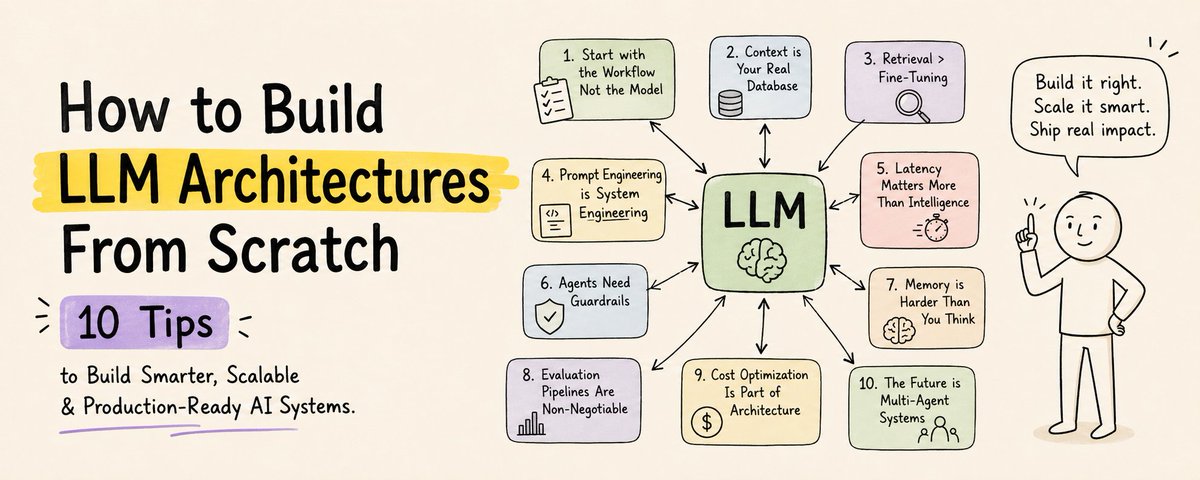
Here are 10 practical lessons for building LLM architectures from scratch.
# 1. Start With the Workflow, Not the Model
Most beginners obsess over:
- GPT-4
- Claude
- Gemini
- Open-source benchmarks
But the model is only one layer.
The real question is:
👉 What workflow are you trying to automate?
Examples:
Customer Support AI
Needs:
- Retrieval
- Ticket memory
- CRM integration
- Human escalation
AI Research Assistant
Needs:
- Web search
- Citation systems
- Long-context reasoning
- Source ranking
AI Coding Agent
Needs:
- Tool calling
- Execution environment
- File memory
- Multi-step planning
Good architectures begin with system design—not model selection.
# 2. Context Is Your Real Database
LLMs are extremely context-sensitive.
The quality of outputs depends heavily on:
- What information enters the context window
- How it’s formatted
- What gets excluded
Most architecture problems are actually context problems.
Bad systems:
- Dump everything into prompts
- Waste tokens
- Increase hallucinations
Good systems:
- Retrieve only relevant information
- Compress intelligently
- Rank context by importance
Think of context as working memory.
Your job is deciding what deserves attention.
# 3. Retrieval Is More Important Than Fine-Tuning
Most teams do NOT need fine-tuning first.
They need better retrieval.
This is why RAG (Retrieval-Augmented Generation) became foundational in modern AI systems.
Instead of retraining the model, retrieve relevant knowledge dynamically.
Core components include:
- Embedding models
- Vector databases
- Chunking pipelines
- Re-ranking systems
A weak retrieval layer creates:
- Hallucinations
- Wrong answers
- Irrelevant outputs
Even powerful models fail with poor retrieval.
# 4. Prompt Engineering Is Actually System Engineering
People treat prompts like magic spells.
In reality:
Prompt engineering is architecture design.
A good prompt system includes:
- Role separation
- Structured outputs
- Tool instructions
- Safety constraints
- Memory formatting
- Context prioritization
Production systems often use:
- Multi-prompt pipelines
- Dynamic prompt injection
- Hidden system prompts
- Intermediate reasoning layers
The best AI products don’t use “one prompt.”
They orchestrate many prompts together.
# 5. Latency Matters More Than Intelligence
Users hate waiting.
Even brilliant outputs feel broken if responses are slow.
This is why architecture decisions must optimize:
- Token usage
- Parallel calls
- Caching
- Retrieval speed
- Streaming responses
Many successful AI products intentionally use:
- Smaller models first
- Larger models only when necessary
Smart orchestration beats brute force.
# 6. Agents Need Guardrails
Autonomous agents sound exciting.
But uncontrolled agents become expensive and unreliable quickly.
A production-ready agent architecture needs:
- Tool permission systems
- Retry limits
- Failure handling
- Timeout logic
- Action verification
- Human checkpoints
Without guardrails:
- Infinite loops happen
- Costs explode
- Wrong actions compound
The more autonomy you add, the more control systems you need.
# 7. Memory Is Harder Than Most People Expect
Memory isn’t just “saving chats.”
Good memory systems require deciding:
- What should be remembered?
- What should expire?
- What should be summarized?
- What matters long term?
Modern AI memory architectures often combine:
- Short-term context windows
- Vector memory
- Structured databases
- Session summaries
Too much memory creates noise.
Too little memory destroys personalization.
Balance matters.
# 8. Evaluation Pipelines Are Non-Negotiable
Most AI builders test manually.
That doesn’t scale.
You need evaluation systems that measure:
- Accuracy
- Hallucination rates
- Latency
- Cost
- Consistency
- Tool success
- User satisfaction
Strong AI teams build:
- Benchmark datasets
- Regression testing
- Automated evaluations
- Human review loops
Without evaluation pipelines:
You can’t improve reliably.
You’re guessing.
# 9. Cost Optimization Is Part of Architecture
Many AI apps fail because inference costs become unsustainable.
Architecture decisions directly affect:
- Token consumption
- API costs
- Infrastructure usage
Simple optimizations matter:
- Context compression
- Caching
- Smaller routing models
- Smart retrieval
- Prompt shortening
Great AI systems aren’t just powerful.
They’re economically sustainable.
# 10. The Future Is Multi-Agent Systems
The next wave of AI products won’t rely on one giant prompt.
They’ll use specialized agents working together.
Examples:
- Research agent
- Planning agent
- Coding agent
- Verification agent
- Memory agent
Each handles a specific responsibility.
This creates:
- Better reasoning
- Modular systems
- Easier debugging
- Improved reliability
Instead of one overloaded model trying to do everything.
# Final Thoughts
Most people think building AI products is about choosing the smartest model.
It’s not.
The real advantage comes from:
- Architecture
- Orchestration
- Retrieval
- Memory
- Evaluation
- Workflow design
LLMs are only the engine.
The architecture is the vehicle.
And the teams that understand this early will build the AI products that actually last.
## 相关链接
- [Tabassum Parveen](https://x.com/Tabbu_ai)
- [@Tabbu_ai](https://x.com/Tabbu_ai)
- [48K](https://x.com/Tabbu_ai/status/2056703901618045262/analytics)
- [Upgrade to Premium](https://x.com/i/premium_sign_up)
- [7:49 PM · May 19, 2026](https://x.com/Tabbu_ai/status/2056703901618045262)
- [48.9K Views](https://x.com/Tabbu_ai/status/2056703901618045262/analytics)
---
*导出时间: 2026/5/20 10:27:07*
---
## 中文翻译
# 从零开始构建大语言模型架构:大多数人悟得太晚的 10 个实战经验
**作者**: Tabassum Parveen
**日期**: 2026-05-19T11:49:56.000Z
**来源**: [https://x.com/Tabassum Parveen/status/2056703901618045262](https://x.com/Tabassum Parveen/status/2056703901618045262)
---

现在每个人都想构建 AI 产品。
但大多数人跳过了最难的部分:
👉 理解大语言模型(LLM)架构究竟是如何工作的。
如今,调用 OpenAI、Anthropic 或 Google 的 API 比以往任何时候都容易。
难的是构建具备以下特性的系统:
- 可靠
- 可扩展
- 快速
- 具有成本效益
- 生产就绪
这正是架构发挥作用的地方。
因为 LLM 产品不仅仅是一个“聊天机器人”。
每一个严肃的 AI 产品背后,都有一整套系统在处理:
- 上下文管理
- 检索
- 工具使用
- 记忆
- 提示词编排
- 延迟优化
- 智能体工作流
- 安全层
- 评估管道
演示 Demo 和真正的 AI 产品之间的区别,通常就在于架构。
以下是从零开始构建 LLM 架构的 10 个实战经验。
# 1. 从工作流开始,而非模型
大多数初学者痴迷于:
- GPT-4
- Claude
- Gemini
- 开源基准测试
但模型只是其中一层。
真正的问题是:
👉 你试图自动化什么工作流?
示例:
客户支持 AI
需要:
- 检索
- 工单记忆
- CRM 集成
- 人工升级
AI 研究助手
需要:
- 网络搜索
- 引用系统
- 长上下文推理
- 来源排序
AI 编程智能体
需要:
- 工具调用
- 执行环境
- 文件记忆
- 多步规划
优秀的架构始于系统设计,而非模型选择。
# 2. 上下文是你真正的数据库
LLM 对上下文极其敏感。
输出的质量很大程度上取决于:
- 什么信息进入了上下文窗口
- 它是如何格式化的
- 排除了什么
大多数架构问题实际上都是上下文问题。
糟糕的系统:
- 把所有东西都倾倒进提示词
- 浪费 Token
- 增加幻觉
优秀的系统:
- 仅检索相关信息
- 智能压缩
- 按重要性对上下文排序
把上下文看作工作记忆。
你的工作是决定什么值得被关注。
# 3. 检索比微调更重要
大多数团队**不**需要一开始就做微调。
他们需要更好的检索。
这就是为什么 RAG(检索增强生成)成为现代 AI 系统基石的原因。
与其重新训练模型,不如动态检索相关知识。
核心组件包括:
- 嵌入模型
- 向量数据库
- 分块管道
- 重排序系统
薄弱的检索层会导致:
- 幻觉
- 错误答案
- 无关输出
即使强大的模型,在检索糟糕时也会失败。
# 4. 提示词工程实际上是系统工程设计
人们把提示词当作魔法咒语。
实际上:
提示词工程就是架构设计。
一个好的提示词系统包括:
- 角色分离
- 结构化输出
- 工具指令
- 安全约束
- 记忆格式化
- 上下文优先级排序
生产级系统通常使用:
- 多提示词管道
- 动态提示词注入
- 隐藏的系统提示词
- 中间推理层
最好的 AI 产品不使用“一个提示词”。
它们将许多提示词编排在一起。
# 5. 延迟比智能更重要
用户讨厌等待。
即使输出很精彩,如果响应很慢,也会让人感觉体验糟糕。
这就是为什么架构决策必须优化:
- Token 使用量
- 并行调用
- 缓存
- 检索速度
- 流式响应
许多成功的 AI 产品有意使用:
- 首先使用较小的模型
- 仅在必要时使用较大的模型
聪明的编排胜过蛮力。
# 6. 智能体需要护栏
自主智能体听起来很令人兴奋。
但不受控制的智能体很快就会变得昂贵且不可靠。
一个生产就绪的智能体架构需要:
- 工具权限系统
- 重试限制
- 失败处理
- 超时逻辑
- 操作验证
- 人工检查点
没有护栏:
- 会发生无限循环
- 成本爆炸
- 错误操作会累积
你添加的自主性越多,需要的控制系统就越多。
# 7. 记忆比大多数人想象的要难
记忆不仅仅是“保存聊天记录”。
好的记忆系统需要决定:
- 应该记住什么?
- 应该让什么过期?
- 应该总结什么?
- 什么具有长期重要性?
现代 AI 记忆架构通常结合:
- 短期上下文窗口
- 向量记忆
- 结构化数据库
- 会话摘要
过多的记忆会制造噪音。
过少的记忆会破坏个性化。
平衡很重要。
# 8. 评估管道是不可或缺的
大多数 AI 构建者是手动测试的。
那无法扩展。
你需要能够衡量以下指标的评估系统:
- 准确性
- 幻觉率
- 延迟
- 成本
- 一致性
- 工具成功率
- 用户满意度
强大的 AI 团队会构建:
- 基准数据集
- 回归测试
- 自动化评估
- 人工审核循环
没有评估管道:
你无法可靠地改进。
你只是在猜测。
# 9. 成本优化是架构的一部分
许多 AI 应用失败,是因为推理成本变得不可持续。
架构决策直接影响:
- Token 消耗
- API 成本
- 基础设施使用
简单的优化很重要:
- 上下文压缩
- 缓存
- 较小的路由模型
- 智能检索
- 提示词缩短
优秀的 AI 系统不仅仅强大。
它们在经济上是可持续的。
# 10. 未来是多智能体系统
下一波 AI 产品不会依赖一个巨大的提示词。
它们将使用协同工作的专业智能体。
示例:
- 研究智能体
- 规划智能体
- 编码智能体
- 验证智能体
- 记忆智能体
每个智能体处理特定的职责。
这创造了:
- 更好的推理能力
- 模块化系统
- 更容易调试
- 提高可靠性
而不是让一个过载的模型试图做所有事情。
# 最后的思考
大多数人认为构建 AI 产品是关于选择最聪明的模型。
其实不是。
真正的优势来自于:
- 架构
- 编排
- 检索
- 记忆
- 评估
- 工作流设计
LLM 只是引擎。
架构才是车辆。
那些尽早理解这一点的团队,将构建出真正经得起时间考验的 AI 产品。
## 相关链接
- [Tabassum Parveen](https://x.com/Tabassum Parveen)
- [@Tabbu_ai](https://x.com/Tabbu_ai)
- [48K](https://x.com/Tabassum Parveen/status/2056703901618045262/analytics)
- [升级到 Premium](https://x.com/i/premium_sign_up)
- [2026年5月19日 下午7:49](https://x.com/Tabassum Parveen/status/2056703901618045262)
- [48.9K 浏览量](https://x.com/Tabassum Parveen/status/2056703901618045262/analytics)
---
*导出时间: 2026/5/20 10:27:07*