# The 25 AI Concepts You Actually Need to Understand in 2026
**作者**: Kanika
**日期**: 2026-08-17T09:13:05.000Z
**来源**: [https://x.com/KanikaBK/status/2089279338004824535](https://x.com/KanikaBK/status/2089279338004824535)
---
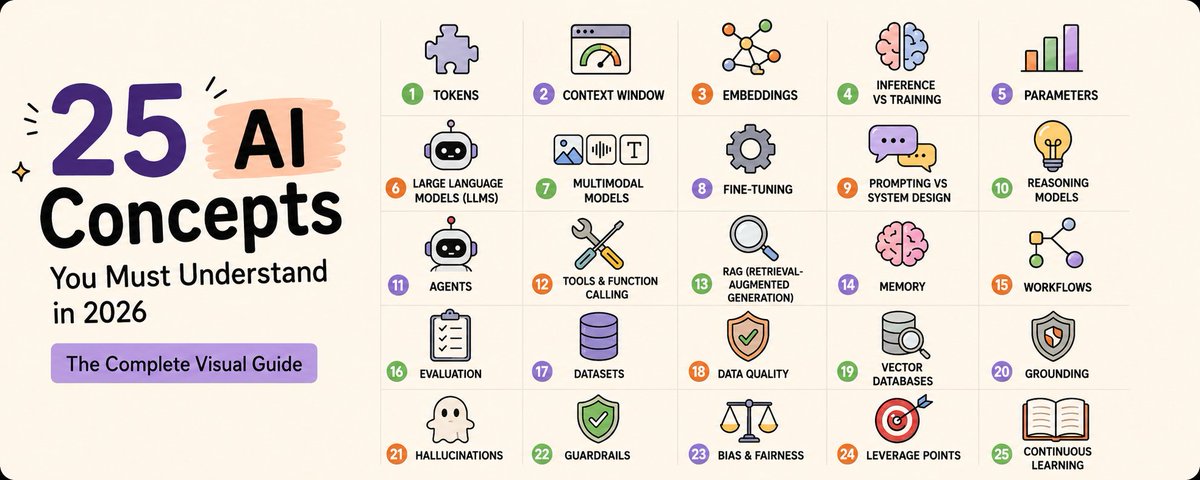
The 25 AI concepts you actually need to understand in 2026, from tokens and embeddings to agents, RAG, guardrails, and leverage points. Skip the buzzwords; learn what matters.
In 2026, the advantage does not come from knowing every AI buzzword.
It comes from understanding a focused set of concepts that explain how modern AI systems actually work. Everyone uses AI. Almost nobody understands how it works. People throw around terms like “agents,” “RAG,” and “embeddings” as if they are magic, then wonder why their systems break.
This is the list that fixes that. Twenty-five concepts, grouped so you can learn them in a logical order. Master these, and you will be able to learn faster, build better systems, and ignore most of the noise.
## A. Foundations (1–5)
These are the basics. If you skip these, everything else will feel like sorcery.
## 1. Tokens – How AI breaks and processes text
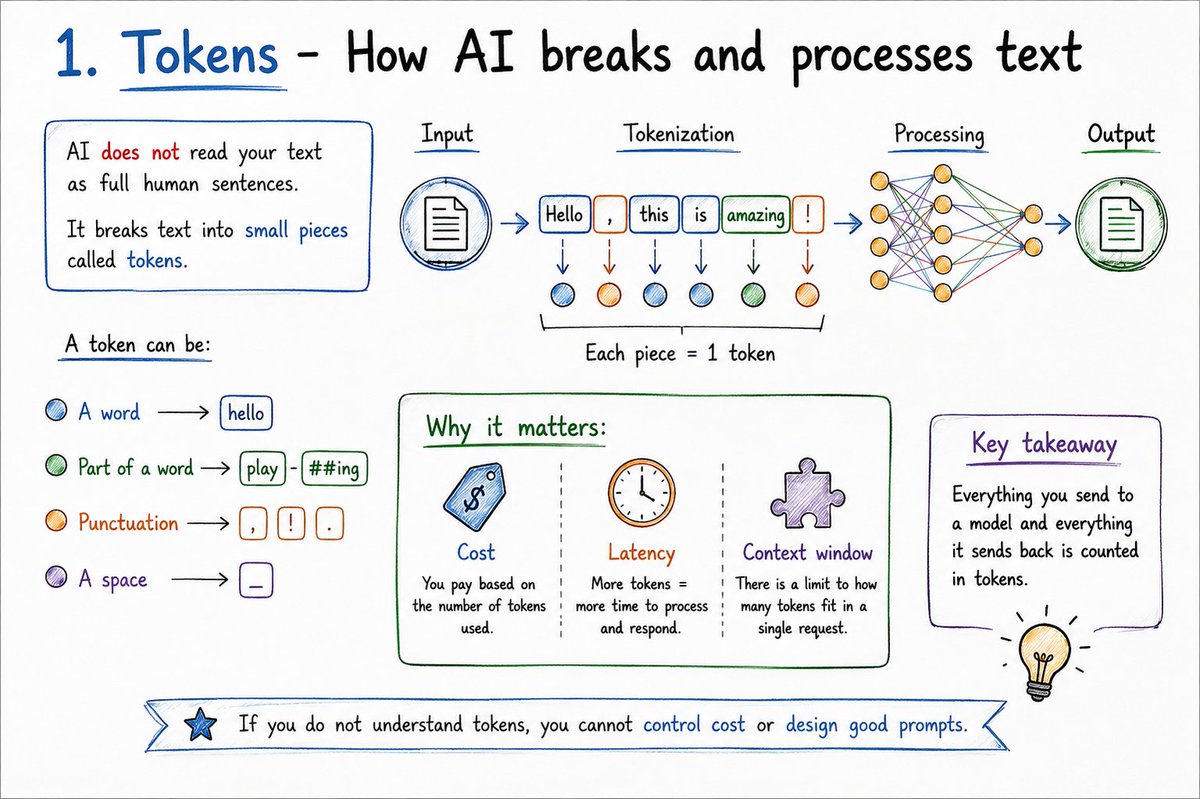
AI does not read your text as full human sentences.
It breaks text into small pieces called tokens. A token can be a word, part of a word, punctuation, or even a space. Everything you send to a model and everything it sends back is counted in tokens.
Why it matters: Tokens determine cost, latency, and how much you can fit in a single request. If you do not understand tokens, you cannot control cost or design good prompts.
## 2. Context Window – How much information a model can hold at once
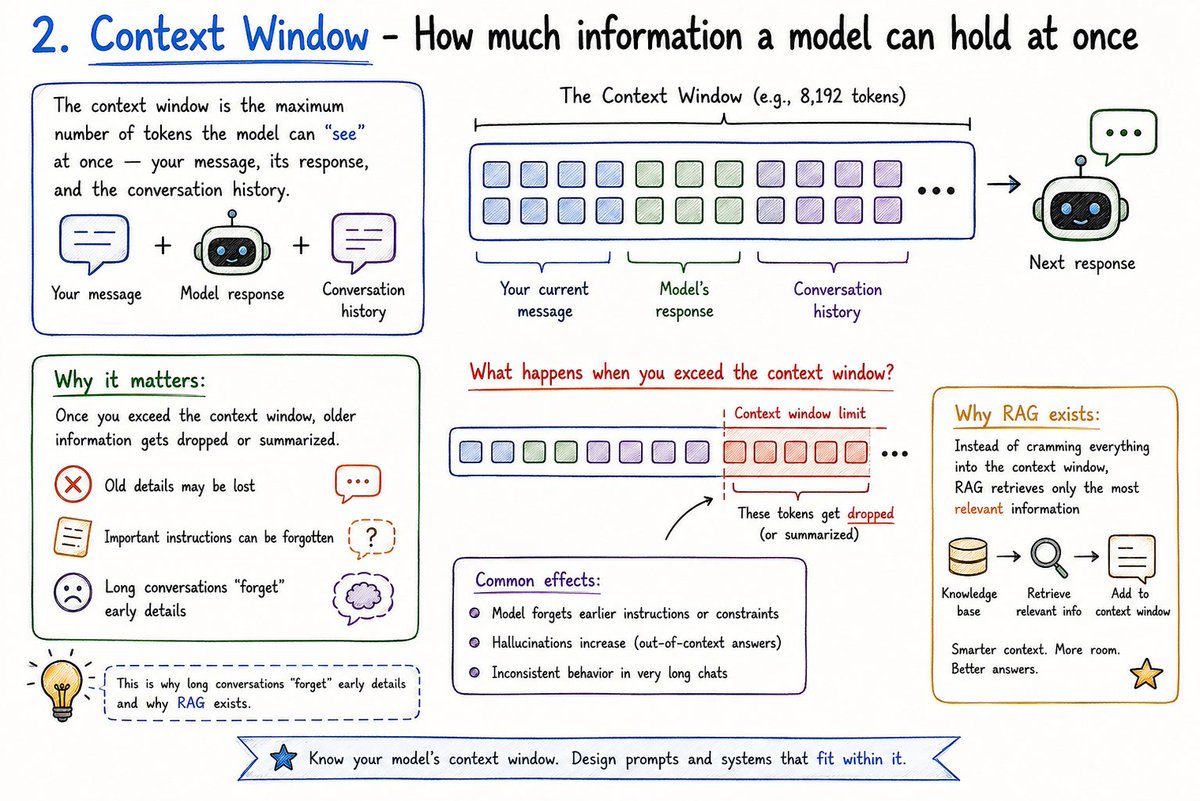
The context window is the maximum number of tokens the model can “see” at once your message, its response, and the conversation history.
Why it matters: Once you exceed the context window, older information gets dropped or summarized. This is why long conversations “forget” early details and why RAG exists.
## 3. Embeddings – How meaning is represented as numbers
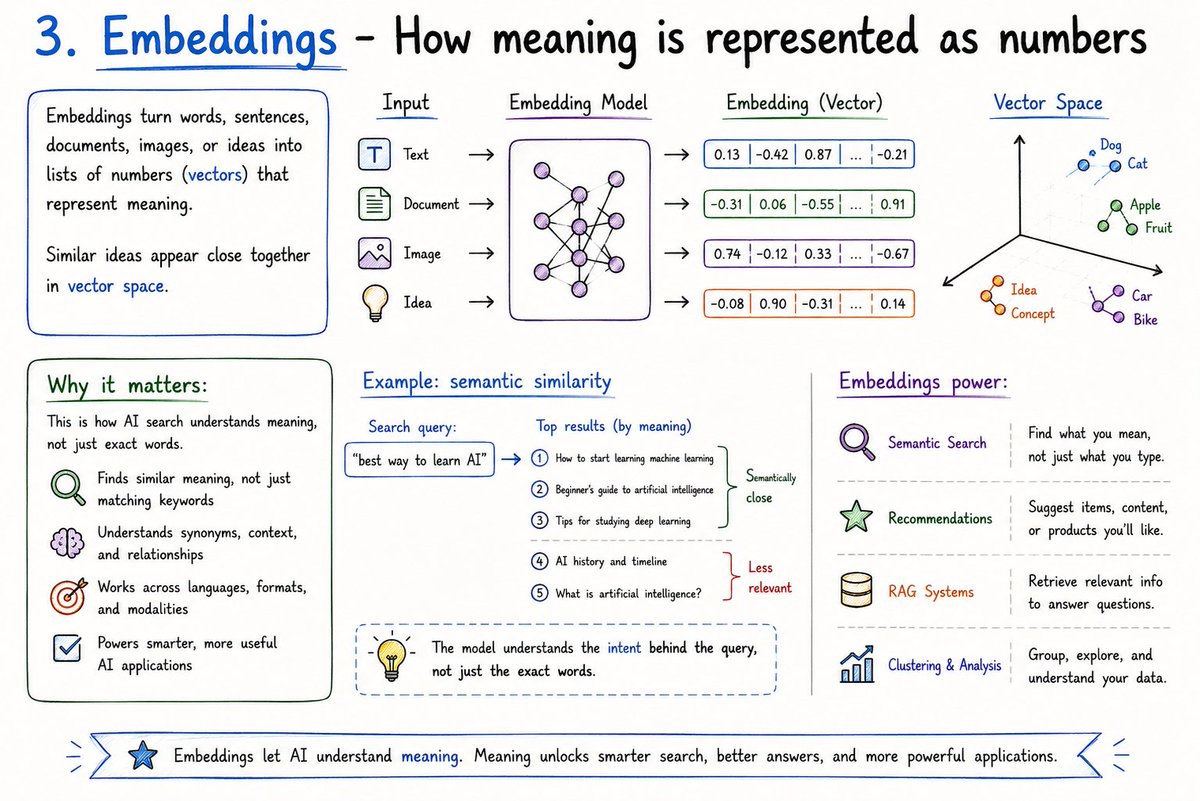
Embeddings turn words, sentences, documents, images, or ideas into lists of numbers (vectors) that represent meaning. Similar ideas appear close together in vector space.
Why it matters: This is how AI search understands meaning, not just exact words. Embeddings power semantic search, recommendations, and RAG systems.
## 4. Inference vs Training – Using a model vs teaching a model
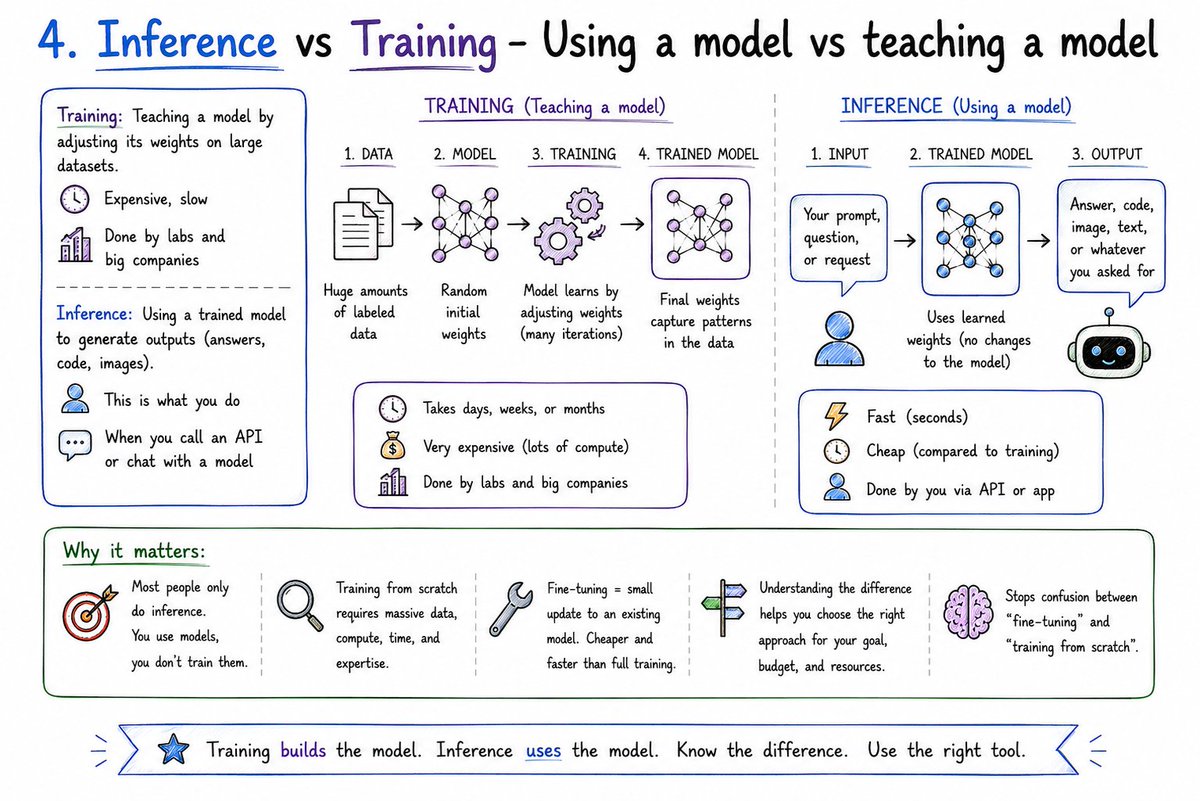
- Training: Teaching a model by adjusting its weights on large datasets. Expensive, slow, done by labs and big companies.
- Inference: Using a trained model to generate outputs (answers, code, images). This is what you do when you call an API or chat with a model.
Why it matters: Most people only do inference. Understanding the difference stops you from confusing “fine-tuning” with “training from scratch” and helps you choose the right approach.
## 5. Parameters – What “size” of a model actually means
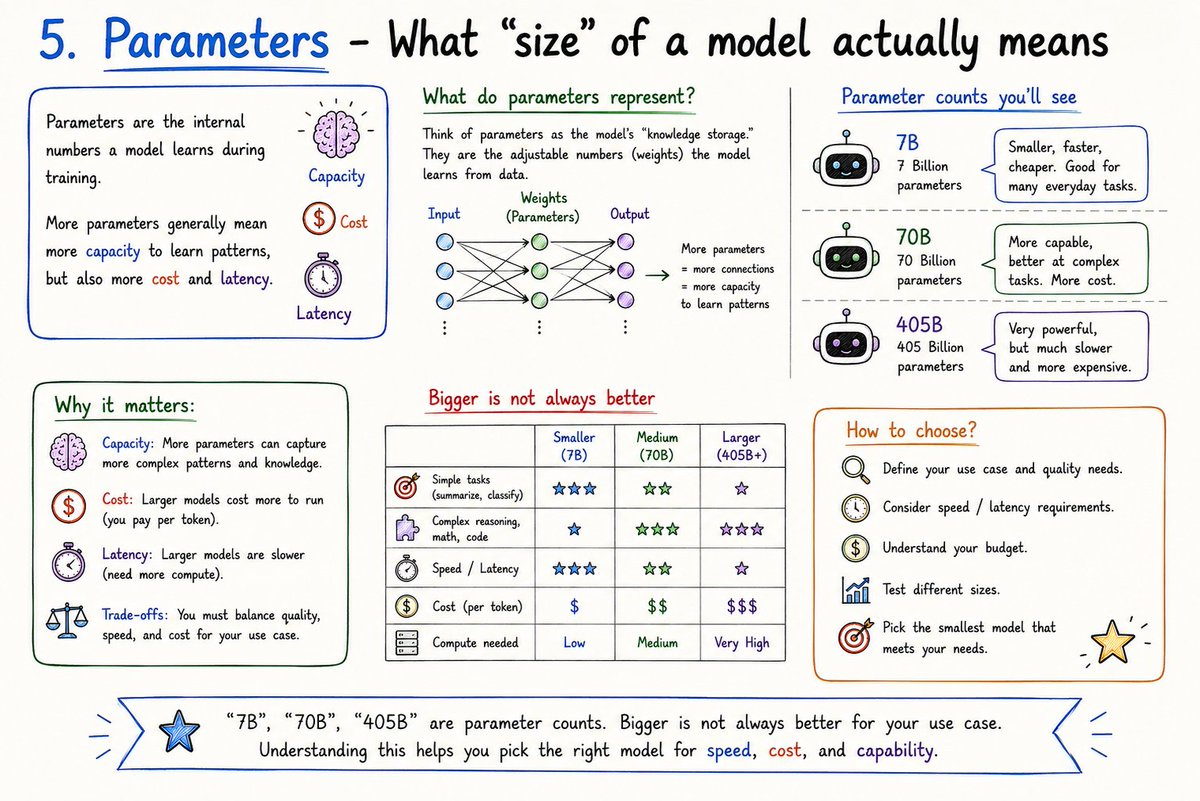
Parameters are the internal numbers a model learns during training. More parameters generally mean more capacity to learn patterns, but also more cost and latency.
Why it matters: “7B,” “70B,” “405B” are parameter counts. Bigger is not always better for your use case. Understanding this helps you pick the right model for speed, cost, and capability.
## B. Models & Capabilities (6–10)
Once you understand the foundations, these concepts explain what modern models can do.
## 6. Large Language Models (LLMs) – The core systems behind modern AI
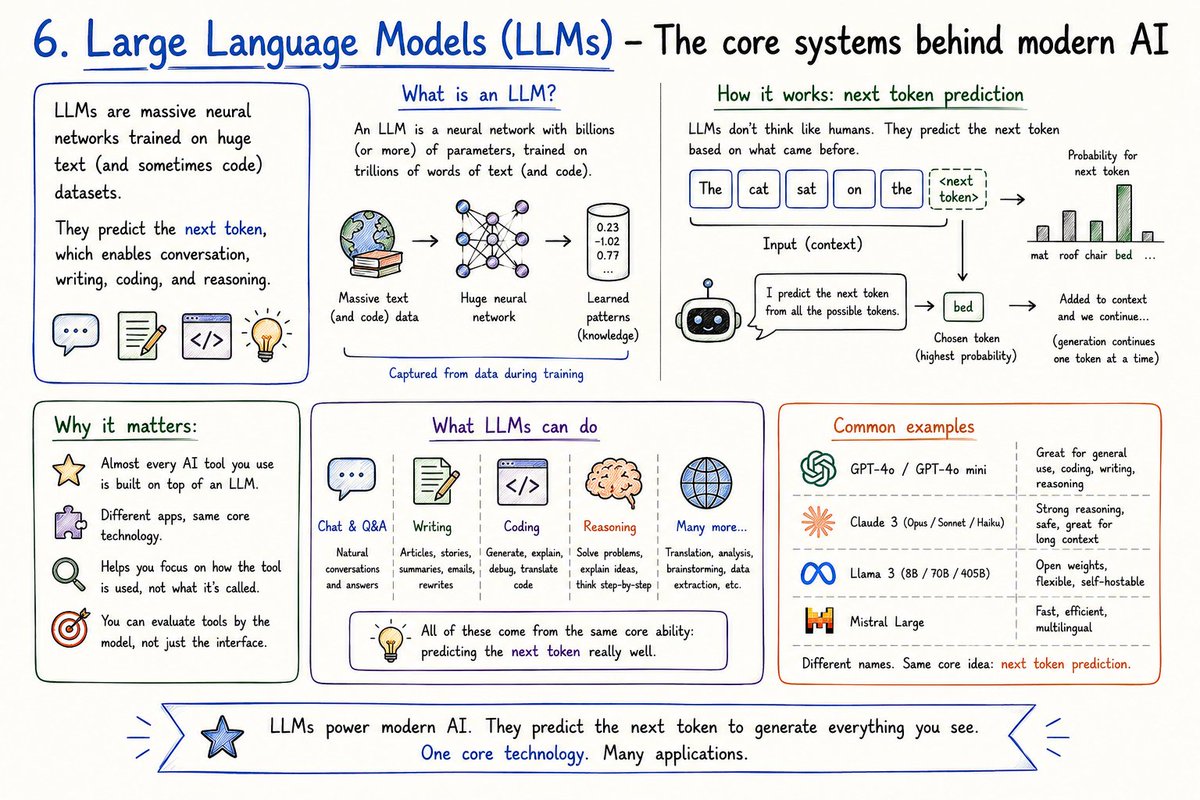
LLMs are massive neural networks trained on huge text (and sometimes code) datasets. They predict the next token, which enables conversation, writing, coding, and reasoning.
Why it matters: Almost every AI tool you use is built on top of an LLM. Knowing this stops you from treating each product as a completely different technology.
## 7. Multimodal Models – Models that handle text, images, audio, etc.
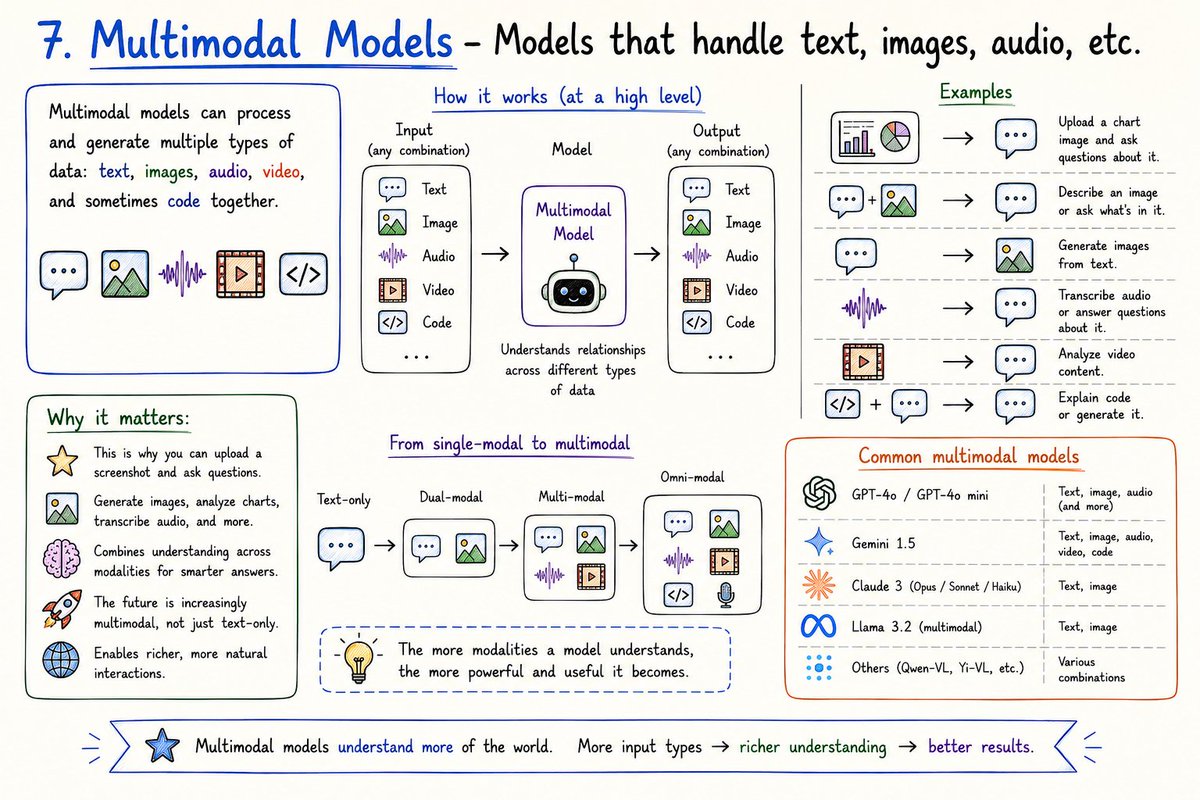
Multimodal models can process and generate multiple types of data: text, images, audio, video, and sometimes code together.
Why it matters: This is why you can upload a screenshot and ask questions, or generate images from text. The future is increasingly multimodal, not just text-only.
## 8. Fine-tuning – Adapting a model to specific data or tasks
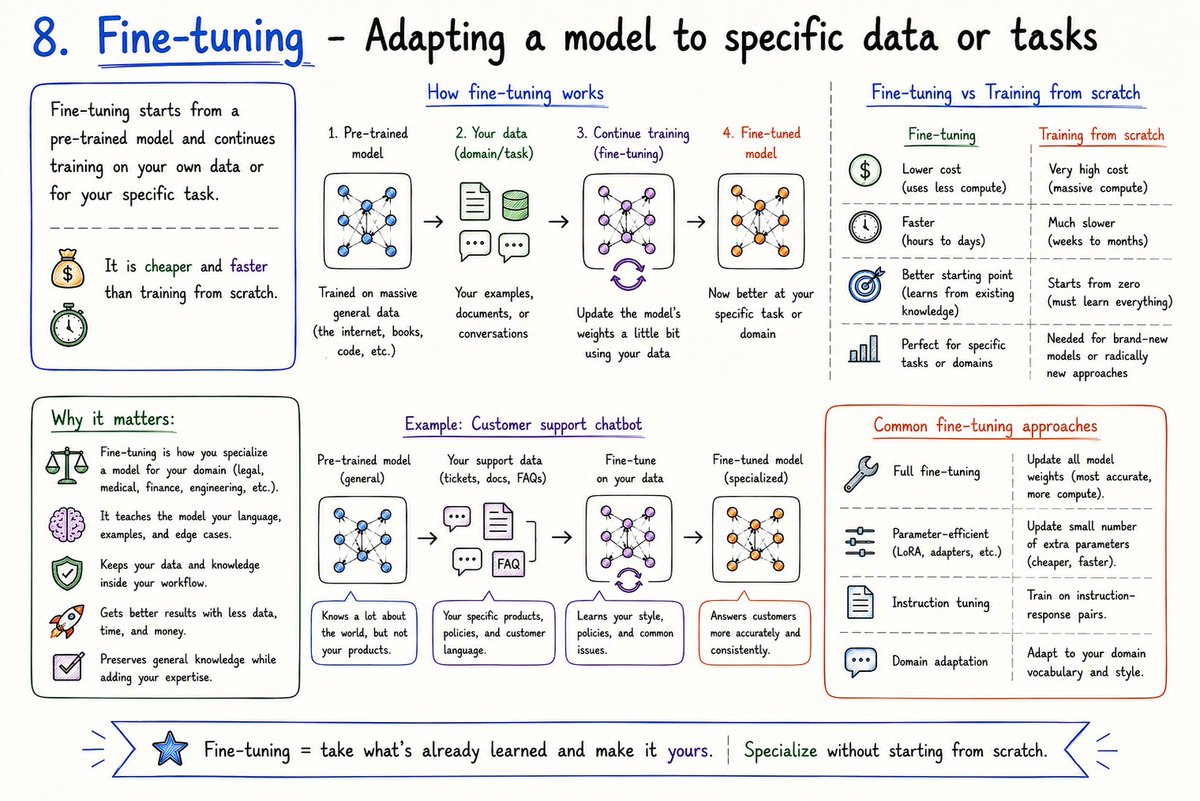
Fine-tuning starts from a pre-trained model and continues training on your own data or for your specific task. It is cheaper and faster than training from scratch.
Why it matters: Fine-tuning is how you specialize a model for your domain (legal, medical, your company’s style) without rebuilding everything.
## 9. Prompting vs System Design – Why structure matters more than clever wording
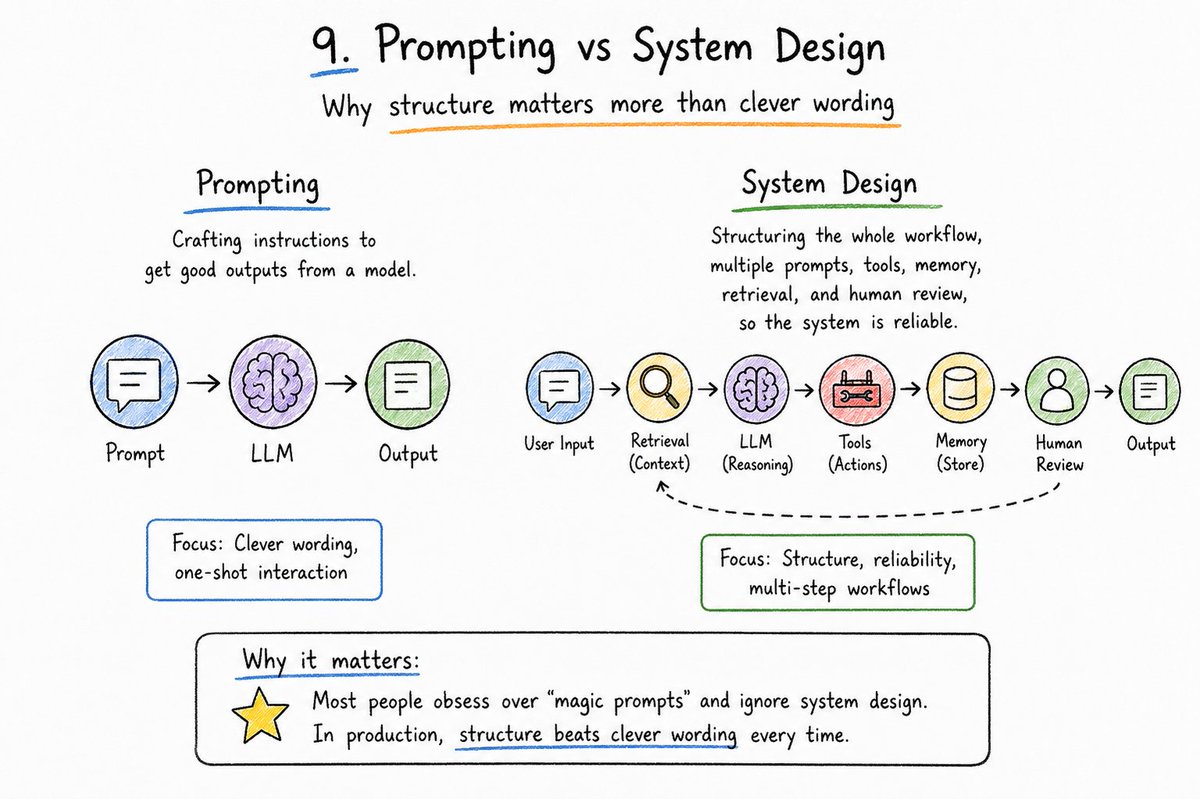
- Prompting: Crafting instructions to get good outputs from a model.
- System Design: Structuring the whole workflow, multiple prompts, tools, memory, retrieval, and human review, so the system is reliable.
Why it matters: Most people obsess over “magic prompts” and ignore system design. In production, structure beats clever wording every time.
## 10. Reasoning Models – Models optimized for multi-step thinking
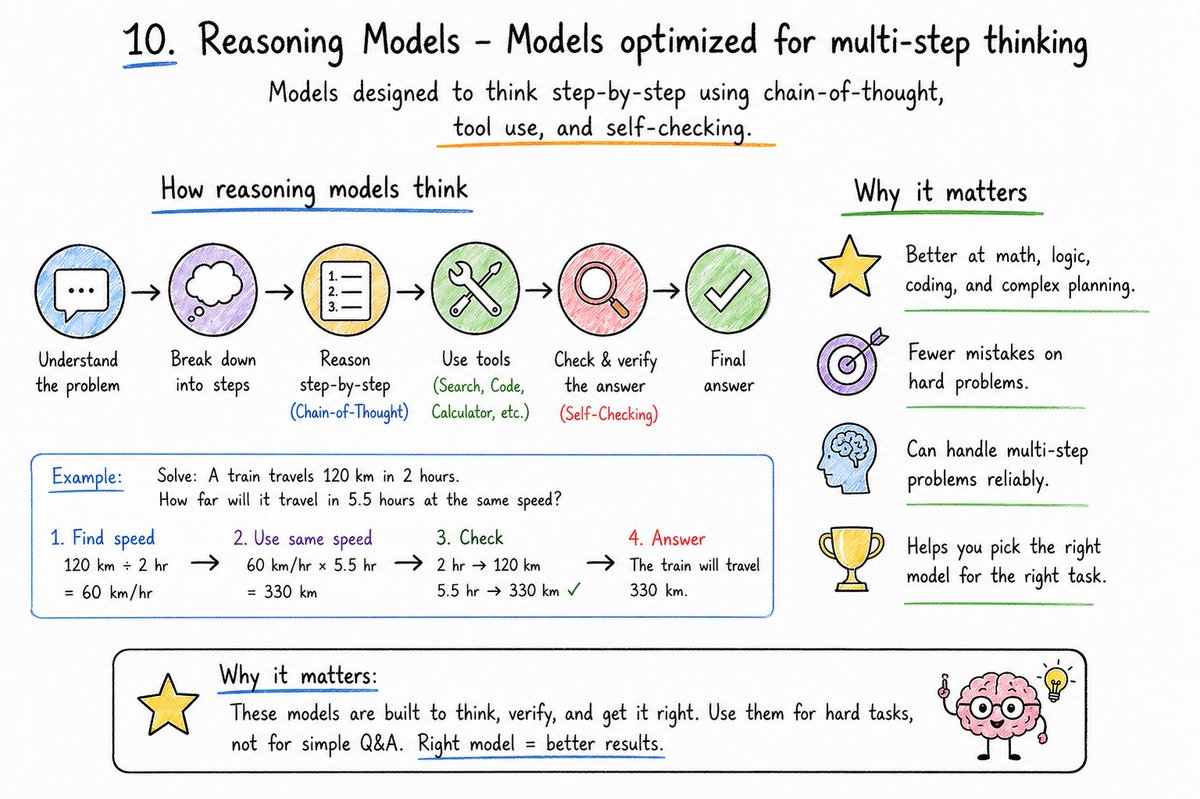
Reasoning models are designed to think step-by-step, often using techniques like chain-of-thought, tool use, and self-checking.
Why it matters: These models are better at math, logic, coding, and complex planning. Understanding this helps you choose the right model for hard tasks instead of blaming “AI is stupid.”
## C. Systems & Agents (11–16)
This is where AI moves from chatbots to real systems that do work.
## 11. AI Agents – Systems that can plan and take multi-step actions
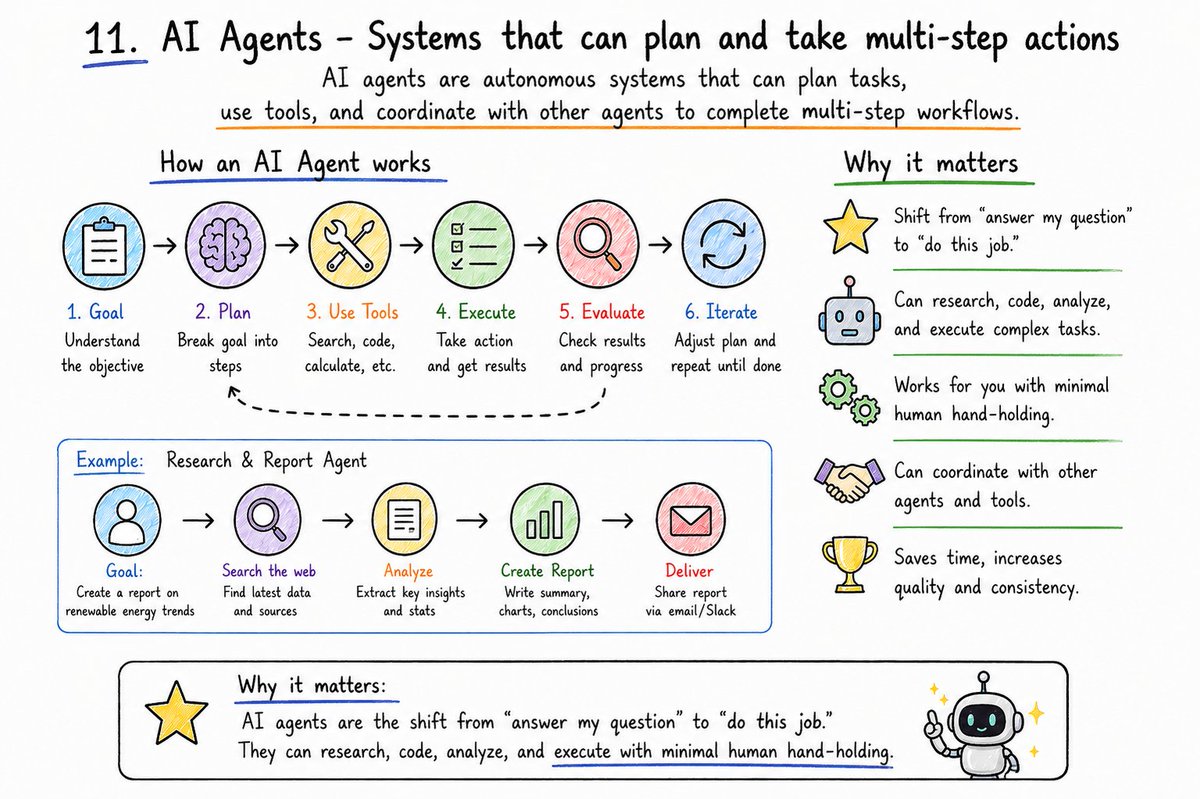
AI agents are autonomous systems that can plan tasks, use tools, and coordinate with other agents to complete multi-step workflows.
Why it matters: Agents are the shift from “answer my question” to “do this job.” They can research, code, analyze, and execute with minimal human hand-holding.
## 12. Tool Use / Function Calling – How models interact with external systems
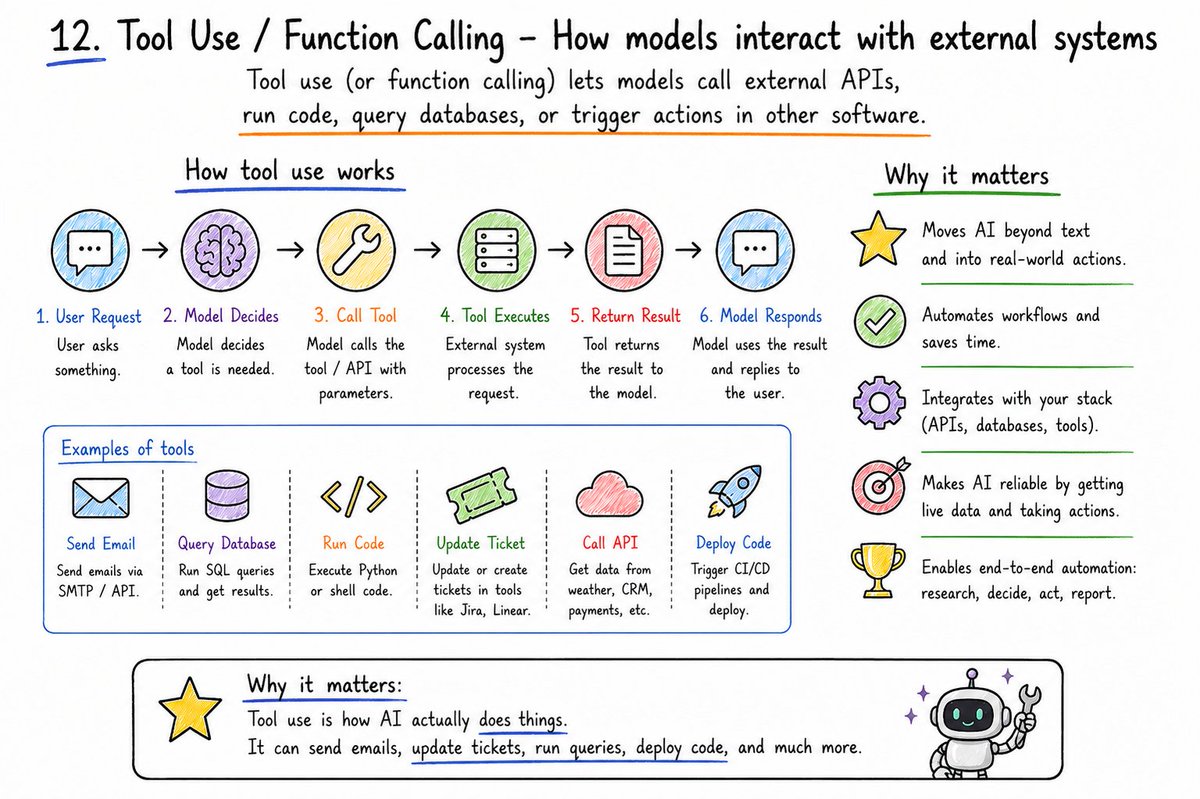
Tool use (or function calling) lets models call external APIs, run code, query databases, or trigger actions in other software.
Why it matters: This is how AI moves beyond text and actually does things: sending emails, updating tickets, running queries, deploying code.
## 13. Memory – Short-term vs long-term knowledge in AI systems
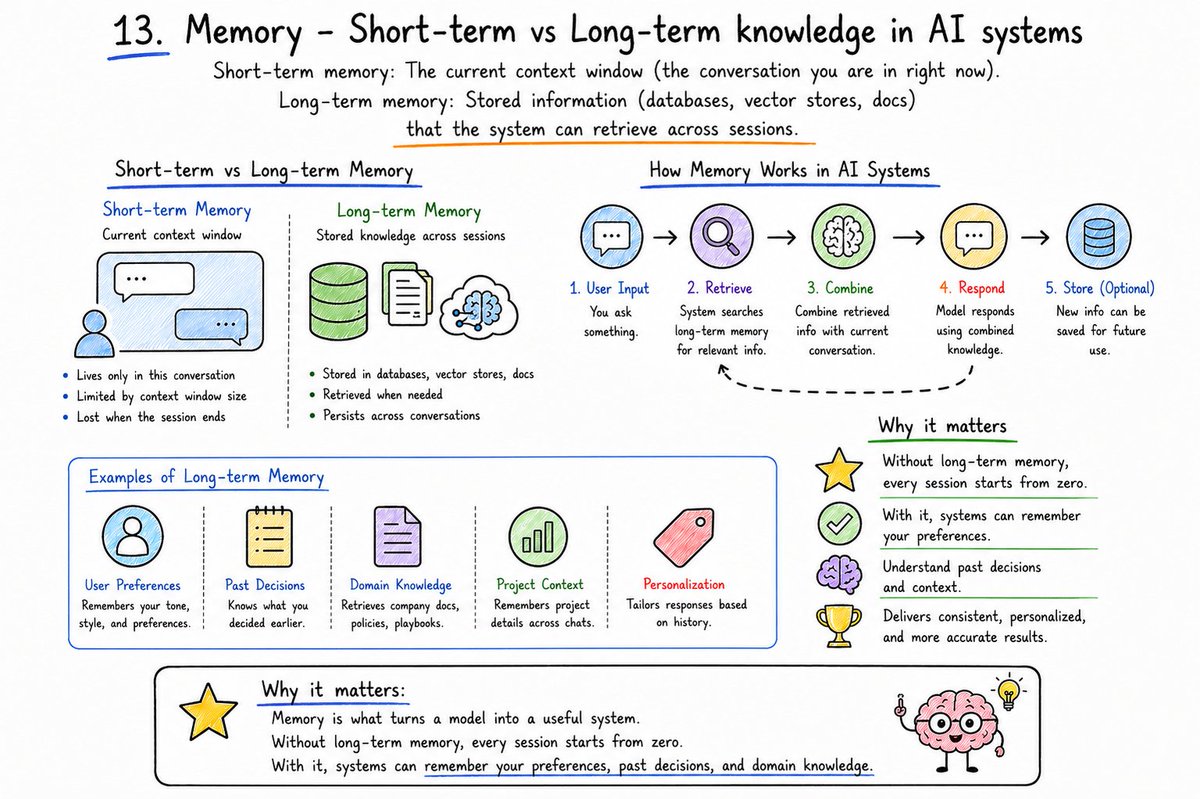
- Short-term memory: The current context window (the conversation you are in right now).
- Long-term memory: Stored information (databases, vector stores, docs) that the system can retrieve across sessions.
Why it matters: Without long-term memory, every session starts from zero. With it, systems can remember your preferences, past decisions, and domain knowledge.
## 14. Orchestration – Coordinating multiple models or agents
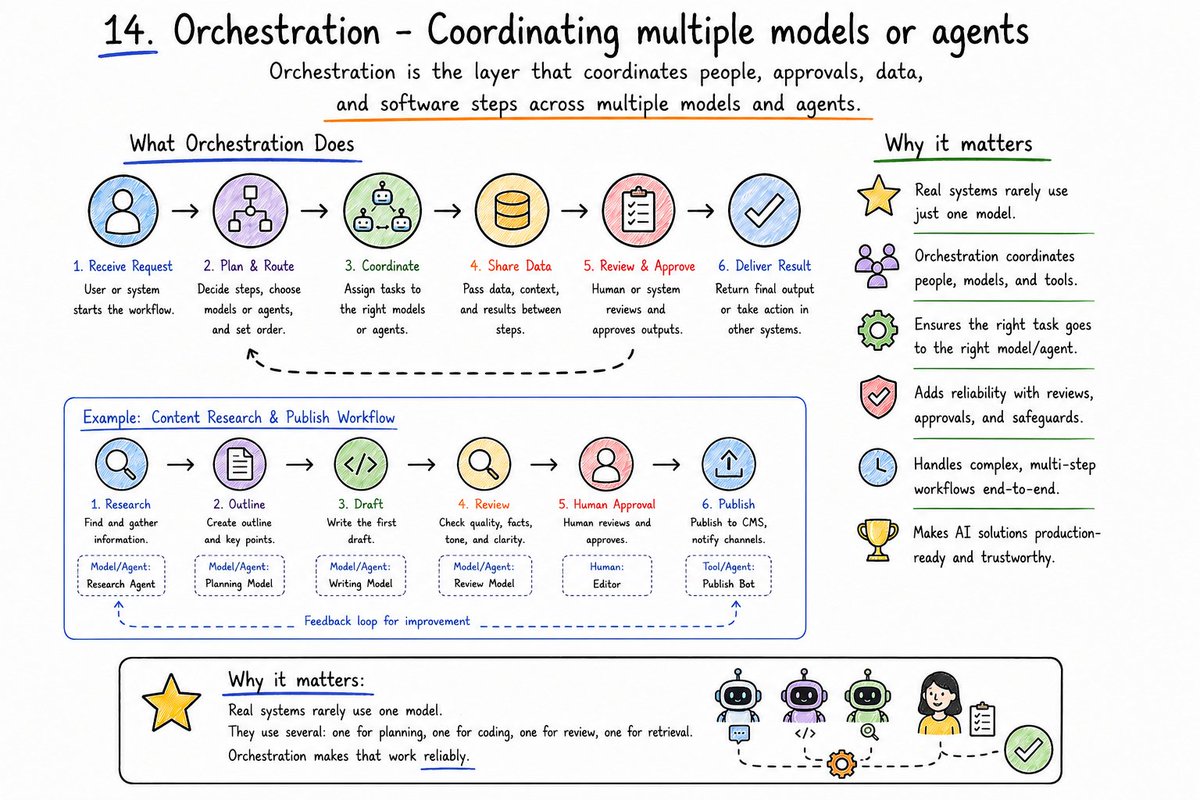
Orchestration is the layer that coordinates people, approvals, data, and software steps across multiple models and agents.
Why it matters: Real systems rarely use one model. They use several: one for planning, one for coding, one for review, one for retrieval. Orchestration makes that work reliably.
## 15. RAG (Retrieval-Augmented Generation) – Grounding AI in your own data
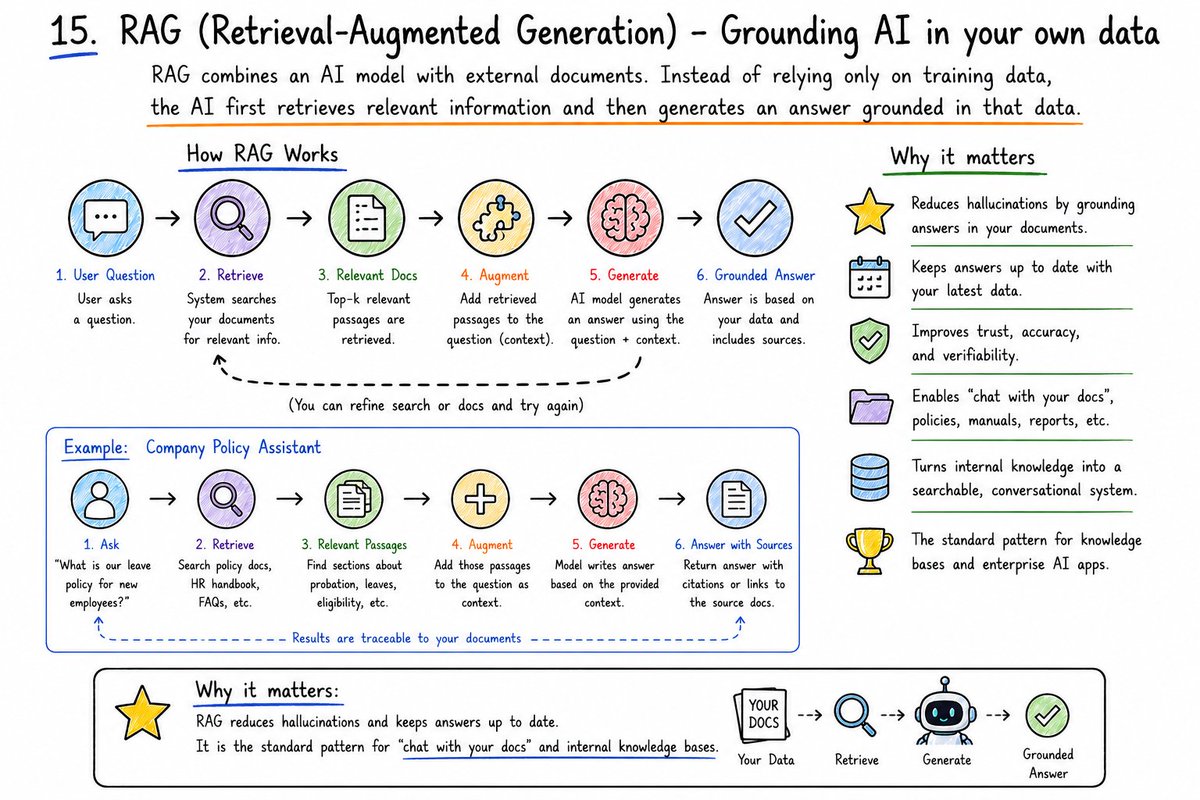
RAG combines an AI model with external documents. Instead of relying only on training data, the AI first retrieves relevant information and then generates an answer grounded in that data.
Why it matters: RAG reduces hallucinations and keeps answers up to date. It is the standard pattern for “chat with your docs” and internal knowledge bases.
## 16. Workflows / Pipelines – Repeatable multi-step AI processes
Workflows are predefined, repeatable sequences of AI steps: retrieve → summarize → draft → review → publish.
Why it matters: Workflows turn one-off experiments into reliable systems. They are how you scale AI from “cool demo” to “part of how we work.”
## D. Quality, Reliability & Risk (17–21)
These concepts determine whether your AI systems are trustworthy or dangerous.
## 17. Hallucinations – When AI produces confident but false output
Hallucinations are outputs that sound plausible but are factually wrong or made up.
Why it matters: Every AI system will hallucinate sometimes. Understanding this forces you to add verification, retrieval, and human review where it matters.
## 18. Evaluation – How to measure whether AI output is actually good
Evaluation is how you measure accuracy, relevance, safety, and usefulness of AI outputs (beyond “looks good to me”).
Why it matters: Without evaluation, you cannot improve systematically. You are just guessing whether your system is getting better or worse.
## 19. Guardrails – Constraints that keep systems safe and consistent
Guardrails are rules, filters, and constraints that keep AI behavior within safe, acceptable bounds (no PII leakage, no harmful content, no unauthorized actions).
Why it matters: Guardrails are the difference between “cool experiment” and “production system.” They prevent costly mistakes and reputational damage.
## 20. Alignment – Making AI behavior match human goals and values
Alignment is the effort to ensure AI systems pursue human-intended goals and respect human values, not just optimize for their objective function.
Why it matters: Misaligned systems can be technically impressive but practically dangerous. Alignment is why we care about safety, oversight, and human-in-the-loop.
## 21. Latency vs Intelligence Tradeoff – Speed versus depth of reasoning
There is always a tradeoff between how fast a model responds and how deeply it can reason. Smaller, faster models are less capable; larger, slower models are more capable.sloanreview.
Why it matters: You cannot have maximum speed and maximum intelligence at minimum cost. Understanding this helps you design systems that are “fast enough” and “smart enough” for the job.
## E. Practical Application (22–25)
These concepts determine whether AI actually creates value in your work.
## 22. Human-in-the-Loop – Where human judgment must stay involved
Human-in-the-loop means keeping humans in the workflow for decisions that require judgment, ethics, or accountability.
Why it matters: Not everything should be automated. Knowing where humans must stay involved prevents disasters and keeps trust.
## 23. Compounding Systems – Setups that improve with use over time
Compounding systems are designed so that every use makes them smarter: better data, better prompts, better retrieval, better workflows.
Why it matters: Most AI setups are static. Compounding systems get better every month, creating a real competitive advantage.
## 24. Cost Control – Managing tokens, model choices, and efficiency
Cost control is managing tokens, API calls, model sizes, and caching so AI does not become a money pit.
Why it matters: AI costs scale with usage. Without cost control, successful systems become financially unsustainable.
## 25. Leverage Points – Where AI creates real advantage vs busywork
Leverage points are the places where AI actually moves the needle: core workflows, bottlenecks, high-value decisions, not random busywork.
Why it matters: Most AI projects automate low-value tasks and ignore the real constraints. Finding leverage points is how AI becomes strategic, not just decorative.
## How to use these concepts
You do not need to master all 25 at once.
Start with the foundations (1–5), then move into agents and systems (11–16) as you build. Use the list as a filter: if a new tool or trend does not connect to these concepts, it is often noise.
A practical learning path:
1. Learn tokens, context, embeddings, and inference.
2. Understand agents, tool use, memory, and RAG.
3. Add evaluation, guardrails, and cost awareness.
4. Apply everything through small real projects.
## What most people get wrong
Common mistakes:
- Chasing every new model release without understanding basics. They know the latest model name but cannot explain tokens or embeddings.
- Treating prompts as magic instead of system design. They obsess over “perfect prompts” and ignore retrieval, memory, and workflows.
- Ignoring evaluation and reliability until things break. They ship first, then wonder why outputs are inconsistent or unsafe.
- Over-automating before understanding where human judgment is required. They automate everything, then get burned by edge cases and edge-case consequences.
## Key takeaway
In 2026, the advantage does not come from knowing every AI buzzword.
It comes from understanding a focused set of concepts that explain how modern AI systems actually work. Master these 25, and you will be able to learn faster, build better systems, and ignore most of the noise.
Hope you liked the article.
Building better AI workflows for creators like you. ❣️I’m Kanika (
[@KanikaBK](https://x.com/@KanikaBK)) — follow for more practical tests and setups. Also subscribe to my newsletter: [https://passiveincomehabit.beehiiv.com/](https://passiveincomehabit.beehiiv.com/)
## 相关链接
- [Kanika](https://x.com/KanikaBK)
- [@KanikaBK](https://x.com/KanikaBK)
- [2.7K](https://x.com/KanikaBK/status/2089279338004824535/analytics)
- [@KanikaBK](https://x.com/@KanikaBK)
- [https://passiveincomehabit.beehiiv.com/](https://passiveincomehabit.beehiiv.com/)
- [Upgrade to Premium](https://x.com/i/premium_sign_up)
- [5:13 PM · Aug 17, 2026](https://x.com/KanikaBK/status/2089279338004824535)
- [2,783 Views](https://x.com/KanikaBK/status/2089279338004824535/analytics)
---
*导出时间: 2026/8/17 20:08:04*
---
## 中文翻译
# 2026年你真正需要理解的25个AI概念
**作者**: Kanika
**日期**: 2026-08-17T09:13:05.000Z
**来源**: [https://x.com/KanikaBK/status/2089279338004824535](https://x.com/KanikaBK/status/2089279338004824535)
---

2026年你真正需要理解的25个AI概念,从Token和嵌入到智能体、RAG、护栏和杠杆点。跳过流行语;学习真正重要的东西。
在2026年,优势并不来自于知道每一个AI流行语。
它来自于理解一套能够解释现代AI系统实际工作原理的核心概念。每个人都在使用AI。几乎没有人理解它是如何工作的。人们随意抛出像“智能体”、“RAG”和“嵌入”这样的术语,好像它们是魔法一样,然后却奇怪为什么他们的系统会崩溃。
这份清单就是为了解决这个问题。25个概念,经过分组,以便你可以按逻辑顺序学习。掌握这些,你将能够学得更快,构建更好的系统,并忽略大多数噪音。
## A. 基础 (1–5)
这些是基础。如果你跳过这些,其他一切都会感觉像巫术。
## 1. Token —— AI如何拆分和处理文本

AI不会像人类那样阅读完整的句子。
它将文本拆分成称为Token的小块。一个Token可以是一个单词、单词的一部分、标点符号,甚至是一个空格。你发送给模型的所有内容以及它发回的所有内容都以Token为单位进行计数。
为什么重要:Token决定了成本、延迟以及你可以在单个请求中放入多少内容。如果你不理解Token,你就无法控制成本或设计好的提示词。
## 2. 上下文窗口 —— 模型一次可以容纳多少信息

上下文窗口是模型一次可以“看到”的Token的最大数量——包括你的消息、它的回复以及对话历史。
为什么重要:一旦你超出了上下文窗口,旧的信息就会被丢弃或总结。这就是为什么长对话会“忘记”早期的细节,以及为什么RAG存在的原因。
## 3. 嵌入 —— 意义如何被表示为数字

嵌入将单词、句子、文档、图像或想法转换为代表意义的数字列表(向量)。相似的想法在向量空间中靠得很近。
为什么重要:这就是AI搜索能够理解意义而不仅仅是精确单词的方式。嵌入支持语义搜索、推荐系统和RAG系统。
## 4. 推理与训练 —— 使用模型与教导模型

- 训练:通过在大型数据集上调整权重来教导模型。昂贵、缓慢,由实验室和大公司完成。
- 推理:使用训练好的模型来生成输出(答案、代码、图像)。这是当你调用API或与模型聊天时所做的事情。
为什么重要:大多数人只进行推理。理解这种差异可以防止你混淆“微调”和“从头训练”,并帮助你选择正确的方法。
## 5. 参数 —— 模型的“大小”到底意味着什么

参数是模型在训练期间学习的内部数字。更多的参数通常意味着更强的学习能力,但也意味着更高的成本和延迟。
为什么重要:“7B”、“70B”、“405B”是参数计数。对于你的用例来说,更大并不总是更好。理解这一点有助于你根据速度、成本和能力选择合适的模型。
## B. 模型与能力 (6–10)
一旦你理解了基础,这些概念将解释现代模型能做什么。
## 6. 大型语言模型 (LLM) —— 现代AI背后的核心系统

LLM是在海量文本(有时还有代码)数据集上训练的巨大神经网络。它们预测下一个Token,这使得对话、写作、编程和推理成为可能。
为什么重要:几乎你使用的每一个AI工具都是建立在LLM之上的。知道这一点可以阻止你将每个产品视为完全不同的技术。
## 7. 多模态模型 —— 处理文本、图像、音频等的模型

多模态模型可以处理和生成多种类型的数据:文本、图像、音频、视频,有时还包括代码。
为什么重要:这就是为什么你可以上传截图并提问,或者从文本生成图像。未来越来越多是多模态的,而不仅仅是纯文本。
## 8. 微调 —— 使模型适应特定数据或任务

微调从一个预训练模型开始,并在你自己的数据或针对你的特定任务上继续训练。这比从头训练更便宜、更快速。
为什么重要:微调是你让模型专用于你的领域(法律、医学、你公司的风格)而无需重建一切的方法。
## 9. 提示与系统设计 —— 为什么结构比聪明的措辞更重要

- 提示:精心设计指令以从模型获得良好的输出。
- 系统设计:构建整个工作流程、多个提示词、工具、记忆、检索和人工审查,使系统可靠。
为什么重要:大多数人痴迷于“魔法提示词”而忽视系统设计。在生产环境中,结构总是胜过聪明的措辞。
## 10. 推理模型 —— 为多步骤思维而优化的模型

推理模型被设计为逐步思考,通常使用思维链、工具使用和自我检查等技术。
为什么重要:这些模型在数学、逻辑、编码和复杂规划方面表现得更好。理解这一点有助于你为困难任务选择合适的模型,而不是责怪“AI很笨”。
## C. 系统与智能体 (11–16)
在这里,AI从聊天机器人转变为真正可以工作的系统。
## 11. AI智能体 —— 可以计划和采取多步骤行动的系统

AI智能体是能够规划任务、使用工具并与其他智能体协调以完成多步骤工作流程的自主系统。
为什么重要:智能体是从“回答我的问题”到“完成这项工作”的转变。它们可以在极少的人工干预下进行研究、编码、分析和执行。
## 12. 工具使用/函数调用 —— 模型如何与外部系统交互

工具使用(或函数调用)允许模型调用外部API、运行代码、查询数据库或触发其他软件中的操作。
为什么重要:这就是AI超越文本并真正做事的方式:发送电子邮件、更新工单、运行查询、部署代码。
## 13. 记忆 —— AI系统中的短期与长期知识

- 短期记忆:当前的上下文窗口(你当前所在的对话)。
- 长期记忆:存储的信息(数据库、向量存储、文档),系统可以跨会话检索这些信息。
为什么重要:没有长期记忆,每次会话都从零开始。有了它,系统可以记住你的偏好、过去的决策和领域知识。
## 14. 编排 —— 协调多个模型或智能体

编排是协调人员、审批、数据和软件步骤跨越多个模型和智能体的层级。
为什么重要:真正的系统很少只使用一个模型。它们使用几个:一个用于规划,一个用于编码,一个用于审查,一个用于检索。编排使其可靠地工作。
## 15. RAG (检索增强生成) —— 将AI建立在你自己的数据之上

RAG将AI模型与外部文档结合起来。AI不只依赖训练数据,而是首先检索相关信息,然后基于该数据生成答案。
为什么重要:RAG减少了幻觉,并保持答案是最新的。它是“与文档对话”和内部知识库的标准模式。
## 16. 工作流/管道 —— 可重复的多步骤AI流程
工作流是预定义的、可重复的AI步骤序列:检索 → 总结 → 起草 → 审查 → 发布。
为什么重要:工作流将一次性的实验转变为可靠的系统。它们是你将AI从“很酷的演示”扩展为“我们工作方式的一部分”的方法。
## D. 质量、可靠性与风险 (17–21)
这些概念决定了你的AI系统是值得信赖还是危险的。
## 17. 幻觉 —— 当AI产生自信但错误的输出时
幻觉是听起来合理但事实错误或凭空捏造的输出。
为什么重要:每个AI系统有时都会产生幻觉。理解这一点迫使你在重要的地方添加验证、检索和人工审查。
## 18. 评估 —— 如何衡量AI输出是否真的很好
评估是衡量AI输出的准确性、相关性、安全性和有用性(不仅仅是“在我看来不错”)的方法。
为什么重要:没有评估,你就无法系统地改进。你只是在猜测你的系统是变好了还是变坏了。
## 19. 护栏 —— 保持系统安全和一致的约束
护栏是规则、过滤器和约束,使AI行为保持在安全、可接受的范围内(无PII泄漏、无有害内容、无未授权操作)。
为什么重要:护栏是“很酷的实验”和“生产系统”之间的区别。它们防止代价高昂的错误和声誉损害。
## 20. 对齐 —— 使AI行为与人类目标和价值观相匹配
对齐是确保AI系统追求人类预期的目标并尊重人类价值观的努力,而不仅仅是优化其目标函数。
为什么重要:未对齐的系统可能在技术上令人印象深刻,但实际上很危险。对齐就是我们要关注安全、监督和人在回路中的原因。
## 21. 延迟与智能的权衡 —— 速度与推理深度的关系
模型响应的速度与推理深度之间总是存在权衡。更小、更快的模型能力较弱;更大、更慢的模型能力更强。
为什么重要:你无法以最低的成本同时获得最高的速度和最高的智能。理解这一点有助于你设计对于工作来说“足够快”和“足够智能”的系统。
## E. 实际应用 (22–25)
这些概念决定了AI是否真的能在你的工作中创造价值。
## 22. 人在回路 —— 人类判断必须参与的地方
人在回路意味着在工作流程中保留人类,以做出需要判断、伦理或问责的决策。
为什么重要:并非一切都应该自动化。知道人类必须参与的地方可以防止灾难并保持信任。
## 23. 复利系统 —— 随着时间的推移通过使用而改进的设置
复利系统的设计使得每一次使用都使它们变得更聪明:更好的数据、更好的提示词、更好的检索、更好的工作流程。
为什么重要:大多数AI设置是静态的。复利系统每个月都会变得更好,创造出真正的竞争优势。
## 24. 成本控制 —— 管理Token、模型选择和效率
成本控制是管理Token、API调用、模型大小和缓存,以防止AI成为无底洞。
为什么重要:AI成本随使用量扩展。没有成本控制,成功的系统将在财务上不可持续。
## 25. 杠杆点 —— AI创造真正优势而非忙碌工作的地方
杠杆点是AI真正起作用的地方:核心工作流程、瓶颈、高价值决策,而不是随机的忙碌工作。
为什么重要:大多数AI项目自动化了低价值任务并忽略了真正的约束。找到杠杆点是使AI变得具有战略性而非仅仅是装饰性的方法。
## 如何使用这些概念
你不需要一次掌握所有25个。
从基础(1–5)开始,然后在构建时进入智能体和系统(11–16)。将此列表用作过滤器:如果一个新工具或趋势不与这些概念相关联,它通常只是噪音。
一个实用的学习路径:
1. 学习Token、上下文、嵌入和推理。
2. 理解智能体、工具使用、记忆和RAG。
3. 增加评估、护栏和成本意识。
4. 通过小的实际项目应用一切。
## 大多数人做错了什么
常见的错误:
- 在不理解基本原理的情况下追逐每一个新模型的发布。他们知道最新的模型名称,但无法解释Token或嵌入。
- 将提示词视为魔法而不是系统设计。他们痴迷于“完美的提示词”而忽视检索、记忆和工作流程。
- 在事情崩溃之前忽视评估和可靠性。他们先发布,然后奇怪为什么输出不一致或不安全。
- 在理解哪里需要人类判断之前过度自动化。他们自动化一切,然后被边缘情况及其后果所伤害。
## 核心要点
在2026年,优势并不来自于知道每一个AI流行语。
它来自于理解一套能够解释现代AI系统实际工作原理的核心概念。掌握这25个概念,你将能够学得更快,构建更好的系统,并忽略大多数噪音。
希望你喜欢这篇文章。
为像你这样的创作者构建更好的AI工作流程。❣️我是Kanika (
[@KanikaBK](https://x.com/@KanikaBK)) —— 关注更多实用的测试和设置。同时也订阅我的通讯:[https://passiveincomehabit.beehiiv.com/](https://passiveincomehabit.beehiiv.com/)
## 相关链接
- [Kanika](https://x.com/KanikaBK)
- [@KanikaBK](https://x.com/KanikaBK)
- [2.7K](https://x.com/KanikaBK/status/2089279338004824535/analytics)
- [@KanikaBK](https://x.com/@KanikaBK)
- [https://passiveincomehabit.beehiiv.com/](https://passiveincomehabit.beehiiv.com/)
- [升级到高级版](https://x.com/i/premium_sign_up)
- [2026年8月17日 下午5:13](https://x.com/KanikaBK/status/2089279338004824535)
- [2,783次观看](https://x.com/KanikaBK/status/2089279338004824535/analytics)
---
*导出时间: 2026/8/17 20:08:04*