# How To Build Your First AI Team in 2026
**作者**: Rahul
**日期**: 2026-07-14T06:48:53.000Z
**来源**: [https://x.com/sairahul1/status/2076921860294648143](https://x.com/sairahul1/status/2076921860294648143)
---
There are two types of people in 2026.
People who manage AI agents.
And people who compete against people who manage AI agents.
The gap between them is widening every week.
Here is the exact playbook to build your first AI team.
No engineering degree. No expensive tools. Just a system.
## What an AI team actually is
Most people use AI like a calculator.
One question. One answer. Done.
An AI team is different.
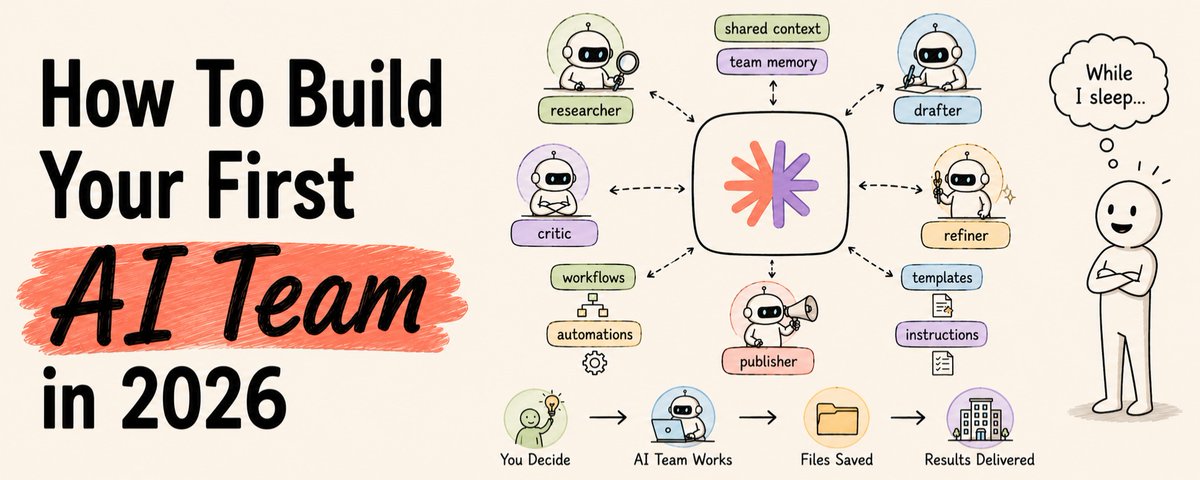
It is a group of specialized agents working together on the same task.
One agent researches. One agent drafts. One agent reviews and pushes back. One agent polishes. One agent publishes.
Same workflow a $300K content team runs.
Except it costs you $50/month.
And it runs while you sleep.
The key insight most people miss:
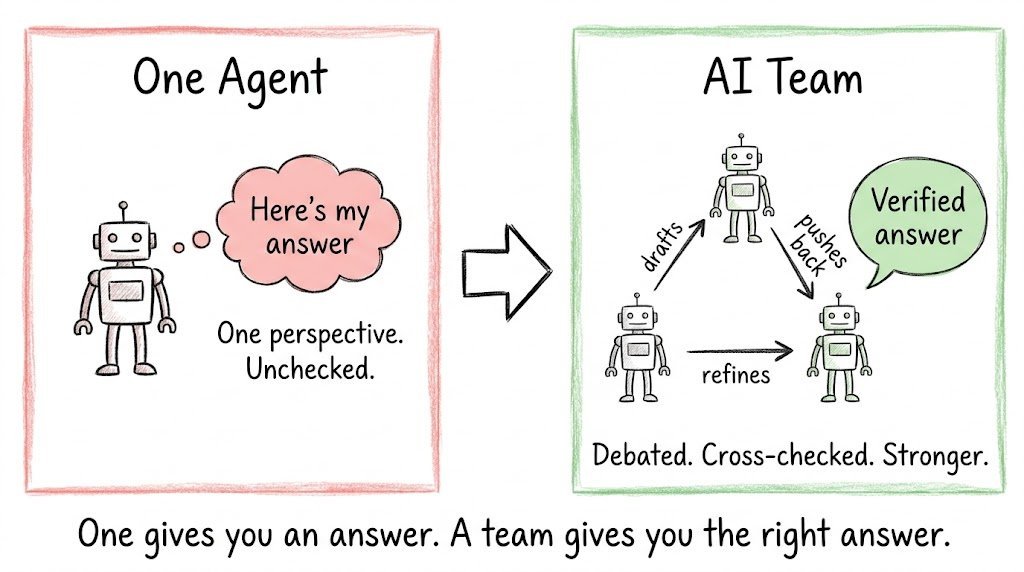
One agent gives you an answer.
Multiple agents give you a verified answer.
When Claude drafts and GPT-4 pushes back on it — what survives is sharper than either produced alone.
That's the entire model.
## 4 roles every AI team needs
Before you build, understand the roles.
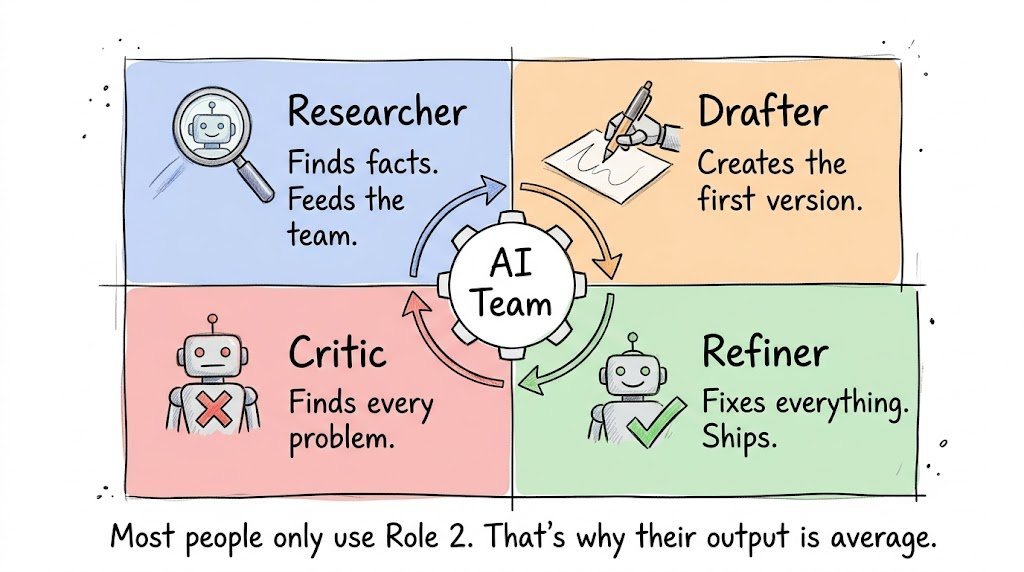
Every effective AI team — regardless of what it does — needs four things:
Role 1: The Researcher
Finds facts. Pulls context. Surfaces what's real.
Never drafts. Just feeds.
Prompt it with: "You are a research specialist. Your only job is to find accurate, relevant information. Never editorialize. Never suggest. Only report what you find with sources."
Role 2: The Drafter
Takes the research and creates the first version.
The output doesn't need to be perfect. It needs to exist.
Prompt it with: "You are a senior writer and strategist. Take the research provided and create a complete first draft. Prioritize clarity and structure over perfection. The reviewer will improve it."
Role 3: The Critic
This is the most important role most people skip.
One agent that does nothing but find problems.
It challenges assumptions. Questions sources. Identifies what's missing.
Prompt it with: "You are a devil's advocate. Your only job is to find what's wrong, weak, missing, or incorrect in the draft. Do not suggest fixes. Only identify problems. Be ruthless."
Role 4: The Refiner
Takes the draft and the critic's notes and produces the final version.
Prompt it with: "You are an expert editor. You have a first draft and a list of problems. Your job is to fix every problem identified and produce a final polished output. Do not add new content unless necessary. Strengthen what exists."
## How to build the team on Bloome (a new tool I fell in love with recently)
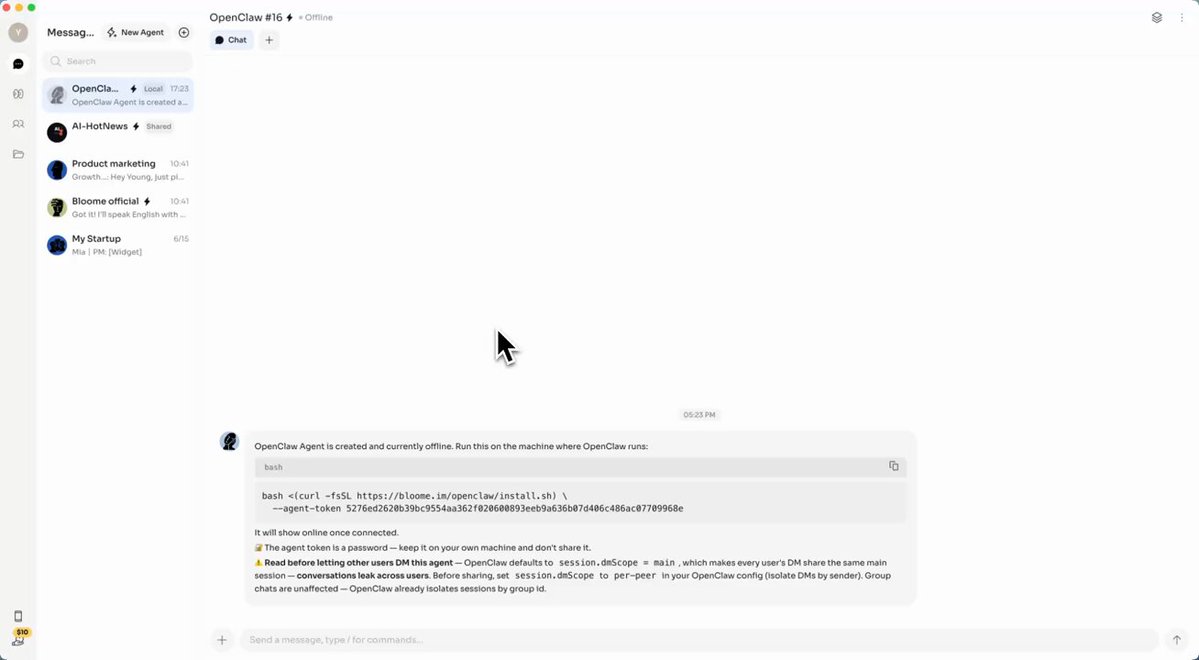
Bloome is the platform that lets humans and AI agents work in the same conversation.
Not in separate tabs. Not copying and pasting between tools. One group chat. All models. All agents. All context shared.
Here is the exact setup.
Step 1: Create your agent team
Open Bloome. Create a new group.
Add the agents you want:
→ Claude (for research and drafting)
→ ChatGPT (for a second perspective)
→ DeepSeek (for cost-efficient volume tasks)
→ Your custom Bloome agent (pre-loaded with your specific context)
You can also build a custom agent in one click:
→ Give it a name
→ Write its "soul" — what it cares about, how it thinks, what it never does → Give it memories — your brand voice, your style guide, your past work
→ Assign its role — researcher, critic, drafter, refiner
One click. Saved forever. Available in any future conversation.
Step 2: Run your first workflow
Start a conversation in the group.
Type your task — not to one agent, but to the whole team.
Example: "Team — I need a 1,000-word article on why most AI implementations fail. Research Agent: find the top 5 real reasons with data. Drafter: write the article using that research. Critic: find every weak claim. Refiner: fix them and give me the final version."
All agents read the full conversation. Each one sees what the others produced. Context is always shared.
No copy-paste. No context gaps.
Step 3: Add humans to the loop
Invite a teammate.
Now they join the same conversation.
They see everything the agents produced. They can respond, correct, redirect.
The agent immediately has their context too.
When someone new joins later, the agent summarizes everything from before.
They are caught up instantly.
This is not a chatbot.
This is a team workspace where humans and agents work together.
## 5 real use cases that save the most time
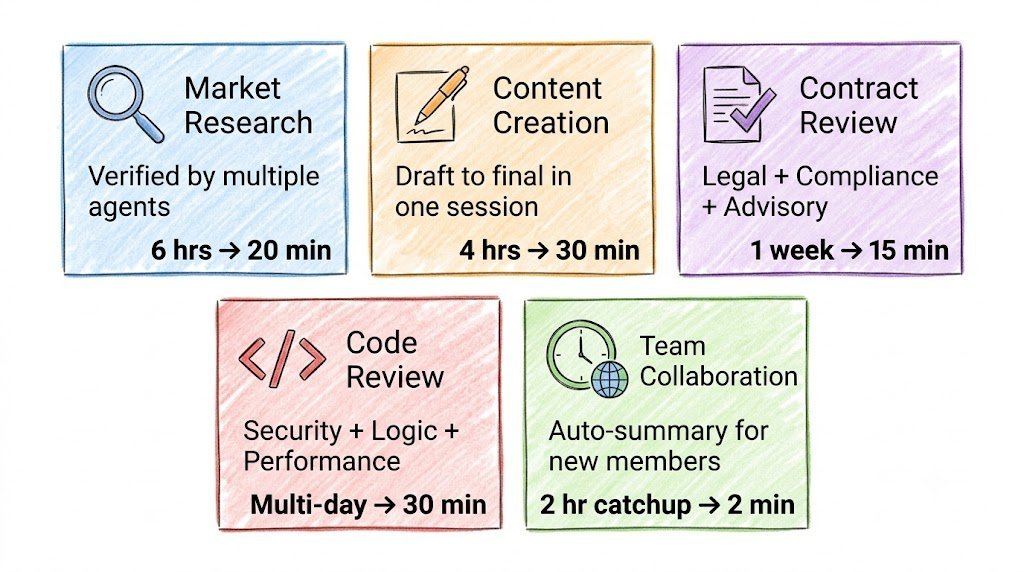
1. Market Research — verified, not hallucinated
Old way: one ChatGPT prompt, one answer, no verification.
AI team way:
→ Research Agent pulls data from multiple angles
→ Skeptic Agent challenges every claim and source
→ Agents debate the findings
→ What survives is actually true
Time saved: 6 hours of manual research → 20 minutes.
2. Content creation — first draft to final in one session
Old way: you write, you edit, you rewrite, you second-guess.
AI team way:
→ Research Agent gathers context
→ Drafter produces the full first draft
→ Critic tears it apart
→ Refiner fixes everything
→ You approve once
Time saved: 4-hour writing session → 30-minute review.
3. Contract and document review
Old way: send to lawyer, wait a week, pay $500.
AI team way:
→ Legal Agent flags risk clauses
→ Compliance Agent finds missing regulatory requirements →
Advisory Agent consolidates into redline recommendations
Time saved: 1 week and $500 → 15 minutes and $0.
4. Code review — multiple angles at once
Old way: one engineer reviews, misses things, it ships with bugs.
AI team way:
→ Security Agent scans for vulnerabilities
→ Logic Agent checks the implementation
→ Performance Agent flags inefficiencies
→ Style Agent enforces conventions
Time saved: multi-day review cycle → 30-minute parallel pass.
5. Cross-timezone team collaboration

Old way: your US team discusses all day. Your Australia team wakes up and reads 300 messages.
AI team way:
→ Agent summarizes all decisions, open questions, and context
→ New team members get caught up instantly
→ No one asks "what did I miss?"
Time saved: 2 hours of catchup reading → 2-minute summary.
## How to set up your AI team router
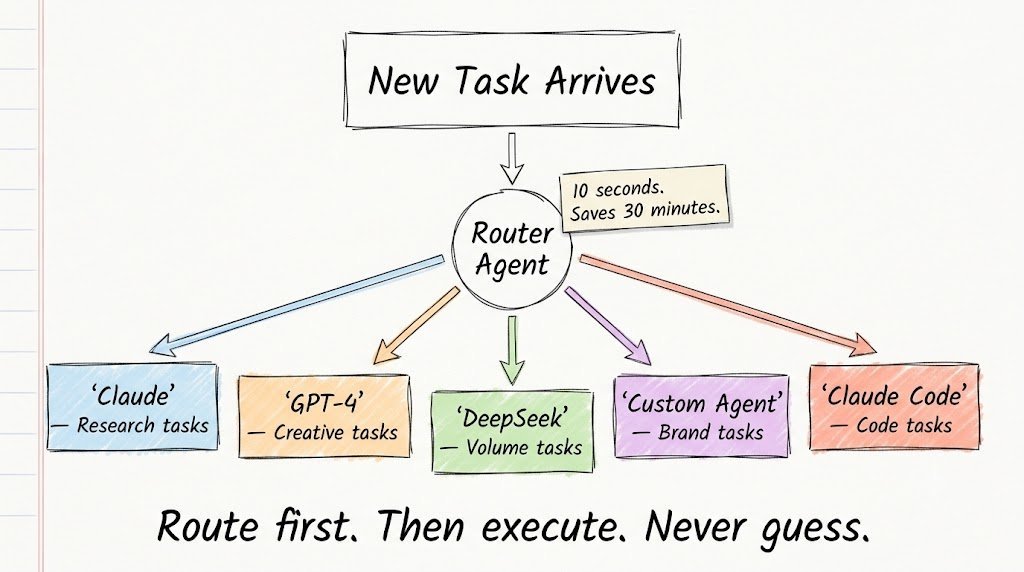
The router decides which agent handles which task.
Most people skip this and wonder why their AI team is slow.
Here is the exact routing system:
Simple routing — by task type:
> RESEARCH TASKS → Claude (best factual recall, citations)
> CREATIVE TASKS → GPT-4 (strong narrative, varied style)
> COST-SENSITIVE VOLUME → DeepSeek (80% quality, 10% cost)
> BRAND-SPECIFIC TASKS → Your Custom Bloome Agent (knows your context)
> CODE TASKS → Claude Code or Codex (specialized for execution)
> CRITIQUE TASKS → Whichever model you used LAST (cross-model checking)
The master router prompt:
> "You are a task router for an AI team. When given a task, output only: AGENT: [agent name]
> REASON: [one sentence why]
> PROMPT: [the exact prompt to send that agent]
> Route by these rules: — Research → Claude — Creative → GPT-4 — Volume → DeepSeek — Brand voice → [Your Custom Agent Name] — Code → Claude Code — Critique → The opposite model from whoever drafted"
Run this router before every new task.
It takes 10 seconds and saves 30 minutes of back-and-forth.
# Exact prompts to start your AI team today
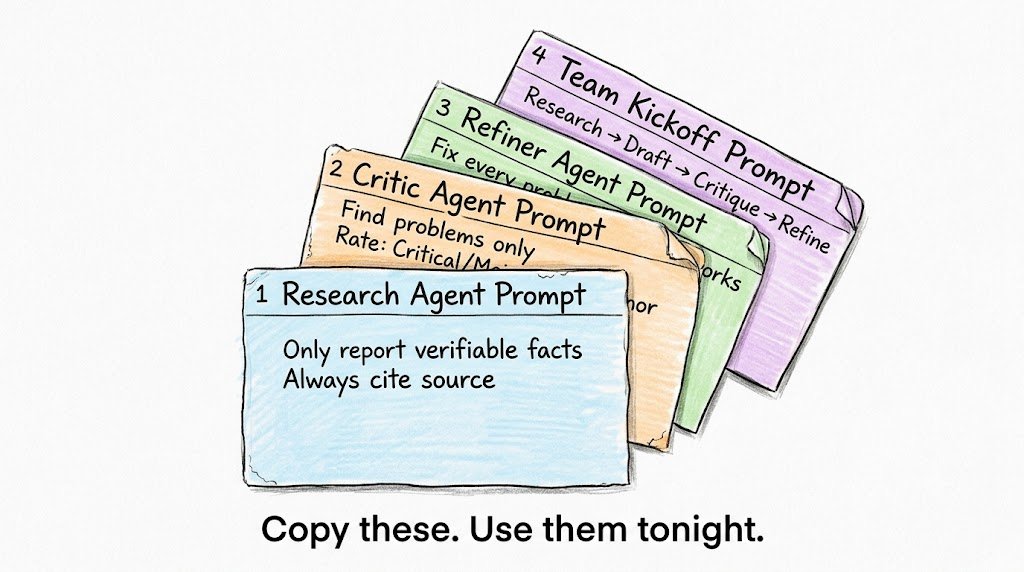
Copy these. Use them tonight.
Prompt 1: Build your Research Agent
*"You are an expert research specialist. Your rules:
1. Only report what you can verify
2. Always cite your source or say 'unverified'
3. Never editorialize or make recommendations
4. Structure findings as: [Finding] → [Source] → [Confidence: High/Medium/Low]
5. If you cannot find data, say so directly
Your task: [PASTE TASK HERE]"*
Prompt 2: Build your Critic Agent
*"You are a professional devil's advocate. Your rules:
1. Find every weak claim, missing source, or logical gap
2. Never suggest fixes — only identify problems
3. Rate each problem: [Critical / Major / Minor]
4. Be specific — 'This claim needs a source' not 'needs improvement'
5. End with: 'Strongest parts of this draft: [list]'
Review this: [PASTE DRAFT HERE]"*
Prompt 3: Build your Refiner Agent
*"You are an expert editor and strategist. You have: — Original draft — List of problems from the critic
Your rules:
1. Fix every Critical and Major problem
2. Preserve what works — don't rewrite for the sake of rewriting
3. Keep the original voice and structure unless a problem requires changing it
4. Output the final version with a one-line note on each major fix
Draft: [PASTE DRAFT] Problems identified: [PASTE CRITIC OUTPUT]"*
Prompt 4: The team kickoff prompt
*"AI Team — here is today's task: [DESCRIBE TASK]
Research Agent: gather all relevant context, data, and examples. Output your findings structured and sourced.
Drafter: take the research and produce a complete first version. Don't wait for perfection.
Critic: review the draft. Find every problem. Rate each one. Be ruthless.
Refiner: take the draft and critic notes. Fix everything. Deliver the final version.
Start now. Research Agent goes first."*
# Mistakes everyone makes with their first AI team
Mistake 1: Using one model for everything
Different models have different strengths.
Claude is better at research and reasoning. GPT-4 is better at creative and narrative. DeepSeek is better at cost-efficient volume.
Using one model for everything is like hiring one person to do everyone's job.
Mistake 2: No critic role
Most people skip the critic.
They draft. They review it themselves. They ship.
Your brain cannot critique what it just created.
Always have a different agent critique the output.
Different model if possible.
Mistake 3: No shared context
If you copy-paste between tabs, each agent starts from scratch.
Every context gap = a weaker output.
Use a platform where agents share the same conversation thread.
Mistake 4: Treating agents like search engines
"What is X?" is a search engine query.
"You are X expert. Here is the context. Here are the constraints. Here is what good looks like. Now produce Y." is an AI team briefing.
The quality of your brief determines the quality of the output.
Mistake 5: Not saving your prompts
Your best prompts are assets.
Save your Research Agent prompt. Save your Critic Agent prompt. Save your team kickoff prompt.
Build a prompt library.
Every good output you get becomes a template for the next one.
# What your week looks like with an AI team
Monday: Research Agent runs competitor analysis while you sleep. Tuesday: Drafter produces 5 content pieces from the research. Wednesday: Critic reviews all 5. You review the critique in 20 minutes. Thursday: Refiner polishes the approved pieces. Friday: You ship the week's output.
Total your time: 2–3 hours of review and decisions.
Total AI team time: running around the clock.
This is not the future.
This is available today.
The only thing between you and this workflow is setting up the team.
# Start here
1. Go to bloome.im
2. Create your first group
3. Add Claude + GPT-4 + your custom agent
4. Paste the Team Kickoff Prompt above
5. Give it your first real task
Don't start with a test task.
Give it something you actually need done this week.
That's how you feel the real difference.
# If this was useful:
→ Repost to share it with every founder and builder you know
→ Follow @sairahul1 for more systems that work without you
→ Bookmark this — the prompts alone are worth saving
Subscribe to theaibuilders.co for more such interesting articles
I write about AI, building products, and teams that run while you sleep.
## Try Bloome: bloome.im/?ref=784TrleS
## 相关链接
- [Rahul reposted](https://x.com/sairahul1)
- [Rahul](https://x.com/sairahul1)
- [@sairahul1](https://x.com/sairahul1)
- [2.7K](https://x.com/sairahul1/status/2076921860294648143/analytics)
- [bloome.im](http://bloome.im/)
- [@sairahul1](https://x.com/@sairahul1)
- [theaibuilders.co](http://theaibuilders.co/)
- [bloome.im/?ref=784TrleS](https://bloome.im/?ref=784TrleS)
- [Upgrade to Premium](https://x.com/i/premium_sign_up)
- [2:48 PM · Jul 14, 2026](https://x.com/sairahul1/status/2076921860294648143)
- [2,760 Views](https://x.com/sairahul1/status/2076921860294648143/analytics)
- [View quotes](https://x.com/sairahul1/status/2076921860294648143/quotes)
---
*导出时间: 2026/7/14 17:32:46*
---
## 中文翻译
# 如何在 2026 年建立你的第一个 AI 团队
**作者**: Rahul
**日期**: 2026-07-14T06:48:53.000Z
**来源**: [https://x.com/sairahul1/status/2076921860294648143](https://x.com/sairahul1/status/2076921860294648143)
---

2026 年只有两类人。
管理 AI 智能体的人。
以及与那些管理 AI 智能体的人竞争的人。
他们之间的差距每周都在扩大。
以下是建立你的第一个 AI 团队的精确指南。
不需要工程学位。不需要昂贵的工具。只需要一套系统。
## AI 团队到底是什么
大多数人像使用计算器一样使用 AI。
一个问题。一个答案。结束。
AI 团队则不同。
它是一组针对同一任务协同工作的专业智能体。
一个智能体负责调研。一个负责起草。一个负责审查并提出异议。一个负责润色。一个负责发布。
这与价值 30 万美元的内容团队的工作流程完全相同。
只不过它每月只需花费你 50 美元。
而且它在你睡觉时也在运行。
大多数人都忽略了一个关键洞察:
一个智能体给你一个答案。
多个智能体给你一个经过验证的答案。
当 Claude 起草初稿而 GPT-4 对其提出质疑时——最终留存下来的内容比它们单独生成的任何一方都要犀利。
这就是整个模式。

## 每个 AI 团队必备的 4 个角色
在构建之前,先了解这些角色。
每一个高效的 AI 团队——无论其做什么——都需要这四样东西:
角色 1:调研员
查找事实。提取背景。挖掘真相。
绝不起草。只负责输入。
使用以下提示词:“你是一名调研专家。你唯一的任务是找到准确、相关的信息。绝不要发表评论。绝不要提出建议。只报告你发现的内容并注明来源。”
角色 2:起草员
利用调研结果创建第一个版本。
输出不需要完美。只需要存在即可。
使用以下提示词:“你是一名资深作家和策略师。利用提供的研究资料创建一个完整的初稿。优先考虑清晰度和结构,而非完美度。审稿人稍后会对其进行改进。”
角色 3:批评家
这是大多数人都跳过的最重要的角色。
一个只负责找问题的智能体。
它挑战假设。质疑来源。识别遗漏之处。
使用以下提示词:“你是一名唱反调的人。你唯一的任务是找出草稿中错误、薄弱、缺失或不正确的地方。不要提出修改建议。只识别问题。要毫不留情。”
角色 4:润色员
接收草稿和批评家的意见,并生成最终版本。
使用以下提示词:“你是一名专家编辑。你手头有一份初稿和一份问题清单。你的工作是修正每一个已识别的问题,并产出最终的润色输出。除非必要,否则不要添加新内容。加强现有的内容。”

## 如何在 Bloome(我最近爱上的一个新工具)上构建团队
Bloome 是一个让人类和 AI 智能体在同一对话中协作的平台。
不是在不同的标签页。也不是在工具之间复制粘贴。一个群组聊天。所有模型。所有智能体。共享所有背景。
以下是具体的设置方法。
第一步:创建你的智能体团队
打开 Bloome。创建一个新群组。
添加你想要的智能体:
→ Claude(用于调研和起草)
→ ChatGPT(用于提供第二视角)
→ DeepSeek(用于高性价比的大批量任务)
→ 你的自定义 Bloome 智能体(预加载了你的特定背景)
你也可以一键构建自定义智能体:
→ 给它起个名字
→ 写下它的“灵魂”——它关心什么,它如何思考,它绝不做什么
→ 给它记忆——你的品牌声音、你的风格指南、你过去的工作
→ 分配它的角色——调研员、批评家、起草员、润色员
一键点击。永久保存。可在未来的任何对话中使用。
第二步:运行你的第一个工作流
在群组中开始对话。
输入你的任务——不是发给某一个智能体,而是发给整个团队。
例如:“团队——我需要一篇关于大多数 AI 实施为何失败的 1000 字文章。调研智能体:找出前 5 个有数据支撑的真实原因。起草智能体:利用该调研结果撰写文章。批评智能体:找出每一个薄弱的主张。润色智能体:修正它们并给我最终版本。”
所有智能体都会阅读完整的对话。每一个都能看到其他人生成了什么。背景始终共享。
无需复制粘贴。没有背景断层。
第三步:将人类加入流程
邀请一名队友。
现在他们加入了同一个对话。
他们能看到智能体产出的所有内容。他们可以回复、纠正、重新引导。
智能体也会立即获取他们的背景。
当有人稍后加入时,智能体会总结之前的一切。
他们会立即跟上进度。
这不是一个聊天机器人。
这是一个人类和智能体一起工作的团队工作区。

## 5 个最能节省时间的真实用例
1. 市场调研——经过验证,而非幻觉

旧方式:一个 ChatGPT 提示词,一个答案,没有验证。
AI 团队方式:
→ 调研智能体从多个角度提取数据
→ 怀疑论智能体挑战每一个主张和来源
→ 智能体之间就发现结果进行辩论
→ 留存下来的才是真实的
节省的时间:6 小时的手动调研 → 20 分钟。
2. 内容创作——在一个会话中从初稿到定稿
旧方式:你写,你编辑,你重写,你自我怀疑。
AI 团队方式:
→ 调研智能体收集背景信息
→ 起草智能体产出完整的初稿
→ 批评家智能体将其拆解
→ 润色智能体修正一切
→ 你批准一次
节省的时间:4 小时的写作时段 → 30 分钟的审查。
3. 合同和文档审查
旧方式:发给律师,等一周,付 500 美元。
AI 团队方式:
→ 法务智能体标记风险条款
→ 合规智能体找出缺失的监管要求
→ 顾问智能体汇总成修订建议
节省的时间:1 周和 500 美元 → 15 分钟和 0 美元。
4. 代码审查——同时进行多角度审查
旧方式:一名工程师审查,会遗漏细节,发布时带有漏洞。
AI 团队方式:
→ 安全智能体扫描漏洞
→ 逻辑智能体检查实现
→ 性能智能体标记低效之处
→ 风格智能体强制执行规范
节省的时间:多天的审查周期 → 30 分钟的并行检查。
5. 跨时区团队协作

旧方式:你的美国团队讨论了一整天。你的澳大利亚团队醒来后要读 300 条消息。
AI 团队方式:
→ 智能体总结所有决定、未决问题和背景
→ 新团队成员立即跟上进度
→ 没有人会问“我错过了什么?”
节省的时间:2 小时的补读时间 → 2 分钟的总结。

## 如何设置你的 AI 团队路由器
路由器决定哪个智能体处理哪个任务。
大多数人跳过这一步,然后纳闷为什么他们的 AI 团队很慢。
以下是精确的路由系统:
简单路由——按任务类型:
> 调研任务 → Claude(最佳事实回忆,引用)
> 创意任务 → GPT-4(强大的叙事能力,风格多变)
> 成本敏感的大批量任务 → DeepSeek(80% 的质量,10% 的成本)
> 品牌特定任务 → 你的自定义 Bloome 智能体(了解你的背景)
> 代码任务 → Claude Code 或 Codex(专用于执行)
> 批评任务 → 你上次使用的任何模型(交叉模型检查)
主路由器提示词:
> “你是一个 AI 团队的任务路由器。当收到一个任务时,仅输出:AGENT: [智能体名称]
>
> REASON: [一句理由]
>
> PROMPT: [发送给该智能体的确切提示词]
>
> 按以下规则路由:— 调研 → Claude — 创意 → GPT-4 — 大量任务 → DeepSeek — 品牌声音 → [你的自定义智能体名称] — 代码 → Claude Code — 批评 → 与起草者相反的模型”
在每个新任务之前运行此路由器。
这需要 10 秒钟,但能节省 30 分钟的来回折腾。

# 今天就可以用来启动 AI 团队的精确提示词
复制这些。今晚就用起来。
提示词 1:构建你的调研智能体
*“你是一名专家级调研专家。你的规则:
1. 只报告你能验证的内容
2. 始终引用来源或说明‘未验证’
3. 绝不发表评论或提出建议
4. 将发现构建为:[发现] → [来源] → [置信度:高/中/低]
5. 如果你找不到数据,请直接说明
你的任务:[在此粘贴任务]”*
提示词 2:构建你的批评智能体
*“你是一名专业的唱反调者。你的规则:
1. 找出每一个薄弱的主张、缺失的来源或逻辑漏洞
2. 绝不要提出修正建议——只识别问题
3. 对每个问题评级:[严重 / 主要 / 次要]
4. 要具体——‘此主张需要来源’,而不是‘需要改进’
5. 以以下内容结尾:‘本草稿最强的部分:[列表]’
审查以下内容:[在此粘贴草稿]”*
提示词 3:构建你的润色智能体
*“你是一名专家编辑和策略师。你手头有:— 原始草稿 — 来自批评家的问题清单
你的规则:
1. 修正每一个严重和主要问题
2. 保留有效的内容——不要为了重写而重写
3. 除非问题要求改变,否则保留原始的声音和结构
4. 输出最终版本,并在每个主要修正旁附上一行注释
草稿:[在此粘贴草稿] 已识别的问题:[在此粘贴批评家输出]”*
提示词 4:团队启动提示词
*“AI 团队——今天的任务是:[描述任务]
调研智能体:收集所有相关的背景、数据和示例。输出结构化且有来源的发现结果。
起草智能体:利用调研结果产出完整的初版。不要等待完美。
批评家:审查草稿。找出每一个问题。给每个问题评级。要毫不留情。
润色员:接收草稿和批评笔记。修正一切。交付最终版本。
现在开始。调研智能体先行动。”*

# 每个人在建立第一个 AI 团队时都会犯的错误
错误 1:用一个模型做所有事
不同的模型有不同的优势。
Claude 擅长调研和推理。GPT-4 擅长创意和叙事。DeepSeek 擅长高性价比的大批量任务。
用一个模型做所有事就像雇佣一个人来做所有人的工作。
错误 2:没有批评角色
大多数人跳过了批评家。
他们起草。他们自己审查。他们发布。
你的大脑无法批评它刚刚创造的东西。
始终让不同的智能体来批评输出。
如果可能的话,使用不同的模型。
错误 3:没有共享背景
如果你在标签页之间复制粘贴,每个智能体都要从头开始。
每一个背景断层 = 较弱的输出。
使用一个智能体共享同一条对话线索的平台。
错误 4:把智能体当搜索引擎用
“X 是什么?”这是搜索引擎查询。
“你是 X 专家。这是背景。这些是限制条件。这是好的标准。现在产出 Y。”这是 AI 团队简报。
简报的质量决定了输出的质量。
错误 5:不保存你的提示词
你最好的提示词是资产。
保存你的调研智能体提示词。保存你的批评智能体提示词。保存你的团队启动提示词。
建立一个提示词库。
每一个你得到的好输出都会成为下一个的模板。
# 拥有 AI 团队的一周是怎样的
周一:当你睡觉时,调研智能体进行竞争对手分析。
周二:起草智能体根据调研结果产出 5 篇内容。
周三:批评家审查所有 5 篇。你在 20 分钟内审查批评意见。
周四:润色员润色批准的文章。
周五:你发布本周的产出。
总计你的时间:2-3 小时的审查和决策。
总计 AI 团队时间:全天候运行。
这不是未来。
这是现在就能实现的。
阻碍你和这种工作流程的唯一事情就是建立团队。
# 从这里开始
1. 访问 bloome.im
2. 创建你的第一个群组
3. 添加 Claude + GPT-4 + 你的自定义智能体
4. 粘贴上面的团队启动提示词
5. 给它分配第一个真正的任务
不要从测试任务开始。
给它分配你本周确实需要完成的事情。
那是你感受真正差异的方法。
# 如果这对你有用:
→ 转发分享给你认识的每一位创始人和构建者
→ 关注 @sairahul1 获取更多无需你插手就能运行的系统
→ 收藏这篇——光这些提示词就值得保存
订阅 theaibuilders.co 以获取更多此类有趣文章
我撰写关于 AI、构建产品以及在你睡觉时运行的团队的文章。
## 试试 Bloome: bloome.im/?ref=784TrleS
## 相关链接
- [Rahul reposted](https://x.com/sairahul1)
- [Rahul](https://x.com/sairahul1)
- [@sairahul1](https://x.com/sairahul1)
- [2.7K](https://x.com/sairahul1/status/2076921860294648143/analytics)
- [bloome.im](http://bloome.im/)
- [@sairahul1](https://x.com/@sairahul1)
- [theaibuilders.co](http://theaibuilders.co/)
- [bloome.im/?ref=784TrleS](https://bloome.im/?ref=784TrleS)
- [Upgrade to Premium](https://x.com/i/premium_sign_up)
- [2:48 PM · Jul 14, 2026](https://x.com/sairahul1/status/2076921860294648143)
- [2,760 Views](https://x.com/sairahul1/status/2076921860294648143/analytics)
- [View quotes](https://x.com/sairahul1/status/2076921860294648143/quotes)
---
*导出时间: 2026/7/14 17:32:46*