# How To Build a One-Person Company Using Claude Cowork
**作者**: Rahul
**日期**: 2026-06-27T09:03:36.000Z
**来源**: [https://x.com/sairahul1/status/2070795168677265758](https://x.com/sairahul1/status/2070795168677265758)
---
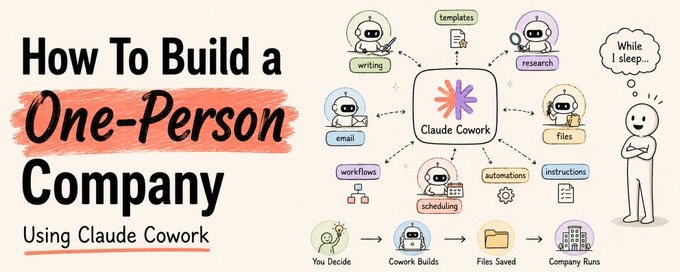
Emails. Formatting. Compiling reports. Preparing decks. Organizing files. Researching. Marketing. Writing. SEO.
The average knowledge worker spends 60% of their day on above work that doesn't require their brain.
Necessary. But not the work only you can do.
Claude Cowork changes this.
Not by making you faster at those tasks.
By removing you from them entirely.
Here is the exact system I use to run a one-person company where Cowork handles the production and I handle the decisions.
Save this. You will use it every week.
## What Cowork actually is
Most people think Claude is a chatbot.
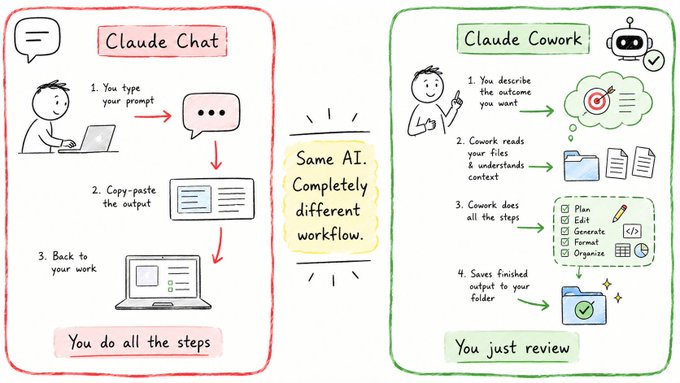
You open it. You type. It responds. You copy the text somewhere. You close the tab.
That is Claude Chat. It's fine. It's not Cowork.
Claude Cowork is a different product entirely.
It lives on your desktop. It reads and writes files on your actual computer. It creates real Word documents and Excel files. It runs multi-step tasks while you do something else. It asks you questions before it starts — instead of guessing and getting it wrong.
The mindset shift:
Claude Chat is a conversation. Cowork is a coworker.
One gives you text to paste somewhere. The other does the job and saves the file where it belongs.
## How to get started in 5 minutes
Before anything else — install.
→ Go to claude.com/download
→ Download the desktop app (Mac or Windows)
→ You need a paid plan — $20/month minimum. I use the $100/month plan :)
→ Open the app
→ Click the "Cowork" tab at the top (between Chat and Code)
→ Select a folder from your computer
→ Switch to Opus 4.6 for complex tasks
That folder is everything.
Cowork reads it. Writes to it. Organizes inside it.
The better your folder — the better your output.
## Step 1 — Build the folder
Most people open Cowork, type a prompt, and get generic output.
The reason: Cowork doesn't know who you are.
Fix this once. Never fix it again.
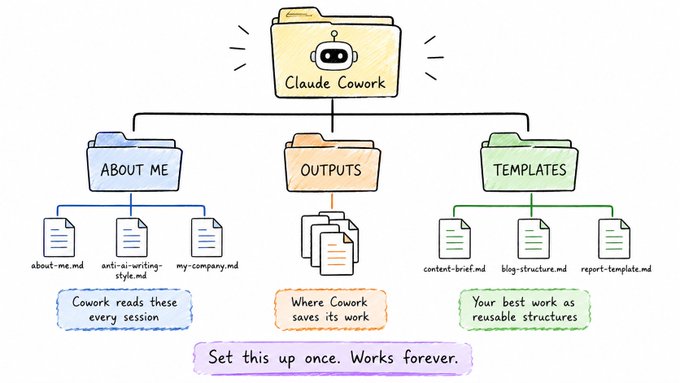
Create a folder called "Claude Cowork" on your computer.
Inside it, 3 subfolders:
→ ABOUT ME
→ OUTPUTS
→ TEMPLATES
## 3 files that change everything
ABOUT ME folder is the most important thing you will ever set up in Cowork.
These files get read at the start of every single session.
They mean you never explain yourself again.
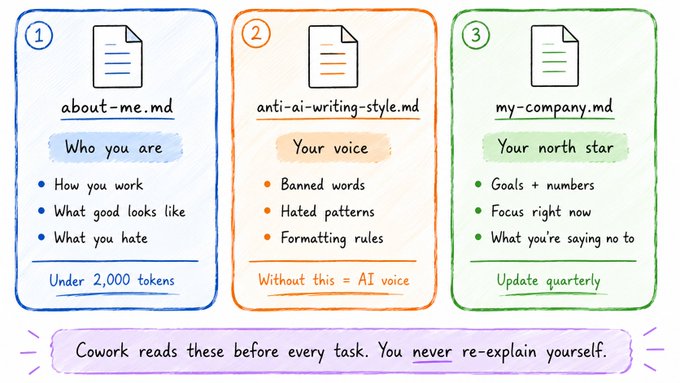
File 1 — about-me.md
Who you are. How you think. What good work looks like for you.
Don't write this yourself.
Let Cowork interview you.
Open a new Cowork session and paste this:
```
You are building my about-me.md file for my Cowork folder.
Interview me using AskUserQuestion — one question at a time.
20 questions total. Push back on vague answers.
Cover:
- What I do and who I work with
- How I start a task and what "done" looks like
- What great work looks like in my field
- What I hate (patterns, shortcuts, AI clichés)
- My hard rules and non-negotiables
After the interview: compile everything into a single
markdown file under 2,000 tokens.
No raw Q&A transcripts. Extract the patterns.
Write as condensed prose and bullet points.
Save as about-me.md in my ABOUT ME/ folder.
```
Answer the questions by talking, not typing.
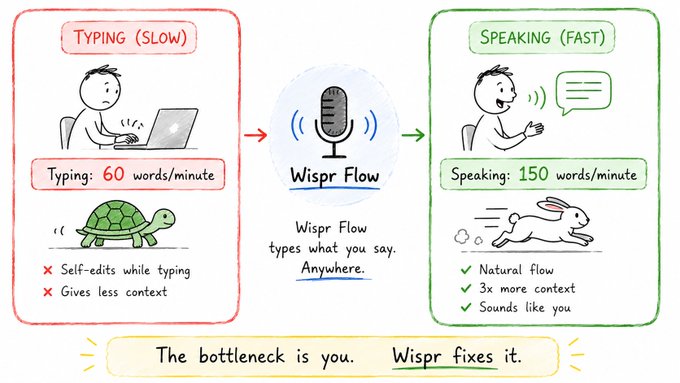
Use Wispr Flow (or any other free voice dictation tool, even Apple Mac has it by default). Hold a key. Talk. Release. Words appear.
Speaking gives 3x more context than typing. Better context = better Cowork output. Every time.
Keep the file under 2,000 tokens.
I learned this the hard way. My original about-me file was 22,000+ tokens. Cowork was spending most of each session just reading my profile — not doing actual work.
Trimmed it to under 2,000. Same quality. 10x less waste.
File 2 — anti-ai-writing-style.md
You hate AI writing. I hate AI writing.
Delve. Harness. Tapestry. In today's fast-paced world.
This file is a list of everything Cowork must never do when it writes for you.
Mine bans 80+ words. Kills specific sentence patterns. Limits paragraphs to 3 lines.
Without this file: Cowork writes like AI. With this file: Cowork writes like you.
Start simple. Add to it every time you see something you hate in Cowork's output.
File 3 — my-company.md
Your goals. Your strategy. What you're focused on. What you're saying no to.
Not your Tuesday deadline. Your north star.
Paste this into the same Cowork session after your about-me interview:
```
You are building my my-company.md file.
This file tells Claude what I'm working toward
so it makes better decisions on every task.
Interview me using AskUserQuestion — 6-8 questions.
Cover:
- My top 2-3 goals this year (specific numbers)
- What platforms and markets matter most right now
- What I'm actively saying no to
- Where I'm spending most of my time this quarter
After the interview: compile into a single markdown file
under 1,000 tokens. Bullet points. No filler.
Save as my-company.md in my ABOUT ME/ folder.
```
Update this file when your strategy actually changes.
Maybe once a quarter.
## Step 2 — Set Global Instructions
Your folder alone is not enough.
Cowork needs to know how to use it.
Go to: Settings → Cowork → Edit Global Instructions
Paste this (customize the file descriptions to match yours):
```
Before every task, read every file in ABOUT ME/:
- about-me.md: [your role, standards, how you work]
- anti-ai-writing-style.md: [your writing rules, banned words]
- my-company.md: [your goals, strategy, current focus]
Never read OUTPUTS/ or TEMPLATES/ unless I point you to a specific file.
Save all deliverables in OUTPUTS/ under a subfolder named after the project.
If the brief is unclear, use AskUserQuestion.
Don't fill gaps with filler.
Don't over-explain.
Deliver the work.
```
You set this once.
It runs before every single Cowork session.
Forever.
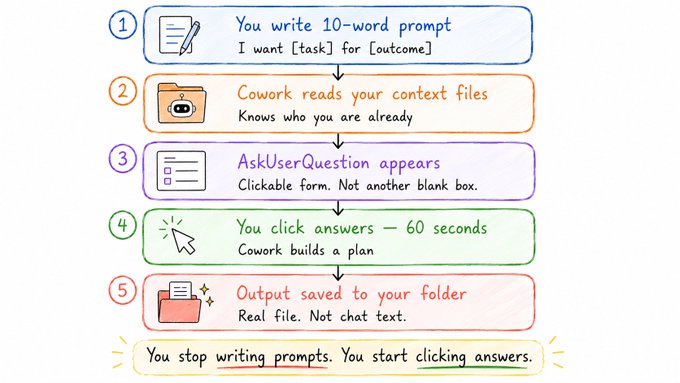
This is why you can write a 10-word prompt and get output that sounds like you wrote it.
The context is already loaded.
## Step 3 — The one prompt that runs everything
Stop writing long prompts.
This is the only prompt you need:
```
I want to [TASK] so that [SUCCESS CRITERIA].
Read my ABOUT ME folder first.
Then use AskUserQuestion to clarify before you start.
```
That's it.
Cowork reads your context files. Asks you the right questions. You click answers (takes 60 seconds). Cowork builds a plan. You approve. It creates the actual file in your OUTPUTS folder.
The whole interaction feels like briefing a smart employee instead of wrestling with a prompt box.
## The feature nobody explains properly
AskUserQuestion.
This is the thing that changed how I work.
Every other AI tool guesses when you're unclear.
It picks an interpretation. Runs with it. Produces polished output that answers the wrong question.
Cowork does something different.
When it needs more information — it stops.
It generates a form. Clickable options. Multi-select choices. Rankings you can drag and reorder.
The AI is now prompting you.
You are not wrestling with a text box trying to write the perfect prompt.
You are clicking through a form in 60 seconds.
Always add this line to any non-trivial prompt:
```
Use AskUserQuestion before you start.
```
I have a Mac text shortcut: I type "/prompt" and it expands to my full template automatically.
Settings → Keyboard → Text Replacements → add /prompt → paste the full template.
One keyboard shortcut. Always ready.
## Step 4 — Install Wispr Flow
This is the bottleneck nobody talks about.
Cowork can read 100,000 words in 15 seconds. It can build a spreadsheet in 90 seconds.
Then it waits for you to type at 60 words per minute.
You speak at 150 words per minute.
Install Wispr Flow.
→ wispr.ai (or any free STT) → Download → Install
→ Choose a keyboard shortcut (I use Shift)
→ Hold the key. Talk. Release. Words appear anywhere on your screen.
Including inside Cowork's chat box.
Now instead of typing "I need a LinkedIn post," you say:
"I recently found out about X and I want to share more about Y but first I want to make sure Z is clear so maybe we should start with..."
Spoken context is 3x richer than typed context.
Better context = better output.
Every time.
## Step 5 — Save tokens. Save money.
The $20/month plan runs out fast if you use Cowork daily.
Here is how to make every credit count.
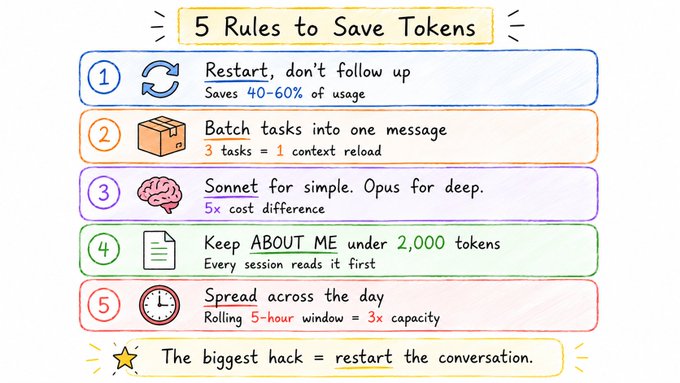
The biggest hack: restart the conversation.
Every follow-up message costs more than the last.
Message 1 costs 1 token of context re-reading. Message 30 costs 31x that.
At 500 tokens per exchange — 20 messages burns 105K tokens.
When Cowork gets something wrong — don't type "no, I meant..."
Restart the conversation from a higher point. Start fresh with a better brief.
That single habit cuts your token usage by 40-60%.
5 more rules:
→ Batch your tasks. 3 separate prompts = 3 context reloads. 1 prompt with 3 tasks = 1 reload.
→ Use Sonnet for simple tasks. Grammar checks, formatting, quick answers. Save Opus for deep work. Sonnet costs 5x less.
→ Keep ABOUT ME files small. Every session starts by reading these. 22,000 tokens → burns budget before any real work. 2,000 tokens → efficient.
→ Start fresh every 20 messages. Ask Cowork to summarize the session. Copy it. New session. Paste summary as first message. Same context. No bloat.
→ Spread sessions across the day. Claude uses a rolling 5-hour usage window. One morning sprint burns your daily limit. Morning + afternoon + evening = 3x the capacity.
## Step 6 — The Templates folder
Every time Cowork builds something you like — save it as a template.
Just say this at the end of your session:
```
Save this as a template in TEMPLATES/.
Strip the content. Keep the structure.
```
Cowork strips the actual content, keeps the skeleton — sections, order, format, length — and saves it.
Next time you need something similar:
```
Use the template in TEMPLATES/[filename].
```
The TEMPLATES folder fills itself.
You don't organize it. You don't maintain it.
You just point to files when you need them.
Over time this folder becomes your most valuable asset.
Every structure that worked. Every format that landed. Every output your clients loved.
Instantly reusable.
## Step 7 — Build your AI employee
This is where Cowork goes from tool to infrastructure.
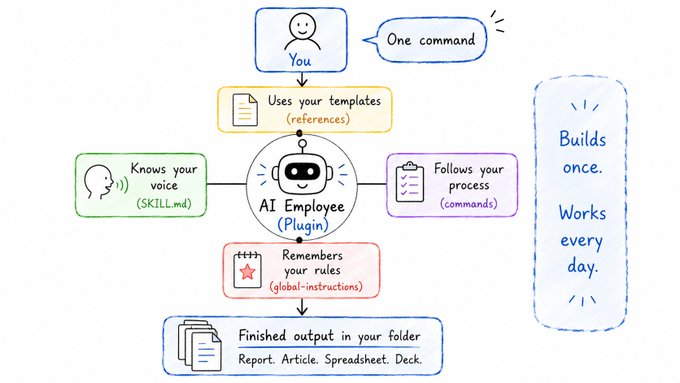
A Cowork plugin is a folder with a specific structure that turns Claude into a specialist.
Not a generalist who can do anything.
A specialist who does one thing exactly the way you do it.
Your content strategist. Your research analyst. Your client report writer.
The folder structure:
```
my-plugin/
├── .claude-plugin/
│ └── plugin.json ← Name and role
├── skills/
│ └── SKILL.md ← Step-by-step workflow
├── commands/
│ └── run.md ← /slash commands
├── references/
│ └── templates.md ← Your best examples
└── global-instructions.md ← Standing orders
```
The SKILL.md is the brain.
Every step. Every rule. Every quality check.
The more specific you write it — the better the output.
Not "analyze the data."
"Compare this week to last week. Calculate percentage change for each metric. Flag anything above 20% variance. Write the insight in one sentence."
Example plugin: a weekly content writer
```
# SKILL.md
## Process
1. Read about-me.md to load voice and audience
2. Read anti-ai-writing-style.md — never break these rules
3. Read the content brief from INPUTS/
4. Research the topic using web search (3 sources minimum)
5. Write a hook using the 3-second scroll-stop test
6. Write the body in sections under 100 words each
7. End with a specific CTA tied to my current goal in my-company.md
8. Run quality checklist before saving
## Rules
- Never use bullet points unless I ask
- Every paragraph max 3 lines
- No AI words (see anti-ai-writing-style.md)
- Hook must make a bold claim in the first line
## Quality Checklist
- [ ] Hook stops the scroll in 3 seconds
- [ ] No banned words or patterns
- [ ] CTA matches current goal
- [ ] Reads like a human wrote it
```
Once built — trigger it with:
```
/content:write
```
One command. Full specialist workflow. Saved to your OUTPUTS folder.
## Step 8 — Automate your full day
This is the endgame.
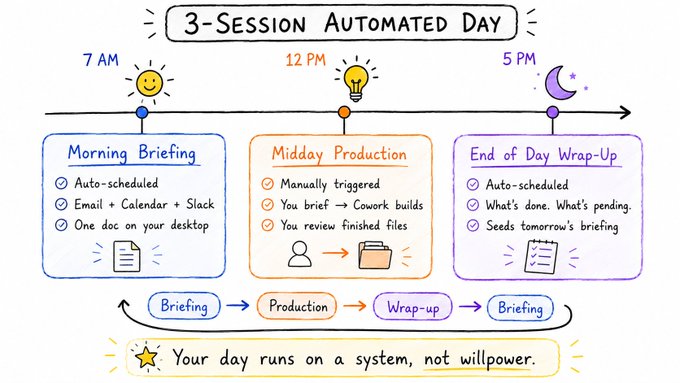
3 scheduled sessions. No manual triggering. Your day runs itself.
7 AM — Morning briefing
Before you open your laptop with full intention:
Cowork has already scanned your email and categorized by urgency. Drafted responses for routine messages. Flagged the 3 that actually need your brain. Pulled your calendar. Created prep notes for every meeting.
One document sitting on your desktop.
You read it in 5 minutes. You know exactly what your day looks like.
Use /schedule in Cowork to set this up as a recurring task.
12 PM — Midday production
Triggered manually when you're ready to get real work done.
You brief Cowork on your 3-5 tasks for the afternoon.
Cowork executes them while you focus on the decisions and relationships that only you can handle.
You come back to finished files.
5 PM — End of day wrap-up
Before you close your laptop:
Cowork reviews what happened. What was handled. What's pending. What carries to tomorrow.
One document that closes the loop.
Which becomes context for tomorrow morning's briefing.
Continuous loop. Zero gaps.
```
/schedule: Every weekday at 7 AM
Read my email (Gmail connector), calendar (Google Calendar connector),
and Slack (Slack connector).
Categorize emails:
- Tier 1: Must respond before 9 AM
- Tier 2: Must respond today
- Tier 3: Can wait this week
- Tier 4: Informational, no reply needed
Draft responses for all Tier 3 and Tier 4 emails.
Flag Tier 1 and Tier 2 for my review.
Pull today's calendar. Write 3-sentence prep notes for each meeting.
Compile everything into Morning-Briefing-[DATE].md
Save to /OUTPUTS/daily-briefings/
```
Set it. Never think about it again.
## Some more things you can do, to improve your everyday
# Plugins
What they are (in 10 words): Pre-built specialist packs that make Claude an expert instantly.
## Why they matter
Without a plugin, Claude Cowork is a brilliant generalist. It can write, research, analyze, organize, and build. But it doesn’t know your industry’s terminology, your team’s workflow, or the specific outputs your role requires.
Plugins change that. They’re bundles of skills, slash commands, and sub-agents designed for specific job functions. Anthropic shipped 11 official plugins in January 2026:
- Productivity — task management, calendars, and daily workflows
- Marketing — content drafting, campaign planning, brand voice
- Sales — account research, call prep, outreach, battlecards
- Finance — financial modeling, analysis, reporting
- Data Analysis — SQL, dashboards, dataset exploration
- Legal — contract review, research, drafting
- Product Management — specs, roadmaps, user stories
- Customer Support — ticket handling, response drafting
- Enterprise Search — search across your connected tools
- Biology Research — scientific literature and data
- And more being added
The impact hit fast. When the Legal plugin launched, Thomson Reuters dropped 16% in a single trading session — its worst day on record. LegalZoom fell 20%. That’s what it looks like when AI starts genuinely doing specialized work.
Install the Sales plugin and Claude can research accounts, prep you for calls, and draft outreach sequences. Install the Data plugin and it explores your dataset, writes SQL, builds dashboards, and flags anomalies. You don’t need to be technical. You just click install
## How to install plugins
1. Open Claude Cowork.
2. Click the “+” button in the chat bar, then click “Plugins” to browse the library.
3. to see everything available.Or go toclaude.com/plugins
4. Pick the plugin that fits your role and click Install.
5. Type “/” in any Cowork chat to see the slash commands that plugin adds.
## Your first prompts (after installing)
After installing the Productivity plugin:
/productivity:start Let’s review what I need to get done today and set up my task list.
After installing the Marketing plugin:
/marketing:draft-content Write a LinkedIn post about [topic]. Match the voice from my brand-voice.md file. Target [audience]. Goal: [what I want people to do].
After installing the Data plugin:
/data:explore I’ve uploaded a CSV in this folder. Give me a summary of what’s in it, flag any anomalies, and suggest three analyses worth running.
The output with a plugin active is noticeably more structured and opinionated than a generic prompt. It knows what a good output looks like for your function.
# Connectors
What they are (in 10 words): Live integrations with Slack, Drive, Notion, and 50+ other tools.
## Why they matter
The typical AI workflow involves a lot of copy-pasting. You screenshot your Slack thread. You copy the doc. You paste it into the chat. You add context manually. It’s exhausting.
Connectors eliminate all of that. Link your tools once, and Claude can reference live data from them mid-conversation. No copy-pasting. No screenshots. No downloads.
-alpha over the last two weeks” and it reads your Slack. Ask it to “pull the Q1 numbers from the revenue doc in Drive” and it opens your Google Doc. Ask it to “find everything tagged as a blocker in Notion” and it searches your workspace.Ask Cowork to “summarize the key decisions from#project
This is free on all plans. It’s the most underused feature in Cowork, in my experience.
## How to connect your tools
1. Go to Settings > Connectors in Claude Desktop.
2. Browse the directory (50+ integrations including Slack, Google Drive, Notion, Figma, Asana, and more).
3. Click a connector and hit “Add.”
4. Authenticate with that tool. Done.
You only do this once. After that, Claude can access live data from that tool in every Cowork session.
## Your first prompt (after connecting Slack)
Search my Slack messages from the last 7 days and give me a summary of anything I need to follow up on. Organize by urgency.
## Or after connecting Google Drive:
Find the most recent document about [project name] in my Drive. Read it and tell me the three most important things I need to know.
## Real use cases
Here is exactly how I use Cowork every week.
Writing this kind of article:
Folder has: about-me.md, anti-ai-writing-style.md, past articles that performed well, reference docs.
Prompt: "I want to write about [topic]. Read my folder. Ask me questions first."
What happens: Cowork reads every file. Asks about audience, angle, what other guides missed. I click answers. It produces an outline. I push back. It adjusts. Writes the draft in my voice because it has my voice profile loaded.
I edit. But the heavy lifting is done.
Client deliverables:
Drop the client brief in the folder next to my templates and past work.
Prompt: "Read the brief in /projects/client-x. Compare to my template. Draft a first version as .docx. Ask me questions first."
What happens: Cowork reads the brief. Compares to my format. Asks things I didn't think of. Creates the actual .docx. Ready to open.
Competitive research:
Drop 3-5 competitor articles into a subfolder.
Prompt: "Read all 4 articles. Create a comparison table: what each covered, what they missed, where I can say something new."
That used to be a junior hire job.
Now it's a prompt.
Weekly briefing that runs itself:
Scheduled every Monday at 7 AM.
Cowork researches whatever I'm tracking. Saves the summary to my briefings folder.
I wake up to a document. I didn't do anything.
## Where Cowork falls short
I promised honesty.
→ No memory between sessions: Every session starts fresh. Fix: keep context in your ABOUT ME files. Set solid global instructions. This workaround works well but you will feel the gap on long projects.
→ Eats your usage fast: Complex tasks burn credits quickly. On the $20 plan you'll feel it within a week of heavy use. Consider the $100 plan if Cowork becomes your main workflow.
→ Desktop only: No mobile. No browser version. The app must stay open while tasks run. Close it — the session dies.
→ Not for quick questions: Use Chat for "what's the capital of France." Cowork is for tasks, not trivia.
→ Review before sending. Still a research preview. Anthropic says this explicitly. Don't send a client deliverable without reading it. Works great 90% of the time. The 10% can surprise you.
## Your first 20 minutes
Open your calendar. Block 20 minutes this week.
Minutes 0-5: Install and build the folder
→ claude.com/download
→ Download → Sign in → Paid plan
→ Create Claude Cowork folder on your computer
→ Create 3 subfolders: ABOUT ME, OUTPUTS, TEMPLATES
Minutes 5-12: Create your 3 core files
→ Open Cowork
→ New session
→ Opus 4.6
→ Paste the about-me interview prompt from above
→ Use Wispr Flow to dictate your answers (download it now: wispr.ai)
→ Let Cowork build about-me.md from your answers
→ Quick: write your anti-ai words in a text file
→ save as anti-ai-writing-style.md
→ Paste the my-company prompt
→ answer 6-8 questions
→ save as my-company.md
Minutes 12-14: Set Global Instructions
→ Settings
→ Cowork
→ Edit Global Instructions
→ Paste the template from above
→ Customize the file descriptions → Save
Minutes 14-18: Run your first real task
→ Think of something you actually need for work this week
→ Type: "I want to [task]. Read my ABOUT ME folder first. Use AskUserQuestion before you start."
→ Click through the form
→ Watch Cowork create a real file in your OUTPUTS folder
→ Open the file. Read it. Edit it. Use it.
Minutes 18-20: Set your Mac text shortcut
→ Settings
→ Keyboard
→ Text Replacements
→ Add: /prompt
→ [your full template]
→ Test it. Type /prompt anywhere. The full template appears.
You are now a Cowork user.
Not the basic kind. The kind with context files, global instructions, and a system.
## What changes
Before Cowork: you spend 60% of your day on production work.
After Cowork: you spend 60% of your day on the decisions only you can make.
Before: you write prompts and pray.
After: you brief a system and review.
Before: every client deliverable starts from scratch.
After: your templates, voice, and standards are loaded before you type a word.
Before: competitive research takes half a day.
After: drop files in a folder, come back to a synthesis.
The bottleneck stops being production.
It becomes you. Your judgment. Your decisions. Your relationships.
That is what a one-person company actually looks like.
## If this was useful:
→ Repost to share it with every solo founder you know
→ Follow @sairahul1 for more systems that run without you
→ Bookmark this — the folder setup alone is worth 2 hours of your time
I write about AI, products, and systems that work while you sleep.
Tools mentioned:
→ Claude Cowork: claude.com/download (need paid plan)
→ Wispr Flow: wispr.ai (free tier available)
## 相关链接
- [Rahul](https://x.com/sairahul1)
- [@sairahul1](https://x.com/sairahul1)
- [4.8M](https://x.com/sairahul1/status/2070795168677265758/analytics)
- [claude.com/download](https://claude.com/download)
- [wispr.ai](https://wispr.ai/)
- [claude.com/plugins](https://claude.com/plugins)
- [#project](https://x.com/search?q=%23project&src=hashtag_click)
- [claude.com/download](https://claude.com/download)
- [wispr.ai](https://wispr.ai/)
- [@sairahul1](https://x.com/@sairahul1)
- [claude.com/download](https://claude.com/download)
- [wispr.ai](https://wispr.ai/)
- [Upgrade to Premium](https://x.com/i/premium_sign_up)
- [5:03 PM · Jun 27, 2026](https://x.com/sairahul1/status/2070795168677265758)
- [4.8M Views](https://x.com/sairahul1/status/2070795168677265758/analytics)
- [View quotes](https://x.com/sairahul1/status/2070795168677265758/quotes)
---
*导出时间: 2026/6/29 11:54:42*
---
## 中文翻译
# 如何利用 Claude Cowork 打造一人公司
**作者**: Rahul
**日期**: 2026-06-27T09:03:36.000Z
**来源**: [https://x.com/sairahul1/status/2070795168677265758](https://x.com/sairahul1/status/2070795168677265758)
---

邮件。格式调整。汇编报告。准备演示文稿。整理文件。调研。市场营销。撰写。SEO。
普通知识工作者每天花 60% 的时间做这些不需要动脑的工作。
必要。但不是非你不可的工作。
Claude Cowork 改变了这一切。
不是通过让你在这些任务上做得更快。
而是通过让你完全脱离这些工作。
这就是我用来运营一人公司的确切系统,Cowork 负责生产,我负责决策。
收藏起来。你每周都会用到。
## Cowork 到底是什么
大多数人认为 Claude 只是一个聊天机器人。
你打开它。输入。它回应。你把文本复制到某处。关闭标签页。
那是 Claude Chat。它还行。但它不是 Cowork。
Claude Cowork 是一个完全不同的产品。
它存在于你的桌面上。它读取并写入你电脑上的实际文件。它创建真实的 Word 文档和 Excel 文件。当你做其他事情时,它会运行多步骤任务。它在开始之前问你问题——而不是猜测并做错。
思维方式的转变:
Claude Chat 是对话。Cowork 是同事。
一个给你文本让你粘贴到某处。另一个完成工作并将文件保存在它该在的地方。

## 如何在 5 分钟内开始
在做任何事之前——先安装。
→ 访问 claude.com/download
→ 下载桌面应用(Mac 或 Windows)
→ 你需要一个付费计划——每月 20 美元起。我用的是每月 100 美元的计划 :)
→ 打开应用
→ 点击顶部的 "Cowork" 标签(在 Chat 和 Code 之间)
→ 从你的电脑中选择一个文件夹
→ 切换到 Opus 4.6 以处理复杂任务
那个文件夹就是一切。
Cowork 读取它。写入它。在里面整理。
你的文件夹越好——输出就越好。
## 第 1 步 — 构建文件夹
大多数人打开 Cowork,输入提示词,得到通用的输出。
原因:Cowork 不知道你是谁。
解决一次。永远不再解决。
在你的电脑上创建一个名为 "Claude Cowork" 的文件夹。
在里面,创建 3 个子文件夹:
→ ABOUT ME(关于我)
→ OUTPUTS(输出)
→ TEMPLATES(模板)

## 改变一切的 3 个文件
ABOUT ME 文件夹是你在 Cowork 中要建立的最重要的东西。
这些文件在每次会话开始时都会被读取。
这意味着你永远不需要再解释自己。
文件 1 — about-me.md
你是谁。你如何思考。对你来说好的工作是什么样的。
不要自己写这个。
让 Cowork 采访你。
打开一个新的 Cowork 会话并粘贴以下内容:
```
You are building my about-me.md file for my Cowork folder.
Interview me using AskUserQuestion — one question at a time.
20 questions total. Push back on vague answers.
Cover:
- What I do and who I work with
- How I start a task and what "done" looks like
- What great work looks like in my field
- What I hate (patterns, shortcuts, AI clichés)
- My hard rules and non-negotiables
After the interview: compile everything into a single
markdown file under 2,000 tokens.
No raw Q&A transcripts. Extract the patterns.
Write as condensed prose and bullet points.
Save as about-me.md in my ABOUT ME/ folder.
```
通过说话来回答问题,而不是打字。
使用 Wispr Flow(或任何其他免费语音听写工具,即使是 Apple Mac 默认也有)。按住一个键。说话。松开。文字出现。
说话提供的上下文是打字的 3 倍。更好的上下文 = 更好的 Cowork 输出。每次都是。
保持文件在 2,000 tokens 以下。
我是吃了苦头才学到这一点的。我最初的 about-me 文件有 22,000+ tokens。Cowork 在每次会话中花费大部分时间只是在阅读我的个人资料——而不是做实际的工作。
将其精简到 2,000 以下。同样的质量。浪费减少了 10 倍。
文件 2 — anti-ai-writing-style.md
你讨厌 AI 写作。我也讨厌 AI 写作。
深入探讨。利用。交织。在当今快节奏的世界里。
这个文件列出了 Cowork 在为你写作时绝不能做的所有事情。
我的文件禁止了 80 多个词。消除了特定的句子模式。将段落限制在 3 行以内。
没有这个文件:Cowork 写得像 AI。有了这个文件:Cowork 写得像你。
从简单开始。每次你在 Cowork 的输出中看到你讨厌的东西时,就添加进去。
文件 3 — my-company.md
你的目标。你的策略。你专注于什么。你对什么说不。
不是你周二截止的任务。你的北极星。
在 about-me 采访结束后,将以下内容粘贴到同一个 Cowork 会话中:
```
You are building my my-company.md file.
This file tells Claude what I'm working toward
so it makes better decisions on every task.
Interview me using AskUserQuestion — 6-8 questions.
Cover:
- My top 2-3 goals this year (specific numbers)
- What platforms and markets matter most right now
- What I'm actively saying no to
- Where I'm spending most of my time this quarter
After the interview: compile into a single markdown file
under 1,000 tokens. Bullet points. No filler.
Save as my-company.md in my ABOUT ME/ folder.
```
当你的策略真正改变时,更新这个文件。
可能一个季度一次。

## 第 2 步 — 设置全局指令
光有文件夹是不够的。
Cowork 需要知道如何使用它。
转到:Settings → Cowork → Edit Global Instructions
粘贴以下内容(自定义文件描述以匹配你的):
```
Before every task, read every file in ABOUT ME/:
- about-me.md: [your role, standards, how you work]
- anti-ai-writing-style.md: [your writing rules, banned words]
- my-company.md: [your goals, strategy, current focus]
Never read OUTPUTS/ or TEMPLATES/ unless I point you to a specific file.
Save all deliverables in OUTPUTS/ under a subfolder named after the project.
If the brief is unclear, use AskUserQuestion.
Don't fill gaps with filler.
Don't over-explain.
Deliver the work.
```
你只需设置一次。
它在每次 Cowork 会话之前运行。
永远。
这就是为什么你可以写一个 10 个单词的提示词,却能得到听起来像你写的输出。
上下文已经加载好了。
## 第 3 步 — 运行一切的唯一提示词
停止写长提示词。
这是你唯一需要的提示词:
```
I want to [TASK] so that [SUCCESS CRITERIA].
Read my ABOUT ME folder first.
Then use AskUserQuestion to clarify before you start.
```
就这样。
Cowork 读取你的上下文文件。问你正确的问题。你点击答案(花费 60 秒)。Cowork 制定计划。你批准。它在你的 OUTPUTS 文件夹中创建实际文件。
整个交互感觉就像是在给一位聪明的员工下达简报,而不是在和一个提示框搏斗。

## 没人能正确解释的功能
AskUserQuestion。
这就是改变我工作方式的东西。
其他所有 AI 工具在你不清楚时都会猜测。
它选择一种解释。就这样做。生成精美的输出,回答了错误的问题。
Cowork 做了一些不同的事情。
当它需要更多信息时——它会停下来。
它生成一个表单。可点击的选项。多选选择。你可以拖动重新排序的排名。
现在 AI 在提示你。
你不是在试图写出完美提示词的文本框里搏斗。
你在 60 秒内点击通过一个表单。
总是将这一行添加到任何非平凡的提示词中:
```
Use AskUserQuestion before you start.
```
我有一个 Mac 文本快捷方式:我输入 "/prompt",它会自动扩展为我的完整模板。
Settings → Keyboard → Text Replacements → add /prompt → paste the full template.
一个键盘快捷键。随时待命。
## 第 4 步 — 安装 Wispr Flow
这是没人谈论的瓶颈。
Cowork 可以在 15 秒内阅读 100,000 个单词。它可以在 90 秒内构建一个电子表格。
然后它等你以每分钟 60 个单词的速度打字。
你说话的速度是每分钟 150 个单词。
安装 Wispr Flow。
→ wispr.ai(或任何免费的 STT)→ Download → Install
→ 选择一个键盘快捷键(我用的是 Shift)
→ 按住键。说话。松开。文字出现在你屏幕的任何地方。
包括在 Cowork 的聊天框里。
现在,你不是输入 "I need a LinkedIn post",而是说:
"I recently found out about X and I want to share more about Y but first I want to make sure Z is clear so maybe we should start with..."
口述上下文比打字上下文丰富 3 倍。
更好的上下文 = 更好的输出。
每次都是。

## 第 5 步 — 节省 Tokens。节省金钱。
如果你每天使用 Cowork,每月 20 美元的计划很快就会用完。
以下是让每一分都算数的方法。
最大的技巧:重新开始对话。
每一条后续消息都比上一条花费更多。
第 1 条消息花费 1 个 token 的上下文重读成本。第 30 条消息花费 31 倍。
以每次交换 500 tokens 计算 —— 20 条消息会消耗 105K tokens。
当 Cowork 弄错时——不要输入 "no, I meant..."。
从更高的点重新开始对话。以更好的简报从头开始。
这单个习惯会将你的 token 使用量减少 40-60%。
还有 5 个规则:
→ 批量处理你的任务。3 个单独的提示词 = 3 次上下文重载。1 个包含 3 个任务的提示词 = 1 次重载。
→ 简单任务使用 Sonnet。语法检查、格式化、快速回答。把 Opus 留给深度工作。Sonnet 便宜 5 倍。
→ 保持 ABOUT ME 文件小而精。每个会话都从读取这些文件开始。22,000 tokens → 在任何实际工作之前就烧掉了预算。2,000 tokens → 高效。
→ 每 20 条消息重新开始一次。让 Cowork 总结会话。复制它。新会话。将总结粘贴为第一条消息。同样的上下文。没有膨胀。
→ 一天中分散会话。Claude 使用滚动 5 小时使用窗口。一次早晨冲刺会烧掉你的每日限额。早晨 + 下午 + 晚上 = 3 倍的容量。

## 第 6 步 — 模板文件夹
每当 Cowork 构建了你喜欢的东西——把它保存为模板。
只需在你的会话结束时说:
```
Save this as a template in TEMPLATES/.
Strip the content. Keep the structure.
```
Cowork 剥离实际内容,保留骨架——部分、顺序、格式、长度——并保存它。
下次你需要类似的东西时:
```
Use the template in TEMPLATES/[filename].
```
TEMPLATES 文件夹会自动填充。
你不需要整理它。你不需要维护它。
你只需要在需要时指向文件。
随着时间的推移,这个文件夹成为你最有价值的资产。
每个有效的结构。每个成功的格式。每个你的客户喜欢的输出。
立即可重用。
## 第 7 步 — 构建你的 AI 员工
这就是 Cowork 从工具转变为基础设施的地方。
Cowork 插件是一个具有特定结构的文件夹,可以将 Claude 变成专家。
不是一个什么都能做的通才。
一个完全按照你的方式做一件事的专家。
你的内容策略师。你的研究分析师。你的客户报告撰写人。
文件夹结构:
```
my-plugin/
├── .claude-plugin/
│ └── plugin.json ← Name and role
├── skills/
│ └── SKILL.md ← Step-by-step workflow
├── commands/
│ └── run.md ← /slash commands
├── references/
│ └── templates.md ← Your best examples
└── global-instructions.md ← Standing orders
```
SKILL.md 是大脑。
每一步。每条规则。每次质量检查。
你写得越具体——输出就越好。
不是 "分析数据"。
"将本周与上周进行比较。计算每个指标的百分比变化。标记任何超过 20% 差异的内容。用一句话写出洞察。"
示例插件:每周内容撰写人
```
# SKILL.md
## Process
1. Read about-me.md to load voice and audience
2. Read anti-ai-writing-style.md — never break these rules
3. Read the content brief from INPUTS/
4. Research the topic using web search (3 sources minimum)
5. Write a hook using the 3-second scroll-stop test
6. Write the body in sections under 100 words each
7. End with a specific CTA tied to my current goal in my-company.md
8. Run quality checklist before saving
## Rules
- Never use bullet points unless I ask
- Every paragraph max 3 lines
- No AI words (see anti-ai-writing-style.md)
- Hook must make a bold claim in the first line
## Quality Checklist
- [ ] Hook stops the scroll in 3 seconds
- [ ] No banned words or patterns
- [ ] CTA matches current goal
- [ ] Reads like a human wrote it
```
一旦构建完成——用以下方式触发:
```
/content:write
```
一个命令。完整的专家工作流程。保存到你的 OUTPUTS 文件夹。

## 第 8 步 — 自动化你的一整天
这是终极目标。
3 个预定会话。无需手动触发。你的一天自动运行。
上午 7 点 — 晨间简报
在你满怀意图地打开笔记本电脑之前:
Cowork 已经扫描了你的电子邮件并按紧急程度分类。为常规信息起草了回复。标记了真正需要你动脑的 3 封邮件。拉取了你的日历。为每次会议创建了准备笔记。
一个文件放在你的桌面上。
你在 5 分钟内读完它。你确切地知道你的一天是什么样的。
在 Cowork 中使用 /schedule 将其设置为定期任务。
中午 12 点 — 午间生产
当你准备做实际工作时手动触发。
你向 Cowork 简述下午的 3-5 个任务。
Cowork 执行这些任务,而你专注于只有你能处理的决策和人际关系。
回来时你面对的是已完成的文件。
下午 5 点 — 每日总结
在你合上笔记本电脑之前:
Cowork 回顾发生了什么。处理了什么。待处理什么。什么要带到明天。
一个结束循环的文件。
它成为第二天早晨简报的上下文。
持续循环。零缺口。
```
/schedule: Every weekday at 7 AM
Read my email (Gmail connector), calendar (Google Calendar connector),
and Slack (Slack connector).
Categorize emails:
- Tier 1: Must respond before 9 AM
- Tier 2: Must respond today
- Tier 3: Can wait this week
- Tier 4: Informational, no reply needed
Draft responses for all Tier 3 and Tier 4 emails.
Flag Tier 1 and Tier 2 for my review.
Pull today's calendar. Write 3-sentence prep notes for each meeting.
Compile everything into Morning-Briefing-[DATE].md
Save to /OUTPUTS/daily-briefings/
```
设置好。永远不再想它。

## 更多你可以做的事情,以改善你的日常生活
# 插件
它们是什么(用 10 个字概括):预构建的专业包,让 Claude 瞬间成为专家。
## 为什么它们很重要
没有插件,Claude Cowork 是一个出色的通才。它可以写作、研究、分析、组织和构建。但它不知道你行业的术语、你团队的工作流程或你的角色所需的特定输出。
插件改变了这一点。它们是为特定工作职能设计的技能包、斜杠命令和子代理。Anthropic 在 2026 年 1 月发布了 11 个官方插件:
- Productivity — 任务管理、日程表和日常工作流程
- Marketing — 内容起草、活动规划、品牌声音
- Sales — 客户研究、电话准备、外联、战卡片
- Finance — 财务建模、分析、报告
- Data Analysis — SQL、仪表板、数据集探索
- Legal — 合同审查、研究、起草
- Product Management — 规格、路线图、用户故事
- Customer Support — 票证处理、回复起草
- Enterprise Search — 跨连接工具搜索
- Biology Research — 科学文献和数据
- 还有更多正在添加中
影响来得很快。当 Legal 插件发布时,Thomson Reuters 在单个交易时段下跌了 16%——这是其历史上最糟糕的一天。LegalZoom 下跌了 20%。这就是当 AI 开始真正做专业工作时的样子。
安装 Sales 插件,Claude 就可以重新...