# 10 AI Concepts Every Builder Must Understand Before Writing a Single Line of Code
**作者**: Rahul
**日期**: 2026-06-02T09:12:07.000Z
**来源**: [https://x.com/sairahul1/status/2061737615175671953](https://x.com/sairahul1/status/2061737615175671953)
---
Most AI tutorials start with code.
They skip the part that actually matters.
The concepts.
So you build a chatbot that half-works. You don't know why it hallucinates. You don't know what a context window actually means. You don't know why your RAG system returns the wrong documents.
And you're debugging blind.
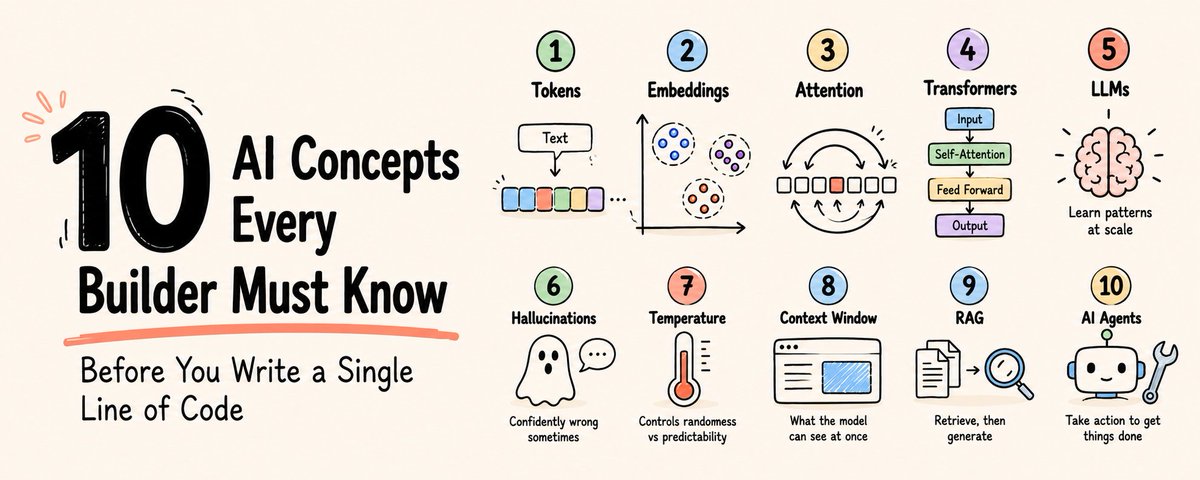
Here are 10 AI concepts every builder must understand before writing a single line.
No PhD required. No jargon.
Just the mental models that make everything click.
Save this. It will save you weeks.
## 1. Tokens — What AI Actually Reads
You write a sentence. The model doesn't see a sentence.
It sees tokens.
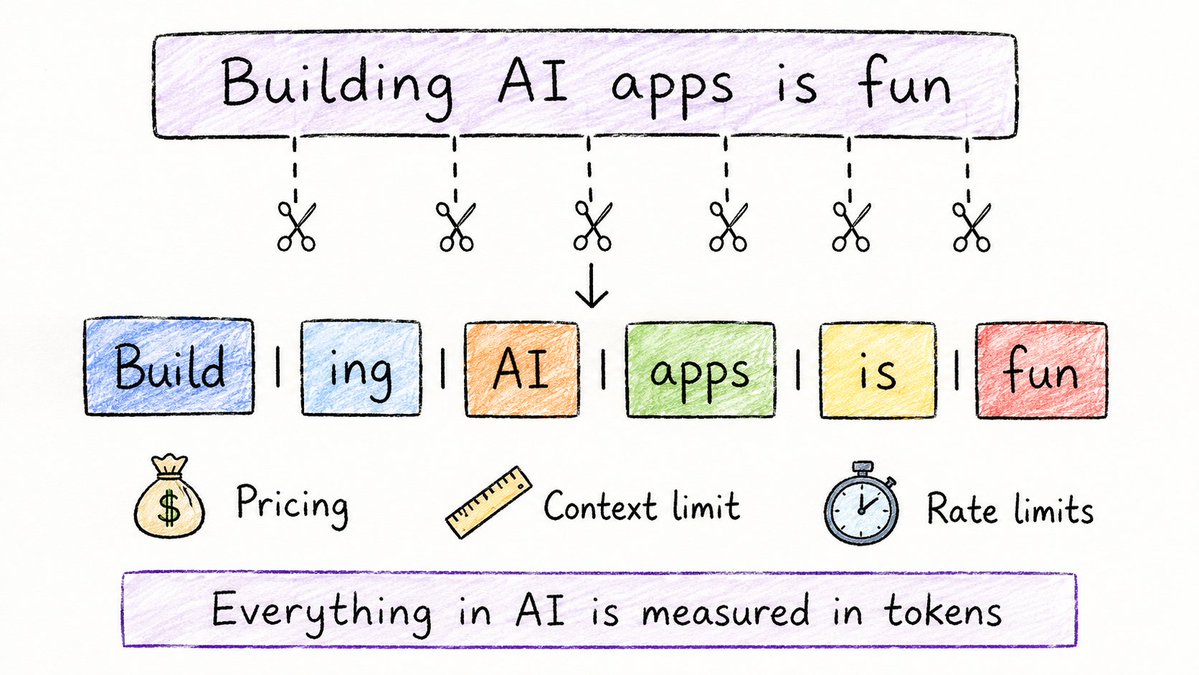
A token is a small chunk of text.
→ Sometimes a full word: "build" → 1 token
→ Sometimes part of a word: "building" → "build" + "ing" → 2 tokens
→ Sometimes punctuation: "." → 1 token
"Building AI apps is fun" → 6 tokens
Why this matters as a builder:
Everything in AI is priced, limited, and measured in tokens.
→ API cost = cost per 1,000 tokens → Context window = max tokens in one request → Rate limits = tokens per minute
The moment you understand tokens, you stop being confused by: → Why your prompt got cut off → Why the API bill was higher than expected → Why the model "forgot" something you said earlier
Rule of thumb: 1,000 tokens ≈ 750 words.
## 2. Embeddings — How AI Understands Meaning
After text becomes tokens, it becomes numbers.
Those numbers are called embeddings.
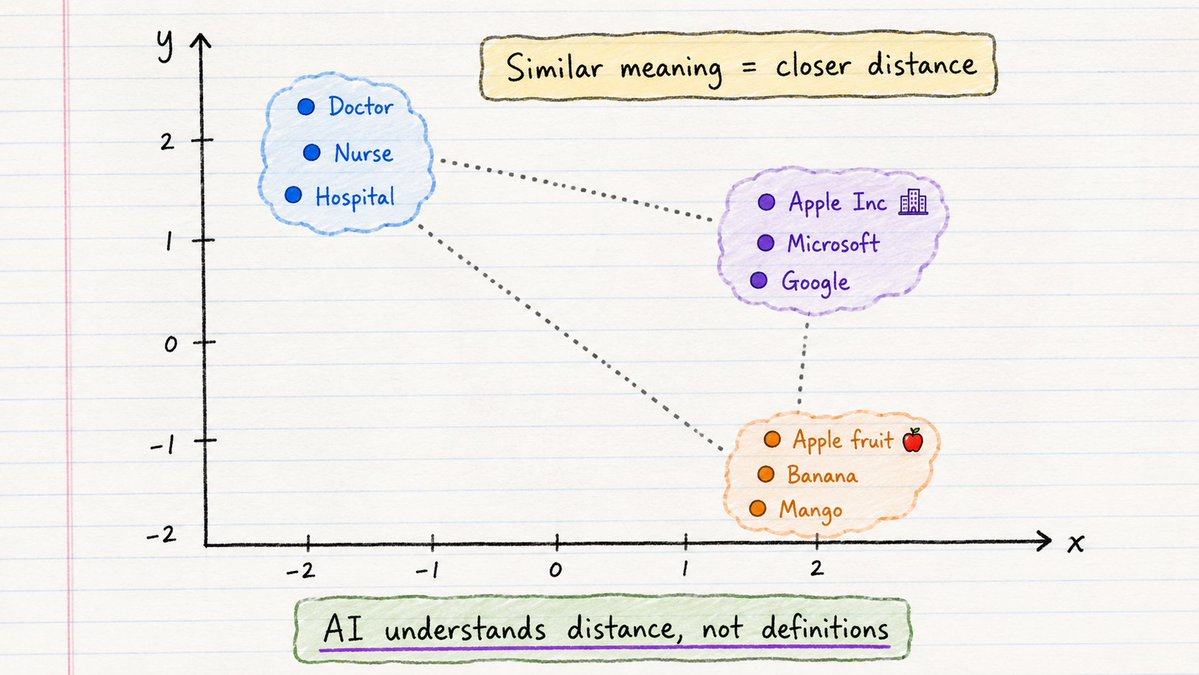
Each word, sentence, or document gets converted into a vector — a long list of numbers that represents its meaning.
The key insight:
Similar meaning = similar numbers = close together in space.
→ "Doctor" sits near "Nurse"
→ "Apple the fruit" sits far from "Apple the company"
→ "King" minus "Man" plus "Woman" ≈ "Queen"
AI doesn't understand meaning the way you do.
It understands distance.
Why this matters as a builder:
Embeddings power everything that "understands intent":
→ Semantic search (finds meaning, not just keywords) → Recommendations (similar items) → RAG systems (finds relevant documents) → Chat with PDF (matches your question to the right page)
If your search returns the wrong results, the embedding model is usually where to look.
## 3. Attention — How AI Understands Context
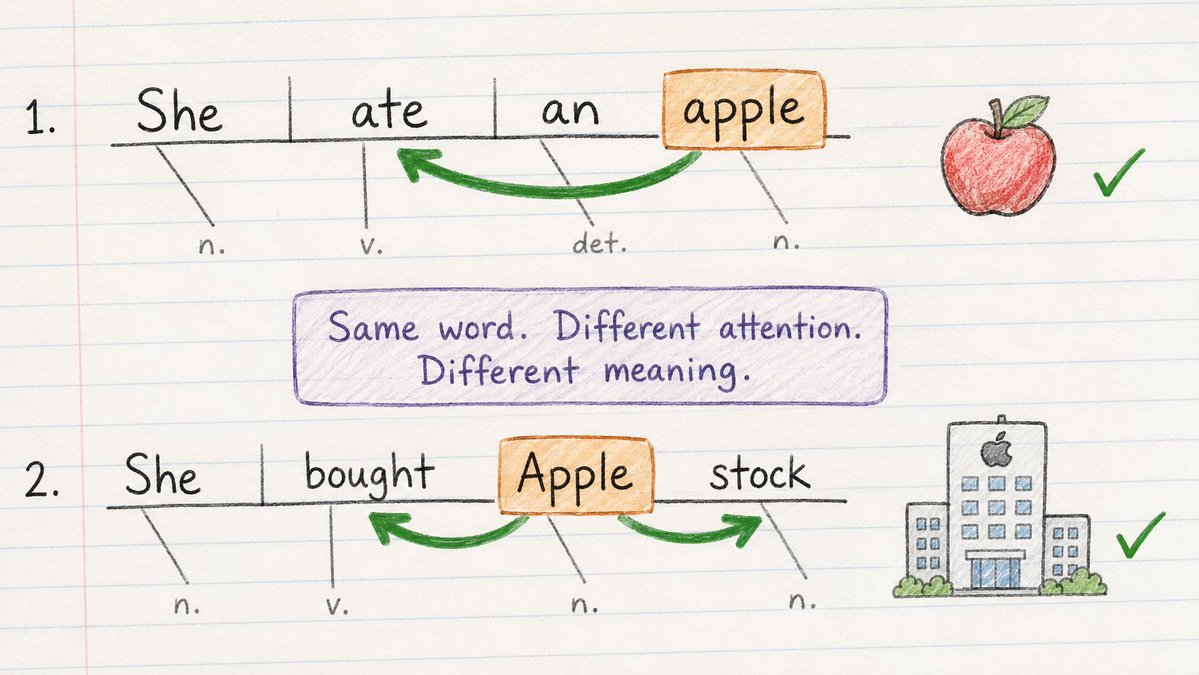
Same word. Completely different meaning.
→ "She ate an apple" → fruit
→ "She bought Apple stock" → company
How does the model know which one?
Attention.
Attention lets every word look at every other word in the sentence and decide what matters most.
It's not reading left to right. It's seeing the whole sentence at once and dynamically connecting the dots.
In "She bought Apple stock": → "Apple" pays high attention to "bought" and "stock" → Model concludes: company
In "She ate an apple": → "apple" pays high attention to "ate" → Model concludes: fruit
Before attention, models read word by word. Slow. Missed long-range connections.
After attention, models see everything at once.
This single idea is why modern AI works.
Why this matters as a builder:
Understanding attention explains why: → Your model handles long prompts well when context is clear → Ambiguous prompts produce inconsistent outputs → Adding context to your prompt dramatically improves results
## 4. Transformers — The Engine Behind Everything
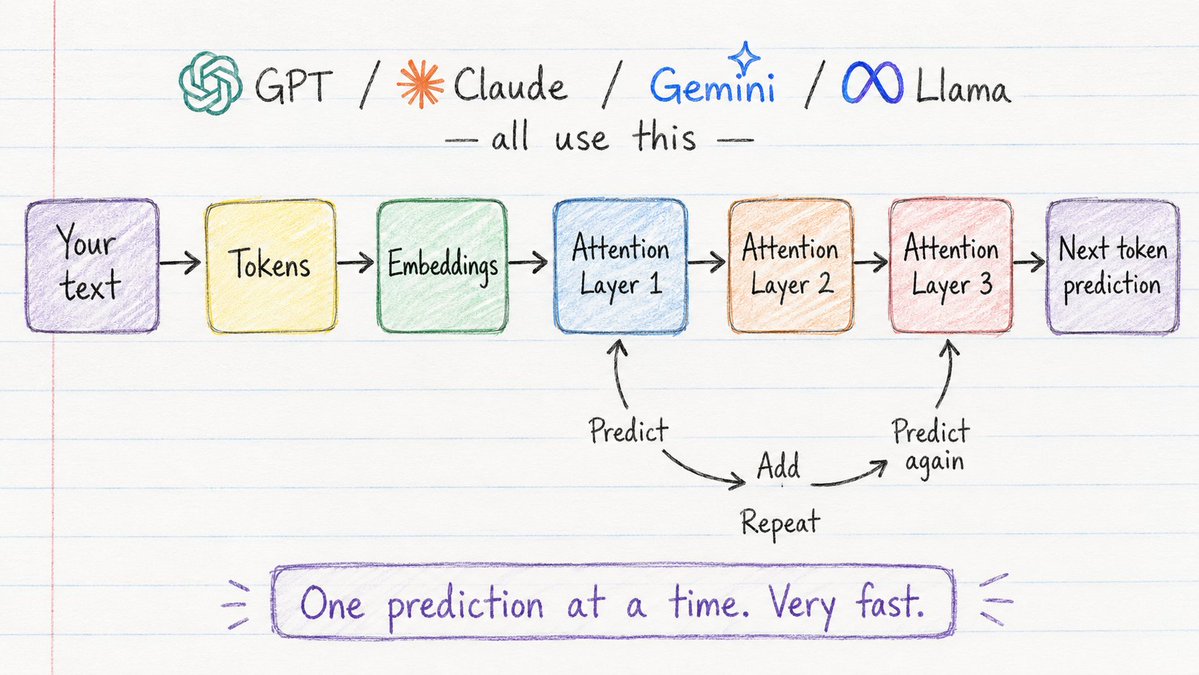
GPT. Claude. Gemini. Llama. Mistral.
All transformers.
The transformer is the architecture that runs under every modern AI model you will ever use.
It works in one simple pipeline:
Text → Tokens → Embeddings → Attention layers → Prediction
The model doesn't generate a full sentence at once.
It predicts one token at a time.
→ Predict next token → Add it to the sequence → Predict next token again → Repeat
That loop — running billions of times per second — is what produces the text you see.
Why this matters as a builder:
Understanding the transformer pipeline explains:
→ Why longer outputs take longer (more prediction loops)
→ Why the model is "non-deterministic" (probability at each step)
→ Why earlier tokens influence later ones
→ Why cutting off context mid-thought breaks output quality
You don't need to build a transformer. You need to understand what's happening inside the box you're calling.
## 5. LLMs — What They Actually Are
An LLM is a transformer trained on a massive amount of text to do one thing:
Predict the next token.
That's it.
Training data: books, websites, code, Wikipedia, Reddit, documentation.
Trillions of tokens.
The training task sounds too simple to explain what these models can do:
→ See text → Predict what comes next → Check if it was right → Adjust weights slightly → Repeat trillions of times
The result: a model that learned the patterns of human language so deeply it can write code, reason through problems, translate languages, and explain complex ideas.
None of that was explicitly programmed.
It emerged from next-token prediction at scale.
The most important thing to understand as a builder:
LLMs are not databases. They don't look up answers. They predict answers based on patterns.
That distinction explains everything — including why they hallucinate.
## 6. Hallucination — Why AI Lies Confidently
This will happen to you in production.
A user asks your AI app a question. The AI gives a confident, well-structured, completely wrong answer.
That's a hallucination.
And here's why it happens.
The model is not trying to tell the truth.
It's trying to predict the most probable next token.
If a false statement looks like something that "should come next" based on training patterns — it generates it. No verification. No lookup. Pure pattern completion.
It will:
→ Cite papers that don't exist
→ Describe API functions that were never created
→ State fake statistics with full confidence
→ Invent plausible-sounding but wrong code
The danger: it never sounds uncertain.
What you do about it as a builder:
→ Use RAG (fetch real data, don't rely on memory)
→ Add verification layers before showing output to users
→ Use tool calls (let the model check, not guess)
→ Never use raw LLM output for facts in production without a check
Understanding hallucination is what separates developers who ship safe AI products from developers who ship embarrassing ones.
## 7. Temperature — The Creativity Dial
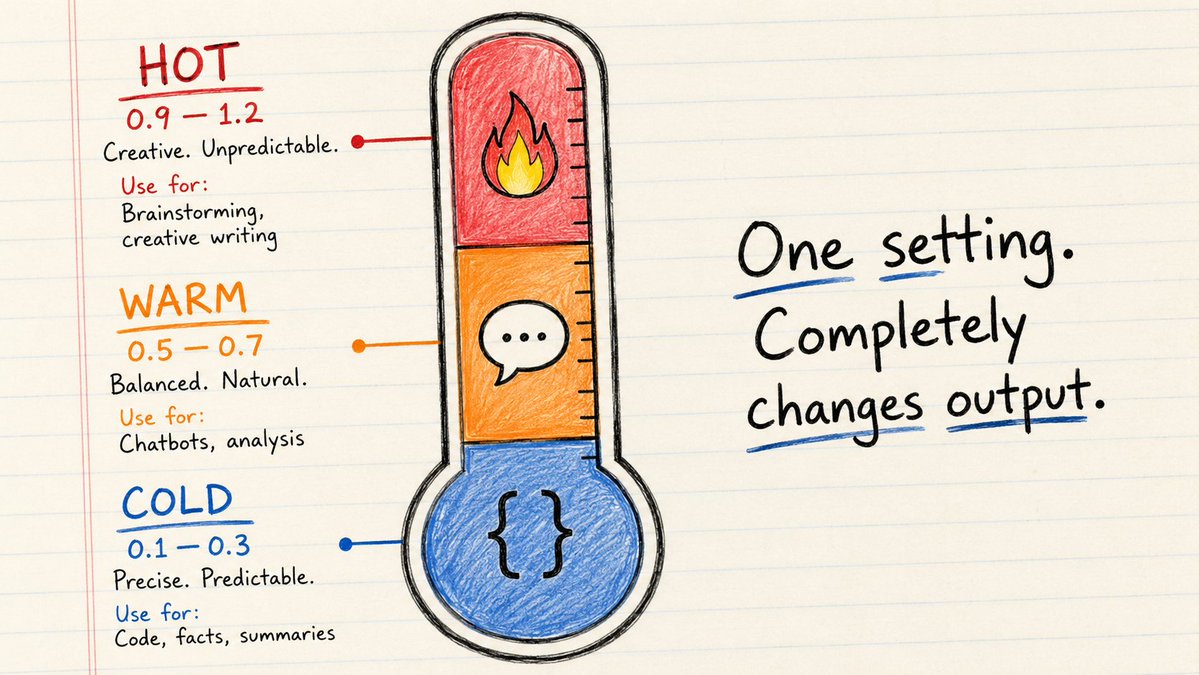
Every time AI generates a token, it calculates probabilities for every possible next word.
Temperature controls what happens next.
→ Low temperature: almost always picks the most likely token. Safe. Predictable.
→ High temperature: picks more randomly from the probability distribution. Creative. Varied.
Practical settings for builders:
Use case Temperature
Writing code 0.1–0.2
Factual Q&A 0.2–0.3
Summarization 0.3–0.5
Chatbot replies 0.5–0.7
Creative writing 0.8–1.0
Brainstorming 1.0+
The mistake most beginners make:
Using the default temperature (usually 0.7–1.0) for everything.
Then wondering why their coding assistant writes creative but broken code.
Temperature is one line of code. Set it intentionally.
## 8. Context Window — AI's Working Memory
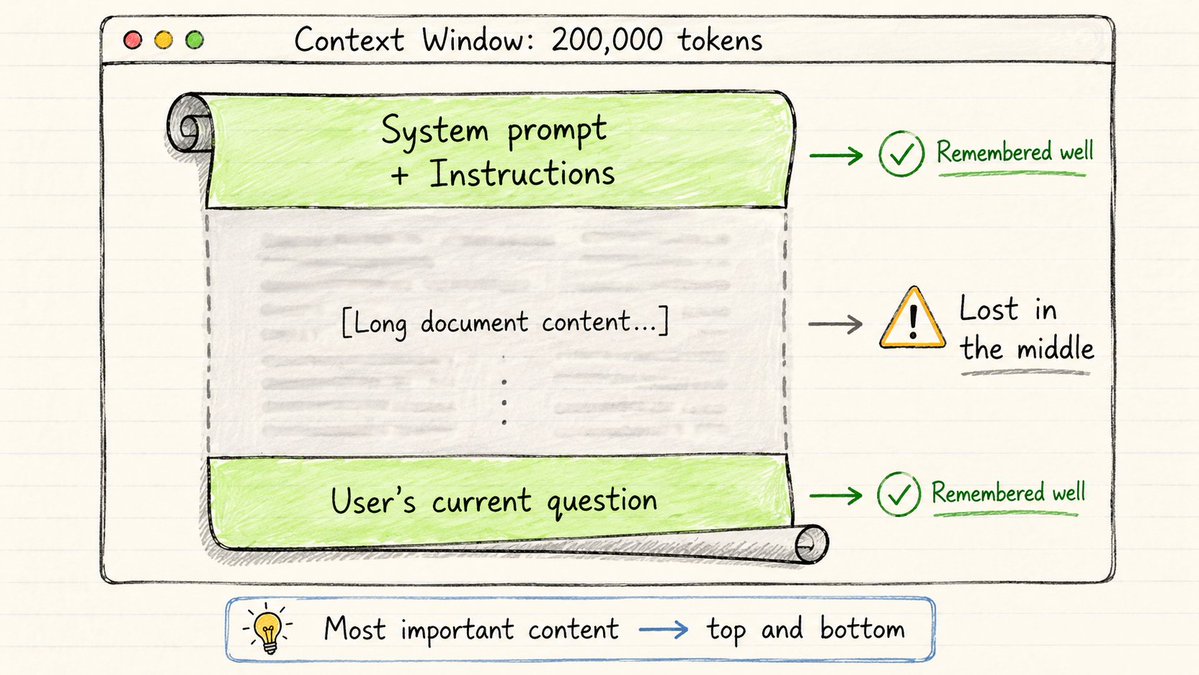
Every AI model can only "see" a fixed amount of text at once.
That limit is the context window.
It includes everything in one request:
→ Your system prompt → Conversation history → Documents you passed in → The model's own responses → Your current message
All of it together must fit inside the window.
Current limits:
→ GPT-4o: 128,000 tokens → Claude 3.5 Sonnet: 200,000 tokens → Gemini 1.5 Pro: 1,000,000 tokens
Bigger sounds better. But there's a problem.
Models don't read context evenly.
They pay more attention to the beginning and end.
The middle? Often ignored.
This is called the "Lost in the Middle" problem.
What this means as a builder:
→ Put the most important instructions at the top of your system prompt → Put the most important context right before the user's question → Don't assume the model "saw" something just because you included it → Chunk and summarize long documents rather than dumping them in whole
Context management is one of the most important skills in AI engineering.
## 9. RAG — How AI Uses Your Data
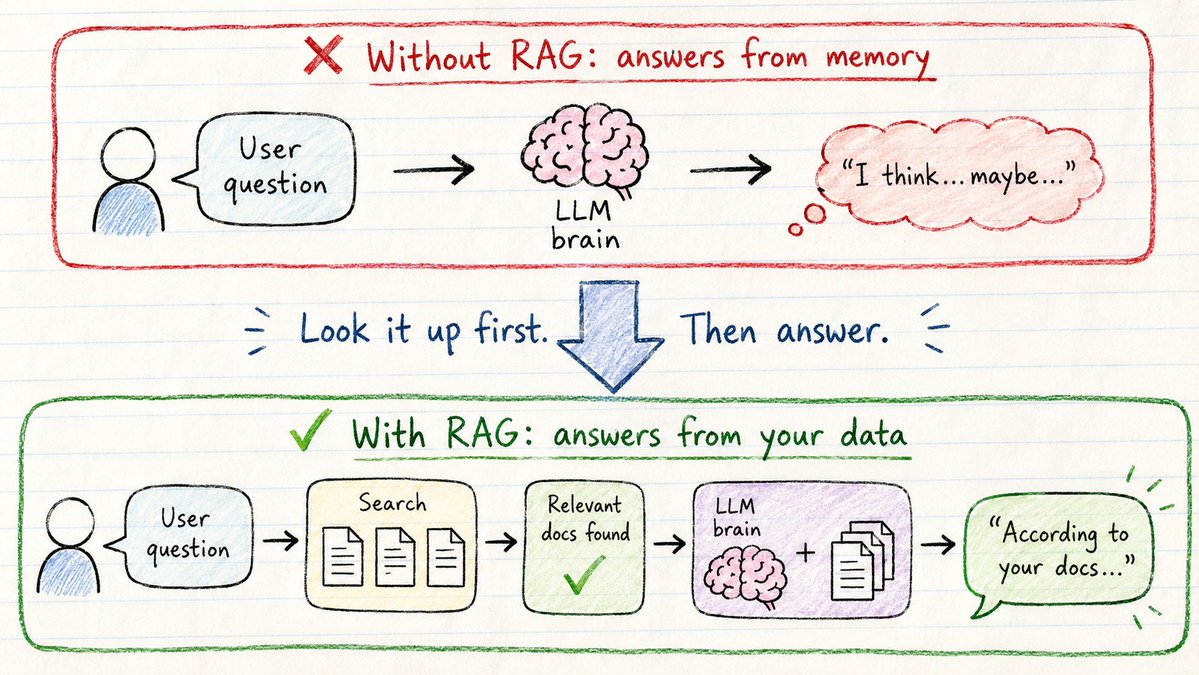
LLMs are trained on data up to a cutoff date.
They don't know about: → Your company's internal documents → Last week's news → Your product documentation → Your users' data
RAG solves this.
RAG = Retrieval-Augmented Generation
Instead of the model answering from memory, it first searches a knowledge base, then answers using what it found.
The flow every builder needs to know:
1. User asks question
2. Question → embedding → search vector database
3. Most relevant documents retrieved
4. Documents + question sent to model
5. Model answers using real, specific data
Why RAG is better than fine-tuning for most use cases:
→ Your data changes? Just update the documents. No retraining.
→ Need source citations? Documents are right there. → Reduces hallucination dramatically.
→ Works with private data that should never be in training.
Every serious AI product you use has RAG under the hood.
Customer support bots. Documentation assistants. Legal tools. Internal knowledge bases.
If you learn one architecture pattern this year, learn RAG.
## 10. AI Agents — AI That Actually Does Things
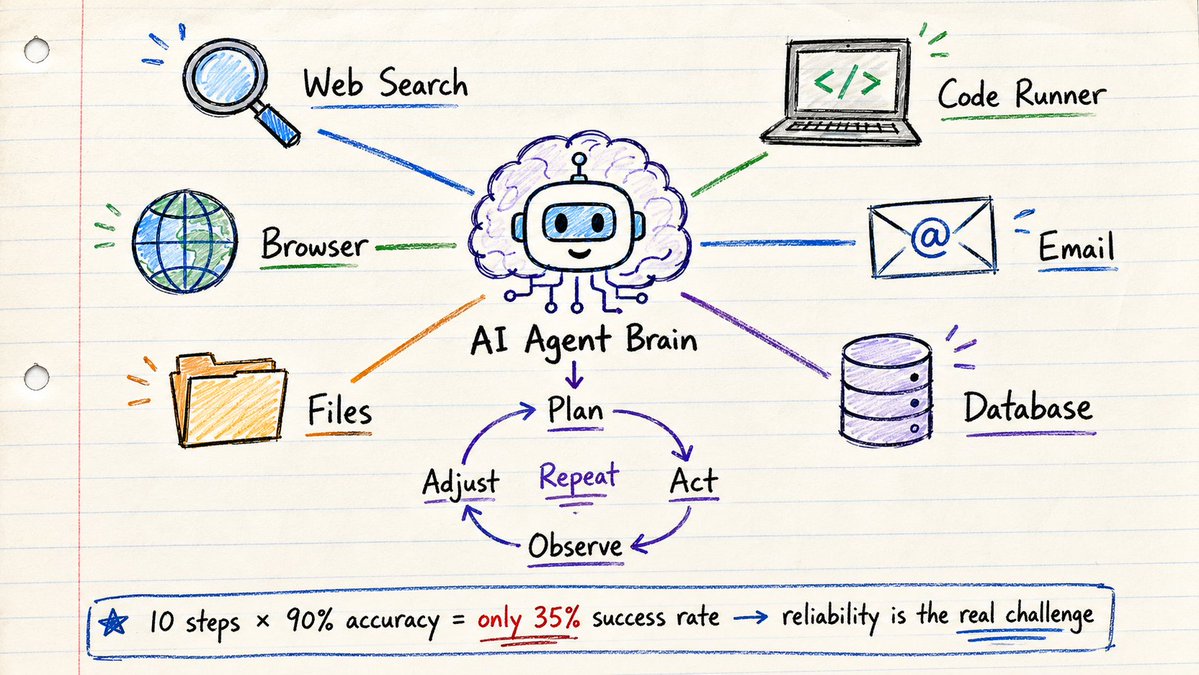
Standard LLM: → You ask. It answers. Done.
AI Agent: → You give a goal. It plans. It uses tools. It checks results. It adjusts. It completes.
The difference is a loop.
The agent loop:
1. Understand the goal
2. Decide what to do next
3. Use a tool to do it
4. Check what happened
5. Decide next step
6. Repeat until done
What tools can agents use?
→ Web search → Code execution → File read/write → API calls → Database queries → Email and calendar → Browser control
Real example — debugging agent:
→ Reads the error → Searches the codebase for the relevant file → Identifies the problem → Writes a fix → Runs tests → Sees 2 tests still failing → Reads the failing tests → Adjusts the fix → Runs again → All tests pass → Done
The model is the brain. Tools are the hands.
What makes agents hard as a builder:
Each step has a failure rate. Three steps at 90% accuracy = 72.9% task completion. Ten steps = 34.8%.
This is why reliability engineering is the real challenge in agents — not building the agent itself.
Here is the exact order to learn these if you are starting from zero:
→ 1. Tokens (understand the unit everything is measured in)
→ 2. Embeddings (understand how meaning becomes numbers)
→ 3. Attention (understand how context works)
→ 4. Transformers (understand the architecture)
→ 5. LLMs (connect it all together)
→ 6. Hallucination (understand the core failure mode)
→ 7. Temperature (learn to control output style)
→ 8. Context Window (learn to manage memory)
→ 9. RAG (learn to use your own data)
→ 10. Agents (learn to build systems that act)
This is not 10 random facts.
It is a complete mental model of how AI engineering works.
Once you understand all 10, AI stops feeling like magic.
It starts feeling like engineering.
And that is when you actually start building things that work.
If this was useful:
→ Repost to help other builders learn this faster
→ Follow @sairahul1 — I write about building real AI systems
→ Bookmark this before your next AI project
I write about Claude, AI systems, and tools for builders.
## 相关链接
- [Rahul](https://x.com/sairahul1)
- [@sairahul1](https://x.com/sairahul1)
- [537K](https://x.com/sairahul1/status/2061737615175671953/analytics)
- [@sairahul1](https://x.com/@sairahul1)
- [Upgrade to Premium](https://x.com/i/premium_sign_up)
- [5:12 PM · Jun 2, 2026](https://x.com/sairahul1/status/2061737615175671953)
- [537.1K Views](https://x.com/sairahul1/status/2061737615175671953/analytics)
- [View quotes](https://x.com/sairahul1/status/2061737615175671953/quotes)
---
*导出时间: 2026/6/4 15:44:09*
---
## 中文翻译
# 在写一行代码前,每个构建者必须理解的 10 个 AI 概念
**作者**: Rahul
**日期**: 2026-06-02T09:12:07.000Z
**来源**: [https://x.com/sairahul1/status/2061737615175671953](https://x.com/sairahul1/status/2061737615175671953)
---

大多数 AI 教程都是从代码开始的。
它们跳过了真正重要的部分。
概念。
所以你构建了一个半成品的聊天机器人。你不知道它为什么会产生幻觉。你不知道上下文窗口到底意味着什么。你不知道为什么你的 RAG 系统返回了错误的文档。
你在盲目调试。
这是每个构建者在写第一行代码之前必须理解的 10 个 AI 概念。
不需要博士学位。没有行话。
只有能让一切豁然开朗的心智模型。
收藏这篇文章。它会为你节省数周的时间。
## 1. Tokens — AI 实际读取的内容

你写了一个句子。模型看到的不是句子。
它看到的是 Token。
Token 是一小段文本。
→ 有时是一个完整的单词:"build" → 1 token
→ 有时是单词的一部分:"building" → "build" + "ing" → 2 tokens
→ 有时是标点符号:"." → 1 token
"Building AI apps is fun" → 6 tokens
这对构建者为何重要:
AI 中的一切都是按 Token 定价、限制和衡量的。
→ API 费用 = 每 1,000 tokens 的费用 → 上下文窗口 = 单次请求中的最大 tokens → 速率限制 = 每分钟 tokens 数
当你理解了 Token,你就不再困惑于:→ 为什么你的提示词被截断 → 为什么 API 账单高于预期 → 为什么模型“忘记”了你之前说的话
经验法则:1,000 tokens ≈ 750 个单词。
## 2. Embeddings — AI 如何理解含义

文本变成 Token 之后,就变成了数字。
这些数字被称为 Embeddings。
每个单词、句子或文档都被转换成一个向量——一长串代表其含义的数字。
关键洞察:
相似的含义 = 相似的数字 = 空间中距离相近。
→ "Doctor"(医生)紧邻 "Nurse"(护士)
→ "Apple the fruit"(苹果这种水果)远离 "Apple the company"(苹果公司)
→ "King"(国王)减去 "Man"(男人)加上 "Woman"(女人)≈ "Queen"(女王)
AI 并不像你那样理解含义。
它理解的是距离。
这对构建者为何重要:
Embeddings 驱动着所有“理解意图”的功能:
→ 语义搜索(查找含义,而不仅仅是关键词) → 推荐(相似物品) → RAG 系统(查找相关文档) → 与 PDF 聊天(将你的问题匹配到正确的页面)
如果你的搜索返回了错误的结果,通常问题出在 Embedding 模型上。
## 3. Attention — AI 如何理解上下文

同一个词。完全不同的含义。
→ "She ate an apple" → 水果
→ "She bought Apple stock" → 公司
模型怎么知道是哪一个?
Attention(注意力机制)。
Attention 让每个词都能查看句子中的其他所有词,并决定什么最重要。
它不是从左到右阅读。它同时看到整个句子并动态地连接线索。
在 "She bought Apple stock" 中: → "Apple" 高度关注 "bought" 和 "stock" → 模型得出结论:公司
在 "She ate an apple" 中: → "apple" 高度关注 "ate" → 模型得出结论:水果
在 Attention 出现之前,模型逐词阅读。缓慢。遗漏长程连接。
Attention 出现后,模型同时看到一切。
这单一的想法就是现代 AI 运作的原因。
这对构建者为何重要:
理解 Attention 解释了为什么: → 当上下文清晰时,你的模型能很好地处理长提示词 → 模棱两可的提示词会产生不一致的输出 → 在提示词中添加上下文会显著改善结果
## 4. Transformers — 一切背后的引擎

GPT。Claude。Gemini。Llama。Mistral。
都是 Transformer。
Transformer 是你将使用的每个现代 AI 模型底层运行的架构。
它在一个简单的流程中工作:
文本 → Tokens → Embeddings → Attention 层 → 预测
模型不会一次性生成完整的句子。
它一次预测一个 token。
→ 预测下一个 token → 将其添加到序列中 → 再次预测下一个 token → 重复
这个循环——每秒运行数十亿次——就是生成你所看到的文本的原因。
这对构建者为何重要:
理解 Transformer 流程解释了:
→ 为什么较长的输出需要更长时间(更多的预测循环)
→ 为什么模型是“非确定性”的(每一步的概率)
→ 为什么早期的 token 会影响后期的
→ 为什么在思考过程中截断上下文会破坏输出质量
你不需要构建 Transformer。你需要理解你正在调用的黑盒内部发生了什么。
## 5. LLMs — 它们到底是什么
LLM 是一个在海量文本上训练过的 Transformer,只做一件事:
预测下一个 token。
就是这样。
训练数据:书籍、网站、代码、维基百科、Reddit、文档。
数万亿个 token。
训练任务听起来太简单了,无法解释这些模型能做什么:
→ 看文本 → 预测接下来是什么 → 检查是否正确 → 微调权重 → 重复数万亿次
结果:一个深刻学习了人类语言模式的模型,它可以编写代码、推理问题、翻译语言并解释复杂的想法。
这些都没有被显式编程。
它是从大规模的下一个 token 预测中涌现出来的。
作为构建者最重要的一点是理解:
LLM 不是数据库。它们不查找答案。它们基于模式预测答案。
这种区别解释了一切——包括为什么它们会产生幻觉。
## 6. Hallucination — 为什么 AI 谎报得很自信
这在生产环境中会发生在你身上。
用户问你的 AI 应用一个问题。AI 给出了一个自信、结构良好、完全错误的答案。
这就是幻觉。
以下是它发生的原因。
模型并不试图讲真话。
它试图预测最可能的下一个 token。
如果一个错误的语句看起来像基于训练模式“接下来应该出现”的东西——它就会生成它。没有验证。没有查找。纯粹的模式补全。
它会:
→ 引用不存在的论文
→ 描述从未创建过的 API 函数
→ 充满自信地陈述虚假统计数据
→ 发明听起来合理但错误的代码
危险在于:它听起来从不犹豫。
作为构建者你能做什么:
→ 使用 RAG(获取真实数据,不要依赖记忆)
→ 在向用户展示输出之前添加验证层
→ 使用工具调用(让模型检查,而不是猜测)
→ 在生产环境中,如果未经过检查,永远不要直接使用原始 LLM 输出作为事实
理解幻觉是将能发布安全 AI 产品的开发者与发布令人尴尬的产品的开发者区分开来的关键。
## 7. Temperature — 创意旋钮

每当 AI 生成一个 token 时,它都会计算每个可能的下一个词的概率。
Temperature 控制接下来发生什么。
→ 低温度:几乎总是选择最可能的 token。安全。可预测。
→ 高温度:从概率分布中更随机地选择。有创意。多样化。
构建者的实用设置:
用例 Temperature(温度)
写代码 0.1–0.2
事实性问答 0.2–0.3
摘要 0.3–0.5
聊天机器人回复 0.5–0.7
创意写作 0.8–1.0
头脑风暴 1.0+
大多数初学者犯的错误:
对所有事情使用默认温度(通常是 0.7–1.0)。
然后纳闷为什么他们的代码助手写的代码很有创意但全是错的。
Temperature 只是一行代码。要有意地设置它。
## 8. Context Window — AI 的工作记忆

每个 AI 模型一次只能“看到”固定数量的文本。
这个限制就是上下文窗口。
它包括一次请求中的所有内容:
→ 你的系统提示词 → 对话历史 → 你传入的文档 → 模型自己的回复 → 你当前的消息
所有这些加起来必须适合放入窗口中。
目前的限制:
→ GPT-4o: 128,000 tokens → Claude 3.5 Sonnet: 200,000 tokens → Gemini 1.5 Pro: 1,000,000 tokens
听起来越大越好。但有个问题。
模型不会均匀地阅读上下文。
它们更关注开头和结尾。
中间呢?经常被忽略。
这就是“迷失在中间”问题。
这对构建者意味着什么:
→ 将最重要的指令放在系统提示词的顶部 → 将最重要的上下文紧放在用户问题之前 → 不要假设模型“看到”了某样东西仅仅因为你包含了它 → 分块并总结长文档,而不是整个扔进去
上下文管理是 AI 工程中最重要的技能之一。
## 9. RAG — AI 如何使用你的数据

LLM 的训练数据只截止到某个日期。
它们不知道: → 你公司的内部文档 → 上周的新闻 → 你的产品文档 → 你用户的数据
RAG 解决了这个问题。
RAG = 检索增强生成
不是模型从记忆中回答,而是首先搜索知识库,然后使用找到的内容回答。
每个构建者都需要知道的流程:
1. 用户提问
2. 问题 → embedding → 搜索向量数据库
3. 检索最相关的文档
4. 文档 + 问题发送给模型
5. 模型使用真实的、具体的数据回答
为什么对于大多数用例,RAG 比微调更好:
→ 你的数据变化了?只需更新文档。无需重新训练。
→ 需要来源引用?文档就在那里。 → 大幅减少幻觉。
→ 适用于永远不应出现在训练中的私有数据。
你使用的每个严肃的 AI 产品底层都有 RAG。
客户支持机器人。文档助手。法律工具。内部知识库。
如果你今年只学一种架构模式,那就学 RAG。
## 10. AI Agents — 真正做事的 AI

标准 LLM: → 你问。它答。结束。
AI Agent: → 你给一个目标。它计划。它使用工具。它检查结果。它调整。它完成。
区别在于一个循环。
Agent 循环:
1. 理解目标
2. 决定下一步做什么
3. 使用工具去执行
4. 检查发生了什么
5. 决定下一步
6. 重复直到完成
Agents 可以使用哪些工具?
→ 网络搜索 → 代码执行 → 文件读写 → API 调用 → 数据库查询 → 电子邮件和日历 → 浏览器控制
真实示例——调试 agent:
→ 读取错误 → 在代码库中搜索相关文件 → 识别问题 → 编写修复 → 运行测试 → 看到 2 个测试仍然失败 → 读取失败的测试 → 调整修复 → 再次运行 → 所有测试通过 → 完成
模型是大脑。工具是手。
作为构建者,什么让 Agents 很难:
每一步都有失败率。三步 90% 的准确率 = 72.9% 的任务完成率。十步 = 34.8%。
这就是为什么可靠性工程是 Agents 真正的挑战——而不是构建 agent 本身。
如果你从零开始,以下是学习这些的确切顺序:
→ 1. Tokens(理解衡量一切的单位)
→ 2. Embeddings(理解含义如何变成数字)
→ 3. Attention(理解上下文如何运作)
→ 4. Transformers(理解架构)
→ 5. LLMs(将所有内容连接起来)
→ 6. Hallucination(理解核心失败模式)
→ 7. Temperature(学习控制输出风格)
→ 8. Context Window(学习管理记忆)
→ 9. RAG(学习使用你自己的数据)
→ 10. Agents(学习构建行动的系统)
这不是 10 个随机的事实。
这是关于 AI 工程如何运作的完整心智模型。
一旦你理解了全部 10 个,AI 就不再感觉像魔法。
它开始感觉像工程。
而那时你实际上就开始构建真正有效的东西了。
如果这对你有用:
→ 转发以帮助其他构建者更快地学习这一点
→ 关注 @sairahul1 —— 我写关于构建真实 AI 系统的内容
→ 在你的下一个 AI 项目之前收藏这篇文章
我写关于 Claude、AI 系统以及给构建者的工具。
## 相关链接
- [Rahul](https://x.com/sairahul1)
- [@sairahul1](https://x.com/sairahul1)
- [537K](https://x.com/sairahul1/status/2061737615175671953/analytics)
- [@sairahul1](https://x.com/@sairahul1)
- [升级到 Premium](https://x.com/i/premium_sign_up)
- [5:12 PM · Jun 2, 2026](https://x.com/sairahul1/status/2061737615175671953)
- [537.1K 次观看](https://x.com/sairahul1/status/2061737615175671953/analytics)
- [查看引用](https://x.com/sairahul1/status/2061737615175671953/quotes)
---
*导出时间: 2026/6/4 15:44:09*