# How we built our knowledge base
**作者**: Cerebras
**日期**: 2026-07-16T18:27:55.000Z
**来源**: [https://x.com/cerebras/status/2077822555159945507](https://x.com/cerebras/status/2077822555159945507)
---
Authors: @hi_im_isaac_, @learnwdaniel, @gaozenghao
note: the interactive version of full technical blog available: https://www.cerebras.ai/blog/how-we-built-our-knowledge-base
Employees ask our internal knowledge base more than 15,000 questions every day. It's become one of the most widely adopted internal tools at the company since launching 3 months ago. Used by humans, automations and agents.
At Cerebras, our teams work across data center operations, chip design, hardware, training, inference, cloud platform, and more. With hundreds of new employees joining every year, our communication channels were filling up with the same questions:
- “Where can I find X?”
- “Who is the expert in Y?”
- “What is Z?”
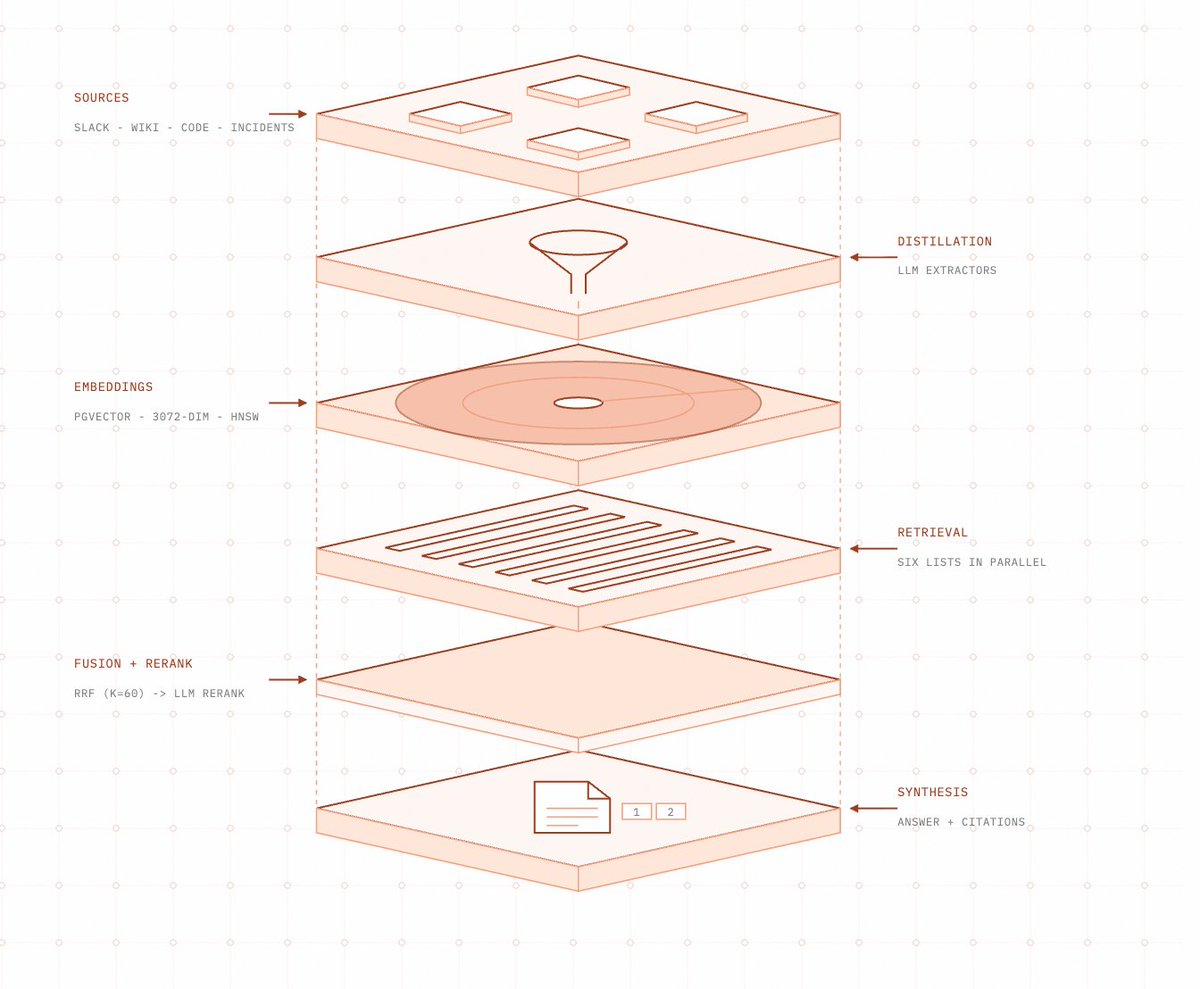
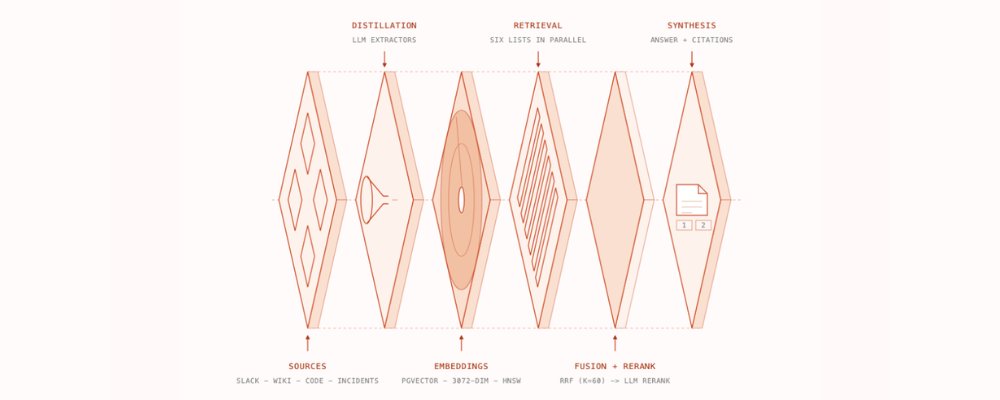
We built Cerebras Knowledge to help people connect people and systems to useful information.
# Meeting data where it lives
Finding information inside an organization is hard. The data is scattered across tools, and every quarter or so someone proposes the same brilliant fix: let’s record everything in one platform so that all information is in a single place. The dream of a single source of truth, of course, rarely works in practice.
Information is generated wherever it is convenient and ergonomic: suggested edits in a document, threads in Slack, code references in GitHub, and status metadata in Jira. These platforms are tailor-made for their specific domains, optimized through years of product engineering and analytics. Discussing a pull request in Google Docs would be a terrible experience.
So we set out to design a system that required minimal change to existing behavior. On the data collection side, this meant extracting data from each platform directly.
## Anatomy of a knowledge base
Our knowledge base provides three things:
- A platform for collecting and storing internal data.
- A platform for querying that data.
- A layer that enforces authentication and authorization, with auditing and analytics.
At the core is a single Postgres table that holds embeddings, raw summaries, and metadata from many sources. The system continually ingests data from across the company and maintains a query-ready datastore.
We wanted a data interface that was simple but could work with most forms of data. We also wanted other developers at Cerebras to be able to build custom connectors. The result is deliberately simple: every source, from Slack threads to netlists, lands in the same embeddings table, and anything in that table is immediately queryable through the same interface:
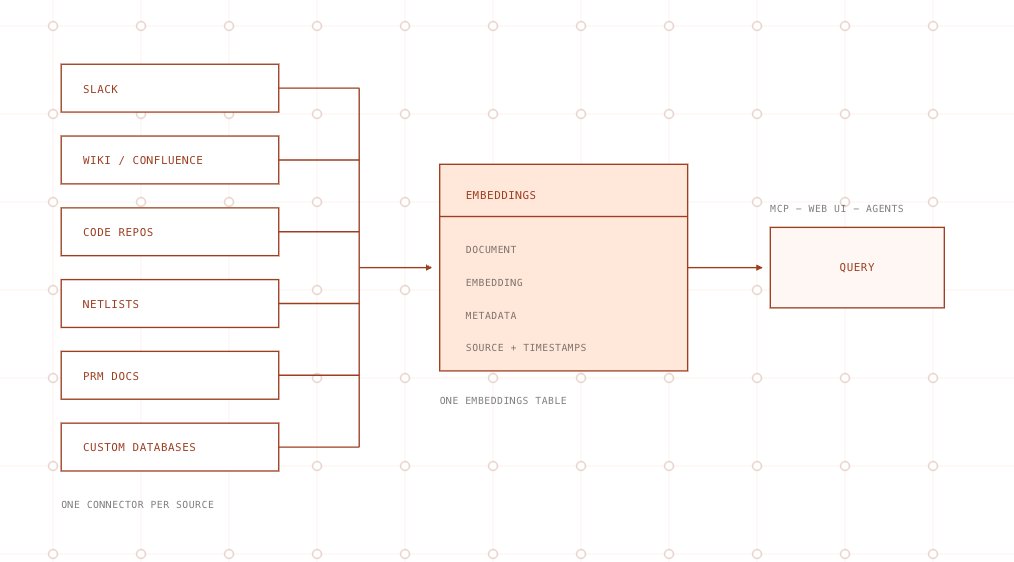
Each data source defines what the data is, how to connect to it, and how often it should be fetched. Each resulting embedding row follows the same interface regardless of whether it came from Slack, a code repository, a document system, or a custom database.
# How we process unstructured Slack conversations
Slack was the most important data source we needed to design for. It is where the most up-to-date engineering discussions happen across the company.
We initially tested whether simple embeddings over raw text performed well enough. We quickly realized that vector search alone was insufficient for matching all relevant data.
Slack messages present several challenges:
- Information density varies enormously: “hey yeah sure mike” and a detailed kernel explanation are both messages.
- Message lengths vary, and shorter messages frequently beat longer, more detailed messages in cosine similarity.
- The meaning of a message often depends on the surrounding conversation.
We needed a hybrid approach. We built Slack ingestion so every thread is retrievable through several search techniques at once, where each technique makes up for the weaknesses of the others:
- Full-text search catches the exact tokens that embeddings blur together: error strings, flag names, host names. When an engineer pastes a literal error message, an exact lexical match is almost always the best evidence, and no amount of semantic similarity should outrank it.
- Embedding search catches paraphrase. The person asking “restore hangs after manifest load” and the person who answered “checkpoint stalls on the NFS mount” may never share vocabulary. Vector similarity is what connects a question to an answer written in different words.(1)
- Inverse document frequency separates signal from filler. A short message built around rare tokens, such as an obscure config flag, deserves to rank. “sounds good, thanks!” sits close to many queries in embedding space but scores near zero once term rarity is taken into account.
- Age decay encodes that Slack answers expire. Two threads can answer the same question, and the one from six months ago may describe infrastructure that no longer exists. When relevance is otherwise equal, the newer thread wins.
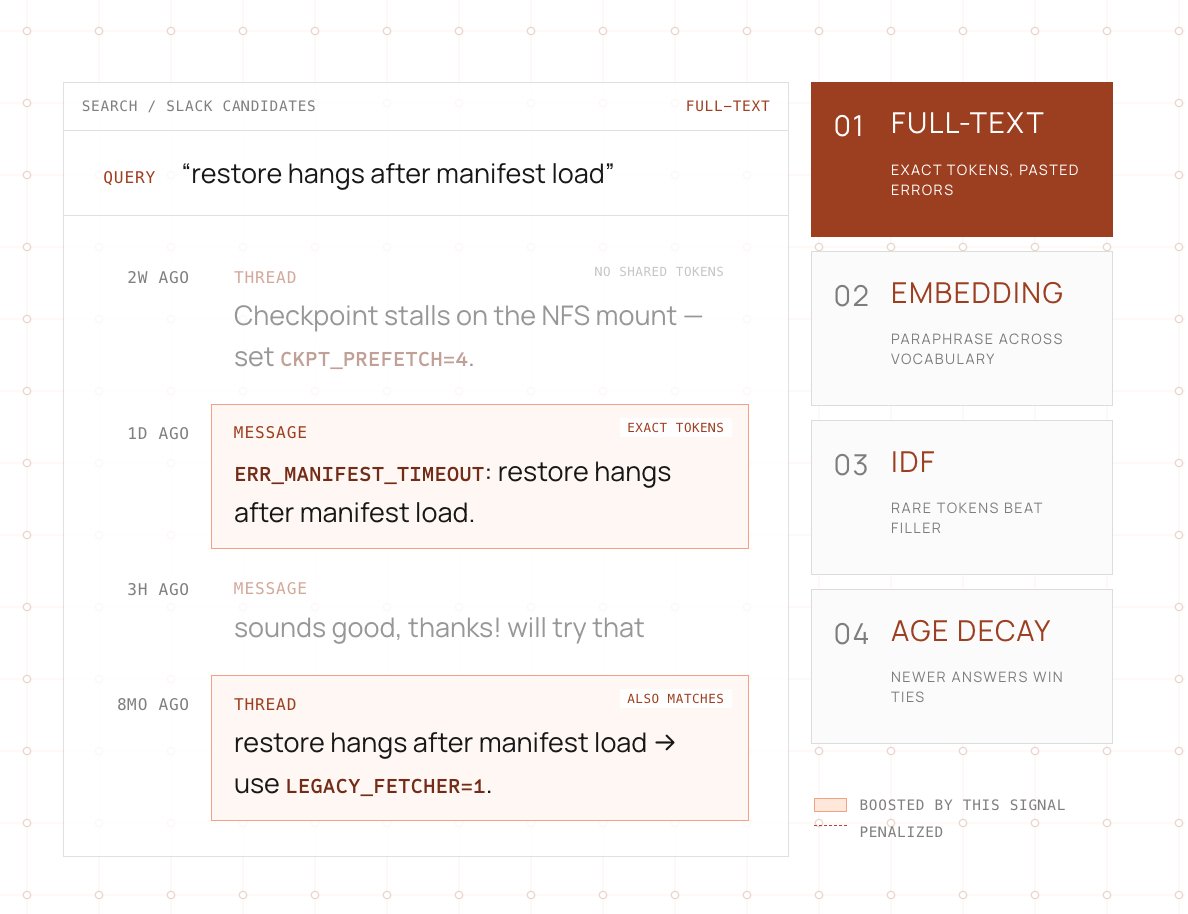
No single scorer is trusted on its own. Each technique produces its own ranked view of the same corpus, and those views are fused at query time (see Reranking).
## Socket Mode
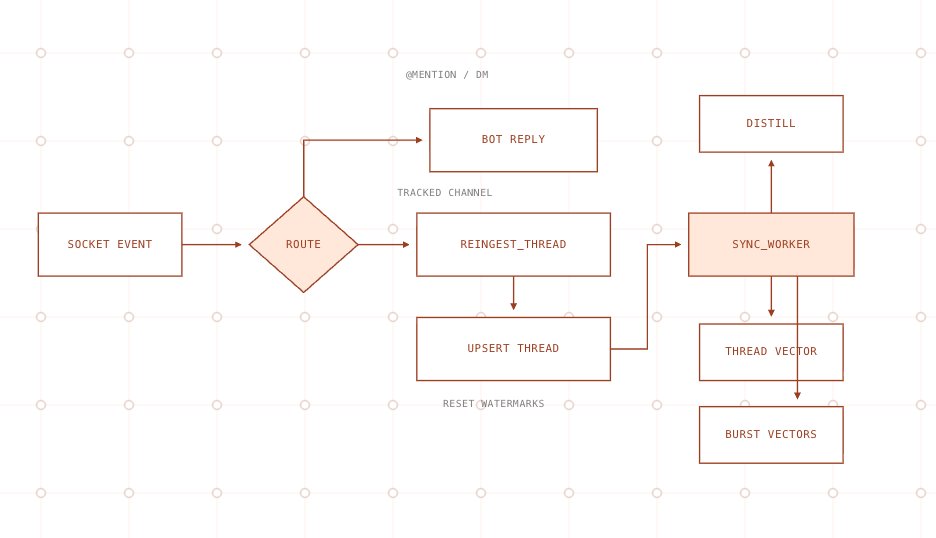
To collect data in real time, we installed a Slack bot into our workspace and ran it in Socket Mode. Slack pushes every message event to us over a persistent WebSocket, so we get real-time updates without polling the Web API and burning through its rate limits.
When an event arrives, we immediately acknowledge it, deduplicate it using the stable event ID, and mark the message for the ingest consumer.
The ingest consumer does not save a new message in isolation. It resolves the thread that the message belongs to and re-fetches the entire conversation, including the parent and every reply, from the Slack API. It then writes the whole thread back as one row. A reply to an existing thread therefore re-pulls the parent and all siblings, so the stored content, participant list, and last-activity timestamp always reflect the complete conversation.
Every Slack channel in our system has its own data source. This provides fine-grained tuning for data freshness. A team may choose to ingest a busy incident channel more frequently, for example.
## Threads and messages
Raw Slack text is keyword-searchable as soon as it lands because we maintain a Postgres full-text (GIN) index over the raw content. To enable useful vector search, however, we do some additional processing.(8)
During distillation, an LLM extracts structured data from the full thread:
- A one-line question that an engineer would actually search for.
- A short summary.
- The resolution.
- The systems and code references mentioned.
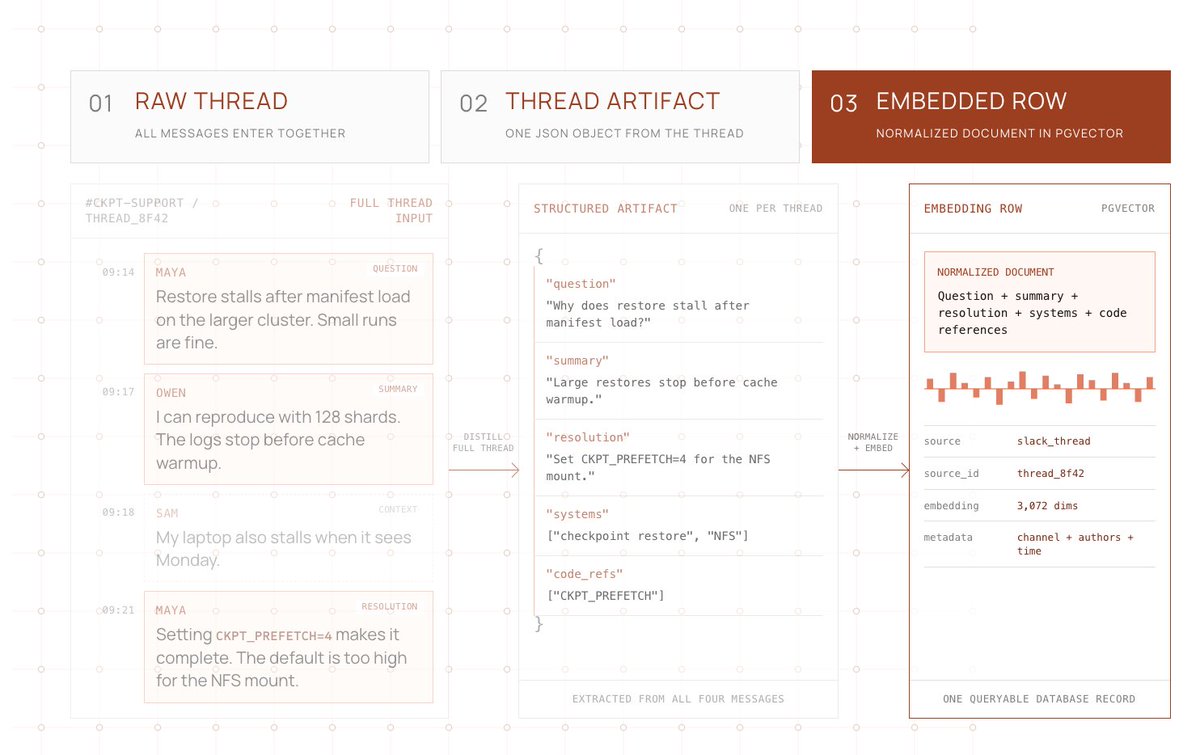
We embed these data points and write them into the shared embeddings table. The original transcript is not embedded directly. In our experiments, accuracy increased significantly when the thread was normalized into a consistent format.(7,9) The additional metadata also gives the semantic match more useful signal.
## Bursting
At this point Slack search was good, but we kept encountering the same problem: important messages inside long threads were not always represented in the thread-level summary.
To boost the signal from individual messages, we use bursting. A burst is a run of consecutive messages from the same author. We embed individual bursts with the thread topic prepended as context(2) because sometimes the answer lives in one tangent message whose vocabulary never makes it into the thread summary. Burst embeddings make that message findable on its own.
To prevent low-signal data from reaching the database, each burst is scored against a weighted combination of signals and must clear a threshold before it is embedded:
- It contains a relatively rare token across the corpus, with IDF of at least 4.0.
- The combined burst is at least 200 characters.
- One or more messages in the burst contain reactions, providing a social boost.
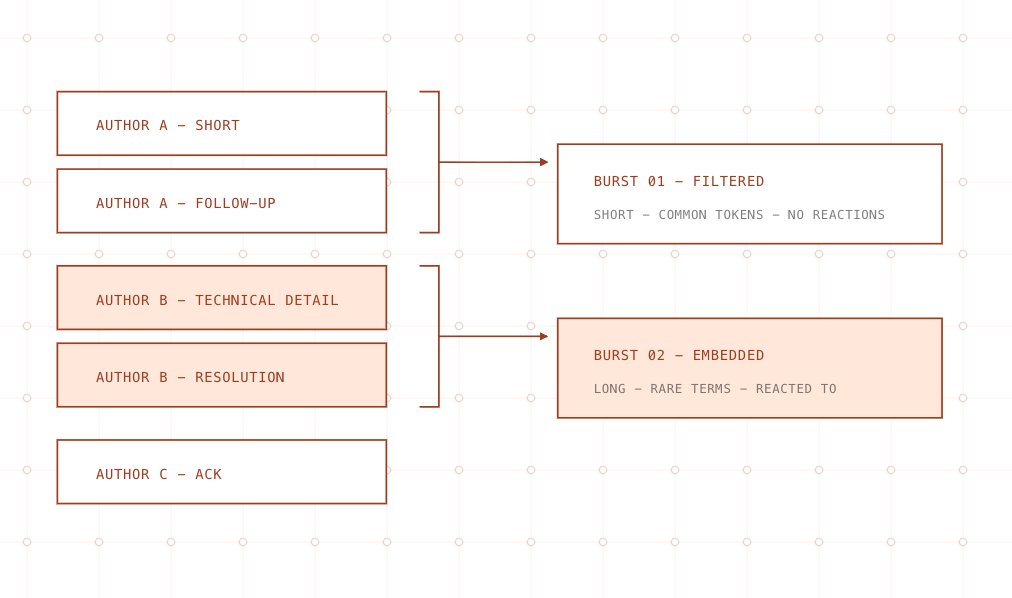
After distillation, qualifying bursts are embedded and stored in the embeddings table alongside the thread-level record.
# Code repositories
Initially we debated whether embedding code repositories was necessary. With the rise of Claude Code and other command-line tools, creating code embeddings felt counterintuitive when it seemed like “grep is all you need.” After talking with others in the industry and reading Cursor’s findings on semantic search in large codebases, we decided to try.
We have many internal repositories, some larger than 40 GB. Our main concern was how to keep them current efficiently.
## Using @cocoindex_io to maintain code embeddings
After several experiments, we landed on CocoIndex, an open-source document embedding framework that specializes in vectorizing codebases.
For each repository, we split the code using language-specific regex boundaries ordered from coarse to fine. The splitter tries higher-level boundaries, such as classes, first. If a resulting chunk is still too large, it falls back to method boundaries and then smaller blocks. We embed the resulting chunks and write the vectors to Postgres. A single file may generate multiple embeddings at different levels of specificity, such as file-level and function-level records.
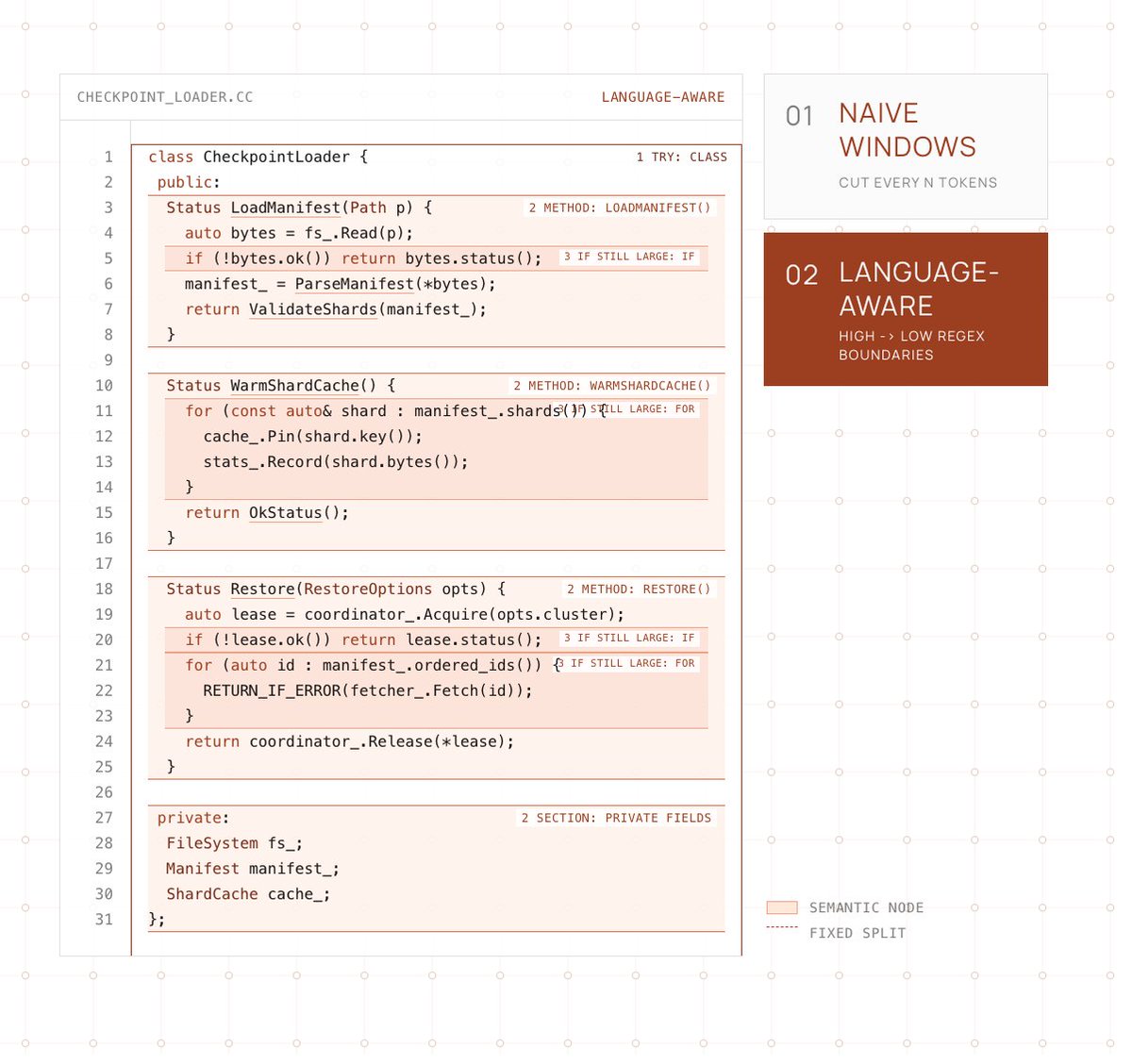
CocoIndex tracks synchronization metadata in Postgres. On each commit, it re-embeds and re-exports only the changed code chunks instead of recomputing the whole repository. This worked especially well for us because the synchronization state and embedding store live in the same database.
As the number of codebases grew, we moved repository onboarding into configuration files that teams can submit themselves, including allowlists and denylists at the file-path level.
## Custom data sources
Some teams already had their own databases and did not want to move data into Slack or a document system just to participate in the knowledge base. They wanted the same query surface over their existing tables.
To support this, we treat custom sources as plugin scripts. A team opens a pull request with a small Python module that knows how to read from its system and emit rows shaped like our embeddings table, plus a matching data source entry.
As long as the script writes into the shared database using the same schema as every other embedding row, the rest of the stack works unchanged. The data becomes queryable alongside Slack, code, and documents, with no special handling elsewhere in the system.
## Planning and tool fan-out
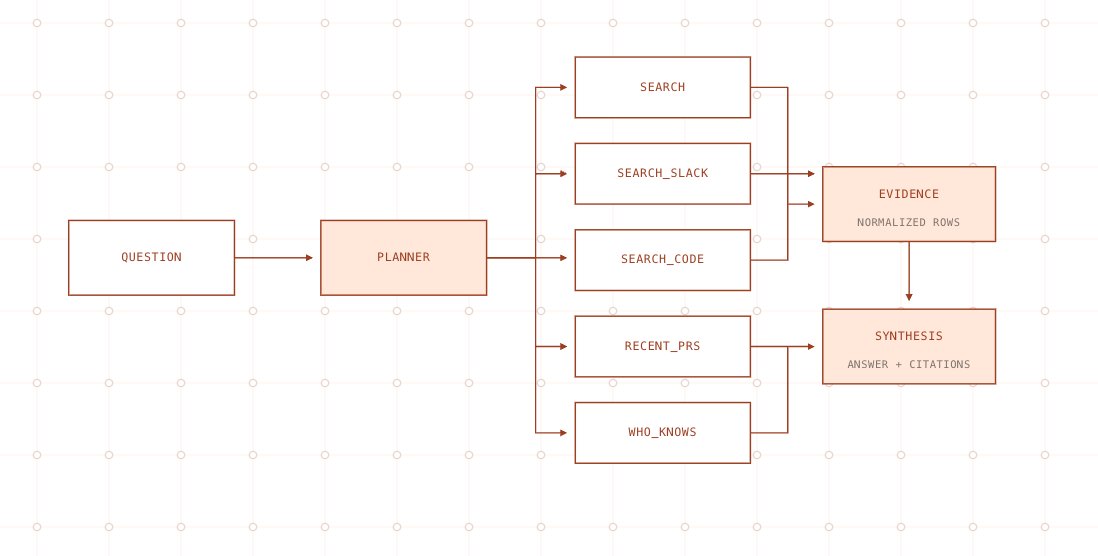
For every query, we first run a short planning pass where an LLM decides which tools and data sources are likely to matter. The main tools:
- subsystem_index: per-file LLM summaries.
- search: the unified vector pipeline across Slack, wiki, code, and other indexed sources, merged and reranked internally.
- search_slack: direct Slack retrieval.
- search_code: ripgrep over source repositories.
- recent_prs: recent pull requests relevant to the question.
- who_knows: people with demonstrated expertise on a topic.
The planner works over a compact description of what we have indexed: which projects exist, which sources are available in each project, and what each source is good at answering. Given the user’s query and active scope, it emits tool selections that the executor fans out in parallel, normalizes into a common evidence format, and passes to a final synthesis LLM.(4)
## Reranking
A document can surface near the top simply because it shares vocabulary with the query while answering a different question. Before reranking, we combine the retrievers’ incompatible result lists with reciprocal rank fusion, or RRF. For every document, we add weight / (60 + rank) for each list in which it appears, with a default weight of 1.0 and a smoothing constant of 60.
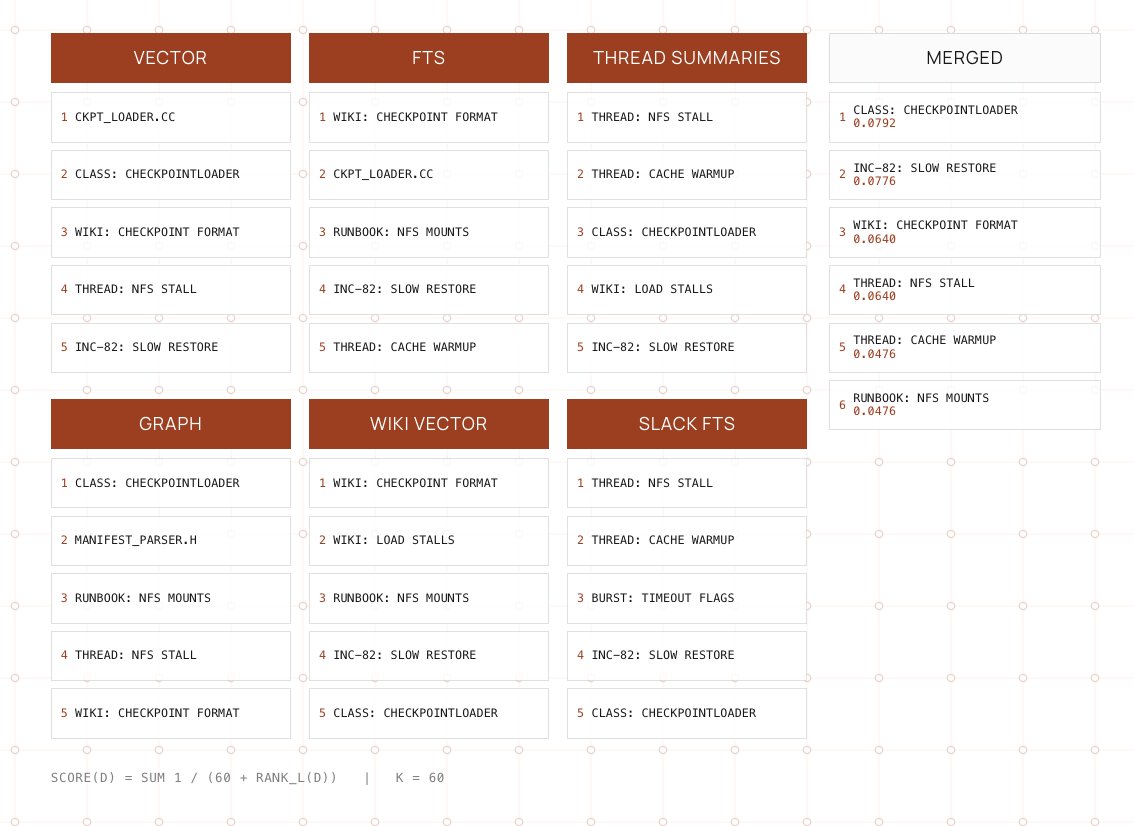
The smoothing constant makes consensus matter more than a single strong vote: a document that shows up near the top across several retrievers can beat one that ranks first in only one of them. We then merge duplicate chunks back to one source, cap how many results each file can contribute, and end up with a more diverse top twenty.
We send the original query and those candidates to a small reranker model. It gives each document a score from zero to ten, and we keep the top ten.(6)
Once the ranking is final, we add context back to the winners. For example, if we match a wiki section we pull in the two neighboring sections so the heading, preconditions, and caveats that chunking split apart aren’t lost. This gives readers a complete snippet instead of a lonely paragraph that’s missing important context.
So the output of search is a rich packet of evidence: results fused from different retrievers, deduplicated at the source level, reranked against the actual question, and only then expanded with surrounding context.
## MCP
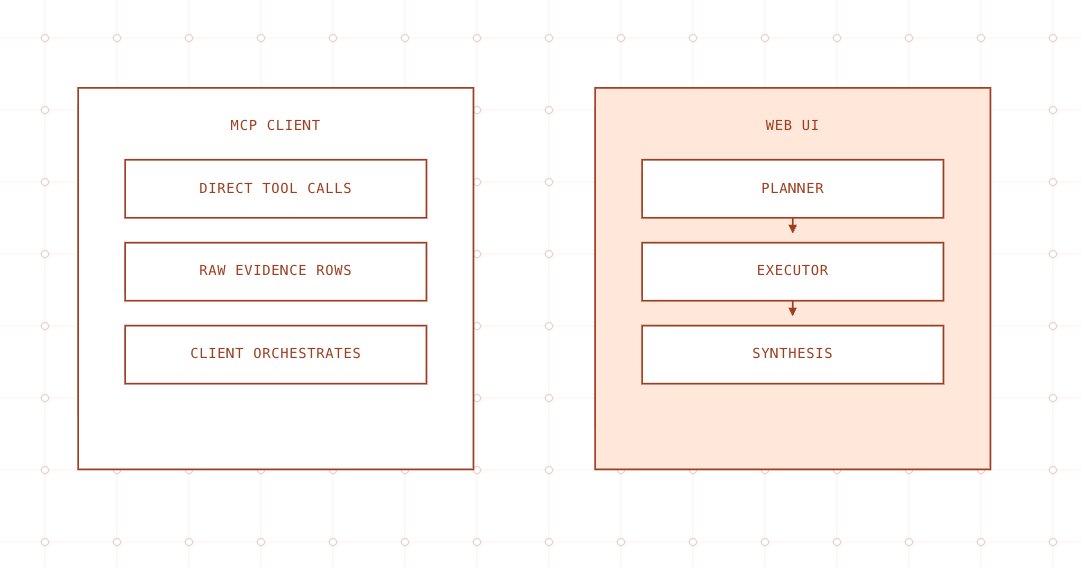
In the MCP integration, we expose retrieval building blocks as direct tools instead of hiding them behind one “answer this question” endpoint. These tools are intentionally simple and as LLM-free as possible so clients can query them quickly and cheaply.(5)
Each MCP tool corresponds to one underlying retrieval primitive, such as search_slack, search_code, search, or who_knows. Tool inputs and outputs are narrow, structured, and stable, making them easy to call from any client or agent without embedding additional orchestration logic inside the tool itself.
Most tools run one query pipeline, such as vector search, lexical search, or ripgrep, apply lightweight scoring heuristics, and return raw evidence rows.
Claude Code, or any MCP-compatible agent, becomes the orchestration engine. It decides which tools to call, in what order, and how to assemble the results into a final answer or code edit. The retrieval layer itself does not depend on those LLM decisions in order to serve requests.
## Web UI
In the web UI, the same tools exist, but they are connected to a complete query pipeline that runs end to end for every user question. The UI agent owns the planner and executor steps.
- Planner: A lightweight LLM pass inspects the query and active project, then chooses which retrieval tools to invoke, such as search, search_slack, and subsystem_index.
- Executor: The system fans those tool calls out in parallel, gathers the results, and normalizes them into a shared evidence schema with scores, recency, and source hints.
- Synthesis: A final LLM pass takes the typed evidence bundle and original question, then produces the answer shown in the UI, including citations, caveats, and cross-source synthesis.
From the user’s perspective, the web UI is simply “ask a question and get an answer.” Under the hood, it runs the same planner → executor → synthesizer pattern that MCP clients can recreate explicitly.
# Organization
As the corpus grew, “search everything everywhere” rapidly stopped being useful. Engineers on compiler teams did not want infrastructure runbooks in their results, and vice versa. Projects are how we make search relevant by default.
## Projects and scoped search
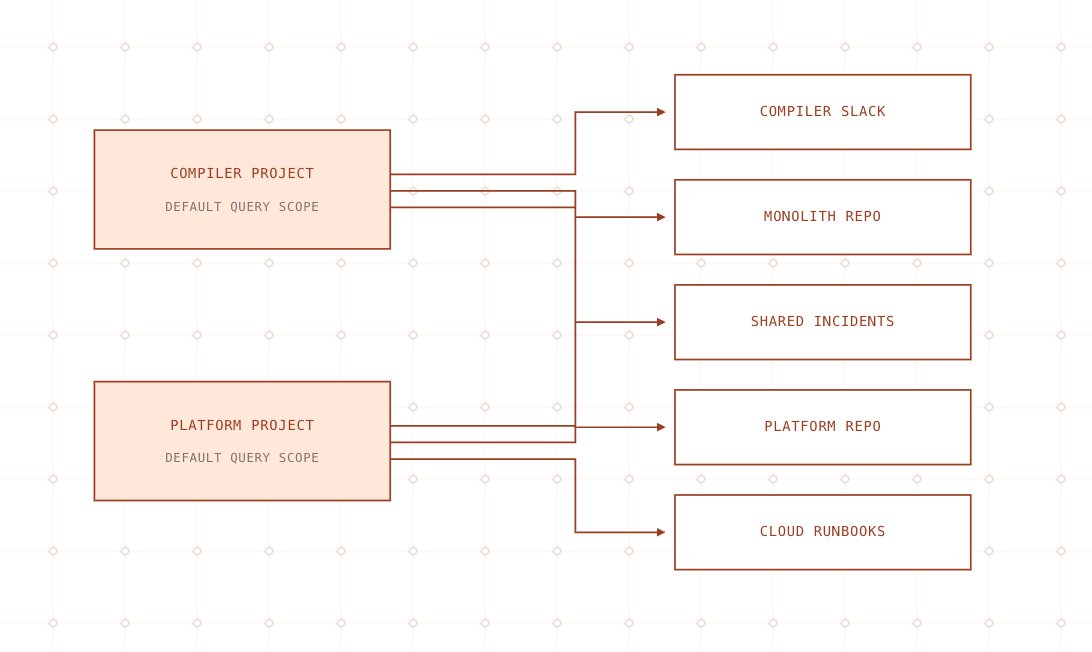
We introduced projects as the primary way to organize the workspace that a query runs over. A project is a named bundle of data sources: specific Slack channels, code repositories, internal databases, and document spaces relevant to a team or initiative.
Projects are intentionally lightweight. The same data source, such as a shared incidents channel or central platform repository, can be referenced by multiple projects instead of being duplicated.
## Onboarding and defaults
During onboarding, users are prompted to select or create a default project that matches how they work, such as ML training infrastructure, Compiler, or Data Center Operations.
That default project is stored on the user profile and scopes queries automatically. A new engineer gets high-signal answers without first having to learn which Slack channels, repositories, or document spaces matter.
# Final Thoughts
In the end, the knowledge base works because it meets people where the information already lives, instead of forcing everything into one rigid system. By combining various search techniques, we can surface evidence quickly. The result is a search experience that stays flexible enough for real company data, but structured enough to remain useful as Cerebras keeps growing.
If you read this far and this is interesting to you, the ai/growth team is hiring reach out if you are interested @learnwdaniel
# References
1. Malkov and Yashunin, Efficient and Robust Approximate Nearest Neighbor Search Using Hierarchical Navigable Small World Graphs, arXiv:1603.09320 / IEEE TPAMI 2018.
2. Anthropic, Introducing Contextual Retrieval, 2024.
3. Cormack, Clarke, and Büttcher, Reciprocal Rank Fusion Outperforms Condorcet and Individual Rank Learning Methods, SIGIR 2009.
4. Li et al., Search-o1: Agentic Search-Enhanced Large Reasoning Models, arXiv:2501.05366, 2025.
5. Anthropic, Code Execution with MCP, 2025.
6. Liu et al., Lost in the Middle: How Language Models Use Long Contexts, arXiv:2307.03172, 2023.
7. Anthropic, Use XML Tags.
8. Salesforce/Slack Engineering, How Slack AI Processes Billions of Messages.
9. Improving Agents, Best Nested Data Format.
10. Cursor, Improving Agent with Semantic Search, 2025.
## 相关链接
- [Cerebras](https://x.com/cerebras)
- [@cerebras](https://x.com/cerebras)
- [1.1M](https://x.com/cerebras/status/2077822555159945507/analytics)
- [@hi_im_isaac_](https://x.com/@hi_im_isaac_)
- [@learnwdaniel](https://x.com/@learnwdaniel)
- [@gaozenghao](https://x.com/@gaozenghao)
- [https://www.cerebras.ai/blog/how-we-built-our-knowledge-base](https://www.cerebras.ai/blog/how-we-built-our-knowledge-base)
- [@cocoindex_io](https://x.com/@cocoindex_io)
- [@learnwdaniel](https://x.com/@learnwdaniel)
- [Efficient and Robust Approximate Nearest Neighbor Search Using Hierarchical Navigable Small World Graphs](https://arxiv.org/abs/1603.09320)
- [Introducing Contextual Retrieval](https://www.anthropic.com/news/contextual-retrieval)
- [Reciprocal Rank Fusion Outperforms Condorcet and Individual Rank Learning Methods](https://dl.acm.org/doi/10.1145/1571941.1572114)
- [Search-o1: Agentic Search-Enhanced Large Reasoning Models](https://arxiv.org/abs/2501.05366)
- [Code Execution with MCP](https://www.anthropic.com/engineering/code-execution-with-mcp)
- [Lost in the Middle: How Language Models Use Long Contexts](https://arxiv.org/abs/2307.03172)
- [Use XML Tags](https://docs.anthropic.com/en/docs/build-with-claude/prompt-engineering/use-xml-tags)
- [Improving Agent with Semantic Search](https://cursor.com/blog/semsearch)
- [Upgrade to Premium](https://x.com/i/premium_sign_up)
- [2:27 AM · Jul 17, 2026](https://x.com/cerebras/status/2077822555159945507)
- [1.1M Views](https://x.com/cerebras/status/2077822555159945507/analytics)
- [View quotes](https://x.com/cerebras/status/2077822555159945507/quotes)
---
*导出时间: 2026/7/18 15:16:52*
---
## 中文翻译
# 我们如何构建知识库
**作者**: Cerebras
**日期**: 2026-07-16T18:27:55.000Z
**来源**: [https://x.com/cerebras/status/2077822555159945507](https://x.com/cerebras/status/2077822555159945507)
---

作者:@hi_im_isaac_, @learnwdaniel, @gaozenghao
注:完整的技术博客交互版本现已上线:https://www.cerebras.ai/blog/how-we-built-our-knowledge-base
员工每天向我们的内部知识库提出超过 15,000 个问题。自三个月前推出以来,它已成为公司内部采用最广泛的工具之一。使用者包括人类、自动化程序和智能代理。
在 Cerebras,我们的团队工作涵盖数据中心运营、芯片设计、硬件、训练、推理、云平台等领域。随着每年有数百名新员工加入,我们的沟通渠道里充斥着相同的问题:
- “我在哪里可以找到 X?”
- “谁是 Y 方面的专家?”
- “什么是 Z?”

我们构建 Cerebras Knowledge 是为了帮助人员、系统与有用信息建立连接。
# 在数据所在地接入数据
在组织内部查找信息很难。数据分散在各种工具中,每隔几个月左右就会有人提出同样的绝妙修复方案:让我们把所有内容都记录在一个平台上,以便所有信息都集中在一个地方。当然,单一事实来源的梦想在实践中很少能实现。
信息是在方便且符合人体工程学的地方产生的:文档中的建议修改、Slack 中的讨论串、GitHub 中的代码引用以及 Jira 中的状态元数据。这些平台是为特定领域量身定制的,经过多年的产品工程和分析进行了优化。在 Google Docs 中讨论拉取请求将是一场糟糕的体验。
因此,我们着手设计一个对现有行为只需做最小改动的系统。在数据采集方面,这意味着直接从每个平台提取数据。
## 知识库剖析
我们的知识库提供三样东西:
- 用于收集和存储内部数据的平台。
- 用于查询该数据的平台。
- 执行身份验证和授权的层,并提供审计和分析功能。
核心是一个单一的 Postgres 表,其中包含来自许多来源的嵌入向量、原始摘要和元数据。系统不断从全公司摄入数据,并维护一个随时可查询的数据存储。
我们需要一个简单但能适用于大多数数据形式的数据接口。我们还希望 Cerebras 的其他开发者能够构建自定义连接器。结果被有意设计得非常简单:每个来源,从 Slack 讨论串到网表,都落入同一个嵌入向量表中,该表中的任何内容都可以通过相同的接口立即查询:

每个数据源都定义了数据是什么、如何连接到它以及应该多久获取一次。无论生成的嵌入向量行是来自 Slack、代码仓库、文档系统还是自定义数据库,它们都遵循相同的接口。
# 我们如何处理非结构化的 Slack 对话
Slack 是我们需要设计的最重要的数据源。这是全公司进行最新工程讨论的地方。

我们最初测试了对原始文本进行简单嵌入是否能表现良好。我们很快意识到,仅靠向量搜索不足以匹配所有相关数据。
Slack 消息带来了几个挑战:
- 信息密度差异巨大:“嘿,是的,当然,迈克”和详细的内核解释都是消息。
- 消息长度各不相同,较短的消息在余弦相似度中经常击败较长、更详细的消息。
- 消息的含义通常取决于周围的对话。
我们需要一种混合方法。我们构建了 Slack 摄取功能,使每个讨论串都可以通过多种搜索技术同时检索,每种技术都弥补了其他技术的弱点:
- 全文搜索捕获了嵌入向量模糊在一起的精确标记:错误字符串、标志名称、主机名。当工程师粘贴字面错误消息时,精确的词汇匹配几乎总是最好的证据,任何程度的语义相似度都不应凌驾于其上。
- 嵌入搜索捕获转述。提问“清单加载后恢复挂起”和回答“NFS 挂载上的检查点停滞”的人可能永远不会共用词汇。向量相似度是将用不同文字编写的问题与答案联系起来的关键。(1)
- 逆文档频率将信号与填充词区分开来。一条由稀有标记(例如一个晦涩的配置标志)组成的短消息值得排名。“听起来不错,谢谢!”在嵌入空间中与许多查询都很接近,但一旦考虑了术语稀有度,其得分接近于零。
- 时间衰减编码表明 Slack 答案会过期。两个讨论串可以回答同一个问题,但六个月前的那条可能描述的是不再存在的基础设施。当相关性相等时,较新的讨论串胜出。

没有单一的评分器是被独立信任的。每种技术都会对相同的语料库产生自己的排名视图,这些视图在查询时被融合(参见重新排序)。
## Socket 模式
为了实时收集数据,我们在工作区中安装了一个 Slack 机器人,并以 Socket 模式运行它。Slack 通过持久的 WebSocket 将每个消息事件推送给我们,因此我们可以获得实时更新,而无需轮询 Web API 并消耗其速率限制。
当事件到达时,我们会立即确认它,使用稳定的事件 ID 对其进行去重,并将消息标记给摄取消费者。
摄取消费者不会孤立地保存新消息。它解析消息所属的讨论串,并从 Slack API 重新获取整个对话,包括父消息和每条回复。然后,它将整个讨论串作为一行写回。因此,对现有讨论串的回复会重新拉取父消息和所有兄弟消息,以便存储的内容、参与者列表和最后活动时间戳始终反映完整的对话。
我们系统中的每个 Slack 频道都有自己的数据源。这为数据新鲜度提供了细粒度的调整。例如,团队可以选择更频繁地摄取一个繁忙的故障频道。
## 讨论串和消息
原始 Slack 文本一旦落地即可进行关键词搜索,因为我们在原始内容上维护了 Postgres 全文 (GIN) 索引。然而,为了启用有用的向量搜索,我们需要做一些额外的处理。(8)
在蒸馏期间,LLM 从完整的讨论串中提取结构化数据:
- 工程师实际会搜索的一行问题。
- 简短摘要。
- 解决方案。
- 提及的系统和代码引用。

我们对这些数据点进行嵌入,并将它们写入共享的嵌入向量表中。原始的记录文本没有被直接嵌入。在我们的实验中,当讨论串被标准化为一致格式时,准确性显著提高。(7,9) 额外的元数据也为语义匹配提供了更有用的信号。
## 突发处理
此时 Slack 搜索已经做得很好了,但我们一直遇到同样的问题:长讨论串中的重要消息并不总是体现在讨论串级别的摘要中。
为了提升来自单条消息的信号,我们使用了“突发”处理。突发是指来自同一作者的连续消息流。我们在嵌入单独的突发时,会将讨论串主题作为上下文添加到前面 (2),因为有时答案存在于一条切题的消息中,而该消息的词汇从未出现在讨论串摘要中。突发嵌入使得该消息可以被独立找到。
为了防止低信号数据进入数据库,每个突发都会根据信号的加权组合进行评分,并且必须在嵌入之前通过阈值:
- 它包含语料库中相对稀有的标记,IDF 至少为 4.0。
- 组合后的突发至少有 200 个字符。
- 突发中的一条或多条消息包含表情反应,提供了社交增强。

蒸馏后,符合条件的突发会被嵌入,并与讨论串级别的记录一起存储在嵌入向量表中。
# 代码仓库
最初,我们争论是否有必要嵌入代码仓库。随着 Claude Code 和其他命令行工具的兴起,在似乎“grep 就是你需要的全部”的时候,创建代码嵌入感觉是反直觉的。在与行业内的其他人交谈并阅读了 Cursor 关于大型代码库中语义搜索的发现后,我们决定尝试一下。
我们有许多内部仓库,有些超过 40 GB。我们主要关注的是如何高效地保持它们的最新状态。
## 使用 @cocoindex_io 维护代码嵌入
经过几次实验,我们选择了 CocoIndex,这是一个专门用于向量化代码库的开源文档嵌入框架。
对于每个仓库,我们使用从粗到细排序的语言特定正则边界来分割代码。分割器首先尝试更高级别的边界,例如类。如果产生的块仍然太大,则回退到方法边界,然后是更小的块。我们对生成的块进行嵌入,并将向量写入 Postgres。单个文件可能会在不同级别的粒度(例如文件级别和函数级别记录)生成多个嵌入。

CocoIndex 在 Postgres 中跟踪同步元数据。在每次提交时,它只重新嵌入和重新导出更改的代码块,而不是重新计算整个仓库。这对我们特别有效,因为同步状态和嵌入存储位于同一个数据库中。
随着代码库数量的增加,我们将仓库入驻迁移到了配置文件中,团队可以自行提交这些文件,包括文件路径级别的允许列表和拒绝列表。
## 自定义数据源
一些团队已经拥有自己的数据库,并且不想仅仅为了参与知识库而将数据移动到 Slack 或文档系统中。他们希望在其现有表上拥有相同的查询表面。
为了支持这一点,我们将自定义来源视为插件脚本。团队打开一个包含小型 Python 模块的拉取请求,该模块知道如何从其系统读取数据并发出形状像我们的嵌入向量表一样的行,外加一个匹配的数据源条目。
只要脚本使用与其他嵌入向量行相同的架构写入共享数据库,堆栈的其余部分就可以保持不变。数据可以与 Slack、代码和文档一起查询,而无需在系统的其他地方进行特殊处理。
## 规划和工具分发
对于每个查询,我们首先运行一个简短的规划阶段,让 LLM 决定哪些工具和数据源可能相关。主要工具包括:
- subsystem_index:每个文件的 LLM 摘要。
- search:跨 Slack、wiki、代码和其他索引来源的统一向量管道,在内部合并和重新排序。
- search_slack:直接 Slack 检索。
- search_code:在源仓库上进行 ripgrep 搜索。
- recent_prs:与问题相关的近期拉取请求。
- who_knows:在某个主题上表现出专业知识的人员。
规划器基于我们索引内容的紧凑描述进行工作:哪些项目存在,每个项目中有哪些来源可用,以及每个来源擅长回答什么问题。根据用户的查询和活动范围,它发出工具选择,由执行器并行分发,规范化为通用的证据格式,并传递给最终的合成 LLM。(4)

## 重新排序
文档之所以能出现在顶部附近,仅仅是因为它与查询共享词汇,而回答的却是另一个问题。在重新排序之前,我们使用倒数排名融合(Reciprocal Rank Fusion,RRF)合并检索器不兼容的结果列表。对于每个文档,我们将其出现的每个列表中的 weight / (60 + rank) 相加,默认权重为 1.0,平滑常数为 60。

平滑常数使共识比单一的强票更重要:在多个检索器中排名靠前的文档可以击败仅在其中一个检索器中排名第一的文档。然后,我们将重复的块合并回一个来源,限制每个文件可以贡献的结果数量,最终得到更多样化的前二十个结果。
我们将原始查询和那些候选文档发送给一个小型的重新排序模型。它给每个文档一个从零到十的分数,我们保留前十名。(6)
一旦排名最终确定,我们会将上下文加回到获胜者身上。例如,如果我们匹配了一个 wiki 章节,我们会拉入相邻的两个章节,这样分块拆分的标题、前提条件和警告就不会丢失。这为读者提供了完整的片段,而不是缺少重要上下文的孤立段落。
因此,搜索的输出是一个丰富的证据包:来自不同检索器的结果融合,在来源级别去重,根据实际问题重新排序,只有那时才用周围的上下文进行扩展。
## MCP
在 MCP 集成中,我们将检索构建块作为直接工具公开,而不是将它们隐藏在一个“回答这个问题”的端点后面。这些工具故意设计得很简单,并尽可能不使用 LLM,以便客户端可以快速且廉价地查询它们。(5)
每个 MCP 工具对应一个底层的检索原语,例如 search_slack、search_code、search 或 who_knows。工具输入和输出狭窄、结构化且稳定,使得从任何客户端或代理调用它们都很容易,而无需在内部嵌入额外的编排逻辑。