# I Turned Claude Opus 4.8 Into My Entire AI Operating System
**作者**: Nate Herk
**日期**: 2026-05-29T14:51:40.000Z
**来源**: [https://x.com/nateherk/status/2060373513014292919](https://x.com/nateherk/status/2060373513014292919)
---
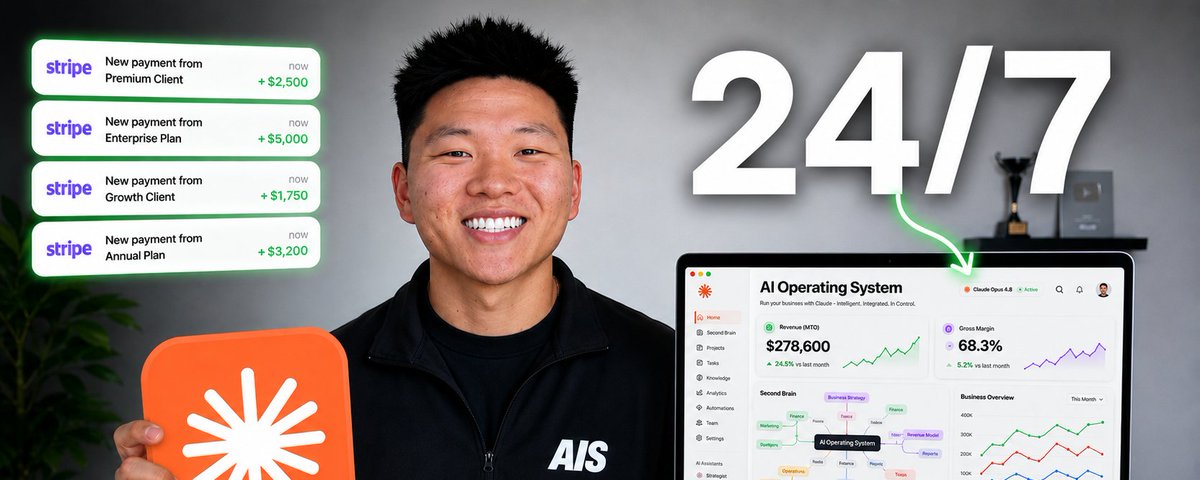
Opus 4.8 Now Runs My Entire Business
It's my second brain. My executive assistant. The thing every business decision now passes through.
I live inside it more than I live inside Chrome.
Here's how I built it, the two frameworks behind it, and the trap that almost cost me 150,000 customers.
## TL;DR
→ The model isn't the moat. Your context is.
→ Default shift: work out of Claude Code, not Chrome. One system sees everything.
→ Two frameworks. Three M's (Mindset, Method, Machine) for the lens. Four C's (Context, Connections, Capabilities, Cadence) for the architecture.
→ Don't stress the file structure. It's all folders. AI can crawl it.
→ Instructions are not the same as capabilities. Scope the keys, not the wishes.
→ Build skills two ways. Forward for workflows you plan. Reverse for workflows you just lived through.
→ Run /insights every few weeks to audit your own usage.
→ Treat the system like a mentor, not a chatbot.
## The Default Shift
I used to bounce between tabs.
Claude on the web for LinkedIn drafts. Claude Code for Python scripts. A few SaaS tools layered on top of all of it. Project folders inside Claude for each type of content I was writing.
Then I noticed the underlying model was the same in every tab.
The only thing that changed between Claude on the web and Claude Code was the context each one had access to. Claude Code had my files, my repo, my history. The web version had whatever I pasted in that day.
Once I saw that, I made one rule. Try to do everything out of Claude Code first.
Brainstorming. YouTube outlines. LinkedIn posts. Skool posts. Meeting prep. None of it has anything to do with code, and all of it now runs through Claude Code.
The side effect was that my SaaS stack shrank. Less context switching. Less monthly spend. One source of truth that gets smarter the more I use it.
A quick note on why 4.8 specifically. I liked Opus 4.6 more than 4.7. 4.7 had a bit of an attitude. It would wander outside the scope of what you asked it to do, sometimes burn extra tokens, and once in a while it would lie to you. 4.8 feels closer to 4.6 again, with real honesty improvements in the docs to back it up.
## Context Is King, Not the Model
If the model were the moat, everyone would be winning.
Everyone has access to Opus 4.8. Everyone has access to whatever the next frontier release is. If the model was what mattered, every LinkedIn post written with Claude would go viral. They don't.
The model is the engine. Your context is the fuel.
Models are stateless. Every new Claude Code session loads your global rules, your claude.md, the files you've pointed it to, and your memories. That's it. Without those, it's a complete beginner every single time.
So here's the audit. Open a fresh Claude Code session. Ask it "based on what's going on in our business, what should I work on next week."
If the answer is generic, you have a context problem.
If the answer is sharp, you have a starting point.
Either way, the next move is the same. Feed it more.
## The Four C's
This is the framework I use to decide what to give the system access to. Each layer builds on the one above it.
1️⃣ Context
→ It knows your business
→ Open a fresh session, ask "what does this business do and who works here," and it should answer
→ This is the foundation everything else sits on
2️⃣ Connections
→ What it can actually touch
→ Your calendar tomorrow, your tasks, the message John sent yesterday, the general team chat
→ If you're copy-pasting context in, you don't have connections yet
3️⃣ Capabilities
→ How you actually do the work
→ Skills, instruction files, your frameworks baked in
→ "When Nate writes a LinkedIn post, use this style, these analogies, this framework"
→ This is where the system stops feeling generic
4️⃣ Cadence
→ Things that happen while your laptop is closed
→ Or while you're focused on something else
→ Scheduled runs, triggered automations, background work
→ This is the final layer because it only works if the first three are solid
Skip a layer and the next one falls apart. Cadence on top of bad context is just automated mistakes at scale.
## The Connections Audit
The hard part isn't connecting tools. It's deciding which tools to connect first.
So here are seven starter buckets I think about. When you sit down to do a weekly review of your own life, where do you actually go to look for each of these?
→ Revenue figures
→ Customer data and customer communication
→ Your calendar
→ Internal team communication
→ Tasks and project management
→ Meetings and meeting notes
→ Knowledge and documentation
Write down the tool you use for each. Now those are your first seven connections.
Mine looks like ClickUp, Gmail, Slack, Google Workspace, Fireflies, QuickBooks, YouTube, and all my local files. Each one connected through an MCP server or a direct API.
The honest advice is don't try to wire them all up in one sitting. Pick one, get it working, move on. The clone-and-go repo I'll mention at the end has an onboarding skill that interviews you, audits your stack, and walks you through it one connection at a time.
## The /insights Command
This is one of the most useful commands in my whole setup.
Run /insights and Claude Code generates an HTML report analyzing your local sessions over the last 30 days. You open the file in a browser and you see:
→ What's working in how you use it
→ What's hindering you
→ Quick wins to try
→ Ambitious workflows you haven't built yet
→ Patterns in where things go wrong
→ Features and usage patterns you're under-using
The first time I ran it, half the suggestions were skills I had been re-prompting from scratch every day without realizing it.
Run it once. Implement the easy stuff. Then run it again every couple of weeks. The point isn't the single audit, it's watching how your usage evolves and whether your sessions are getting denser over time.
## Organize Like It's Just Files
The most asked question I get is "how do I organize my AI OS."
The honest answer is don't stress it.
There's no single right way. It's all folders and files. The second you internalize that, the whole thing gets easier.
Files and folders means you're not locked into Claude Code. The same setup opens in Codex. The same setup opens in any other coding agent. My root has a claude folder, a codex folder, and an agents folder living side by side. Tool agnostic by default.
Files and folders also means the AI can crawl it, reorganize it, and search it for you. I update my claude.md almost every day. I move projects, archive old work, and add new ones every week. Quarter to quarter, my priorities change, so my structure changes with them.
Inside mine I have decisions, audits, archives, and a folder called OtherWorlds where I keep entire standalone Claude Code projects. My YouTube OS lives there. My scheduled automations live there. The book I'm writing lives there. Each is its own Claude Code project, but the main OS can still see and reach into them. I even keep notes documenting where my other Claude Code projects live on the rest of the machine, so the main OS can navigate to them when it needs to.
The only failure mode is too much context with no organization. As long as you and the AI can both find things, you're fine.
One concrete example. Last week a team member sent me a doc and I couldn't remember if it landed in Slack or ClickUp. I asked Claude Code. It found it in ten seconds. That's the unlock. No more scavenger hunts.
## Instructions Are Not Capabilities
Here's where it gets dangerous.
A team I work with had an AI agent that sent three promotional emails to over 150,000 inboxes. The emails weren't approved. The send wasn't approved. The agent picked up a to-do list, interpreted one of the items as "make and send these emails," and just did it.
We had to apologize. We had to take pages down. It was a mess.
The lesson wasn't "be more careful with instructions." The lesson was that instructions are not the same as capabilities.
Saying "never send emails" to an agent that has a send-email tool on its keyring is a wish. The tool is still there. The model can still reach for it. One ambiguous task and the wish gets ignored.
Saying "you don't get a send-email tool at all" is a guardrail. The agent literally cannot do the thing.
Assume that if your agent has access to read something or do something, it will do it eventually. That assumption changes how you scope endpoints, how you wire up MCP servers, and what you let your agents touch in production.
The right way to grow into more autonomy is what I call the bike method.
You don't hand a kid a bike, strap on a helmet, and say go. You walk next to them. You hold the handle. You feel them lean too far and you correct them. Each trip up and down the driveway, you let go a little more. Training wheels come off. Then your hands come off. Eventually they ride down the street alone and you watch from the porch.
Skills and agents earn autonomy the same way. The barrier to entry to build these systems is lower than it's ever been, and that's the trap. Easier to build does not mean safer to deploy. Every successful run earns the next phase of trust. Skip the phases and you get the 150,000-inbox version of the story.
## How I Build Skills
I build skills two ways.
The first is forward. I think about my week. I look for what I do every Monday, what I do every single day, what I'm repeating multiple times a day. Then I tell Claude Code "use the skill creator, here's the end goal, here are the tools I usually reach for, here's how I usually think about it." It drafts the skill. I correct it. I run it. I give feedback. Sometimes a skill takes fifty rounds before I like it. Every time I run it after that, it still evolves. My LinkedIn skill gets a feedback note every single post.
The second way is reverse engineering, and honestly this is how I build most of them now.
I do the thing end to end with Claude Code, no skill in place. When I get to the output I actually want, I stop and say "look back at this conversation. What did we do to get here. What did you think about. What tools did you need. What questions did you ask me. Now turn that into a skill."
The reverse method is faster because you're not guessing at the workflow up front. You already lived it.
One thing worth flagging. Skills don't have to be big SOP-style workflows. A skill can be as simple as a prompt you keep retyping.
My /session-handoff skill is the example. I was typing the same prompt three or four times a day. "I'm about to clear context, give me a summary of what we did, what files we touched, what decisions are locked, what's still open, and where to pick up next." So I made it a slash command. Now I run /session-handoff, it spits out the full breakdown, I /copy, /clear, paste back in, and I'm right where I left off with fresh context.
That single skill saves me more time than half my workflow skills combined. The bar for "is this worth making a skill" is way lower than people think.
## Mentor, Not Dashboard
The biggest mindset shift is treating the system like a mentor instead of a chatbot.
When something feels out of reach, your brain defaults to what's comfortable. Take pulling a quarterly report. You go open the software and do it manually because you already know how. The doubt sneaks in as comfort.
A mentor flips that. You walk in and say "here's a process I do every month, here's the tool, how do I actually automate this." The system walks you through options. You test together. You build the new path.
There's a real cost to this. The first time you do something new, it's slower than the manual version. There's a dip before the climb. The question is whether the climb is worth a one-time twenty percent dip.
Almost always, yes.
But the judgment piece stays with you. You still read the output. You still put your own spin on it. You can outsource your thinking. You cannot outsource your understanding.
That's also why I don't run a fancy dashboard for any of this. People assume an AI Operating System needs a slick visual layer with all the agents and uptime and metrics on display. Mine has none of that. I open Claude Code, I talk to it, I have a few tabs open for different agents, and I work.
The metrics I care about still exist. Free Skool members. Monthly recurring revenue. Active projects. The AIOS can pull any of them on request. I just don't need them staring at me all day to feel like I'm in control.
Productivity isn't hours worked. Productivity is movement toward the goal. If a feature, a skill, or a dashboard doesn't move me closer to the north star, I don't build it.
Here's where it got interesting for me. Once I started filtering every "should I add this" decision through the north star, the whole system got simpler instead of more complex. The temptation to bolt on more stops being a temptation.
## Wrap
The AI isn't the moat. The model isn't the moat. Your context, your connections, your skills, and your cadence are the moat.
Build the four layers. Earn autonomy phase by phase. Don't hand out keys you didn't mean to hand out.
I walk through this step by step in the full video, including the free GitHub repo you can clone as a starter AIOS. Link in the first reply.
## 相关链接
- [Nate Herk](https://x.com/nateherk)
- [@nateherk](https://x.com/nateherk)
- [27K](https://x.com/nateherk/status/2060373513014292919/analytics)
- [Upgrade to Premium](https://x.com/i/premium_sign_up)
- [10:51 PM · May 29, 2026](https://x.com/nateherk/status/2060373513014292919)
- [27.1K Views](https://x.com/nateherk/status/2060373513014292919/analytics)
- [View quotes](https://x.com/nateherk/status/2060373513014292919/quotes)
---
*导出时间: 2026/5/30 11:04:40*
---
## 中文翻译
# 我把 Claude Opus 4.8 变成了我的全能 AI 操作系统
**作者**: Nate Herk
**日期**: 2026-05-29T14:51:40.000Z
**来源**: [https://x.com/nateherk/status/2060373513014292919](https://x.com/nateherk/status/2060373513014292919)
---

Opus 4.8 现在管理着我的整个生意
它是我的第二大脑。我的执行助理。如今,每一项业务决策都要经过它。
我生活在它里面的时间,甚至比我在 Chrome 里的时间还长。
以下是我构建它的方法、背后的两个框架,以及那个差点让我损失 15 万客户的陷阱。
## TL;DR
→ 模型不是护城河。你的上下文才是。
→ 默认习惯的转变:在 Claude Code 中工作,而不是 Chrome。让单一系统洞察一切。
→ 两个框架。作为视角的“三 M”(思维模式 Mindset、方法 Method、机器 Machine)。作为架构的“四 C”(上下文 Context、连接 Connections、能力 Capabilities、节奏 Cadence)。
→ 别纠结文件结构。它们只是文件夹而已。AI 可以遍历它们。
→ 指令不等于能力。要限制的是密钥,而不是愿望。
→ 两种构建技能的方式。正向构建:针对你计划的工作流。反向构建:针对你刚刚经历的工作流。
→ 每隔几周运行一次 /insights 来审计你自己的使用情况。
→ 把系统当作导师,而不是聊天机器人。
## 默认习惯的转变
我曾经在不同的标签页之间来回切换。
用网页版 Claude 起草 LinkedIn 内容。用 Claude Code 写 Python 脚本。在这一堆东西上面再叠几层 SaaS 工具。在 Claude 里为每种我正在撰写的内容类型建立项目文件夹。
后来我意识到,每个标签页底层的模型都是一样的。
网页版 Claude 和 Claude Code 之间唯一的区别,在于它们各自能访问的上下文。Claude Code 拥有我的文件、我的仓库、我的历史记录。网页版只有我当天粘贴进去的内容。
一旦看清了这点,我就定下了一条规矩:尽量优先在 Claude Code 里完成所有事情。
头脑风暴。YouTube 大纲。LinkedIn 帖子。Skool 帖子。会议准备。这些都与代码无关,但现在全都通过 Claude Code 运行。
副作用是,我的 SaaS 堆栈缩水了。减少了对上下文的切换。减少了月度开支。唯一的真实来源,而且我越用它,它就越聪明。
简单说一下为什么 specifically 是 4.8。相比 4.7,我更喜欢 Opus 4.6。4.7 有点“脾气”。它会在你要求的范围之外游离,有时会浪费额外的 token,偶尔还会撒谎。4.8 感觉又接近 4.6 了,并且文档中有真正的诚实度改进作为支撑。
## 上下文为王,而非模型
如果模型是护城河,那人人都能赢。
每个人都有权访问 Opus 4.8。每个人都有权访问下一个前沿版本。如果模型才是关键,那每篇用 Claude 写的 LinkedIn 帖子都应该爆火。但事实并非如此。
模型是引擎。你的上下文是燃料。
模型是无状态的。每次新的 Claude Code 会话都会加载你的全局规则、你的 claude.md、你指向的文件以及你的记忆。仅此而已。没有这些,它每次都是一个完全的新手。
所以,来做个审计。打开一个新的 Claude Code 会话。问它:“基于我们生意的现状,我下周应该做什么。”
如果答案很泛泛,你就有上下文问题。
如果答案很犀利,你就有了一个起点。
无论哪种情况,下一步都是一样的:投喂更多内容。
## 四个 C
这是我用来决定给系统访问什么权限的框架。每一层都建立在其上一层之上。
1️⃣ 上下文
→ 它了解你的生意
→ 打开一个新会话,问“这个业务是做什么的,谁在这里工作”,它应该能回答上来
→ 这是其他一切的基础
2️⃣ 连接
→ 它实际能触及的东西
→ 你明天的日程、你的任务、John 昨天发来的消息、通用团队群聊
→ 如果你还得复制粘贴上下文,说明你还没有建立连接
3️⃣ 能力
→ 你实际完成工作的方式
→ 技能、指令文件、内置的框架
→ “当 Nate 写 LinkedIn 帖子时,使用这种风格、这些类比、这个框架”
→ 这就是系统不再让你感觉像通用的 AI 的地方
4️⃣ 节奏
→ 当你合上笔记本电脑时发生的事情
→ 或者当你专注于其他事情时
→ 定时运行、触发的自动化、后台任务
→ 这是最后一层,因为它只有在前三层稳固时才能起作用
跳过一层,下一层就会崩塌。糟糕的上下文加上节奏,只会把错误规模化地自动执行。
## 连接审计
难点不在于连接工具,而在于决定先连接哪些工具。
这里有七个我认为很实用的起始分类。当你坐下来做每周生活回顾时,你会去哪里查找每一项?
→ 收入数据
→ 客户数据和客户沟通
→ 你的日历
→ 内部团队沟通
→ 任务和项目管理
→ 会议和会议纪要
→ 知识和文档
写下你为每一项使用的工具。这些就是你的前七个连接。
我的配置包括 ClickUp、Gmail、Slack、Google Workspace、Fireflies、QuickBooks、YouTube 以及我所有的本地文件。每一个都通过 MCP 服务器或直接 API 连接。
诚实的建议是:别试图一口气把它们全部接上。选一个,调试通,再继续。我最后会提到的那个“克隆即用”仓库里有一个入职技能,它会采访你、审计你的技术栈,并带你一次搞定一个连接。
## /insights 指令
这是整个设置中最有用的指令之一。
运行 /insights,Claude Code 就会生成一份 HTML 报告,分析你过去 30 天的本地会话。在浏览器中打开文件,你会看到:
→ 你的使用方式中哪些有效
→ 哪些在阻碍你
→ 值得尝试的速赢
→ 你尚未构建的宏大工作流
→ 出问题的模式
→ 你利用不足的功能和使用模式
我第一次运行时,有一半的建议都是我每天都在从头重复提示的技能,而我自己都没意识到。
运行一次。实施那些简单的东西。然后每隔几周再运行一次。重点不是单次审计,而是观察你的使用方式如何演变,以及你的会话是否随时间变得越来越丰富。
## 像管理文件一样去组织
我最常被问到的问题是“我是如何组织我的 AI OS 的”。
诚实的回答是:别纠结这个。
没有唯一正确的方法。只是文件夹和文件而已。一旦你内化了这一点,一切都变得容易了。
文件和文件夹意味着你不会被锁定在 Claude Code 里。同样的设置可以在 Codex 中打开。同样的设置可以在任何其他代码代理中打开。我的根目录下有一个 claude 文件夹、一个 codex 文件夹和一个 agents 文件夹并存。默认工具无关。
文件和文件夹也意味着 AI 可以抓取、重新组织并为你搜索它们。我几乎每天都会更新我的 claude.md。我每周都会移动项目、归档旧工作并添加新项目。季度之间,我的优先级会变,所以我的结构也随之改变。
在我的文件夹里,有 decisions(决策)、audits(审计)、archives(归档),还有一个叫 OtherWorlds 的文件夹,里面存放着完整的独立 Claude Code 项目。我的 YouTube OS 在那里。我的定时自动化在那里。我正在写的书在那里。每一个都是独立的 Claude Code 项目,但主 OS 仍然可以看到并深入它们。我甚至保留了笔记,记录其他的 Claude Code 项目在机器的哪些位置,这样主 OS 在需要时就能导航过去。
唯一的失败模式是上下文过多却毫无组织。只要你和 AI 都能找到东西,你就没问题。
举个具体的例子。上周一位团队成员发给我一个文档,我不记得它是落在 Slack 还是 ClickUp 里了。我问了 Claude Code。它十秒钟就找到了。这就是解锁点。不再需要到处翻找。
## 指令不等于能力
这里就变得有点危险了。
与我合作的一个团队有一个 AI 代理,向超过 15 万个收件箱发送了三封促销邮件。邮件未经批准。发送操作未经批准。代理抓取了一个待办事项清单,将其中一项解读为“制作并发送这些邮件”,然后就直接执行了。
我们不得不道歉。我们不得不撤下页面。简直是场灾难。
教训不是“对待指令要更小心”。教训是指令并不等同于能力。
对一个挂着发邮件工具的代理说“永远不要发邮件”,这是一种愿望。工具还在那里。模型仍然可以使用它。只要任务描述稍显模糊,愿望就会被无视。
说“你根本没有发邮件工具”才是一道护栏。代理在物理上无法执行该操作。
只要你的代理有权读取或执行某事,就要假设它最终会去做。这个假设会改变你如何界定端点范围、如何连接 MCP 服务器,以及你允许代理在生产环境中触碰什么。
逐步获得更多自主权的正确方法,我称之为“自行车法”。
你不会把自行车扔给孩子,扣上头盔,然后说“去吧”。你会走在他们身边。你会握住车把。你感觉到他们倾斜过度,你就纠正他们。每次在车道上往返,你都多放手一点。辅助轮拆掉了。然后你的手也松开了。最终,他们独自骑过街道,你在门廊上看着。
技能和代理也是以同样的方式赢得自主权的。构建这些系统的门槛比以往任何时候都低,这就是陷阱。更容易构建并不意味着更安全部署。每一次成功的运行都能赢得下一阶段的信任。跳过阶段,你就会得到那个 15 万收件箱版本的故事。
## 我如何构建技能
我用两种方式构建技能。
第一种是正向构建。我会思考我的一周。我会寻找每个周一做什么、每天做什么、一天中重复多次做什么。然后我告诉 Claude Code:“使用技能创建器,这是最终目标,这是我通常使用的工具,这是我通常的思考方式。”它会起草技能。我修正它。我运行它。我给反馈。有时一个技能要经过五十轮修正我才满意。那之后每次运行,它仍在进化。我的 LinkedIn 技能每次发帖都会收到一条反馈。
第二种方式是逆向工程,老实说这也是我现在构建大多数技能的方法。
我和 Claude Code 端到端地做一件事,不预设任何技能。当我得到了真正想要的输出时,我停下来说:“回顾这段对话。我们要做什么才到了这一步。你思考了什么。你需要什么工具。你问了我什么问题。现在把它变成一个技能。”
逆向方法更快,因为你不需要在前期猜测工作流。你已经经历过它了。
有一点值得强调。技能不必是大型的 SOP 风格的工作流。一个技能可以简单到你不断重复输入的一条提示词。
我的 /session-handoff(会话交接)技能就是例子。我每天要把同一条提示词打三四遍。“我准备清空上下文了,给我一个总结:我们做了什么,触碰了哪些文件,哪些决策已锁定,哪些还在进行,以及接下来从哪里继续。”所以我把它做成了一个斜杠命令。现在我运行 /session-handoff,它会吐出完整的细分内容,我 /copy(复制),/clear(清空),粘贴回去,立刻就能回到我停下的地方,上下文焕然一新。
这一个技能节省的时间比我一半的工作流技能加起来还多。“这是否值得做成技能”的门槛比人们想象的要低得多。
## 导师,而非仪表盘
最大的思维转变是把系统当作导师,而不是聊天机器人。
当某件事感觉遥不可及时,大脑会默认选择舒适的方式。比如拉取季度报告。你会打开软件手动操作,因为你知道怎么做。怀疑会伪装成舒适感潜入。
导师会反其道而行之。你走进来说“这是我每月做的一个流程,这是工具,我实际上该如何自动化它。”系统会带你过一遍选项。你们一起测试。你们建立新路径。
这样做是有真实成本的。第一次做某件新事时,它比手动慢。攀登之前会有下潜。问题是,攀登是否值得那一次性的 20% 下潜?
几乎总是值得的。
但判断力仍在你手中。你仍然会阅读输出。你仍然会加入自己的风格。你可以外包思考。你不能外包理解。
这也是为什么我不为此运行任何花哨的仪表盘。人们认为 AI 操作系统需要一个带有一流可视化层的东西,展示所有代理、运行时间和指标。我的系统完全没有这些。我打开 Claude Code,跟它对话,为不同的代理打开几个标签页,然后开始工作。
我关心的指标依然存在。Skool 免费成员数。月度经常性收入。活跃项目。AIOS 可以按需拉取其中任何一个。我只是不需要它们整天盯着我看,才能让我觉得一切尽在掌握。
生产力不是工作时长。生产力是向目标迈进。如果一个功能、技能或仪表盘不能让我离北极星更近一步,我就不会构建它。
有趣的地方就在这里。一旦我开始用北极星来过滤每一个“是否要添加这个”的决策,整个系统变得更简单了,而不是更复杂。那种想拼凑更多东西的诱惑不再是诱惑了。
## 结语
AI 不是护城河。模型不是护城河。你的上下文、连接、技能和节奏才是护城河。
构建这四层。分阶段赢得自主权。不要分发你无意分发的密钥。
在完整视频中,我会一步步演示,包括那个可以克隆作为 AIOS 起始模板的免费 GitHub 仓库。链接在第一条回复中。
## 相关链接
- [Nate Herk](https://x.com/nateherk)
- [@nateherk](https://x.com/nateherk)
- [27K](https://x.com/nateherk/status/2060373513014292919/analytics)
- [升级到 Premium](https://x.com/i/premium_sign_up)
- [10:51 PM · May 29, 2026](https://x.com/nateherk/status/2060373513014292919)
- [27.1K Views](https://x.com/nateherk/status/2060373513014292919/analytics)
- [查看引用](https://x.com/nateherk/status/2060373513014292919/quotes)
---
*导出时间: 2026/5/30 11:04:40*