如何自动化你的生活(分步指南) ✍ AI Edge🕐 2026-05-23📦 9.6 KB 🟢 已读 𝕏 文章列表 文章介绍了如何利用 AI 进行生活自动化的三步框架:首先是记录日常任务清单,识别可被部分自动化的环节;其次是选择高杠杆任务进行方案设计,避免过度复杂化;最后是推荐使用 Perplexity Computer 或 Manus 等代理工具来执行工作流。 AI自动化工作流效率提升PerplexityManusAgent时间管理提示词生活黑客 # How to Automate Your Life (step-by-step guide) **作者**: AI Edge **日期**: 2026-05-22T13:32:16.000Z **来源**: [https://x.com/aiedge_/status/2057816817708789940](https://x.com/aiedge_/status/2057816817708789940) --- 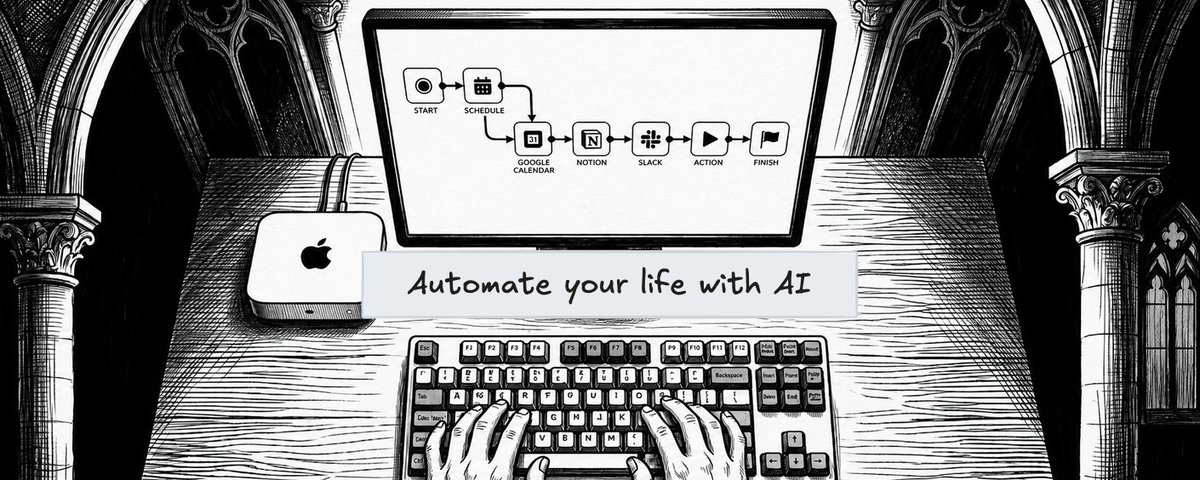 Most people know they need to automate with AI, but they have no clue where to start. They hear about workflows, agents, and ten different AI tools and feel immediately overwhelmed. Too many tools, too complicated, and too much friction for getting started. So, they resort to doing nothing and end up wasting hours per week on manual tasks that AI could've handled if they'd followed the right steps. In this article, I am going to give you the exact three-step framework I use to identify, design, and build any automation in under 10 minutes - no coding or expensive AI tools required. This framework applies to any AI automation you want to build for any aspect of your life. Stick around until the end of the article (bonus section), where I give you two free AI automation resources. Contents I: What do I automate? II: Designing the solution III: Execution layer Bonus: my *free* automation resources bundle ## Step One: What do I automate? Before you touch a single tool, you need to know what you are actually automating. This might sound obvious, but most people skip this step entirely and end up drowning in options with zero useful automations actually built. I want you to conduct a time audit exercise: write down every task you do on a daily, weekly, and monthly basis. Do NOT filter anything out at this stage. The goal is just to get it on paper (or organized digitally); it doesn't matter whether or not you think it can be automated. Three categories: Daily tasks. Weekly tasks. Monthly tasks. Tip: actually go through a full day/weekly routine so you can accurately time log your tasks. Once you have your list, go through it and ask two questions for each item: 1. Can this be fully automated? 2. If not, can AI handle 50-80% of it, so I only handle the final step? That second question matters most. A lot of people look at their list and think nothing is automatable because they are thinking only about full automation. But partial automation is just as valuable. To give you guys a tangible example: I use AI in many ways to help with my writing here on X. However, I do not want AI to write my posts end-to-end. So, I use AI to handle all the research, scraping, grammar checking, and grunt work that goes into hitting the publish button. The curation and taste are still mine, but I leverage AI systems to automate tasks that don't require human touch. Pro tip: Use voice prompting to build this list. Open Claude or ChatGPT and explain that you want to map out everything you do daily and weekly in order to automate it. Ask it to prompt you with questions. You will remember things through conversation that you would never think to write down. An example time tracker log: 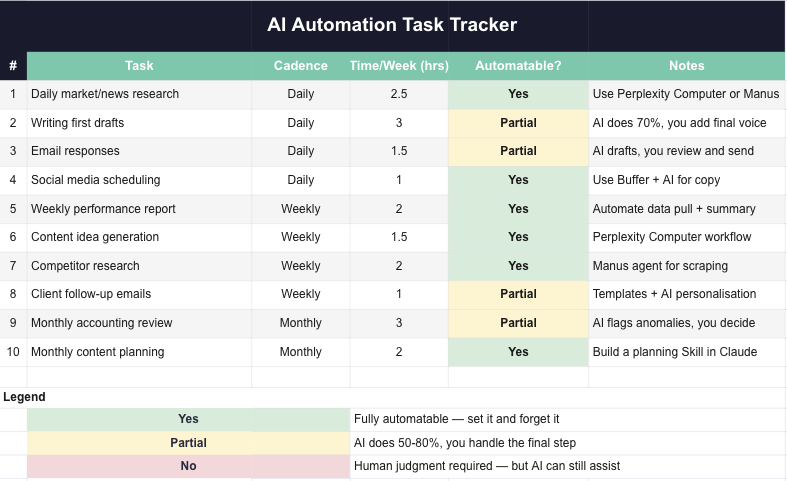 AI Automation Task Tracker At the end of the article (bonus section), I give you my exact template - don't worry about creating your own. ## Step Two: Designing the solution Now, you have your list. What I want you to do now is just pick one thing to start with. Ideally, this is a high-leverage daily task that, if automated, could save you 30-60 minutes+ per day. For me, automating my entire content research system (via Slack + Perplexity Computer + OpenClaw) saved me hours per week. For you, this could be spreadsheet work, email management, calendar management, to-do list tracking, accounting, creative design work, etc. The biggest mistake people make at this stage is trying to automate everything at once. They look at a list of 20 tasks and start building half-functional workflows for everything. Don't do that. Instead, pick the highest-leverage item and commit to automating just one workflow per week. In a perfect world, that means in 2-3 months from now, you'll have 10+ automations running at once. Once you have your task, use this prompt in Claude (or any LLM) to reverse engineer exactly how to automate the workflow you need. I also give you access to the completed mega prompt in the bonus section. 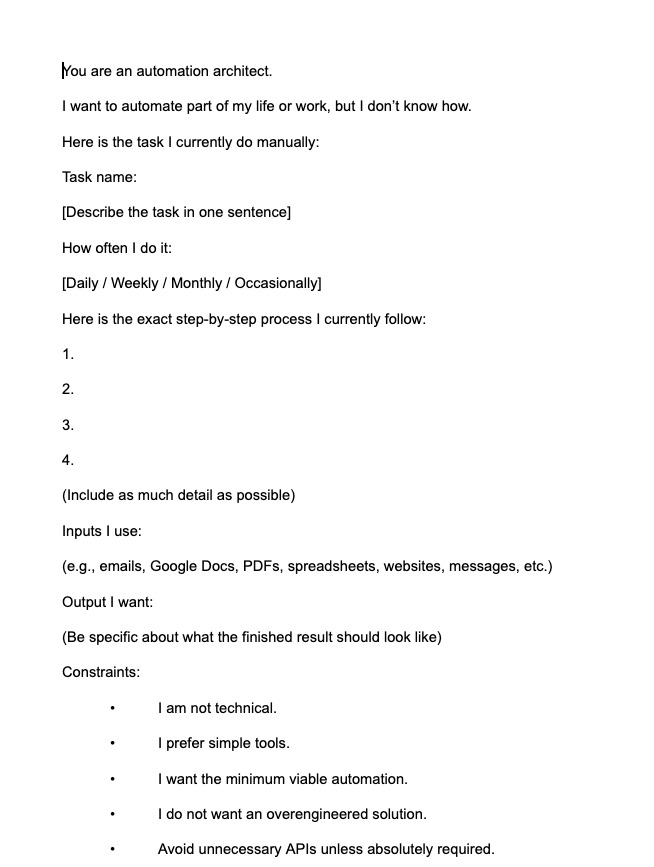 Task Automation Mega Prompt Fill in your specific details, and you will get a clear workflow (the steps, the tools, and the order for executing them). One important note on constraints: most people do not need complex automation. They do not need webhooks, APIs, and five different tools chained together. All you really need is something simple that works. To make this tangible, I'll give you real examples below (with the tools I personally recommend). ## Step Three: Execution layer Two tools handle the majority of automations I run. Both use agent architecture, meaning they do not just answer questions; they execute actual workflows on your behalf. If you're a complete beginner, just pick one of these tools: 1. Perplexity Computer Since its release, Perplexity Computer has quickly become one of my most-used AI tools. What makes it different from a standard LLM is that it leverages multiple AI models inside a single workflow. It can use Gemini for research, Claude for synthesis, and GPT for structuring. It automatically selects the best model at each step, so you don't have to manage any of it. A real example from my own workflow: I use it to build a daily content brief for the AI Edge team. The prompt tells Computer to research developments in AI, identify the strongest ideas, and package them into a ready-to-use brief. It spins up multiple sub-agents running in parallel, synthesizes the outputs, and delivers the brief automatically. What used to take my team and me hours of manual research now runs automatically every morning. 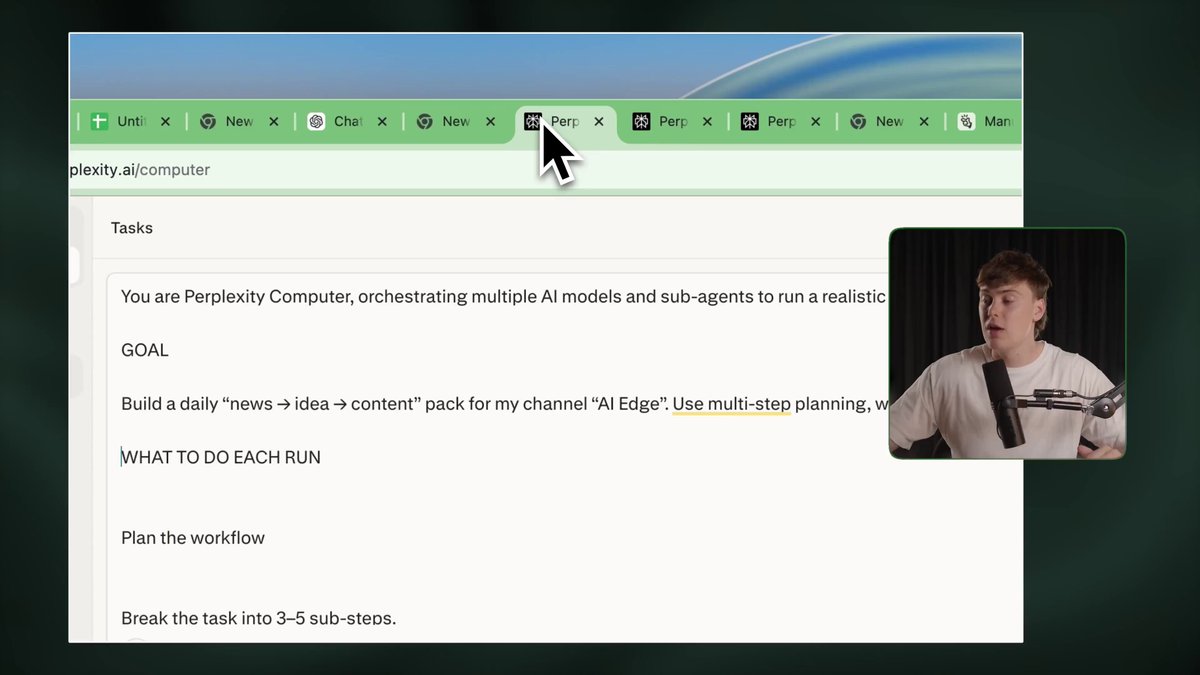 Computer Explained Perplexity Computer's only downside is its cost. It works extremely well and is genuinely useful, but that productivity comes at a premium. If you don't have the means to invest in a premium tool, resort to the alternative option below. 2. Manus Manus is the more accessible alternative, and for most workflows, it performs just as well. Same agent architecture (it can research, synthesize, create files, generate images, and automate recurring tasks), but at a lower price point than Computer (with usage limits). A practical example: give it a prompt to generate a daily intelligence brief, scan for the top developments across your niche, and deliver a concise summary to a log file.  Manus Explained The thing I like about Manus is that it can generate images, build slide decks, and handle visual outputs (useful if your workflow involves thumbnail ideas, presentation drafts, or visual research). using Manus alone.I've created many viral infographics on@aiedge For 90% of the automations you will want to build, sticking with Perplexity Computer or Manus will handle it entirely. 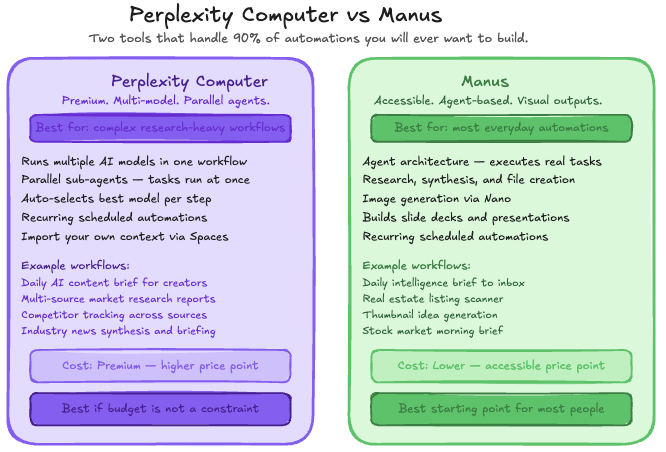 Computer versus Manus The only exception to using these tools as your daily drivers is building highly specific workflows that may require an API connection, feeding live data into a dashboard, and/or syncing data across multiple platforms. For those workflows, the automation architect prompt from Step Two will flag what additional setup is needed. I also recommend using Cowork to handhold you through those more complex workflows. ## Bonus: free resources As promised earlier, I made two free resources to get you started on your AI automation journey. First, I built a template to assist with the time-logging exercise I outlined in Step One. 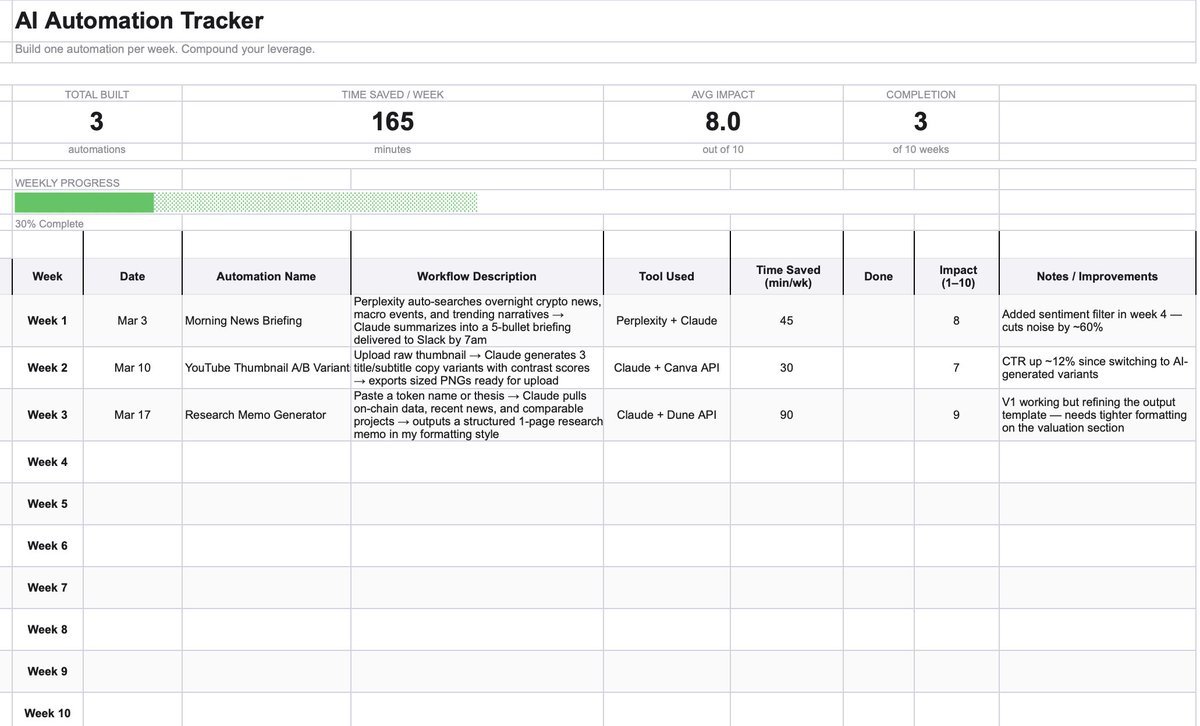 Task Tracker (FREE) Secondly, I built a mega prompt you can use across any LLM to help you identify exactly which tasks you should automate (Step Two). 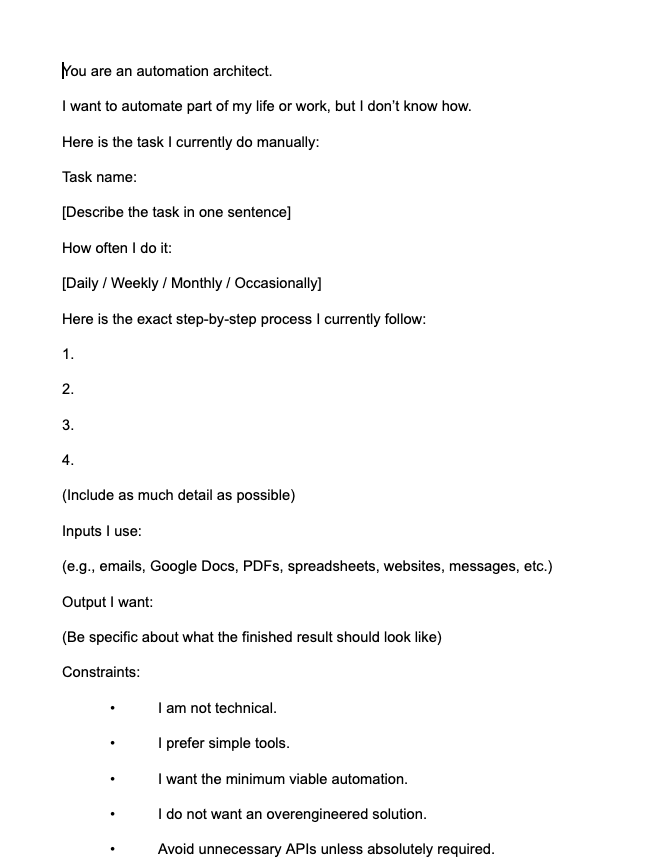 Mega Prompt (FREE) You can find the above resources here: https://www.aiedgehq.co/  ## Closing That is the entire framework. It's simple, repeatable, and it compounds over time in a way that genuinely changes how much you can get done with AI. I hope you found this article valuable and practical. I'm aiming to deliver content exactly like this every single week. If this is the kind of content you want on your feed, follow me at @aiedge_ and @milesdeutscher. Across both accounts, I publish at least 3 articles a week on the hottest topics in AI. Lastly, if you can, please Like/Repost this article so others can find it 💙 ## 相关链接 - [AI Edge](https://x.com/aiedge_) - [@aiedge_](https://x.com/aiedge_) - [114K](https://x.com/aiedge_/status/2057816817708789940/analytics) - [@aiedge](https://x.com/@aiedge) - [https://www.aiedgehq.co/](https://www.aiedgehq.co/) - [https://www.aiedgehq.co/](https://www.aiedgehq.co/) - [@aiedge_](https://x.com/@aiedge_) - [@milesdeutscher](https://x.com/@milesdeutscher) - [Upgrade to Premium](https://x.com/i/premium_sign_up) - [9:32 PM · May 22, 2026](https://x.com/aiedge_/status/2057816817708789940) - [114.8K Views](https://x.com/aiedge_/status/2057816817708789940/analytics) - [View quotes](https://x.com/aiedge_/status/2057816817708789940/quotes) --- *导出时间: 2026/5/23 17:16:42* --- ## 中文翻译 # 如何自动化你的生活(分步指南) **作者**: AI Edge **日期**: 2026-05-22T13:32:16.000Z **来源**: [https://x.com/aiedge_/status/2057816817708789940](https://x.com/aiedge_/status/2057816817708789940) ---  大多数人都知道自己需要利用 AI 进行自动化,但他们完全不知道该从哪里入手。 他们听到各种关于工作流、智能体和十种不同 AI 工具的介绍,立刻就感到不知所措。 工具太多,太复杂,开始入手的阻力太大。 于是,他们什么都不做,结果每周都在手动任务上浪费数小时,而如果当初他们采取了正确的步骤,这些任务本可以由 AI 处理。 在本文中,我将向你提供我使用的确切三步框架,用于在 10 分钟内识别、设计并构建任何自动化——无需编写代码或使用昂贵的 AI 工具。 此框架适用于你想为生活任何方面构建的任何 AI 自动化。 请坚持读到文章最后(bonus section),我会为你提供两个免费的 AI 自动化资源。 目录 I: 我该自动化什么? II: 设计解决方案 III: 执行层 Bonus: 我的*免费*自动化资源包 ## 第一步:我该自动化什么? 在你接触任何工具之前,你需要知道你真正要自动化的是什么。这听起来可能显而易见,但大多数人完全跳过了这一步,最终淹没在各种选择中,实际上却没有构建出任何有用的自动化。 我希望你进行一项时间审计练习:写下你每天、每周和每月做的每一项任务。在这个阶段,**不要**过滤掉任何东西。 目标只是把它记在纸上(或以数字形式组织);至于你认为它是否可以自动化,并不重要。 三个类别:每日任务、每周任务、每月任务。 提示:实际度过完整的一天/一周例行公事,以便你可以准确地记录你的任务时间。 一旦你有了清单,逐项浏览并针对每个项目问两个问题: 1. 这能完全自动化吗? 2. 如果不能,AI 能处理其中的 50-80% 吗,这样我就只需处理最后一步? 第二个问题最重要。许多人看着他们的清单,认为没有什么是可以自动化的,因为他们只考虑完全自动化。但部分自动化同样具有价值。 给你们一个具体的例子:我在 X 平台上写文章时,在很多方面使用 AI 提供帮助。然而,我不希望 AI 端到端地撰写我的推文。因此,我利用 AI 来处理所有的研究、抓取、语法检查以及为了点击发布按钮而做的苦力活。 内容策划和品味依然属于我,但我利用 AI 系统来自动化那些不需要人工干预的任务。 专业提示:使用语音提示来建立这个清单。打开 Claude 或 ChatGPT,解释你想映射出你每天和每周所做的所有事情以便自动化。让它向你提问。通过对话,你会记起那些你永远想不到要写下来的事情。 时间追踪日志示例:  AI 自动化任务追踪器 在文章末尾(bonus section),我会提供我的确切模板——不用担心自己创建。 ## 第二步:设计解决方案 现在,你有了你的清单。我现在要你做的是只选**一件事**作为开始。 理想情况下,这是一个高杠杆的日常任务,如果自动化,每天可以为你节省 30-60 分钟以上。 对我来说,自动化我的整个内容研究系统(通过 Slack + Perplexity Computer + OpenClaw)每周为我节省了数小时。 对你来说,这可能是电子表格工作、邮件管理、日程管理、待办事项列表追踪、会计、创意设计工作等。 人们在这个阶段犯的最大错误是试图一次自动化所有事情。他们看着一份包含 20 个任务的清单,开始为所有事情构建半功能的工作流。 不要那样做。相反,选择杠杆率最高的项目,并致力于每周只自动化一个工作流。 在一个理想的世界里,这意味着从现在起 2-3 个月内,你将同时运行 10 个以上的自动化。 一旦你有了任务,在 Claude(或任何大语言模型)中使用这个提示词来逆向工程,弄清楚如何自动化你需要的工作流。 我还会在 bonus section 中为你提供完整版的超级提示词。  任务自动化超级提示词 填写你的具体细节,你将得到一个清晰的工作流(步骤、工具以及执行它们的顺序)。 关于约束条件的一个重要说明:大多数人不需要复杂的自动化。他们不需要 Webhooks、API 和五种不同的工具链接在一起。你真正需要的只是简单有效的东西。 为了让你更有实感,我会在下面给你举真实的例子(包含我个人推荐的工具)。 ## 第三步:执行层 两个工具就能处理我运行的大部分自动化。两者都使用智能体架构,这意味着它们不仅仅是回答问题,而是代表你执行实际的工作流。 如果你是一个完全的新手,只选择以下工具之一: 1. Perplexity Computer 自发布以来,Perplexity Computer 迅速成为我最常用的 AI 工具之一。它与标准大语言模型的不同之处在于,它在单一工作流中利用了多个 AI 模型。 它可以使用 Gemini 进行研究,使用 Claude 进行综合,使用 GPT 进行结构化。它会自动在每一步选择最佳模型,因此你无需管理任何环节。 来自我个人工作流的一个真实例子:我用它为 AI Edge 团队建立每日内容简报。提示词会指示 Computer 研究 AI 的发展,识别最强的想法,并将它们打包成现成的简报。它会启动多个并行运行的子智能体,综合输出结果,并自动交付简报。 过去我和团队需要数小时手动研究的工作,现在每天早上都会自动运行。  Computer 原理解析 Perplexity Computer 唯一的缺点是它的成本。它非常好用,确实很有价值,但这种生产力是有代价的。如果你没有资金投资于高级工具,请使用下面的替代方案。 2. Manus Manus 是更容易获得的替代方案,对于大多数工作流,它的表现同样出色。相同的智能体架构(它可以进行研究、综合、创建文件、生成图像并自动化重复性任务),但价格比 Computer 低(但有使用限制)。 一个实用的例子:给它一个提示词以生成每日情报简报,扫描你所在领域的顶尖发展,并将简明摘要发送到日志文件。  Manus 原理解析 我喜欢 Manus 的一点是它可以生成图像、构建幻灯片并处理视觉输出(如果你的工作流涉及缩略图创意、演示文稿草稿或视觉研究,这很有用)。 仅使用 Manus,我就在@aiedge上创建了许多病毒式传播的信息图。 对于你想构建的 90% 的自动化,坚持使用 Perplexity Computer 或 Manus 就能完全搞定。  Computer 对比 Manus 将这些工具作为日常驱动的唯一例外是构建高度特定的工作流,这些工作流可能需要 API 连接、将实时数据输入仪表板和/或跨多个平台同步数据。 对于这些工作流,第二步中的自动化架构师提示词会标记出需要哪些额外的设置。 我还推荐使用 Cowork 来引导你完成那些更复杂的工作流。 ## Bonus: 免费资源 正如之前承诺的,我制作了两个免费资源来帮助你开始你的 AI 自动化之旅。 首先,我建立了一个模板来协助我在第一步中概述的时间记录练习。  任务追踪器 (FREE) 其次,我构建了一个超级提示词,你可以在任何大语言模型中使用它来帮助你准确识别你应该自动化的任务(第二步)。  超级提示词 (FREE) 你可以在这里找到上述资源: https://www.aiedgehq.co/  ## 结语 这就是整个框架。它简单、可重复,并且随着时间的推移,它会以一种真正改变你利用 AI 完成工作量的方式产生复利效应。 我希望你觉得这篇文章既有价值又实用。我的目标是每周都提供完全像这样的内容。 如果你的动态中想要这类内容,请在 @aiedge_ 和 @milesdeutscher 关注我。 在这两个账号上,我每周至少发布 3 篇关于 AI 最热门话题的文章。 最后,如果可以的话,请点赞/转发这篇文章,以便其他人也能看到 💙
非 非技术人员30天掌握AI与自动化实战指南 文章作者作为非技术背景的设计师,分享了自己在三个月内通过AI工具(主要是Claude)自动化整个公司运营的实战经验。他将其浓缩为30天路线图,核心策略包括:逆向工程优秀的AI提示词文件、编写标准作业程序(SOP)让AI执行、养成随时通过自然语言编码的习惯、识别并自动化重复性任务,以及利用工作流工具提升效率。文章强调了AI作为虚拟员工的潜力,能为非技术人员节省大量成本。 技术 › 工具与效率 ✍ Mark Vassilevskiy🕐 2026-04-18 AIClaude自动化SOP提示词工作流Agent非技术实战指南效率提升
1 17 项最佳实践让 Claude Cowork 的效能提升 100 倍 本文作者分享了使用 Claude Cowork 七周并运行 400 场会话后总结的 17 项最佳实践。这些实践涉及情境架构、任务设计、自动化调度及插件使用,旨在通过优化设置与管理,将 Cowork 从简单的工具转变为高效的自主工作系统。 技术 › Claude ✍ Nav Toor🕐 2026-03-02 ClaudeCowork最佳实践自动化工作流Agent效率提升插件提示词上下文管理
飞 飞书多维表格AI同事:手把手教你搞定发票报销 本文介绍了如何利用飞书多维表格自带的AI智能体,实现发票报销流程的自动化。通过拍照或上传发票,AI自动识别数据并录入表格,结合定时任务和排版打印插件,将耗时数小时的报销工作缩短至五分钟。文章详细讲解了从安装配置、创建表格、设置机器人到生成报销单据的全过程,展示了AI在提升办公效率方面的强大能力。 技术 › 工具与效率 ✍ AI少年🕐 2026-07-28 飞书多维表格AI智能体自动化办公发票报销工作流打印排版效率提升Agent实操教程
W WorkBuddy高阶教程|万字复盘:如何让Agent接手真实项目 本文通过一场实战培训,复盘如何使用 WorkBuddy 让 AI Agent 接手真实项目。文章从建立上下文、派发任务(SGP 原则)、定义工作空间、创建项目分身到 DeepResearch 并行调研,详细讲解了让 AI 持续推进复杂任务的方法论。 技术 › Agent ✍ 智见AI-大鹏🕐 2026-07-20 WorkBuddyAgentAI实战提示词项目管理上下文DeepResearch自动化工作流技术分享
为 为什么顶级 AI 工程师不再写提示词:Loops 与 Harness 的崛起 文章指出,AI 交互方式正在从单一的“提示词”转向“循环”。顶级工程师不再手动编写 Prompt,而是设计自动化循环,让智能体自我迭代直至任务完成。以 Slate 工具为例,介绍了如何通过编写 JavaScript“程序”来掌控循环逻辑,实现多模型并行处理和真实世界交互,从而构建更强大的智能系统。 技术 › Agent ✍ Rahul🕐 2026-07-18 AI工程AgentLoopSlate自动化Claude编程提示词工作流JavaScript
我 我把 Loop Engineering 做成了一个 Skill 作者将 Loop Engineering 架构封装成了一个开源 Skill,旨在帮助用户通过回答业务问题快速定制化搭建持续运行的 AI 系统。该 Skill 强调先锁定目标、防漂移检查及人工审批权,适合需要长期自动化工作流的用户。 技术 › Skill ✍ Easycompany🕐 2026-07-15 Loop EngineeringAgentSkillAI自动化开源工作流架构设计
普 普通人不会搭建知识库?方法超简单1分钟教会你 文章指出很多人搭建知识库失败的根本原因在于资料难以持续稳定地“入库”。作者介绍了通过 WorkBuddy 与 ima 知识库的组合,利用自然语言指令和自动化文件夹监控,将网页链接、本地文件等低成本地沉淀到知识库中,从而将知识库从简单的收藏夹转变为能辅助内容生产的数字助理。 技术 › 工具与效率 ✍ SakuAI🕐 2026-07-10 知识库WorkBuddyima工作流AI工具自动化内容创作Agent效率提升
为 为什么你的AI知识库一直搭建不起来?看看是不是缺了这四层架构 文章指出AI知识库搭建失败常因只有资料层,缺了索引、规则和工作流。资料层重质不重量,索引层解决检索路径,规则层限定输出与引用规范,工作流层确保落地任务。 技术 › Agent ✍ 金尘马🕐 2026-07-09 AI知识库架构设计RAG工作流提示词知识管理Agent个人效率
L Loop 入门指南:别再一句句写提示词了 本文探讨了 Claude Code 中的“Loop(循环)”概念,即 Agent 反复循环工作直到满足停止条件。文章详细介绍了四类 Loop:回合制、目标制、时间制和主动式,并分析了各自的最佳适用场景及如何控制 Token 消耗与保证代码质量。 技术 › Claude Code ✍ 老白(每日 AI 干货)🕐 2026-07-09 Claude CodeAgentLoopAI 编程提示词工作流自动化
实 实操记录:我用 WorkBuddy 跑通的第一条完整 AI 办公闭环 文章记录了作者使用 WorkBuddy 实现完整 AI 办公闭环的实战经验。详细解析了 Ask、Plan、Craft 三步执行法,以及工作空间、连接器、专家和技能的配置逻辑。对比了 Claude Code 等开发工具的差异,并分享了处理 Excel 生成周报、制作落地页及远程助理的具体案例,总结了六条使用铁律和避坑指南。 技术 › 工具与效率 ✍ mousepotato🕐 2026-07-06 WorkBuddyAI办公实操指南自动化效率提升Agent工作流避坑指南
C Codex 如何应用于办公和知识场景 这篇文章介绍了如何利用 Codex 的 AI 工作台能力处理办公与知识管理任务。文章阐述了 Codex 的核心概念、从单次任务到自动化系统的五级进阶用法,以及五步工作法。作者提供了搭建环境的具体建议和16个实用工作流模板,旨在帮助用户将重复劳动自动化,提升工作效率。 技术 › Codex ✍ Gorden Sun🕐 2026-06-29 AI工作流自动化办公效率知识管理Codex教程工具提示词Agent
W WorkBuddy 从入门到榨干:把它养成一个 AI 同事 本文详细介绍了 WorkBuddy 作为 AI 办公 Agent 的使用指南。作者将其定位为桌面工作台而非聊天工具,详细拆解了其文件处理、远程指令、技能调用和自动化四大核心能力。文章提供了新手起步路线图、推荐的 Skill 优先级、25 个高频应用场景(如会议纪要、表格清洗、周报自动化)以及 8 个关键使用习惯,旨在帮助用户将重复性工作沉淀为稳定流程。 技术 › Agent ✍ 博蓝🕐 2026-06-29 WorkBuddyAI 办公自动化技能工作流效率工具提示词实战教程Agent