# Claude Prompting Masterclass: How to Get Elite Outputs
**作者**: AI Edge
**日期**: 2026-03-16T14:10:14.000Z
**来源**: [https://x.com/aiedge_/status/2033546384172056751](https://x.com/aiedge_/status/2033546384172056751)
---

Prompt engineering is the #1 AI skill to learn right now - and it's not even close.
Get it right, and you literally have 24/7 access to any piece of information, strategy, or idea you could ever think of.
Just a couple of years ago, people had no choice but to pay thousands to consultants, strategists, and other experts for the kind of information AI can now synthesize in minutes.
The problem is, 95% of people never properly learned how to communicate with AI, and because of that, they're leaving a ridiculous amount of value, insights, and productivity on the table.
With that said, mastering this guide is literally life-changing, and it's why I can't think of an AI skill more impactful.
I've been prompting AI models for the past two years, and I'm at the point where I get exactly what I want from LLMs 99% of the time.
This article will hopefully help you achieve the same.
Let's get into it.
Article Contents
l: Common Pitfalls
II: The Foundations (What Every Good Claude Prompt Needs)
III: Advanced Techniques
IV: Anthropics Tips & Tricks
Closing
## Common Pitfalls
Before we get into what works, let's talk about what doesn't.
I could literally make this section 2000 words long, but for the sake of length, I've highlighted the three most common pitfalls.
Fix these alone, and you'll immediately notice a difference in your outputs.
1. No Context
This is the biggest mistake I see.
When you prompt Claude without context, you're essentially asking a world-class expert to help you with zero background information.
The output will always be generic because the input was generic.
Think of it like hiring the best consultant in the world and just saying, "give me advice."
Advice about what? For who? In what situation?
Context is everything. The more relevant information you feed Claude upfront (your goal, your audience, your constraints, your situation), the more surgical and useful the output becomes.
We'll get into how to correct this common mistake in section two, below.
2. Being Too Vague
Vague prompts produce vague answers. It's that simple.
Most people write prompts the way they'd type a Google search: short, broad, and keyword-driven. Claude isn't a search engine; it's a reasoning model that predicts the next logical output based on the inputs you provide.
The more specific your input, the more precise your output.
If you want a specific result, you need to ask a specific question. Define the format you want, the length, tone, etc.
TLDR: Leave nothing open to interpretation.
3. Not Iterating
The biggest misconception about prompting is that a great output should come from a single prompt.
It rarely does.
The best prompters treat Claude like an ongoing conversation. They get an initial output, identify what's missing, and refine. Each iteration gets closer to exactly what they need.
## The Foundations
Luckily for us, we don't have to guess which prompting fundamentals work with Claude models; Anthropic has outlined them all for us.
According to the Anthropic team, ten steps make a Claude prompt great:
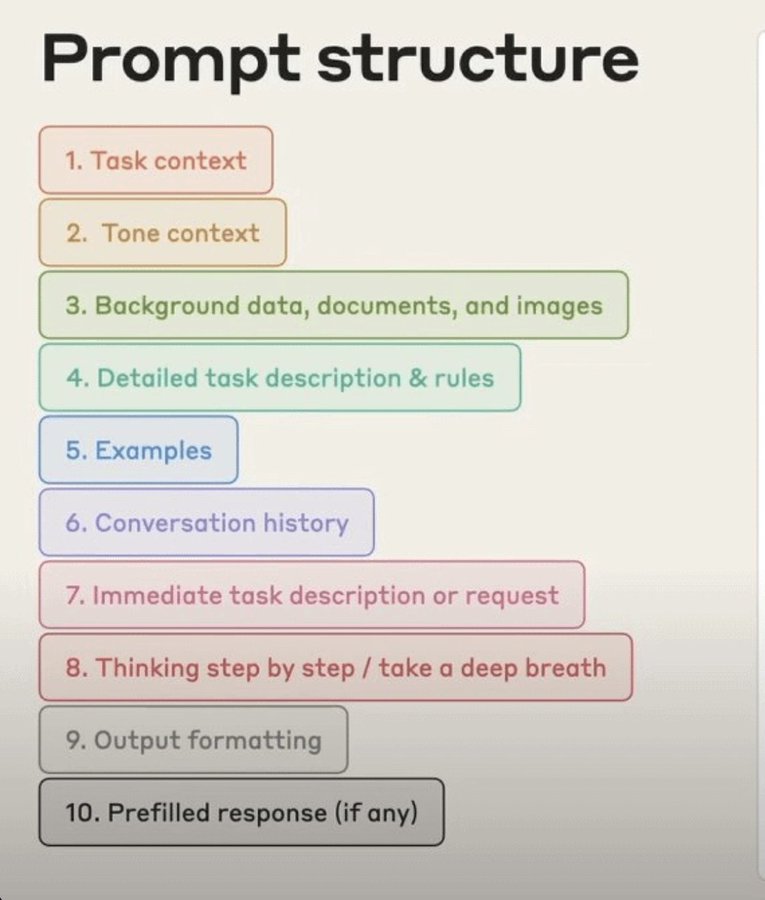
TL;DR - Prompting Structure
We can boil this prompting structure down to five essential components:
1. Task Context
Set the role and task upfront. This is the foundation of every good prompt. Claude needs to know who it is and what it is doing before anything else.
Example: you are [insert role] and your job is to [insert task]
2. Background Data
Give Claude something to work with. Upload relevant docs, files, or context profiles. The more relevant information you provide, the more precise the output.
3. Detailed Task Description & Rules
Expand on your goal with specific constraints and guidelines. Don't just say what you want - say exactly how you want it done.
I like to explain my end goal to Claude and have the model propose a plan to get there.
4. Examples
The single biggest unlock for output quality. If you have a desired output format or a previous response you loved, show it to Claude using the <example> tag (more on this later). Nothing calibrates Claude models faster than a concrete reference point.
5. Output Formatting
Tell Claude exactly how you want the response structured before it replies.
Some examples I like: bullet points, infographics (I share many on this page), table format, and phrases like "condense your response to less than 500 words."
Out of the ten steps outlined, these are the absolute essentials for every single prompt you send to a Claude model.
If you want to add more of the ten steps, great, but at a minimum, include these five.
Bringing it all together:
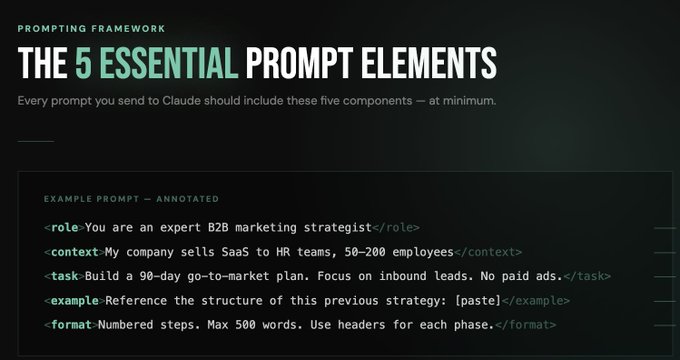
Essential Prompt Elements
## Advanced Prompting Techniques
There are a million advanced prompting techniques available.
These are the only methods worth noting - and they genuinely work VERY well inside Cladue (you'll want to save these somewhere).
1. Structured Prompting (JSON & XML Tags)
Structured prompting is the single biggest upgrade you can make to your LLM inputs.
Instead of writing prompts in plain English text, you organize them using XML tags or JSON formatting.
Think of this as speaking the same "language" as Claude.
Tag formats provide a structured map of exactly what you want - and the outputs reflect that precision.
For XML tags, you put all your text inside < > tags.
It looks like this
JSON formatting looks like this:
2. Reverse Prompting
Most people tell Claude what to do. Reverse prompting flips that entirely.
Instead of writing the prompt yourself, you ask Claude to question you to gather the context it needs.
Example: "Ask me 10 questions to gather all the context necessary to build me a personalized business plan."
This is one of the most underrated techniques in prompting. Use it whenever you're stuck, whenever the outputs feel off, or whenever you're approaching a new type of task for the first time.
3. Deep Thinking Triggers
Claude has extended reasoning capabilities, but most people never activate them.
By default, Claude gives you a fast response. That's great for simple tasks, but for complex problems, strategy, analysis, or anything that requires genuine reasoning, you want Claude to think more deeply before it responds.
Add any of these to your prompts:
4. Chain Prompting
Chain prompting is the art of breaking one big task into a sequence of smaller, connected prompts.
Instead of asking Claude to do everything in one go, you build toward the final output step by step.
Each prompt feeds into the next, and the quality compounds with every exchange.
Instead of just giving Claude instructions, you're actually communicating with the models back and forth.
Example:
This works because each step gives Claude full context from the previous one. The final output is almost always sharper, more coherent, and more detailed than anything you'd get from a single prompt.
5. Feedback Looping
Most people accept the first output they get. This is wrong.
Feedback looping is the practice of actively critiquing Claude's output and asking it to improve, until the result is exactly what you need.
It looks like this:
## IV: Anthropics Tips & Tricks
I read every single Claude prompting doc and sourced every Anthropic prompting resource, so you don't have to.
Here is the summary of how to properly prompt Claude models.
Claude Prompting Best Practices Doc:
https://platform.claude.com/docs/en/build-with-claude/prompt-engineering/claude-prompting-best-practices
- Be clear and direct
- Context is key
- Use examples (3-5 is ideal)
- Claude was trained on XML tags - use them
- Put longform data at the top: Place your long documents and inputs near the top of your prompt, above your query, instructions, and examples.
TLDR of the entire handbook:
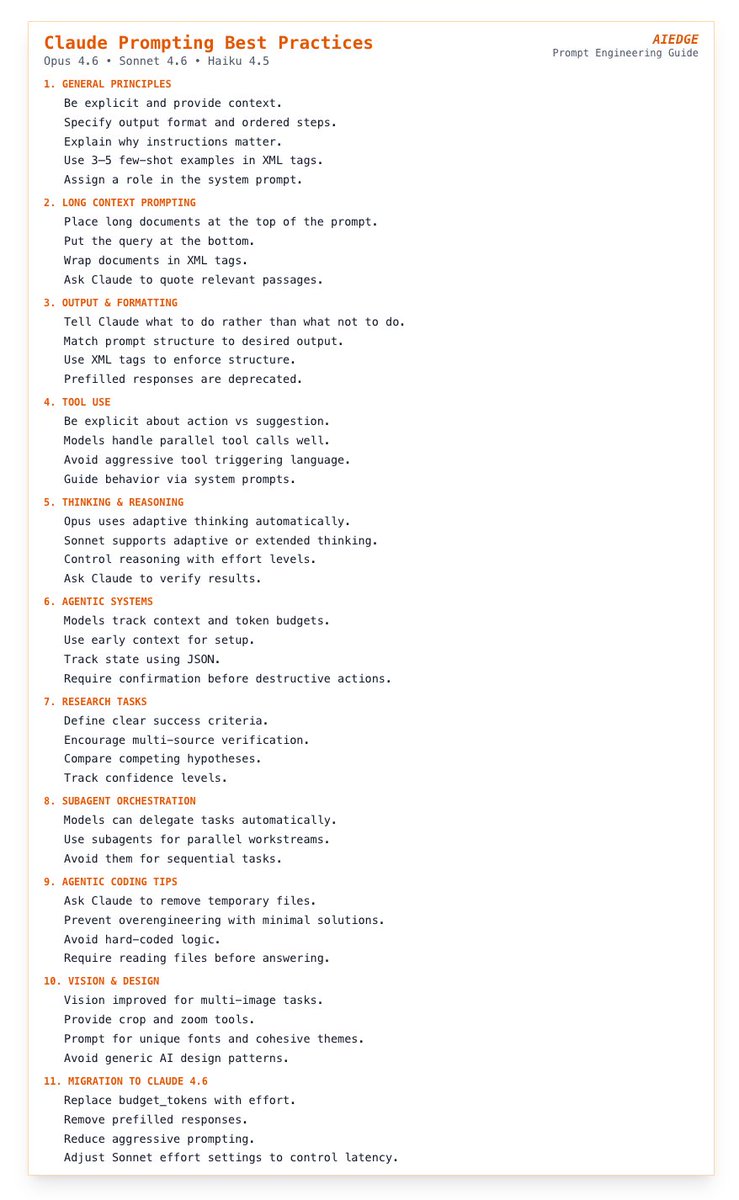
TLDR of Anthropic's Best Practices Doc
How to Prompt Engineer:
https://platform.claude.com/docs/en/build-with-claude/prompt-engineering/overview
- Ask Claude to quote sources before answering
- Keep context tight - more isn't always better
- Have Claude self-check before finishing
- Bad latency? Switch models, don't switch your prompt
Prompt Generator Tool:
A tool to build Claude prompts
https://platform.claude.com/dashboard
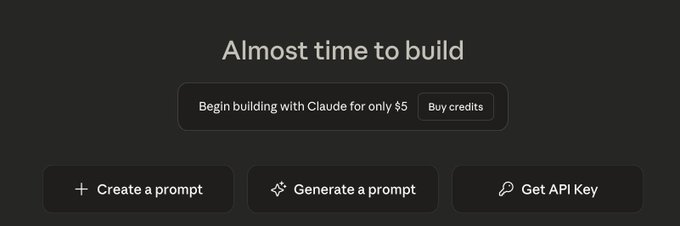
Prompt Generator by Anthropic
Anthropic Interactive Prompting Guide:
A GitHub guide to learn prompt engineering
https://github.com/anthropics/prompt-eng-interactive-tutorial
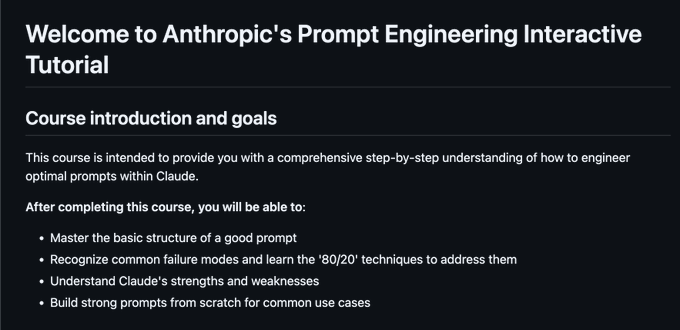
Anthropic Interactive Prompting Guide
Other Anthropic prompting tips (from various sources):
- Build system prompts
- Tools should be minimal
- Use a Scratchpad: Telling Claude to use a scratchpad to show its work improves accuracy. End users do not need to see the scratchpad, but it helps Claude reason more carefully before producing its final answer.
- Define success criteria: Tell Claude exactly what success looks like (like you would with an employee)
## Closing
Hopefully, you found this guide helpful.
My goal was to make this complex topic practical and actionable for you.
If you found this article valuable, be sure to follow me @aiedge_ - I'm posting articles 3x/week just like this one.
I'm curious to know - what are your best Claude prompting tips? Leave them in the comments below, I'm sure others will find it valuable.
Lastly, please Like/Repost this article to support💙
## 相关链接
- [AI Edge](https://x.com/aiedge_)
- [@aiedge_](https://x.com/aiedge_)
- [179K](https://x.com/aiedge_/status/2033546384172056751/analytics)
- [https://platform.claude.com/docs/en/build-with-claude/prompt-engineering/claude-prompting-best-practices](https://platform.claude.com/docs/en/build-with-claude/prompt-engineering/claude-prompting-best-practices)
- [https://platform.claude.com/docs/en/build-with-claude/prompt-engineering/overview](https://platform.claude.com/docs/en/build-with-claude/prompt-engineering/overview)
- [https://platform.claude.com/dashboard](https://platform.claude.com/dashboard)
- [https://github.com/anthropics/prompt-eng-interactive-tutorial](https://github.com/anthropics/prompt-eng-interactive-tutorial)
- [@aiedge_](https://x.com/@aiedge_)
- [Upgrade to Premium](https://x.com/i/premium_sign_up)
- [10:10 PM · Mar 16, 2026](https://x.com/aiedge_/status/2033546384172056751)
- [179.9K Views](https://x.com/aiedge_/status/2033546384172056751/analytics)
- [View quotes](https://x.com/aiedge_/status/2033546384172056751/quotes)
---
*导出时间: 2026/3/18 20:43:16*