# How To Prompt Claude 5 Models (by Anthropic)
**作者**: AI Edge
**日期**: 2026-06-11T13:33:48.000Z
**来源**: [https://x.com/aiedge_/status/2082492486518546472](https://x.com/aiedge_/status/2082492486518546472)
---
TL;DR: How to prompt the Claude 5 family (Fable, Opus & Sonnet) for maximum token efficiency, smarter responses & more Claude productivity.
The bottom line is that the way you prompt the Claude 5 family needs to fundamentally change from any other Anthropic model you're used to.
Each model has its own unique quirks, and by the end of the article, you'll know exactly how to navigate them and use Fable, Opus & Sonnet 5 for maximum productivity.
This is everything that you need to know (by Anthropic).
Table of Contents
l: General Claude 5 Prompting Principles
II: Prompting Fable 5
III: Prompting Opus 5
IV: Prompting Sonnet 5
V: Recap & Practical Takeaways
All the tips, strategies, and methods suggested here are sourced directly from Anthropic themselves - at the end of this guide, I listed all my sources.
## I: General Claude 5 Prompting Principles
Before we get into each individual model, there are a few principles that apply across the entire Claude 5 family.
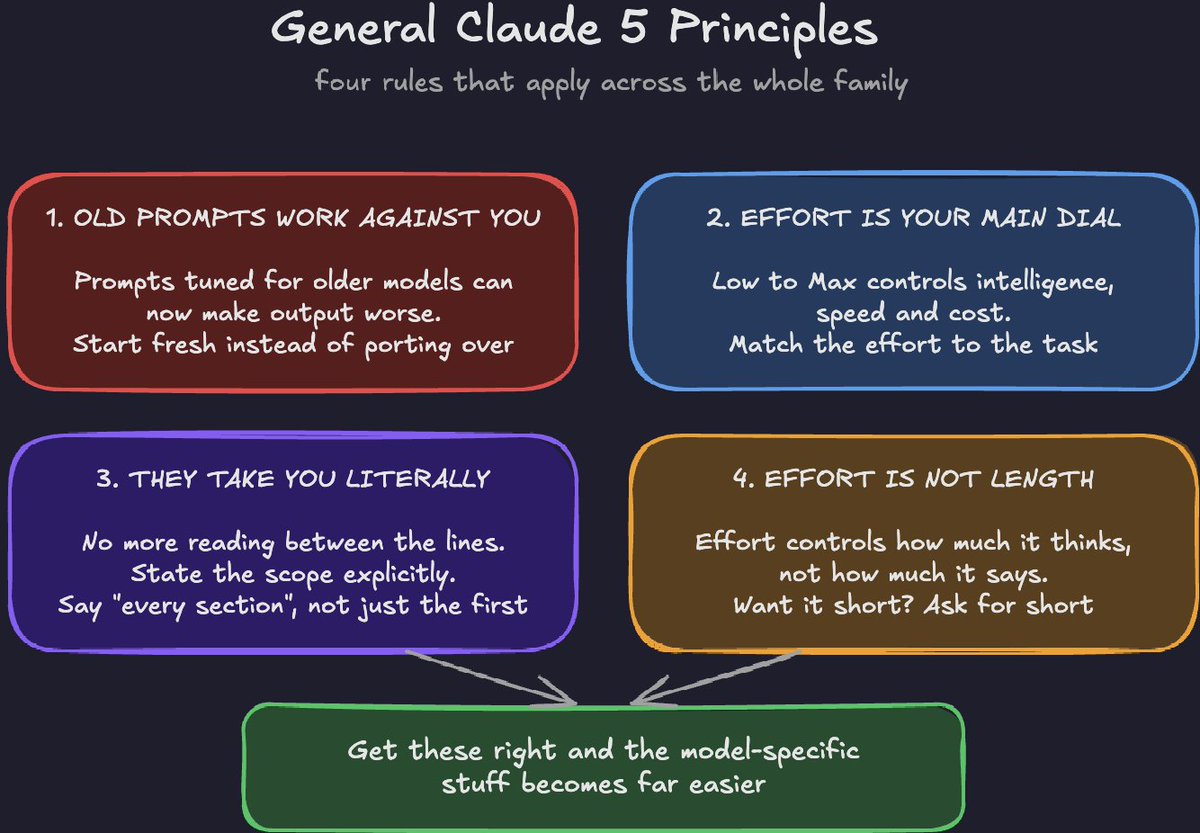
Get these right, and the model-specific stuff becomes far easier; in general, if you only make a few changes to how you prompt the Claude 5 family, make it these:
1. Your old prompts may be working against you
Anthropic is very clear about this. Prompts, skills, and project instructions you tuned for older models can now actually produce worse results than a simple fresh prompt would (the reason is that older Claude models needed a lot of hand-holding).
If a prompt, skill, or system prompt was built for an older model, the best move is to start fresh rather than port it over.
2. Effort level
Every Claude 5 model has an effort setting, and it is the primary control for the trade-off between intelligence, speed, and cost.
The general scale looks like this:
Low or medium: quick questions, simple rewrites, basic research, anything conversational
High: the default, and right for most tasks
Xhigh: your hardest problems, complex builds, multi-step analysis, anything where quality is non-negotiable
Max: absolute maximum capability, no constraints on token spend.
3. Say what you want, because new models take you literally
Older models would read between the lines and generalize. The Claude 5 family is more literal.
It does exactly what you ask, and it does not silently assume you meant something broader.
4. Controlling output length
Turning effort down does not reliably make responses shorter. If you want a shorter answer, you have to actually ask for one.
A short instruction like "keep this concise, skip the caveats, get to the point" does more than any effort setting will.
General Claude 5 Principles
## II: Prompting Fable 5
Fable 5 is the most unique model on this list for a few reasons: it's extremely autonomous, expensive, and capable.
It is built to run autonomously for hours, manage dozens of subagents, and complete multi-day tasks with very little hand-holding.
Here's how to maximize it:
1. Tell it why, not just what
Other models run fine on pure instructions, but Fable does not. It wants the reasoning behind the task, because context lets it connect your request to the bigger picture rather than guessing at your intent, and this is also why it asks so many clarifying questions before it starts. \
Anthropic recommends this exact structure:
```
TELL IT WHY "I'm working on [the larger task] for [who it's for]. They need [what the output enables]. With that in mind: [your actual request]."
```
2. Keep your instructions short
With Fable, over-engineering your prompt can actually make the output worse, because you are constraining a model that would have found the right approach on its own.
Add needed context but keep instructions short.
3. Checkpoints
Fable is built to run on its own, which means if you do not set the checkpoints, it will set them itself. For anything important or sensitive, you want to draw those lines explicitly.
```
CHECKPOINT PROMPT "Pause for me only when the work genuinely requires my input: a destructive or irreversible action, a real scope change, or something only I can provide. Otherwise, keep going and report back when done."
```
4. Give Fable a memory database
Fable performs noticeably better when it can record lessons from previous runs and refer back to them. This can be as simple as pointing it at a markdown file to write notes in.
```
MEMORY INSTRUCTION
"Store one lesson per file with a one-line summary at the top.
Record corrections and confirmed approaches alike, including why
they mattered. Don't save what the repo or chat history already
records. Update an existing note rather than creating a
duplicate. Delete notes that turn out to be wrong."
```
Optimal Fable 5 Prompting Structure
```
OPTIMAL FABLE PROMPT
"I'm working on [the larger task] for [who it's for].
They need [what the output enables].
Request: [your specific ask in one clear sentence]
Output format: [exactly how you want the result delivered]
Constraints: [what Fable must not assume on its own]"
[Diagram: the four-part Fable prompt structure]
```
These tips are the highest-leverage changes you should make to the way that you prompt Fable.
But if you use Fable 5 often and want a deeper dive, read this:
> **AI Edge@aiedge_**: [原文链接](https://x.com/aiedge_/status/2065064961999847849)
>
## III: Prompting Opus 5
Just a few days ago, Anthropic published the new Opus 5 prompting guidelines. I haven't seen anyone talk about it yet, so you're getting the early scoop here.
Opus 5 is the model most of you will use day-to-day. It is a capable all-rounder that performs brilliantly out of the box, but there are a few tweaks you can implement to make it even better.
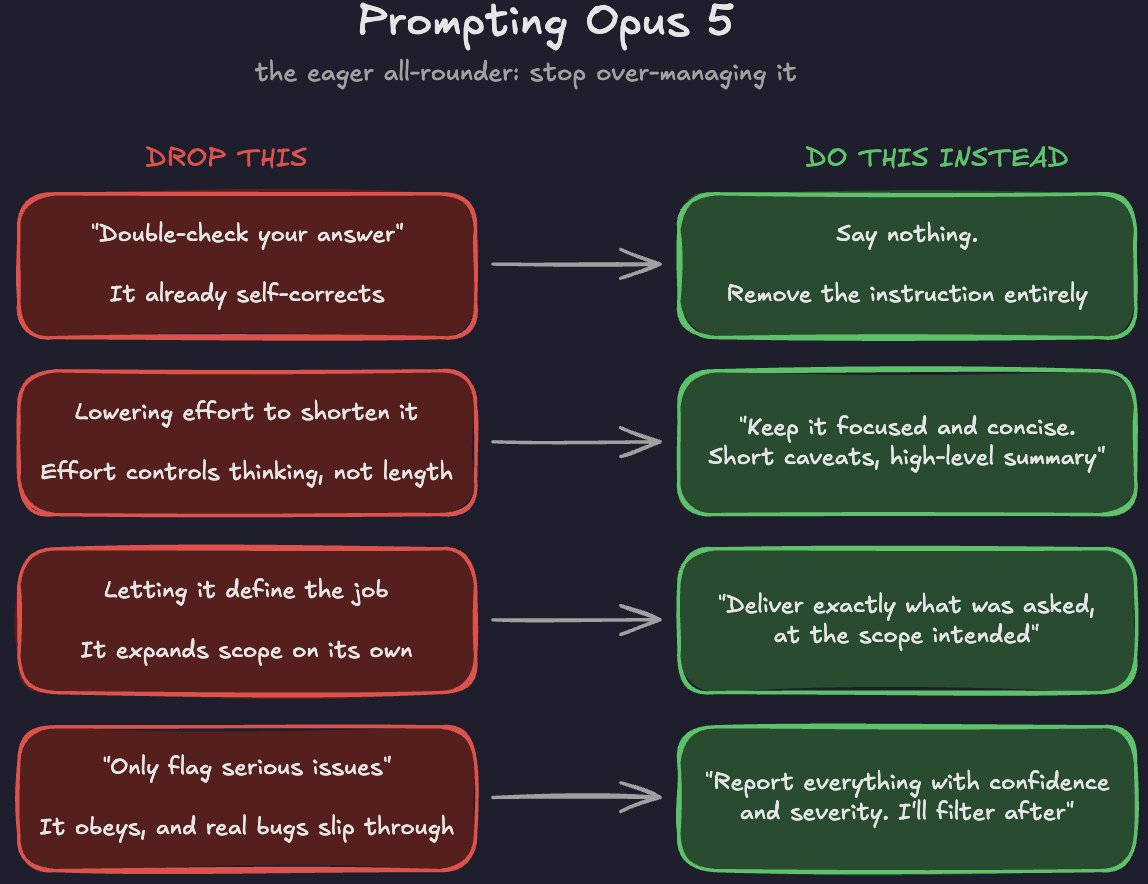
1. Stop telling it to double-check itself
No need to add "verify your answer" or "double-check before responding" to important prompts. Opus 5 already catches and fixes its own mistakes without being asked.
When you tell it to re-check, you are stacking on top of what it already does, which burns tokens for no real gain.
2. Ask for short
Opus 5's default answers are longer than previous versions. Again, if you want a shorter answer, you have to actually say so.
A simple instruction handles it:
```
CONCISENESS PROMPT "Keep responses focused, brief, and concise. Spend most of the response on the main answer, and keep caveats short. When explaining something, give a high-level summary unless I ask for depth."
```
3. Constraining the scope
Opus 5 can expand a task on its own, adding steps you did not ask for or applying its own judgment about what the job should be.
Just make sure to be clear about exactly what you want Opus to do, and tell it to stay on track for only those goals.
4. Reviews
Many of you will probably be using Opus 5 for review work. Things like codebase review, writing review, and so on.
Make sure to ask for everything, THEN filter.
This one is slightly counterintuitive from the first point, but for review work, it's necessary.
For example, if you ask Opus 5 to "only flag the serious issues" or "be conservative" when reviewing something, it takes you literally and reports less. This means other real problems may slip through, so the fix is to ask for full coverage first, then filter in a second pass.
Prompting Opus 5
## IV: Prompting Sonnet 5
And lastly, Sonnet 5, the fastest model in the group.
I like to think of Sonnet 5 as the workhorse. It's fast, cheap, and genuinely good at pretty much anything you throw at it. For most everyday work, it is the model you want to run.
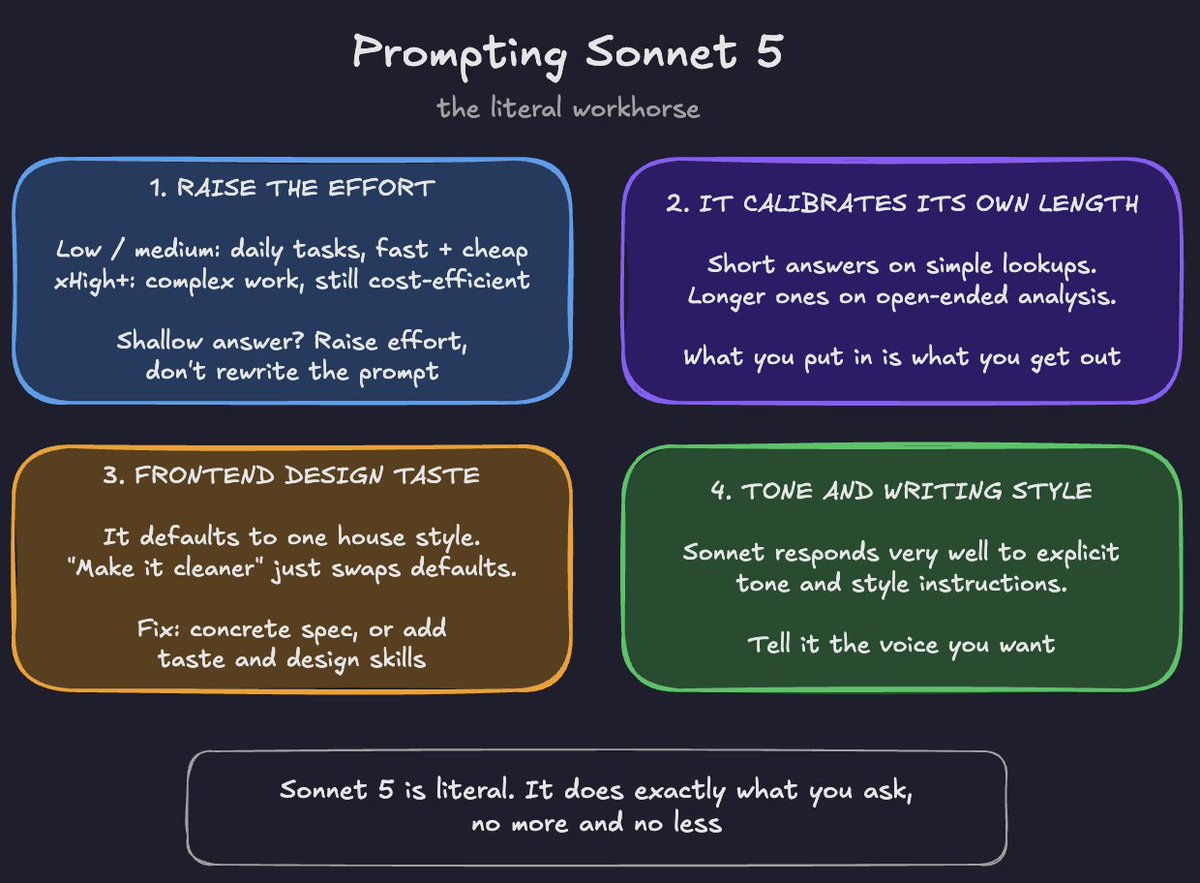
1. Raise the effort
Sonnet 5 respects effort levels strictly, especially at the low end. At low and medium, it scopes its work to exactly what was asked and nothing more. This is great for speed and cost, but if you throw a genuinely complex problem at it on low effort, you can get extremely shallow reasoning back.
The fix is not to write a cleverer prompt or switch models, but to simply swap reasoning efforts to xHigh+ and let the model think properly.
Sonnet 5 on low/medium is best for daily tasks, but xHigh+ is still extremely capable while staying cost-efficient.
2. Sonnet calibrates its own length
Unlike Opus 5, Sonnet 5 adjusts response length to the complexity of the task.
i.e., short answers on simple lookups and longer ones on open-ended analysis - just keep this in mind for how you prompt in terms of length & complexity. What you put in is generally what you get out.
3. Frontend design taste
This is the one most people will actually feel. On open-ended design and frontend briefs, Sonnet 5 settles into a consistent house style. It looks fine for some projects and completely wrong for others.
Generic instructions like "don't use that color" or "make it cleaner" just move it to a different fixed style.
To fix this, two things work: a) give it a concrete frontend spec and b) add taste/design skills so Sonnet 5's frontend capabilities improve.
4. Tone & writing style
Sonnet responds very well to tone & writing style instructions.
Feel free to add things like:
```
Use a warm, collaborative tone. Acknowledge the user's framing before answering.
```
Prompting Sonnet 5
## V: Recap & Practical Takeaways
This was a dense one, so here is everything condensed into what actually matters.
The Universal Rules: these apply to all Claude 5 models
- Start fresh, don't port over. Prompts, skills, and instructions built for older models often make Claude 5 worse, not better.
- Stop over-instructing.
- Match effort to task. Low and medium for daily work. High as your default. xHigh and above for the genuinely hard stuff. Most
- Say exactly what you mean.
Using Specific Models
Fable 5 → genuinely hard, long-running jobs.
Opus 5 → capable all-rounder, daily use
Sonnet 5 → speed, cost, and volume.
If you take nothing else from this article, take these three things:
1. With Fable, tell it why, and make sure to use checkpoints inside your loops.
2. With Opus, ask for less, and direct it towards only your end goal.
3. With Sonnet, be specific. It does exactly what you ask, so vagueness gets you a vague result.
Resources used for this article:
Prompting Fable 5: https://platform.claude.com/docs/en/build-with-claude/prompt-engineering/prompting-claude-fable-5
Prompting Opus 5: https://platform.claude.com/docs/en/build-with-claude/prompt-engineering/prompting-claude-opus-5
Prompting Sonnet 5: https://platform.claude.com/docs/en/build-with-claude/prompt-engineering/prompting-claude-sonnet-5
## Closing
I hope you found this article helpful.
If you did, be sure to follow me here @aiedge_. Every single week, I post articles that help you better understand and use AI.
If you enjoy AI content in a written format, feel free to subscribe to my newsletter.
Every Wednesday, I send a publication that contains one key AI workflow I built, an AI news recap, and my own personal research into robotics, AI & more.
If that interests you, subscribe here:
https://newsletter.aiedgehq.co/

100% free, no spam ever & unsub anytime
## 相关链接
- [AI Edge](https://x.com/aiedge_)
- [@aiedge_](https://x.com/aiedge_)
- [63K](https://x.com/aiedge_/status/2082492486518546472/analytics)
- [Jun 11](https://x.com/aiedge_/status/2065064961999847849)
- [1.9M](https://x.com/aiedge_/status/2065064961999847849/analytics)
- [https://platform.claude.com/docs/en/build-with-claude/prompt-engineering/prompting-claude-fable-5](https://platform.claude.com/docs/en/build-with-claude/prompt-engineering/prompting-claude-fable-5)
- [https://platform.claude.com/docs/en/build-with-claude/prompt-engineering/prompting-claude-opus-5](https://platform.claude.com/docs/en/build-with-claude/prompt-engineering/prompting-claude-opus-5)
- [https://platform.claude.com/docs/en/build-with-claude/prompt-engineering/prompting-claude-sonnet-5](https://platform.claude.com/docs/en/build-with-claude/prompt-engineering/prompting-claude-sonnet-5)
- [@aiedge_](https://x.com/@aiedge_)
- [https://newsletter.aiedgehq.co/](https://newsletter.aiedgehq.co/)
- [Upgrade to Premium](https://x.com/i/premium_sign_up)
- [11:44 PM · Jul 29, 2026](https://x.com/aiedge_/status/2082492486518546472)
- [63.2K Views](https://x.com/aiedge_/status/2082492486518546472/analytics)
- [View quotes](https://x.com/aiedge_/status/2082492486518546472/quotes)
---
*导出时间: 2026/7/30 10:09:11*
---
## 中文翻译
# 如何提示 Claude 5 模型(作者:Anthropic)
**作者**: AI Edge
**日期**: 2026-06-11T13:33:48.000Z
**来源**: [https://x.com/aiedge_/status/2082492486518546472](https://x.com/aiedge_/status/2082492486518546472)
---

TL;DR:如何提示 Claude 5 系列(Fable、Opus 和 Sonnet),以实现最大的 token 效率、更智能的响应以及更高的 Claude 生产力。
底线是,你提示 Claude 5 系列的方式需要与你习惯使用的任何其他 Anthropic 模型发生根本性的改变。
每个模型都有其独特的怪癖,在文章结束时,你将确切知道如何应对它们,并利用 Fable、Opus 和 Sonnet 5 实现最大的生产力。
这就是你需要知道的一切(来自 Anthropic)。
目录
l:Claude 5 通用提示原则
II:提示 Fable 5
III:提示 Opus 5
IV:提示 Sonnet 5
V:总结与实用要点
此处建议的所有技巧、策略和方法均直接来源于 Anthropic——在本指南的末尾,我列出了所有来源。
## I:Claude 5 通用提示原则
在深入探讨每个单独的模型之前,有一些原则适用于整个 Claude 5 系列。
掌握了这些,特定于模型的内容就会变得容易得多;一般来说,如果你只对提示 Claude 5 系列的方式做几点改变,那就做这些:
1. 你的旧提示词可能会对你不利
Anthropic 对此非常清楚。你为旧模型微调过的提示词、技能和项目指令,现在产生的结果实际上可能比一个简单的新提示词更差(原因是旧的 Claude 模型需要很多手把手的指导)。
如果一个提示词、技能或系统提示词是为旧模型构建的,最好的做法是重新开始,而不是直接移植过来。
2. 努力程度
每个 Claude 5 模型都有一个努力程度设置,它是控制智能、速度和成本之间权衡的主要手段。
大致的规模如下:
低或中:快速提问、简单重写、基础研究、任何对话类内容
高:默认设置,适用于大多数任务
极高(Xhigh):你最棘手的问题、复杂的构建、多步骤分析、任何质量不可妥协的任务
最大:绝对的最大能力,不受 token 支出的限制。
3. 直说你的需求,因为新模型会按字面意思理解
旧模型会读出弦外之音并进行概括。Claude 5 系列则更倾向于按字面意思理解。
它完全按照你的要求去做,不会默默地假设你的意思是更广泛的内容。
4. 控制输出长度
降低努力程度并不能可靠地缩短响应。如果你想要更短的答案,你必须明确要求。
像“保持简洁,跳过警告,直奔主题”这样的简短指令,比任何努力程度设置都有效。

Claude 5 通用原则
## II:提示 Fable 5
Fable 5 是这份名单上最独特的模型,原因有几点:它极其自主、昂贵且功能强大。
它被设计为可以自主运行数小时,管理数十个子代理,并在很少的手把手指导下完成多日任务。
以下是最大化其效用的方法:
1. 告诉它“为什么”,而不仅仅是“做什么”
其他模型在纯指令下运行良好,但 Fable 不行。它想要任务背后的推理,因为上下文让它能将你的请求与更大的图景联系起来,而不是猜测你的意图,这也是为什么它在开始之前会问很多澄清性问题。
Anthropic 推荐这种确切的结构:
```
告诉它为什么 “我正在为[谁]处理[更大的任务]。他们需要[输出能带来什么]。考虑到这一点:[你的实际请求]。”
```
2. 保持指令简短
对于 Fable,过度设计你的提示词实际上可能会使输出变差,因为你在限制一个本来会自己找到正确方法的模型。
添加必要的上下文,但保持指令简短。
3. 检查点
Fable 被设计为独立运行,这意味着如果你不设置检查点,它就会自己设置。对于任何重要或敏感的事情,你需要明确划定这些界限。
```
检查点提示词 “仅在工作真正需要我输入时才暂停我:破坏性或不可逆的操作、实际范围变更,或只有我能提供的事情。否则,继续进行,完成后汇报。”
```
4. 给 Fable 一个记忆数据库
当 Fable 能够记录以前运行中的教训并回头参考时,它的表现会明显更好。这可以很简单,比如指向一个 markdown 文件让它写入笔记。
```
记忆指令
“将每个教训存储在一个文件中,顶部放一行摘要。
记录修正和确认的方法,包括它们为什么重要。
不要保存仓库或聊天历史已经记录的内容。
更新现有笔记而不是创建重复项。
删除结果错误的笔记。”
```
最佳 Fable 5 提示结构
```
最佳 FABLE 提示词
“我正在为[谁]处理[更大的任务]。
他们需要[输出能带来什么]。
请求:[用一个清晰的句子表达你的具体要求]
输出格式:[确切地说明你希望结果如何交付]
约束:[Fable 绝不能自行假设的内容]”
[图表:四部分 Fable 提示词结构]
```
这些技巧是你应该对提示 Fable 的方式进行的高杠杆改变。
但是如果你经常使用 Fable 5 并且想深入了解,请阅读这里:
> **AI Edge@aiedge_**: [原文链接](https://x.com/aiedge_/status/2065064961999847849)
>
## III:提示 Opus 5
就在几天前,Anthropic 发布了新的 Opus 5 提示指南。我还没看到任何人谈论它,所以你在这里能抢先看到。
Opus 5 是你们大多数人日常都会使用的模型。它是一个功能强大的全能型选手,开箱即用表现出色,但你可以进行一些调整使其变得更好。
1. 别再叫它自我检查了
不需要在重要的提示词中添加“验证你的答案”或“回复前仔细检查”。Opus 5 已经可以在不被要求的情况下捕捉并修复自己的错误。
当你叫它重新检查时,你是在它已经做的事情上叠加操作,这会消耗 token 但没有实际收益。
2. 要求简短
Opus 5 的默认答案比以前的版本要长。同样,如果你想要更短的答案,你必须明确说出来。
一个简单的指令就能处理:
```
简洁性提示词 “保持响应专注、简短和简洁。将大部分响应用于主要答案,并保持警告简短。解释某事时,给出高层摘要,除非我要求深度。”
```
3. 限制范围
Opus 5 可以自行扩展任务,添加你没有要求的步骤,或者应用它自己关于工作应该是什么样子的判断。
只要确保清楚地说明你到底希望 Opus 做什么,并告诉它只专注于那些目标。
4. 审查
你们中的许多人可能会使用 Opus 5 进行审查工作。比如代码库审查、写作审查等等。
确保先要求所有内容,然后再过滤。
这一点与第一点稍微有点反直觉,但对于审查工作来说,这是必要的。
例如,如果你要求 Opus 5 在审查时“只标记严重问题”或“保守一点”,它会按字面意思理解并报告得更少。这意味着其他真正的问题可能会漏掉,所以解决办法是先要求全面覆盖,然后在第二轮中进行过滤。

提示 Opus 5
## IV:提示 Sonnet 5
最后是 Sonnet 5,该组中最快的模型。
我喜欢把 Sonnet 5 看作是主力军。它快速、便宜,并且几乎擅长你扔给它的任何任务。对于大多数日常工作,它是你想运行的模型。
1. 提高努力程度
Sonnet 5 严格遵守努力程度级别,尤其是在低端。在低和中端时,它将其工作范围限制在 exactly 被问到的内容上,绝不多做。这对速度和成本很有好处,但如果你在低努力程度上扔给它一个真正复杂的问题,你可能会得到极其肤浅的推理。
解决办法不是写一个更聪明的提示词或切换模型,而是简单地将推理努力程度交换到 xHigh+,让模型正确思考。
低/中端的 Sonnet 5 最适合日常任务,但 xHigh+ 仍然非常强大,同时保持成本效益。
2. Sonnet 会自动校准长度
与 Opus 5 不同,Sonnet 5 会根据任务的复杂性调整响应长度。
即,简单查找时答案较短,开放式分析时答案较长——只要记住这一点,以便你在提示时考虑长度和复杂性。投入决定产出。
3. 前端设计品味
这是大多数人实际上会感受到的一点。在开放式设计和前端简报上,Sonnet 5 会陷入一种一致的家装风格。它对某些项目看起来不错,对其他项目则完全不对劲。
像“不要使用那种颜色”或“让它更干净”这样的通用指令只是让它移动到另一种固定的风格。
要解决这个问题,有两件事有效:a) 给它一个具体的前端规范,b) 添加品味/设计技能,以便 Sonnet 5 的前端能力得到提高。
4. 语气和写作风格
Sonnet 对语气和写作风格指令的响应非常好。
请随意添加如下内容:
```
使用温暖、协作的语气。在回答之前确认用户的框架。
```

提示 Sonnet 5
## V:总结与实用要点
这是一篇内容密集的文章,所以这里将所有内容浓缩为真正重要的部分。
通用规则:这些适用于所有 Claude 5 模型
- 重新开始,不要移植。为旧模型构建的提示词、技能和指令通常会让 Claude 5 变得更差,而不是更好。
- 停止过度指导。
- 将努力程度与任务匹配。日常工作用低和中。高作为默认设置。真正困难的事情用 xHigh 及以上。大多数时候,完全说出你的意思。
使用特定模型
Fable 5 → 真正困难、长时间运行的工作。
Opus 5 → 功能强大的全能型选手,日常使用
Sonnet 5 → 速度、成本和数量。
如果你从这篇文章中没有带走其他东西,请带走这三点:
1. 对于 Fable,告诉它“为什么”,并确保在你的循环中使用检查点。
2. 对于 Opus,要求更少,并将它引导至仅关注你的最终目标。
3. 对于 Sonnet,要具体。它完全按照你要求的做,所以模糊会得到模糊的结果。
本文使用的资源:
提示 Fable 5:https://platform.claude.com/docs/en/build-with-claude/prompt-engineering/prompting-claude-fable-5
提示 Opus 5:https://platform.claude.com/docs/en/build-with-claude/prompt-engineering/prompting-claude-opus-5
提示 Sonnet 5:https://platform.claude.com/docs/en/build-with-claude/prompt-engineering/prompting-claude-sonnet-5
## 结尾
我希望你觉得这篇文章有帮助。
如果你觉得有帮助,请务必在这里关注我 @aiedge_。每周,我都会发布文章,帮助你更好地理解和使用 AI。
如果你喜欢书面形式的 AI 内容,欢迎订阅我的通讯。
每周三,我会发送一份出版物,其中包含我构建的一个关键 AI 工作流程、AI 新闻回顾,以及我自己对机器人技术、AI 等方面的个人研究。
如果你感兴趣,请在这里订阅:
https://newsletter.aiedgehq.co/

100% 免费,永无垃圾邮件 & 随时可以取消订阅
## 相关链接
- [AI Edge](https://x.com/aiedge_)
- [@aiedge_](https://x.com/aiedge_)
- [63K](https://x.com/aiedge_/status/2082492486518546472/analytics)
- [Jun 11](https://x.com/aiedge_/status/2065064961999847849)
- [1.9M](https://x.com/aiedge_/status/2065064961999847849/analytics)
- [https://platform.claude.com/docs/en/build-with-claude/prompt-engineering/prompting-claude-fable-5](https://platform.claude.com/docs/en/build-with-claude/prompt-engineering/prompting-claude-fable-5)
- [https://platform.claude.com/docs/en/build-with-claude/prompt-engineering/prompting-claude-opus-5](https://platform.claude.com/docs/en/build-with-claude/prompt-engineering/prompting-claude-opus-5)
- [https://platform.claude.com/docs/en/build-with-claude/prompt-engineering/prompting-claude-sonnet-5](https://platform.claude.com/docs/en/build-with-claude/prompt-engineering/prompting-claude-sonnet-5)
- [@aiedge_](https://x.com/@aiedge_)
- [https://newsletter.aiedgehq.co/](https://newsletter.aiedgehq.co/)
- [Upgrade to Premium](https://x.com/i/premium_sign_up)
- [11:44 PM · Jul 29, 2026](https://x.com/aiedge_/status/2082492486518546472)
- [63.2K Views](https://x.com/aiedge_/status/2082492486518546472/analytics)
- [View quotes](https://x.com/aiedge_/status/2082492486518546472/quotes)
---
*导出时间: 2026/7/30 10:09:11*