# Math Behind Large Language Model
**作者**: Amit Shekhar
**日期**: 2026-05-23T07:24:54.000Z
**来源**: [https://x.com/amitiitbhu/status/2058086754025136494](https://x.com/amitiitbhu/status/2058086754025136494)
---
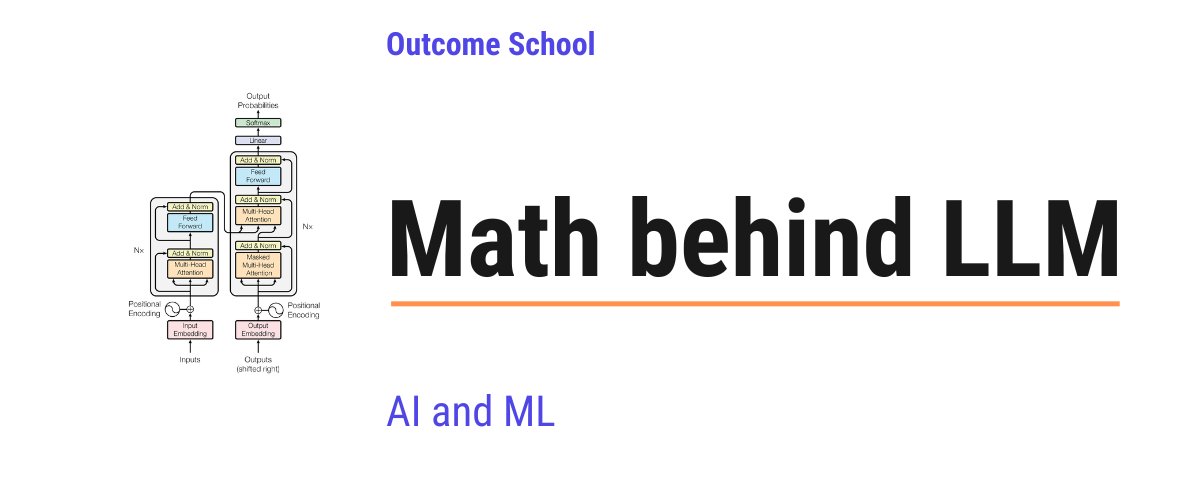
Large Language Models can feel like magic. But underneath, every LLM is built on a small set of mathematical ideas - attention, scaling, gradients, loss, position encoding, and normalization. Once we understand the math behind each of these, the magic turns into clear, simple steps.
We will cover the following blogs in this series:
1. Math behind Attention - Q, K, and V
2. Math behind √dₖ Scaling Factor in Attention
3. Math Behind Backpropagation
4. Math Behind Gradient Descent
5. Math Behind Cross-Entropy Loss
6. Math Behind RoPE (Rotary Position Embedding)
7. RMSNorm (Root Mean Square Layer Normalization)
Let's get started.
## 1. Math behind Attention - Q, K, and V
In this blog, we will learn about the math behind Attention: Query(Q), Key(K), and Value(V) with a step-by-step numeric example.
The idea is simple: we compare what each word is looking for (Query) with what every other word offers (Key), and then use those comparisons to collect the actual information (Value) from the most relevant words.
Every Large Language Model uses this exact computation at its core.
Read the full blog: Math behind Attention - Q, K, and V
## 2. Math behind √dₖ Scaling Factor in Attention
In this blog, we will learn about why we scale the dot product attention by √dₖ in the Transformer architecture with a step-by-step numeric example.
The part we are focusing on today is / sqrt(d_k). This is the scaling factor. We divide the dot product scores by the square root of the Key dimension before passing them to softmax.
This single line, / sqrt(d_k), looks simple. But without it, the Transformer architecture would struggle to learn effectively, especially with larger dimensions.
Read the full blog: Math behind √dₖ Scaling Factor in Attention
## 3. Math Behind Backpropagation
In this blog, we will learn about the math behind backpropagation in neural networks.
Backpropagation is the core algorithm that allows neural networks to learn from their mistakes. Without it, training neural networks efficiently would not be possible.
Backpropagation is a method used to calculate how much each weight in a neural network contributed to the error, so that we can adjust those weights to reduce the error.
Read the full blog: Math Behind Backpropagation
## 4. Math Behind Gradient Descent
In this blog, we will learn about the math behind gradient descent with a step-by-step numeric example.
Gradient descent is the most fundamental optimization algorithm used to train machine learning and deep learning models.
In simple words:
Gradient Descent = A simple way to slide down the error curve step by step until we reach the lowest point.
Read the full blog: Math Behind Gradient Descent
## 5. Math Behind Cross-Entropy Loss
In this blog, we will learn about the math behind Cross-Entropy Loss with a step-by-step numeric example.
It is the most widely used loss function in classification tasks, and it powers the training of almost every modern AI model, including GPT, BERT, and image classifiers.
In simple words:
Cross-Entropy Loss = A number that tells us how wrong our predicted probabilities are.
Read the full blog: Math Behind Cross-Entropy Loss
## 6. Math Behind RoPE (Rotary Position Embedding)
In this blog, we will learn about the math behind Rotary Position Embedding (RoPE) and why it is used in modern Large Language Models.
Instead of adding a position vector, RoPE rotates the Query and Key vectors based on their position. After the rotation, the dot product between any two tokens automatically reflects the relative distance between them.
This is how RoPE gives modern Large Language Models a clean, scalable, and elegant way to understand position.
Read the full blog: Math Behind RoPE (Rotary Position Embedding)
## 7. RMSNorm (Root Mean Square Layer Normalization)
In this blog, we will learn about RMSNorm, a faster and simpler alternative to Layer Normalization that powers most modern Large Language Models like Llama, Mistral, Gemma, Qwen, PaLM, and DeepSeek.
Instead of centering and scaling the numbers (like LayerNorm does), RMSNorm just scales them using their root mean square value. Same stabilizing effect, less work.
In simple words:
RMSNorm = A simpler and faster way to normalize numbers inside a neural network.
Read the full blog: RMSNorm (Root Mean Square Layer Normalization)
That's it for now.
Thanks
## 相关链接
- [Amit Shekhar](https://x.com/amitiitbhu)
- [@amitiitbhu](https://x.com/amitiitbhu)
- [286K](https://x.com/amitiitbhu/status/2058086754025136494/analytics)
- [Math behind Attention - Q, K, and V](https://outcomeschool.com/blog/math-behind-attention-qkv)
- [Math behind √dₖ Scaling Factor in Attention](https://outcomeschool.com/blog/scaling-dot-product-attention)
- [Math Behind Backpropagation](https://outcomeschool.com/blog/math-behind-backpropagation)
- [Math Behind Gradient Descent](https://outcomeschool.com/blog/math-behind-gradient-descent)
- [Math Behind Cross-Entropy Loss](https://outcomeschool.com/blog/math-behind-cross-entropy-loss)
- [Math Behind RoPE (Rotary Position Embedding)](https://outcomeschool.com/blog/math-behind-rope-rotary-position-embedding)
- [RMSNorm (Root Mean Square Layer Normalization)](https://outcomeschool.com/blog/rmsnorm-root-mean-square-layer-normalization)
- [Upgrade to Premium](https://x.com/i/premium_sign_up)
- [3:24 PM · May 23, 2026](https://x.com/amitiitbhu/status/2058086754025136494)
- [286.5K Views](https://x.com/amitiitbhu/status/2058086754025136494/analytics)
- [View quotes](https://x.com/amitiitbhu/status/2058086754025136494/quotes)
---
*导出时间: 2026/7/30 10:23:50*
---
## 中文翻译
# 大语言模型背后的数学
**作者**: Amit Shekhar
**日期**: 2026-05-23T07:24:54.000Z
**来源**: [https://x.com/amitiitbhu/status/2058086754025136494](https://x.com/amitiitbhu/status/2058086754025136494)
---

大语言模型看起来可能像魔法。但在其底层,每个大语言模型都建立在一小部分数学概念之上——注意力机制、缩放、梯度、损失、位置编码和归一化。一旦我们理解了这其中的每一个数学原理,魔法就会变得清晰且简单。
本系列文章将涵盖以下博客:
1. 注意力机制背后的数学 - Q, K, 和 V
2. 注意力机制中 √dₖ 缩放因子背后的数学
3. 反向传播背后的数学
4. 梯度下降背后的数学
5. 交叉熵损失背后的数学
6. RoPE(旋转位置编码)背后的数学
7. RMSNorm(均方根层归一化)
让我们开始吧。
## 1. 注意力机制背后的数学 - Q, K, 和 V
在这篇博客中,我们将通过一个分步数值示例来学习注意力机制背后的数学原理:查询 (Query, Q)、键 和值。
这个概念很简单:我们将每个单词正在寻找的内容(查询 Q)与每个其他单词所提供的内容(键 K)进行比较,然后利用这些比较结果从最相关的单词那里收集实际信息(值 V)。
每个大语言模型的核心都使用了这种确切的计算方式。
阅读完整博客:注意力机制背后的数学 - Q, K, 和 V
## 2. 注意力机制中 √dₖ 缩放因子背后的数学
在这篇博客中,我们将通过一个分步数值示例来学习为什么在 Transformer 架构中要用 √dₖ 来缩放点积注意力。
我们今天关注的部分是 `/ sqrt(d_k)`。这就是缩放因子。我们在将点积分数传递给 softmax 函数之前,将其除以键维度的平方根。
这一行简单的代码 `/ sqrt(d_k)` 看起来微不足道。但如果没有它,Transformer 架构将难以有效学习,尤其是在处理较大维度时。
阅读完整博客:注意力机制中 √dₖ 缩放因子背后的数学
## 3. 反向传播背后的数学
在这篇博客中,我们将学习神经网络中反向传播背后的数学原理。
反向传播是核心算法,它使神经网络能够从错误中学习。没有它,就无法高效地训练神经网络。
反向传播是一种用于计算神经网络中每个权重对误差贡献程度的方法,以便我们可以调整这些权重来减少误差。
阅读完整博客:反向传播背后的数学
## 4. 梯度下降背后的数学
在这篇博客中,我们将通过一个分步数值示例来学习梯度下降背后的数学原理。
梯度下降是用于训练机器学习和深度学习模型的最基础的优化算法。
简单来说:
梯度下降 = 一种沿着误差曲线一步步向下滑动,直到到达最低点的简单方法。
阅读完整博客:梯度下降背后的数学
## 5. 交叉熵损失背后的数学
在这篇博客中,我们将通过一个分步数值示例来学习交叉熵损失背后的数学原理。
它是分类任务中最广泛使用的损失函数,并为几乎所有的现代 AI 模型(包括 GPT、BERT 和图像分类器)的训练提供动力。
简单来说:
交叉熵损失 = 一个告诉我们预测概率有多大错误的数值。
阅读完整博客:交叉熵损失背后的数学
## 6. RoPE(旋转位置编码)背后的数学
在这篇博客中,我们将学习旋转位置编码背后的数学原理,以及为什么现代大语言模型会使用它。
RoPE 不像传统方法那样添加位置向量,而是根据位置旋转查询向量和键向量。旋转之后,任意两个 token 之间的点积会自动反映它们之间的相对距离。
这就是 RoPE 为现代大语言模型提供了一种清晰、可扩展且优雅的位置理解方式的原因。
阅读完整博客:RoPE(旋转位置编码)背后的数学
## 7. RMSNorm(均方根层归一化)
在这篇博客中,我们将学习 RMSNorm,它是层归一化的一种更快、更简单的替代方案,为大多数现代大语言模型(如 Llama、Mistral、Gemma、Qwen、PaLM 和 DeepSeek)提供支持。
与层归一化那样对数值进行中心化和缩放不同,RMSNorm 仅使用数值的均方根值进行缩放。具有相同的稳定效果,但工作量更少。
简单来说:
RMSNorm = 一种在神经网络内部对数值进行归一化的更简单、更快的方法。
阅读完整博客:RMSNorm(均方根层归一化)
目前就先讲到这里。
谢谢
## 相关链接
- [Amit Shekhar](https://x.com/amitiitbhu)
- [@amitiitbhu](https://x.com/amitiitbhu)
- [286K](https://x.com/amitiitbhu/status/2058086754025136494/analytics)
- [Math behind Attention - Q, K, and V](https://outcomeschool.com/blog/math-behind-attention-qkv)
- [Math behind √dₖ Scaling Factor in Attention](https://outcomeschool.com/blog/scaling-dot-product-attention)
- [Math Behind Backpropagation](https://outcomeschool.com/blog/math-behind-backpropagation)
- [Math Behind Gradient Descent](https://outcomeschool.com/blog/math-behind-gradient-descent)
- [Math Behind Cross-Entropy Loss](https://outcomeschool.com/blog/math-behind-cross-entropy-loss)
- [Math Behind RoPE (Rotary Position Embedding)](https://outcomeschool.com/blog/math-behind-rope-rotary-position-embedding)
- [RMSNorm (Root Mean Square Layer Normalization)](https://outcomeschool.com/blog/rmsnorm-root-mean-square-layer-normalization)
- [Upgrade to Premium](https://x.com/i/premium_sign_up)
- [3:24 PM · May 23, 2026](https://x.com/amitiitbhu/status/2058086754025136494)
- [286.5K Views](https://x.com/amitiitbhu/status/2058086754025136494/analytics)
- [View quotes](https://x.com/amitiitbhu/status/2058086754025136494/quotes)
---
*导出时间: 2026/7/30 10:23:50*