Hermes Curator:解决 Agent 技能漂移与上下文腐朽的自动化管理系统 ✍ mem0🕐 2026-05-02📦 12.7 KB 🟢 已读 𝕏 文章列表 本文介绍了 Hermes Agent v0.12.0 版本中推出的 Hermes Curator 功能。针对自改进 Agent 普遍存在的技能囤积和上下文腐朽问题,Hermes Curator 作为一个后台维护系统,通过遥测驱动的状态机自动追踪技能使用频率。它能将长期未用的技能由活跃转为陈旧,直至归档,并利用低成本辅助模型定期审查和合并重复技能。此外,系统提供 CLI 工具和“固定”机制,确保关键技能不被误删,从而在不干扰用户工作的情况下,降低 Token 成本并提升 Agent 推理效率。 HermesHermes CuratorAgentSelf-ImprovingMemory ManagementSkill DriftLLMNous Research # How Hermes Agent Solves Skill Drift and Context Rot as a Self-Improving Agent **作者**: mem0 **日期**: 2026-04-30T20:58:00.000Z **来源**: [https://x.com/mem0ai/status/2050351798142288050](https://x.com/mem0ai/status/2050351798142288050) --- 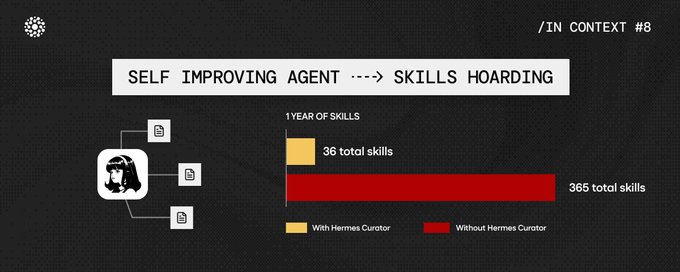 Self-improving agents have a skills-hoarding problem. Every skill the agent writes stays forever, even the unused ones. Hermes Agent shipped Hermes Curator to fix it. The skills catalog grows and the agent ends up rereading its own old work on every prompt instead of solving the new one. Yesterday, @nousresearch just shipped Hermes Curator. Hermes Curator is a background maintenance pass for agent-created skills. It tracks how often each skill is viewed, used, and patched, moves long-unused skills through active → stale → archived states, and periodically spawns a short auxiliary-model review that proposes consolidations or patches drift. It exists so that skills created via the self-improvement loop don't pile up forever. > **Nous Research@NousResearch**: [原文链接](https://x.com/NousResearch/status/2049956455982182593) > > Hermes Agent v0.12.0 - “The Curator Release” > >  # How does Hermes Curator manage skills? Hermes agents save skills as they learn. Every "agent-created" saved skill becomes a file in your skills folder. Without maintenance, that folder grows forever, the agent loads more of it on every prompt, and the catalog turns into noise. Curator is the cleanup system @nousresearch to prevent that. It only runs when you're not working. Roughly once a week, when the agent has been idle for at least two hours, it wakes up and runs a single review pass in the background. The pass has two parts. 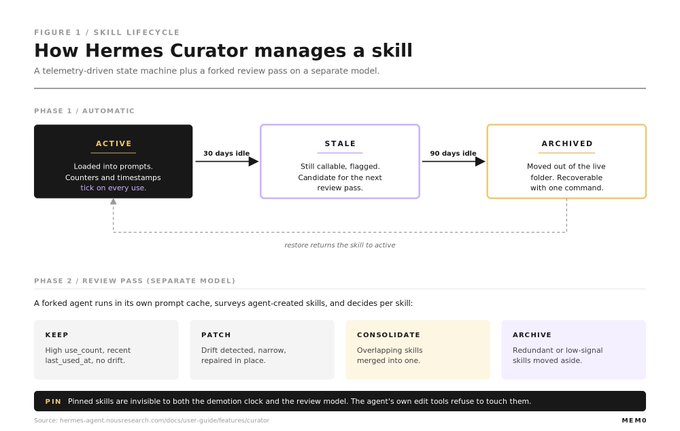 Figure 1. Hermes Curator skill lifecycle: telemetry-driven state machine plus a forked review pass The first part is automatic.Curator checks the last-used time on every skill. Anything untouched for 30 days gets marked stale. Anything untouched for 90 days gets moved into an archive folder. Nothing is ever deleted, and any archived skill can be brought back with one command. The second part uses a separate, cheaper model.That model reads the skills the agent has written, decides which ones overlap, which ones have drifted, and whether any of them should be merged, patched, or archived. Because it runs on an auxiliary slot, you can point it at a cheap model like Gemini Flash instead of paying main-chat-model rates for housekeeping. > All of these numbers are configurable in config.yaml under curator:. If 30 days is too aggressive for your workflow, raise it. If you want a daily review pass, drop the interval. You can manage it through the config.yaml or Hermes Curator CLI. There are three guardrails worth calling out.. - Curator only ever touches skills the agent wrote or you wrote by hand. Skills that shipped with Hermes or skills you installed from the hub are off-limits. - You can pin any skill. Pinned skills are invisible to the automatic clock and to the review model. Even the agent's own editing tools refuse to modify a pinned skill. This is the lever you use to protect anything you depend on. - Every counter and timestamp Curator uses lives in one sidecar file inside the skills folder. You can read it. You can audit it. There is no hidden database. # What Hermes Curator does? Curator does four things: 1. It watches. Every time a skill is loaded into a prompt or read by the agent, a counter ticks up and a timestamp gets written. That sidecar file is the memory of how useful each skill has actually been. 2. It demotes. If a skill has not been touched in 30 days, it moves from active to stale. Stale skills still work, but the system has flagged them as suspicious. If 60 more days pass and nothing has touched them, they get moved out of the live folder into an archive folder. Nothing is deleted. You can always pull a skill back with one command. 3. It reviews. Roughly once a week, when the agent is idle for a couple of hours, a separate cheap model wakes up and reads the skills folder. It looks for skills that drift, skills that overlap, and skills that should be merged into one cleaner version. It can patch them, combine them, or send them to the archive. Then it goes back to sleep. 4. It respects pins. Anything you mark as pinned is invisible to the demotion clock and to the review model. Even the agent itself cannot rewrite a pinned skill. This is the lever that keeps anything you depend on from drifting underneath you. That is the entire user-visible behavior. Watch, demote, review, respect pins. ## Curator CLI You don't have to wait for the weekly curator cleanup. Curator ships with a small CLI surface that lets you check on it, trigger a run, pause it, or protect specific skills. ``` hermes curator status # last run, counts, pinned list, LRU top 5 hermes curator run # trigger a review now (background by default) hermes curator run --sync # same, but block until the LLM pass finishes hermes curator pause # stop runs until resumed hermes curator resume hermes curator pin <skill> # never auto-transition this skill hermes curator unpin <skill> hermes curator restore <skill> # move an archived skill back to active ``` The most useful one day to day is hermes curator status. Beyond the obvious last-run timestamp and counts, it also lists the five least-recently-used skills, which is a quick way to see what is most likely to go stale next. If you spot something on that list you actually want to keep, hermes curator pin it before the next run. # Why this matters now The math is simple. Even at one new skill saved per day, the catalog hits 30 in a month and 365 by year one. With Curator's review pass merging near-duplicates, only about 3 unique skills survive per month. That is roughly 36 a year instead of 365. 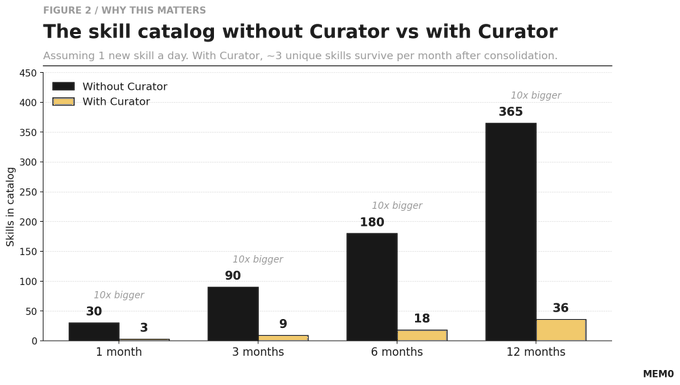 Figure 2. Comparison of number of agent-created skills with Hermes Curator Most of those "agent-created" skills are not unique. The agent will have written fix-a-bug five different ways across five different days, none of them aware the others exist. Curator's Hermes Curator review pass exists exactly for this: it reads the catalog, recognizes the overlap, and consolidates near-duplicates into one canonical skill while moving the redundant copies to the archive. Two things go wrong if nothing prunes. 1. The token bill goes up, because every prompt pays to read a bigger and bigger directory. 2. The reasoning gets worse, because five near-duplicate skills all match the same query and the model has no good signal for which to pick. Sometimes it picks the wrong one. Sometimes it tries to use two at once. Either way, the agent gets slower and dumber as the catalog grows. Curator's design choices read like scar tissue. It runs only once a week, only when the agent has been idle for at least two hours, and always in a separate process, because the team does not want a cleanup pass interfering with your live work. The pin feature exists because the agent, left alone, will rewrite skills you depend on. Pin is the same contract mem0 ships as core memories: facts the agent is forbidden from overwriting. Different surface, identical idea. # Memory and Skills It is worth being precise about what kind of "memory" Curator handles, because the field tends to mix two very different things into the same word. Memory, in the way most people use it, is what the agent knows. Facts about the user, the project, and the domain. Past conversations and the decisions that came out of them. References the agent needs to keep within reach. Memory holds the context the agent operates inside. The memory layer is where this lives, and mem0 is what manages it. 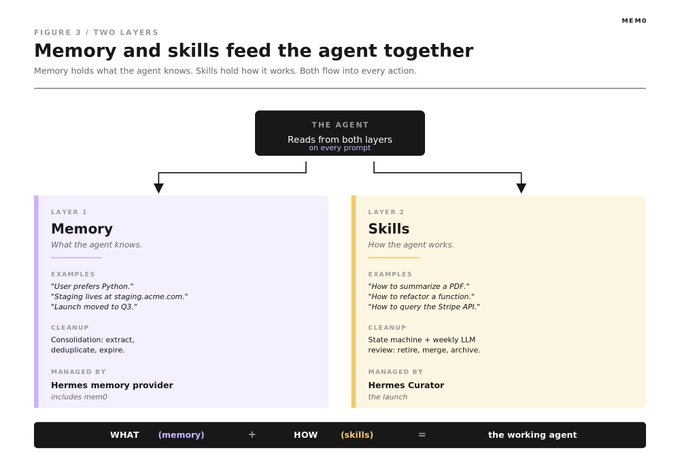 Figure 3. Memory and Skills Layer Mem0 is available as one of the Hermes Agent memory provider. You can do a quick 30-second setup, or use our open source GitHub repository and self-host. Read our guide here: > **mem0@mem0ai**: [原文链接](https://x.com/mem0ai/status/2040149098364580026) > Skills are different. A skill is procedural knowledge live on the core of agent action and projects. It is a how-to file the agent wrote for itself: how to book a flight, how to refactor a file, how to query a particular API. Skills tell the agent how to do work. The skill layer is where this lives, and Hermes Curator is what manages it. These two systems do not compete. They handle different parts of the same problem: keeping the agent's accumulated state useful instead of just heavy. Memory consolidation handles what the agent knows. Curator handles how the agent works. Together, they cover both halves of what a long-running agent needs to maintain. > The reason this matters: it is easy to look at Curator and think "this is just memory management". They sit at different layers, decay at different rates, and need different cleanup logic. Building one does not replace the other. Building both is what gets you an agent that actually keeps learning. # The pattern The shape of an agent runtime keeps growing. A few years ago an agent was a model and a prompt. Then we added - a tool registry so it could act - a memory layer so it could remember across conversations - long-context window tricks so it could read more in a single shot Today, a serious agent runtime has more plumbing than agent. There is a serving layer with KV cache eviction. A long-term memory layer with periodic consolidation, run by its own background model. A skills layer with usage tracking, state transitions, pinning, and a separate review pass. That layer that manage the skills layer is Hermes Curator. There is a tool layer with permissioning, a prompt cache with expiry, and an orchestrator that decides which background job runs when. The agent is actually maintaining four different kinds of memory at once. - Working memory in the cache, used and discarded each turn. - Semantic memory in the vector store, holding the facts the agent can look up. - Episodic memory in the conversation log, the record of what happened. - Procedural memory in the skills folder, the how-to library. Each of these decays at its own rate, fills up at its own pace, and needs its own quiet cleanup process running in the background. ## Takeaway Hermes Curator is what cleanup should look like for an agent that learns. It watches what gets used, retires what doesn't, merges duplicates, and lets you pin anything you don't want touched. The behavior is simple. The surprising part is that nobody had built it yet. If you are building agents that save their own skills, a cleanup pass is not optional infrastructure for much longer. Every week without a context management layer means more skills for your future self to sort through, and a greater chance the skills you depend on get lost in the noise. > Self-improving agents need self-pruning systems and context management. In Context #8 This blog is part of In Context, a mem0 blog series covering AI Agent memory and context engineering. mem0 is an intelligent, open-source memory layer designed for LLMs and AI agents to provide long-term, personalized, and context-aware interactions across sessions.* - Get your free API Key here: app.mem0.ai - or self-host mem0 from our open source github repository ## 相关链接 - [mem0](https://x.com/mem0ai) - [@mem0ai](https://x.com/mem0ai) - [1.7K](https://x.com/mem0ai/status/2050351798142288050/analytics) - [@nousresearch](https://x.com/@nousresearch) - [self-improvement loop](https://hermes-agent.nousresearch.com/docs/user-guide/features/skills#agent-managed-skills-skill_manage-tool) - [May 1](https://x.com/NousResearch/status/2049956455982182593) - [471K](https://x.com/NousResearch/status/2049956455982182593/analytics) - [@nousresearch](https://x.com/@nousresearch) - [Apr 4](https://x.com/mem0ai/status/2040149098364580026) - [35K](https://x.com/mem0ai/status/2040149098364580026/analytics) - [mem0](https://mem0.ai/?utm_source=x_article_mem0&utm_medium=incontext_article&utm_campaign=curator_memory&utm_content=curator_memory) - [app.mem0.ai](https://app.mem0.ai/?utm_source=x_article_mem0&utm_medium=incontext_article&utm_campaign=curator_memory&utm_content=curator_memory) - [github repository](https://github.com/mem0ai/mem0) - [Upgrade to Premium](https://x.com/i/premium_sign_up) - [7:08 AM · May 2, 2026](https://x.com/mem0ai/status/2050351798142288050) - [1,747 Views](https://x.com/mem0ai/status/2050351798142288050/analytics) - [View quotes](https://x.com/mem0ai/status/2050351798142288050/quotes) --- *导出时间: 2026/5/2 09:21:39* --- ## 中文翻译 # Hermes Agent 如何作为自我改进代理解决技能漂移和上下文腐烂 **作者**: mem0 **日期**: 2026-04-30T20:58:00.000Z **来源**: [https://x.com/mem0ai/status/2050351798142288050](https://x.com/mem0ai/status/2050351798142288050) ---  自我改进的代理存在一个“囤积技能”的问题。代理编写的每一个技能都会永久保留,即使是那些未被使用的。Hermes Agent 推出了 Hermes Curator 来解决这个问题。技能目录不断膨胀,导致代理最终在每个提示词上都要重读自己过去的工作,而不是解决新问题。 昨天,@nousresearch 刚刚发布了 Hermes Curator。 Hermes Curator 是针对代理创建的技能的一种后台维护机制。它跟踪每个技能的被查看、使用和修补的频率,将长期未使用的技能从 **活跃 → 陈旧 → 归档** 状态流转,并定期启动一个简短的辅助模型审查,提出合并或修复漂移的建议。 它的存在是为了确保通过 **自我改进循环** 创建的技能不会无限堆积。 > **Nous Research@NousResearch**: [原文链接](https://x.com/NousResearch/status/2049956455982182593) > > Hermes Agent v0.12.0 - “The Curator Release”(策展人版本) > >  # Hermes Curator 如何管理技能? Hermes 代理会在学习过程中保存技能。每一个“代理创建”的保存的技能都会成为技能文件夹中的一个文件。如果没有维护,该文件夹将无限增长,代理在每个提示词上加载更多内容,最终目录变成噪音。 Curator 是 @nousresearch 开发的清理系统,旨在防止这种情况。 它只在你不工作时运行。大约每周一次,当代理空闲至少两小时后,它会唤醒并在后台运行一次审查。该审查分为两个部分。  图 1. Hermes Curator 技能生命周期:遥测驱动的状态机加上分支审查过程 第一部分是自动化的。Curator 检查每个技能的“最后使用时间”。任何 30 天未触及的技能都会被标记为陈旧。任何 90 天未触及的技能都会被移至归档文件夹。没有任何内容会被删除,任何归档的技能都可以通过一条命令恢复。 第二部分使用一个独立的、更便宜的模型。该模型读取代理编写的技能,决定哪些重叠,哪些发生了漂移,以及是否应该合并、修补或归档其中的任何一个。因为它在辅助槽位上运行,你可以将其指向像 Gemini Flash 这样的廉价模型,而不必为主聊天模型级别的管家工作付费。 > 所有这些数字都可以在 config.yaml 的 curator: 下进行配置。如果 30 天对你的工作流来说太激进,可以提高它。如果你需要每日审查,可以缩短间隔。 你可以通过 config.yaml 或 Hermes Curator CLI 来管理它。 有三个值得注意的防护措施。 - Curator 只会触及代理编写的或你手动编写的技能。Hermes 自带的技能或你从中心安装的技能是受限的。 - 你可以固定任何技能。固定的技能对自动计时器和审查模型是不可见的。即使是代理自己的编辑工具也拒绝修改固定的技能。这是用来保护你依赖的任何东西的手段。 - Curator 使用的每个计数器和时间戳都存在于技能文件夹内的一个附属文件中。你可以读取它。你可以审计它。没有隐藏的数据库。 # Hermes Curator 做什么? Curator 做四件事: 1. **它监控**。每当一个技能被加载到提示词中或被代理读取时,计数器就会增加,并写入一个时间戳。该附属文件记录了每个技能实际用途的“记忆”。 2. **它降级**。如果一个技能在 30 天内未被触及,它会从活跃变为陈旧。陈旧的技能仍然有效,但系统已将其标记为可疑。如果再过 60 天仍然没有任何东西触及它们,它们将被移出活动文件夹进入归档文件夹。不删除任何内容。你始终可以通过一条命令拉回一个技能。 3. **它审查**。大约每周一次,当代理空闲几个小时时,一个独立的廉价模型会唤醒并读取技能文件夹。它会寻找漂移的技能、重叠的技能,以及应该合并为一个更简洁版本的技能。它可以修补它们、组合它们,或将它们发送到归档。然后它回去休眠。 4. **它尊重固定**。你标记为固定的任何内容对降级时钟和审查模型都是不可见的。即使是代理本身也不能重写固定的技能。这是防止你依赖的东西在你不知不觉中发生漂移的手段。 这就是全部的用户可见行为。监控、降级、审查、尊重固定。 ## Curator CLI 你不必等待每周的 Curator 清理。Curator 附带一个小型的 CLI 界面,允许你检查状态、触发运行、暂停或保护特定技能。 ``` hermes curator status # 上次运行时间、计数、固定列表、最近最少使用前 5 hermes curator run # 立即触发审查(默认为后台) hermes curator run --sync # 同上,但会阻塞直到 LLM 传递完成 hermes curator pause # 暂停运行直到恢复 hermes curator resume hermes curator pin <skill> # 永不自动转换此技能 hermes curator unpin <skill> hermes curator restore <skill> # 将归档的技能移回活跃状态 ``` 日常中最有用的是 `hermes curator status`。除了显而易见的上次运行时间戳和计数外,它还列出了五个最近最少使用的技能,这是快速查看下一个可能变陈旧的内容的方法。如果你在该列表中发现了你实际上想要保留的内容,请在下次运行前通过 `hermes curator pin` 固定它。 # 为什么这现在很重要 算术很简单。即使按每天保存一个新技能的速度,目录在一个月内也会达到 30 个,在第一年达到 365 个。有了 Curator 的审查传递合并近重复项,每个月大约只保留 3 个独特的技能。那是每年大约 36 个,而不是 365 个。  图 2. 使用 Hermes Curator 与不使用的代理创建技能数量对比 这些“代理创建”的技能大多不是独特的。代理会在五个不同的日子里以五种不同的方式编写修复错误,彼此都不知道对方的存在。 Curator 的 Hermes Curator 审查正是为此存在的:它读取目录,识别重叠,将近重复项合并为一个规范技能,同时将冗余副本移至归档。 如果不进行修剪,就会出两件事。 1. Token 账单上升,因为每个提示词都要花费更多去读取越来越大的目录。 2. 推理变差,因为五个近重复的技能都匹配同一个查询,而模型没有好的信号来选择哪一个。 有时它选错了。有时它试图同时使用两个。无论哪种方式,随着目录的增长,代理会变得更慢、更笨。 Curator 的设计选择读起来像伤疤组织。它每周只运行一次,仅在代理空闲至少两小时时运行,并且总是在单独的进程中,因为团队不希望清理过程干扰你的实时工作。固定功能的存在是因为,如果放任不管,代理会重写你依赖的技能。Pin 就像 mem0 作为核心记忆发布的契约:禁止代理覆盖的事实。不同的界面,相同的思想。 # 记忆与技能 值得精确说明 Curator 处理的是哪种“记忆”,因为该领域倾向于将两种非常不同的东西混为同一个词。 大多数人所说的记忆,是代理知道的东西。关于用户、项目和领域的事实。过去的对话以及从中产生的决定。代理需要保持触手可及的参考。 记忆保存代理运作所处的上下文。记忆层是它的归宿,mem0 是管理它的工具。  图 3. 记忆与技能层 Mem0 可作为 Hermes Agent 的记忆提供者之一。你可以进行快速的 30 秒设置,或者使用我们的开源 GitHub 仓库自行托管。在此阅读我们的指南: > **mem0@mem0ai**: [原文链接](https://x.com/mem0ai/status/2040149098364580026) > 技能是不同的。技能是存在于代理行动和项目核心中的程序性知识。它是代理为自己编写的操作文件:如何预订航班、如何重构文件、如何查询特定的 API。技能告诉代理如何工作。技能层是它的归宿,Hermes Curator 是管理它的工具。 这两个系统并不竞争。它们处理同一个问题的不同部分:保持代理的累积状态有用,而不仅仅是沉重。记忆整合处理代理知道什么。Curator 处理代理如何工作。它们共同涵盖了长期运行的代理需要维护的两个 halves。 > 这一点之所以重要:很容易看着 Curator 想“这仅仅是内存管理”。它们位于不同的层,以不同的速率衰减,需要不同的清理逻辑。构建一个并不能替代另一个。同时构建两者才能让你得到一个真正持续学习的代理。 # 模式 代理运行时的形态不断增长。 几年前,代理只是一个模型和一个提示词。然后我们添加了 - 工具注册表,以便它能够行动 - 记忆层,以便它能够跨对话记忆 - 长上下文窗口技巧,以便它能够一次性读取更多内容 今天,一个严肃的代理运行时,其管道比代理本身还多。有一个带 KV 缓存驱逐的服务层。一个由自己的后台模型运行的、具有定期整合的长期记忆层。一个具有使用跟踪、状态转换、固定和单独审查传递的技能层。 那个管理技能层的层就是 Hermes Curator。 有一个带权限控制的工具层,一个带过期的提示词缓存,以及一个决定后台作业何时运行的协调器。 代理实际上同时维护四种不同类型的记忆。 - 缓存中的工作记忆,每回合使用并丢弃。 - 向量存储中的语义记忆,保存代理可以查找的事实。 - 对话日志中的情节记忆,发生事情的记录。 - 技能文件夹中的程序记忆,操作指南库。 每一个都有自己的衰减率,自己的填充速度,并且需要自己在后台运行的静默清理过程。 ## 要点 Hermes Curator 展示了针对会学习的代理的清理应该是什么样子的。它监控使用了什么,淘汰未使用的,合并重复项,并允许你固定不想触及的任何内容。行为很简单。令人惊讶的是,还没有人建造它。 如果你正在构建保存自己技能的代理,清理传递很快将不再是可选的基础设施。 没有上下文管理层的每一周,都意味着未来的你要整理更多的技能,并且你依赖的技能丢失在噪音中的机会更大。 > 自我改进的代理需要自我修剪系统和上下文管理。 In Context #8 本博客是 In Context 的一部分,这是一个 mem0 博客系列,涵盖 AI Agent 记忆和上下文工程。 mem0 是一个智能的、开源的记忆层,旨在为 LLM 和 AI 代理提供跨会话的长期、个性化和上下文感知的交互。* - 在此获取你的免费 API Key:app.mem0.ai - 或从我们的开源 github 仓库自行托管 mem0 ## 相关链接 - [mem0](https://x.com/mem0ai) - [@mem0ai](https://x.com/mem0ai) - [1.7K](https://x.com/mem0ai/status/2050351798142288050/analytics) - [@nousresearch](https://x.com/@nousresearch) - [self-improvement loop](https://hermes-agent.nousresearch.com/docs/user-guide/features/skills#agent-managed-skills-skill_manage-tool) - [May 1](https://x.com/NousResearch/status/2049956455982182593) - [471K](https://x.com/NousResearch/status/2049956455982182593/analytics) - [@nousresearch](https://x.com/@nousresearch) - [Apr 4](https://x.com/mem0ai/status/2040149098364580026) - [35K](https://x.com/mem0ai/status/2040149098364580026/analytics) - [mem0](https://mem0.ai/?utm_source=x_article_mem0&utm_medium=incontext_article&utm_campaign=curator_memory&utm_content=curator_memory) - [app.mem0.ai](https://app.mem0.ai/?utm_source=x_article_mem0&utm_medium=incontext_article&utm_campaign=curator_memory&utm_content=curator_memory) - [github repository](https://github.com/mem0ai/mem0) - [Upgrade to Premium](https://x.com/i/premium_sign_up) - [7:08 AM · May 2, 2026](https://x.com/mem0ai/status/2050351798142288050) - [1,747 Views](https://x.com/mem0ai/status/2050351798142288050/analytics) - [View quotes](https://x.com/mem0ai/status/2050351798142288050/quotes) --- *导出时间: 2026/5/2 09:21:39*
T The Hermes Agent Memory Guidebook 这是一份关于 Hermes Agent 记忆系统的终极指南。文章深入解析了 Hermes 的三层记忆架构:开箱即用的原生层、可选的插件层以及社区扩展层。作者详细说明了本地数据库与 Markdown 文件的协同工作机制,澄清了关于记忆合并的常见误区,并强调了记忆在 Agent 从无状态聊天机器人转变为具备技能累积和个性化能力的智能体过程中的关键作用。 技术 › Agent ✍ Kevin Simback🕐 2026-05-28 HermesAgentMemoryArchitectureNous ResearchTutorialMemory ManagementLLM
H Hermes Agent 进阶指南:从架构原理到构建自进化的多智能体系统 本文深入介绍了 Nous Research 开源项目 Hermes Agent。文章详细解析了其独特的“学习闭环”架构,该架构结合了三层持久化内存、自进化技能系统以及 GEPA 优化引擎,解决了传统 Agent 随会话结束而遗忘的问题。文中还将 Hermes 与 OpenClaw 进行了对比,并提供了从零开始配置多个个性化 Agent(程序员、研究员、设计师)的实战教程,旨在帮助开发者打造能够 24/7 运行且持续学习的个人 AI 队伍。 技术 › Hermes ✍ Akshay🕐 2026-05-28 AgentHermes自进化LLM开发者工具系统架构教程Nous ResearchGEPA多智能体
H How to Become a Hermes Agent Operator 本文介绍了由 Nous Research 开源的高杠杆 AI 框架 Hermes Agent。文章详细阐述了其架构(大脑、个性、技能集)、具备记忆与自学习能力的闭环机制,以及如何从单机部署扩展为 VPS 上的自动化营销团队。作者分享了将其作为营销基础设施的实际经验与配置指南。 技术 › Agent ✍ Shann³🕐 2026-05-16 HermesAgent营销自动化Nous ResearchDevOps工作流VPS开源LLM实战指南
H Hermes Agent 大师课程:完整指南 本文是一份关于 Hermes Agent 的 12 部分系列课程汇总,涵盖了从工作流程、学习系统、技能管理到多平台集成、浏览器控制等核心功能,详细介绍了该系统的架构设计与最佳实践。 技术 › Hermes ✍ Tony Simons🕐 2026-07-20 AgentHermesLLM教程系统架构工具集成多代理自动化
A Agent 的数据面概念扫盲-建立技术侧认知体系 本文深入解析了 Agent 数据面的核心概念,将其比作操作系统的内存管理单元。文章详细阐述了 Context Engineering 的演变、Session/Thread/Profile 的架构差异,以及 Session Memory 与 Long-term Memory 的区别。作者还重点介绍了 Hermes 中的 Memory 设计方案、SQLite FTS5 与 BM25 算法原理,以及向量检索与关键词检索在 RAG 中的混合应用,旨在为开发者建立一套完整的 Agent 数据面技术认知体系。 技术 › Agent ✍ MateMatt🕐 2026-07-12 AgentContext EngineeringRAGMemoryBM25SQLite FTS5向量检索HermesLong-term MemoryLLM
H Hermes Agent 架构详细拆解:工业级 Agent 框架底层运行时揭秘 本文详细拆解了 Hermes Agent 的底层架构,将其定义为工业级运行时而非简单的 LLM 循环。文章类比前端工程模式,阐述了 Agent = Harness + Model 的核心公式。重点解析了从平台入口、适配器层、事件总线、GatewayRunner 核心调度层到 AI Agent 执行层的五层架构,揭示了 Hermes 如何通过共享线程池、会话复用和生命周期管理,实现高并发、有状态且安全可靠的 Agent 运行环境。 技术 › Hermes ✍ MateMatt🕐 2026-07-07 AgentHermes架构设计LLM事件总线多线程源码解析运行时HarnessReAct
H Hermes Analyst 体验升级:UI 大幅改进与嵌套编排器解析 作者分享了 Hermes Analyst Agent 近期的重大更新体验。重点介绍了 Hermes Desktop 端的发布解决了 WSL2 下的文件访问痛点,提供了类似 ChatGPT 的可视化和配置管理界面。文章深入解析了“嵌套编排器(Nested Orchestrator)”功能,通过编排层和子代理的并行协作,显著提升了复杂研究任务的输出质量和深度。此外,还提及了 Stripe 集成和 Telegram 富文本支持等新特性。 技术 › Hermes ✍ 0xJeff🕐 2026-06-17 HermesAgentDesktop嵌套编排器工具评测Nous ResearchUI/UX研究能力
H Hermes Agent多智能体群聊协作配置教程 这是一份关于如何利用 Hermes 的 Profile 机制构建多智能体协作群聊的实操教程。文章详细介绍了配置 1 个主 Agent(Leader)和 3 个辅助 Agent(数据、技术、市场研究员)的完整流程。内容涵盖了 Profile 创建、共享 API 密钥配置、角色 Prompt 编写、Discord 机器人对接以及发言顺序控制与成本优化策略。 技术 › Agent ✍ DeFi狙击手 | Ai🕐 2026-05-28 Hermes多智能体Agent配置教程提示词群聊协作成本控制LLMDeepSeek
A AI 神经系统诊断:Agent 运行时的六种病症 文章提出了一个新的视角来理解和调试 AI Agent:将其错误类比为人类神经系统疾病。作者指出,所谓的“AI 幻觉”在医学上更接近于“虚构症”。文章详细列举了 Agent 运行时中的六种病症,包括“遗忘症”、“幻肢状态”等,并针对每种症状提供了具体的诊断工具(如 gbrain, Mem0)和解决方案,强调通过检查“器官”(记忆、环境、工具链)来优化 Agent 性能。 技术 › Agent ✍ Vox🕐 2026-05-25 AgentOpenClawHermes调试心理学LLM记忆自动化幻觉工具推荐
H Hermes Agent 记忆系统架构指南 本文详细介绍了 Hermes Agent 的记忆系统架构。作者指出,记忆是 Agent 区别于普通 Chatbot 的核心。Hermes 的记忆栈分为三层:开箱即用的原生层(包含本地数据库和两个 Markdown 文件)、可选的官方插件提供商层、以及社区构建的扩展层。文章深入解析了内存文件的运作机制,如字符上限、自动合并的误区以及 Agent 如何自主管理记忆。 技术 › Hermes ✍ Kevin Simback🕐 2026-05-24 Agent记忆系统HermesArchitecture开发者工具LLM技术栈插件系统
H Hermes Agent 入门指南:模型选择与 Skill 配置实战 本文是 Hermes Agent 的新手入门教程,通过 PPT 生成的实战对比测试,深入解析了“模型能力”与“Skill 技能”之间的乘数关系。文章指出,仅靠强模型或好 Skill 无法达到最佳效果,必须两者配合。作者介绍了 Ring-2.6-1T 模型在工具调用和多步规划上的优势,并强调了在使用 Hermes Agent 时“先规划(Plan)、后执行”的重要性。 技术 › Skill ✍ Lonely🕐 2026-05-18 HermesAgentLLM教程模型评测实战技巧Ring模型PPT生成工作流工具推荐
A Agent 记忆架构指南:为什么你需要 Wiki 和 录音 文章探讨了 AI Agent 开发中的记忆瓶颈,指出单纯扩大上下文窗口并不足以解决遗忘问题。作者提出了 GBrain 和 Lossless 两个核心模式:GBrain 像公司 Wiki,用于跨会话查询事实和决策;Lossless 像会议录音,允许在长对话中无损检索原始细节。文章详细解释了二者的区别、应用场景以及如何在 OpenClaw 和 Hermes 运行时中集成。 技术 › Agent ✍ Vox🕐 2026-05-18 AgentGBrainLosslessOpenClawHermes上下文管理记忆架构RAGLLM开发指南