# How to Build LLM Architectures From Scratch
**作者**: Shabnam Parveen
**日期**: 2026-05-24T11:58:12.000Z
**来源**: [https://x.com/shabnam_774/status/2058517919760355729](https://x.com/shabnam_774/status/2058517919760355729)
---
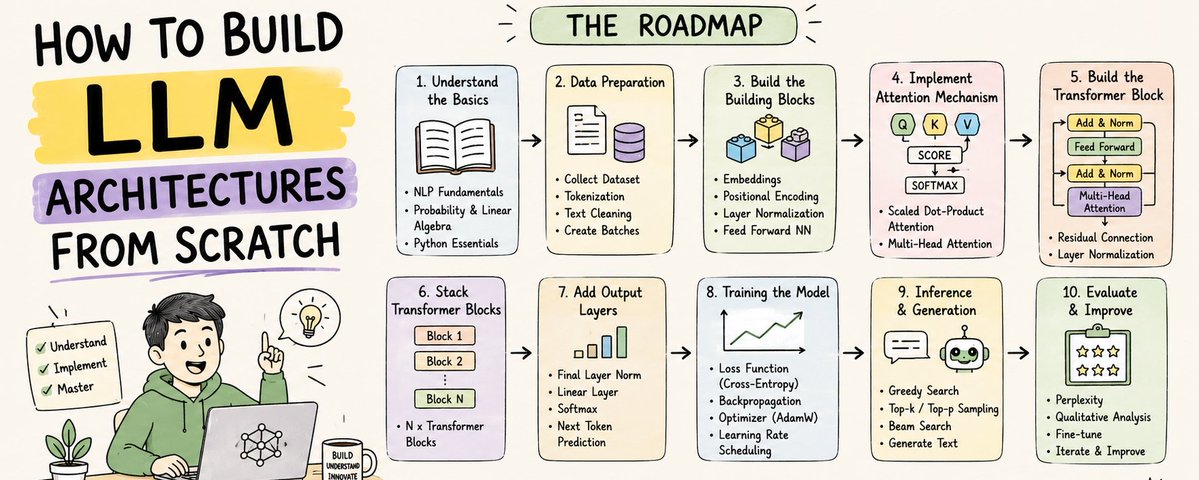
A Deep Dive Into the Systems Behind Models Like OpenAI ChatGPT and Anthropic Claude
Most people use AI models every day.
Very few understand how they’re actually built.
Under the hood, Large Language Models (LLMs) are not magic.
They are massive prediction systems trained on huge amounts of text using carefully designed neural network architectures.
But building one from scratch is far more complex than simply “training a chatbot.”
It involves:
- Data engineering
- Tokenization
- Transformer architectures
- Distributed training
- GPU optimization
- Reinforcement learning
- Inference systems
- Alignment layers
- Memory optimization
This article breaks down the full architecture of modern LLMs step-by-step in a practical and understandable way.
# 1. What Is an LLM?
A Large Language Model is a neural network trained to predict the next token in a sequence.
Example:
Input:
> “The future of AI is”
The model predicts:
> “transformative”
Then continues predicting one token at a time.
That’s the foundation of systems like:
- OpenAI GPT models
- Anthropic Claude
- Google Gemini
- Meta Llama
At scale, this simple prediction process becomes incredibly powerful.
# 2. The Core Pipeline of Building an LLM
The full process looks like this:
Raw Internet Data
↓
Cleaning + Filtering
↓
Tokenization
↓
Transformer Architecture
↓
Pretraining
↓
Fine-Tuning
↓
RLHF / Alignment
↓
Inference Optimization
↓
Deployment
Every stage matters.
A weak dataset or poor architecture design can ruin the entire model.
# 3. Step One: Data Collection
LLMs need enormous datasets.
Modern frontier models train on:
- Books
- Wikipedia
- Research papers
- Websites
- Code repositories
- Documentation
- Conversations
- Forums
Data sources may include:
- Common Crawl
- GitHub
- ArXiv
- Stack Overflow
- Public datasets
The goal is diversity + scale.
A small model trained on excellent data often beats a larger model trained on noisy data.
# 4. Data Cleaning and Filtering
Raw internet data is messy.
You must remove:
- Spam
- Duplicates
- Low-quality text
- Toxic content
- Broken formatting
- Repeated sequences
- AI-generated garbage
This stage is massively underestimated.
Companies spend enormous resources on data quality because:
> Better data > Bigger models
Common filtering methods include:
- Deduplication
- Heuristic filtering
- Quality scoring
- Language detection
- Safety filtering
- NSFW removal
# 5. Tokenization: Converting Text Into Numbers
Neural networks don’t understand words.
They understand numbers.
So text becomes tokens.
Example:
"ChatGPT is powerful"
↓
[1532, 4021, 318, 7821]
This process is called tokenization.
Popular tokenization methods:
- BPE (Byte Pair Encoding)
- SentencePiece
- WordPiece
Tokens can represent:
- Words
- Subwords
- Characters
- Punctuation
Efficient tokenization dramatically affects performance and cost.
# 6. Embeddings: Giving Tokens Meaning
Tokens are converted into vectors.
A vector is basically a list of numbers representing semantic meaning.
Example:
King → [0.2, -0.8, 1.4, ...]
Queen → [0.3, -0.7, 1.5, ...]
Similar concepts end up close together in vector space.
This is how models learn relationships between words.
Embeddings are the foundation of semantic understanding.
# 7. The Transformer Architecture
This changed everything.
The Transformer architecture was introduced in the landmark paper:
> “Attention Is All You Need” by Google Brain researchers in 2017.
Transformers replaced older systems like:
- RNNs
- LSTMs
Because they scaled dramatically better.
The Transformer architecture powers nearly every modern LLM today.
# 8. Self-Attention: The Heart of LLMs
Self-attention allows the model to determine:
> Which words matter most in context.
Example:
"The animal didn’t cross the street because it was tired."
The model learns that:
> “it” refers to “animal”
not “street.”
Self-attention dynamically weighs relationships between tokens.
This enables contextual understanding.
# 9. Understanding Q, K, and V (Query, Key, Value)
Attention works using:
- Query vectors
- Key vectors
- Value vectors
Think of it like search.
Each token asks:
> “Which other tokens are relevant to me?”
Then attention scores determine importance.
Formula:
Attention(Q,K,V) = softmax(QKᵀ / √dₖ)V
This is one of the most important equations in modern AI.
# 10. Multi-Head Attention
Instead of using one attention mechanism:
LLMs use many attention heads simultaneously.
Each head learns different relationships:
- Grammar
- Logic
- Syntax
- Context
- Long-term dependencies
This massively improves representation learning.
# 11. Positional Encoding
Transformers process tokens in parallel.
But language has order.
So models need positional information.
Example:
Dog bites man
Man bites dog
Same words. Completely different meaning.
Positional encoding helps the model understand sequence structure.
# 12. Feed Forward Networks
After attention layers, tokens pass through feed-forward neural networks.
These layers:
- Refine representations
- Increase nonlinearity
- Improve reasoning capacity
A transformer block usually contains:
Attention
↓
Normalization
↓
Feed Forward Network
↓
Normalization
Repeated dozens or hundreds of times.
# 13. Scaling Laws
One major discovery in AI:
> Bigger models trained on more data generally perform better.
Scaling involves:
- More parameters
- More tokens
- More compute
Examples:
- GPT-2 → 1.5B parameters
- GPT-3 → 175B parameters
Modern frontier systems may use trillions of parameters (sometimes via Mixture-of-Experts).
# 14. Training the Model
Training means adjusting weights to minimize prediction error.
Process:
Input sentence
↓
Predict next token
↓
Compare prediction vs actual token
↓
Calculate loss
↓
Backpropagation
↓
Update weights
This repeats billions of times.
Training large models can require:
- Thousands of GPUs
- Weeks or months
- Massive distributed systems
# 15. GPUs and Distributed Training
LLMs are computational monsters.
Training requires clusters of GPUs like:
- NVIDIA H100
- A100
Training methods include:
- Data parallelism
- Tensor parallelism
- Pipeline parallelism
Frameworks:
- PyTorch
- DeepSpeed
- Megatron-LM
- JAX
Infrastructure becomes as important as model design.
# 16. Loss Functions and Optimization
The model learns using optimization algorithms like:
- AdamW
- SGD variants
Objective:
Minimize prediction loss.
Cross-entropy loss is commonly used for language modeling.
Smaller loss = better predictions.
# 17. Fine-Tuning
After pretraining, models are specialized.
Examples:
- Coding assistants
- Medical models
- Legal AI
- Customer support bots
Fine-tuning uses smaller curated datasets.
This adapts the base model to specific tasks.
# 18. RLHF: Reinforcement Learning From Human Feedback
This is what makes ChatGPT-like systems conversational.
Humans rank outputs.
The model learns preferences.
Pipeline:
Base Model
↓
Supervised Fine-Tuning
↓
Reward Model
↓
Reinforcement Learning
RLHF helps models become:
- Helpful
- Harmless
- Honest
# 19. Context Windows and Memory
Context window = how much text the model can “remember” during inference.
Examples:
- 4K tokens
- 32K tokens
- 128K+ tokens
Longer context requires advanced optimization because attention costs grow rapidly.
New techniques include:
- Flash Attention
- Sliding window attention
- Retrieval augmentation
# 20. Inference Optimization
Training is expensive.
Inference must be fast.
Optimization techniques include:
- Quantization
- KV caching
- Speculative decoding
- TensorRT
- Distillation
Goal:
Lower latency + lower cost.
# 21. Retrieval-Augmented Generation (RAG)
LLMs don’t truly “know” everything.
So modern systems retrieve external knowledge dynamically.
Pipeline:
User Query
↓
Search Database
↓
Retrieve Relevant Chunks
↓
Inject Into Prompt
↓
Generate Response
This improves:
- Accuracy
- Freshness
- Enterprise applications
# 22. Mixture-of-Experts (MoE)
Modern frontier models increasingly use MoE architectures.
Instead of activating the entire model:
Only selected expert networks activate per token.
Benefits:
- Larger effective parameter counts
- Lower compute cost
- Better scaling efficiency
This is believed to be important in many modern systems.
# 23. AI Alignment and Safety
Raw models can produce harmful outputs.
Alignment layers help enforce:
- Safety
- Policy compliance
- Truthfulness
- Behavioral constraints
Techniques include:
- Constitutional AI
- RLHF
- Red teaming
- Adversarial testing
Alignment is now one of the hardest problems in AI.
# 24. The Real Challenge Isn’t the Architecture
Most people think the hardest part is building the transformer.
It isn’t.
The hardest parts are:
- Data quality
- Infrastructure
- Scaling
- Optimization
- Alignment
- Inference economics
The transformer paper was only the beginning.
The real engineering challenge is making these systems scalable and usable.
# 25. Final Thought
LLMs are one of the most important technological breakthroughs in modern history.
But they are not magic.
They are the result of:
- Mathematics
- Distributed systems
- Massive datasets
- Optimization engineering
- Human feedback loops
And we are still extremely early.
The next decade of AI will likely be defined by:
- Better reasoning
- Autonomous agents
- Multimodal systems
- Efficient architectures
- Real-time personalization
Understanding how LLMs are built is no longer optional for engineers.
It’s becoming foundational knowledge for the future of technology.
## 相关链接
- [Shabnam Parveen](https://x.com/shabnam_774)
- [@shabnam_774](https://x.com/shabnam_774)
- [44K](https://x.com/shabnam_774/status/2058517919760355729/analytics)
- [Upgrade to Premium](https://x.com/i/premium_sign_up)
- [7:58 PM · May 24, 2026](https://x.com/shabnam_774/status/2058517919760355729)
- [44.7K Views](https://x.com/shabnam_774/status/2058517919760355729/analytics)
- [View quotes](https://x.com/shabnam_774/status/2058517919760355729/quotes)
---
*导出时间: 2026/5/25 10:17:55*
---
## 中文翻译
# 从零开始构建大语言模型架构
**作者**: Shabnam Parveen
**日期**: 2026-05-24T11:58:12.000Z
**来源**: [https://x.com/shabnam_774/status/2058517919760355729](https://x.com/shabnam_774/status/2058517919760355729)
---

深入解析 OpenAI ChatGPT 和 Anthropic Claude 等模型的底层系统
大多数人每天都在使用 AI 模型。
但很少有人真正了解它们的构建原理。
在底层,大语言模型 并非魔法。
它们是基于海量文本训练而成的庞大预测系统,使用了精心设计的神经网络架构。
但从零开始构建一个 LLM,远比简单地“训练一个聊天机器人”要复杂得多。
这涉及:
- 数据工程
- 分词
- Transformer 架构
- 分布式训练
- GPU 优化
- 强化学习
- 推理系统
- 对齐层
- 内存优化
本文将以一种实用且易于理解的方式,逐步拆解现代大语言模型的完整架构。
# 1. 什么是 LLM?
大语言模型是一个用于预测序列中下一个 token 的神经网络。
示例:
输入:
> “AI 的未来是”
模型预测:
> “变革性的”
然后继续一次预测一个 token。
这就是以下系统的基础:
- OpenAI GPT 系列
- Anthropic Claude
- Google Gemini
- Meta Llama
在规模化下,这个简单的预测过程会变得极其强大。
# 2. 构建大语言模型的核心流程
整个过程如下所示:
原始互联网数据
↓
清洗 + 过滤
↓
分词
↓
Transformer 架构
↓
预训练
↓
微调
↓
RLHF / 对齐
↓
推理优化
↓
部署
每一个阶段都至关重要。
微弱的数据集或糟糕的架构设计都会毁掉整个模型。
# 3. 第一步:数据收集
大语言模型需要海量的数据集。
现代前沿模型 的训练数据包括:
- 书籍
- 维基百科
- 研究论文
- 网站
- 代码仓库
- 文档
- 对话记录
- 论坛
数据来源可能包括:
- Common Crawl
- GitHub
- ArXiv
- Stack Overflow
- 公开数据集
目标在于多样性 + 规模。
用优质数据训练的小模型,往往胜过用噪声数据训练的大模型。
# 4. 数据清洗与过滤
原始互联网数据是杂乱的。
你必须移除:
- 垃圾信息
- 重复内容
- 低质量文本
- 有毒内容
- 格式损坏
- 重复序列
- AI 生成的垃圾内容
这一阶段的重要性被严重低估。
公司在数据质量上投入巨大资源,因为:
> 更好的数据 > 更大的模型
常见的过滤方法包括:
- 去重
- 启发式过滤
- 质量打分
- 语言检测
- 安全过滤
- 移除 NSFW 内容
# 5. 分词:将文本转换为数字
神经网络不理解单词。
它们理解数字。
因此文本变成了 token。
示例:
"ChatGPT is powerful"
↓
[1532, 4021, 318, 7821]
这个过程被称为分词。
流行的分词方法:
- BPE (Byte Pair Encoding)
- SentencePiece
- WordPiece
Token 可以代表:
- 单词
- 子词
- 字符
- 标点符号
高效的分词会极大地影响性能和成本。
# 6. 嵌入:赋予 Token 意义
Token 被转换为向量。
向量本质上是一组代表语义含义的数字。
示例:
King → [0.2, -0.8, 1.4, ...]
Queen → [0.3, -0.7, 1.5, ...]
相似的概念在向量空间中会靠得很近。
这就是模型学习词与词之间关系的方式。
嵌入是语义理解的基础。
# 7. Transformer 架构
这改变了一切。
Transformer 架构是在一篇具有里程碑意义的论文中介绍的:
> Google Brain 研究员于 2017 年发表的《Attention Is All You Need》。
Transformer 取代了像这样的旧系统:
- RNN
- LSTM
因为它们的扩展性要好得多。
Transformer 架构为当今几乎所有现代大语言模型提供动力。
# 8. 自注意力机制:大语言模型的核心
自注意力机制允许模型确定:
> 哪些词在上下文中最重要。
示例:
"The animal didn’t cross the street because it was tired."
模型学习到:
> “it”指的是“animal”
而不是“street”。
自注意力机制动态地衡量 token 之间的关系。
这使得上下文理解成为可能。
# 9. 理解 Q、K 和 V(查询、键、值)
注意力机制使用:
- 查询向量
- 键向量
- 值向量
可以把它想象成搜索。
每个 token 都会问:
> “哪些其他 token 与我相关?”
然后注意力分数决定重要性。
公式:
Attention(Q,K,V) = softmax(QKᵀ / √dₖ)V
这是现代 AI 中最重要的公式之一。
# 10. 多头注意力
大语言模型不是使用一个注意力机制,而是同时使用许多注意力头。
每个头学习不同的关系:
- 语法
- 逻辑
- 句法
- 上下文
- 长期依赖关系
这极大地提高了表征学习 的效果。
# 11. 位置编码
Transformer 并行处理 token。
但语言是有顺序的。
因此模型需要位置信息。
示例:
Dog bites man
Man bites dog
单词相同。意思完全不同。
位置编码帮助模型理解序列结构。
# 12. 前馈神经网络
在注意力层之后,token 会通过前馈神经网络。
这些层:
- 提炼表征
- 增加非线性
- 提升推理能力
一个 Transformer 块通常包含:
注意力
↓
归一化
↓
前馈网络
↓
归一化
这一过程会重复几十次甚至上百次。
# 13. 扩展定律
AI 领域的一个重大发现:
> 在更多数据上训练的更大的模型,通常表现更好。
扩展包括:
- 更多参数
- 更多 token
- 更多算力
例子:
- GPT-2 → 15 亿参数
- GPT-3 → 1750 亿参数
现代前沿系统可能使用数万亿个参数(有时通过混合专家模型 实现)。
# 14. 训练模型
训练意味着调整权重以最小化预测误差。
过程:
输入句子
↓
预测下一个 token
↓
对比预测值与实际 token
↓
计算损失
↓
反向传播
↓
更新权重
这个过程会重复数十亿次。
训练大模型可能需要:
- 数千块 GPU
- 数周或数月的时间
- 大规模的分布式系统
# 15. GPU 与分布式训练
大语言模型是计算怪兽。
训练需要 GPU 集群,例如:
- NVIDIA H100
- A100
训练方法包括:
- 数据并行
- 张量并行
- 流水线并行
框架:
- PyTorch
- DeepSpeed
- Megatron-LM
- JAX
基础设施变得与模型设计一样重要。
# 16. 损失函数与优化
模型使用优化算法进行学习,例如:
- AdamW
- SGD 变体
目标:
最小化预测损失。
交叉熵损失通常用于语言建模。
更小的损失 = 更好的预测。
# 17. 微调
预训练之后,模型需要进行专业化处理。
例子:
- 编码助手
- 医疗模型
- 法律 AI
- 客户支持机器人
微调使用精选的小型数据集。
这使基础模型适应特定的任务。
# 18. RLHF:基于人类反馈的强化学习
这就是让 ChatGPT 等系统具备对话能力的原因。
人类对输出进行排序。
模型学习偏好。
流程:
基础模型
↓
监督微调
↓
奖励模型
↓
强化学习
RLHF 帮助模型变得:
- 有用
- 无害
- 诚实
# 19. 上下文窗口与记忆
上下文窗口 = 模型在推理期间能“记住”多少文本。
例子:
- 4K tokens
- 32K tokens
- 128K+ tokens
更长的上下文需要高级优化,因为注意力成本增长极快。
新技术包括:
- Flash Attention
- 滑动窗口注意力
- 检索增强
# 20. 推理优化
训练很昂贵。
推理必须快。
优化技术包括:
- 量化
- KV 缓存
- 投机解码
- TensorRT
- 蒸馏
目标:
更低延迟 + 更低成本。
# 21. 检索增强生成
大语言模型并不真正“知道”所有事情。
因此现代系统动态检索外部知识。
流程:
用户查询
↓
搜索数据库
↓
检索相关片段
↓
注入提示词
↓
生成回复
这改善了:
- 准确性
- 时效性
- 企业应用
# 22. 混合专家模型
现代前沿模型越来越多地使用 MoE 架构。
不是激活整个模型:
而是每个 token 只激活选定的专家网络。
优势:
- 更大的有效参数数量
- 更低的计算成本
- 更好的扩展效率
这被认为是许多现代系统中的关键技术。
# 23. AI 对齐与安全
原始模型可能会产生有害输出。
对齐层有助于强制执行:
- 安全性
- 策略合规
- 真实性
- 行为约束
技术包括:
- 宪法 AI
- RLHF
- 红队测试
- 对抗性测试
对齐目前是 AI 领域最难的问题之一。
# 24. 真正的挑战不在于架构
大多数人认为最难的部分是构建 Transformer。
其实不是。
最难的部分是:
- 数据质量
- 基础设施
- 扩展
- 优化
- 对齐
- 推理经济学
Transformer 论文仅仅是个开始。
真正的工程挑战在于让这些系统具有可扩展性和可用性。
# 25. 最后的思考
大语言模型是现代史上最重要的技术突破之一。
但它们不是魔法。
它们是以下内容的成果:
- 数学
- 分布式系统
- 海量数据集
- 优化工程
- 人类反馈循环
我们仍然处于极早期。
未来十年的 AI 可能将由以下特征定义:
- 更好的推理能力
- 自主智能体
- 多模态系统
- 高效架构
- 实时个性化
对于工程师来说,了解大语言模型的构建方式已不再是可选项。
它正成为未来技术的基础知识。
## 相关链接
- [Shabnam Parveen](https://x.com/shabnam_774)
- [@shabnam_774](https://x.com/shabnam_774)
- [44K](https://x.com/shabnam_774/status/2058517919760355729/analytics)
- [升级到 Premium](https://x.com/i/premium_sign_up)
- [2026年5月24日 下午7:58](https://x.com/shabnam_774/status/2058517919760355729)
- [44.7K 浏览量](https://x.com/shabnam_774/status/2058517919760355729/analytics)
- [查看引用](https://x.com/shabnam_774/status/2058517919760355729/quotes)
---
*导出时间: 2026/5/25 10:17:55*