# I Built 10 MCP Server Setups in 30 Days. I Now Charge Companies $3,000 to Connect Their Tools
**作者**: CyrilXBT
**日期**: 2026-04-28T11:48:49.000Z
**来源**: [https://x.com/cyrilXBT/status/2049093475560301009](https://x.com/cyrilXBT/status/2049093475560301009)
---
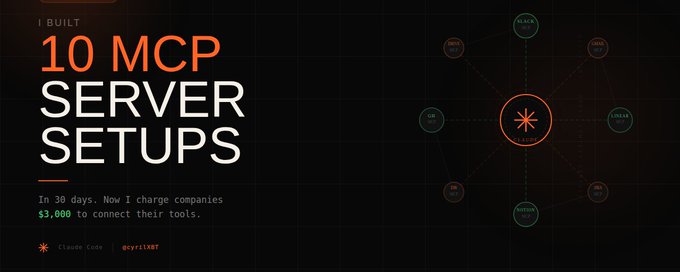
Thirty days ago I did not know what an MCP server was.
Today I have 10 completed setups, 4 paying clients, and a service that charges $3,000 per project with a waitlist forming behind it.
This is not a story about being technical. I am not a software engineer. I do not have a computer science degree. I learned this skill the same way I learn every skill that pays me money.
I found the thing most people had not figured out yet. I built it obsessively for 30 days. I documented everything. Then I started charging for it.
Here is the entire playbook.
## What MCP Actually Is and Why Nobody Understands It Yet
Most people in tech have heard the acronym by now.
Model Context Protocol.
Anthropic released it as an open standard for connecting AI models to external tools, databases, and services. The idea is simple: instead of Claude being a closed system that only knows what you tell it in the chat window, MCP lets Claude connect to your actual tools and operate them directly.
Your CRM. Your database. Your email. Your calendar. Your internal APIs. Your file system.
Claude stops being a chatbot and starts being an operator.
The reason most people have not figured out how to monetize this yet is that the technical setup has historically required knowing how to configure servers, write integration code, handle authentication flows, and debug connection issues across multiple systems.
That barrier is exactly where the $3,000 service lives.
Because here is the truth about most businesses:
They know they need their tools connected.
They have no idea how to do it.
And they will pay well for someone who can make it work in a day.
## Why $3,000 Is the Right Price Point
Before the playbook, you need to understand the pricing logic.
$3,000 feels like a lot for a setup job. It is not. Here is the math that makes it obvious.
The average business paying for this setup is spending between 10 and 20 hours a week on manual data transfer between tools. Someone pulls a report from the CRM and pastes it into a spreadsheet. Someone copies customer data from one system into another. Someone manually compiles information from three different platforms into a weekly report.
At $30 an hour in labor cost, that is $300 to $600 a week.
$1,200 to $2,400 a month.
$14,400 to $28,800 a year.
Your $3,000 setup pays for itself in 6 to 12 weeks.
After that it is pure savings every single month forever.
That is not a freelance fee conversation.
That is a capital investment conversation with a documented return.
The clients who understand this close fast. The clients who do not understand this are not your clients yet. They will be once you show them the math.
## The 30-Day Learning Sprint That Built the Service
I did not wait until I felt ready to start charging.
I started building immediately and charged once I had proof the setups worked.
Here is exactly how the 30 days broke down.
Week 1: Understanding the Architecture
The first thing I did was stop reading articles about MCP and start building one.
The fastest way to understand any technical system is to make it do something real as quickly as possible.
My first setup was connecting Claude to a local file system using the MCP filesystem server. It took 4 hours including debugging. By the end I understood the core concepts: the MCP server acts as a bridge, Claude acts as the client, and the protocol defines how they communicate.
Once I understood that model, every subsequent setup was a variation on the same pattern.
I used Claude Code to help me with every build. Not as a crutch. As a pair programmer who never gets tired and never judges bad questions.
This prompt became my most used setup tool:
I am building an MCP server setup to connect Claude to [TOOL/SERVICE].
Help me:
1. Identify the best existing MCP server for this integration or
determine if I need to build a custom one
2. Walk me through the exact configuration steps
3. Write the configuration file with real values, not placeholders
4. Help me test the connection and verify it is working
5. Document the setup so I can replicate it and hand it off to a client
My technical level: intermediate. I understand APIs and JSON but I am
not a backend engineer.
By the end of Week 1 I had completed 3 setups: filesystem, GitHub, and a basic Postgres database connection.
Week 2: The Business Integrations
Week 2 was where the money started to become obvious.
I shifted from technical setups to business tool integrations. The ones real companies actually use.
Notion. Linear. Slack. HubSpot. Google Drive. Airtable.
These are the tools sitting in every startup and SMB in the world. Most of them have existing MCP servers in the community. The skill is knowing which ones work reliably, how to configure them correctly, and how to combine multiple servers into a setup where Claude can move fluidly between all of them.
The combination that generated my first paying client inquiry was Notion plus Linear plus Slack.
A founder saw me post about it. Messaged me the same day. Paid $3,000 three days later.
Week 3: Custom Server Builds
By Week 3 I was comfortable enough with the architecture to start building custom MCP servers for tools that did not have existing community solutions.
This is where the pricing goes up.
A standard setup using existing servers: $1,500 to $3,000.
A custom server build for a proprietary internal tool: $3,000 to $7,500.
I built two custom servers in Week 3. One for a client's internal Postgres database with a custom schema. One for a SaaS product's own API that they wanted Claude to be able to query directly.
Claude Code handled 80% of the code generation. My job was architecture, testing, and making sure the outputs were correct before handing them to clients.
Week 4: Systemizing and Scaling
Week 4 was about turning everything I learned into a repeatable service.
I built a setup library. Every configuration file I had written, organized by tool category. Every debugging solution I had found, documented in plain language. Every client handoff package templated so I could produce it in under an hour.
The service that took me 8 hours to deliver in Week 1 took me 2 hours to deliver in Week 4.
That is how the margin compounds.
## The 10 MCP Setups That Pay the Most
Not all setups are equal. Here are the 10 that generate the most client demand and the highest willingness to pay.
1. CRM plus Email (HubSpot or Salesforce plus Gmail)
The highest demand setup right now. Claude can read contact records, draft personalized emails based on deal stage, and update the CRM after conversations. Replaces 2 to 3 hours of manual work per sales rep per week.
2. Project Management plus Communication (Linear plus Slack plus Notion)
Founders and ops people pay for this immediately. Claude can create tasks from Slack messages, update Linear tickets, and write Notion documentation from project discussions. The manual version of this workflow takes 45 minutes a day.
3. Database Query and Reporting (Postgres or Supabase)
Any business with data they cannot easily access pays for this. Claude can query their database in plain English, generate reports, and surface insights without the founder needing to know SQL.
4. GitHub plus Documentation (GitHub plus Notion or Confluence)
Engineering teams. Claude can pull PR descriptions, generate documentation from code changes, and keep technical wikis current automatically. Engineering managers love this one.
5. Google Workspace Suite (Drive plus Gmail plus Calendar plus Sheets)
The generalist setup. Most useful for operators and executive assistants. Claude becomes a full workspace operator that can manage files, draft communications, schedule from context, and build reports.
6. E-Commerce Operations (Shopify plus Email plus Analytics)
Store owners. Claude can pull order data, generate customer communication, analyze performance by product, and flag issues in real time.
7. Financial Data (QuickBooks or Stripe plus Spreadsheets)
Finance teams and CFOs. Claude can query transaction data, generate cash flow summaries, and flag anomalies without the human needing to run reports manually.
8. Support Ticket System (Intercom or Zendesk plus Knowledge Base)
Support teams. Claude can analyze ticket patterns, draft response templates, update the knowledge base from resolved tickets, and escalate based on sentiment.
9. Content and Social (Notion plus Buffer or Typefully plus Analytics)
Content teams and creators. Claude can pull content from Notion, schedule it, analyze performance, and recommend what to write next based on what performed best.
10. Custom Internal API Connection
The premium tier. Any company with a proprietary internal system that no existing MCP server covers. Custom build. Custom price.
## The Exact Technical Process for Each Setup
Every setup follows the same four-step process regardless of which tools are involved.
Step 1: Discovery
Before you write a single line of configuration, you need to understand exactly what the client wants Claude to do with each connected tool.
Use this discovery prompt to run the client conversation:
I am setting up MCP servers to connect Claude to your business tools.
Help me understand the workflow by answering these questions:
1. What are the 3 most time-consuming manual tasks involving
moving data between your tools right now?
2. Which tools are involved in each task?
3. What does the ideal automated version of each task look like?
4. What data should Claude never touch or modify?
5. Who needs to be notified when Claude takes an action?
Your answers will determine exactly which servers I build and
how I configure them.
Step 2: Configuration
Once you know what to build, use this prompt to generate the configuration file:
Generate a complete MCP configuration file for connecting Claude to
these tools: [LIST TOOLS].
For each tool:
1. Identify whether to use an existing MCP server or build custom
2. Write the exact JSON configuration
3. Handle authentication using environment variables only
4. Add appropriate tool descriptions so Claude knows when to use each one
5. Flag any potential conflicts between servers
Output a production-ready claude_desktop_config.json that I can
deploy immediately.
Step 3: Testing
Never hand off an untested setup. Use this testing protocol with every client:
Test this MCP setup by performing the following actions in sequence:
1. Confirm connection to each server is active
2. Perform a read operation on each connected tool
3. Perform a write operation on each connected tool with test data
4. Verify the test data was created correctly
5. Clean up any test data
6. Confirm all tools are responding within acceptable time limits
Report the result of each test and flag any failures with
the error message and your diagnosis.
Step 4: Handoff
The handoff package is what separates a $500 setup job from a $3,000 one.
Every client receives four things.
A one-page setup summary explaining what is connected, what Claude can now do, and what it cannot do.
A plain-language operations guide explaining how to know everything is working, what to do if something stops working, and who to contact.
A configuration backup with all files needed to reinstall the setup if something breaks.
A 45-minute handoff call where you walk them through their first real use of the connected setup.
The documentation takes 90 minutes to produce. It makes the delivery feel like a premium product and generates referrals.
## How to Find Clients Without Cold Outreach
Every client I have closed in 30 days came from content, not cold email.
The formula is simple.
Post about what you are building before you finish building it.
When I was on Setup 3, I posted about what connecting Notion plus Linear plus Slack looked like in practice. One paragraph. No technical jargon. Just the outcome.
A founder replied within 2 hours. That became my first paid client.
When I finished Setup 7 with the financial data connection, I posted the before and after. The manual process took a CFO 3 hours every Monday. The connected setup took her 8 minutes.
Two inquiries in the same day.
The posts that convert best follow this exact structure:
The specific pain the client had before the setup. The specific outcome after. The number that changed. One line about the tool combination. A question at the end that makes people self-identify.
You do not need a portfolio website. You do not need a LinkedIn profile. You need to post about what you are building every time you finish building something.
The clients find you.
## The Pricing Structure That Scales
Here is the full pricing menu I now use:
Standard Setup (2 to 4 existing MCP servers, established tools): $1,500 to $3,000 depending on complexity.
Advanced Setup (4 to 6 servers, some configuration complexity, business-critical tools): $3,000 to $5,000.
Custom Server Build (proprietary tool, no existing MCP server): $4,000 to $8,000.
Maintenance Retainer (monitoring, updates, one modification per month): $300 to $500 per month.
The retainer is the part most people skip and should not.
Every setup you complete is a recurring revenue opportunity. The tools you connect to update their APIs. The client's needs change. The MCP server community releases better versions.
$500 a month per client in retainer is $6,000 a year per client for 2 to 3 hours of monthly work.
Five clients on retainer is $30,000 a year before you do a single new setup.
## What the Next 30 Days Look Like
The MCP ecosystem is moving fast.
New servers are being released every week. The tool coverage is expanding constantly. The clients who have not heard of this yet will hear about it in the next 90 days and start looking for people who can set it up.
The window where knowing this gives you a real edge is not permanent.
The builders who complete their first 5 setups in the next 30 days will have documented proof, real client results, and a portfolio before the market gets crowded.
The ones who wait until it feels less technical will be competing with 50 other people offering the same service at lower prices.
Start with one tool you already use.
Connect it to Claude.
Document what changed.
Post about it.
Charge for the next one.
The skill compounds. The portfolio compounds. The referrals compound.
This is the work.
Follow @cyrilXBT to master MCP servers, Claude Code, and every AI skill that generates real income the moment it emerges.
## 相关链接
- [CyrilXBT](https://x.com/cyrilXBT)
- [@cyrilXBT](https://x.com/cyrilXBT)
- [3.5K](https://x.com/cyrilXBT/status/2049093475560301009/analytics)
- [@cyrilXBT](https://x.com/@cyrilXBT)
- [Upgrade to Premium](https://x.com/i/premium_sign_up)
- [7:48 PM · Apr 28, 2026](https://x.com/cyrilXBT/status/2049093475560301009)
- [3,540 Views](https://x.com/cyrilXBT/status/2049093475560301009/analytics)
- [View quotes](https://x.com/cyrilXBT/status/2049093475560301009/quotes)
---
*导出时间: 2026/4/28 21:06:52*