# Obsidian Masterclass: The Complete Guide From Empty Vault to a Second Brain That Runs Your Life
**作者**: CyrilXBT
**日期**: 2026-06-10T00:13:27.000Z
**来源**: [https://x.com/cyrilXBT/status/2064501160602390835](https://x.com/cyrilXBT/status/2064501160602390835)
---
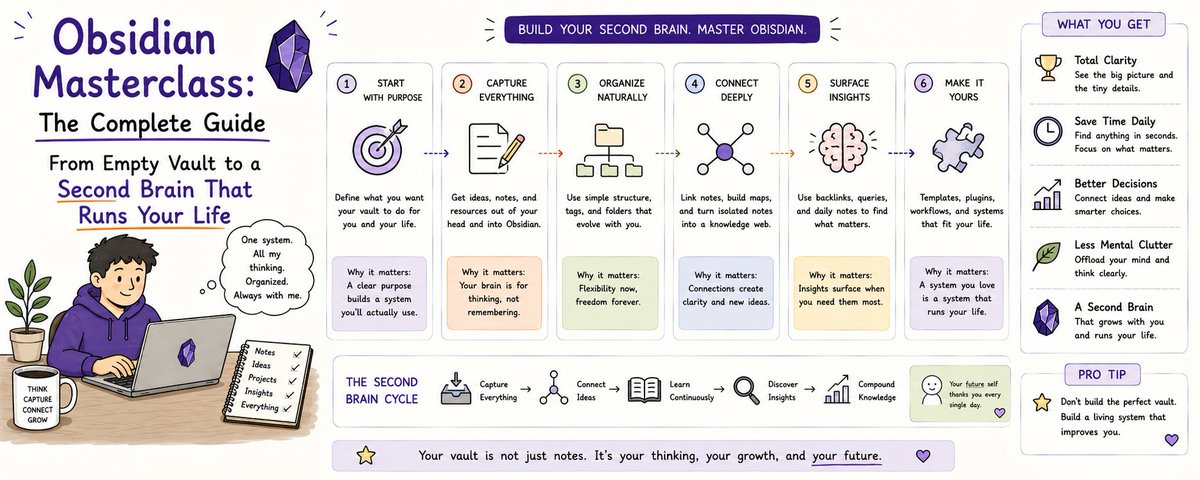
Most people download Obsidian and spend the first week excited.
The second week confused.
The third week using Notion again.
Not because Obsidian is difficult. Because nobody gave them the complete picture before they started building. They set up a folder structure that made sense on day one and broke down by week four. They took notes that went nowhere. They installed fifteen plugins and used three of them.
This masterclass is the complete picture.
From the philosophy that makes Obsidian worth using to the architecture that makes it compound, to the Claude integration that makes it intelligent, to the daily practice that makes it stick.
By the end you will have everything you need to build a second brain that gets more valuable every week you use it.
## Part 1: Why Obsidian and Why Now
Before you build anything understand what makes Obsidian fundamentally different from every other note-taking tool.
Your notes are files.
Not database entries. Not cloud objects. Not content locked inside a proprietary format.
Plain text Markdown files that live on your computer. Files that will be readable by any device, any operating system, any software in existence fifty years from now.
This matters more than it sounds.
Notion can shut down. Evernote already degraded. Roam changed their pricing model. Every cloud-based note-taking tool is a bet that the company stays solvent, keeps your data accessible, and doesn't change the pricing in ways that make it unaffordable.
Obsidian is not that bet.
Your notes are yours permanently. The vault you build today will exist in exactly the same form in twenty years regardless of what happens to any company.
Your notes can connect.
The linking system in Obsidian mirrors how ideas actually relate to each other rather than how a filing cabinet organizes paper.
A note about attention connects to a note about deep work connects to a note about energy management. Not because they share a folder. Because you drew an explicit link between them. The connection exists independently of any folder structure.
Over time your vault becomes a network of connected ideas that surface relevant information when you need it rather than requiring you to remember exactly where you filed something.
Your notes can be intelligent.
This is the part that changed everything in 2025 and 2026.
Connect Claude to your vault via the Filesystem MCP and Claude can read every note you have ever written, reason across the entire collection simultaneously, find connections you missed, surface relevant history when you are making a decision, and generate outputs that require reading across thousands of notes to produce.
The vault that used to be passive storage becomes an active thinking partner.
That combination of permanent files, connected ideas, and AI intelligence is what makes Obsidian worth the investment in learning it properly.
## Part 2: The Philosophy Before the Architecture
Most Obsidian tutorials skip this section entirely.
They jump straight to folder structures and plugin recommendations.
The philosophy is what determines whether your vault compounds or just accumulates.
The retrieval-first principle.
Every organizational decision should be made by asking: when I need this in the future, what will I know about it that I can use to find it?
Not: what category does this belong in right now?
The filing cabinet question optimizes for the moment of capture. The retrieval question optimizes for every future moment when you need the information.
These produce different answers.
A note about Jensen Huang's comments on AI infrastructure filed under People/Jensen-Huang is retrieval-friendly only if you remember it was about Jensen Huang. Filed under Topics/AI-Infrastructure it's retrieval-friendly if you remember it was about AI infrastructure. Connected to both via wikilinks it's findable either way.
The retrieval-first principle pushes you toward naming conventions that describe content, consistent tagging that describes type and status, and linking that creates multiple paths to the same note.
The atomic note principle.
One idea per note.
Not one topic per note. One idea.
An atomic note about the concept of compounding interest in knowledge systems is a reusable asset. You can link to it from a note about Obsidian, a note about investing, a note about habit formation, and a note about why expertise takes years to develop. All four links point to the same idea expressed once.
A note that contains everything you know about compounding is a filing cabinet entry. It sits in one place. It connects to nothing. It's useful exactly once.
Atomic notes are small. They're designed to be connected. They're written in your own words because they represent your understanding not your collection of what others said.
The shift from collecting information to processing it into atomic notes is the most important habit change in building a second brain.
The connection principle.
The value of a note is not in what it contains. It is in what it connects to.
A perfectly written note with no connections is worth less than a rough note connected to ten other notes. The connections are what create the network effect that makes a vault valuable.
Every permanent note should have at least two connections to existing notes before it's considered done. The discipline of finding the second connection is what forces genuine thinking about how the idea fits into your existing knowledge.
The output principle.
A vault that never produces output is a hobby.
The measure of a second brain is not how many notes it contains. It is how many decisions it improves, how many pieces of writing it fuels, how many insights it surfaces before you need them.
Every structural decision should be made by asking: does this make outputs easier or harder to produce?
## Part 3: The Vault Architecture
The architecture is the foundation. Get this right and the vault scales indefinitely. Get it wrong and you rebuild it every six months.
Five principles govern the architecture:
One: Every note belongs in exactly one folder. No note is in multiple folders. No note sits at the root level.
Two: Folders represent types of content not topics. Topics are handled by tags and links.
Three: The naming convention is consistent enough that you can navigate without opening folders.
Four: The architecture is designed for a vault with ten thousand notes not a vault with one hundred.
Five: Claude can navigate it without a map.
The folder structure:
VAULT/
00-INBOX/
01-PERMANENT/
02-LITERATURE/
03-MAPS/
04-PROJECTS/
05-DAILY/
06-RESOURCES/
07-OUTPUTS/
08-COMPOUND/
09-ARCHIVE/
10-SYSTEM/
00-INBOX is your capture buffer. Everything unprocessed lands here. Nothing lives here permanently. The inbox empties itself every evening through processing.
01-PERMANENT is the heart of the vault. Atomic notes in your own words. Every idea you have processed and understood lives here. This folder compounds over time because every new permanent note has the potential to connect to every existing one.
02-LITERATURE holds notes from specific sources. The book you read. The article you processed. The podcast episode you transcribed. Literature notes feed into permanent notes. They are not the final destination of information. They are the processing station.
03-MAPS holds Maps of Content. These are notes whose primary purpose is to link to other notes on a topic and add commentary on how they relate. Not a folder. A navigational layer inside the vault.
04-PROJECTS holds one subfolder per active project. Every note specific to a project lives here. When a project completes the folder moves to 09-ARCHIVE.
05-DAILY holds your daily notes. One file per day. The timestamped record of what happened, what you captured, what you decided.
06-RESOURCES holds reference material. Things you might need someday. Not things you are actively using.
07-OUTPUTS holds finished work produced from the vault. Articles, reports, frameworks. The evidence that the vault is producing rather than just accumulating.
08-COMPOUND holds Claude-generated outputs. Connections discovered between notes. Patterns identified across captures. Syntheses generated from accumulated permanent notes. This folder did not exist in traditional Obsidian setups. It is the intelligence layer made visible.
09-ARCHIVE holds everything that is no longer active. Never delete. Archive.
10-SYSTEM holds CLAUDE.md, templates, and skill files. The infrastructure that makes everything else run.
## Part 4: The File Naming Convention
Consistent naming eliminates the search problem before it starts.
Every file follows one convention:
YYYY-MM-DD-[TYPE]-[TOPIC].md
The date prefix sorts files chronologically automatically. The type identifier tells you what kind of note it is before you open it. The topic identifier makes keyword search reliable.
Type identifiers:
daily → daily notes
perm → permanent notes
lit → literature notes
map → maps of content
proj → project overview notes
meet → meeting notes
dec → decision notes
ref → reference notes
Examples:
2026-06-09-daily-monday.md
2026-06-08-perm-compounding-knowledge.md
2026-06-07-lit-thinking-fast-and-slow.md
2026-06-05-map-productivity.md
2026-06-04-proj-obsidian-masterclass.md
2026-06-01-dec-switch-to-obsidian.md
The naming convention means you can find any note by searching for a partial match. You know the type. You know roughly when you created it. You know the topic. Three pieces of information make every note findable without navigating folders.
## Part 5: The Properties System
Properties are the structured data layer inside every note. They're what make filtering and database-style queries possible.
Every note in the vault has a properties block at the top:
---
type: permanent
status: active
created: 2026-06-09
tags: [productivity, compounding, knowledge-systems]
---
Additional properties by note type:
For permanent notes:
---
type: permanent
status: active
created: 2026-06-09
tags: [relevant-topics]
connections: [number-of-explicit-links]
---
For project notes:
---
type: project
status: active
started: 2026-06-01
deadline: 2026-07-01
completion: 35
next_action: Write section 4
---
For decision notes:
---
type: decision
date: 2026-06-09
chosen: [what you decided]
assumption: [key belief this rests on]
review_date: 2026-09-09
outcome: [fill in when known]
---
The properties system is what makes Dataview queries and Claude filtering work. When Claude needs to find all active projects it reads the type and status properties. When you want to see all notes created this month it queries the created property.
## Part 6: The CLAUDE.md
The CLAUDE.md is the most important file in the vault. It's what makes Claude's outputs specific to your life and work rather than generically helpful.
Every Claude interaction in this vault starts by reading this file. The quality of everything Claude produces is determined by the specificity of what's in it.
# Vault Intelligence System — CLAUDE.md
## Identity
Name: [YOUR NAME]
Primary domain: [YOUR WORK AND FOCUS]
Stage: [WHERE YOU ARE IN YOUR WORK]
## Vault Purpose
[One paragraph describing what this vault
is for specifically. Not "general knowledge
management" but the specific domains,
questions, and projects it serves.]
## Primary Intellectual Interests
[List 8-12 specific topics you think about
regularly. Specific enough that Claude
can identify when a new note is relevant.]
1. [INTEREST 1]
2. [INTEREST 2]
...
## Active Projects
[PROJECT NAME]: [One sentence status]
Current phase: [PHASE]
Next action: [SPECIFIC NEXT STEP]
Priority: [HIGH/MEDIUM/LOW]
## Current Active Theses
[The positions you currently hold that
new information might support or contradict]
Thesis 1: [STATEMENT]
Supporting evidence: [BRIEF SUMMARY]
Counter-evidence: [WHAT CHALLENGES IT]
Last updated: [DATE]
## Decision Log Context
[How I make decisions and what I care about
when evaluating options]
## Content Standards
[If you create content: voice, format,
topics, what you never publish]
## Vault Navigation
00-INBOX: Raw captures
01-PERMANENT: Atomic notes
02-LITERATURE: Source notes
03-MAPS: Topic maps
04-PROJECTS: Active projects
05-DAILY: Daily notes
06-RESOURCES: Reference material
07-OUTPUTS: Finished work
08-COMPOUND: Claude-generated outputs
09-ARCHIVE: Completed material
10-SYSTEM: CLAUDE.md and infrastructure
## Intelligence Layer Instructions
When finding connections:
Strong connection = reading one note changes
how you read the other. Not same topic.
Actually illuminating.
When monitoring theses:
Flag when new notes contradict active theses.
Don't flag things that merely add complexity.
When generating syntheses:
The synthesis must say something no individual
note says. If it doesn't it's a summary.
When detecting patterns:
A pattern requires at least 4 notes from
different sources demonstrating the same
structural similarity.
## Update Schedule
Active projects: weekly
Active theses: monthly
Primary interests: quarterly
The Active Theses section is the most underused part of every CLAUDE.md. Most people skip it. The thesis monitor that checks new notes against your positions is what makes the intelligence layer genuinely useful rather than just interesting.
## Part 7: The Linking System
Linking is the skill that separates a vault that compounds from a vault that accumulates.
Three types of links and when to use each:
Direct links connect one note to another:
[[Note Name]]
Use when one note directly references the content of another. The most common link type. Creates explicit navigation paths through the vault.
Block links connect to a specific paragraph:
[[Note Name#^block-id]]
Use when the connection is to a specific claim or observation rather than the whole note. More precise than a direct link.
Aliases let you link using different text:
[[Note Name|the concept I'm referencing]]
Use when you want the link text to flow naturally in the sentence rather than using the exact note name.
The three linking habits that compound over time:
The two-link rule: No permanent note gets filed without at least two explicit links to existing notes. The first connection is usually obvious. The second requires genuine thought about how the idea fits the existing network. The harder thinking produces better connections.
The backlink review: Every time you open a permanent note spend thirty seconds looking at its backlink panel. The panel shows every note that links to it. If any backlink represents a connection worth making explicit in the other direction add the link before closing. This habit keeps the network bidirectional.
The map update: Every time you create a permanent note on a topic that has a Map of Content add the note to the map with a one-sentence description of what it contributes. The maps stay current without maintenance sessions.
## Part 8: The Daily Note System
The daily note is where everything enters the vault. It's the front door.
The template:
---
type: daily
date: {{date:YYYY-MM-DD}}
day: {{date:dddd}}
---
# {{date:MMMM D, YYYY}}
## Morning Context
[[{{date:YYYY-MM-DD}}-morning-brief]]
## The One Thing
> [Single most important outcome for today]
## Schedule
| Time | Event |
|------|-------|
## Captures
*Everything that comes in lands here.
No filing decisions during the day.*
## Decisions Made
DECISION:
CONTEXT:
REASONING:
## Open Loops
*Unfinished items to carry forward*
## End of Day
What happened:
Carrying forward:
Tomorrow's One Thing:
The morning brief link points to a Claude-generated file that appears automatically at 6AM. You open your daily note and the context is already there. Your project status. Your open loops from yesterday. External developments relevant to your work.
You spend five minutes reading. You write The One Thing. You start working.
The rest of the day the daily note is a capture buffer. Everything lands in Captures. No decisions about where to file anything. Just capture and keep moving.
At 8PM the capture processor runs automatically and files everything that accumulated during the day into the correct vault locations.
## Part 9: The Permanent Note Writing Process
The permanent note is the most important skill to develop in Obsidian.
Most people skip this step. They take literature notes from sources and call them done. They have a vault full of what other people said rather than what they understand.
A permanent note is not a summary. It is your understanding expressed in your words.
The process from raw capture to permanent note:
Step 1: Read the capture actively
Don't just read your literature note or capture. Engage with it. What do you actually think about this? Where does it fit with what you already know? What does it contradict?
Step 2: Write in your own words without looking
Close the source. Write the idea from memory in your own words. If you can't write it from memory you don't understand it yet. Go back. Read again. Try again.
Step 3: Find the connections
Search your vault for at least two existing notes this idea connects to. Not same-topic connections. Genuinely illuminating connections. What does reading this note and an existing note together tell you that reading either alone doesn't?
Step 4: Write the note
---
type: permanent
status: active
created: [DATE]
tags: [relevant-topics]
---
# [CONCEPT NAME]
[Your understanding in 2-4 sentences.
Not what the source said.
What you understand.]
## Why This Matters
[Why this concept matters for questions
you're currently working on]
## The Tension
[What this concept is in tension with.
The opposing view or complicating factor.]
## Connections
- [[CONNECTION 1]] — [how they relate]
- [[CONNECTION 2]] — [how they relate]
## Source
[[LITERATURE NOTE]] — [what the source
contributed to this understanding]
Step 5: File it
Move to 01-PERMANENT. The naming convention handles discoverability.
The permanent note is done when it says something in your words that required reading and thinking to produce. Not when it contains the information.
## Part 10: Maps of Content
Maps of Content are the navigation layer of the vault.
A Map of Content for a topic with many notes looks like this:
---
type: map
topic: [TOPIC]
updated: [DATE]
---
# [TOPIC] — Map of Content
## The Core Question
[What is this topic fundamentally about.
The question all these notes are trying to answer.]
## Foundation Notes
[Notes that establish the basic framework]
- [[Note 1]] — [what it contributes]
- [[Note 2]] — [what it contributes]
## Complications and Tensions
[Notes that challenge or complicate the foundation]
- [[Note 3]] — [the tension it introduces]
## Applications
[Notes applying this topic to specific domains]
- [[Note 4]] — [the application]
## Synthesis
[[Synthesis Note If Generated]] — [what it adds]
## Open Questions
[Questions accumulated from all notes
in this topic that aren't yet answered]
## Connected Maps
- [[RELATED MAP 1]]
Create a Map of Content when a topic accumulates more than fifteen permanent notes. Before that the backlink panel on any note in the topic is sufficient navigation.
The Open Questions section is the most generative part. It's a standing research agenda that updates as notes accumulate. Every time you add a note that partially answers a question update the question. Every time you encounter something new that raises a question add it.
## Part 11: The Intelligence Layer
This is where Obsidian in 2026 becomes something different from Obsidian in 2022.
Connect Claude via the Filesystem MCP and five automated workflows transform the vault from passive storage into an active thinking system.
Setup:
Install Claude Desktop. Edit the config file:
{
"mcpServers": {
"obsidian": {
"command": "npx",
"args": [
"-y",
"@modelcontextprotocol/server-filesystem",
"/path/to/your/vault"
]
}
}
}
Restart Claude Desktop. Test with:
List the folders in my vault and describe
the structure you see.
The Five Intelligence Workflows:
Workflow 1: Morning Brief (6AM daily)
Claude reads your CLAUDE.md, your active project notes, yesterday's daily note open loops, and searches for relevant external developments. Produces a structured brief that appears linked in your daily note before you open your laptop.
Workflow 2: Evening Capture Processor (8PM daily)
Claude reads everything in your daily note's Captures section. Files tasks to project notes, creates permanent notes from ideas, stores decisions in memory, carries open loops to tomorrow's daily note. The inbox clears itself.
Workflow 3: Nightly Connection Finder (11PM daily)
Claude reads notes created or modified in the last 48 hours and searches the entire vault for strong connections not yet made explicit. Produces connection notes in 08-COMPOUND describing what each connection reveals.
Workflow 4: Weekly Pattern Detector (Sunday 6PM)
Claude reads all notes from the week and identifies structural patterns appearing across multiple notes from different sources. Named patterns deposited in 08-COMPOUND with the notes demonstrating them cited.
Workflow 5: Monthly Synthesis Generator (1st of month)
For any topic with 10 or more permanent notes Claude synthesizes across them producing an output that requires all the notes to produce. Saved to 08-COMPOUND with links from all contributing notes.
## Part 12: The Six Core Claude Prompts
Beyond automated workflows six manual prompts handle the most common intelligence requests.
The Connection Finder:
Read [[NOTE NAME]] and search my entire vault
for strong connections to this note that
aren't already explicit.
Strong connection = reading both notes together
reveals something that reading either alone doesn't.
Only surface non-obvious connections. Skip anything
already linked or obviously same-topic.
The Question Answerer:
I'm working on this question: [YOUR QUESTION]
Search my vault for notes that directly or
indirectly address it. Tell me what my own
accumulated notes say about this question
before you add anything from outside.
Then tell me what my vault can't answer.
The Decision Support:
I'm making this decision: [DECISION]
Read my CLAUDE.md for active theses and context.
Search my vault for any historical decisions
similar to this one.
Tell me:
- What relevant history exists in my notes
- What assumption this decision rests on
- What would have to be true for this to go wrong
- Your honest recommendation with reasoning
The Writing Activator:
I'm writing about: [TOPIC]
Search 01-PERMANENT for every note relevant
to this topic.
Tell me:
- The strongest claim my notes support
- The specific evidence available in the vault
- The counterarguments my notes raise
- What's missing that I should research
Don't tell me what to write. Show me what
my notes already know.
The Thinking Partner:
Read my recent notes from the last 14 days
across 05-DAILY and 01-PERMANENT.
Find:
- Where I appear to hold contradictory positions
- Arguments I'm making without developing evidence
- Questions I've referenced multiple times
without addressing directly
Push on each one. Don't validate. Challenge.
The Vault Audit:
Read the structure of my vault and tell me:
- Which permanent notes have fewer than 2 connections
- Which topics have notes accumulating without
a Map of Content
- Which active theses in CLAUDE.md haven't
been updated in more than 90 days
- What the vault's most connected notes are
and what that reveals about my actual interests
## Part 13: The Plugins Worth Installing
Obsidian has over a thousand community plugins. Most of them you will never use. These seven are the ones that matter.
Templater: Creates templates with dynamic variables. The daily note template that auto-fills today's date. The permanent note template that reminds you to add connections. Essential.
Dataview: Queries your vault like a database. Show all active projects. Show all notes created this week. Show all permanent notes with fewer than two connections. Essential once your vault exceeds two hundred notes.
Calendar: Adds a visual calendar to the sidebar. Click any date to open that day's note. Creates daily notes automatically when you click a future date.
Periodic Notes: Manages daily, weekly, monthly, and quarterly notes with templates for each.
Outliner: Makes working with bullet points significantly better. Fold, unfold, move items up and down. Minor but worth it.
Excalidraw: Draws diagrams inside Obsidian. Useful for systems maps, architecture diagrams, and visual thinking.
Style Settings: Customizes the appearance of themes. Not essential but useful once you've settled on a theme.
Install these seven. Ignore everything else until you've built the habit with these.
## Part 14: The Three-Month Build Plan
The vault doesn't come together at once. Build it in sequence.
Month 1: Foundation
Week 1: Set up the folder structure. Write your CLAUDE.md. Install the seven plugins. Build your templates.
Week 2: Establish the daily note habit. Every day open your daily note. Write The One Thing. Capture throughout the day. Fill in End of Day.
Week 3: Start processing captures into permanent notes. Aim for three permanent notes per week. Focus on the two-link rule.
Week 4: Connect Claude via MCP. Run the morning brief manually. Verify it produces accurate output from your CLAUDE.md. Start the evening processor.
Goal at month end: 12+ permanent notes. Daily note habit established. Claude connected.
Month 2: Intelligence
Week 5-6: Configure all five automated workflows. Let them run for two weeks. Review the compound outputs folder and assess quality. Refine your CLAUDE.md based on what the outputs reveal about missing context.
Week 7: Build your first Map of Content for whichever topic has accumulated the most permanent notes.
Week 8: Use the six manual Claude prompts on real work. Decision you're currently making. Article you're writing. Question you're trying to answer.
Goal at month end: Automated workflows running reliably. First Map of Content built. Manual prompts integrated into actual work.
Month 3: Compounding
Week 9-10: Focus on connection density. Review the vault audit output. Add connections to any permanent note with fewer than two. Create Maps of Content for any topic with fifteen or more notes.
Week 11: Review the compound outputs folder. The pattern reports should be surfacing genuinely non-obvious patterns. The connection notes should be making non-obvious links. If not refine the relevant skills.
Week 12: Write a synthesis manually on the topic you know best. Compare it to the Claude-generated synthesis on the same topic. The gap between them tells you something about both your thinking and the system's calibration.
Goal at month end: Vault producing genuine insights you wouldn't produce manually. Compound outputs folder generating real value. The vault feels like a thinking partner not a filing cabinet.
## Part 15: What Month 6 Looks Like
At month six the vault is a different category of tool than it was at month one.
The permanent notes number in the hundreds. The connection density means almost every new note surfaces multiple existing notes when added. The pattern reports are identifying recurring themes across your thinking that you couldn't see from inside any individual week.
The morning brief knows your operation well enough to surface the specific open loop from three days ago that's relevant to what you're doing today. The synthesis outputs are producing frameworks you find yourself referencing in real conversations and real decisions.
The most important change is not the quantity of outputs.
It's the quality of thinking the vault enables.
When facing a decision you have a record of every similar decision you've made. When writing about a topic you have a network of connected ideas rather than a blank page. When your thinking evolves and contradicts a previous position the vault flags it so you can update consciously rather than hold contradictions you're not aware of.
The vault at month six knows more about your intellectual history than you can hold consciously.
That's what a second brain is actually for.
Not to store more.
To think better.
Build the foundation this weekend. Write the CLAUDE.md this evening. Take the first three permanent notes today.
The compounding starts from the first connection.
Follow @cyrilXBT for every Obsidian system, Claude integration, plugin recommendation, and vault architecture that makes your second brain compound over time.
## 相关链接
- [CyrilXBT](https://x.com/cyrilXBT)
- [@cyrilXBT](https://x.com/cyrilXBT)
- [19K](https://x.com/cyrilXBT/status/2064501160602390835/analytics)
- [@modelcontextprotocol/server-filesystem](https://x.com/@modelcontextprotocol/server-filesystem)
- [@cyrilXBT](https://x.com/@cyrilXBT)
- [Upgrade to Premium](https://x.com/i/premium_sign_up)
- [8:13 AM · Jun 10, 2026](https://x.com/cyrilXBT/status/2064501160602390835)
- [19.6K Views](https://x.com/cyrilXBT/status/2064501160602390835/analytics)
- [View quotes](https://x.com/cyrilXBT/status/2064501160602390835/quotes)
---
*导出时间: 2026/6/10 13:27:08*
---
## 中文翻译
# Obsidian 大师课:从空空如也的笔记库到掌控生活的第二大脑完整指南
**作者**: CyrilXBT
**日期**: 2026-06-10T00:13:27.000Z
**来源**: [https://x.com/cyrilXBT/status/2064501160602390835](https://x.com/cyrilXBT/status/2064501160602390835)
---

大多数人下载 Obsidian 后,第一周都很兴奋。
第二周感到困惑。
第三周又回到了 Notion。
并不是因为 Obsidian 很难。而是因为没人在他们开始构建之前给出全景图。他们建立了一个在第一天看起来很合理的文件夹结构,但在第四周就崩溃了。他们记的笔记毫无去向。他们安装了十五个插件,却只用了三个。
本课程就是那个全景图。
从让 Obsidian 值得使用的哲学理念,到让它产生复利的架构,再到让它变得智能的 Claude 集成,最后是让这一切坚持下来的日常实践。
在课程结束时,你将拥有构建一个第二大脑所需的一切,这个大脑的价值会随着你使用的每一周而增加。
## 第一部分:为什么选择 Obsidian 以及为什么是现在
在构建任何东西之前,请理解是什么让 Obsidian 在本质上区别于其他所有笔记工具。
你的笔记是文件。
不是数据库条目。不是云端对象。不是被锁在专有格式里的内容。
它们是存在于你电脑上的纯文本 Markdown 文件。这些文件在五十年后仍可被任何设备、任何操作系统、任何软件读取。
这比听起来重要得多。
Notion 可能会倒闭。Evernote 已经衰落。Roam 改变了定价模式。每一个基于云端的笔记工具都是在赌这家公司能保持偿付能力,保持你的数据可访问,并且不会把价格改到让你付不起。
Obsidian 不需要这个赌注。
你的笔记永远属于你。无论任何公司发生什么,你今天构建的笔记库在二十年后仍将以完全相同的形式存在。
你的笔记可以互联。
Obsidian 的链接系统模仿了想法之间实际的关联方式,而不是文件柜整理纸张的方式。
一篇关于注意力的笔记连接到一篇关于深度工作的笔记,再连接到一篇关于精力管理的笔记。不是因为它们在同一个文件夹里。而是因为你在它们之间画了一条明确的链接。这种链接独立于任何文件夹结构而存在。
随着时间的推移,你的笔记库变成了一个互联的想法网络,能在你需要时浮现相关信息,而不需要你确切记得你把东西归档在哪里了。
你的笔记可以智能化。
这是改变 2025 和 2026 年一切的关键点。
通过文件系统 MCP 将 Claude 连接到你的笔记库,Claude 就能阅读你写过的每一条笔记,在整个集合中同时进行推理,发现你错过的连接,在你做决策时浮现相关历史记录,并生成需要阅读数千条笔记才能产出的结果。
曾经是被动存储的笔记库变成了主动的思考伙伴。
永久文件、互联想法和 AI 智能的结合,正是 Obsidian 值得投入精力去学习的根本原因。
## 第二部分:架构先于哲学
大多数 Obsidian 教程完全跳过了这一部分。
它们直接跳到文件夹结构和插件推荐。
哲学理念决定了你的笔记库是产生复利还是仅仅堆积物品。
**检索优先原则**。
每一个组织决策都应该通过询问这个问题来做:将来我需要这条信息时,我会知道关于它的什么信息并以此找到它?
而不是:它现在属于哪个分类?
文件柜式的问题优化了“捕获”的那一刻。检索式的问题优化了未来每一个你需要该信息的时刻。
这些会产生不同的答案。
一条关于黄仁勋对 AI 基础设施评论的笔记,归档在 People/Jensen-Huang 下,只有当你记得这是关于黄仁勋时才方便检索。归档在 Topics/AI-Infrastructure 下,只有当你记得这是关于 AI 基础设施时才方便检索。通过双向链接同时连接到两者,无论哪种方式你都能找到它。
检索优先原则会推动你采用描述内容的命名惯例、描述类型和状态的一致标签,以及创建通往同一条笔记的多条路径的链接。
**原子笔记原则**。
一条笔记一个想法。
不是一条笔记一个主题。而是一个想法。
一条关于知识系统中复利概念原子笔记是一个可复用的资产。你可以从一篇关于 Obsidian 的笔记、一篇关于投资的笔记、一篇关于习惯养成的笔记,以及一篇关于为什么专家需要数年时间才能形成的笔记中链接到它。所有四个链接都指向仅表达一次的同一个想法。
一篇包含你所知道的关于复利的一切的笔记是一个文件柜条目。它待在一个地方。它不连接任何东西。它只有用一次。
原子笔记很小。它们的设计初衷就是为了互联。它们用你自己的话写成,因为它们代表了你的理解,而不是你收集的别人的话。
从收集信息转变为将其处理为原子笔记,是构建第二大脑中最重要的习惯改变。
**连接原则**。
一条笔记的价值不在于它包含什么。而在于它连接到什么。
一篇写得完美但没有连接的笔记,其价值低于一篇连接了十条其他笔记的粗糙笔记。连接正是创造让笔记库产生价值的网络效应的东西。
每一条永久笔记在被认为完成之前,至少应该有两条连接到现有笔记的连接。寻找第二个连接的纪律会迫使你真正思考这个想法如何融入你现有的知识体系。
**输出原则**。
一个从不产生输出的笔记库只是一个爱好。
衡量第二大脑的标准不是它包含多少条笔记。而是它改善了多少决策,它为多少写作提供了燃料,它在你需要之前浮现了多少洞察。
每一个结构决策都应该通过询问这个问题来做:这是让产出变得更容易还是更难?
## 第三部分:笔记库架构
架构是基础。把这个做对了,笔记库就能无限扩展。做错了,你每六个月就要重建一次。
五个原则主导着架构:
第一:每一条笔记都只属于一个文件夹。没有笔记存在于多个文件夹中。没有笔记放在根目录下。
第二:文件夹代表内容的类型而不是主题。主题由标签和链接处理。
第三:命名惯例足够一致,让你无需打开文件夹就能导航。
第四:架构是为包含一万条笔记的笔记库设计的,而不是一百条。
第五:Claude 无需地图即可导航它。
文件夹结构:
VAULT/
00-INBOX/ (收件箱)
01-PERMANENT/ (永久笔记)
02-LITERATURE/ (文献笔记)
03-MAPS/ (地图)
04-PROJECTS/ (项目)
05-DAILY/ (日记)
06-RESOURCES/ (资源)
07-OUTPUTS/ (产出)
08-COMPOUND/ (复利)
09-ARCHIVE/ (归档)
10-SYSTEM/ (系统)
00-INBOX 是你的捕获缓冲区。所有未处理的东西都落在那里。没有东西永久住在这里。收件箱每天晚上通过处理清空自己。
01-PERMANENT 是笔记库的核心。用你自己的话写成的原子笔记。每一个你处理和理解过的想法都住在这里。这个文件夹随着时间推移产生复利,因为每一条新的永久笔记都有潜力连接到现有的每一条笔记。
02-LITERATURE 保存来自特定来源的笔记。你读的书。你处理过的文章。你转录的播客 episode。文献笔记汇入永久笔记。它们不是信息的最终目的地。它们是处理站。
03-MAPS 保存内容地图。这些笔记的主要目的是链接到关于某个主题的其他笔记,并添加关于它们如何关联的评论。不是文件夹。是笔记库内的导航层。
04-PROJECTS 为每个活跃项目保存一个子文件夹。每个特定于项目的笔记都住在这里。当一个项目完成时,文件夹移至 09-ARCHIVE。
05-DAILY 保存你的每日笔记。每天一个文件。关于发生了什么、你捕获了什么、你决定了什么的时间戳记录。
06-RESOURCES 保存参考资料。你可能某天需要的东西。不是你正在积极使用的东西。
07-OUTPUTS 保存从笔记库产出的成品工作。文章、报告、框架。笔记库在产出而不仅仅是堆积的证据。
08-COMPOUND 保存 Claude 生成的输出。在笔记之间发现的连接。在捕获中识别出的模式。从积累的永久笔记中生成的综合。这个文件夹在传统的 Obsidian 设置中不存在。它是可视化的智能层。
09-ARCHIVE 保存所有不再活跃的东西。永不删除。归档。
10-SYSTEM 保存 CLAUDE.md、模板和技能文件。让其他一切运行的基础设施。
## 第四部分:文件命名惯例
一致的命名在一开始就消除了搜索问题。
每个文件遵循一个惯例:
YYYY-MM-DD-[TYPE]-[TOPIC].md
日期前缀自动按时间顺序排序文件。类型标识符在打开之前告诉你是什么类型的笔记。主题标识符使关键词搜索可靠。
类型标识符:
daily → 日记
perm → 永久笔记
lit → 文献笔记
map → 内容地图
proj → 项目概览笔记
meet → 会议笔记
dec → 决策笔记
ref → 参考资料
示例:
2026-06-09-daily-monday.md
2026-06-08-perm-compounding-knowledge.md
2026-06-07-lit-thinking-fast-and-slow.md
2026-06-05-map-productivity.md
2026-06-04-proj-obsidian-masterclass.md
2026-06-01-dec-switch-to-obsidian.md
命名惯例意味着你可以通过搜索部分匹配找到任何笔记。你知道类型。你知道你大概什么时候创建的。你知道主题。三条信息让每一条笔记无需导航文件夹就能被找到。
## 第五部分:属性系统
属性是每条笔记内的结构化数据层。它们使过滤和数据库式查询成为可能。
笔记库中的每一条笔记在顶部都有一个属性块:
---
type: permanent
status: active
created: 2026-06-09
tags: [productivity, compounding, knowledge-systems]
---
按笔记类型的附加属性:
对于永久笔记:
---
type: permanent
status: active
created: 2026-06-09
tags: [relevant-topics]
connections: [number-of-explicit-links]
---
对于项目笔记:
---
type: project
status: active
started: 2026-06-01
deadline: 2026-07-01
completion: 35
next_action: Write section 4
---
对于决策笔记:
---
type: decision
date: 2026-06-09
chosen: [what you decided]
assumption: [key belief this rests on]
review_date: 2026-09-09
outcome: [fill in when known]
---
属性系统是让 Dataview 查询和 Claude 过滤工作的原因。当 Claude 需要找到所有活跃项目时,它读取类型和状态属性。当你想看本月创建的所有笔记时,它查询创建属性。
## 第六部分:CLAUDE.md
CLAUDE.md 是笔记库中最重要的文件。它是让 Claude 的输出针对你的生活和工作变得具体,而不是泛泛有用的东西。
在这个笔记库中的每一次 Claude 交互都从阅读这个文件开始。Claude 产出的所有东西的质量都由其中内容的特异性决定。
# Vault Intelligence System — CLAUDE.md
## Identity
Name: [YOUR NAME]
Primary domain: [YOUR WORK AND FOCUS]
Stage: [WHERE YOU ARE IN YOUR WORK]
## Vault Purpose
[One paragraph describing what this vault
is for specifically. Not "general knowledge
management" but the specific domains,
questions, and projects it serves.]
## Primary Intellectual Interests
[List 8-12 specific topics you think about
regularly. Specific enough that Claude
can identify when a new note is relevant.]
1. [INTEREST 1]
2. [INTEREST 2]
...
## Active Projects
[PROJECT NAME]: [One sentence status]
Current phase: [PHASE]
Next action: [SPECIFIC NEXT STEP]
Priority: [HIGH/MEDIUM/LOW]
## Current Active Theses
[The positions you currently hold that
new information might support or contradict]
Thesis 1: [STATEMENT]
Supporting evidence: [BRIEF SUMMARY]
Counter-evidence: [WHAT CHALLENGES IT]
Last updated: [DATE]
## Decision Log Context
[How I make decisions and what I care about
when evaluating options]
## Content Standards
[If you create content: voice, format,
topics, what you never publish]
## Vault Navigation
00-INBOX: Raw captures
01-PERMANENT: Atomic notes
02-LITERATURE: Source notes
03-MAPS: Topic maps
04-PROJECTS: Active projects
05-DAILY: Daily notes
06-RESOURCES: Reference material
07-OUTPUTS: Finished work
08-COMPOUND: Claude-generated outputs
09-ARCHIVE: Completed material
10-SYSTEM: CLAUDE.md and infrastructure
## Intelligence Layer Instructions
When finding connections:
Strong connection = reading one note changes
how you read the other. Not same topic.
Actually illuminating.
When monitoring theses:
Flag when new notes contradict active theses.
Don't flag things that merely add complexity.
When generating syntheses:
The synthesis must say something no individual
note says. If it doesn't it's a summary.
When detecting patterns:
A pattern requires at least 4 notes from
different sources demonstrating the same
structural similarity.
## Update Schedule
Active projects: weekly
Active theses: monthly
Primary interests: quarterly
Active Thesis(活跃论题)部分是每个 CLAUDE.md 中最未被充分利用的部分。大多数人都跳过了它。检查新笔记与你的立场的论题监视器,是让智能层真正有用而不是仅仅有趣的关键。
## 第七部分:链接系统
链接是将产生复利的笔记库和仅仅堆积物品的笔记库区分开来的技能。
三种链接类型及何时使用每种:
**直接链接**将一条笔记连接到另一条:
[[Note Name]]
当一条笔记直接引用另一条笔记的内容时使用。最常见的链接类型。创建穿过笔记库的明确导航路径。
**块链接**连接到特定段落:
[[Note Name#^block-id]]
当连接是针对特定声明或观察而不是整条笔记时使用。比直接链接更精确。
**别名**允许你使用不同的文本链接:
[[Note Name|the concept I'm referencing]]
当你希望链接文本在句子中自然流畅,而不是使用确切的笔记名称时使用。
随着时间推移产生复利的三个链接习惯:
**双链接规则**:没有永久笔记被归档时至少没有两条指向现有笔记的明确链接。第一个连接通常是显而易见的。第二个需要真正思考这个想法如何适合现有的网络。更艰难的思考产生更好的连接。
**反向链接回顾**:每次你打开一条永久笔记,花三十秒查看它的反向链接面板。该面板显示链接到它的每一条笔记。如果任何反向链接代表了一个值得在另一个方向上明确的连接,请在关闭前添加该链接。这个习惯保持网络的双向性。
**地图更新**:每次你在具有内容地图的主题上创建永久笔记时,将该笔记添加到地图,并附上一句描述其贡献的句子。地图保持最新,无需维护会话。
## 第八部分:日记系统
日记是所有东西进入笔记库的地方。它是前门。
模板:
---
type: daily
date: {{date:YYYY-MM-DD}}
day: {{date:dddd}}
---
# {{date:MMMM D, YYYY}}
## Morning Context
[[{{date:YYYY-MM-DD}}-morning-brief]]
## The One Thing
> [Single most important outcome for today]
## Schedule
| Time | Event |
|------|-------|
## Captures
*Everything that comes in lands here.
No filing decisions during the day.*
## Decisions Made
DECISION:
CONTEXT:
REASONING:
## Open Loops
*Unfinished items to carry forward*
## End of Day
What happened:
Carrying