# How to Write AI Prompts That Work in the Real World (FULL COURSE)
**作者**: CyrilXBT
**日期**: 2026-05-16T15:32:27.000Z
**来源**: [https://x.com/cyrilXBT/status/2055672735343243499](https://x.com/cyrilXBT/status/2055672735343243499)
---
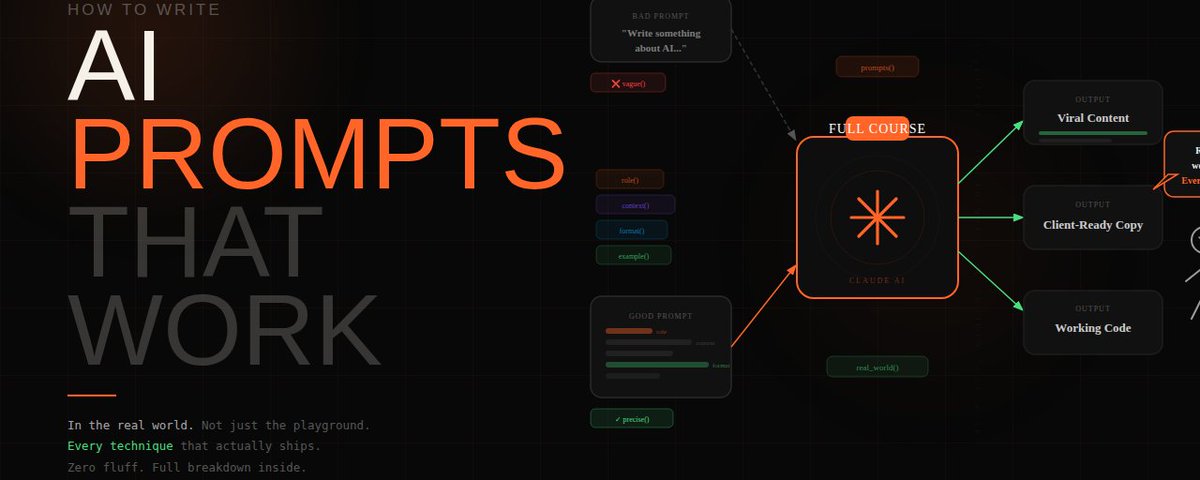
Not theory. Real prompts that ship real things.
Everyone teaches prompt engineering wrong.
They hand you a list of tips like "be specific" and "give context" and then send you off to figure it out yourself. You copy their example prompt, try it on your actual problem, and it falls flat.
That is because most prompt engineering content is written by people who experiment in sandboxes. Not people who are shipping products, writing 20 pieces of content a week, or building tools that need to work reliably every single time.
I am not here to teach you the theory. I am going to show you the exact prompts I use to build real things. Signal bots. Content systems. Research tools. Articles. All of it.
By the end of this, you will have a working mental model and a set of prompts you can drop into Claude today and get output worth using.
## Why Most Prompts Fail
Before the good stuff, let us get clear on why your prompts are probably underperforming.
There are three reasons.
One: You are being vague without realizing it.
"Write me a tweet about AI" is vague. "Write me a tweet about why most people will be replaced by AI agents within 5 years, written in a punchy controversial tone, with a hook that starts with a bold claim in all caps, and ends with a question that makes the reader uncomfortable" is specific.
Vague input always produces generic output. Claude is not a mind reader. The more detail you load in, the more useful the result.
Two: You are not giving Claude a role.
Claude is capable of being a seasoned copywriter, a senior developer, a brutal editor, or a market analyst. But if you do not tell it what role to play, it defaults to being a helpful assistant. Which is fine for casual questions and useless for serious work.
The moment you assign a role, output quality jumps.
Three: You have no format constraint.
If you do not specify format, length, structure, or style, you get whatever Claude thinks is appropriate. Sometimes that is great. Most of the time it is a generic multi-paragraph essay when you wanted three punchy bullet points.
Format is part of the prompt. Always.
## The Prompt Stack I Actually Use
Here is the framework I run on every serious prompt. I call it RACE.
R — Role: Who is Claude in this task? A — Action: What exactly needs to happen? C — Context: What background does Claude need? E — Example or Format: What should the output look like?
That is it. Four elements. Every prompt that fails is missing at least one of them.
## Section 1: Content Prompts That Convert
I write a lot. Tweets, threads, newsletters, long-form articles. And I learned early that the difference between content that gets bookmarked and content that gets skipped is specificity in the prompt.
Here is the tweet prompt I use when I want something that actually gets engagement.
You are a crypto and AI content creator with 140K followers on X.
Your audience is builders, traders, and early adopters who want to stay ahead of the curve.
Write a tweet using this exact structure:
- First line: bold claim in ALL CAPS that creates immediate tension or FOMO
- Lines 2 to 4: short punchy sentences that back up or contrast the claim
- Line 5 to 6: a personal insight or observation
- Final line: a question or single call to action
Topic: [INSERT TOPIC]
Tone: direct, no fluff, slightly controversial, no hashtags
Rules:
- No dashes
- No AI-sounding words like "delve", "harness", "game-changer"
- Each line stands alone. No bunching into paragraphs.
- Maximum 280 characters but aim for 220
That prompt has produced some of my best performing content. The reason it works is that it bakes the structure into the prompt itself. Claude does not have to guess what I want. The format is pre-loaded.
Now here is the thread prompt I use when I want something educational that also builds authority.
You are an expert educator writing a Twitter thread for an audience of ambitious solo builders and crypto-native creators.
Write a 7-tweet thread on: [TOPIC]
Rules:
- Tweet 1 is the hook. It must start with a bold statement or surprising fact. No "In this thread" openers.
- Tweets 2 through 6 each cover one practical insight or actionable tip
- Tweet 7 is the summary and soft CTA. Something like "follow me for more" written naturally, not salesy
- Every tweet stands alone with its own line breaks
- No bullet points inside tweets. Prose only.
- No dashes
- Use CAPS sparingly but strategically for emphasis
- Voice: seasoned, direct, slightly contrarian, human
## Section 2: Research and Analysis Prompts
This is where prompt engineering gets underrated. Most people use Claude for writing. The builders who pull ahead use it for research.
Here is the prompt I use when I need to understand a new crypto narrative fast.
You are a senior crypto analyst with 10 years of experience covering DeFi, L1s, and emerging narratives.
I need a fast breakdown of: [TOPIC OR PROJECT NAME]
Structure your response as follows:
1. What it is (2 sentences max, no jargon)
2. Why it matters right now (market timing, catalysts, narrative fit)
3. The bull case (3 specific points)
4. The bear case or main risk (2 specific points)
5. Who is most likely to benefit
6. One thing most people are getting wrong about this
Tone: sharp, analytical, no hype. Write like you are briefing a seasoned trader who has 5 minutes.
I use this before I write any market commentary. It gives me a structured foundation I can then write from in my own voice.
Here is another one I use for competitive research on tools or products I want to understand.
You are a product strategist doing a competitive teardown.
Analyze: [PRODUCT OR TOOL NAME]
Cover:
1. Core value proposition (one sentence)
2. Who the ideal user is
3. Three things they do better than competitors
4. Three things they do worse or have not solved
5. The business model
6. The biggest threat to their growth
7. One insight that most people reviewing this product miss
Keep each section to 3 sentences or less. Be specific. No generic observations.
## Section 3: Code and Build Prompts
If you are building with Claude, the quality of your prompts is the difference between shipping in two hours and spending two days debugging garbage.
Here is the system prompt I use when I open a new build session.
You are a senior software developer with 20 years of experience.
You write clean, minimal, production-ready code. You do not over-engineer. You do not explain what you are going to do before doing it. You just build.
When I give you a task:
- Write the complete code, not pseudocode
- Use the simplest solution that works
- If you need to make an assumption, state it in one line at the top, then proceed
- If there are edge cases I should know about, list them after the code, not before
- Never ask clarifying questions unless the task is genuinely impossible to interpret
My stack: [INSERT YOUR STACK]
This system prompt alone cuts a huge amount of back and forth. Claude stops hedging and starts building.
Here is the debugging prompt I use when something is broken and I need it fixed fast.
You are debugging this code. Do not rewrite everything. Fix only what is broken.
Here is the code:
[PASTE CODE]
Here is the error:
[PASTE ERROR MESSAGE]
Here is what I expect to happen:
[DESCRIBE EXPECTED BEHAVIOR]
Here is what is actually happening:
[DESCRIBE ACTUAL BEHAVIOR]
Give me the fixed version with a one-line explanation of what was wrong. That is it.
Short. Specific. No room for Claude to over-explain or rewrite things that do not need rewriting.
## Section 4: Long-Form Article Prompts
Writing 2,000 to 3,000 word articles at scale without losing quality is one of the hardest content challenges. Most AI-assisted articles read like AI wrote them. Here is how I avoid that.
The key is giving Claude a voice brief alongside the topic.
You are ghostwriting a long-form article for a crypto and AI content creator named Cyril.
Voice rules:
- Direct and confident. Never hedges with phrases like "it might be worth considering"
- No fluff intros. Get to the point in the first paragraph
- Uses CAPITALIZATION strategically for emphasis, not randomly
- No dashes in writing
- Short punchy sentences. Varies length for rhythm.
- Occasionally contrarian. Challenges conventional wisdom.
- Sounds like a real person who has done the thing, not researched it
Article title: [TITLE]
Target length: [WORD COUNT]
Target audience: [AUDIENCE]
Main argument: [ONE SENTENCE DESCRIBING THE CORE THESIS]
Structure:
- Intro: hook the reader with a bold claim or uncomfortable truth
- Body: [NUMBER] sections each with a subheading, practical insight, and example
- Outro: end with a call to action that does not feel forced
Do not use the word "delve", "harness", "game-changer", "unlock", or "leverage" anywhere.
That voice brief section is the most important part. Without it you get generic prose. With it, the output sounds like a real writer with a point of view.
## Section 5: Editing and Refinement Prompts
The most underused prompt category. Once you have a draft, use Claude to sharpen it instead of starting from scratch.
Here is my editing prompt.
You are a brutal editor. Your job is not to make this sound better. Your job is to cut everything that does not earn its place.
Here is the draft:
[PASTE DRAFT]
Do the following:
1. Cut any sentence that repeats a point already made
2. Replace any vague word with a specific one
3. Shorten any sentence over 25 words
4. Flag any paragraph that does not move the reader forward
5. Rewrite the first sentence if it is weak
Return the edited version. Then below it, give me a 3-bullet list of the biggest structural issues if any remain.
Here is a simpler one I use when I just want to punch up a headline or hook.
Give me 10 alternative versions of this headline. Make them progressively more bold and controversial. Do not explain them. Just list them.
Original: [HEADLINE]
Running this takes 30 seconds and almost always surfaces something better than what I started with.
## Section 6: The Meta-Prompt
This is the one most people do not know about.
When you do not know how to write a prompt for something, ask Claude to write the prompt for you.
I need to accomplish this task: [DESCRIBE THE TASK]
Write me a detailed prompt I can use to get Claude to do this well.
The prompt should include:
- A role for Claude
- Clear instructions
- Format requirements
- Any rules or constraints that would improve output quality
Return only the prompt. No explanation.
This sounds recursive and it is. But it works. Claude knows what makes a good prompt. Use that knowledge to bootstrap tasks you do not know how to structure yet.
## The Prompts That Ship Real Things
Let me bring this back to the core point.
Prompt engineering is not about memorizing frameworks or reading academic papers. It is about understanding one thing:
CLAUDE WILL DO EXACTLY WHAT YOU TELL IT TO DO.
The gap between what you wanted and what you got is almost always a communication problem, not a model problem. The more clearly you specify the role, the action, the context, and the format, the closer the output lands to what you actually need.
The prompts in this article are not hypothetical. I use them to run a content operation, build tools, and ship products.
Start with the ones closest to your current problem. Use them exactly. Then tweak based on what the output gives you.
That is prompt engineering in practice.
Not theory. Not sandbox experiments. Real prompts that build real things.
## Quick Reference: Prompt Templates
Tweet prompt — Role + structure + topic + format rules
Thread prompt — Role + 7-tweet structure + voice constraints
Research prompt — Role + topic + numbered breakdown format
Build session — Senior dev role + no-hedging rules + your stack
Debug prompt — Code + error + expected vs actual + fix only what is broken
Article prompt — Voice brief + title + structure + banned words
Editing prompt — Brutal editor role + specific edit tasks + flag issues
Meta-prompt — Describe task and let Claude write the prompt for you
Want to go deeper on building with Claude?
Follow @cyrilXBT on X for daily AI and builder content.
## 相关链接
- [CyrilXBT](https://x.com/cyrilXBT)
- [@cyrilXBT](https://x.com/cyrilXBT)
- [16K](https://x.com/cyrilXBT/status/2055672735343243499/analytics)
- [@cyrilXBT](https://x.com/@cyrilXBT)
- [Upgrade to Premium](https://x.com/i/premium_sign_up)
- [11:32 PM · May 16, 2026](https://x.com/cyrilXBT/status/2055672735343243499)
- [16K Views](https://x.com/cyrilXBT/status/2055672735343243499/analytics)
- [View quotes](https://x.com/cyrilXBT/status/2055672735343243499/quotes)
---
*导出时间: 2026/5/17 15:24:36*
---
## 中文翻译
# 如何编写在现实世界中有效的 AI 提示(完整教程)
**作者**: CyrilXBT
**日期**: 2026-05-16T15:32:27.000Z
**来源**: [https://x.com/cyrilXBT/status/2055672735343243499](https://x.com/cyrilXBT/status/2055672735343243499)
---

不是理论。而是能交付实际成果的真实提示。
每个人教提示工程的方法都错了。
他们会给你一张清单,上面写着“要具体”、“给背景”,然后让你自己去摸索。你复制了他们的示例提示,用在自己的实际问题上一试,结果彻底失败。
这是因为大多数提示工程内容是由在沙盒里做实验的人写的。而不是那些正在发布产品、每周写 20 篇内容,或者构建每次都需要稳定运行的工具的人。
我不是来这里教你理论的。我将向你展示我用来构建真实事物的确切提示。信号机器人。内容系统。研究工具。文章。所有这一切。
看完这个,你将拥有一个可用的思维模型和一套提示,你可以直接把它们丢进 Claude,并获得值得使用的输出。
## 为什么大多数提示会失败
在讲干货之前,我们要先弄清楚为什么你的提示表现不佳。
有三个原因。
一:你在不自知的情况下含糊其辞。
“给我写一条关于 AI 的推文”是含糊的。“给我写一条推文,阐述为什么大多数人会在 5 年内被 AI 代理取代,语调要有力且具争议性,开头要用全大写的惊人言论做钩子,结尾要提一个让读者感到不适的问题”则是具体的。
含糊的输入总是产生通用的输出。Claude 不是读心者。你加载的细节越多,结果就越有用。
二:你没有赋予 Claude 一个角色。
Claude 可以是一位资深的文案、高级开发人员、严厉的编辑或市场分析师。但如果你不告诉它扮演什么角色,它默认会成为一个好心的助手。这对随意的问题没问题,但对严肃的工作毫无用处。
一旦你分配了角色,输出质量就会跃升。
三:你没有格式限制。
如果你不指定格式、长度、结构或风格,你会得到 Claude 认为合适的任何东西。有时那很棒。但大多数时候,当你想要三句有力的要点时,它却给你一篇通用的多段落文章。
格式是提示的一部分。永远都是。
## 我实际使用的提示框架
这是我在每个严肃提示上运行的框架。我称之为 RACE。
R — Role(角色):Claude 在这个任务中是谁?
A — Action(行动):具体需要发生什么?
C — Context(背景):Claude 需要什么背景信息?
E — Example or Format(示例或格式):输出应该是什么样子的?
就这样。四个要素。每一个失败的提示都至少缺少其中之一。
## 第 1 部分:能转化的内容提示
我写很多东西。推文、推文串、通讯、长文。我很早就学到,内容是被收藏还是被跳过,区别在于提示的具体程度。
这是我在想要真正获得互动时使用的推文提示。
你是一位加密货币和 AI 内容创作者,在 X 上有 14 万粉丝。
你的受众是想要保持领先优势的构建者、交易员和早期采用者。
使用以下确切结构写一条推文:
- 第一行:全大写的惊人言论,制造即时的紧张感或错失恐惧(FOMO)
- 第 2 到 4 行:简短有力的句子,支持或对比该言论
- 第 5 到 6 行:个人见解或观察
- 最后一行:一个问题或单一的行动号召
主题:[插入主题]
语调:直接、无废话、略带争议、无标签(话题标签)
规则:
- 无破折号
- 不用像 “delve”、“harness”、“game-changer” 这样听起来像 AI 的词
- 每一行独立存在。不要聚集成段落。
- 最多 280 个字符,但目标是 220 个
这个提示产生了我一些表现最好的内容。它有效的原因是它将结构直接 baked(烘焙)进了提示中。Claude 不必猜测我想要什么。格式是预加载的。
现在这是我在想要具有教育意义且能建立权威感时使用的推文串提示。
你是一位专业教育家,正在为雄心勃勃的独立构建者和加密原生创作者写一个推文串。
写一个关于:[主题] 的 7 条推文串
规则:
- 第 1 条推文是钩子。必须以大胆的陈述或令人惊讶的事实开头。不要用“在这个推文串里”这样的开场白。
- 第 2 到 6 条推文各涵盖一个实用的见解或可操作的建议
- 第 7 条推文是总结和温和的行动号召。比如“关注我获取更多”,要写得自然,不要有推销感
- 每条推文独立存在,带有自己的换行符
- 推文内部不要用要点。只允许散文。
- 不要破折号
- 谨慎但策略性地使用全大写字母以示强调
- 语气:资深、直接、略带反骨、像真人
## 第 2 部分:研究和分析提示
这是提示工程被低估的地方。大多数人用 Claude 来写作。那些脱颖而出的构建者用它来做研究。
这是当我需要快速理解一个新的加密叙事时使用的提示。
你是一位拥有 10 年经验的高级加密分析师,涵盖 DeFi、L1 和新兴叙事。
我需要一个关于:[主题或项目名称] 的快速分析
按以下结构构建你的回复:
1. 它是什么(最多 2 句话,无行话)
2. 为什么它在当下重要(市场时机、催化剂、叙事契合度)
3. 多头理由(3 个具体点)
4. 空头理由或主要风险(2 个具体点)
5. 谁最有可能受益
6. 关于这一点大多数人都弄错的一件事
语调:犀利、分析性、无炒作。写得像你在向一位只有 5 分钟时间的资深交易员做简报。
我在写任何市场评论之前都会使用这个。它为我提供了一个结构化的基础,然后我可以用自己的语调进行写作。
这是另一个我用于想要了解的工具或产品的竞争性研究的提示。
你是一位正在进行竞争性拆解的产品策略师。
分析:[产品或工具名称]
涵盖:
1. 核心价值主张(一句话)
2. 理想用户是谁
3. 他们比竞争对手做得好的三件事
4. 他们做得不好或尚未解决的三件事
5. 商业模式
6. 他们面临的最大增长威胁
7. 大多数评论者忽略的一个见解
每个部分保持在 3 句话以内。要具体。不要通用观察。
## 第 3 部分:代码和构建提示
如果你正在使用 Claude 构建,你的提示质量是决定了是 2 小时交付还是花 2 天调试垃圾代码的关键。
这是我在开始新的构建会话时使用的系统提示。
你是一位拥有 20 年经验的高级软件工程师。
你编写干净、极简、生产就绪的代码。你不过度设计。你在做之前不解释你要做什么。你只管构建。
当我给你一个任务时:
- 编写完整的代码,而不是伪代码
- 使用可行的最简单解决方案
- 如果你需要做假设,在顶部用一行说明,然后继续
- 如果有我应该知道的边缘情况,在代码之后列出,而不是之前
- 永远不要问澄清问题,除非该任务真的无法解读
我的技术栈:[插入你的技术栈]
光是这个系统提示就减少了大量的来回拉扯。Claude 停止打太极,开始构建。
这是当东西坏了而我需要快速修复时使用的调试提示。
你正在调试这段代码。不要重写所有内容。只修复坏了的部分。
这是代码:
[粘贴代码]
这是错误:
[粘贴错误信息]
这是我期望发生的:
[描述期望行为]
这是实际发生的:
[描述实际行为]
给我修复后的版本,并用一行解释哪里错了。就这样。
简短。具体。不给 Claude 留下过度解释或重写不需要重写部分的空间。
## 第 4 部分:长文提示
在不失去质量的情况下大规模撰写 2,000 到 3,000 字的文章是最难的内容挑战之一。大多数 AI 辅助的文章读起来就像 AI 写的。以下是我避免这种情况的方法。
关键是在主题之外给 Claude 一份语调简报。
你正在为一位名为 Cyril 的加密货币和 AI 内容创作者代笔写一篇长文。
语调规则:
- 直接且自信。永远不要用像“这可能值得考虑”这样的短语来以此打掩护
- 没有废话的开头。在第一段直奔主题
- 策略性地使用大写字母以示强调,而不是随意使用
- 写作中不要用破折号
- 简短有力的句子。变化长度以调整节奏。
- 偶尔持反观点。挑战传统智慧。
- 听起来像一个真正做过这件事的人,而不是研究过它的人
文章标题:[标题]
目标长度:[字数]
目标受众:[受众]
主要论点:[一句话描述核心论题]
结构:
- 开头:用一个大胆的言论或令人不舒服的真相吸引读者
- 正文:[数字] 个部分,每个部分都有小标题、实用见解和例子
- 结尾:以一个不生硬的行动号召结束
任何地方都不要使用 “delve”、“harness”、“game-changer”、“unlock” 或 “leverage” 这些词。
那个语调简报部分是最重要的。没有它,你得到的都是通用散文。有了它,输出的声音就像一个真正有观点的作家。
## 第 5 部分:编辑和润色提示
这是最未被充分利用的提示类别。一旦你有了草稿,用 Claude 来打磨它,而不是从头开始。
这是我的编辑提示。
你是一位严厉的编辑。你的工作不是让它听起来更好。你的工作是删减所有不该存在的内容。
这是草稿:
[粘贴草稿]
执行以下操作:
1. 删除任何重复观点的句子
2. 用具体的词替换任何模糊的词
3. 缩短任何超过 25 个单词的句子
4. 标记任何不能推动读者前进的段落
5. 如果第一句很弱,重写它
返回编辑后的版本。然后在下方,如果有遗留的结构性问题,给我一个 3 点的列表。
这是一个更简单的版本,当我只是想优化标题或钩子时使用。
给我这个标题的 10 个替代版本。让它们逐渐变得更大胆和更具争议性。不要解释它们。只列出它们。
原标题:[标题]
运行这个需要 30 秒,几乎总能找到比我开始时更好的东西。
## 第 6 部分:元提示
这是大多数人不知道的一个。
当你不知道如何为某事编写提示时,让 Claude 为你编写提示。
我需要完成这个任务:[描述任务]
给我写一个详细的提示,我可以用它来让 Claude 很好地完成这件事。
提示应包括:
- Claude 的角色
- 清晰的指令
- 格式要求
- 任何能提高输出质量的规则或约束
只返回提示。没有解释。
这听起来是递归的,确实是。但它有效。Claude 知道什么构成了一个好的提示。利用这些知识来引导你还不知道如何构建的任务。
## 能交付实际成果的提示
让我回到核心点。
提示工程不是关于记忆框架或阅读学术论文。它是关于理解一件事:
Claude 会完全按照你告诉它的去做。
你想要的和你得到的之间的差距几乎总是一个沟通问题,而不是模型问题。你越清楚地指定角色、行动、背景和格式,输出就越接近你实际需要的东西。
这篇文章中的提示不是假设。我使用它们来运营内容业务、构建工具和发布产品。
从最接近你当前问题的那个开始。完全照着用。然后根据输出的结果进行调整。
这就是实践中的提示工程。
不是理论。不是沙盒实验。构建真实事物的真实提示。
## 快速参考:提示模板
推文提示 — 角色 + 结构 + 主题 + 格式规则
推文串提示 — 角色 + 7 条推文结构 + 语调约束
研究提示 — 角色 + 主题 + 编号分解格式
构建会话 — 资深开发角色 + 不打太极规则 + 你的技术栈
调试提示 — 代码 + 错误 + 期望与实际 + 只修复坏了的部分
文章提示 — 语调简报 + 标题 + 结构 + 禁用词
编辑提示 — 严厉编辑角色 + 具体编辑任务 + 标记问题
元提示 — 描述任务并让 Claude 为你编写提示
想深入了解如何使用 Claude 构建?
在 X 上关注 @cyrilXBT 以获取每日 AI 和构建者内容。