# I Spent 30 Days Building Only With Claude. I Haven't Opened Figma Since.
**作者**: CyrilXBT
**日期**: 2026-04-18T14:22:10.000Z
**来源**: [https://x.com/cyrilXBT/status/2045508188808565152](https://x.com/cyrilXBT/status/2045508188808565152)
---
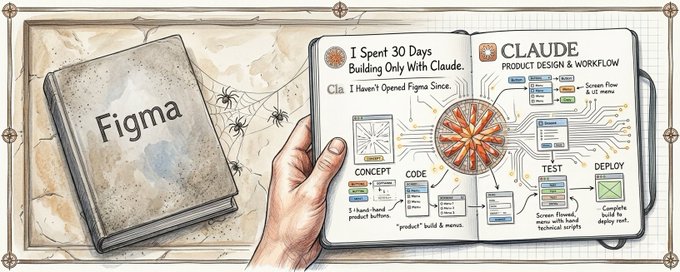
Thirty days ago I opened Figma to start a new project. I stared at the blank canvas for about four minutes. Then I closed it and opened Claude instead. That was the last time I used Figma.
I did not plan for that to happen.
I have been using design tools since 2019. Figma was part of my daily stack. I knew every shortcut. I had templates saved. I had component libraries I had spent months building out. None of that mattered when I started actually sitting with Claude for entire build sessions instead of just using it to write captions or fix a bug.
What happened over 30 days changed how I think about building entirely.
This is not a hot take. This is a documented account of what actually shifted and why I have not gone back.
## Why I Even Started This
I run a solo operation.
No co-founder. No design team. No developers on retainer. Just me, a laptop, and a stack of tools I have been iterating on for years. I build crypto tools, AI dashboards, content products, and scanners. Most of them I ship quietly, test with my audience, and iterate based on what actually gets used.
The problem with being solo is that every hour you spend on one thing is an hour you are not spending on something else. Design always took longer than I wanted it to. Not because I was bad at it. Because design decisions have infinite surface area. Colors, spacing, typography, component hierarchy, responsive behavior. Every one of those decisions requires a choice and every choice costs time.
I started experimenting with using Claude for full build sessions after noticing that the tools I was building inside Claude conversations were actually looking decent. Not placeholder decent. Actually usable.
So I made a rule for myself. 30 days. Every build starts in Claude. I do not open Figma unless Claude gives me something it genuinely cannot solve.
I never opened Figma.
## Week One: Learning to Prompt Like a Senior Designer
The first thing I learned is that Claude is not magic out of the box.
If you prompt it the way most people do you will get generic output. Safe output. The kind of output that looks like every other AI-generated UI you have ever closed a tab on.
The shift happened when I started treating my prompts the way a creative director talks to a designer. Not "make me a dashboard" but rather a full design brief with personality, constraints, aesthetic direction, and user context baked in.
Here is the prompt structure I landed on by day 6:
Once I had that framework the output quality jumped immediately.
By day 7 I had shipped a working dark-mode dashboard for Signal Bot Pro that would have taken me 3 days in Figma plus another 2 to hand off to a developer. Claude gave me production-ready HTML, CSS, and JavaScript in a single session. I refined it across two follow-up messages.
Total time: 4 hours.
## Week Two: The Iteration Loop Nobody Talks About
The thing people miss about building with Claude is not the first output.
It is the iteration speed.
In Figma, when you want to change a component you open the file, find the component, modify it, check how it cascades, update the variants, and re-export everything that changed. That process has friction at every step.
In Claude, iteration is a conversation. You say what is wrong and it fixes it. You describe a different direction and it rewrites. You paste in feedback and it responds to each point.
On day 11 I was building a landing page for a new tool I was testing. I went through 6 complete design iterations in one afternoon. Not tweaks. Full direction changes. Different font pairings, different layout structures, different color schemes. Each iteration took about 8 minutes.
That would have been 3 days of Figma work.
Here is the exact iteration prompt I use when I want to pivot the direction without losing the functionality:
The "give me the full updated code, not a diff" line matters. It keeps the session clean and prevents compounding errors across partial updates.
## Week Three: Things I Did Not Expect Claude to Handle
By week three I stopped being surprised.
I expected Claude to handle UI. I did not expect it to handle the design decisions I used to agonize over.
Font pairing. Color accessibility. Spacing systems. Layout hierarchy. Responsive breakpoints. Dark mode token structures. All of it.
I built a newsletter template on day 16. I gave Claude my brand colors, told it I wanted an editorial dark aesthetic, and asked for a two-column layout with a market snapshot sidebar. What came back had:
A properly structured CSS variable system for theming. Responsive behavior that actually worked on mobile without me asking for it. Font pairing I would not have chosen myself but was objectively better than what I had planned. Semantic HTML that would have taken me an hour to structure manually.
Here is what that prompt looked like:
The first output was 80 percent there. Two follow-up messages got it to production.
## The Design Decisions I Stopped Making
Here is what actually changed in how I work.
Before: I would spend 45 minutes choosing a font combination. I would open Google Fonts, browse for too long, second-guess myself, test it in the design, and usually end up with something safe.
After: I describe the feeling I want and the context and let Claude pair the fonts. I have started discovering combinations I would never have chosen that are genuinely better.
Before: I would spend an hour building out a color system. Figuring out shades, accessibility contrast ratios, dark mode equivalents.
After: I give Claude my primary brand colors and ask for a full token system. It handles the math and the logic.
Before: I would prototype interactions in Figma, then rebuild them in code, then fix the gaps between how they looked in prototype and how they behaved in the browser.
After: I skip the prototype entirely. I build directly in code inside the Claude session. What I see is what ships.
The compound effect of removing those decision points from my day is enormous. Not just in time saved. In cognitive load. I go into build sessions thinking about the product and the user, not about whether 16px or 18px is the right body font size.
## What Claude Still Cannot Do (Be Honest)
I am not going to pretend this is perfect.
There are things Claude gets wrong consistently and you need to know them going in.
Complex responsive behavior breaks sometimes. If you have a very specific grid that needs to reflow across 4 breakpoints in a particular way, Claude will get close but you will spend time debugging edge cases. Budget for it.
Animation that requires precise timing. Claude can write CSS animations but the feel of a micro-interaction requires a human eye and iteration. It gets you 70 percent of the way there but the last 30 percent is yours to finish.
Anything that requires visual judgment against an existing brand system. If you have a highly specific existing design language Claude does not know, you have to document it in extreme detail in your prompt or you will get approximations.
Visual hierarchy on complex pages. If there are more than 6 distinct content types on one page Claude starts making choices that are functional but not necessarily right for your specific context. You need to give it a stronger brief.
None of these are dealbreakers. They are just things to know so you do not go in with unrealistic expectations.
## The Number That Made Me Realize This Was Real
By day 23 I had shipped 6 tools, 2 landing pages, 1 newsletter template, 3 Telegram promotional graphics, and a full dashboard.
In a normal month before this experiment I would ship maybe 2 of those things. The rest would be in a Figma file somewhere in progress.
The constraint of being solo has always been output speed. You have ideas faster than you can build. That gap between idea velocity and build velocity is where most solo products go to die.
Claude compresses that gap. Not eliminates. Compresses.
I have more shipped, tested, real things to learn from than I have ever had in a single month.
That feedback loop is the real product. Not any individual tool I shipped.
## How I Structure a Build Session Now
For anyone who wants to actually try this, here is exactly how I run a session end to end.
Step 1: The Brief
I write a full brief before I open Claude. Who is this for. What does it need to do. What should it feel like. What are the hard constraints. I write this in plain language like I am briefing someone on Slack.
Step 2: The First Prompt
I paste the brief with my standard designer prompt framework at the top. I ask for the full production code on the first pass, not a plan or an outline.
Step 3: Review in Browser Immediately
I paste the output into a local HTML file or a code sandbox and open it in the browser immediately. I do not read the code first. I look at the output like a user would.
Step 4: Single Focused Feedback
I give Claude one area of feedback at a time. Not a list of 12 things. One thing. This keeps the output clean and the iteration tight.
Step 5: Lock and Ship
When it is 90 percent right I stop iterating and ship. The last 10 percent is for version two after real users have touched it.
## Why I Have Not Opened Figma
I want to be clear about something.
I did not abandon Figma because Claude is better at design. Figma is a more powerful visual tool. A skilled designer in Figma can do things Claude cannot replicate.
I stopped opening Figma because the bottleneck in my operation was never design skill.
It was output speed.
The question I kept asking in that tool was "is this pixel-perfect" when the question I should have been asking was "is this shipped and in front of real people."
Claude answered the second question better than any tool I have used.
I am not a designer who became a builder. I am a builder who used to get stuck in design. That distinction matters. If your identity is in the craft of visual design, Claude is a collaborator, not a replacement. If your identity is in shipping products and seeing what works, Claude is the fastest path from idea to real.
Thirty days of evidence told me which one I am.
The tab is still closed.
Follow @cyrilxbt for more AI content
## 相关链接
- [CyrilXBT](https://x.com/cyrilXBT)
- [@cyrilXBT](https://x.com/cyrilXBT)
- [45K](https://x.com/cyrilXBT/status/2045508188808565152/analytics)
- [@cyrilxbt](https://x.com/@cyrilxbt)
- [Upgrade to Premium](https://x.com/i/premium_sign_up)
- [10:22 PM · Apr 18, 2026](https://x.com/cyrilXBT/status/2045508188808565152)
- [45K Views](https://x.com/cyrilXBT/status/2045508188808565152/analytics)
- [View quotes](https://x.com/cyrilXBT/status/2045508188808565152/quotes)
---
*导出时间: 2026/4/19 22:13:35*