# How to Turn Obsidian Into a Personal Operating System That Never Breaks Down
**作者**: CyrilXBT
**日期**: 2026-05-20T02:26:13.000Z
**来源**: [https://x.com/cyrilXBT/status/2056924424838815824](https://x.com/cyrilXBT/status/2056924424838815824)
---
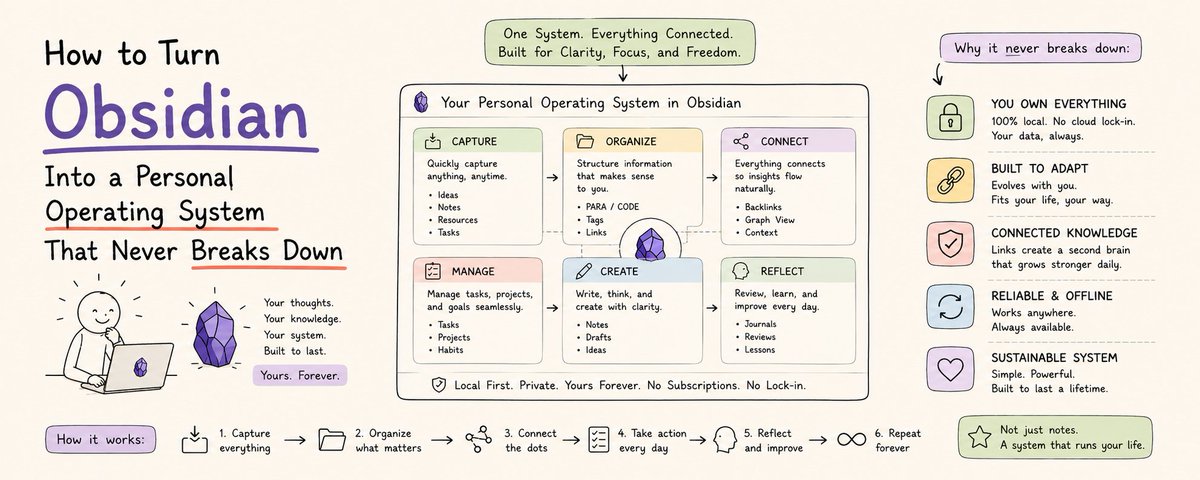
Most productivity systems break down for the same reason.
They are designed for good days.
On a good day you have the time and energy to maintain the system. You file notes correctly. You update project statuses. You review your inbox. You process everything that came in.
On a bad day the system becomes a source of guilt rather than leverage. You have not processed the inbox in four days. Notes are piled in random folders. Project statuses are weeks out of date.
You stop using the system because maintaining it takes more energy than it saves.
The Obsidian personal operating system is designed differently.
It is not designed for good days.
It is designed to survive bad ones.
The architecture maintains itself when you are overwhelmed, produces useful output when you are inconsistent, and compounds intelligently whether you are actively curating it or not.
This guide is the complete build for an Obsidian system that runs your life and never breaks down regardless of what life throws at you.
## Why Most Obsidian Systems Break
Before the build you need to understand why the systems most people build do not last.
They break for three reasons.
Manual maintenance burden. The system requires you to update it regularly to stay accurate. Project statuses need manual updates. Dashboards need manual refreshing. Tags need manual application. When life gets busy the maintenance falls behind and the system becomes unreliable. An unreliable system gets abandoned.
Complexity that compounds over time. People start with a simple structure and add complexity every time they encounter a problem the current system does not handle. Six months later they have a baroque architecture that takes 20 minutes to navigate and requires reading documentation they wrote themselves to understand.
No intelligence layer. The vault stores information but does not reason about it. You capture ideas but never find them again. You take meeting notes but never surface the action items when they become relevant. The system is an archive not an intelligence.
The operating system architecture solves all three.
Manual maintenance disappears because Claude Code connected via MCP maintains the system automatically.
Complexity stays controlled because the architecture has a fixed number of components each with a specific function and no component duplicates another.
Intelligence gets added through Claude which reads the vault, makes connections, surfaces relevant information, and generates outputs that the vault alone cannot produce.
## The Three-Layer Architecture
The personal operating system has three distinct layers.
Layer 1: The Storage Layer
This is Obsidian itself. Plain text Markdown files organized in a consistent structure. Every piece of information your life generates lives here in a format that is human-readable, machine-readable, and permanent.
Layer 2: The Intelligence Layer
This is Claude Code connected to your vault via the Filesystem MCP. Claude reads your files, makes connections across them, generates outputs from them, and updates them based on what happens in your life.
Layer 3: The Automation Layer
This is N8N running on a $5 server. It schedules workflows, fires triggers, calls the Claude API, and passes information between systems without you initiating anything.
These three layers are what transform a collection of notes into an operating system.
Remove any one layer and you have something less.
Storage without intelligence is an archive.
Storage with intelligence but without automation is a tool you use.
All three together is a system that operates.
## The Vault Structure That Never Breaks
The vault structure is the foundation of everything. Get this right and the system stays coherent as it grows. Get it wrong and it becomes a maze.
The structure has eight folders. Every note in your entire vault belongs in exactly one of them. No folder is optional. No folder overlaps with another.
00 - CAPTURE/
[Everything unprocessed lands here]
01 - ACTIVE/
projects/
[project-name]/
overview.md
tasks/
notes/
outputs/
areas/
health/
finances/
relationships/
learning/
career/
daily/
[YYYY-MM-DD].md
02 - RESOURCES/
research/
references/
templates/
bookmarks/
03 - SYSTEM/
CLAUDE.md
skills/
workflows/
logs/
04 - GENERATED/
briefings/
summaries/
analyses/
drafts/
05 - QUEUE/
[pending tasks for Claude]
06 - CALENDAR/
events/
reviews/
07 - ARCHIVE/
[completed projects and outdated content]
The logic behind every folder:
00 - CAPTURE exists because capture and processing are separate activities. You capture at the speed of thought. You process at the speed of attention. The capture folder absorbs everything without judgment so nothing gets lost because processing was too slow.
01 - ACTIVE contains only what is alive right now. Projects you are working on. Areas of your life you are responsible for. Daily notes. Nothing historical. Nothing aspirational. Only current.
02 - RESOURCES is the reference library. Things you might need someday. Not things you are working on now.
03 - SYSTEM is the operating system itself. CLAUDE.md. Skill files. Workflow definitions. Logs. The infrastructure layer.
04 - GENERATED is where Claude deposits outputs. Never manually edit files here. They are system outputs.
05 - QUEUE is the inbox for Claude tasks. You drop files here describing what you need. Claude processes them. Outputs land in GENERATED.
06 - CALENDAR tracks time-based information. Upcoming events. Periodic reviews. Things organized by when rather than what.
07 - ARCHIVE is where things go when they are complete. Projects you finished. References that are outdated. Never delete. Archive.
## The CLAUDE.md That Makes It Intelligent
The CLAUDE.md is the document that tells Claude everything about your life before any workflow runs.
Without it every Claude session starts from zero. With it every session starts from complete context about who you are, what you are working on, and what matters right now.
# Personal Operating System — CLAUDE.md
## Identity
Name: [YOUR NAME]
Role: [YOUR PRIMARY ROLE]
Location: [YOUR CITY]
## Life Areas and Current Status
Health: [BRIEF STATUS — e.g., "Training for half marathon,
running 4x per week"]
Finances: [BRIEF STATUS — e.g., "Saving for house deposit,
target by December 2026"]
Relationships: [BRIEF STATUS — e.g., "Partner: [name].
Key friendships to maintain: [names]"]
Learning: [BRIEF STATUS — e.g., "Currently studying:
[topic]. Goal: [outcome]"]
Career: [BRIEF STATUS — e.g., "Current role: [title].
Working toward: [goal]"]
## Active Projects
[PROJECT NAME]: [ONE-SENTENCE DESCRIPTION] |
Status: [STATUS] | Next: [SPECIFIC NEXT ACTION]
[Repeat for every active project]
## Current Priorities
1. [MOST IMPORTANT THING THIS WEEK]
2. [SECOND MOST IMPORTANT]
3. [THIRD MOST IMPORTANT]
## Standards for Generated Content
Voice: [HOW YOU WRITE AND COMMUNICATE]
Format preferences: [YOUR PREFERENCES]
What you never want: [SPECIFIC THINGS TO AVOID]
## Operating Rules
- Never delete files. Move to ARCHIVE with timestamp.
- Never send communications without human review.
- Always date-stamp generated files as YYYY-MM-DD.
- Log every significant action in SYSTEM/logs/operations.md.
- When uncertain about placement, use GENERATED and flag.
## Update Schedule
This file is reviewed and updated: [YOUR SCHEDULE —
e.g., every Monday morning]
Update the Current Priorities section every Monday morning. This is the single most important maintenance habit in the entire system. Five minutes of honest reflection on what actually matters this week dramatically improves the relevance of everything the system generates.
## The Five Workflows That Make It an Operating System
Five workflows transform the vault from a storage system into an operating system.
Each one runs automatically. Each one outputs to GENERATED. Each one maintains itself without your manual intervention.
Workflow 1: The Daily Morning Briefing
Every morning at 6AM this workflow reads your vault and generates a briefing.
The Claude prompt:
Read CLAUDE.md for full life context.
Generate a morning briefing covering:
MOST IMPORTANT TODAY: The single highest-leverage action
I can take today based on my current priorities.
SCHEDULE: Any events in CALENDAR/events/ dated today.
Prepare a one-sentence brief for each one.
OPEN LOOPS: Any items prefixed with OPEN: in yesterday's
daily note.
PROJECT PULSE: For each active project in CLAUDE.md:
one sentence on status, one sentence on next action.
WEEKLY FOCUS: If today is Monday, read the previous week's
daily notes and identify the most important thing to
accomplish this week.
Format for under 300 words. Start with MOST IMPORTANT TODAY.
Save to: GENERATED/briefings/[DATE]-morning.md
This briefing runs before you open your laptop. You read it in three minutes. You know what matters before you see a single notification.
Workflow 2: The Capture Processor
Every evening at 8PM this workflow processes everything in 00 - CAPTURE.
The Claude prompt:
Read all files in the CAPTURE folder created today.
For each captured item:
1. Identify what type it is:
TASK: Something that requires action
IDEA: Something to develop or research later
REFERENCE: Information to store for later use
NOTE: Context or observation about something active
EVENT: Something time-bound to calendar
2. File it in the correct location:
TASK → Create a task note in the relevant project or area
IDEA → File in RESOURCES/research/ with the date
REFERENCE → File in RESOURCES/references/ by topic
NOTE → Append to the relevant project or daily note
EVENT → Create an event file in CALENDAR/events/
3. For TASKS: extract the specific action, assign a due date
if mentioned, and add to the relevant project task list.
4. After processing: move the original capture file to ARCHIVE.
Log all processing actions in SYSTEM/logs/capture-log.md.
This workflow means 00 - CAPTURE empties itself every evening. Nothing accumulates. Nothing gets lost in the inbox. Every capture ends up exactly where it belongs without you doing the filing.
Workflow 3: The Weekly Review Generator
Every Sunday at 7PM this workflow generates your weekly review.
The Claude prompt:
Read all daily notes from the past 7 days.
Read all project notes modified this week.
Read CLAUDE.md for current life context and priorities.
Generate the weekly review:
WHAT MOVED FORWARD:
Specific wins from the week. What caused each one.
Be specific. Name the projects, the actions, the results.
WHAT DID NOT MOVE:
Honest assessment of what stalled.
The most likely reason for each item that did not progress.
THE WEEK'S PATTERN:
One theme or insight that appeared repeatedly.
Whether it signals something to change.
NEXT WEEK'S PRIORITIES:
Three specific priorities for next week ranked by impact.
For each: why it matters, what the specific next action is.
ONE DECISION:
The most important decision sitting open right now.
What information you have to make it.
What the cost of delaying it another week is.
Save to: GENERATED/summaries/[DATE]-weekly-review.md
Update CLAUDE.md: Current Priorities section with next
week's top 3.
The weekly review used to take 45 minutes of staring at your notes trying to remember what happened.
Now it takes 10 minutes to read what the system generated and 2 minutes to add anything it missed.
Workflow 4: The Queue Processor
Every 2 hours this workflow checks 05 - QUEUE for any files you dropped there.
The convention is simple. Name the file with a verb and a topic:
RESEARCH-stoic-philosophy-applications.md
SUMMARIZE-project-meeting-notes.md
DRAFT-email-to-landlord-about-repairs.md
PLAN-trip-to-portugal-october.md
DECIDE-whether-to-accept-new-client.md
The workflow reads the filename to understand the task type and the file content for specific instructions.
The Claude prompt:
Check the QUEUE folder for any unprocessed files.
For each file found:
1. Read the filename to identify the task type
2. Read the file content for specific instructions
3. Execute the task using the relevant skill from
SYSTEM/skills/ if one exists
4. Save output to GENERATED/[task-type]/[DATE]-[topic].md
5. Move the queue file to ARCHIVE/queue-processed/
Log all queue processing in SYSTEM/logs/queue-log.md.
If the task requires information not available in the vault:
Flag in the output as NEEDS HUMAN INPUT: [what is needed]
The queue processor is the most powerful workflow in the system because it handles anything.
You think of something you want at midnight. You drop a file in the queue. It is processed by 2AM. The output is waiting when you wake up.
Workflow 5: The Project Health Monitor
Every Monday at 7AM this workflow checks all active projects.
The Claude prompt:
Read CLAUDE.md for the list of active projects.
Read the overview.md file in each active project folder.
Read any project files modified in the last 7 days.
For each project generate a health assessment:
STATUS: On track / At risk / Stalled / Blocked
EVIDENCE: What specifically indicates this status.
Be concrete. Name files, dates, and specific observations.
NEXT ACTION: The single most important thing this project
needs in the next 48 hours.
FLAG: Any project that has had no activity for more than
7 days. These need human attention.
Save health report to:
GENERATED/briefings/[DATE]-project-health.md
For any FLAGGED projects: create a file in QUEUE named:
REVIEW-[project-name].md with a summary of the situation.
The project health monitor surfaces problems before they become crises. A project that has been stalled for seven days gets flagged on Monday morning rather than discovered in a panic when a deadline arrives.
## The Anti-Breakdown Features
The operating system is designed with three specific anti-breakdown mechanisms.
The Capture Safety Net
Everything goes to 00 - CAPTURE first. No decision is required at capture time. You never skip capturing something because you do not know where to file it. The capture folder absorbs everything and the processor files it later.
This means the system survives your busy days intact. On a day when you have no time for anything you still capture to 00 - CAPTURE. The processor handles the rest that evening automatically.
The Archive Never Delete Rule
Nothing in this system ever gets deleted. Completed projects move to ARCHIVE. Outdated references move to ARCHIVE. Processed captures move to ARCHIVE.
This means the system never loses information. You cannot break it by archiving too aggressively. The cost of keeping everything is zero because storage is infinite and the system never requires you to browse the archive for daily operation.
The CLAUDE.md Single Source of Truth
Everything about your life that Claude needs to operate exists in one file. One file to update. One file to review. One file that governs every workflow.
When your priorities change you update CLAUDE.md and every subsequent workflow reflects the new reality automatically. You do not have to update five different documents or re-explain your situation in five different sessions.
## The Build Order That Gets You Running in One Weekend
Build the system in this exact order. Resist the urge to build everything simultaneously.
Saturday Morning: Storage Layer
Create the eight folders. Set up the CLAUDE.md with your actual current information. Write one project overview for your most active project with consistent properties.
Time required: 2 hours.
Saturday Afternoon: Intelligence Layer
Install Claude Desktop. Configure the Filesystem MCP. Point it at your vault. Run the first morning briefing manually and verify it produces accurate output based on your CLAUDE.md.
Time required: 1 hour.
Saturday Evening: First Queue Task
Drop one file in your QUEUE folder with a real task. A research topic you have been meaning to explore. A decision you have been postponing. A summary of notes you took this week.
Let Claude process it. Review the output. Note what to improve in your CLAUDE.md.
Time required: 30 minutes.
Sunday Morning: Automation Layer
Set up N8N. Build the morning briefing workflow as a cron job. Let it run at its scheduled time and verify the output appears in GENERATED automatically.
Time required: 2 hours.
Sunday Afternoon: Remaining Workflows
Add the capture processor, weekly review generator, and queue processor as additional N8N workflows.
Time required: 2 hours.
By Sunday evening you have all five workflows running. The operating system is operational.
## What Never Breaking Down Actually Looks Like
Three months after building this system you will notice something.
The system has been running the entire time.
Not because you maintained it perfectly. You did not. There were weeks where you barely touched Obsidian. There were days where captures piled up in 00 - CAPTURE for three days before you thought about them.
But the morning briefing kept running every morning. The captures kept getting processed every evening. The weekly review kept generating every Sunday. The project health monitor kept flagging stalled projects every Monday.
The system kept operating whether you were operating it or not.
That is the difference between a productivity tool and an operating system.
A tool requires you to use it.
An operating system runs.
Build the foundation this weekend.
The operating system runs from the first morning it is live.
Follow @cyrilXBT for the exact CLAUDE.md templates, N8N workflow configurations, and Filesystem MCP setup that makes this entire architecture run.
## 相关链接
- [CyrilXBT reposted](https://x.com/cyrilXBT)
- [CyrilXBT](https://x.com/cyrilXBT)
- [@cyrilXBT](https://x.com/cyrilXBT)
- [16K](https://x.com/cyrilXBT/status/2056924424838815824/analytics)
- [@cyrilXBT](https://x.com/@cyrilXBT)
- [Upgrade to Premium](https://x.com/i/premium_sign_up)
- [10:26 AM · May 20, 2026](https://x.com/cyrilXBT/status/2056924424838815824)
- [16.1K Views](https://x.com/cyrilXBT/status/2056924424838815824/analytics)
- [View quotes](https://x.com/cyrilXBT/status/2056924424838815824/quotes)
---
*导出时间: 2026/5/20 14:40:32*
---
## 中文翻译
# 如何将 Obsidian 打造成永不崩溃的个人操作系统
**作者**: CyrilXBT
**日期**: 2026-05-20T02:26:13.000Z
**来源**: [https://x.com/cyrilXBT/status/2056924424838815824](https://x.com/cyrilXBT/status/2056924424838815824)
---

大多数生产力系统崩溃的原因都是一样的。
它们是为状态好的日子设计的。
在状态好的日子里,你有时间和精力去维护系统。你会正确归档笔记,更新项目状态,清理收件箱,处理完所有涌入的信息。
在状态糟糕的日子里,系统就成了愧疚感的来源,而不是助力的杠杆。你的收件箱已经四天没处理了。笔记杂乱无章地堆积在随机文件夹里。项目状态已经落后好几周了。
你不再使用这个系统,因为维护它所消耗的能量比它节省的还要多。
Obsidian 个人操作系统的设计理念截然不同。
它不是为状态好的日子设计的。
它是为了在状态糟糕的日子里也能生存而设计的。
这种架构在你不堪重负时会自我维护,在你使用不一致时也能产出有用的输出,无论你是否在主动整理,它都能智能地复利增长。
这份指南提供了一个完整的 Obsidian 系统构建方案,它将接管你的生活,并且无论生活给你带来什么,它都永不崩溃。
## 为什么大多数 Obsidian 系统会崩溃
在开始构建之前,你需要了解为什么大多数人构建的系统无法长久维持。
它们的崩溃源于三个原因。
**手动维护的负担。** 系统要求你定期更新以保持准确。项目状态需要手动更新。仪表盘需要手动刷新。标签需要手动打上。当生活变得忙碌时,维护工作就会滞后,系统变得不可靠。不可靠的系统最终会被抛弃。
**随时间推移而叠加的复杂性。** 人们通常从简单的结构开始,每当遇到当前系统无法处理的问题时就增加复杂性。六个月后,他们拥有了一个巴洛克式(极尽繁复)的架构,导航需要 20 分钟,还需要阅读自己写的文档才能理解。
**缺乏智能层。** 知识库只是存储信息,但不对信息进行推理。你捕捉了想法,但再也没找到它们。你记了会议笔记,但在行动事项变得相关时从未浮现出来。这个系统是一个档案库,而不是智能体。
操作系统架构解决了这三个问题。
手动维护消失了,因为通过 MCP 连接的 Claude Code 会自动维护系统。
复杂性得到控制,因为架构拥有固定数量的组件,每个组件都有特定的功能,互不重复。
智能性通过 Claude 得到增强,它能读取知识库,建立连接,提取相关信息,并生成仅靠知识库本身无法产出的结果。
## 三层架构
这个个人操作系统有三个截然不同的层次。
**第一层:存储层**
这就是 Obsidian 本身。以一致的结构组织的纯文本 Markdown 文件。你生活中产生的每一条信息都栖息于此,采用人类可读、机器可读且永久保存的格式。
**第二层:智能层**
这是通过文件系统 MCP 连接到你知识库的 Claude Code。Claude 读取你的文件,建立连接,从中生成输出,并根据你生活中发生的事情更新文件。
**第三层:自动化层**
这是运行在 5 美元服务器上的 N8N。它调度工作流,触发器,调用 Claude API,并在系统之间传递信息,而无需你手动发起。
正是这三层将一堆笔记转化为了一个操作系统。
移除任何一层,它就不再完整。
没有智能的存储只是档案库。
有智能但没有自动化的存储只是一个你使用的工具。
三者结合才是一个能够运行的系统。
## 永不崩溃的库结构
库结构是一切的基础。这部分做好了,系统在增长时也能保持连贯。这部分做错了,它就会变成一座迷宫。
该结构包含八个文件夹。你整个库中的每一条笔记都只属于其中一个。没有一个是可选的。没有一个是重叠的。
```
00 - CAPTURE/
[所有未处理的内容都落在这里]
01 - ACTIVE/
projects/
[项目名称]/
overview.md
tasks/
notes/
outputs/
areas/
health/
finances/
relationships/
learning/
career/
daily/
[YYYY-MM-DD].md
02 - RESOURCES/
research/
references/
templates/
bookmarks/
03 - SYSTEM/
CLAUDE.md
skills/
workflows/
logs/
04 - GENERATED/
briefings/
summaries/
analyses/
drafts/
05 - QUEUE/
[等待 Claude 处理的任务]
06 - CALENDAR/
events/
reviews/
07 - ARCHIVE/
[已完成的项目和过时的内容]
```
每个文件夹背后的逻辑:
**00 - CAPTURE** 的存在是因为捕捉和处理是分开的活动。你以思考的速度捕捉。你以注意力的速度处理。捕捉文件夹无差别地吸收一切,这样就不会因为处理速度太慢而丢失任何东西。
**01 - ACTIVE** 仅包含当前活跃的内容。你正在进行的项目。你需要负责的生活领域。每日笔记。没有历史记录。没有空想。只有当下的。
**02 - RESOURCES** 是参考资料库。某天你可能会用到的东西。不是你现在正在做的东西。
**03 - SYSTEM** 是操作系统本身。CLAUDE.md。技能文件。工作流定义。日志。这是基础设施层。
**04 - GENERATED** 是 Claude 存放输出的地方。永远不要手动编辑这里的文件。它们是系统产出。
**05 - QUEUE** 是 Claude 任务的收件箱。你把描述需求的文件放在这里。Claude 处理它们。输出结果存放在 GENERATED 中。
**06 - CALENDAR** 追踪基于时间的信息。即将到来的事件。周期性回顾。按时间而非内容组织的东西。
**07 - ARCHIVE** 是事情完成后去的地方。你完成的项目。过时的参考。永远不要删除。归档。
## 赋予系统智能的 CLAUDE.md
CLAUDE.md 是这样一个文档:在任何工作流运行之前,它会告诉 Claude 关于你生活的一切。
如果没有它,每次 Claude 会话都从零开始。有了它,每次会话都拥有关于你是谁、你在做什么以及当前什么很重要的完整上下文。
```markdown
# 个人操作系统 — CLAUDE.md
## 身份
姓名:[你的姓名]
角色:[你的主要角色]
地点:[你的城市]
## 生活领域与当前状态
健康:[简要状态 — 例如:“正在备战半程马拉松,每周跑步4次”]
财务:[简要状态 — 例如:“正在储蓄买房首付,目标2026年12月”]
人际关系:[简要状态 — 例如:“伴侣:[姓名]。需要维持的关键友谊:[姓名列表]”]
学习:[简要状态 — 例如:“目前正在学习:[主题]。目标:[成果]”]
职业:[简要状态 — 例如:“当前职位:[头衔]。正在朝:[目标]努力”]
## 活跃项目
[项目名称]:[一句话描述] | 状态:[状态] | 下一步:[具体的下一步行动]
[为每个活跃项目重复此格式]
## 当前优先级
1. [本周最重要的事情]
2. [第二重要的]
3. [第三重要的]
## 生成内容的标准
语气:[你的写作和沟通风格]
格式偏好:[你的偏好]
你绝不想要的内容:[需要避免的具体事项]
## 运行规则
- 永远不要删除文件。移动到 ARCHIVE 并加上时间戳。
- 未经人工审核,永远不要发送通讯。
- 始终将生成的文件加上 YYYY-MM-DD 格式的时间戳。
- 在 SYSTEM/logs/operations.md 中记录每一个重要操作。
- 当不确定放置位置时,放入 GENERATED 并标记。
## 更新计划
此文件将在 [你的计划 — 例如:每周一早晨] 进行审查和更新。
每周一早晨更新“当前优先级”部分。这是整个系统中最重要的单一维护习惯。五分钟诚实地反思本周真正重要的事情,将极大地提高系统生成的所有内容的相关性。
```
## 使其成为操作系统的五个工作流
五个工作流将知识库从存储系统转变为操作系统。
每一个都会自动运行。每一个都输出到 GENERATED。每一个都在无需你手动干预的情况下自我维护。
**工作流 1:每日晨间简报**
每天早上 6 点,这个工作流读取你的知识库并生成一份简报。
Claude 提示词:
```
阅读 CLAUDE.md 以获取完整的生活上下文。
生成一份包含以下内容的晨间简报:
今天最重要:基于我当前的优先级,我今天可以采取的杠杆率最高的单一行动。
日程:CALENDAR/events/ 中今天的任何事件。
为每个事件准备一句话简介。
未完结循环:昨天每日笔记中任何带有 OPEN: 前缀的项目。
项目脉搏:对于 CLAUDE.md 中的每个活跃项目:
用一句话说明状态,一句话说明下一步行动。
本周焦点:如果今天是星期一,阅读上周的每日笔记并确定本周要完成的最重要的那件事。
格式控制在 300 字以内。以“今天最重要”开始。
保存至:GENERATED/briefings/[DATE]-morning.md
```
这份简报在你打开笔记本电脑之前就会运行好。你在三分钟内读完它。在看到任何通知之前,你就知道什么才是重要的。
**工作流 2:捕捉处理器**
每天晚上 8 点,这个工作流处理 00 - CAPTURE 中的所有内容。
Claude 提示词:
```
阅读今天在 CAPTURE 文件夹中创建的所有文件。
对于每个捕捉到的项目:
1. 识别其类型:
TASK(任务):需要采取行动的事情
IDEA(想法):稍后需要开发或研究的事情
REFERENCE(参考):需要存储以备后用的信息
NOTE(笔记):关于某些活跃事物的上下文或观察
EVENT(事件):需要放入日历的限时事项
2. 将其归档到正确的位置:
TASK → 在相关的项目或领域中创建任务笔记
IDEA → 带日期存入 RESOURCES/research/
REFERENCE → 按主题存入 RESOURCES/references/
NOTE → 追加到相关的项目或每日笔记
EVENT → 在 CALENDAR/events/ 中创建事件文件
3. 对于 TASKS:提取具体行动,如果提到了截止日期则进行分配,并添加到相关的项目任务列表中。
4. 处理完成后:将原始捕捉文件移动到 ARCHIVE。
在 SYSTEM/logs/capture-log.md 中记录所有处理行动。
```
这个工作流意味着 00 - CAPTURE 每天晚上都会自动清空。没有东西堆积。没有东西在收件箱中丢失。每个捕捉到的内容最终都会到达它该去的地方,而无需你亲自归档。
**工作流 3:每周回顾生成器**
每个周日晚上 7 点,这个工作流生成你的每周回顾。
Claude 提示词:
```
阅读过去 7 天的所有每日笔记。
阅读本周修改过的所有项目笔记。
阅读 CLAUDE.md 以获取当前的生活上下文和优先级。
生成每周回顾:
有什么进展:
本周的具体胜利。是什么促成了每一个胜利。
要具体。列出项目、行动和结果。
什么没动:
诚实地评估什么停滞了。
每个未进展项目的最可能原因。
本周的模式:
反复出现的一个主题或见解。
这是否暗示需要改变什么。
下周的优先级:
下周按影响力排名的三个具体优先级。
对于每一个:为什么重要,具体的下一步行动是什么。
一个决策:
目前悬而未决的最重要决策。
你掌握什么信息来做出决策。
再推迟一周的代价是什么。
保存至:GENERATED/summaries/[DATE]-weekly-review.md
更新 CLAUDE.md:用下周的前三项更新“当前优先级”部分。
```
每周回顾过去需要盯着笔记看 45 分钟,试图回忆发生了什么。
现在只需要 10 分钟阅读系统生成的内容,以及 2 分钟补充任何遗漏的部分。
**工作流 4:队列处理器**
每 2 小时,这个工作流检查 05 - QUEUE 中是否有你放入的文件。
约定很简单。用动词和主题命名文件:
RESEARCH-stoic-philosophy-applications.md
SUMMARIZE-project-meeting-notes.md
DRAFT-email-to-landlord-about-repairs.md
PLAN-trip-to-portugal-october.md
DECIDE-whether-to-accept-new-client.md
工作流读取文件名以了解任务类型,并读取文件内容以获取具体指令。
Claude 提示词:
```
检查 QUEUE 文件夹中是否有未处理的文件。
对于找到的每个文件:
1. 阅读文件名以识别任务类型
2. 阅读文件内容以获取具体指令
3. 使用 SYSTEM/skills/ 中的相关技能(如果存在)执行任务
4. 将输出保存至 GENERATED/[task-type]/[DATE]-[topic].md
5. 将队列文件移动到 ARCHIVE/queue-processed/
在 SYSTEM/logs/queue-log.md 中记录所有队列处理。
如果任务需要知识库中不可用的信息:
在输出中标记为 NEEDS HUMAN INPUT: [需要什么]
```
队列处理器是系统中最强大的工作流,因为它能处理任何事情。
你在半夜想到想要什么东西。把一个文件丢进队列。它在凌晨 2 点被处理。当你醒来时,输出结果就在那里等着你。
**工作流 5:项目健康监控器**
每周一早上 7 点,这个工作流检查所有活跃项目。
Claude 提示词:
```
阅读 CLAUDE.md 以获取活跃项目列表。
阅读每个活跃项目文件夹中的 overview.md 文件。
阅读过去 7 天内修改过的任何项目文件。
为每个项目生成健康评估:
状态:正常 / 有风险 / 停滞 / 受阻
证据:具体是什么表明了该状态。
要具体。列出文件名、日期和具体观察结果。
下一步行动:该项目在未来 48 小时内需要的单一最重要的事情。
标记:任何超过 7 天没有任何活动的项目。这些需要人工关注。
将健康报告保存至:
GENERATED/briefings/[DATE]-project-health.md
对于任何被标记的项目:在 QUEUE 中创建一个名为:
REVIEW-[project-name].md 的文件,并附带情况摘要。
```
项目健康监控器能在问题变成危机之前将其暴露出来。一个停滞了七天的项目会在周一早上被标记出来,而不是在截止日期到来时才在恐慌中被发现。
## 防崩溃特性
这个操作系统设计有三个特定的防崩溃机制。
**捕捉安全网**
所有东西都先进入 00 - CAPTURE。捕捉时不需要做任何决定。你永远不会因为不知道归档到哪里而跳过捕捉。捕捉文件夹吸收一切,处理器稍后再进行归档。
这意味着即使在最忙的日子里,系统也能完好无损地存活。在你没有任何时间的一天里,你仍然可以捕捉到 00 - CAPTURE。处理器会在当晚自动处理其余的工作。
**归档永不删除规则**
这个系统中的任何东西都不会被删除。完成的项目移动到 ARCHIVE。过时的参考移动到 ARCHIVE。处理过的捕捉移动到 ARCHIVE。
这意味着系统永远不会丢失信息。你不会因为过度归档而破坏它。保留所有内容的成本为零,因为存储是无限的,而且系统从不要求你浏览归档来进行日常操作。
**CLAUDE.md 单一事实来源**
Claude 运作所需关于你生活的一切都存在于一个文件中。只需更新一个文件。只需审查一个文件。只需一个文件就能管理所有工作流。
当你的优先级发生变化时,你更新 CLAUDE.md,随后的每个工作流都会自动反映新的现实。你不必更新五个不同的文档,也不必在五个不同的会话中重新解释你的情况。
## 让你在周末就能运行起来的构建顺序
请严格按照此顺序构建系统。抵制同时构建所有内容的冲动。
**周六上午:存储层**
创建八个文件夹。用你当前的实际情况设置 CLAUDE.md。