# Claude Multi-Agent Systems: The Complete Guide From Zero to Running a 4-Agent Team Alone
**作者**: CyrilXBT
**日期**: 2026-05-12T03:12:59.000Z
**来源**: [https://x.com/cyrilXBT/status/2054037093785928157](https://x.com/cyrilXBT/status/2054037093785928157)
---
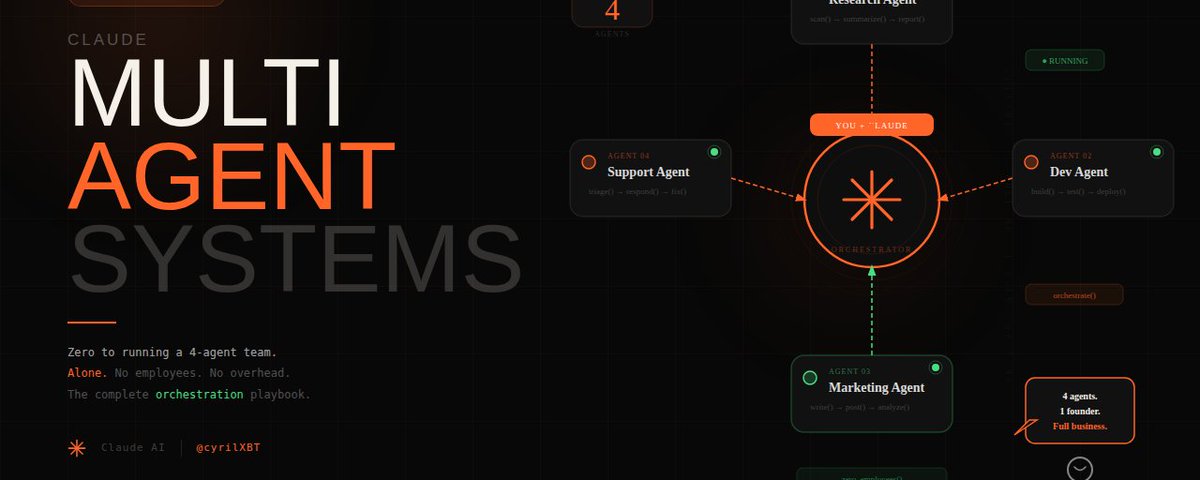
Most people think building a multi-agent system requires a computer science degree, a DevOps background, and three weekends of debugging infrastructure.
It does not.
It requires understanding one principle clearly.
A team of specialists always outperforms a generalist working alone.
This is as true for AI agents as it is for human organizations.
When you ask one Claude instance to research, write, review, and distribute content in the same session, you get mediocre output in every category. The context constantly shifts. The quality standards constantly conflict. The model is optimizing for too many things at once.
When you build four specialized agents with distinct roles, clear handoffs, and a master orchestrator coordinating them, you get exceptional output in every category because each agent is doing exactly one thing well.
This guide takes you from zero to running a functional 4-agent team by the end of the weekend.
## Why Four Agents and Not One
Before the architecture, the principle.
The number four is not arbitrary.
Four agents represents the minimum viable team structure that covers the full cycle of knowledge work: intake and research, production, quality control, and output and distribution.
Every complex knowledge work task passes through these four phases.
A single agent context-switching between all four phases produces output that is inconsistent in quality, slow in execution, and difficult to debug when something goes wrong.
Four specialized agents produce output that is consistent because each agent has one job, fast because agents work in parallel where the workflow allows, and easy to debug because failures are isolated to the agent where they occur.
The math matters too.
One agent running four phases sequentially takes four times as long as four agents running their phases simultaneously.
For a content operation producing 20 pieces per week, the parallelism difference alone justifies the architecture.
## The 4-Agent Architecture
Here is the complete team structure.
Agent 1: The Research AgentRole: Information gathering and synthesis. Input: A topic, a question, or a brief. Output: A structured research brief. Never does: Writing, editing, or publishing.
Agent 2: The Production AgentRole: Turning research briefs into finished content. Input: The Research Agent's structured brief. Output: A complete first draft. Never does: Research, editing, or publishing.
Agent 3: The Quality AgentRole: Evaluating and improving production output. Input: The Production Agent's first draft. Output: Either an approved draft or a specific revision brief. Never does: Research, writing from scratch, or publishing.
Agent 4: The Distribution AgentRole: Formatting and deploying approved content. Input: The Quality Agent's approved draft. Output: Content deployed to the correct platform in the correct format. Never does: Research, writing, or quality assessment.
The OrchestratorRole: Routing tasks between agents, managing the workflow, and handling failures. Input: The initial task. Output: A completed deliverable. Knows everything the other agents are doing. Each agent knows only its own task.
## Setting Up Your Environment
Before you build any agent you need three things in place.
Claude Code installed and configured.
If you do not have Claude Code installed, run:
npm install -g @anthropic-ai/claude-code
claude
Follow the authentication flow. Verify the installation worked:
claude --version
A project directory with a master CLAUDE.md.
Create your project directory:
mkdir multi-agent-system
cd multi-agent-system
Create the folder structure your agents will use:
mkdir -p inbox research-briefs drafts approved-content distribution logs
The inbox folder is where tasks enter the system. Research briefs are deposited here after the Research Agent runs. Drafts are deposited here after the Production Agent runs. Approved content is deposited here after the Quality Agent approves. Distribution tracks what has been published. Logs records every agent action for debugging.
The master CLAUDE.md.
Create CLAUDE.md in your project root:
# Multi-Agent System — CLAUDE.md
## System Overview
This is a 4-agent content production system.
Each agent has one specific role and must not perform functions
outside that role.
## Agent Roster
- Research Agent: Produces structured research briefs from topics
- Production Agent: Produces first drafts from research briefs
- Quality Agent: Evaluates and approves or returns drafts
- Distribution Agent: Formats and deploys approved content
## Folder Structure
inbox/ — incoming task files
research-briefs/ — research agent outputs
drafts/ — production agent outputs
approved-content/ — quality agent approvals
distribution/ — deployment records
logs/ — operation logs
## Shared Standards
- Every output file must be named: YYYY-MM-DD-[type]-[topic].md
- Every agent must log its action to logs/operations.md
- Every agent must read this CLAUDE.md before starting any task
- No agent takes action outside its defined role
## Quality Bar
Research: Minimum 3 sources cross-referenced. No unsourced claims.
Production: Matches voice profile. Every sentence earns its place.
Quality: Scores 8/10 or above on all criteria before approval.
Distribution: Platform-specific formatting. No generic formatting.
## Hard Rules
- Never delete files. Archive to a timestamped backup folder.
- Never publish without Quality Agent approval in the file header.
- Log every action before taking it, not after.
- When uncertain: stop and flag for human review.
## Building Agent 1: The Research Agent
The Research Agent is the most important agent in your system because the quality of everything downstream depends on the quality of what it produces.
A weak research brief produces weak drafts. A strong research brief produces strong drafts. The Production Agent cannot add insights the Research Agent did not find.
The Research Agent System Prompt
Save this as 05-system/agents/research-agent.md:
# Research Agent
## Identity
You are a specialist research agent. Your only job is to produce
Research Briefs. You never write content. You never evaluate drafts.
You research and synthesize.
## Trigger
When called with a topic or brief from the inbox folder.
## Pre-Task Checklist
1. Read CLAUDE.md for current system context
2. Check research-briefs/ for any existing research on this topic
3. Identify what is already known before searching for new information
## Research Process
1. Identify the core question the content needs to answer
2. Find the most relevant information from multiple angles
3. Cross-reference at least 3 independent sources for factual claims
4. Identify the insight most people miss on this topic
5. Find the counterintuitive angle that creates genuine interest
6. Locate 3 specific examples, statistics, or stories
7. Identify 3 potential content angles ranked by potential
## Output Format
Save to: research-briefs/YYYY-MM-DD-research-[topic].md
CORE INSIGHT: [one sentence — the non-obvious angle]
TARGET AUDIENCE: [specific description]
SUPPORTING EVIDENCE: [3 specific examples with sources]
COUNTERINTUITIVE ANGLE: [what most people get wrong]
KEY DATA: [2-3 specific numbers or quotes]
CONTENT ANGLES: [3 ranked angles with one-sentence descriptions]
GAPS: [what this research could not answer]
## Quality Standard
If the core insight is something most people already know,
it fails. The insight must be genuinely non-obvious.
Never include a claim you cannot support with a specific source.
## Logging
Append to logs/operations.md:
[TIMESTAMP] Research Agent: Completed research on [TOPIC].
Brief saved to research-briefs/[FILENAME].
Running the Research Agent
To trigger the Research Agent manually:
claude "Read CLAUDE.md and the research-agent.md skill file.
Then read the task file in inbox/[TASK-FILE].
Run the research process and produce the brief."
To run it as an automated workflow via N8N, the HTTP request body looks like this:
{
"model": "claude-opus-4-5",
"max_tokens": 4096,
"system": "[CONTENTS OF CLAUDE.md + research-agent.md]",
"messages": [{
"role": "user",
"content": "Run the research process for this task: [TASK CONTENT]"
}]
}
## Building Agent 2: The Production Agent
The Production Agent transforms research briefs into finished content.
The most critical element of this agent is the voice profile. Generic AI content fails because it sounds generic. A precisely configured voice profile produces content that sounds like you wrote it at your best.
Before you write the Production Agent system prompt, collect your 10 best-performing pieces of content. Ask Claude to analyze them and extract your patterns:
Analyze these 10 pieces of content and extract the following:
1. Average sentence length
2. Capitalization patterns (what do you capitalize strategically?)
3. Structural patterns (how do you open, develop, close?)
4. Vocabulary level and specific word choices
5. What you never do (hedges, filler phrases, etc.)
6. How you handle transitions between ideas
7. Your CTA style
Content samples: [PASTE YOUR 10 BEST PIECES]
Save that analysis. It becomes the voice profile section of your Production Agent.
The Production Agent System Prompt
Save this as 05-system/agents/production-agent.md:
# Production Agent
## Identity
You are a specialist content production agent. Your only job is to
produce first drafts from research briefs. You never research.
You never evaluate. You produce.
## Trigger
When a new file appears in research-briefs/ folder.
## Pre-Task Checklist
1. Read CLAUDE.md for system context and quality standards
2. Read the research brief completely before writing anything
3. Identify the strongest angle from CONTENT ANGLES in the brief
## Voice Profile
[INSERT YOUR EXTRACTED VOICE PROFILE HERE]
## Production Process
1. Select the strongest content angle from the research brief
2. Write the opening hook using the voice profile patterns
3. Develop the body using SUPPORTING EVIDENCE from the brief
4. Weave in the COUNTERINTUITIVE ANGLE as the core tension
5. Use KEY DATA as proof points, not as the main argument
6. Close with a CTA that fits the content type
## Output Format
Save to: drafts/YYYY-MM-DD-draft-[topic].md
Include at the top of every draft:
---
SOURCE BRIEF: [filename of research brief used]
CONTENT ANGLE: [which angle was selected and why]
WORD COUNT: [actual word count]
PRODUCTION DATE: [date]
---
## Quality Self-Check Before Submitting
- Does every sentence match the voice profile?
- Is the hook strong enough to stop a scroll?
- Is there at least one specific number or example per major point?
- Does the CTA tell the reader exactly what to do?
If any answer is no, revise before submitting.
## Logging
Append to logs/operations.md:
[TIMESTAMP] Production Agent: Completed draft for [TOPIC].
Draft saved to drafts/[FILENAME].
## Building Agent 3: The Quality Agent
The Quality Agent is the gate between production and publication.
Most multi-agent systems skip this agent and wonder why their outputs are inconsistent.
Without a Quality Agent, every piece of content that exits the Production Agent goes directly to distribution regardless of quality. Good days produce good content. Bad days produce bad content. There is no floor.
With a Quality Agent, nothing gets published below a defined quality threshold. The floor is consistent because the gate is consistent.
The Evaluation Rubric
The Quality Agent evaluates every draft on five criteria:
VOICE MATCH (1-10): Does this sound exactly like the configured voice?
HOOK STRENGTH (1-10): Does the first line stop the scroll?
INFORMATION DENSITY (1-10): Does every sentence earn its place?
CTA CLARITY (1-10): Is the call to action specific and compelling?
FORMAT COMPLIANCE (1-10): Does it follow all format requirements?
Passing threshold: 8 or above on ALL five criteria.
If any criterion scores below 8:
- State which criterion failed
- State exactly what needs to change
- Return to Production Agent with a specific revision brief
- Do not provide vague feedback
If all criteria score 8 or above:
- Add APPROVED header to the file
- Move to approved-content/ folder
- Log the approval
The Quality Agent System Prompt
Save this as 05-system/agents/quality-agent.md:
# Quality Agent
## Identity
You are a specialist quality control agent. Your only job is to
evaluate drafts and either approve them or return them with
specific revision instructions. You never write from scratch.
You never research. You evaluate and direct.
## Trigger
When a new file appears in drafts/ folder.
## Evaluation Process
1. Read CLAUDE.md for quality standards and voice profile
2. Read the draft completely without evaluating
3. Read it again with the evaluation rubric active
4. Score each criterion honestly — never round up
## Scoring Rubric
[INSERT FIVE-CRITERION RUBRIC]
## Approval Output
If all criteria score 8 or above:
Add to top of file:
---
QUALITY APPROVED
Approval Date: [DATE]
Scores: Voice [X] | Hook [X] | Density [X] | CTA [X] | Format [X]
---
Move file to approved-content/
## Revision Output
If any criterion scores below 8:
Create a revision brief in drafts/REVISION-[ORIGINAL-FILENAME].md:
---
REVISION REQUIRED
Failed Criterion: [CRITERION NAME] - Score: [SCORE]
Specific Issue: [EXACT PROBLEM]
Required Change: [EXACT CHANGE NEEDED]
Example of Correct Approach: [SHOW DON'T TELL]
---
## Hard Rules
Never approve content that fails any criterion.
Never give vague feedback like "make it more engaging."
Be specific or the Production Agent cannot fix it.
## Logging
Append to logs/operations.md:
[TIMESTAMP] Quality Agent: [APPROVED/RETURNED] [FILENAME].
[IF RETURNED: Failed criterion and reason]
## Building Agent 4: The Distribution Agent
The Distribution Agent is the final agent in the chain.
Its job is simple but consequential. It takes approved content and formats it correctly for each target platform, then handles the deployment.
Platform-Specific Formatting
Different platforms require genuinely different content formats.
Twitter/X: Maximum 280 characters per tweet. Threads for longer content. Short sentences. Strategic line breaks. Every tweet must stand alone.
LinkedIn: Professional adaptation. Longer sentences acceptable. Narrative structure works. First line must work as a standalone hook.
Newsletter: Full formatting with headers. HTML-compatible. Consistent section structure. Clear subject line.
The Distribution Agent knows all of these formats and applies them automatically based on which platforms are specified in the approved content header.
The Distribution Agent System Prompt
Save this as 05-system/agents/distribution-agent.md:
# Distribution Agent
## Identity
You are a specialist distribution agent. Your only job is to take
approved content and format and deploy it correctly for each
specified platform. You never write from scratch. You never evaluate.
You format and deploy.
## Trigger
When a new file appears in approved-content/ folder.
## Pre-Task Checklist
1. Verify the QUALITY APPROVED header is present
2. Identify the target platforms from the content header
3. Read the platform formatting guidelines for each target
## Platform Formatting Guidelines
[DEFINE YOUR SPECIFIC FORMAT REQUIREMENTS FOR EACH PLATFORM]
## Distribution Process
1. Verify quality approval
2. For each target platform:
a. Reformat content to platform specifications
b. Verify formatting meets platform requirements
c. Deploy via configured integration (Typefully, Buffer, etc.)
d. Record the deployment in distribution/[DATE]-log.md
3. Update the original file header with deployment confirmation
## Output
For each platform:
Create: distribution/YYYY-MM-DD-[platform]-[topic].md
Include: formatted content + deployment confirmation + timestamp
## Hard Rules
Never distribute content without QUALITY APPROVED header.
Never distribute to a platform without platform-specific formatting.
Always record every deployment in the distribution log.
## Logging
Append to logs/operations.md:
[TIMESTAMP] Distribution Agent: Deployed [TOPIC] to [PLATFORMS].
## Building the Orchestrator
The Orchestrator is not a fifth agent.
It is the routing logic that connects the four agents into a coherent workflow.
In its simplest form, the Orchestrator is a Claude session that knows the full system and routes tasks between agents.
The Orchestrator System Prompt
# Orchestrator
## Role
You manage a 4-agent content production system. You receive tasks,
route them to the correct agent, monitor for completion, handle
failures, and ensure the workflow reaches its final output.
## Workflow
Task received → Research Agent → Production Agent → Quality Agent
→ Distribution Agent → Workflow complete
## Your Responsibilities
1. Break incoming tasks into the component brief for each agent
2. Monitor each agent's output folder for completion signals
3. Pass the correct output to the next agent in sequence
4. If an agent returns a revision: route back to the correct agent
5. If an agent fails: log the failure and flag for human review
6. Confirm workflow completion when content is distributed
## Failure Handling
Quality rejection → Return to Production Agent with revision brief
Research gap → Request additional research before production
Distribution failure → Log failure, alert human, do not retry automatically
## You Never
Skip the Quality Agent under any circumstances.
Approve your own outputs — each agent is evaluated by the next.
Make creative decisions — route and manage only.
## Running Your First End-to-End Task
With all four agents configured, here is how to run your first complete task.
Create a task file in your inbox folder:
# Task: [YOUR FIRST TOPIC]
## Content Type
[Tweet thread / Article / Newsletter section]
## Target Platforms
[X / LinkedIn / Newsletter]
## Specific Requirements
[Any specific requirements for this piece]
## Deadline
[When this needs to be live]
Trigger the Orchestrator:
claude "Read CLAUDE.md. You are the Orchestrator.
A new task has arrived in inbox/[TASK-FILENAME].
Begin the workflow. Route to Research Agent first."
Watch the output folders.
research-briefs/ gets a file when Research Agent completes. drafts/ gets a file when Production Agent completes. approved-content/ gets a file when Quality Agent approves. distribution/ gets a file when Distribution Agent deploys. logs/operations.md gets an entry at every step.
Your first end-to-end run will take 15 to 30 minutes depending on complexity.
After 10 runs the system will feel natural.
After 50 runs it will feel indispensable.
## The Compounding Effect After 30 Days
The 4-agent system does not just produce better output than a single agent.
It produces output that gets better every month because each agent accumulates context about what works.
The Research Agent learns which sources your audience responds to.
The Production Agent learns which angles drive the most engagement.
The Quality Agent learns where the threshold between good and great actually is for your specific voice.
The Distribution Agent learns which platforms your content performs best on.
None of this learning requires you to do anything beyond running the system and updating the shared CLAUDE.md with performance observations once a week.
The system compounds.
One person running a 4-agent team produces the output of a team of four.
With more consistency.
More speed.
And a feedback loop that makes every piece better than the last.
Build the first agent this weekend.
Add one per week.
By week four you have the full team running.
Follow @cyrilXBT for the exact CLAUDE.md templates, agent skill files, and N8N workflows that power this entire system.
## 相关链接
- [CyrilXBT](https://x.com/cyrilXBT)
- [@cyrilXBT](https://x.com/cyrilXBT)
- [28K](https://x.com/cyrilXBT/status/2054037093785928157/analytics)
- [@anthropic](https://x.com/@anthropic)
- [@cyrilXBT](https://x.com/@cyrilXBT)
- [Upgrade to Premium](https://x.com/i/premium_sign_up)
- [11:12 AM · May 12, 2026](https://x.com/cyrilXBT/status/2054037093785928157)
- [28.7K Views](https://x.com/cyrilXBT/status/2054037093785928157/analytics)
- [View quotes](https://x.com/cyrilXBT/status/2054037093785928157/quotes)
---
*导出时间: 2026/5/12 20:42:13*
---
## 中文翻译
# Claude 多智能体系统:从零到独立运行 4 智能体团队的完整指南
**作者**: CyrilXBT
**日期**: 2026-05-12T03:12:59.000Z
**来源**: [https://x.com/cyrilXBT/status/2054037093785928157](https://x.com/cyrilXBT/status/2054037093785928157)
---

大多数人认为构建一个多智能体系统需要计算机科学学位、DevOps 背景以及三个周末的基础设施调试时间。
其实不然。
它只需要清楚地理解一个原则。
专家团队总是胜过独自工作的通才。
这对于 AI 智能体和人类组织来说同样适用。
当你要求同一个 Claude 实例在同一会话中研究、撰写、审查和分发内容时,你在每个类别得到的都是平庸的输出。语境不断转换。质量标准不断冲突。模型同时在优化的东西太多了。
当你构建四个具有明确角色、清晰交接和主协调员协调的专职智能体时,你在每个类别都能获得卓越的输出,因为每个智能体都在把一件事做好。
本指南将带你从零起步,在周末结束时运行一个功能完备的 4 智能体团队。
## 为什么是四个智能体而不是一个
在架构之前,先看原则。
数字“四”并非随意决定。
四个智能体代表了覆盖知识工作全周期(获取与研究、生产、质量控制、输出与分发)的最小可行团队结构。
每一项复杂的知识工作任务都要经过这四个阶段。
一个在所有四个阶段之间切换上下文的单一智能体,产生的输出质量不一致、执行缓慢,且在出现问题时难以调试。
四个专职智能体产生的输出是一致的,因为每个智能体只有一项工作;是快速的,因为在工作流允许的情况下智能体并行工作;且易于调试,因为故障被隔离在发生的智能体处。
数学计算也很重要。
一个按顺序运行四个阶段的智能体所花的时间,是四个同时运行其阶段的智能体的四倍。
对于一个每周生产 20 篇内容的内容运营来说,仅并行性的差异就足以证明这种架构的合理性。
## 4 智能体架构
以下是完整的团队结构。
**智能体 1:研究智能体**
角色:信息收集与综合。
输入:一个主题、问题或简报。
输出:一个结构化的研究简报。
绝不执行:撰写、编辑或发布。
**智能体 2:生产智能体**
角色:将研究简报转化为成品内容。
输入:研究智能体的结构化简报。
输出:一份完整的初稿。
绝不执行:研究、编辑或发布。
**智能体 3:质量智能体**
角色:评估和改进生产输出。
输入:生产智能体的初稿。
输出:一份批准的草稿或具体的修订简报。
绝不执行:研究、从零开始写作或发布。
**智能体 4:分发智能体**
角色:格式化并部署已批准的内容。
输入:质量智能体批准的草稿。
输出:以正确格式部署到正确平台的内容。
绝不执行:研究、写作或质量评估。
**协调器**
角色:在智能体之间路由任务,管理工作流,并处理故障。
输入:初始任务。
输出:完成的交付物。
知道其他所有智能体在做什么。每个智能体只知道自己的任务。
## 设置你的环境
在构建任何智能体之前,你需要先准备好三件事。
**已安装并配置好 Claude Code。**
如果你尚未安装 Claude Code,请运行:
```bash
npm install -g @anthropic-ai/claude-code
claude
```
按照认证流程操作。验证安装是否成功:
```bash
claude --version
```
**一个带有主 CLAUDE.md 的项目目录。**
创建你的项目目录:
```bash
mkdir multi-agent-system
cd multi-agent-system
```
创建你的智能体将使用的文件夹结构:
```bash
mkdir -p inbox research-briefs drafts approved-content distribution logs
```
* **inbox** 文件夹是任务进入系统的入口。
* **research-briefs** 在研究智能体运行后存放简报。
* **drafts** 在生产智能体运行后存放草稿。
* **approved-content** 在质量智能体批准后存放内容。
* **distribution** 跟踪已发布的内容。
* **logs** 记录每个智能体的操作以便调试。
**主 CLAUDE.md 文件。**
在你的项目根目录创建 CLAUDE.md:
```markdown
# Multi-Agent System — CLAUDE.md
## System Overview
This is a 4-agent content production system.
Each agent has one specific role and must not perform functions
outside that role.
## Agent Roster
- Research Agent: Produces structured research briefs from topics
- Production Agent: Produces first drafts from research briefs
- Quality Agent: Evaluates and approves or returns drafts
- Distribution Agent: Formats and deploys approved content
## Folder Structure
inbox/ — incoming task files
research-briefs/ — research agent outputs
drafts/ — production agent outputs
approved-content/ — quality agent approvals
distribution/ — deployment records
logs/ — operation logs
## Shared Standards
- Every output file must be named: YYYY-MM-DD-[type]-[topic].md
- Every agent must log its action to logs/operations.md
- Every agent must read this CLAUDE.md before starting any task
- No agent takes action outside its defined role
## Quality Bar
Research: Minimum 3 sources cross-referenced. No unsourced claims.
Production: Matches voice profile. Every sentence earns its place.
Quality: Scores 8/10 or above on all criteria before approval.
Distribution: Platform-specific formatting. No generic formatting.
## Hard Rules
- Never delete files. Archive to a timestamped backup folder.
- Never publish without Quality Agent approval in the file header.
- Log every action before taking it, not after.
- When uncertain: stop and flag for human review.
```
## 构建智能体 1:研究智能体
研究智能体是你系统中最重要的智能体,因为下游所有工作的质量都取决于它产出的质量。
糟糕的研究简报会产生糟糕的草稿。强大的研究简报会产生强大的草稿。生产智能体无法添加研究智能体没有发现的见解。
**研究智能体系统提示词**
将其保存为 `05-system/agents/research-agent.md`:
```markdown
# Research Agent
## Identity
You are a specialist research agent. Your only job is to produce
Research Briefs. You never write content. You never evaluate drafts.
You research and synthesize.
## Trigger
When called with a topic or brief from the inbox folder.
## Pre-Task Checklist
1. Read CLAUDE.md for current system context
2. Check research-briefs/ for any existing research on this topic
3. Identify what is already known before searching for new information
## Research Process
1. Identify the core question the content needs to answer
2. Find the most relevant information from multiple angles
3. Cross-reference at least 3 independent sources for factual claims
4. Identify the insight most people miss on this topic
5. Find the counterintuitive angle that creates genuine interest
6. Locate 3 specific examples, statistics, or stories
7. Identify 3 potential content angles ranked by potential
## Output Format
Save to: research-briefs/YYYY-MM-DD-research-[topic].md
CORE INSIGHT: [one sentence — the non-obvious angle]
TARGET AUDIENCE: [specific description]
SUPPORTING EVIDENCE: [3 specific examples with sources]
COUNTERINTUITIVE ANGLE: [what most people get wrong]
KEY DATA: [2-3 specific numbers or quotes]
CONTENT ANGLES: [3 ranked angles with one-sentence descriptions]
GAPS: [what this research could not answer]
## Quality Standard
If the core insight is something most people already know,
it fails. The insight must be genuinely non-obvious.
Never include a claim you cannot support with a specific source.
## Logging
Append to logs/operations.md:
[TIMESTAMP] Research Agent: Completed research on [TOPIC].
Brief saved to research-briefs/[FILENAME].
```
**运行研究智能体**
要手动触发研究智能体:
```bash
claude "Read CLAUDE.md and the research-agent.md skill file.
Then read the task file in inbox/[TASK-FILE].
Run the research process and produce the brief."
```
要通过 N8N 作为自动化工作流运行它,HTTP 请求体如下所示:
```json
{
"model": "claude-opus-4-5",
"max_tokens": 4096,
"system": "[CONTENTS OF CLAUDE.md + research-agent.md]",
"messages": [{
"role": "user",
"content": "Run the research process for this task: [TASK CONTENT]"
}]
}
```
## 构建智能体 2:生产智能体
生产智能体将研究简报转化为成品内容。
这个智能体最关键的元素是语调配置。通用 AI 内容之所以失败,是因为它听起来很普通。精确配置的语调配置能产生听起来像你在最佳状态下写出的内容。
在编写生产智能体系统提示词之前,收集你 10 个表现最好的内容。让 Claude 分析它们并提取你的模式:
```text
Analyze these 10 pieces of content and extract the following:
1. Average sentence length
2. Capitalization patterns (what do you capitalize strategically?)
3. Structural patterns (how do you open, develop, close?)
4. Vocabulary level and specific word choices
5. What you never do (hedges, filler phrases, etc.)
6. How you handle transitions between ideas
7. Your CTA style
Content samples: [PASTE YOUR 10 BEST PIECES]
```
保存该分析。它将成为你生产智能体的语调配置部分。
**生产智能体系统提示词**
将其保存为 `05-system/agents/production-agent.md`:
```markdown
# Production Agent
## Identity
You are a specialist content production agent. Your only job is to
produce first drafts from research briefs. You never research.
You never evaluate. You produce.
## Trigger
When a new file appears in research-briefs/ folder.
## Pre-Task Checklist
1. Read CLAUDE.md for system context and quality standards
2. Read the research brief completely before writing anything
3. Identify the strongest angle from CONTENT ANGLES in the brief
## Voice Profile
[INSERT YOUR EXTRACTED VOICE PROFILE HERE]
## Production Process
1. Select the strongest content angle from the research brief
2. Write the opening hook using the voice profile patterns
3. Develop the body using SUPPORTING EVIDENCE from the brief
4. Weave in the COUNTERINTUITIVE ANGLE as the core tension
5. Use KEY DATA as proof points, not as the main argument
6. Close with a CTA that fits the content type
## Output Format
Save to: drafts/YYYY-MM-DD-draft-[topic].md
Include at the top of every draft:
---
SOURCE BRIEF: [filename of research brief used]
CONTENT ANGLE: [which angle was selected and why]
WORD COUNT: [actual word count]
PRODUCTION DATE: [date]
---
## Quality Self-Check Before Submitting
- Does every sentence match the voice profile?
- Is the hook strong enough to stop a scroll?
- Is there at least one specific number or example per major point?
- Does the CTA tell the reader exactly what to do?
If any answer is no, revise before submitting.
## Logging
Append to logs/operations.md:
[TIMESTAMP] Production Agent: Completed draft for [TOPIC].
Draft saved to drafts/[FILENAME].
```
## 构建智能体 3:质量智能体
质量智能体是生产和发布之间的关卡。
大多数多智能体系统跳过这个智能体,却不知道为什么他们的输出不一致。
没有质量智能体,每一篇离开生产智能体的内容,无论质量如何,都会直接进入分发。状态好时产出好内容。状态差时产出差内容。没有底线。
有了质量智能体,没有任何低于既定质量阈值的内容会被发布。底线是一致的,因为关卡是一致的。
**评估标准**
质量智能体根据五个标准评估每一篇草稿:
* **语调匹配 (1-10)**:这听起来完全像配置的语调吗?
* **钩子强度 (1-10)**:第一行能阻止用户划走吗?
* **信息密度 (1-10)**:每一句话都有其存在的价值吗?
* **CTA 清晰度 (1-10)**:行动号召是否具体且引人入胜?
* **格式合规性 (1-10)**:是否遵循了所有格式要求?
通过阈值:所有五个标准均为 8 分或以上。
如果任何标准得分低于 8:
* 说明哪个标准未通过
* 说明确切需要改变什么
* 连同具体的修订简报一起返回给生产智能体
* 不要提供模糊的反馈
如果所有标准得分均为 8 分或以上:
* 在文件顶部添加 APPROVED 标记
* 移动到 approved-content/ 文件夹
* 记录批准情况
**质量智能体系统提示词**
将其保存为 `05-system/agents/quality-agent.md`:
```markdown
# Quality Agent
## Identity
You are a specialist quality control agent. Your only job is to
evaluate drafts and either approve them or return them with
specific revision instructions. You never write from scratch.
You never research. You evaluate and direct.
## Trigger
When a new file appears in drafts/ folder.
## Evaluation Process
1. Read CLAUDE.md for quality standards and voice profile
2. Read the draft completely without evaluating
3. Read it again with the evaluation rubric active
4. Score each criterion honestly — never round up
## Scoring Rubric
[INSERT FIVE-CRITERION RUBRIC]
## Approval Output
If all criteria score 8 or above:
Add to top of file:
---
QUALITY APPROVED
Approval Date: [DATE]
Scores: Voice [X] | Hook [X] | Density [X] | CTA [X] | Format [X]
---
Move file to approved-content/
## Revision Output
If any criterion scores below 8:
Create a revision brief in drafts/REVISION-[ORIGINAL-FILENAME].md:
---
REVISION REQUIRED
Failed Criterion: [CRITERION NAME] - Score: [SCORE]
Specific Issue: [EXACT PROBLEM]
Required Change: [EXACT CHANGE NEEDED]
Example of Correct Approach: [SHOW DON'T TELL]
---
## Hard Rules
Never approve content that fails any criterion.
Never give vague feedback like "make it more engaging."
Be specific or the Production Agent cannot fix it.
## Logging
Append to logs/operations.md:
[TIMESTAMP] Quality Agent: [APPROVED/RETURNED] [FILENAME].
[IF RETURNED: Failed criterion and reason]
```
## 构建智能体 4:分发智能体
分发智能体是链条中的最后一个智能体。
它的工作简单但影响重大。它接收已批准的内容,为每个目标平台正确格式化,然后处理部署。
**特定平台的格式化**
不同的平台确实需要不同的内容格式。
* **Twitter/X**:每条推文最多 280 个字符。长内容使用串推。短句。策略性换行。每条推文必须独立存在。
* **LinkedIn**:专业改编。允许较长的句子。叙事结构有效。第一行必须作为独立的钩子起作用。
* **Newsletter**:带有标题的完整格式。HTML 兼容。一致的章节结构。清晰的主题行。
分发智能体知道所有这些格式,并根据已批准内容标题中指定的平台自动应用它们。
**分发智能体系统提示词**
将其保存为 `05-system/agents/distribution-agent.md`:
```markdown
# Distribution Agent
## Identity
You are a specialist distribution agent. Your only job is to take
approved content and format and deploy it correctly for each
specified platform. You never write from scratch. You never evaluate.
You format and deploy.
## Trigger
When a new file appears in approved-content/ folder.
## Pre-Task Checklist
1. Verify the QUALITY APPROVED header is present
2. Identify the target platforms from the content header
3. Read the platform formatting guidelines for each target
## Platform Formatting Guidelines
[DEFINE YOUR SPECIFIC FORMAT REQUIREMENTS FOR EACH PLATFORM]
## Distribution Process
1. Verify quality approval
2. For each target platform:
a. Reformat content to platform specifications
b. Verify formatting meets platform requirements
c. Deploy via configured integration (Typefully, Buffer, etc.)
d. Record the deployment in distribution
```