# How to Build an Obsidian Knowledge Vault That Gets Smarter Every Day Without You Doing Anything
**作者**: CyrilXBT
**日期**: 2026-05-07T03:52:36.000Z
**来源**: [https://x.com/cyrilXBT/status/2052235121416188114](https://x.com/cyrilXBT/status/2052235121416188114)
---
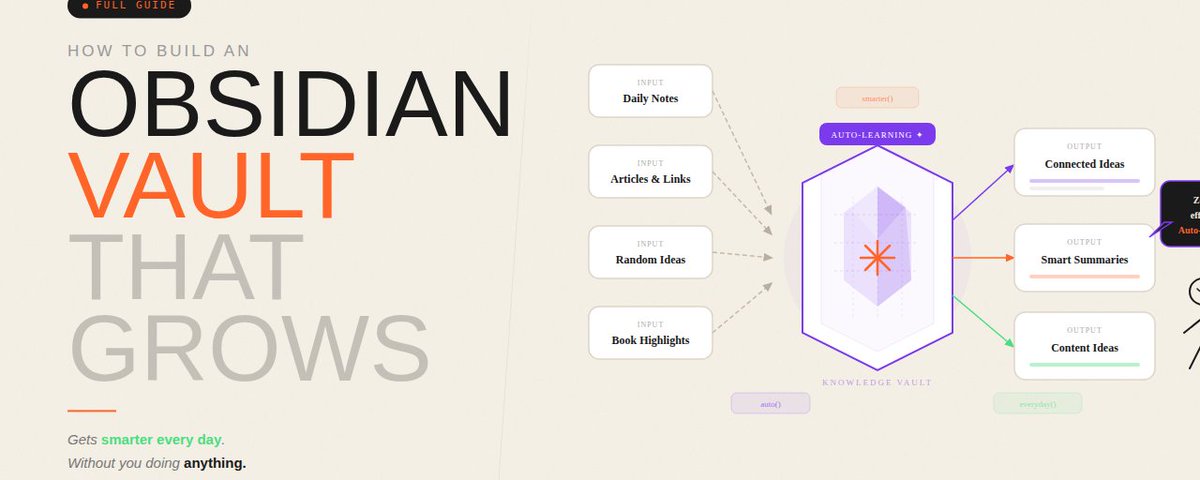
Every article you read. Every tweet you save. Every voice note you record. All of it flows in automatically. Claude connects the dots. You collect the insight.
Most people treat their Obsidian vault like a filing cabinet. They put things in. They never take anything back out. Six months later they have a beautifully organized archive of information they have completely forgotten and never act on.
This guide builds something completely different. Not a vault you add to. A vault that adds to you. A system where every piece of information you consume flows in automatically, Claude surfaces the connections you missed, and the insight compounds every single day without you doing any extra work.
The difference between a second brain and a dead archive is one thing: feedback. Information that goes in but never comes back out is not a knowledge system. It is a graveyard with good folders. This guide builds the feedback loop that turns your vault from a storage system into a thinking partner.
WHY MOST KNOWLEDGE SYSTEMS FAIL
The promise of a second brain is that you will never lose a good idea again. The reality for most people is that they spend three hours setting up a beautiful folder structure, add content for two weeks, and then stop opening the app entirely because nothing useful ever comes back out.
The failure mode is always the same. The system is designed for input. Nobody designs for output. You capture everything. You retrieve nothing. The vault grows. Your thinking does not.
There are three specific reasons this happens and every one of them is fixable.
First: capture friction. If adding something to your vault takes more than 10 seconds of manual effort, you will stop doing it under any real cognitive load. Most people's capture workflow involves copying, pasting, tagging, categorizing, and summarizing — all before they have even processed what they just read. By the time the friction is high enough, the habit breaks.
Second: no connection layer. Most vaults are collections of isolated notes. Each article lives in its own file. Each idea sits in its own folder. There is no mechanism that looks across everything and says: this thing you saved in March connects directly to this problem you are working on today. Without that layer the vault is a library with no search function.
Third: no reason to return. If your vault does not push insights back to you, you have to remember to pull them. Nobody remembers. The vault becomes something you add to occasionally and open only when you are actively searching for something specific. That is not a thinking partner. That is a bookmarking tool.
A second brain that never talks back is not a second brain. It is a very organized way to forget things.
The system this guide builds solves all three. Capture is automatic — you never manually add anything. Connection is Claude's job — it reads across everything and surfaces what matters. Return is built into the daily ritual — the vault briefs you every morning without you asking.
THE ARCHITECTURE: FOUR LAYERS THAT WORK TOGETHER
Before touching any tool, understand the four-layer structure. Every piece of software in this system serves exactly one function. Nothing overlaps. Everything flows in one direction.
Layer one is capture. This is every tool that brings information into the system without you manually typing anything. Readwise for articles and highlights. Airr for podcast clips. Whisper for voice notes. A dedicated Telegram bot for quick saves from your phone. Nothing in this layer requires you to categorize, tag, or summarize. Raw information in. Nothing else.
Layer two is the pipeline. N8N automation watches each capture source and routes new content into the correct location in your Obsidian vault. No manual filing. No copy-pasting. A new article highlight appears in Readwise and within minutes it is in your vault as a formatted markdown file with the source, date, and content automatically structured.
Layer three is Obsidian. The vault itself. A folder of markdown files on your local machine. This is the permanent storage layer. Everything lives here. Nothing gets deleted. The vault is the ground truth of everything you have ever consumed and thought worth saving.
Layer four is Claude. This is the intelligence layer that runs across everything else. Claude reads the vault. Finds connections. Surfaces patterns. Writes the daily briefing. Answers questions about your own thinking. This is the layer that makes the vault a thinking partner instead of an archive.
STEP ONE: AUTOMATED CAPTURE WITHOUT FRICTION
The capture layer has one job: collect everything without asking anything of you. Every friction point in capture is a future gap in your knowledge base. Set this up once. Never touch it again.
Articles and highlights: Readwise is the backbone of the capture layer for written content. Install the browser extension. Every article you read, highlight the sentences that matter. Readwise stores them automatically. You do nothing else. No summarizing. No tagging. Highlight and move on.
Readwise also connects to Kindle, Twitter bookmarks, Instapaper, and Pocket. Any content you save in any of those platforms flows into Readwise automatically. One tool aggregates everything.
Podcasts and audio: Airr lets you clip podcast moments with a shake of your phone. The transcript of the clip saves automatically. For anything longer — a meeting, a lecture, a voice note — record it and run it through Whisper. Paste the audio file in and get a clean transcript in seconds.
Quick capture from anywhere: Build a Telegram bot that accepts any message you send it and routes it to your vault. An idea that hits you in the car. A tweet you want to think about. A question that comes up in conversation. Send it to the bot. It lands in your vault's inbox folder automatically. Takes 30 minutes to build with Claude Code and N8N.
N8N Workflow — Telegram to Obsidian:
Node 1: Telegram Trigger → event: message → chat_id: your_bot_id
Node 2: Code (format note) → filename: inbox/{{date}}-quick-capture.md → content: # Quick Capture / {{message}} / Source: Telegram / Date: {{date}}
Node 3: Write File to Obsidian vault → path: /your-vault/inbox/ → operation: create
STEP TWO: THE VAULT STRUCTURE THAT SCALES
The folder structure of your vault determines how well Claude can navigate it. Do not over-engineer this. Five folders. That is the entire structure.
Inbox — Everything lands here first. Unprocessed. Raw. The staging area for all automated captures before they get filed.
Notes — Processed highlights, articles, podcast clips. One file per source. Automatically formatted by the N8N pipeline.
Ideas — Your own thinking. Quick captures. Observations. Voice notes transcribed. Your brain's output, not other people's input.
Projects — Active work. One folder per project. Claude reads these when you ask for project-specific context or decisions.
CLAUDE.md — The instruction layer. The file Claude reads first in every session. Tells it who you are, what you are working on, and what you want from it.
The simplicity is intentional. Every complex folder structure eventually collapses under its own weight because you stop knowing which folder something belongs in and the capture friction rises until the system breaks. Five folders. One rule: when in doubt, put it in inbox.
STEP THREE: THE CLAUDE.md FILE THAT MAKES EVERYTHING WORK
This is the most important file in the entire system. Without it Claude starts every session cold — no context about who you are, what you are working on, or what you want from the vault. With it Claude is a collaborator who has been reading your notes for months.
CLAUDE.md is a markdown file in the root of your vault. Claude reads it automatically at the start of every session. Copy this template directly:
# Who I Am
Name: [Your name] Work: [What you do — be specific] Focus: [The one thing you are trying to get better at right now] Goals 2026: [3 specific outcomes you are working toward]
# Current Projects
Active: [What you are building or working on right now] Stuck on: [Where you need the most thinking help] Next milestone: [What done looks like for the current sprint]
# How This Vault Works
Inbox: /inbox — unprocessed captures, file here first Notes: /notes — processed articles, highlights, research Ideas: /ideas — my own thinking and observations Projects: /projects — active work folders
# What I Want From You
- Surface connections I have not seen
- Challenge my assumptions before agreeing with them
- When I ask what to focus on — answer from the vault context, not generically
- Flag when something I believe contradicts something I saved earlier
# What I Am Reading and Thinking About
[Update this weekly — current obsessions, active questions, things puzzling you]
Update the Current Projects and What I Am Reading sections every Monday morning. Five minutes. This single habit is what keeps Claude's context accurate as your work evolves. A stale CLAUDE.md produces stale answers.
STEP FOUR: THE DAILY BRIEF THAT RUNS AUTOMATICALLY
Every morning before you open a single app, the vault briefs you. New connections found overnight. Patterns across this week's captures. The one question worth thinking about today based on everything you have been reading.
You do not request this brief. It runs automatically through N8N on a schedule. By the time you sit down to work it is already in your inbox folder waiting.
Copy this prompt directly into your N8N Claude node:
"You are reading my Obsidian knowledge vault. Read everything in /inbox from the last 24 hours and everything in /notes from the last 7 days.
Then do three things:
1. CONNECTIONS — Find the 3 most interesting connections between recent captures and older notes I probably have not noticed. Be specific. Quote the relevant passages.
2. PATTERN — Identify one pattern across everything I have been reading this week. What is my brain clearly working on even if I have not said it explicitly?
3. QUESTION — Give me one question worth sitting with today based on the pattern you identified. Not a task. A question.
Write this as a clean markdown file formatted for Obsidian. Save it to /inbox/brief-{{date}}.md"
Set this to run every weekday at 6am. Read it before you open anything else.
STEP FIVE: THE WEEKLY SYNTHESIS
Once a week, run a deeper synthesis. Fifteen minutes. Sit with Claude and talk about what the vault has been building toward.
Copy this prompt:
"Read my entire Obsidian vault. Focus on everything added in the last 7 days.
I want four things:
1. EMERGING THESIS — What idea am I building toward without having stated it explicitly yet? What position is forming in my thinking?
2. CONTRADICTIONS — What have I saved recently that contradicts something I believed before? Show me both sides from my own notes.
3. KNOWLEDGE GAPS — Based on what I am reading and thinking about, what am I clearly not reading that I should be? What perspective is missing?
4. ONE ACTION — Given everything in this vault, what is the single highest-leverage thing I could do or think about this week?
Be direct. Challenge me. Do not summarize what I already know."
The synthesis session is where the real compounding happens. The daily brief surfaces connections. The weekly synthesis builds a thesis. Over six months of weekly sessions you will have a record of how your thinking evolved — every assumption you held and changed, every idea that started small and grew into something you act on.
THE COMPOUND EFFECT NOBODY TALKS ABOUT
At one month the vault feels like a useful tool. You are saving more, losing fewer ideas, and the daily brief occasionally surfaces something interesting.
At three months it starts feeling different. Claude begins connecting things from month one to things from month three. You ask it a question about a current problem and it finds the relevant note from eight weeks ago that you had completely forgotten. The vault knows things about your thinking that you do not consciously remember.
At six months it is something else entirely. You have a record of every belief you held and changed. Every question you were sitting with and the answer that eventually emerged. Every pattern that showed up in your reading before you consciously recognized it as an obsession.
The AI you have after six months of this is not the same one you started with. It has been reading your mind while you were busy living your life.
This is the compound interest of your own thinking. Most knowledge never compounds because it sits in isolation. This system makes those connections automatically. Every idea you consume joins a growing network of ideas that Claude can navigate on your behalf.
Your competitor who starts this system six months after you is not just behind on the setup. They are behind on six months of connections, patterns, and synthesis that make the system genuinely intelligent about your specific way of thinking. That gap does not close by working harder. It only closes by starting earlier.
THE FULL SETUP SEQUENCE
01 — Install Obsidian and create your five-folder structure Inbox, Notes, Ideas, Projects, and your CLAUDE.md in the root. Do not add any other folders. Start simple and let the structure evolve from actual usage.
02 — Connect Readwise to your vault Readwise has a native Obsidian integration. Enable it. Every highlight you make anywhere automatically appears in your Notes folder as a formatted markdown file.
03 — Build the Telegram capture bot with N8N Use the workflow above. Takes 30 minutes. Once running it handles every quick capture from your phone for the rest of your life.
04 — Write your CLAUDE.md file Use the template above. Be specific and honest. The quality of Claude's output is directly proportional to the quality of the context you give it in this file.
05 — Set up the daily brief automation in N8N Schedule the brief prompt to run every weekday at 6am. Output goes to your inbox folder. Read it before you open anything else.
06 — Block 15 minutes every Monday for the weekly synthesis Put it in your calendar now. This is the session where compounding actually happens. Do not skip it in week two because the vault feels too empty. The vault is never too empty to find something worth thinking about.
START WITH FIVE NOTES
The most common reason people never build this system is that it feels like too much to set up at once.
Start smaller. Today, put five notes in Obsidian. Anything — five articles you have been meaning to read, five ideas that have been sitting in your head, five questions you keep returning to. Connect Claude to that folder. Ask it to find connections across those five notes.
It will find something you missed. It always does. That moment — when Claude surfaces a connection between two things you thought were completely unrelated — is the moment the system stops being a concept and starts being something you want to feed every day.
Start with five notes tonight. The vault does the rest.
Follow @cyrilXBT for the exact N8N workflows, CLAUDE.md templates, and weekly synthesis prompts behind this system — posted every week.
## 相关链接
- [CyrilXBT](https://x.com/cyrilXBT)
- [@cyrilXBT](https://x.com/cyrilXBT)
- [22K](https://x.com/cyrilXBT/status/2052235121416188114/analytics)
- [@cyrilXBT](https://x.com/@cyrilXBT)
- [Upgrade to Premium](https://x.com/i/premium_sign_up)
- [11:52 AM · May 7, 2026](https://x.com/cyrilXBT/status/2052235121416188114)
- [22.2K Views](https://x.com/cyrilXBT/status/2052235121416188114/analytics)
- [View quotes](https://x.com/cyrilXBT/status/2052235121416188114/quotes)
---
*导出时间: 2026/5/7 17:28:37*
---
## 中文翻译
# 如何打造一个每天自动变聪明的 Obsidian 知识库(无需任何手动操作)
**作者**: CyrilXBT
**日期**: 2026-05-07T03:52:36.000Z
**来源**: [https://x.com/cyrilXBT/status/2052235121416188114](https://x.com/cyrilXBT/status/2052235121416188114)
---

你阅读的每一篇文章。你保存的每一条推文。你录下的每一条语音备忘录。所有这些内容都会自动流入。Claude 负责串联这些点。你只负责收集洞察。
大多数人把他们的 Obsidian 知识库当成一个档案柜。他们把东西放进去。却从来不把东西拿出来。六个月后,他们拥有了一个组织精美的信息档案馆,但他们完全忘了这些内容,也从未付诸行动。
本指南构建的东西完全不同。不是让你去添加内容的库。而是给你增添价值的库。一个你消费的每一条信息都自动流入的系统,Claude 会呈现你错过的联系,而洞察每天都会自我复利,不需要你做任何额外工作。
第二大脑和死档案的区别在于一件事:反馈。只进不出的信息不是知识系统。那是带有好文件夹的墓地。本指南构建的反馈循环,能将你的知识库从存储系统转变为思考伙伴。
**为什么大多数知识系统会失败**
第二大脑的承诺是,你永远不会再丢失一个好点子。大多数人的现实是:他们花了三个小时搭建漂亮的文件夹结构,添加了两周内容,然后就完全不再打开这个应用了,因为从来没有有用的东西反馈回来。
失败模式总是相同的。系统是为输入而设计的。没有人设计输出。你捕获一切。你却什么也没检索。库在膨胀。你的思考却在停滞。
发生这种情况有三个具体原因,每一个都是可以解决的。
第一:捕获阻力。如果在向库中添加内容时,需要超过 10 秒钟的手动操作,你就会在任何真正的认知负荷下停止这样做。大多数人的捕获工作流涉及复制、粘贴、标记、分类和总结——这一切甚至在他们处理刚刚读到的内容之前就完成了。当阻力大到一定程度时,习惯就会中断。
第二:没有连接层。大多数知识库是孤立笔记的集合。每篇文章都有自己的文件。每个想法都有自己的文件夹。没有机制能跨所有内容进行观察并说:你在三月保存的这条内容,直接关联着你今天正在解决的这个问题。没有这一层,知识库就是一个没有搜索功能的图书馆。
第三:没有理由返回。如果你的知识库不把洞察推送给你,你就得记得去拉取。没人记得住。这个库变成了偶尔添加东西、只在主动搜索特定内容时才打开的工具。那不是思考伙伴。那是书签工具。
一个从不回话的第二大脑不是第二大脑。那是一种非常有条理的遗忘方式。
本指南构建的系统解决了这三个问题。捕获是自动的——你永远不会手动添加任何东西。连接是 Claude 的工作——它通读所有内容并呈现重要的部分。返回机制内置于日常仪式中——库每天早上都会自动向你汇报,甚至无需你询问。
**架构:协同工作的四层结构**
在接触任何工具之前,先理解这四层结构。这个系统中的每个软件只服务于一个功能。没有重叠。一切单向流动。
第一层是捕获。这是将信息带入系统而不需要你手动输入任何内容的工具集合。Readwise 用于文章和高亮。Airr 用于播客片段。Whisper 用于语音笔记。一个专用的 Telegram 机器人用于从手机快速保存。这一层的任何东西都不要求你分类、标记或总结。原始信息进入。仅此而已。
第二层是管道。N8N 自动化监控每个捕获源,并将新内容路由到 Obsidian 库中的正确位置。无需手动归档。无需复制粘贴。Readwise 中出现的新文章高亮,几分钟内就会作为格式化的 markdown 文件出现在你的库中,来源、日期和内容自动结构化。
第三层是 Obsidian。库本身。你本地机器上的一个 markdown 文件文件夹。这是永久存储层。一切都存在这里。什么都不会被删除。这个库是你曾经消费过的并认为值得保存的一切内容的基准事实。
第四层是 Claude。这是跨越其他所有层运行的智能层。Claude 阅读库。发现联系。呈现模式。撰写每日简报。回答关于你自己思考的问题。正是这一层让库从档案变成了思考伙伴。
**第一步:无摩擦的自动捕获**
捕获层只有一项工作:收集一切,不向你提出任何要求。捕获中的每一个摩擦点,都是你未来知识库中的缺口。一次设置好。永远不要再碰它。
文章和高亮:Readwise 是书面内容捕获层的骨干。安装浏览器扩展。阅读每篇文章时,高亮重要的句子。Readwise 会自动存储它们。你不需要做任何其他事。无需总结。无需标记。高亮并继续。
Readwise 还连接到 Kindle、Twitter 书签、Instapaper 和 Pocket。你在这些平台上保存的任何内容都会自动流入 Readwise。一个工具聚合所有内容。
播客和音频:Airr 让你摇一摇手机就能剪辑播客片段。片段的转录文本会自动保存。对于更长的内容——会议、讲座、语音笔记——录制并通过 Whisper 运行。粘贴音频文件,几秒钟内就能获得清晰的转录文本。
随时随地快速捕获:构建一个 Telegram 机器人,接受你发送的任何消息并将其路由到你的库。开车时突然想到的想法。你想思考的推文。对话中提出的问题。发送给机器人。它会自动落入你库的收件箱文件夹。使用 Claude Code 和 N8N 只需 30 分钟即可构建。
N8N 工作流 — Telegram 到 Obsidian:
节点 1:Telegram 触发器 → 事件:message → chat_id: your_bot_id
节点 2:代码(格式化笔记)→ 文件名:inbox/{{date}}-quick-capture.md → 内容:# Quick Capture / {{message}} / 来源:Telegram / 日期:{{date}}
节点 3:写入文件到 Obsidian 库 → 路径:/your-vault/inbox/ → 操作:create
**第二步:可扩展的库结构**
库的文件夹结构决定了 Claude 能多好地浏览它。不要过度设计。五个文件夹。这就是全部结构。
**Inbox(收件箱)** — 所有内容首先落在这里。未处理。原始。所有自动捕获的暂存区,在归档之前。
**Notes(笔记)** — 处理过的亮点、文章、播客片段。每个来源一个文件。由 N8N 管道自动格式化。
**Ideas(想法)** — 你自己的思考。快速捕获。观察。转录的语音笔记。是你大脑的输出,而不是别人的输入。
**Projects(项目)** — 进行中的工作。每个项目一个文件夹。当你请求特定项目上下文或决策时,Claude 会读取这些。
**CLAUDE.md** — 指令层。Claude 在每次会话中首先读取的文件。告诉它你是谁,你在做什么,你想要什么。
这种简洁是刻意的。每一个复杂的文件夹结构最终都会在自身重量下崩溃,因为你不再知道某样东西属于哪个文件夹,捕获阻力上升,直到系统崩溃。五个文件夹。一条规则:有疑问时,放入收件箱。
**第三步:让一切运转的 CLAUDE.md 文件**
这是整个系统中最重要的文件。没有它,Claude 每次会话都从零开始——没有关于你是谁、你在做什么或你想从库中得到什么的上下文。有了它,Claude 就像一个已经阅读你笔记数月的协作者。
CLAUDE.md 是库根目录下的一个 markdown 文件。Claude 在每次会话开始时自动阅读它。直接复制这个模板:
# Who I Am(我是谁)
Name: [Your name](姓名)
Work: [What you do — be specific](工作——具体描述)
Focus: [The one thing you are trying to get better at right now](专注点——你现在想提升的一件事)
Goals 2026: [3 specific outcomes you are working toward](2026 年目标——你正在努力的 3 个具体结果)
# Current Projects(当前项目)
Active: [What you are building or working on right now](进行中:你现在正在构建或做什么)
Stuck on: [Where you need the most thinking help](卡点:你在哪些方面最需要思考帮助)
Next milestone: [What done looks like for the current sprint](下一个里程碑:当前冲刺完成的样子)
# How This Vault Works(本库如何运作)
Inbox: /inbox — unprocessed captures, file here first(收件箱:未处理的捕获,首先存放在此)
Notes: /notes — processed articles, highlights, research(笔记:处理过的文章、亮点、研究)
Ideas: /ideas — my own thinking and observations(想法:我自己的思考和观察)
Projects: /projects — active work folders(项目:进行中的工作文件夹)
# What I Want From You(我对你的期望)
- Surface connections I have not seen(呈现我没看到的联系)
- Challenge my assumptions before agreeing with them(在同意我的假设之前挑战它们)
- When I ask what to focus on — answer from the vault context, not generically(当我问该关注什么时——从库的上下文回答,而不是泛泛而谈)
- Flag when something I believe contradicts something I saved earlier(标记我相信的内容与我之前保存的内容相矛盾的情况)
# What I Am Reading and Thinking About(我在读和想什么)
[Update this weekly — current obsessions, active questions, things puzzling you](每周更新——当前的痴迷点、活跃的问题、困扰你的事情)
每周一早上更新“当前项目”和“我在读和想什么”部分。五分钟。这单一的习惯让 Claude 的上下文随着你工作的演变而保持准确。陈旧的 CLAUDE.md 产生陈旧的答案。
**第四步:自动运行的每日简报**
每天早上,在你打开任何应用之前,库会向你汇报。连夜发现的新联系。本周捕获内容的模式。根据你阅读的所有内容,今天值得思考的一个问题。
你不需要请求这份简报。它通过 N8N 按计划自动运行。当你坐下来工作时,它已经在你的收件箱文件夹里等待了。
直接将此提示复制到你的 N8N Claude 节点中:
“你正在阅读我的 Obsidian 知识库。阅读过去 24 小时 /inbox 中的所有内容以及过去 7 天 /notes 中的所有内容。
然后做三件事:
1. **CONNECTIONS(联系)** — 找出最近捕获的内容和旧笔记之间最有趣的 3 个联系,这些可能是我不曾注意到的。具体一点。引用相关段落。
2. **PATTERN(模式)** — 在我本周阅读的所有内容中确定一个模式。即使我没有明确说出来,我的大脑显然在处理什么?
3. **QUESTION(问题)** — 根据你确定的模式,给我一个今天值得思考的问题。不是一个任务。是一个问题。
将其写成一个格式干净的 markdown 文件,用于 Obsidian。保存到 /inbox/brief-{{date}}.md”
设置为每个工作日上午 6 点运行。在打开其他任何内容之前先阅读它。
**第五步:每周综合**
每周一次,进行更深层次的综合。十五分钟。和 Claude 坐在一起,谈谈库一直在构建什么。
复制这个提示:
“阅读我的整个 Obsidian 库。重点关注过去 7 天添加的内容。
我想要四件事:
1. **EMERGING THESIS(新兴论题)** — 我正在向哪个想法发展,尽管我还没有明确陈述出来?我的思维中正在形成什么立场?
2. **CONTRADICTIONS(矛盾)** — 我最近保存了什么与我以前相信的东西相矛盾?从我自己的笔记中展示双方。
3. **KNOWLEDGE GAPS(知识盲区)** - 根据我的阅读和思考内容,我明显没有读什么但我应该读的?缺失了什么视角?
4. **ONE ACTION(一个行动)** — 鉴于库中的所有内容,本周我能做的或能想到的单一最高杠杆的事情是什么?
要直接。挑战我。不要总结我已经知道的事情。”
综合会话是真正复利发生的地方。每日简报呈现联系。每周综合构建论题。经过六个月的每周会话,你将拥有一份关于你的思维如何演变的记录——你持有并改变的每一个假设,每一个从小开始并发展成你付诸行动的想法。
**没人谈论的复利效应**
在一个月的时候,库感觉像一个有用的工具。你保存得更多,丢失的想法更少,每日简报偶尔会呈现一些有趣的东西。
到了三个月,感觉开始不同了。Claude 开始将第一个月的东西与第三个月的东西联系起来。你问它一个关于当前问题的问题,它找到了八周前的相关笔记,而你完全忘记了。库了解一些你自己有意识不记得的关于你思考的事情。
到了六个月,它完全是另一种东西。你拥有你持有和改变的每一个信念的记录。你思考的每一个问题以及最终浮现的答案。在你有意识地将其识别为一种痴迷之前,就在你的阅读中出现的每一个模式。
你使用六个月后拥有的 AI 与你开始时使用的 AI 并不是同一个。它在你忙于生活的时候一直在阅读你的思想。
这就是你自己思维的复利。大多数知识永远不会复利,因为它们孤立地存在。这个系统会自动建立这些联系。你消费的每一个想法都加入到一个不断增长的想法网络中,Claude 可以代表你浏览这个网络。
那个在你开始这个系统六个月后才开始起步的竞争对手,不仅仅是落后在设置上。他们落后了六个月的联系、模式和综合,正是这些让系统真正了解你的特定思维方式。这个差距不能通过更努力的工作来弥补。只能通过更早开始来弥补。
**完整的设置顺序**
01 — 安装 Obsidian 并创建你的五个文件夹结构 Inbox、Notes、Ideas、Projects,以及在根目录下创建你的 CLAUDE.md。不要添加任何其他文件夹。从简单开始,让结构根据实际使用发展。
02 — 连接 Readwise 到你的库 Readwise 有原生的 Obsidian 集成。启用它。你在任何地方做的每一个高亮都会自动作为格式化的 markdown 文件出现在你的 Notes 文件夹中。
03 — 使用 N8N 构建 Telegram 捕获机器人 使用上面的工作流。需要 30 分钟。一旦运行,它将在你余生处理从手机进行的每一个快速捕获。
04 — 编写你的 CLAUDE.md 文件 使用上面的模板。要具体和诚实。Claude 输出的质量与你在此文件中提供的上下文质量直接成正比。
05 — 在 N8N 中设置每日简报自动化 安排简报提示在每个工作日上午 6 点运行。输出进入你的收件箱文件夹。在打开其他任何内容之前先阅读它。
06 — 每周一封锁 15 分钟进行每周综合 现在把它放在你的日历上。这是复利实际发生的会话。不要在第二周跳过它,因为库感觉太空了。库永远不会太空而找不到值得思考的东西。
**从五个笔记开始**
人们从未建立这个系统的最常见原因是,一次性设置感觉太多了。
从小处着手。今天,在 Obsidian 中放入五个笔记。任何东西——五篇你打算读的文章,五个一直在你脑海中的想法,五个你一直在思考的问题。将 Claude 连接到该文件夹。让它找出这五个笔记之间的联系。
它会找到你错过的东西。它总是会的。那一刻——当 Claude 呈现两个你认为完全无关的事情之间的联系时——就是系统不再是一个概念,而开始成为你每天想要喂养的东西的时刻。
今晚从五个笔记开始。剩下的交给库。
关注 @cyrilXBT 以获取此系统背后的确切 N8N 工作流、CLAUDE.md 模板和每周综合提示——每周发布。